STANFORD INSTITUTE FOR ECONOMIC POLICY RESEARCH
SIEPR Discussion Paper No. 08-03
Community-Based Production of Open Source Software:
What do we know about the developers who participate?
By Paul A. David Stanford University Joseph S. Shapiro MIT October 2008
Stanford Institute for Economic Policy Research
Stanford University
Stanford, CA 94305
(650) 725-1874
The Stanford Institute for Economic Policy Research at Stanford University supports research bearing on
economic and public policy issues. The SIEPR Discussion Paper Series reports on research and policy
analysis conducted by researchers affiliated with the Institute. Working papers in this series reflect the views
of the authors and not necessarily those of the Stanford Institute for Economic Policy Research or Stanford
University.
DOI: 10.1016/j.infoecopol.2008.10.001
____________________________________________________________________________________________________________
Community-Based Production of Open Source Software:
What do we know about the developers who participate? *
By
Paul A. David
Stanford University & All Souls College, University of Oxford & UNU-Merit (Maastricht)
Joseph S. Shapiro
Massachusetts Institute of Technology
First draft: April 2006 Refereed draft: 15 June 2007 This version: 16 October 2008
* ACKNOWLEDGEMENTS
The research reported in this paper was made possible by grant awards to Stanford University from the National Science Foundation program on Digital Technology and Society: IIS-0112962 (2001-04) and IIS-0329259 (2003-05). The international Project for Research on the Economics of Free/Libre & Open Source Software (PREFLOSS) has been sustained by funding under these awards and by support from the Stanford Institute for Economic Policy Research (SIEPR), and by its European academic partner institutions: UNU-MERIT and the former Infonomics Institute associated with the University of Maastricht), IMRI (at
Université Paris-Dauphine), Informatics-GSyC (at Universidad Rey Juan Carlos, Mostoles) and SPRU/INK (at University of Sussex). [See
http://siepr.stanford.edu/programs/OpenSoftware_David/OS_Project_Funded_Announcmt.htm.] Many colleagues have had a helpful hand in making this study possible: Andrew H. Waterman, Rishab A. Ghosh, and Ruediger Glott made vital contributions to the design and preliminary analysis of the data from the FLOSS-US Survey for 2003, and to subsequent study of the relationship between its findings and those from the 2002 FLOSS-EU Survey. Francesco Rullani provided critical help by obtaining from the Source Forge archives membership size information for projects to which individual survey participants reported having contributed.Gregorio Robles ran computer searches that validated asserted project participation for a subsample of respondents by matching their e-mail addresses with those found in the code repositories of large projects hosted elsewhere than on Source Forge. In preparing this paper, we have benefited from the comments and suggestions offered by participants at the OSSEMP 2007 Workshop of the 3rd International Conference on Open Source Software, held at the University of Limerick, 14 June, 2007. The recommendations in Edward Steinmueller’s detailed review of an earlier draft and those of an anonymous
reviewer have helped greatly to improve the article’s organization and exposition. None of those thanked here should be held responsible for the defects that may remain.
Contact author: P. A. David, Department of Economics, Stanford University, Stanford, CA. USA 94305-6072. Tel: (650) 723-3710; Fax: (650) 725- 5702. Email: [email protected]
Abstract
This paper seeks to close an empirical gap regarding the motivations, personal attributes and behavioral patterns among free/libre and open source (FLOSS) developers, especially those involved in community-based production, and considers the bearing of its findings on the existing literature and the future directions for research. Respondents to an extensive web-survey’s (FLOSS-US 2003) questions about their reasons for beginning to work FLOSS are classified according to their distinct “motivational profiles” by hierarchical cluster analysis. Over half of them also are matched to projects of known membership sizes, revealing that although some members from each of the clusters are present in the small, medium and large ranges of the distribution of project sizes, the mixing fractions for the large and the very small project ranges are statistically different. Among developers who changed projects, there is a discernable flow from the bottom toward the very small towards to large projects, some of which is motivated by individuals seeking to improve their programming skills. It is found that the profile of early motivation, along with other individual attributes, significantly affects individual developers’ selections of projects from different regions of the size range.
Keywords: Open source software, FLOSS projects, community-based peer production, population heterogeneity, micro-motives, motivational profiles, web-cast surveys, hierarchical cluster analysis
1. Introduction: Closing a Surprising Gap in Empirical Research on Open Source There is surprising gap in the present state of empirical knowledge regarding the motivations, personal attributes and behavioral patterns of those who are engaged in producing free/libre and open source software (FLOSS). There has been no lack of theoretical conjectures, anecdotal insights from participant observers and systematic collection and analysis of survey questionnaire data, all directed toward answering the question “Who are the open source software developers, and why do they do it?” Much has been learned, yet the resulting collective picture has remained rather blurry, if not inchoate, especially at the focal point where interest in the question has been strongest and one might therefore have expected that the resolution would be sharpest. Unarguably, the focal point of the recent wave of academic research and business interest in “open source” as a movement and a mode of producing computer programs has centered on the large collaborative development “communities” that are associated with emblematically successful FLOSS products such as the Linux kernel, Mozilla (and lately Firefox), KDE, Gnome, FreeBSD, and Python. That interest certainly is warranted, and yet has not been well served. It remains difficult to extract from the existing research literature an
empirically grounded picture of any sizable portion of the global population that is participating in one or another of the large, community-based collaborations developing open source software systems. That is the bothersome ‘gap’, and the surprise is that it has persisted this long and, unlike other obtrusive gaps, has remained largely unremarked upon.1
1.1 “Minding the gap”: What we don’t know, but need to learn about the participants in the “commons-based peer production” paradigm
The particular lacuna in the literature that concerns us has formed because obtaining suitably large and appropriately constituted samples of observations on the population of large project participants turns out to be not such a simple a matter as one might casually assume. The difficulty, in a nutshell, is that the kind of data which is most straightforward for quantitative researchers to obtain is not what one really wants if the aim is to understand processes such as skills mobilization, the coordination of effort, and organizational governance in the context of large community-based development projects. On the one hand, web-cast surveys have been collecting extensive bodies of data from self-identified open source developers at large, although it is becoming increasing clear that many (if not most) of those who regard themselves as open source software developers are not participants in big collaborative projects, but, instead, are individuals who work independently or in
1
Calling attention to hazardous ‘gaps’ remains a regular public practice – as may be noted at some stops on the London Underground, where passengers boarding the train are cautioned by the loudspeaker system to “Please mind the gap!” between the platform and the cars.
very small groups to compose and release programs under one or another “open source” license.2 On the other hand, numerous small-scale surveys and case studies have successfully examined specific research issues, such as the strength of ideological vis-à-vis utilitarian or purely pecuniary motives, the emergence of internal specialization and division of labor, movements of individuals from contributing to project forum discussions to core development tasks such as algorithm design or the responsibility of being a maintainer with authority to commit new material or patches to the codebase of particular modules or “code packages.” These obviously are topics that hold considerable interest, and so have been studied within the context of particular community-based FLOSS projects. Yet, the individuals whose behaviors are observed (and whose attitudes and concerns are expressed) in those contexts may well be self-selected into the specific project on the basis of characteristics, attitudes or propensities that render them (and their project) idiosyncratic, rather than “typical” or “representative” of the population that distributes itself among the totality of community-based development efforts; and a fortiori unrepresentative of developers who choose to work independently, or on very small projects. It would be necessary to accumulate an appropriately stratified comparative set of such project studies on the basis of which a meta-analysis of findings might be performed, but, inasmuch as the need for that has not been perceived, the substantial effort that this would entail has not been undertaken.
The empirical strategy pursued here addresses these problems by classifying the respondents to an extensive web-survey (FLOSS-US 2003) according to the approximate membership sizes of the principal projects on which these individuals were working, thereby permitting separation and analysis of sub-populations associated with different portions of the distribution of project sizes. Our analysis introduces a further methodological innovation, designed to capture significant heterogeneities in motives of the general population of FLOSS developers: hierarchical cluster analysis is use to extract a set of distinctive “motivational profiles” from the entire web-sample’s responses to a battery of questions concerning their reasons (Likert-scaled on “importance”) for beginning to develop FLOSS. This procedure assigns each individual to one or another among the set of the identified “profiles,” which are interpreted with the aid of normalized motivational intensity maps. In this way we are able to reveal the existence of some significant differences in the mixtures of motivational profiles, as well as in the distributions of other individual characteristics among the participants in community-based projects participants, as contrasted with the mass of developers that are essentially working independently or in very small projects.
2
Dalle and David (2005, 2006), and Dalle et al. (2005) draw attention to the importance of differentiating between developers in community-based (“C-mode”) production of FLOSS and those working in “I-mode”
1.2 Why go to the trouble of trying to closing this gap?
The fascination of contemporary social thinkers and social scientists with “open source software” is quite understandable when one considers the several distinct novelties that were presented by the growth of the free/libre and open source software movement, and the emergence of large communities of volunteers engaged in developing computer programs that were made freely available for
downloading. Early contributions to the academic literature on “the open-source phenomenon” were directed primarily to identifying the motivations underlying the sustained and in many instances intensive involvement of many people in this non-contractual and unremunerated productive activity. That issue has been particularly prominent in economists’ and management and organization
scientists’ contributions to the literature. This reflects the view prominent within those branches of social science that widespread voluntary participation in the creation of commercially valuable goods which are to be distributed without charge constitutes a quite significant behavioral anomaly. Others, particularly legal scholars, have been more intrigued with the implications of using novel contractual terms for licensing intellectual property use for purposes quite different than garnering revenue, namely assuring open access to future versions of the code built upon current contributions (Benkler 2002, McGowan 2005). Still others, observing these developments from the vantage points of organizational and political science have focused on the implications of the potentials for wider implementation of a new organizational paradigm -- initially described by Weber (2004) and forcefully advocated by Benkler (2006) under the label “commons-based peer production.”
In good measure it is the impressive technical achievements and the communitarian ethos associated with the mode of software production carried on by the members of large, geographically distributed projects, and their dependence upon and expression through a particular class of (copyleft) software licensing terms, that has generated the great interest that the open source movement had commanded in both popular and scholarly circles. But the picture one draws from the research literature of the population of FLOSS developers remains disappointingly “blurry”, if not somewhat inchoate.
One is presented with a widely varying assortment of human motivations for participating in open source development, ranging from “fun” to “necessity of modifying programs” or “liberating code” from proprietary vendor’s packages, to improving one’s software skills, or furthering one’s professional career in the software industry.3 Considerable disagreement persists as to whether FLOSS code, particularly that produced by the larger, well-known projects is mainly contributed by volunteers or is being paid for by corporate sponsors, and, correspondingly, whether those projects are attracting skilled professional programmers, young students who join communities as social contexts in which to learn about computer software development, or other individuals who are seeking to
3
familiarize themselves with specific programs that they wish to customize for their own immediate needs.4 It is possible, indeed plausible that all of the foregoing statements are descriptively valid about some developers that are participating in some projects. But without being able to assign quantitative weight to the variety of motivations among developers, or to say something about the nature of the projects in which they participate, the richness of the detail has the effect of defeating efforts to discern the main outlines or think about their implications for the sustainability of community-based production of open source software.5 How faithful a likeness the collective portraits drawn from the foregoing research efforts are to the participants in the larger open source software development projects should be a matter for concern, because the picture’s accuracy is relevant for an understanding of the incentives to which members of those project are likely to respond, the capabilities of those communities as social entities, and the mechanisms of coordination and resource allocation that are at work where open source software is being produced in “community mode.” The scale of these projects poses problems of coordination and governance that render them very different, and more interesting than the “independent mode” of creating open source software, which can be as simple as deciding to release pre-existing (copyrighted) code, or new code under open source license.6
Precisely for those reasons there is a need to improve our descriptive knowledge about the population of FLOSS developers that are at work in these larger, community-based projects, for such information would be likely to have a quite direct bearing on a number of critical practical issues. These include the distribution of expertise in algorithm design and programming among the
community of developers that the large projects can expect to attract, the strength (and durations) of their attachments to particular projects, and the strategies of governance and management of human resources in the absence of contractual relationships and the so-called “high-power incentives” of direct pecuniary payments that are under the control of project leaders. Recruitment and retention of volunteers is a much more significant issue in the life of large FLOSS projects than it is for those that originate when one or a few developers re-release a mature code base under an open source license, without aspiring to expand it by attracting a large and active community. Coordination of numerous volunteers (see Dalle and David 2008), and management of projects in which there are both paid and unpaid contributors that are likely to have different motives and responsiveness to a variety of incentives (see Michlmayr, 2004; Michlmayr and Hill, 2003) pose many issues that simply don’t arise
4
For example, compare, respectively, Lerner, Pathak and Tirole (2006), Maurer and Scotchmer (2006), with Ghosh and Glott (2005), and with Lakhani and von Hippel (2002).
5
On issues of sustainability, see, e.g., Fitzgerald (2005); also David (2006) and references therein. 6
Even the role of the choice of licensing can be thought to be implicated in the decision to undertake a project that will require mobilizing volunteers from the open source software community at large, for the characteristic “copy-left” feature of open source licenses is a commitment mechanism that affords contributors future access to the program that will evolve from their (and others’) contributions – if the undertaking is successful.
with the same force when a very small number of individuals are involved -- especially as it is more likely in the latter cases that the participants can be co-located.
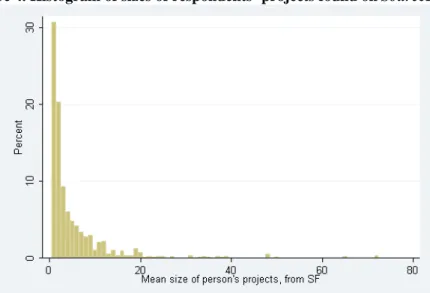
It therefore is surprising that greater concern has not been expressed in the literature about the potentially serious gap in our knowledge about the developers that are attracted to participate in community-based projects. Observers of the open source movement (since Krishnamurthy 2002) have been aware that a large proportion of those identifying themselves as contributing to FLOSS are engaged on very small projects (scattered in separate "caves") rather than belonging to the large collaborative project "communities." Whereas Krishnamurthy (2002) arrived at this on the basis of studying a small sample of project groups hosted by Source Forge (the widely known open source collaboration environment), a complete enumeration of the over 54 thousand project-groups on SourceForge.Net at the close of 2003 discloses that 67 percent of them had only a single participant-member.7 The supposition that a random sample of survey respondents to web-cast surveys would include a substantial segment of I-mode developers may be inferred from the fact that among the 1473 FLOSS-US (2003) Survey respondents who list a current project, 64.8 percent described it as
“unknown” or “slightly known,” and as many as 33.0 percent said they launched the project alone, while another 46.8 percent reported having launched it with others.8
But it is more than the sheer wealth of quantitatively un-weighted detail that frustrates clarity of description and interpretation in this area. The collective portrait of FLOSS developers has
remained “blurred” because the constituent subjects are varied, and they are in motion. Firstly, much of the literature, whether theoretically or empirically informed has tended to approach the descriptive task as though the desired goal was to arrive at “representative agent” characterization of the
developers that were participating in the FLOSS movement. In what regard such a construct would be useful remains unclear. But, in the event, the literature has seen a growing assortment of candidates entered into contention for that mantle, as successive research contributions have added still another motivation to the lengthening list – each accompanied by some supporting anecdotal evidence. Consequently, the picture conjured up when one tries to distill the various contending assertions as to who are “the open source developers and why they are doing it”, unfortunately, is one of a
representative “agent” whose is suffering a nearly pathological multiple personality disorder -- being animated by a mélange of very different sources of gratification and accordingly diverse behavioral orientations. A more plausible conceptualization of a heterogeneous population in which there are
7
Healy and Schussman’s (2003) study of the August 2002 Source Forge archive had put the median project size at 1 developer. We are indebted to Francesco Rullani, who supplied the estimates based on projects with non-zero membership in the January 2003 SourceForge.Net data archive, further details about which are available in Guiri et al. (2004), and David and Rullani (2008). Whether the bulk of these small projects are truly solo development efforts conducted on Source Forge is not certain, as some may have originated in code previously written for commercial purposes and subsequently released under open source license by the copyright holders. 8
Another consistent indirect indicator of the numerical importance of very small open source projects may be cited: of 1055 FLOSS-US survey respondents reporting the proportion of code they had contributed to their current project, 31 percent put that figure at or above 95 percent. See David (2006) for further discussion.
recognizably distinct demographic and personality or motivational “types” would direct empirical research differently, and more intelligibly, toward identifying a set of dominant “types” and establish their respective numerical weights in the population of FLOSS developers.
Secondly, when one considers human motivations as well as individual capabilities, and roles and position in the community, it must be admitted that these are mutable qualities rather than
characteristics that remain fixed. Becoming a competent programmer, a participant in community, and a project member are not processes bounded by crisply defined and standardized “states”. Although it would be convenient to suppose the micro-level dynamics could be revealed by “snapshot” showing the whole ensemble of actors in cross-section, that would be informative only of a community that was in steady-state equilibrium – and we have no warrant to assume such a condition obtains. This applies even more strongly to the “communities” associated with specific FLOSS projects, because the latter are likely to have life-cycles whose durations are considerably shorter than that of the collectivity of such projects. Consequently the degree of structure, of institutionalization of governance arrangements, rate of membership turnover and intensity of commitment are not static properties of the projects that have been studied, and variations in findings from one study to the next could well reflect differences among their respective “life cycle stages.” In the absence of careful “controls” for the latter, efforts to compare and synthesize findings, and casual aggregation of impressions from a variety of case studies are likely to be a source of confusion rather than deeper insights.9
Similarly, tastes and priorities that affect micro-level behavior may change with social experience and material circumstances, and the expressed reasons for having acted in one way and not another are likely to be affected by individuals’ changing need for self-identification in reference to their current social contexts.10 Social scientists’ hopes of identifying stable universal motivational drives and correspondingly predictable patterns of behavior in response to some set of situational stimuli would seem to rest on relinquishing the conceit that simple and persuasive general
psychological explanations can be found for actions that are aspects of very general classes of human behavior. Volunteering something of personal value (one’s time or money) to a cause that benefits
9
von Krogh et al. (2008) propose a framework for the comparative, longitudinal study of open source software projects that recognizes the reciprocal interactions between individual intrinsic sources of motivation, socially shaped norms of practice and formal institutional structures. Although possibly implied, the life-cycle dynamics of community and project do not figure explicitly in their interesting proposal for the future direction of research. See also Krishnamurthy (2005) on the role of social “incentives” in shaping developers’ motives and behaviors.
10 The endogenous elements in individual motivation (defined as the reason for “doing something”), and the feedback not only from private experience but more strongly from social norms that legitimate and assign moral value to particular courses of action within specific social contexts, has been explored by MacIntyre (1984). This richer psycho-social perspective recently has been embraced by von Krogh et al. (2008) as a promising framework for studying open source software projects. See Rullani (2007) for an effort to econometrically estimate the effects of antecedent community social interaction experience on project-founding behaviors of developers on Source Forge.
others, such as contributing to the production of open source software, is not likely to have a unique explanation that is accessible to theorists of homo economicus. For economists, it has proved more useful to proceed by seeking to isolate motivating considerations and constraints that impinge upon, and shape the extent of human behaviors “at the margin”: better to ask the reasons for choosing to joining a large open source projects rather than smaller ones, or a community project with one purpose rather than another, or, indeed preferring a particular “copyleft” license (such as the GNU GPL) under which to release the code that one has written, than to expect to find “the reason why” people put themselves into situations where they will face choices of those kinds.11
Still another dimension of “motion” on the part of the micro-level agents in the world of open source projects is that relating to the circulation of developers among projects. There is considerable potential for ambiguity in this, for when one asks “who are the participants in community-based FLOSS development?” the answer should properly distinguish between those who ever have been mainly involved in such activities, and those who are thus engaged at some particular moment in time. Obviously, if developers form a principal attachment to a project and never leave it, there would be no point at all to this distinction; and, once again, in a steady-state world, where both the numbers of active projects and their membership sizes were stationary, there would be at best limited scope for temporal change in the distribution of developers observed at the upper (or lower) extremes of the project size distribution. On the other hand, were there an appreciable rate of turnover in the membership of large projects, the characteristics, acquired attributes and attitudes typical of the population of participants in such projects could be hard to extrapolate reasonably from samples of existing project members – unless the circulation of personnel tended to be stratified by project size. To put this differently, if there was substantial local attraction to projects of more or less the sizes of those from which the “movers” had originated, one would not need to worry about the
representativeness of sub-sample of developers found in a small and non-randomly selected set of projects, or whether the population of large project members today would be replaced tomorrow by one that didn’t resemble it closely. Where open source developers first acquire practical experience, and where they subsequently come to apply it and share it with others, is obviously dependent not only on the sites where skills and opportunities for employment are to be found.12 What is most striking about this is the paucity of empirical guidance for thinking about these questions, because, important though it may be, the circulation of developers among projects has not been systematically examined from this angle.
11
The positive case for focusing attention on “motivations-at-the-margin” in understanding resource allocation behaviour in the context of open source software projects has been more fully elaborated and applied in Dalle and David (2005), and Dalle et al. (2005).
12
On the potential for software skills development provided by experience in FLOSS communities associated with large projects, see the findings of the EC funded survey research studies directed by Rishab A. Ghosh (UNU-MERIT, Maastricht), including: FLOSSPOLS (2005), FLOSSImpact (2006) and FLOSSWorld (2007); also David and Shapiro (2007).
Yet, far more straightforward than the foregoing noteworthy complications, there is another, quite fundamental source of the “blurry vision” projected by the literature concerned with open source developers. Curiously, given the researchers’ primary fixation on issues relating to the phenomenon of community-based software production, they have not paid adequate attention to examining the right data. As has already been suggested, many of the generalizations currently in circulation about the characteristics, motives and behaviors of contributors to FLOSS, to the extent that they have a substantially empirical basis, rest insecurely upon two bodies of observational evidence that are not exactly “fit for purpose.” On the one hand there are several extensive web-cast surveys that have drawn self-selected responses from the population of developers at large, among which, as has been pointed out, a sizeable proportion are not engaged in community-based projects. 13 On the other hand, an important component of the research literature has been based on the findings of targeted small-sample email surveys, and still more intensive interview-based case studies. Among these is the handful that has focused upon specific FLOSS development communities associated with big projects (the Linux kernel, and GNOME being popular objects of repeated study).14 The individuals whose behaviors are observed (and whose attitudes and concerns are expressed) in such case studies may be self-selected into projects on the basis of characteristics, attitudes or propensities that render them (and their project) idiosyncratic rather than “typical” or “representative” of the population that distributes itself among the totality of community-based development efforts. Thus, the research relying on large web-cast survey populations may claim to be in some sense representative of FLOSS developers at large, but by that token not necessarily of those who are engaged in community-based software production; whereas the participants in the small collection of large projects selected for study has not been shown to be representative of the membership of the broader class of such projects.
Thus, to recapitulate, our principal goal here must be simply to improve the resolution of the group portrait of sub-population of developers who have chosen to develop FLOSS by working in one or another of the larger “community” (that is in C-mode) mode, and to determine whether and in what respects they differ from those who have chosen to work essentially independently (in I-mode). Quite
13
See, primarily, the 2002 FLOSS-EU survey (Ghosh et al., 2002); the 2003 FLOSS-US survey (David, Waterman and Arora, 2003. Included with these might be the 2003 Boston Consulting Group Survey ) the largest of the targeted email surveys, gathering 684 responses from individuals listed as project group members on Source Forge. For analyses of this dataset, see Lakhani et al., 2002, and Lakhani and Wolf, 2005. Table 1 (below, in Section 2.1) provides further details of these data sources on developers characteristics and motivations.
14
See Table 1, in Section 2.1 (below); also, Bitzer et al (2004), Bonaccorsi and Rossi (2004), Iannici (2005), Lee et al. (2003), Rossi and Bonaccorsi (2005), Ye and Kishida (2003) and the more extensive review of empirical papers in von Krogh et al 2008. There have been still other highly informative empirical studies of developers associated with Linux and others among the large project (e.g., Hertel, Nieder, and Herrmann 2003), including those that have been concerned with analyses of the pattern of communications among all the participants (see Crowston and Howison, 2005, 2006; Howison, Inoue and Crowston, 2006), the nature of attachments and the changing roles of participants in these projects (Elliott and Scacchi, 2006). But these have not focused on questions relating to the motives for participation, developers capabilities and experience, or the persistence of project attachments.
apart from the fact that this task is “doable” and yet has been left not done, there are compelling reasons for returning to these often discussed topics in the micro-economics and micro-sociology of FLOSS communities in order to arrive at a more discriminating descriptive study of the human resources that are engaged in the “open source way of working.” These follow from an acknowledgement of the potentially important longer-term implications of community-based open source software development as a “paradigm-shifting” phenomenon, a movement whose consequences may well beyond those affecting the organizational evolution of the software industry.
1.3. Organization of the paper: a ‘roadmap’ of our procedures and main results
Section 2 describes the main data source upon which the present analysis rests, the 2003 FLOSS-US Survey whose design and descriptive findings were reported by David, Waterman and Arora (2003). We situate this source (in Section 2.1) among the set of nine surveys carried out before 2005, all but one of which had focused on discovering the characteristics and avowed motives of contributors to the development of FLOSS, and indicate the particular features of this survey that rendered it especially suitable for the present purposes. We follow the previous research contributions in giving special attention to the question of motivation in Section 2.2 discusses the strengths and limitations of the available information from the FLOSS-US respondents about their reasons for beginning to develop open source software, and for their choices of the first project and the main project in which they currently were participating.
Section 3 occupies a major portion of the paper, in which we present a multi-step reanalysis of the motivations data for the subset of 1459 individuals who supplied complete answers to the battery of FLOSS-US questions that asked them to assign relative importance of each of 11 suggested reasons for beginning to contribute to FLOSS development. Contrasts been the character of those Likert-scaled responses, and the salient reasons for project choice are reviewed in Section 3.1. Although the attention focused on delineating FLOSS developers’ motivations has encouraged the projection of a static picture, Section 3.2 takes notice of evidence extracted from surveys that points to the mutability of motives – in regard to both the reasons for current involvement with FLOSS and the choices among projects. Not only do motives evolve, but there is reason to view those changes as interdependent with changes in individual material circumstances and social contexts. This points to the usefulness for purposes of statistical analysis of explicitly recognizing developer’s stated reasons for having first become involved with FLOSS development as a lagged endogenous state-variable that may be treated as a pre-determined “fixed” effect; the advantages of this for econometric studies of the putative role of motivation in accounting for subsequent behavioral patterns are considerable. In Section 3.3 we are able to show that the population of self-identified developers at large is
heterogeneous in the “fixed” patterns of its members’ initial motivations for involving themselves in FLOSS activities. This is done first by adopting a “bootstrap” estimation approach to calculating the
variance of individual responses to each of the specific items in the battery of questions about motivation, re-sampling from the universe of all 1459 responses to show the variations that would appears in projects of 30, and 100 (randomly drawn) members. Second, factor analysis is applied to the complete set of Likert-scaled responses, and the resulting factor-loadings are used to generate a distribution of motivational factor scores, the properties of which can be examined and interpreted. Having established an empirical basis for treating individual “motivation” as a multi-dimensional profile, and shown the population of developers at large to be heterogeneous in those “profiles,” we proceed (in Section 3.4) to group them into distinct “types”, or “motivational profile clusters”. Rather than trying to chop up the continuous distribution for motivational factor scores, hierarchical
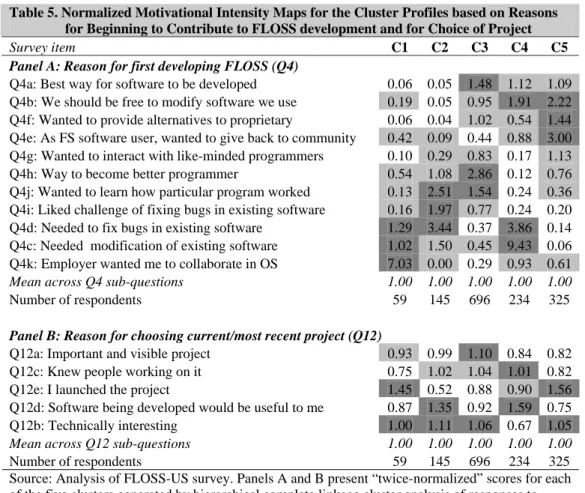
clustering analysis has been applied to the full set of Likert-scaled responses regarding developers’ reasons for beginning to work on FLOSS development. The results, which enable us to assign one of five mutually exclusive motivational profiles to each of the survey respondents is a significant advance beyond the present state of the literature, in that it yields quantitative estimates of the numerical weights of distinct motivational (cluster) types in the population of developers at large.
To aid in the interpretation of the resulting five clusters, we introduce (in Section 3.5) the device of “normalized motivational intensity maps”, using the distribution of Likert scores to show the relative intensity of importance assigned to each of the questionnaire’s 11 specific suggested reasons for becoming involved in FLOSS development. This approach is applied both for the entire set of survey respondents and for the sub-populations comprising the component clusters, and presented graphically in intensity maps for each. Rather strikingly, these reveal the main features in which the motivational profiles represented in those clusters are systematically different from one another. Lastly, to round out our portraits of those several motivational types, we examine the available information provided by the written “other reasons” that the survey respondents could supply as supplements to the way they answered questions which suggested reasons for initially contributing to FLOSS development and choosing specific projects. The “other reasons” lend themselves to classification within an extended version of Deci and Ryan’s (1985) “intrinsic-extrinsic” taxonomic scheme for human motivations, and the distributions of the “other reasons” to which developers attached importance among those categories for each of the clusters’ members. This contributes to providing a richer, more nuanced interpretation of the ‘caricatures’ we present of these distinctive motivational profiles. The portraits of each clusters’ membership then are rounded out with descriptive statistics of demographic and occupational variables elicited by the FLOSS-US survey, which reveal that some significant variations exist among them also in those objective dimensions.
Section 4 connects the micro-level data pertaining to individual developers with information about the projects with which they cay be associated. The discussion starts with a brief description of the methods used in locating the FLOSS-US survey respondents in projects whose position in the contemporaneous distribution of project sizes can be obtained, thereby assigning some 847 of the 1459 FLOSS-US survey respondents to three domains within the project size distribution: those at the
extreme lower end, having 1 or 2 members (which we associate with I-mode production), those at the opposite extreme having 30 members or more (which we take to represent “large” project engaged in
C-mode production of FLOSS), and the those in the intervening “middle” range from 3 to 29 members. Consistent with the known skew of the SourceForge project size distribution, fully half of this linked sample of survey respondents are found to have been engaged at the low end of the project size distribution, whereas approximately 20 percent were associated with projects at the upper end of the distribution.
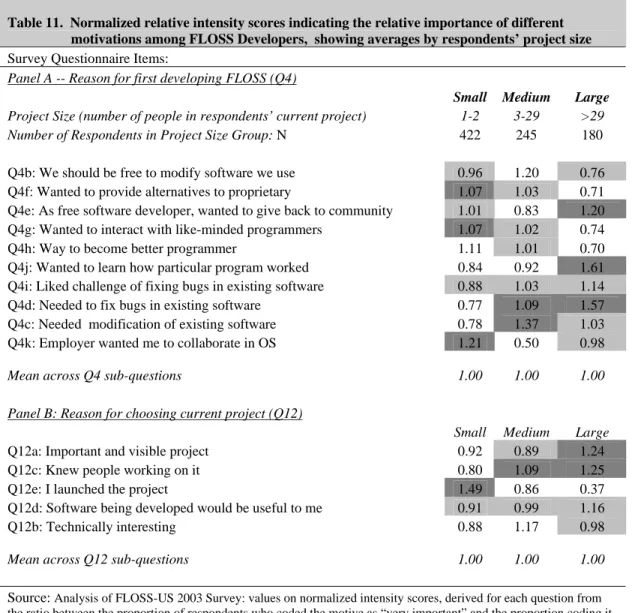
With the project-linked survey respondents partitioned among these three size ranges, Section 4.1 examines the association between project size and patterns of motivation in these sub-populations, using the information from the distribution of motivational factor scores, and the device of
motivation-intensity maps to identify differences in this respect between FLOSS developers who were working in I-mode and those in C-mode projects. The question of the extent and directionality of the circulation of developers among projects, and specifically the degree which such movements occur across the boundaries that we defined (rather than being largely confined with the respective strata of small, medium and large projects) is examined in Section 4.2. This analysis makes use of the data from the FLOSS-US survey’s questions about the respondents’ initial and current projects in those cases where the two were different.
Section 5 brings together the preceding findings about the characteristics of the FLOSS developers in the different motivational clusters, on the one hand, and the distribution of those motivational types across the small, medium and large projects, on the other hand. This integration proceeds in two main steps. We look first (in Section 5.1) at the issue of whether the mixture of motivational factors of the developer populations is much the same or exhibits distinct differences as one moves across the range of their project sizes. Then the descriptive statistics of developers at the upper and lower extrema of the project size distribution are compared to identify whether there are significant statistical differences between those contributing to FLOSS production in C-mode and those who are working in I-mode.This analysis examines demographic, occupational and experience characteristics, as well as the variation of expected proportions of motivational types and motivational intensities across the range from the large to the very small projects.
A further (second) step in the analysis (in Section 5.2) asks whether the initial motivations of developers and their objective characteristics have significant predictive power on the choices made by FLOSS developers regarding the sizes of the main projects to which they contribute. For this purpose we estimate an ordered probit regression model, whose independent variables include experience in FLOSS, age upon first developing FLOSS, occupational status, earnings from FLOSS, expected future job roles, country of residence, and educational attainment.
The paper concludes (in Section 6) by recapitulating the main empirical findings and considers briefly some of their implications for future research on the interplay between individual
motivations, organizational practices and institutional structures in the mobilization and coordination of resources, and the governance of community-based production of open source software.
2. Data from other studies and from the present paper
The basic dataset on which our analysis in this paper rests is drawn from the responses to the 2003 FLOSS-US web-cast survey (conducted between January and June 2003) that elicited a total of 1,587 valid responses from open source software developers.15 The online survey asked 46 questions about developers’ demographic characteristics, education, occupational status, software experience, reasons for participating in FLOSS development, open source project roles and contributions, remuneration, and other topics. Respondents learned about the survey from advertisements posted on 50 websites and mailing lists in many countries. Hence these data do not represent a probabilistic sample of all FLOSS developers. Other data on FLOSS developers use a similar voluntary sample, whether gathered from web posting of a questionnaire (e.g., Ghosh et al. 2002), or from responses to targeted e-mailing of a questionnaire in the case of the Boston Consulting Group’s “Hacker Survey” (Lakhani et al., 2002; Lakhani and Wolf, 2005).
Several advantages of working with the FLOSS-US data in the present connection may be noted briefly at the outset. First, although the number of observations is smaller than those available from the FLOSS-EU, it is still quite ample and the geographical balance between Europe and North American respondents is more representative of the global population.16 Secondly, while responses to the same array of suggested reasons for beginning to contribute to open source software development are available from both surveys (by design), those from the FLOSS-US survey are Likert-scaled. Thirdly, the self-selected sample elicited by the web-cast survey method is likely to yield a more representative sample of the global population, particular in the relative balance between participants to very small and large projects, in comparison with the BCG approach, which targeted individuals in the e-mail lists of established projects. Lastly, the timing of the FLOSS-US survey in 2003 coincides with the coverage of a documented database of all the projects in the SourceForge archive, from which it was convenient to obtain project size information that could be linked to the files for more
15
David, Waterman, and Arora (2003) provide a detailed description of the survey methods (including the web-postings and non-English translations of the request for cooperation) and the basic statistical findings. The present study is a reanalysis of the FLOSS-US dataset, which has selected the subset of respondents who provided complete answers to questions regarding their motivations for beginning to contribute to open source software development.
16
SourceForge.Net contains perhaps the web’s largest repository of open source projects, and comparing the geographical location of FLOSS-US respondents against the more than a million registrants on SourceForge in 2006 (as estimated by Robles and Gonzalas-Barahona [this Issue]) provides some idea of the extent to which the FLOSS-US represents the larger universe of developers (see also Robles et al., 2006). The comparison we have made of the regions of residence of the two populations shows a reassuringly close correspondence, although because the SF.Net population is very large, the proportions are precisely estimated and the differences between the two are statistically significant. These statistics are not shown here due to space constraints, but may be obtained privately from the authors.
than half of the individual survey respondents – particularly those who reported themselves engaged principally in projects that were discovered to fall into the very small and medium size-ranges.
Since the true universe of FLOSS developers has dynamic size and lacks clear definition, it is not possible to strictly examine the representative-ness of any sample, even one that is quite large; an on-line survey such as FLOSS-US cannot even report a defined response rate.17 Nevertheless, it is important to set this data source in the context of other studies conducted in roughly the same time period, namely the opening quinquenium of the present century, and to establish that if we cannot say whether or not it is representative of the global FLOSS developer population, it is reassuring that the FLOSS-US respondents collectively resemble those described by other survey-based studies of that population in respect to a number of their basic characteristics.
2.1 The FLOSS-US Survey in Context
At least eight other empirical analyses have surveyed FLOSS developers during the period up to 2005, almost all of which had among their goals a clearer understanding these developers’ motives. One may group these surveys into the three categories summarized in Table 1: four of the studies prepared an online survey to which developers were invited to respond (Robles et al. 2001; Ghosh et al. 2002; David, Waterman, and Arora 2003; Mitsubishi 2004)18; three surveys involved contacting developers whose emails were obtained from online code repositories, achieving response rates from 8 to 34 percent, and gaining between 79 and 684 respondents (Lakhani et al., 2002; Lakhani and Wolf 2005; Hars and Ou, 2002 and Haruvy, Wu, and Chakravarty 2003); and two surveys, each of which obtained a few hundred responses, were conducted by emailing questionnaires to participants in a single large project (Lakhani and von Hippel 2002 on Apache, and Hertel, Nieder, and Herrman 2003 on the Linux kernel).
Table 1 about here
The heterogeneous methods, unequal sample universes, different survey dates, diverse phrasing of questions and answer choices, and varied selection biases due to low response rates across these studies, all allow one to reasonably question their comparability. Nonetheless, comparing the demographics of their respondents gives some idea of their consistency. Several studies’ lack of reporting of standard deviations makes it difficult to know the statistical significance of differences
17
Although one might infer that FLOSS-US developers had a greater proclivity to participate in a survey than was the case among the developers that are not represented among the responses, this is not edifying, and even that conclusion must be qualified by the observation that not all those who might have wished to respond actually became aware of the survey before it was closed.
18
The 2003 FLOSS-US survey, as a described by David, Waterman and Arora (2003), repeated an number of basic questions in the same form in which they appeared in the 2002 FLOSS-EU survey of developers designed by Ghosh et al. (2002) The survey conducted by Mitsubishi (2004) followed suit, especially repeating the motivational questions of the two previous surveys.
between surveys, but for some of the demographic variables the mean values across these surveys are very similar. The mean ages of the developers in these samples are quite tightly clustered between 27 and 30 years; between 95 and 99 percent of respondents are male, and the respondent sub-populations have mean durations of FLOSS experience in the range from 4.1 to 5.3 years.19
Other demographics vary widely among these surveys. The portion of survey respondents from North America ranges from 1 percent in Mitsubishi (2004), a study focusing on Asian
developers, to 48 percent in Hertel, Nieder, and Herrman (2003), a study focusing on Linux. Between 14 and 32 percent of respondents are students, and between 4 and 11 percent are not employed. In Robles et al. (2001), the survey yielding the largest sample, 15 percent of the respondents had a graduate degree,20 whereas the corresponding figure is 43 percent for the respondents to the FLOSS-US (as reported by David, Waterman, and Arora, 2003).
As has been noted (in the discussion of Section 1.1) these empirical studies collectively emphasize an assortment of motives for FLOSS contributors. Almost all included questions seeking to elicit information on the relevance of a variety of suggested reasons for participating in FLOSS, Robles et al. (2001), which focused on software engineering questions, being the exception in that regard. The FLOSS-EU survey allowed developers to choose up to 4 from 14 listed reasons for joining a FLOSS community, and to choose another four reasons for staying in the FLOSS
community, and Ghosh et al. (2002) report that the two dominant motivations were focused on human capital formation: “sharing knowledge and skills” and “learning and developing new skills” were mentioned twice as frequently as any of the other listed reasons. The least frequently cited motives were making money, gaining reputation, and distributing non-marketable software. Similar results arose from a question on the expectations held by respondent regarding the motivations of others in the FLOSS movement. The FLOSS-US survey instrument included one battery of questions (in Q 4) about the respondent’s reasons for first developing FLOSS, and a second question (Q12) asks for the respondent’s reasons for selection to work on a particular FLOSS project. Many respondents wrote in other reasons, but the reasons indicated as having been important in motivating initial involvement in FLOSS development are reported (by David, Waterman, and Arora, 2003) to be rather differently focused than those found from the FLOSS-EU data: the preponderant responses were strongly normative, emphasizing the ideology of “libre” software and a communitarian ethos (“we should be free to modify software we use,” and wanting “to give something back to the community”). This presented a contrast with the tenor of the reasons stated for having selected one’s main project, which
19
It may be noted that all these surveys also concur in not having obtained any responses from FLOSS
developers located on the continent of Africa -- probably as much a reflection of the surveyors’ limited access to websites and email lists there than of anything else, although even in 2006, as Gonzales-Barahona et al report [this Issue), the Africa’s proportion of the global FLOSS developer population remains quite small.
20
Robles et al. (2001) was a short survey aimed at programmers and software engineers, and which did not explore motivations but asked only technical questions. The difference in focus between this and other surveys may partly explain the higher educational attainment in FLOSS-US and others vis-à-vis Robles et al. (2001).
were more instrumental and ego-oriented (“it was technically interesting” and the “software . . . would be useful to me”).
Among the surveys with defined sample universes, the Boston Consulting Group study (Lakhani et al.,2002) similarly permitted respondents to indicate their agreement with various proposed motives for developing FLOSS. The dominant reasons included intellectual stimulation and improvement of skills, whereas the least common motivations were the requirement of a license, and the goal of “beating” proprietary software. Hars and Ou (2002) found that 70 percent of respondents identified improvement of programming skills as a dominant motivation, 52 percent stressed the value of a peer network, and 39 percent cited their need to use or modify the software in question. Haruvy, Wu, and Chakravarty (2003) had developers choose items from a 7-point Likert scale, and report that “[q]uite a few respondents sent emails expressing indignation at survey items which suggested [that] monetary items could possibly motivate their contributions to open source projects” (p. 21). They convert these responses into scalar intensity values for selfish and non-selfish motives, and find a modal unselfish-to-selfish ratio of 1.25.
The two surveys in Table 1 that studied the developers participating in a large project identify additional motives. Lakhani and von Hippel (2002) explain that Apache developers devote time to the mundane task of reading and answering user queries because such activities help the developers improve their own code and websites, and they suggest that such direct rewards may supersede altruism or direct enjoyment of work as motivations for FLOSS development.21 Hertel, Nieder, and Herrmann (2003) derive seven factors from principal component analysis on motivational questions, which they interpret as follows (i) identification as a Linux user, (ii) identification as a Linux developer, (iii) desire to improve a developer’s own software and career prospects, (iv) positive expected reactions of friends and family, (v) ideological motives regarding FLOSS, (vi) enjoyment of programming, and, as a counter-motive (vii) expenditure of time on FLOSS programming. While this study identifies multiple motives for developers, like many others, it does not emphasize
heterogeneity of motivation within the population of developers. Thus, the survey respondents might reflect the existence of several groups each distinguished by a unique motivation, or a homogeneous population of developers, each of whom has multiple motivations. To fully understand the
motivations of FLOSS developers, however, requires an effort to distinguish empirically between those two interpretive possibilities – which is the main task that will occupy us in the next section.
2.2 Problems of bias and noise in data about individual motivations
We proceed with the caveat that our data, being generated in response to a web-cast survey,
21
This interpretation represents an extension of von Hippel’s user-innovator model which figures as the guiding framework for empirical research in other studies, including, more recently, those focused upon open source software production. See von Hippel (1988, 2002); Morrison, Roberts, and von Hippel (2000); and Henkel and von Hippel (2004).
pertains to a self-selected population’s reported characteristics, perceptions and expressed reasons for (some of) their actions. Further, our use of the information supplied by developers in response to questions posed by the FLOSS-US survey about their reasons for beginning to participate in open source development, and their choice of particular projects on which to focus their contributions adds some special sources for concern. But it seems quite unavoidable in the circumstances, even though economists typically are inclined not to accord much weight to the personal testimony that economic actors might offer regarding the subjective beliefs or reasons for their behaviors.22
No incentive in the structure or implementation of the FLOSS-US survey would have encouraged developers to misrepresent their motives in replying to the anonymous on-line
questionnaire, and developers’ stated reasons for their participation should not be dismissed in favor of essentially a aprioristic speculations guided by psychology, or sociology or economics. But a measure of skepticism and considerable caution nevertheless is warranted in working with these micro-data on expressed motivations. Developers may generate beliefs and statements about their “values” to satisfy their suppositions about what survey-takers will regard to be appropriate; or, for reasons of cognitive dissonance, they may offer statements about their perceptions or goals that have the effect of rendering the their own behaviors more readily rationalized and consistent.23 Errors in measurement in stated reasons may therefore be correlated with other, objective observations on behavior, and so may give rise to biased regression estimates when the forms of data are used in conjunctions with one another.
In view of the interest of this study in learning whether the attributes of the developers who contribute to community production in large projects are different from those who are drawn to projects in the lower range of the size distribution, it is natural to worry that the reporting of motivations might be distorted in some way that was related to choices of project size. If such relationships do exist, not all of them seem as transparent and straightforward as the connection between being motivated to learn to be a better programmer by observing and interacting with others, and choosing not to develop software independently; or to reverse the causation, finding opportunities for skills development in the FLOSS large project that one had joined out of curiosity to be a
important “reason” for participating in the open source movement. To illustrate the point that the motivation-size connections are multi-valent, consider one of the most widely discussed of the early “economic” explanations offered for the puzzle of the “open source software movement” by Lerner and Tirole (2002), who suggested that software developers might volunteer their efforts without requiring immediate compensation because the open setting of FLOSS projects permitted career-seeking algorithm designers and programmers to openly exhibit their technical expertise; by sharing
22
Rather than asking individuals about the motives and intentions that led them to make one choice rather than another, the modern theory of demand instructs us that it is better to proceed by observing how behaviors change when constraints are altered, and interpreting the outcomes as reflecting “revealed preferences.” 23
the fruits of their knowledge, they might more readily build a reputation that would widely “signal” their expert capabilities to potential employers. 24 A different argument that similarly involved an instrumental or extrinsic purpose, has come from the management and innovation studies side25: developing and freely sharing open source software could be a form of innovative investment that allowed those undertaking it to better satisfy their own particular human wants, by developing a new artifact that would meet its creator’s need more satisfactorily than any of those that were already available. The latter explanation therefore “naturalized” open-source software developers as simply one among a larger class of “user-innovators” who looked forward to benefitting directly from the “own use-value” of the customized programs they were creating or modifying so as to better meet their personal use requirements.
Neither of the foregoing depictions of what is motivating FLOSS developers would seem to carry any clear and compelling implications regarding the size of the projects that people thus motivated would chose to join. Fleshing out the specifics of these “reasons” a bit further, however, points to different considerations that could favor either large project or small project participation. Opportunities to generate direct financial benefits are likely to be more certain in the case of programmers who were owners or partners in a software services enterprise, and thus could work essentially independently, or on small projects to adapt or modify existing open source programs, or develop new ones for clients with idiosyncratic needs. The prospects of commercial success in each of such endeavors are likely to be closely circumscribed by the market competition of others with similar skills, whereas both the expectation and the up-side variance in the “payoffs” from successfully initiating and leading a large project would tend to be considerable bigger by
comparison. On that argument, the motivation of “signaling” one’s software expertise, suggested by Lerner and Tirole (2002) would seem more immediately pertinent in the case of developers who choose to contribute to large open source software projects, especially as displaying extraordinary technical abilities in that arena would make them more widely visible and elicit expressions of peer-esteem that attracted the attention of potential employers. But, except for the exceptional few, the expected pecuniary rewards of winning that sort of reputational tournament may well be dominated
24
See Lerner and Tirole (2002), whose influential paper asked (p.98): “Why would thousands of top-notch programmers contribute freely to the provision of a public good?” Their suggestion that there was a reputation-building advantage to making prominent contributions to a large and successful open source project echoed the point made by Dasgupta and David (1994), concerning the “signaling value” for young researchers of initially accepting academic “open science” appointments, even though they contemplate eventual employments in corporate proprietary R&D labs.
25 See, e.g., von Hippel (2002) for the initial reflexive extension of his previous research on user-innovators (von Hippel 1988) to both “explain” open-source software development, and broaden the significance of user-driven innovation. Hars and Ou (2002) added empirical support to this line of explanation, emphasizing the value placed by survey respondents on “own use” of their contributions to open source code, and reported finding positive correlation between high values accorded to this reason for participating in FLOSS development and greater reported weekly hours of work. Lakhani and von Hippel (2002) suggested “own-use” motives might be especially important for developers carrying out ordinary, unchallenging programming tasks.
by the opportunities to create a small software service business. Materialistic and rational
“explanations” in that case might actually be masking “reasons” that involve ego-gratification and the quest for peer esteem as an end in itself.
3. Analysis of Survey Data on Motives for Engaging in FLOSS Development
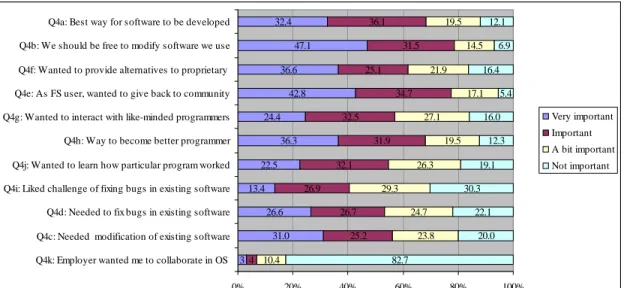
The FLOSS-US survey included two sets of questions about the motives of developers. The first of these (Q4) asks the importance of several motivations in the respondent’s decision to first develop FLOSS. Respondents choose from a four-option Likert scale (very important, important, a bit important, or not important) for each of 11 listed motivations. (These are displayed in Fig.1a, below.) While FLOSS-US presented sub-parts of Q4 in alphabetical order, denoting the questionnaire items by letters a through k, the chart in Fig. 1a re-orders these questions and the distribution of Likert-scaled response to each in a sequence starting with intense expressions of ideological that can be read as serving to identify (or self-identify) the respondent with the ethos and values of the “open source movement,” or with a particular community of FLOSS developers. The ordering of responses proceeds downwards toward responses that place greater and greater emphasis on pragmatic and technical reasons.
Figure 1a about here
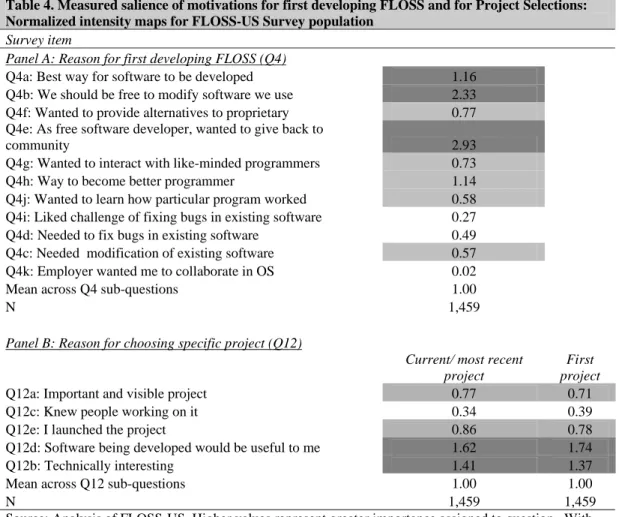
Some measure of instability or endogenous formation of motivations is afforded by the second survey question (Q12), which asks why developers chose to participate in a particular project, and allow for the possibility of reasons that would different in case of the respondents’ current project from those that governed this choice in the case of the first project. The suggested options for answers to Q12 are shown in Figure 1b, but (unlike Q4) this question did not ask for Likert-scaled responses.) While Q4 invites articulation of general expressions of interest and values, Q12 captures decisions at the margin—given a developer’s reason for developing FLOSS: What pushed the individual to select that particular project over alternatives? Again the chart presents sub-parts of Q12 in descending order, from social and community-oriented to technical. FLOSS-US obtained Q12 responses separately for a respondent’s current or most recent project (for exposition, we subsequently call this the “current” project) and for a respondent’s first project.26
Figure 1b about here
Overall, pecuniary and direct career motives have comparative small importance among the reasons listed in Q4 for beginning their participation, and direct business sponsorship is infrequent: only 7 percent say that their employers’ having directed them to collaborate in open source
26
Our analysis generally makes use of Q12 results for both the first and the principle recent or current projects, as will be seen, but in a few cases only the current project data are used.
development work was very important or important in their initial involvements.27 Commitment to the FLOSS ethos, by contrast, has notable prominence: 68 to 79 percent list positive ideological reasons (Q4a,b,e) as being either very important or important, whereas only 52 percent assigned that measure of importance to the negative element of the FLOSS movement’s anti-proprietary software stance (Q4f). Whereas the proportion declaring freedom “to modify software we use” (Q4b) to be
unimportant just approaches 7 percent, the proportions that felt the same way regarding their actual “need” to modify existing software, or to fix bugs in existing software was almost three time larger (20 and 22 percent, respectively). The motivation to become a better programmer (Q4h) was assigned the top two degrees of importance by just over 68 percent of the respondents, and matched the joining FLOSS activities because they constituted “the best way for software to be developed” (Q4a) in assigned importance. Pragmatic interests in learning how particular programs worked, and interacting with like-minded programmers held somewhat less power as a motivation for initial involvement in FLOSS, with 55-59 percent scoring those reasons as important or very important. It may be remarked that the FLOSS-EU and the FLOSS-US data both show that ideological and pragmatic reasons each have important roles in inducing programmers’ to embark upon open source software development, whereas only for very small minorities do direct career considerations and employer sponsorship appear to figure importantly in that regard. The FLOSS-US survey sample, which drew about half its members from Western Europe -- compared with the 70 percent share that the latter region held in the FLOSS-EU sample population -- shows greater importance being assigned to ideological motivations, whereas it is the pragmatic aspects of open source code development that are cited with greater relative frequently as important reasons. 28
While respondents often emphasize ideological motives for first developing FLOSS, they give greater emphasis to practical reasons for choosing a particular project. From Figure 1b it is seen that fewer than half of developers listed a project’s importance and visibility as reasons for joining it, while about two-thirds mentioned their chosen project’s technical appeal, and nearly 80 percent expected that the software would be personally useful. There were only small differences between respondents’ motives for choosing their current and first projects. For example, 61 percent of
27
It will be seen by inspection of Figure 1a that the sum “very important” and “important” responses varies directly with the former of the two components, so giving the sum in the text is not misleading in indicating differences in relative importance attached to the prompted reasons.
28
Since the FLOSS-US 2003 Surveys included questions on motivation that were very similar (by design) to those posed in the FLOSS-EU 2002, a merged FLOSS-EU and FLOSS-US dataset could be created by R. Glott and A. Waterman, using responses from 4,402 respondents to very similarly worded questions regarding their reasons for participating in FLOSS development. This yielded counts of positive responses to the six principal motivations noted in the text. Over half of respondents emphasized their desires to improve programming skills, while only 43 percent emphasized the value of “sharing knowledge and contributing to community.” Still fewer – only 30 percent – emphasized the value of providing alternatives to proprietary software, and only a fourth valued the experience of participating in community. The percentages cited refer to the proportion of all respondents who had either listed the motivation in question on their answers to the FLOSS-EU questionnaire, or marked the Likert-scale to indicate that reason as “very important” when answering the FLOSS-US questionnaire. Further analysis of this dataset is the subject of a future paper.