On the Difficulty to Design Arabic
E-learning System in Statistics
Taleb Ahmad Wolfgang H¨ardle
CASE-Center for Applied Statistics and Economics
Institut f¨ur Statistik and ¨Okonometrie
Motivation 1-1
Motivation
• E-learning plattform, e-books, MD*booklets are useful for
Statistics education.
• The system MM*STAT was developed at the School for
Business and Economics of Humboldt-Universit¨at zu Berlin.
Motivation 1-2
Figure 1: MM*STAT with the multiple languages
e-learning in Arabic language
ﻲﻧوﺮﺘﻜﻟﻻاﻢﻴﻠﻌﺘﻟا
ﻲﻓ ﻲﺋﺎﺼﺣﻻا
Motivation 1-3 اﺬه ﺐﻠﻄﺘﻳﻲﻧوﺮﺘﻜﻟﻻابﺎﺘﻜﻟا Internet Explorer 5 ﺮﺜآأوأ . ﺪهﺎﺷتﺎﻣﻮﻠﻌﻤﻟاﻦﻣﺪﻳﺰﻤﻟ ﺔﻴﻨﻘﺘﻟاةﺪﻋﺎﺴﻤﻟا . ﻮﻳﺪ ﻴﻓﺐ ﻴﺣﺮﺗﻦﻣﻎﻧﺎ ﻐﻔﻟﻮﻓﻲﻟدﺮﻴ هوﻮﻳﺪ ﻴﻓﺐ ﻴﺣﺮﺗﻦﻣﺪ ﻧﺮﺑﺰ ﻧور
Motivation 1-4
• The implementation of MM*STAT needed for Arab
educational institutions is however difficult.
• MD*Book created the interactive e-learning documents .
• This tool uses the LATEX format file to enable compilation
into PDF, Java, HTML.
• We aim to use the LATEX file format for creating an Arabic
text.
e-learning in Arabic language
ﻲﻧوﺮﺘﻜﻟﻻاﻢﻴﻠﻌﺘﻟا
ﻲﻓ ﻲﺋﺎﺼﺣﻻا
Motivation 1-5
• As we will show this remains a problem, basically caused by
the incompatibility of the standard Latex2html with the phenomenons of the Arabic typography.
• We need therefore to adapt the MM*STAT architecture in a
Outline 2-1
Outline
1. Motivation X 2. What is e-learning ? 3. What is e-book ? 4. Arabic MM*STAT5. Difficulties to design, an Arabic MM*STAT
6. Arabic MM*STAT Realisation
7. Conclusion
e-learning in Arabic language
ﻲﻧوﺮﺘﻜﻟﻻاﻢﻴﻠﻌﺘﻟا
ﻲﻓ ﻲﺋﺎﺼﺣﻻا
What is e-learning ? 3-1
What is e-learning ?
• E-learning most often means an approach to facilitate and
enhance learning through the use of devices based on computer and communications technology.
• Such devices include personal computers, CDROMs, Digital
Television, Mobile Phones.
• Communications technology enables the use of the Internet,
What is e-learning ? 3-2
• E-Learning is the modern model of education, transferring the
classical text books to an electronic medium.
• It has become an important stream of education in present
and has a promising future.
• E-Learning uses net work technology to manage, design,
deliver, select, and extend classical learning.
e-learning in Arabic language
ﻲﻧوﺮﺘﻜﻟﻻاﻢﻴﻠﻌﺘﻟا
ﻲﻓ ﻲﺋﺎﺼﺣﻻا
What is an e-book ? 4-1
What is an e-book ?
• Definitions of e-books differ. Hawkins (2000) states that ”an
e-book is the contents of a book made available in an electronic form.”
• Morgan (1999) limits the definition of e-books, as opposed to
e-texts, to being a hardware/software combination used to read electronic data on a specially designed portable device.
• An e-Book is an electronic version of a traditional print book
What is an e-book ? 4-2
• Most books can be read as PDF files HTML, or any other
encrypted format.
• Most e-book pages take the normal book page form. It may
be in full colored, include graphics and photos.
e-learning in Arabic language
ﻲﻧوﺮﺘﻜﻟﻻاﻢﻴﻠﻌﺘﻟا
ﻲﻓ ﻲﺋﺎﺼﺣﻻا
Arabic MM*STAT 5-1
Arabic MM*STAT
• Arabic MM*STAT is a Web-based learning platform that
provides a fully integrated student environment to learn statistics.
• MM*STAT allows an interactive introduction into the world of
Arabic MM*STAT 5-2
The goal is to:
• Contribute to the evolution of Statistics e-learning by the
development of an efficient system.
• To create an Arabic MM*STAT, because there were not
enough Arabic statistic e-learning platforms. The purpose of this study is to develop a platform that will be used
completely in Arabic, together with other languages such as English and German.
e-learning in Arabic language
ﻲﻧوﺮﺘﻜﻟﻻاﻢﻴﻠﻌﺘﻟا
ﻲﻓ ﻲﺋﺎﺼﺣﻻا
Arabic MM*STAT 5-3
We know that the Arabic language is different from English and other languages in a number of respects:
• Arabic language is written from right to left.
• It is possible to form hundreds of words from one root word
(al- Fedaghi and al-Sadoun, 1990).
• In Arabic the definite article and prepositions, are not
separated from their following word by a space, on another hand some words have different meanings but have the same written form.
Arabic MM*STAT 5-4
• The peculiar morphology of Arabic might render methods
used for English text retrieval inappropriate.
• For example, the English phrase ”and she wrote it”
comprising of four words would be written in Arabic as one word ”wakatabathu” (wa=and, kataba=wrote, t=she,hu=it). Moukdad, H., Andrew, L., (2001).
• Most Arabic letters can be connected to other letters on both
the left and right sides.
• In order to look up an Arabic word in a dictionary or index, it
must be reduced to its root; unlike English,
• Figure 3 presents the example of Arabic Symbols
e-learning in Arabic language
ﻲﻧوﺮﺘﻜﻟﻻاﻢﻴﻠﻌﺘﻟا
ﻲﻓ ﻲﺋﺎﺼﺣﻻا
Arabic MM*STAT 5-5 English Arabic Aussprache Good morning حﺎﺒﺻ ﺮﻴﺨﻟا Sabah alhair Good afternoon ن كرﺎه ﺪﻴﻌﺳ Naharak Said Good evening ﺮﻴﺨﻟاءﺎﺴﻣ Masa alhair Hello ﺎﺒﺣﺮﻣ Marhaba Good luck ﺣ ﺪﻴﻌﺳﻆ Has said Goodbye ﺎﻋادو wadaan
How are you ﻚﻟاﻮﺣاﻒﻴآ
Kaif ahwalak
See you again ﺔﻴﻧﺎﺛكارا Arak saniatan thanks اﺮﻜﺷ schukran fine مﺎﻤﺗ tamam I ﺎﻧا ana you ﺖﻧا anta Thank you ﻚﻟاﺮﻜﺷ Schukran laka For me ﻲﻟ li For you ﻚﻟ laka With pleasure روﺮﺴﺑ bisurur what اذﺎﻣ masa
What do you want ﺪﻳﺮﺗاذﺎﻣ
Masa turid
What are you doing ﻞﻌﻔﺗاذﺎﻣ Masa tafail Come here لﺎﻌﺗ Taal Help me ﻲﻧﺪﻋﺎﺳ saidni go ﺐهذ Sahaba Wait for me ﻲﻧﺮﻈﺘﻧا Intasrni All right ﺎﻨﺴﺣ hasanan when ﻰﺘﻣ Mata How many ﻢآ Kam
Thanks for your help ﻚﺗﺪﻋﺎﺴﻤﻟاﺮﻜﺷ
Schukran limusaadatik
This is a present for you ﻚﻟﺔﻳﺪهﻩﺬه
Hasi hadia laka
how ﻒﻴآ Kaif this ﻩﺬه Hasi Now نﻻا Alan tomorrow اﺪﻏ gadan yesterday ﺲﻣا Ams today مﻮﻴﻟا Aljaum here ﺎﻨه Huna there كﺎﻨه Hunaka yes ﻢﻌﻧ Naam No ﻻ La possible ﻦﻜﻤﻣ Mumkin understood مﻮﻬﻔﻣ mafhum I want ﺪﻳراﺎﻧا Ana uraid I like ﺐﺣا uhaib I wish ﻰﻨﻤﺗا Atamana
Arabic MM*STAT 5-6
• For example, there are many terms in Statistics that simply do
not have corresponding Arabic terms.
• A classic example in Statistics is that Arabic makes no
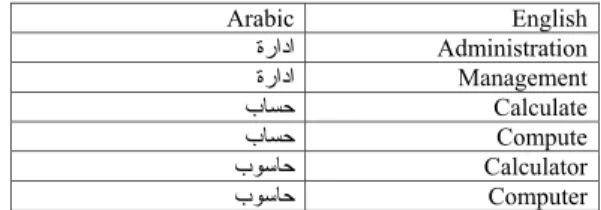
distinction between ”administration” and ”management” -both are ”idara” in Arabic. This can create unacceptable ambiguities in translation.
• Other examples of terms that have ambiguous meanings in
translated Arabic are (Calculate, Compute ) and (Calculator, Computer).
• Figure 4 presents these examples:
e-learning in Arabic language
ﻲﻧوﺮﺘﻜﻟﻻاﻢﻴﻠﻌﺘﻟا
ﻲﻓ ﻲﺋﺎﺼﺣﻻا
Arabic MM*STAT 5-7 English Arabic Administration ةرادا Management ةرادا Calculate بﺎﺴﺣ Compute بﺎﺴﺣ Calculator بﻮﺳﺎﺣ Computer بﻮﺳﺎﺣ
Arabic MM*STAT 5-8
• Generally, the difficulty with someone who has translated a
software product into another language to get a realistic picture of the challenges.
• Not only are there vocabularies the translator might not know,
but they also must adapt sentence structure, significance, and colloquialisms to convey equivalent meaning.
e-learning in Arabic language
ﻲﻧوﺮﺘﻜﻟﻻاﻢﻴﻠﻌﺘﻟا
ﻲﻓ ﻲﺋﺎﺼﺣﻻا
Difficulties to design, an Arabic MM*STAT 6-1
Difficulties to design, an Arabic MM*STAT
We now discuss some practical and technical problems.
• The development of MM*Stat (M¨uller, M., R¨onz, B.,
Ziegenhagen, U., 2000) has been the first step in the transition from traditional textbooks to integrated learning environments.
• This project is with multiple languages and our goal is to
apply this project in Arabic language.
• To do this, one needs Arabic Windows XP version, as a tool
Difficulties to design, an Arabic MM*STAT 6-2
Technical Procedure
• Translate MM*STAT documents in an Arabic Microsoft
Word, and save the files with unicode (file.unicode).
• Direction: Writing in Arabic is from right to left but the
direction in HTML appears from left to right, which technical problem for working in Arabic.
• Solution : To solve this problem we use the code dir = ”rtl”
in HTML file at every paragraph and link - Figure - Table and the statistics forms.
e-learning in Arabic language
ﻲﻧوﺮﺘﻜﻟﻻاﻢﻴﻠﻌﺘﻟا
ﻲﻓ ﻲﺋﺎﺼﺣﻻا
Difficulties to design, an Arabic MM*STAT 6-3
• Then the direction of the writing changes from right to left.
• MD*Book software environment requires LATEX . Another
problem is the LATEX Format.
• Arab text does not work with LATEX . We aim to finding a
solution to this problem in our project.
• There was a project for Arabtex in LATEX presented by Prof.
Difficulties to design, an Arabic MM*STAT 6-4
• This project was a good step but it is not enough, because
the letter in Arab text in this project was written with English, not with Arabic
• This project did not have the ability to reduce Statistics on an
Arabic Website.
• This project uses only PDF, not HTML.
• To summarize, the goal of my work is to create an electronic
book in Arabic using LATEX source code and the MD*Book tool.
e-learning in Arabic language
ﻲﻧوﺮﺘﻜﻟﻻاﻢﻴﻠﻌﺘﻟا
ﻲﻓ ﻲﺋﺎﺼﺣﻻا
Arabic MM*STAT Realisation 7-1
Arabic MM*STAT Realisation
• Figure 5 presents Arabic MM*STAT : Cover Page
• Figure 6 presents Arabic MM*STAT : Content Page
• The user can enter the courses topics via a list of contents
and can go to any desired topic or course chapter. By hovering the mouse pointer over a selected course file for a few seconds will appear to identify the course topic.
Arabic MM*STAT Realisation 7-2
Figure 5: Arabic MM*Stat: Cover Page
e-learning in Arabic language
ﻲﻧوﺮﺘﻜﻟﻻاﻢﻴﻠﻌﺘﻟا
ﻲﻓ ﻲﺋﺎﺼﺣﻻا
Arabic MM*STAT Realisation 7-4
• Figure 7 shows a graphical user interface (GUI) of a statistic
topic in Arabic MM*STAT and Figure 8 shows the
corresponding English version. ( Both the figures explain the
lecture 1.8: Crouping Continuous Data ).
• The Arabic MM*STAT Course has five components
structures; the lecture, information, explained , enhanced and interactive.
e-learning in Arabic language
ﻲﻧوﺮﺘﻜﻟﻻاﻢﻴﻠﻌﺘﻟا
ﻲﻓ ﻲﺋﺎﺼﺣﻻا
Arabic MM*STAT Realisation 7-6
Figure 8: English MM*Stat: Layer Architecture and Screenshot
e-learning in Arabic language
ﻲﻧوﺮﺘﻜﻟﻻاﻢﻴﻠﻌﺘﻟا
ﻲﻓ ﻲﺋﺎﺼﺣﻻا
Arabic MM*STAT Realisation 7-7
• Figure 9 presents the different elements of a statistics lecture.
This structure called MD*Booklet.
• Each lecture gives the basic concepts of the general statistical
theory, definitions, formulae,mathematical proofs .
• Arabic MM*Stat provides the students to compute
distribution functions, graphics and derive results for
Arabic MM*STAT Realisation 7-8
Figure 9: MM*Stat: with course Poission Distribution.
e-learning in Arabic language
ﻲﻧوﺮﺘﻜﻟﻻاﻢﻴﻠﻌﺘﻟا
ﻲﻓ ﻲﺋﺎﺼﺣﻻا
Conclusion 8-1
Conclusion
• There is the possibity of creating an e-learning system with
Arabic MM*STAT
• Problems are encountered, both in the context of the Arabic
language itself and the technical problems, which is the nonexistence of a possibilty to use LATEX code in Arabic.
• Our next goal is to explore possible solutions to the problem
References 9-1
References
• AbdulJaleel, N., Larkey, L., English to Arabic Transliteration
for Information Retrieval: A Statistical Approach, Center for Intelligent Information Retrieval Computer Science, University of Massachusetts.
• Al-Fedaghi, S and H. Al-Sadoun. Morphological compression
of Arabic text. Information Processing Management 26(2) , 1990.
• Ahmad, T., Mungo, J.,On the Difficulty to Design Arabic
E-learning System in Statistics Humboldt-Universit¨at zu
Berlin, 2006.
• Bates, T., Forum on National strategies for E-learning, IIEP
Virtual Institute, 21 October to 15 November 2002.
e-learning in Arabic language
ﻲﻧوﺮﺘﻜﻟﻻاﻢﻴﻠﻌﺘﻟا
ﻲﻓ ﻲﺋﺎﺼﺣﻻا
References 9-2
• Jemni, M., Bahattab, A., A collaborative approach for
development of arabic courses for E-learning, a case study of Tunisian-Saudi Arabian experience.
• Hammad, S., AL-ayyoub,A.,Sarie,T., combining existing
E-learning components towards an ivle, Arab Open University, Amman.
• H¨ardle,W., Klinke,S., Ziegenhagen,U., eLearning - A Critical
Review, Humboldt-Universit¨at zu Berlin, January 5, 2006.
• Lagally, K., ArabTeX : a System for Typesetting Arabic : User
References 9-3
• Mungo, J., e-learning/e-teaching An Implementation and
Evaluation of a Finance Introductory Course,
Humboldt-Universit¨at zu Berlin, 2004.
• Moukdad, H., Andrew, L.,
Information Retrieval from Full-Text Arabic Databases,Can Search Engines Designed for English Do the Job?,Canada, 2001.
• M¨uller, M., R¨onz, B., Ziegenhagen, U.,The Multimedia
Project MM*Stat for Teaching Statistics, In COMPSTAT. Proceedings in Computational Statistics, Physica
Verlag,(2000).
• Maegaard, B., Choukri, K., Mokbel, C., Yaseen, M., Language
Technology for Arabic, NEMLAR, Center for Sprogteknolo gi. University of Copenhagen, July 2005.
e-learning in Arabic language
ﻲﻧوﺮﺘﻜﻟﻻاﻢﻴﻠﻌﺘﻟا
ﻲﻓ ﻲﺋﺎﺼﺣﻻا