Procedia Computer Science 79 ( 2016 ) 632 – 639
1877-0509 © 2016 The Authors. Published by Elsevier B.V. This is an open access article under the CC BY-NC-ND license (http://creativecommons.org/licenses/by-nc-nd/4.0/).
Peer-review under responsibility of the Organizing Committee of ICCCV 2016 doi: 10.1016/j.procs.2016.03.080
ScienceDirect
7th International Conference on Communication, Computing and Virtualization 2016
Improving Security in Multi Authority Attribute Based Encryption
with Fast Decryption
Nikita Gorasia
a*, R.R.Srikanth
b, Dr. Nishant Doshi
c, Jay Rupareliya
d a,b,c,dDepartment of Computer Engineering/ Information Technology, Marwadi Education Foundation, Rajkot, GujaratAbstract
Attribute Based Encryption (ABE) is a type of public encryption in decryptor can only decrypt the ciphertext if its attributes of secret key matches the attributes of ciphertext but functionality comes at higher cost. The main idea of this paper is to provide multi authority in attribute based encryption which also allows fast decryption. Multi authority concept allows any polynomial number of independent authorities to monitor attributes, distribute secret keys and decrypt the message. In this paper, a secure multi authority attribute based encryption with fast decryption scheme is design.
© 2016 The Authors. Published by Elsevier B.V.
Peer-review under responsibility of the Organizing Committee of ICCCV 2016.
Keywords: attribute based encryption; multi authority attribute based encryption; ciphertext policy; constant ciphertext length;
1.Introduction
Attribute based encryption (ABE) concept is most widely used to secure the data transmitted through network. In this concept, data or message is encrypted using the attributes of the users and only those users can decrypt the message which are able to satisfied the access structure. Sahai and Waters [12] introduce the concept of attribute
based encryption where user data is encrypted using its attribute and only able to decrypt when the user satisfies the conditions. Then many concepts where introduce regarding security and fast decryption. Attribute Based Encryption is become more important for securing electronic transaction as it depends on attributes of the user. Many schemes are developed for
* Corresponding author (Nikita Gorasia)
E-mail address: [email protected]
© 2016 The Authors. Published by Elsevier B.V. This is an open access article under the CC BY-NC-ND license (http://creativecommons.org/licenses/by-nc-nd/4.0/).
attributed based encryption using its two policies i.e. key policy attributed based encryption and ciphertext attribute based encryption.
A concept of multi authority was first introduce by Chase [13] in 2007. In that paper, Chase allow any number of
authorities to monitor the attributes of the users and distribute secret key. It can also tolerate an arbitrary number of corrupt authorities. When number of users’ increases, efficiency of decrypting the ciphertext decreases. So to overcome this problem, the concept of constant ciphetext length was introduce by Emura Keita [1] in 2009. After that
many schemes were proposed for constant ciphertext length.
2.Related Work
In 2009, Keita Emura et al.[1] propose a CPABE with steady length of ciphertext and consistent length of the
quantity of matching processing’s. Access structure utilized as a part of this plan is AND gates on multi value attributes. It doesn’t provides anonymity of recipient and experiment is perform on PC. In 2010, Javier Herranz et al.[2] propose a first collusion-resistance ABE plan which delivers constant size ciphertexts and which concedes
sensibly expressive unscrambling policies. Support only threshold policy. In 2011, Kitak Kim et al.[3] propose a new
scheme for chosen ciphertext secure ciphertext policy attribute based encryption scheme with constant size ciphertext and t of n threshold policy. Support threshold policy, constant-size ciphertext and chosen ciphertext security. In 2011, Junzuo Lai et al.[4] describe the development of ciphertext-policy hiding CP-ABE from attribute
concealing internal item PE formally. At that point, it propose a concrete development of ciphertext policy hiding CP-ABE. Uses Non-standard complexity assumptions.
In 2012, AijinGe et al.[5] uses CCA secure CP-ABE scheme that support flexible threshold access structure for
constant ciphertext length which support threshold and AND policy. In 2012, Nishant Doshi et al.[6] propose the
CP-ABE-CL scheme based on single authority ABE scheme under the limit that the number of attributes(barring wildcard attributes) in the ciphertext approach is a subset of properties in the recipient’s secret key. Security proof is given using generic model using DBDH assumption. Uses AND- gates with positive, negative and wildcard attributes policy.
In 2012, Nishant Doshi et al.[7] overcome the problem of secret key of user. Proposed a scheme that can add,
delete or update any number of attributes in secret key of user in Ciphertext Policy Attribute based Encryption Scheme. It requires updating secret key of user. Only CA can perform add/delete/update. Use AND-gates policy. In 2012, Nishant Doshi et al.[8] propose a scheme having constant ciphertext length approach where the number of
attributes in ciphertext policy must be a subset of attributes in the recipient's secret key. In 2013, Nishant Doshi et al.[9] proposed a scheme support fully secure CP-ABE scheme with constant ciphertext length for single authority
system. Based on only AND-gates. Recently in 2014, XU Peng et al.[10] propose a scheme whose binary size of hash
function’s ranges linearly. It has the comparable execution with existing schemes in the perspectives like the time expenses of encryption and unscrambling, the expressiveness of access arrangement and the provable security. It is secure under DBDH assumption. Based on AND-gates with multivalued attributes. Also at the same year that is 2014, Yinghui Zhang et al.[11] proposed a scheme which supports features like constant computational cost and
constant ciphertext length. Based on AND-gates with multivalued attribute values and wildcard.
Chase[13] proposed a multi-authority attribute based encryption framework to conquer the downsides of a single
authority attribute based framework. The proposed framework utilizes a Central Authority (CA) and Multi attribute authorities (AAs). The issue with the Chase multi authority quality based encryption framework is that the CA can decrypt each ciphertext which decreases the user security and secrecy of user information and also based on KP-ABE[12].
In 2009, Sascha Muller[14] proposed first Multi Authority Ciphertext Policy Attribute Based Encryption
ciphertext attacks. Disadvantage of the scheme is that central authority is allow to decrypt any ciphertext in the system. In 2009, Chase and Chow[15] proposed a multi-authority attribute based encryption scheme without the
central authority. Pseudo random functions (PRF) is used for any distributed system. In 2010, Huang Lin et al.[16]
proposed a Threshold Multi Authority Fuzzy Identity Based Encryption (MA-FIBE) scheme without Central Authority. Based on Fuzzy Identity Based Encryption (FIBE)[17] which is based on Threshold policy. In 2011, Zhen
Liu et al.[18] propose a scheme which provide an approach with Multi Authority Ciphertext Policy Attribute Based
Encryption (MA-ABE) scheme without random oracles. Support small attribute universe. Based on any monotonic access structure.
In 2011, Zhenzhou Guo et al.[19] propose a scheme which allows multiple messages be encrypted during one
process and reducing feedback time of encryption. Notations are not in KP-ABE or CP-ABE schemes and based on AND-gates. In 2011, Nishant and Devesh[20] proposed two schemes for multi-authority CP-ABE in which one
scheme is dealing with variable in terms of length where other scheme is dealing with ciphertext’s length for MA-ABE under the condition that the number of attributes in the ciphertext policy is a subset of user’s secret key. Fails to provide recipient’s anonymity. Based on AND gates on multi value attributes. In 2011, Jin Li et al.[21] proposed a
multi authority ciphertext policy (AND doors with special case) ABE plan with responsibility, which permits tracing the character of a getting out of misbehaving user who released the decryption key to others, and subsequently diminishes the trust suspicions on the authorities as well as the users. The tracing procedure is efficient and its computational overhead is just corresponding to the length of the identity. In 2011, Lewko and Waters[22] proposed
an adaptively secure Multi Authority Ciphertext Policy Attribute Based Encryption (MA-CP-ABE) system for monotone access structures. The system discard the trusted central authority. In 2013, Haiying MA et al.[23]System
permits adaptive pirates to be traced and fully secure using dual system encryption method. Is not practical due to infeasible large sizes of public key and ciphertext. Based on AND gates with multi value attributes.
3.Preliminaries 3.1. Notations
For randomly generating secret of user very every cryptographic schemes require randomness. Operation of selecting element a uniformly and randomly from element set X we use a ęR X. This paper manages computational security setting where security was characterize taking into account the string length.
3.2.Attribute Based Encryption
Bilinear Group: The security of the CP-ABE scheme depends on the mathematical group called bilinear group, which are group with bilinear map.
Definition 3.2.1 (Bilinear map).
Let G and GT be two multiplicative cyclic groups of prime order p. Let g be a generator of G and ݁ ܩ ൈ ܩ ՜ ܩܶ is a bilinear map with following the properties:
1. Bilinearity: for all ݑǡ ݒ א ܩ and ܽǡ ܾ א ܼǡ we have ݁ሺݑǡ ݒሻ =݁ሺݑǡ ݒሻ.
2. Non-degeneracy: ݁ሺ݃ǡ ݃ሻ ് ͳ. If the group operation in G and the bilinear map ݁ǣܩ ൈ ܩ ՜ ܩܶ are both eƥciently computable than it is said that G is bilinear group.
Definition 3.2.2 (Discrete Logarithm Problem). Given two group elements g and h, find an integer ܽ א ܼ such that
݄ ൌ ݃݉݀ whenever such integer exist.
Definition 3.2.3 (Access Structure). Assume ܣ ൌ ሼܣͳǡ ܣʹ ǥ ܣ݊ሽ be the set of all AND policies possible sets. Let
ܤ ൌ ሼܤͳǡ ܤʹǤ Ǥ Ǥ ܤ݊ሽ the set of OR policies possible set andܵ ൌ ሼܵͳǡ ܵʹǤ Ǥ Ǥ ܵ݊ሽbe the set of threshold policy. Let
ܷ ൌ ሼܷͳǡ ܷʹ ǥ ܷ݊ሽ be the attributes of user. Here ݁is the admissible bilinear map function. If ܷ א ܣbut ܷב ܤ then ܣ ൌ ܤ and if ܷ א ܤbut ܷב ܣ thenܤ ൌ ܣ.
4.Our Contribution
In this paper, a new scheme is proposed that is targeted to achieve multi authorities. The research work is to achieve the multi authorities attribute based encryption with fast decryption by applying the concept of fast decryption and multiplicity is also achieved which solve the problem. We are using AND, OR and Threshold policies.
5.Proposed Scheme
The proposed algorithm consists of six different algorithms.
Let ܼbe the group of prime order. Assume A be the set of all AND policies possible sets, B be the set of OR
policies possible set and S be the set of threshold policy. Let U be the attributes of user. Allowed bilinear map function is declare by݁. Here assumption is that α and α' the two different universal hash function where ߙǡ ് ߙԢǡ and alsoߙǡǡ ߙԢǡא ܼ.
Setup: CA run setup algorithm and it will choose a bilinear group ܩ of prime order with generator݃. After that
two exponents ݕǡ ߚ א ܼோ is chosen. It is assume that MPK will be available to all other algorithms. ܯܲܭ ൌ ܩǡ ݃ǡ ݄ ൌ ݃ߚǡ ܻ ൌ ݁ሺ݃ǡ ݃ሻߚ
ܯܵܭ ൌ ሺߚǡ ݕሻ
AAi Setup: AA will run this algorithm and it will generate PK and SK of different attribute of݅. Then ߙǡא ܼோ exponent is selected.
݆ א ሾͳǡ ݊ሿܲܭǡ ൌ ݃ఈǡೕ
ܵܭǡൌ ߙǡ
KeyGen(MSK,u) :CA will run this algorithm and it will create SK for user ݑ. List of attributes of user will declare as L and initially it will be emptyǤ ݎ א ܼோ is chosen by the algorithm.
ܵܭ ൌ ࢍሺ࢟ା࢘ሻȀࢼ ܲܭ ൌ ݃
ܮ ൌ ]
RequestAttributeSK(PK,u,SKi) :AA will run this algorithm which will contain attribute ݅, identity of user, user’s
public key and it gives output in the form of adding attribute ݅ in user’s secret key. Now here AA will not use the SK of user and simply add the attribute ݅ in key. So it will void the attack from malicious AA. Even attributes I will be added to list L of user by AA.
ܦ௫ ൌ ሺ݃ሻఈǡೕܽ݊݀ܮ ൌ ܮ ݒ
ǡ
Encrypt(M,AS,PK1,PK2,…,PKN,(S,t)):Encryption algorithm require input as message M, access structure AS and authorities’ public key for sender that uses attribute in AS and set of attributes S with threshold value t. ݏ א ܼோ
exponent will be chosen by sender. Now the ciphertext (CT) will be calculate as follow:
ܥଵൌ ܯǤ ܻ௦ ܥଶൌ ݃௦ ܥଷൌ ሺς௧א݃ఈೌሻ௦ ܥସൌ ሺς௧א݃ఈೌሻ௦ ܥହൌ ሺς௧אௌ݃ఈೌሻ௦ ܥൌ ሺ݄ሻ௦ൌ ݃ఉ௦
ܥܶ ൌ ܥଵǡ ܥଶǡ ܥଷǡ ܥସǡ ܥହǡ ܥ
Decrypt (SK,CT) : Algorithm of decryption requires input as SK of user, ciphertext (CT) which in turn it gives output as message. If access structure policy of CT is satisfied by the user’s secret key than only it can be decrypted, otherwise it cannot be decrypt the message and NULL output will be shown. We assume that ܣܵ ك ܮ andܣܵ ൌ
ܹ. Now, if it identifies the attributes in AS then user simply multiplies all its related attributes which were given in its secret key.
ܥଵ݁ሺ݃ǡ ܥଶሻ݁ሺ݃ǡ ܥଷሻ݁ሺ݃ǡ ܥସሻ݁ሺ݃ǡ ܥହሻ݁ሺܥଷǡ ሺςሺሾ௧אሿځ௦ሻ݃ఈೌሻሻ
݁ሺܥǡ ݃ሺ௬ାሻȀఉሻ݁ሺሺς௧אௌ݃ఈೌሻǡ ܥଶሻ݁ሺሺςሺሾ௧אௌሻୀ௧ሿሺתௌሻሻ݃ఈೌሻ௦ǡ ሺܥସሻሻ݁ሺܥହǡ ሺܥଷሻሻ 6.Result Analysis
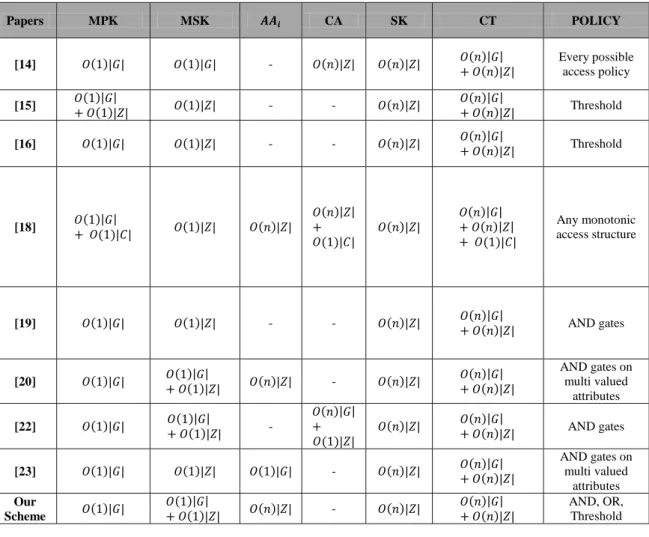
Table 1 Comparison of Time Complexity Of Different Keys, Authorities, Ciphertext And Policies Used
Papers MPK MSK CA SK CT POLICY [14] ܱሺͳሻȁܩȁ ܱሺͳሻȁܩȁ - ܱሺ݊ሻȁܼȁ ܱሺ݊ሻȁܼȁ ܱሺ݊ሻȁܩȁ ܱሺ݊ሻȁܼȁ Every possible access policy [15] ܱሺͳሻȁܩȁ ܱሺͳሻȁܼȁ ܱሺͳሻȁܼȁ - - ܱሺ݊ሻȁܼȁ ܱሺ݊ሻȁܩȁ ܱሺ݊ሻȁܼȁ Threshold [16] ܱሺͳሻȁܩȁ ܱሺͳሻȁܼȁ - - ܱሺ݊ሻȁܼȁ ܱሺ݊ሻȁܩȁ ܱሺ݊ሻȁܼȁ Threshold [18] ܱሺͳሻȁܩȁ ܱሺͳሻȁܥȁ ܱሺͳሻȁܼȁ ܱሺ݊ሻȁܼȁ ܱሺ݊ሻȁܼȁ ܱሺͳሻȁܥȁ ܱሺ݊ሻȁܼȁ ܱሺ݊ሻȁܩȁ ܱሺ݊ሻȁܼȁ ܱሺͳሻȁܥȁ Any monotonic access structure [19] ܱሺͳሻȁܩȁ ܱሺͳሻȁܼȁ - - ܱሺ݊ሻȁܼȁ ܱሺ݊ሻȁܩȁ ܱሺ݊ሻȁܼȁ AND gates [20] ܱሺͳሻȁܩȁ ܱሺͳሻȁܩȁ ܱሺͳሻȁܼȁ ܱሺ݊ሻȁܼȁ - ܱሺ݊ሻȁܼȁ ܱሺ݊ሻȁܩȁ ܱሺ݊ሻȁܼȁ AND gates on multi valued attributes [22] ܱሺͳሻȁܩȁ ܱሺͳሻȁܩȁ ܱሺͳሻȁܼȁ - ܱሺ݊ሻȁܩȁ ܱሺͳሻȁܼȁ ܱሺ݊ሻȁܼȁ ܱሺ݊ሻȁܩȁ ܱሺ݊ሻȁܼȁ AND gates [23] ܱሺͳሻȁܩȁ ܱሺͳሻȁܼȁ ܱሺͳሻȁܩȁ - ܱሺ݊ሻȁܼȁ ܱሺ݊ሻȁܩȁ ܱሺ݊ሻȁܼȁ AND gates on multi valued attributes Our Scheme ܱሺͳሻȁܩȁ ܱሺͳሻȁܩȁ
ܱሺͳሻȁܼȁ ܱሺ݊ሻȁܼȁ - ܱሺ݊ሻȁܼȁ ܱሺ݊ሻȁܩȁ ܱሺ݊ሻȁܼȁ AND, OR, Threshold
In the above table 1 time complexity of different keys, authorities, ciphertext and policies used in it is shown. Here in table ܩ represents the bilinear group, ܼ represents the exponential values and ܥ represents the certified verification and n is number of attributes.
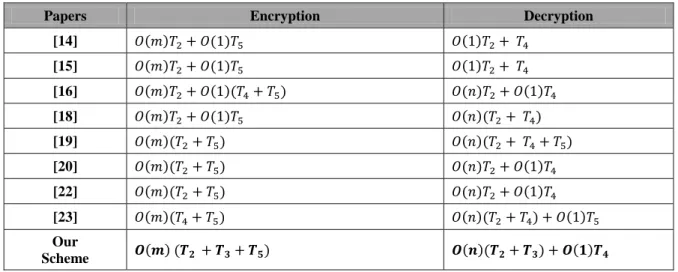
operations are compared and calculated in the form of complexity. Now, in table ܶ1, ܶ2, ܶ3, ܶ4, ܶ5 is addition, multiplication, subtraction, pairing operation and exponential respectively. ݉Represents total number of attributes in policy of ciphertext and ݊ represents number of attributes in user’s secret key. The complexity of our work is shown in the last row of the table which consist different operation and they are multiplication, subtraction, pairing operation and exponential.
Table 2 Comparison of Time Complexity Of Encryption And Decryption Of Each Paper
Papers Encryption Decryption
[14] ܱሺ݉ሻܶଶ ܱሺͳሻܶହ ܱሺͳሻܶଶ ܶସ [15] ܱሺ݉ሻܶଶ ܱሺͳሻܶହ ܱሺͳሻܶଶ ܶସ [16] ܱሺ݉ሻܶଶ ܱሺͳሻሺܶସ ܶହሻ ܱሺ݊ሻܶଶ ܱሺͳሻܶସ [18] ܱሺ݉ሻܶଶ ܱሺͳሻܶହ ܱሺ݊ሻሺܶଶܶସሻ [19] ܱሺ݉ሻሺܶଶ ܶହሻ ܱሺ݊ሻሺܶଶܶସ ܶହሻ [20] ܱሺ݉ሻሺܶଶ ܶହሻ ܱሺ݊ሻܶଶ ܱሺͳሻܶସ [22] ܱሺ݉ሻሺܶଶ ܶହሻ ܱሺ݊ሻܶଶ ܱሺͳሻܶସ [23] ܱሺ݉ሻሺܶସ ܶହሻ ܱሺ݊ሻሺܶଶ ܶସሻ ܱሺͳሻܶହ Our Scheme ࡻሺሻሺࢀ ࢀ ࢀሻ ࡻሺሻሺࢀ ࢀሻ ࡻሺሻࢀ 7.CONCLUSION
Cryptography become important aspect for transmitting data through network. So to prevent main aspects of security i.e. authentication, integrity, confidential and non-repudiation. These are the main points that need to secure while using cryptography. There are many algorithms which secure the data transmitted through network. Traditionally algorithms generate keys in the form of bits which was difficult for user to remember the key. So Identity Based Encryption was developed to overcome this problem. In this scheme, user were identified by their user name. Example of such scheme is Gmail. After that attribute based encryption scheme was developed. In that a user is only allowed to decrypt the data if only if attributes of user matches with the attributes of ciphertext.
In this paper, a scheme is developed for securing the data with fast decryption. The policies which are used in this scheme is AND, OR, Threshold. Proposed scheme contains six algorithms and they are Setup, Attribute Authority, KeyGen, Encryption and Decryption. All contains different parameters and are calculated as per its algorithm. In proposed scheme, threshold value is used for more security purpose. Comparison table with some existing solutions is shown below:
Table 3 Comparison With Existing Work
Sr. No. Items
Constant Ciphertext length in Multi-Authority Ciphertext Policy
Attribute Based Encryption
Constant size Ciphertext in Threshold Attribute Based
Encryption
Our Scheme
1. Security Fails to provide secure system.
Disadvantages of this scheme is it does not focus on security aspects.
Provides Security
2. Multiplicity
It’s an advantage that it provides multi authority and constant ciphertext length.
Limitation is it does not apply
to multiple users. Allow multiplicity
3. Fast Decryption Doing constant ciphertext length, fast decryption can achieve.
Developed a new scheme to achieve fast decryption by
Allow fast decryption
The proposed scheme can be applied for all policies. In future, the work can be extended by applying this scheme on different devices rather than desktop and different policies. Furthermore, proposed scheme can be done using key policy attribute based encryption scheme.
References
1. Emura Keita, Atsuko Miyaji, Akito Nomura, KazumasaOmote, and Masakazu Soshi, "A ciphertext-policy attribute-based encryption scheme with constant ciphertext length.", In Information Security Practice and Experience, pp. 13-23, 2009.
2. Herranz Javier, Fabien Laguillaumie, and Carla Ràfols, "Constant size ciphertexts in threshold attribute-based encryption", In Public Key Cryptography, pp. 19-34, 2010.
3. Kim Kitak, Woo Kwon Koo, Jong Hwan Park, and Dong Hoon Lee, "Chosen Ciphertext Secure Ciphertext-Policy AttributeBased Encryption with Constant Ciphertext Length and Threshold Policy.”
4. Lai Junzuo, Robert H. Deng, and Yingjiu Li, "Fully secure cipertext-policy hiding CP-ABE", In Information Security Practice and Experience, pp. 24-39, 2011.
5. Ge Aijun, Rui Zhang, Cheng Chen, Chuangui Ma, and Zhenfeng Zhang, "Threshold ciphertext policy attribute-based encryption with constant size ciphertexts", In Information Security and Privacy, pp. 336-349, 2012.
6. Doshi Nishant, and DeveshJinwala, "Hidden access structure ciphertext policy attribute based encryption with constant length ciphertext”, In Advanced Computing, Networking and Security, pp. 515-523, 2012.
7. Doshi Nishant, and DeveshJinwala, "Updating attribute in CP-ABE: A New Approach", IACR Cryptology ePrint Archive: 496, 2012. 8. Doshi Nishant, and DeveshJinwala, "Constant Ciphertext Length in CP-ABE", IACR Cryptology ePrint Archive: 500, 2012.
9. Doshi Nishant, and Devesh C. Jinwala, "Fully secure ciphertext policy attributeǦbased encryption with constant length ciphertext and faster decryption”, Security and Communication Networks, 2013.
10. XU Peng, Yong TANG, Wenbin JIANG, Hai JIN, and Deqing ZOU, "Ciphertext-Policy Attribute-Based Encryption with Short Keys",
Chinese Journal of Electronics 23, no. 4, 2014.
11. Zhang Yinghui, Dong Zheng, Xiaofeng Chen, Jin Li, and Hui Li, "Computationally Efficient Ciphertext-Policy AttributeBased Encryption with Constant-Size Ciphertexts”, In Provable Security, pp. 259-273, 2014.
12. Goyal Vipul, Omkant Pandey, Amit Sahai, and Brent Waters, "Attribute-based encryption for fine-grained access control of encrypted data", In Proceedings of the 13th ACM conference on Computer and communications security, pp. 89-98, 2006.
13. Chase Melissa, "Multi-authority attribute based encryption", In Theory of Cryptography, pp. 515-534, 2007.
14. Sascha Müller, Stefan Katzenbeisser, and Claudia Eckert, “On Multi-authority ciphertext-policy attribute-based encryption”, In:Bulletin of the Korean Mathematical Society 46,no.4 pp. 803-819, 2009.
15. Chase Melissa, and Sherman SM Chow, "Improving privacy and security in multi-authority attribute-based encryption", In Proceedings of the 16th ACM conference on Computer and communications security, pp. 121-130, 2009.
16. Lin Huang, Zhenfu Cao, Xiaohui Liang, and Jun Shao, "Secure threshold multi authority attribute based encryption without a central authority", Information Sciences 180, no. 13, pp.2618-2632, 2010.
17. Sahai, Amit, and Brent Waters, "Fuzzy identity-based encryption", In Advances in Cryptology–EUROCRYPT 2005, pp. 457473, 2005. 18. Liu Zhen, Zhenfu Cao, Qiong Huang, Duncan S. Wong, and Tsz Hon Yuen, "Fully secure multi-authority ciphertext-policy attribute-based
encryption without random oracles", In Computer Security–ESORICS 2011, pp. 278-297, 2011.
19. Guo Zhenzhou, Mingchu Li, Yongrui Cui, and Xinxin Fan, "Dynamic Multi-Attribute Based Encryption.", JDCTA: International Journal of Digital Content Technology and its Applications 5, no. 9, pp.281-289, 2010.
20. Doshi Nishant, and DeveshJinwala, "Constant ciphertext length in multi-authority ciphertext policy attribute based encryption.", In
Computer and Communication Technology (ICCCT), 2011 2nd International Conference on, pp. 451-456, 2011.
21. Li Jin, Qiong Huang, Xiaofeng Chen, Sherman SM Chow, Duncan S. Wong, and DongqingXie, "Multi-authority ciphertextpolicy attribute-based encryption with accountability", In Proceedings of the 6th ACM Symposium on Information, Computer and Communications Security, pp. 386-390, 2011.
applying constant size ciphertext
4. Based on AND Threshold AND, OR,
22. Lewko A., Waters, B, “Decentralizing Attribute-Based Encryption”, In: CRYPTOLOGY ePrint Archive, Report 2010/351, 2010.
23. MA Haiying, Guosun ZENG, Zhanjun WANG, and Jinchao XU, "Fully Secure Multi-authority Attribute-based Traitor Tracingڅ.",
Journal of Computational Information Systems 9, no. 7, pp.2793-2800,2013.
24. Bethencourt John, Amit Sahai, and Brent Waters, "Ciphertext-policy attribute-based encryption”, In Security and Privacy, 2007. SP'07. IEEE Symposium on, pp. 321-334, 2007.