Introduction
From the beginning, the concept of diagnostic species has always been linked to the concept of fi-delity – the concentration in occurrence or abun-dance of species in a particular vegetation unit. The first approaches to assess fidelity values were rather intuitive (Szafer & Pawlowski, 1927). These were later replaced, as the development of more power-ful computers and software for vegetation data analysis progressed, by more objective statistical analyses and methods (cf. Chytrý & Tichý, 2003). A publication written by our colleagues from Masaryk University in Brno (Chytrý & Tichý, 2003)
about the diagnostic species of alliances and classes of the Czech Republic was the main inspiration for the book Diagnostic, constant and dominant species of the higher vegetation units of Slovakia(Jarolímek & Šibík, 2008) which has been recently published. We de-cided to analyse phytosociological relevés, stored in the Slovak national vegetation database – SNVD (Šibíková et al., 2009) in the database program TUR-BOVEG (Hennekens & Schaminée, 2001), using the same methodology and then to present the re-sults of statistical analyses of phytosociological data from Slovakia to general public.
The aims of the monograph were a) to evaluate the
ANNALI DI BOTANICA
Ann. Bot. (Roma), 2010
SHARPNESS AND UNIQUENESS OF THE PHYTOSOCIOLOGICAL CLASSES OF SLOVAKIA
JAROLÍMEKI.1, ŠIBÍKJ.1, TICHÝL.2, KLIMENTJ.3
1Institute of Botany, Slovak Academy of Sciences, Dúbravská cesta 14, SK-845 23 Bratislava,
Slovak Republic, e-mail: [email protected], [email protected]
2Department of Botany and Zoology, Masaryk University, Kotlárská 2, CZ-611 37 Brno,
Czech Republic, e-mail: [email protected]
3Botanical Garden of Comenius University, SK-038 15 Blatnica, Slovak Republic,
e-mail: [email protected]
ABSTRACT- This study extracts the diagnostic, constant and dominant species of Slovak vegetation types based on statistical analy-sis of phytosociological data stored in the national vegetation database. The affinities of vascular plant, bryophyte and lichen species to the major syntaxa (alliances and classes) were calculated using a statistically defined coefficient of fidelity.
Additionally, the evaluation of vegetation units by the criteria of sharpness and uniqueness was created. These criteria allow us to identify well-delimited alliances and classes or to point out those, for which delimitation is problematic and which are more diffi-cult to define by statistical principles. The syntaxonomical revision and delimitation of some units with low values of sharpness and uniqueness should be considered in the future.
KEY WORDS- DATABASE, PHYTOSOCIOLOGY, PLANT COMMUNITIES, SYNTAXONOMY, TURBOVEG, VEGETATION SURVEY
Received August 18, 2009 Accepted October 09, 2009
affinity of individual taxa occurring in Slovakia to particular vegetation units (alliances and classes) using statistically defined fidelity values (Chytrý et al., 2002); b) to evaluate the quality of delimitation of individual higher syntaxa (alliances and classes) in-cluded in the syntaxonomical scheme presented in this book (and recently used in SNVD) and at the same time to point out its strong as well as weak spots.
The aim of this paper is to acquaint the general pub-lic with the pubpub-lication by Jarolímek et al. (2008a), which is available at the Institute of Botany Slovak Academy of Sciences.
Material and Methods
The data set of 43,222 phytosociological relevés from the SNVD was analysed in the program JUICE, version 6.4.6 (Tichý, 2002). The species with a fidelity of above 24 (Φ> 0.24) were considered as diagnostic. Constant species are those with a high occurrence frequency in the given vegetation unit. Different threshold frequency values for constant species were applied for classes (25 %) and alliances (40 %). Dominant species were defined as those having a percentage cover higher than 50 % in at least 3 % of the relevés in the given vegetation unit. Sharpness is defined as the number or quality of di-agnostic species in a vegetation unit, relative to the average species richness of its stands. A vegetation unit is sharp if a large proportion of its species are confined to it, being mostly absent or rare in other vegetation units, while it is progressively less sharp if most of its species are generalists frequently found also in other vegetation units (Chytrý & Tichý, 2003).
Uniqueness was used for the first time in the paper of Chytrý & Tichý (2003) to identify unique vegeta-tion units in the data set. It “expresses whether or not there are similar vegetation units of the same rank (e.g., class or alliance). A vegetation unit is unique if none of its diagnostic species has simul-taneously diagnostic status in other vegetation units,
while its uniqueness decreases if it shares its diag-nostic species with other vegetation units.”
For more information concerning the methods see Chapter 1 (Jarolímek et al., 2008a) in the publication by Jarolímek & Šibík (2008).
Results
The publication Diagnostic, constant and dominant species of the higher vegetation units of Slovakia (Jarolímek & Šibík, 2008) consists of two chapters. The first one (Jarolímek et al., 2008a) deals with statistical analysis of data stored in Slovak national vegetation database (Šibíková et al., 2009); the second one (Jarolímek et al., 2008b) represents a revised list of syntaxa (vegetation units) of Slovakia. The discus-sion on complex evaluation of vegetation, based not only on floristic composition, but also on the qual-itative and quantqual-itative participation of all compo-nents (cf. Rejmánek, 1977; Theurillat et al., 1995) is appended, as well.
On the basis of the results published in Jarolímek et al.(2008a), we decided to present the evaluation of classes as an example of analysed data. For the eval-uation of alliances, see the Chapter 1.3.2 in the pub-lication by Jarolímek et al.(2008a).
Table 1 comprises all classes ordered by decreasing value of sharpness index (S). In this manner, the classes are ranked by decreasing proportion of qual-ity of diagnostic species relative to the average species richness of vegetation stands (Chytrý & Tichý, 2003).
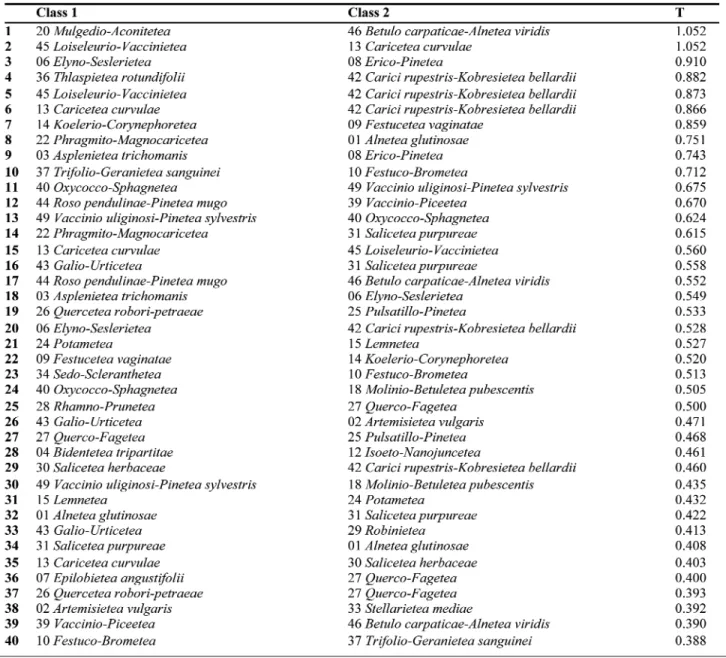
The pairs of the most similar classes are presented in Table 2. Couples of classes are ranked by de-creasing value of index T, which expresses similar-ity of the classes in the left column to the classes in the right column.
Discussion
Classes with the highest sharpness index comprise rare communities occurring in extreme habitats, such as species-poor halophytic communities of the Thero-Suaedeteaand communities on blown sands of
the Festucetea vaginatae, together with species-poor water pioneer communities of classes Charetea frag-ilis, Potameteaand Lemnetea. The latter two were also identified within the sharpest groups in the analysis of Czech data (Chytrý & Tichý, 2003), due to the specific ecological conditions of aquatic environ-ments in comparison with terrestrial habitats. The relict communities from the most extreme moun-tain habitats with an occurrence of many arctic-alpine taxa (class Carici rupestris-Kobresietea) and relict pine communities of canyons and limestone cliffs (class Erico-Pinetea) reach high values of the sharp-ness index, as well.
Conversely, tall-herb and nitrophilous communities of the classes Mulgedio-Aconiteteaand Galio-Urticetea are the least sharp, due to the occurrence of nu-merous taxa with a wide ecological range. The class Thlaspietea rotundifoliiin Slovakia, similar to the Czech Republic (cf. Chytrý & Tichý, 2003), seems to be one of the least sharp classes, probably owing to its pioneer character and the fact these communities often occur on rocky and gravelly microsites among another vegetation types, where the species are mixed. The class Rhamno-Prunetea, which belongs to syntaxa that are difficult to define by diagnostic taxa, has a low sharpness index, too. The main reason is the transition character of these mosaic or ecotone communities, occurring on transition sites between open land and forest vegetation.
Classes Vaccinio-Piceeteaand Querco-Fagetea represent natural and semi-natural vegetation. Whereas they belong to the sharpest syntaxa in the Czech Repub-lic (Chytrý & Tichý, 2003), they show lower sharp-ness in Slovakia. This difference might result from unclear classification of spruce communities of lower altitudes, which grow secondarily in beech habitats and are included in the class Vaccinio-Piceetea. The other reason of their lower sharpness might be the different ecological amplitude of herbs, trees and shrubs. While herbs accurately reflect soil, mi-croclimatic and other properties of habitats, the ecological amplitude of most trees and shrubs is much wider (Sillinger, 1935) and reflects mainly
meso- and macroclimatic conditions. In this man-ner, we can explain the floristic similarity of sub-alpine nitrophilous tall-herb communities of the Adenostylion alliariaeand dwarf-pine and spruce veg-etation occupying similar habitats with available nu-trients and soil moisture (Šibík, 2007).
Values of uniqueness (U) of classes partially corre-late with the values of sharpness index, which is dif-ferent from the results obtained by the analysis of the Czech national phytosociological database (Chytrý & Tichý, 2003). A high value of the U index shows high uniqueness of a given unit. The unit is considered unique when any of its diagnostic taxa (defined by Phi value > 0.05, see Chytrý & Tichý, 2003) is not concurrently diagnostic in any other unit. The uniqueness of a unit decreases if it shares some diagnostic taxa with other units. In general, rare vegetation units represented by a small number of relevés and/or species-poor syntaxa occupying extreme habitats appear to form a group of the most unique units. The further group of units with the lowest values of the U index includes the classes occurring mostly in the subalpine belt – Mulgedio-Aconitetea, Loiseleurio-Vaccinieteaand Roso pendulinae-Pinetea mugo, in which occur many taxa with positive fidelity to several syntaxa. The low frequency or ab-sence of narrow specific forest-alpine transition zones or treeline-ecotone species (cf. Körner, 2003) might be explained by the sharing of numerous di-agnostic species with several different syntaxa oc-curring in the subalpine belt.
The pairs of the most similar classes presented here are often composed of floristically similar, but structurally different units (e.g., Mulgedio-Aconitetea and Betulo carpaticae-Alnetea viridis, Loiseleurio-Vaccini-etea and CaricLoiseleurio-Vaccini-etea curvulae, Elyno-SesleriLoiseleurio-Vaccini-etea and Erico-Pinetea) or between successively ensuing vegetation types (Thlaspietea rotundifoliiand Carici rupestris-Kobre-sietea bellardii, Asplenietea trichomanisand Elyno-Sesleri-etea). Some authors (e.g., Westhoff, 1967; Pignatti et al., 1995) do not reflect the differences in structure of floristically similar vegetation units in the syn-taxonomical system of higher units (classes).
There-fore, some vegetation surveys strictly follow the floristic criterion for delimitation of higher syntaxa (cf. Mucina 1997). However, these authors also apply this principle only to a certain extent and only in some cases (Šibík, 2007). For example, Pignatti et al. (1995) give several examples in their work of “ecoclinal classes”, but they prefer the ecological differentiation to vertical (and climatic) limits of cer-tain communities. In one case, the authors accept the differences between forest communities, based on different stages of succession and, hence, they accept the class Rhamno-Prunetea; in another case, they merged subalpine shrub and spruce vegetation (Šibík, 2007). According to the methodological con-cept of Dengler et al.(2004), the character species should be determined only within the structural types; separately for herbaceous vegetation (includ-ing dwarf shrubs), shrub and woodland vegetation. Herbaceous plants and cryptogams can thus be eval-uated as character species in both structural types at the same time.
Similarly to the Czech Republic (Chytrý & Tichý, 2003), it was also shown in Slovakia that the most similar are the structurally different communities of aquatic vegetation, Potametea(submerged vegetation) and Lemnetea(pleustonic vegetation). Communities defined on different plot sizes also appear similar – Sedo-Scleranthetea and Festuco-Brometea. Chytrý & Otýpková (2003) point out that in some situations, sampling in either small or large plots may result in assignment of relevés to different phytosociological classes or habitat types. Therefore, defining vegeta-tion and habitat types as scale-dependent concepts is needed. The similarity between Elyno-Seslerietea and Erico-Pineteaalso could be interpreted by a dif-ferent scale of sample plots. Relevés of Sedo-Scler-anthetea and Elyno-Seslerietea are usually sampled in smaller plots than their adjacent classes. Interesting insight and precise description of the structural di-versity of the plant community and its dynamics ac-cording to both spatial and temporal scales has been proposed by Gillet & Gallandat (1996).
In addition, few structurally homogeneous
vegeta-tion units show high similarity (e.g., Koelerio-Corynephoreteaand Festucetea vaginatae, Quercetea robori-petraeae and Pulsatillo-Pinetea). In these cases, we might consider merging them into a single class (cf. Chytrý & Tichý, 2003). It is also important to take into account the fact that some vegetation units are at the border of their distributional range in Slova-kia and they are represented by fragmentary stands that lack some specific floristic elements. In a wider geographical context, it is possible that the differ-entiation of particular syntaxa would be confirmed.
Aknowledgements.The authors are grateful to the reviewer for his valuable comments and suggesti-ons. For English improvement we are indebted to Ivana Šibíková. This paper was supported by the grant agency VEGA, grant Nr. 2/0121/09 and the long-term research plan of Masaryk University (Czech Ministry of Education, MSM 0021622416).
References
Chytrý M. & Otýpková Z., 2003 – Plot sizes used for phytosocio-logical sampling of European vegetation. J. Veg. Sci. 14:563–570. Chytrý M. & Tichý L., 2003 – Diagnostic, constant and dominant species of vegetation classes and alliances of the Czech Republic: A sta-tistical revision.Folia Fac. Sci. Nat. Univ. Masaryk. Brun., Biol.
108:1–231.
Chytrý M., Tichý M., Holt J. & Botta-Dukát Z., 2002 – Deter-mination of diagnostic species with statistical fidelity measures.
J. Veg. Sci. 13:79–90.
Dengler J., Koska I., Timmermann T., Berg C., Clausnitzer U., Isermann M., Linke C., Päzolt J., Polte T. & Spangenberg A., 2004 – New descriptions and typifications of syntaxa within the project ‘Plant communities of Mecklenburg-Vorpommern and their vulnerabi-lity’– Part II. Feddes Repert. 115/3–4:343–392.
Gillet F. & Gallandat J.-D., 1996 – Integrated synusial phytosociology: some notes on a new, multiscalar approach to vegetation analysis.J. Veg. Sci. 7:13–18.
Hennekens S. M. & Schaminée J. H. J., 2001 – TURBOVEG, a comprehensive data base management system for vegetation data.
J. Veg. Sci. 12:589–591.
Jarolímek I. & Šibík J. (eds), 2008 – Diagnostic, constant and dom-inant species of the higher vegetation units of Slovakia. Veda, Bratislava, 332 p.
Jarolímek I., Šibík J., Tichý L. & Kliment J., 2008a – Diagnostic, constant and dominant species of the higher vegetation units of Slova-kia.In: Jarolímek I. & Šibík J. (eds). Diagnostic, constant and dominant species of the higher vegetation units of Slovakia. – Veda, Bratislava, p. 9–294.
Jarolímek I., Šibík J., Hegedüšová K., Janišová M., Kliment J., Kucera P., Májeková J., Michálková D., Sadlonová J., Šibíková J., Škodová I, Uhlírová J., Ujházy K., Ujházyová M., Vala-chovic M. & Zaliberová M., 2008b – A list of vegetation units of Slovakia.In: Jarolímek I. & Šibík J. (eds). Diagnostic, constant and dominant species of the higher vegetation units of Slova-kia. Veda, Bratislava, p. 295–329.
Körner Ch., 2003 –Alpine plant life. Functional plant ecology of high mountain ecosystems. 2ndedition.Springer-Verlag, Berlin,
Hei-delberg, New York, 344 p.
Mucina L., 1997 –Conspectus of classes of European vegetation.
Folia Geobot. Phytotax. 32:117–172.
Pignatti S., Oberdorfer E., Schaminée J. H. J. & Westhoff V., 1995 –On the concept of vegetation class in phytosociology.J. Veg. Sci.
6:143–152.
Rejmánek, M. 1977: The concept of structure in phytosociol-ogy with references to classification of plant communities. – Vegetatio 35:55–61.
Sillinger P., 1935 –Pojem lesní asociace.Lesnické práce 14:269– 277.
Szafer W. & Pawlowski B., 1927 – Die Pflanzenassoziationen des Tatra-Gebirges. Bemerkungen über die angewandte Arbeitstechnik.Bull. Int. Acad. Polon. Sci., Cl. Sci. Math., Ser. B 3, Sci. Nat., Cra-covie, Suppl. 2:1–12.
Šibík J., 2007 –Fyziognómia a štruktúra ako dôlezitý faktor pri vyt-váraní univerzálneho fytocenologického systému.Bull. Slov. Bot. Spo-loc n. 29:147–157.
Šibíková I., Šibík J., Jarolímek I. & Kliment J., 2009 – Current knowledge and phytosociological data on the high-altitude vegetation in the Western Carpathians – a review.Biologia, 64/2: 215–224. Theurillat J.-P., Aeschimann D., Kupfer Ph. & Spichiger, R., 1995 – The higher vegetation units of the Alps.Colloq. Phytosoc.
23/1994:189–239.
Tichý L., 2002 – JUICE, software for vegetation classification.
J. Veg. Sci. 13:451–453.
Westhoff V., 1967 –Problems and use of structure in the classifica-tion of vegetaclassifica-tion. The diagnostic evaluaclassifica-tion of structure in the Braun-Blanquet system.Acta Bot. Neerl. 15:495–511.
p q f p y g f
Table 1. Left page.Sharpness Index (S) and Uniqueness
Index (U) of vegetation classes of Slovakia, ranked by
de-creasing values of the Sharpness index.
Explanations: Tv Code– Turboveg Code; Abb–
Abbrevia-tion of class name; n– No. of relevés; a– Average taxa No. rounded to the whole number; hlU– Ten (twenty) highest [+ + (+)] and lowest [– –(–)] values of the Index U; sU– Se-quence of the classes ranked by decreasing values of the Index U.
Table 2.Below. Classes with highest similarity to the other
classes.Couples of classes are ranked by decreasing value of
index T, which expresses similarity of the classes in the left column to the classes in the right column. Only 40 pairs with the highest similarity are shown.