Module Handbook
Information Engineering and
Manage-ment (M.Sc.)
Winter Term 2015/2016
SPO 2015
04.08.2015
Department of Economics and Management
Department of Informatics
Publishers:
Department of Economics and Management Karlsruhe Institute of Technology (KIT) 76128 Karlsruhe
TABLE OF CONTENTS TABLE OF CONTENTS
For informational use only. For legally binding information please refer to the german version of the handbook.
Table of Contents
1 Structure of the Master program in Information Engineering and Management 12
2 Module Handbook - a helpful guide throughout the studies 13
3 Actual Changes 15
4 Mandatory Modules 19
4.1 All Subjects . . . 19
Information Engineering and Management- IW4WWIW. . . 19
Stochastic Models in Information Engineering and Management- IW4WWOR . . . 21
Interdisciplinary Seminar Module- IW4IWSEM. . . 22
Master Thesis- IW4IWMATHESIS . . . 24
5 Elective Modules 25 5.1 Business Administration . . . 25
Advanced CRM- IW4BWLISM1 . . . 25
Electronic Markets- IW4BWLISM2 . . . 27
Market Engineering- IW4BWLISM3. . . 29
Business & Service Engineering- IW4BWLISM4 . . . 30
Service Management- IW4BWLISM6. . . 31
Service Analytics- IW4BWLKSR1. . . 32
Service Design Thinking- IW4BWLKSR2. . . 33
Finance 1- IW4BWLFBV1 . . . 34
Finance 2- IW4BWLFBV2 . . . 35
Insurance Management I- IW4BWLFBV6 . . . 36
Insurance Management II- IW4BWLFBV7 . . . 37
Strategic Corporate Management and Organization- IW4BWLUO1 . . . 38
Strategic Decision Making and Organization - IW4BWLUO4 . . . 39
Industrial Production II- IW4BWLIIP2. . . 40
Industrial Production III- IW4BWLIIP6 . . . 41
Energy Economics and Energy Markets- IW4BWLIIP4 . . . 42
Energy Economics and Technology- IW4BWLIIP5 . . . 43
Entrepreneurship (EnTechnon)- IW4BWLENT1 . . . 44
Innovation Management- IW4BWLENT2 . . . 45
Marketing Management- IW4BWLMAR5 . . . 46
Sales Management- IW4BWLMAR6 . . . 48
Strategy, Communication, and Data Analysis- IW4BWLMAR7 . . . 49
Evidence-based Marketing- IW4BWLMAR8 . . . 50
Services Marketing- IW4BWLMAR9 . . . 51
Management Accounting- IW4BWLIBU1 . . . 52
5.2 Economics . . . 53
Applied Strategic Decisions- IW4VWL2 . . . 53
Macroeconomic Theory- IW4VWL8. . . 54
Economic Theory and its Application in Finance- IW4VWL14 . . . 55
Microeconomic Theory- IW4VWL15 . . . 56
Collective Decision Making- IW4VWL16 . . . 57
Experimental Economics- IW4VWL17 . . . 58
TABLE OF CONTENTS TABLE OF CONTENTS
Analytics and Statistics- IW4STAT4 . . . 65
Econometrics and Statistics I- IW4STAT5 . . . 66
Econometrics and Statistics II- IW4STAT6 . . . 67
5.5 Informatics . . . 68
Computer Security- IW4INSICH. . . 68
Advanced Topics in Cryptography- IW4INFKRYP . . . 69
Introduction to Algorithmics- IW4INEAT . . . 71
Advanced Algorithms: Design and Analysis- IW4INAADA . . . 72
Advanced Algorithms: Engineering and Applications- IW4INAALGOB . . . 73
Language Technology and Compiler- IW4INCOMP1 . . . 74
Software Systems- IW4INSWS . . . 75
Software Methods- IW4INSWM . . . 76
Applied Web Engineering- IW4INPWE . . . 77
Wireless Networking- IW4INWN . . . 78
Networking Labs- IW4INNL . . . 79
Future Networking- IW4INFN . . . 80
Networking- IW4INNW . . . 81
Networking Security - Theory and Praxis- IW4INNTP. . . 82
Communication and Database Systems- IW4INKD . . . 83
Innovative Concepts of Data and Information Management- IW4INIKDI. . . 84
Theory and Practice of Data Warehousing and Mining- IW4INDWMTP . . . 86
Theory and Practice of Database Technology- IW4INDBTP . . . 87
Dynamic IT-Infrastructures- IW4INDITI . . . 88
Biosignal Processing- IW4INBSV . . . 89
Speech Processing- IW4INSV . . . 90
Curves and Surfaces- IW4INKUF . . . 91
Context Sensitive Systems- IN4INKUS . . . 92
Human-Machine-Interaction- IW4INMMI . . . 93
Algorithms in Computer Graphics- IW4INACG. . . 94
Foundations and Application of IT-Security- IW4INGAS. . . 95
Parallel Processing- IW4INPV. . . 96
Web Engineering- IW4INWEBE. . . 97
Autonomous Robotics- IN4INAR . . . 98
Web Data Management- IW4INAIFB4 . . . 99
Intelligent Systems and Services- IW4INAIFB5 . . . 100
Semantic Technologies- IW4INAIFB6 . . . 101
Ubiquitous Computing- IW4INAIFB7 . . . 102
Organic Computing- IW4INAIFB8. . . 103
Development of Business Information Systems- IW4INAIFB11 . . . 104
Fundamentals of Robotics- IW4INROB. . . 105
Medical Simulation and Neural Medicine- IW4INMSNM . . . 106
Automated visual inspection- IW4INAS. . . 107
Machine Vision- IW4INMVW . . . 108
Automated Planning and Decision-making- IW4INAPE . . . 109
TABLE OF CONTENTS TABLE OF CONTENTS
6 Courses 118
6.1 All Courses . . . 118
Advanced Econometrics of Financial Markets- 2520381 . . . 118
Advanced Game Theory- 2521533 . . . 119
Advanced Topics in Economic Theory- 2520527 . . . 120
Current issues in Innovation Management- 2545018 . . . 121
Algorithm Engineering- 2400051 . . . 122
Algorithms for Ad-Hoc and Sensor Networks- AAS . . . 123
Algorithms for Routing- 24638. . . 124
Algorithms for Memory Hierarchies - ASH . . . 125
Algorithms II- 24079 . . . 126
Algorithms in Cellular Automata- 24622 . . . 127
Algorithms for Visualization of Graphs- 24118 . . . 128
Computational Geometry- ALGG . . . 129
- 2400034 . . . 130
Algorithms for Internet Applications- 2511102 . . . 131
Big Data Analytics- 24114 . . . 132
Requirements Analysis and Requirements Management- 2511218 . . . 133
Applied Differential Geometry- ADG . . . 134
Applied Econometrics- 2520020 . . . 135
Planning and Management of Industrial Plants- 2581952. . . 136
Anthropomatics: Humanoid Robotics - 24644 . . . 137
Applying Formal Verification- 2400093 . . . 138
Employment Law I- 24167 . . . 139
Employment Law II- 24668 . . . 140
Asset Pricing- 2530555 . . . 141
Asymmetric Encryption Schemes- 24115 . . . 142
Auction Theory- 2520408 . . . 143
Selected topics in Cryptography- 24623 . . . 144
Automatic Software Parallelization- APS . . . 145
Automated Visual Inspection and Image Processing- 24169 . . . 146
Basics of Liberalised Energy Markets- 2581998 . . . 147
Provable Security in Cryptography- 24166 . . . 148
Image Data Compression- 2400112 . . . 149
Biologically Inspired Robot- 24619 . . . 150
Biomedric Systems for Person Identification- 2403011 . . . 151
Biosignals and User Interfaces- 24105 . . . 152
Exchanges- 2530296 . . . 153
Brain-Computer Interfaces - BCI . . . 154
Business and IT Service Management- 2595484 . . . 155
Business Dynamics- 2540531. . . 156
Business Plan Workshop- 2572184. . . 157
Business Administration in Information Engineering and Management- 2540500 . . . 158
Case Studies in Pricing- 2572182. . . 160
Challenges in Supply Chain Management- 2550494 . . . 161
Computer Vision for Human-Computer Interaction- 24180 . . . 162
Corporate Financial Policy- 2530214 . . . 163
Current Issues in the Insurance Industry- 2530350 . . . 164
Customer Relationship Management- 2540508 . . . 165
Data and Storage Management- 24074 . . . 166
Data Mining and Applications- 2520375 . . . 167
TABLE OF CONTENTS TABLE OF CONTENTS
Data Privacy Protection in Interconnected Information Systems- 24605. . . 176
Data Protection Law- 24018 . . . 177
Derivatives- 2530550. . . 178
Design Thinking- 2545010. . . 179
Design and Evaluation of innovative user interfaces- 24103 . . . 180
Developing Business Models for the Semantic Web- 2513305 . . . 181
Digital signatures - 2400057. . . 182
Document Management and Groupware Systems- 2511212. . . 183
eEnergy: Markets, Services, Systems - 2540464 . . . 184
Efficient Energy Systems and Electric Mobility- 2581006 . . . 185
eFinance: Information Engineering and Management for Securities Trading- 2540454 . . . 186
Introduction to Video Analysis- 24684 . . . 187
Introduction to Information Fusion- 24172 . . . 188
Introduction in Computer Networks- 24519 . . . 189
Emissions into the Environment- 2581962 . . . 190
Empirical Software Engineering- 24156 . . . 191
Theory of endogenous growth- 2561503 . . . 192
Energy and Environment- 2581003 . . . 193
Energy Trade and Risk Management- 2581020 . . . 194
Energy Policy- 2581959 . . . 195
Energy Systems Analysis- 2581002 . . . 196
Entrepreneurial Leadership & Innovation Management- 2545012 . . . 197
Entrepreneurship- 2545001 . . . 198
Entrepreneurship Research- 2545002 . . . 199
Gas-Markets- 2581022 . . . 200
Discrete-event Simulation in Production and Logistics- 2550488. . . 202
European and International Law- 24666 . . . 203
Experimental Economics- 2540489 . . . 204
Case studies seminar: Innovation management- 2545019 . . . 205
Fixed Income Securities- 2530260 . . . 206
Financial Analysis- 2530205. . . 207
Financial Econometrics- 2520022. . . 208
Financial Intermediation- 2530232 . . . 209
Human brain and central nervous system: anatomy, information transfer, signal processing, neuro-physiology and therapy- 24139 / 24678 . . . 210
Mixed Integer Programming I- 2550138 . . . 211
Mixed Integer Programming II- 25140 . . . 212
Geometric basics for Geometry Processing- 2400029 . . . 213
Geometric Optimzation- 2400026 . . . 214
Business Models in the Internet: Planning and Implementation- 2540456 . . . 215
Business Planning- 2545005 . . . 216
Business Strategies of Banks- 2530299 . . . 217
Design Príncipes for Interactive Real-Time Systems“- 24648 . . . 218
Global Optimization I- 2550134 . . . 219
TABLE OF CONTENTS TABLE OF CONTENTS
Integrated Network and Systems Management- 2400004 . . . 234
International Management in Engineering and Production- 2581956 . . . 235
International Finance- 2530570 . . . 236
Cost and Management Accounting- 2530210 . . . 237
Internet of Everything- 24104 . . . 238
Internet Law- 24354 . . . 239
IT-Security Management for Networked Systems- 24149 . . . 240
Knowledge Discovery- 2511302. . . 241
Cognitive Modeling- 24612 . . . 242
Component Based Software Architecture- 24667 . . . 243
Context Sensitive Systems- 24658 . . . 245
Convex Analysis- 2550120 . . . 246
Mechanisms and Applications of Workflow Systems- 24111 . . . 247
Hospital Management- 2550493 . . . 248
Credit Risk- 2530565. . . 249
Cryptographic Voting Schemes- 24691. . . 250
Curves and Surfaces in CAD I- 2400006 . . . 251
Curves and Surfaces in CAD II- CFD2 . . . 252
Curves and Surfaces in CAD III- KFCAD3 . . . 253
Reading Group Context Sensitive Systems- 24696 . . . 254
Reading Group Human-Machine-Interaction- 24697 . . . 255
Reading Group - 24673 . . . 256
Markets and Organizations: Principles- 2540502 . . . 257
Management Accounting 1- 2579900. . . 259
Management Accounting 2 - 2579902 . . . 260
Managing New Technologies- 2545003 . . . 261
Management of IT-Projects- 2511214. . . 262
IT Complexity in Practice- 2511404 . . . 263
Trademark and Unfair Competition Law- 24136 / 24609 . . . 264
Market Engineering: Information in Institutions- 2540460. . . 265
Marketing Analytics- 2572170 . . . 266
Marketing Strategy Business Game- 2571176. . . 267
Marketing Communication- 2540440 . . . 268
Market Research- 2571150 . . . 269
Market Microstructure- 2530240 . . . 270
Machine Learning 1 - Basic Methods- 24150 . . . 271
Machine Learning 2 – Advanced methods- 24620. . . 272
Master Seminar in Information Engineering and Management- 2540510 . . . 273
Mathematical Theory of Democracy- 2525537. . . 274
Mechano-Informatics and Robotics- 2400077 . . . 275
Medical Simulation Systems I- 24173 . . . 276
Medical Simulation Systems II- 24676 . . . 277
Human-Machine-Interaction- 24659 . . . 278
Microprocessors II- 24161 . . . 279
Mobile Communication- 24643 . . . 280
Modeling and Analyzing Consumer Behaviour with R- 2540470 . . . 281
Models of Parallel Processing- 24606 . . . 282
Modeling Strategic Decision Making - 2577908 . . . 283
- 24657 . . . 284
Modeling and Simulation of Networks and Distributed Systems- 24669 . . . 285
Modelling, Measuring and Managing of Extreme Risks- 2530355 . . . 286
TABLE OF CONTENTS TABLE OF CONTENTS
Meshes and point clouds- 24122 . . . 295
Network Security: Architectures and Protocols- 24601 . . . 296
Next Generation Internet- 24674 . . . 297
Non- and Semiparametrics- 2521300. . . 298
Nonlinear Optimization I- 2550111 . . . 299
Nonlinear Optimization II- 2550113 . . . 300
Public Media Law- 24082 . . . 301
Life Cycle Assessment- n.n. . . 302
Marketing Communication- 2572200 . . . 303
Open Innovation – Concepts, Methods and Best Practices- 2571199 . . . 304
Operations Research in Health Care Management- 2550495 . . . 305
Operations Research in Supply Chain Management - 2550480 . . . 306
Optimization in a Random Environment- 25687 . . . 307
OR-oriented modeling and analysis of real problems (project)- 25688. . . 308
Organic Computing- 2511104 . . . 309
Managing Organizations- 2577902 . . . 311
Organization Theory- 2577904 . . . 312
P&C Insurance Simulation Game- INSGAME . . . 313
- 2520320 . . . 314
Parallel Algorithms- 2400053 . . . 315
Parallel computer systems and parallel programming- 24617 . . . 316
Parametric Optimization- 2550115 . . . 317
Patent Law- 24656 . . . 318
Personalization and Services- 2540533 . . . 319
Simulation Game in Energy Economics- 2581025. . . 320
Portfolio and Asset Liability Management- 2520357. . . 321
Practical Course in Algorithm Design- ALGTprak . . . 322
Advanced Lab Applied Informatics- 25070p . . . 323
Practical Course Automatic Speech Recognition- 24298 . . . 324
Practical course: Geometric Modeling- 2400007 . . . 325
Practical Course Modeling and Simulation of Networks and Distributed Systems- 24878 . . . 326
Lab Protocol Engineering- PEprak . . . 327
Advanced Lab in Ubiquitous Computing- 24146p . . . 328
Practical Course Distributed Data Management - praktvd . . . 329
Practical Course Web Engineering- 24880. . . 330
Analyzing Big Data - Laboratory Course- 24874. . . 331
Practical Course: Context Sensitive ubiquitous Systems- 24895. . . 332
Practical Course: Sensor-based HCI Systems- 24875 . . . 333
Multicore Programming in Practice: Tools, Models, Languages- 24293 . . . 334
Consulting in Practice- PUB . . . 335
Selling IT-Solutions Professionally- PLV . . . 336
Practical seminar: Health Care Management (with Case Studies)- 2550498 . . . 337
Predictive Mechanism and Market Design- 2520402 . . . 338
Price Negotiation and Sales Presentations- 2572198 . . . 339
TABLE OF CONTENTS TABLE OF CONTENTS Randomized Algorithms- 24171. . . 354 Rationale Splines- rsp . . . 355 - RIO. . . 356 Recommender Systems- 2540506 . . . 357 Corporate Complince- 2400087. . . 359
Regulatory Management and Grid Management - Economic Efficiency of Network Operation - 2540494360 Regulation Theory and Practice- 2560234 . . . 361
Requirements Engineering- 2400050. . . 362
Risk Communication- 2530395 . . . 363
Risk Management in Industrial Supply Networks- 2581992. . . 364
Roadmapping- 2545016 . . . 365
Robotics I – Introduction to robotics- 24152 . . . 366
Robotics II - Learning and planning robots- 24712 . . . 367
Robotik III - Sensors in Robotics- 24635 . . . 368
Sales Management and Retailing- 2572156 . . . 369
Side-Channel Attacks in Cryptography- 24165. . . 370
Semantic Web Technologies- 2511310 . . . 371
Algorithm Design Seminar- 2400047 . . . 372
Seminar in Applied Informatics- 25070s . . . 373
Seminar in Cryptography- SemiKryp3 . . . 374
Seminar in Cryptography- SemiKryp2 . . . 375
Seminar in Law- rechtsem . . . 376
Seminar in Security- SemSich. . . 377
Seminar in Enterprise Information Systems- SemAIFB1 . . . 378
Seminar Image Analysis and Fusion- 2400035 . . . 379
Seminar Data Mining I- 2521388 . . . 380
Seminar Data Mining II- 2520375 . . . 381
Seminar Efficient Algorithms- SemAIFB2 . . . 382
Seminar Energy Economics- SemEW . . . 383
Entrepreneurship Seminar- SemTuE1 . . . 384
Seminar Innovation management- SemTuE2 . . . 385
Seminar in Behavioral and Experimental Economics- n.n. . . 386
Seminar in Finance- 2530280 . . . 387
Seminar Financial Economics and Risk Management- 2530353 . . . 388
Seminar in Industrial Production- SemIIP2 . . . 389
Seminar Information Engineering and Management - SemIW . . . 390
Seminar Management Accounting- 2579904 . . . 391
Seminar Mobility Services- 2595475 . . . 392
Seminar on Morals and Social Behavior- SemPÖ1 . . . 393
Seminar on Topics in Experimental Economics- n.n. . . 394
Seminar on Topics in Political Economics- SemPÖ2 . . . 395
Seminar Pricing - 2540445 . . . 396
Seminar Risk and Insurance Management- SemFBV1 . . . 397
Seminar Service Science, Management & Engineering- 2595470 . . . 398
Seminar Statistics- SemSTAT . . . 399
Seminar Stochastic Models- SemWIOR1 . . . 400
Seminar Knowledge Management- SemAIFB4 . . . 401
Seminar in strategic and behavioral marketing- 2572197 . . . 402
Seminar in Discrete Optimization- 2550491 . . . 403
Seminar in Experimental Economics- SemWIOR3 . . . 404
Seminar in Continous Optimization- 2550131 . . . 405
TABLE OF CONTENTS TABLE OF CONTENTS
Service Design Thinking- 2595600 . . . 414
Service Innovation- 2595468 . . . 415
Service Oriented Computing 2- 2511308. . . 416
Services Marketing- 2572202 . . . 417
Security- 24941. . . 418
Signals and Codes- 24137 . . . 419
Simulation I- 2550662 . . . 420
Simulation II - 2550665 . . . 421
Smart Energy Distribution- 2511108 . . . 422
Social Choice Theory- 2520537. . . 423
Software-Evolution- 24164. . . 424
Software Laboratory: OR Models II- 2550497 . . . 425
Software Quality Management- 2511208. . . 426
Software Development for Modern, Parallel Platforms- 24660 . . . 427
Social Network Analysis in CRM- 2540518 . . . 428
Special Topics in Management Accounting- 2579905 . . . 430
Special Topics in Information Engineering & Management- 2540498 . . . 431
Special Topics of Enterprise Information Systems- SBI . . . 432
Special Topics of Efficient Algorithms- 25700sp . . . 433
Special Topics of Knowledge Management- 25860sem. . . 434
Special Topics in Optimization I- 2550128 . . . 435
Special Topics in Optimization II- 2550126 . . . 436
Specification and Verification of Software- SpezVer . . . 437
Language Technology and Compiler- 24661 . . . 438
Natural Language Processing and Software Engineering- 24187 . . . 439
Facility Location and Strategic Supply Chain Management- 2550486 . . . 440
- 2521391 . . . 441
Statistical Methods in Financial Risk Management- 2521353 . . . 442
Statistics and Econometrics in Business and Economics- 2521325/2521326. . . 443
Advanced Statistics- 2550552 . . . 444
Statistical Modeling of generalized regression models- 2521350. . . 445
Tax Law I- 24168 . . . 446
Tax Law II- 24646. . . 447
Stochastic Calculus and Finance- 2521331 . . . 448
Markov Decision Models I- 2550679 . . . 449
Markov Decision Models II- 2550682 . . . 450
Strategic Brand Management- 2571185 . . . 451
Strategical Aspects of Energy Economy- 2581958 . . . 452
Strategic and Innovative Decision Making in Marketing- 2571165 . . . 453
Strategic Management of Information Technology- 2511602 . . . 454
Supply Chain Management in the automotive industry- 2581957 . . . 455
Supply Chain Management in the Process Industry - 2550494 . . . 456
Supply Chain Management with Advanced Planning Systems- 2581961 . . . 457
Symmetric Encryption- 24629 . . . 458
TABLE OF CONTENTS TABLE OF CONTENTS
Subdivision algorithms- . . . 473
Copyright- 24121 . . . 474
Valuation- 2530212. . . 475
Natural Language Processing and Dialog Modeling- 2400007 . . . 476
Behavioral Approaches in Marketing- 2572167 . . . 477
Distributed Computing- 2400050 . . . 478
Civil Law for Advanced- 24650 . . . 479
Seminar: Governance, Risk & Compliance- 2400041 . . . 480
Law of Contracts- 24671 . . . 481
Computer Contract Law- VGE . . . 482
Heat Economy- 2581001 . . . 483
Web Engineering- 24124 . . . 484
Web Science - 2511312 . . . 485
- 24522 . . . 486
How Statistics Begins to Understand the Difference Between Cause and Effect- WSUW . . . 487
Seminar Economic Theory- SemWIOR2 . . . 488 7 Appendix: Qualification objectives of the Master’s program in Information Engineering and
Manage-ment 489
1 STRUCTURE OF THE MASTER PROGRAM IN INFORMATION ENGINEERING AND MANAGEMENT
1
Structure of the Master program in Information Engineering and
Man-agement
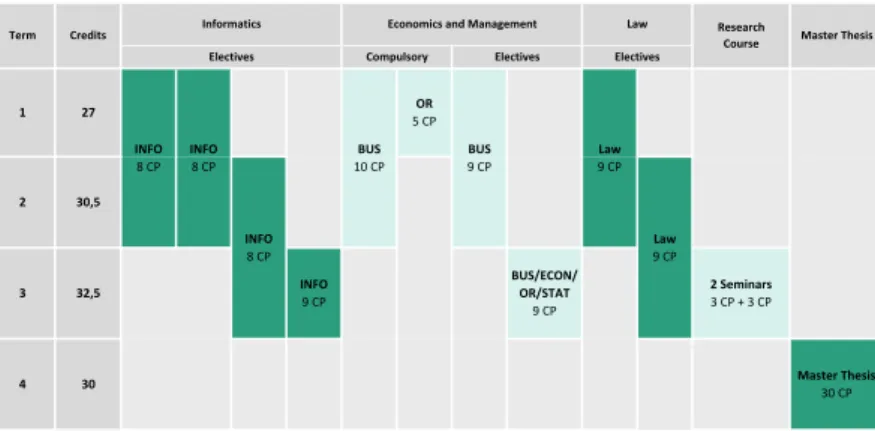
The Master program inInformation Engineering and Managementhas 4 terms. The terms 1 to 3 of the program are method–oriented and provide the students with state-of-the-art knowledge in informatics, business administration, operations research, economics, statistics and law. The interdisciplinary approach is especially emphasized in the interdisciplinary seminar.
It is recommended to study the courses in the following sequence:
• The (mandatory) modules in business administration and operations research should be studied in the first two terms of the program.
• The interdisciplinary seminar module should be taken until the end of the third term of the program.
• The (elective) modules from business administration, economics, operations research, and statistics, from informatics, and from law should be studied in the first three terms of the program.
• The 4-th term is reserved for the Master Thesis in which the student proves his ability for independent scientific research in informatics, the economic sciences, and law.
Figure 1 shows a summary of this recommendation with the structure of the disciplines and with credit points allocated to the modules of the program.
120
Term Credits Informatics Economics and Management Law Research
Course Master Thesis
Electives Compulsory Electives Electives
1 27 INFO 8 CP INFO 8 CP BUS 10 CP OR 5 CP BUS 9 CP Law 9 CP 2 30,5 INFO 8 CP Law 9 CP 3 32,5 INFO 9 CP BUS/ECON/ OR/STAT 9 CP Master Thesis 30 CP 2 Seminars 3 CP + 3 CP 4 30
Figure 1: Structure of the Master program in Information Engineering and Management SPO2015 (Recommenda-tion)
2 MODULE HANDBOOK - A HELPFUL GUIDE THROUGHOUT THE STUDIES
2
Module Handbook - a helpful guide throughout the studies
The program exists of several subjects (e.g. business administration, economics, operations research). Every subject is split intomodules and every module itself exists of one or more interrelated courses. The extent of every module is indicated by credit points (CP), which will be credited after the successful completion of the module. Some of the modules areobligatory. According to the interdisciplinary character of the program, a great variety of individual specialization and deepening possibilities exists for a large number of modules. This enables the student to customize content and time schedule of the program according to personal needs, interest and job perspective. Themodule handbookdescribes the modules belonging to the program. It describes particularly:
• the structure of the modules • the extent (in CP),
• the dependencies of the modules, • the learning outcomes,
• the assessment and examinations.
The module handbook serves as a necessary orientation and as a helpful guide throughout the studies. The module handbook does not replace thecourse catalogue, which provides important information concerning each semester and variable course details (e.g. time and location of the course).
Begin and completion of a module
Every module and every course is allowed to be credited only once. The decision whether the course is assigned to one module or the other (e.g. if a course is selectable in two or more modules) is made by the student at the time of signing in for the corresponding exam. The module issucceeded, if the general exam of the module and/or if all of its relevant partial exams have been passed (grade min 4.0). In order to that the minimum requirement of credits of this module have been met.
General exams and partial exams
The module exam can be taken in a general exam or several partial exams. If the module exam is offered as a general exam, the entire content of the module will be reviewed in a single exam. If the module exam exists of partial exams, the content of each course will be reviewed in corresponding partial exams. The registration for the examinations takes place online via the self-service function for students. The following functions can be accessed on
https://studium.kit.edu/meinsemester/Seiten/pruefungsanmeldung.aspx: • Sign in and sign off exams
• Retrieve examination results • Print transcript of records
For further and more detailed information also seehttps://studium.kit.edu/Seiten/FAQ.aspx.
Types of exams
The exams are split into written exams, oral exams and alternative exam assessments. Exams are always graded. Non exam assessments can be repeated several times and are not graded.
2 MODULE HANDBOOK - A HELPFUL GUIDE THROUGHOUT THE STUDIES
Additional accomplishments
Additional accomplishments are voluntarily taken exams, which have no impact on the overall grade of the student and can take place on the level of single courses or on entire modules. It is also mandatory to declare an additional accomplishment as such at the time of registration for an exam. Additional accomplishments with at most 30 CP may appear additionally in the certificate.
Further information
More detailed information about the legal and general conditions of the program can be found in the examination regulation of the programhttp://www.sle.kit.edu/amtlicheBekanntmachungen.php).
3 ACTUAL CHANGES
3
Actual Changes
Important changes are pointed out in this section in order to provide a better orientation. Although this process was done with great care, other/minor changes may exist. Please also check our updates onhttp://www.wiwi.kit.edu/lehreMHB. php#mhb_aktuell
IW4BWLISM3 - Market Engineering (S.
29)
Anmerkungen
The course “Computational Economics” [2590458] will not be offered any more in this module from winter term 2015/2016 on. The examination will be offered latest until summer term 2016 (repeaters only).
IW4BWLUO4 - Strategic Decision Making and Organization (S.
39)
Anmerkungen
The course “Organization Theory” will not be offered any more from summer term 2015 on. The examination will be offered latest until winter term 2015/2016 (repeaters only).
IW4BWLIIP2 - Industrial Production II (S.
40)
Anmerkungen
The course “Material Flow Analysis and Life Cycle Assessment [2581995]” will not be offered any more from winter term 2015/16. The examination had been offered latest on July 2015 (repeaters only).
The course “Life Cycle Assessment” will be offered from winter term 2015/16 and replace the course “Material Flow Analysis and Life Cycle Assessment [2581995]”.
Apart from the core course the courses offered are recommendations and can be replaced by courses from the Module Industrial Production III.
IW4BWLIIP6 - Industrial Production III (S.
41)
Anmerkungen
The course “The Management of R&D Projects with Case Studies [2581963]” will not be offered any more from summer term 2015. The examination will be offered latest until winter term 2015/16 (repeaters only).
The course “Project Management” will be offered from winter term 2015/16 and replace the course “The Management of R&D Projects with Case Studies [2581963]”.
Apart from the core course the courses offered are recommendations and can be replaced by courses from the Module Industrial Production II.
IW4BWLIIP4 - Energy Economics and Energy Markets (S.
42)
Anmerkungen
The course “Basics of Liberalised Energy Markets” [2581998] will be reduced to 3 credits in winter term 2015/2016.
IW4BWLMAR5 - Marketing Management (S.
46)
Bedingungen
Only one of the following courses can be counted towards the final grade of the module:
Marketing Strategy Business Game, Business Plan Workshop, Open Innovation – Concepts, Methods and Best Practices or Strategic Brand Management.
Exception: In summer term 2016 exceptionally two of the courses can be chosen or, in case one course has already been chosen previously, a second course can be chosen.
IW4BWLMAR6 - Sales Management (S.
48)
Bedingungen
The course „Sales Management and Retailing“ [2572156] is compulsory and must be passed. This rule only applies to students who take the first examination within the module “Sales Management” after 01.12.2015.
IW4BWLMAR8 - Evidence-based Marketing (S.
50)
3 ACTUAL CHANGES
IW4VWL2 - Applied Strategic Decisions (S.
53)
Anmerkungen
The coursePredictive Mechanism and Market Designis not offered each year.
The course “Decision Theory” [2520365] will not be offered any more from summer term 2015 on. The examination will be offered latest until winter term 2015/2016 (repeaters only).
IW4STAT1 - Mathematical and Empirical Finance (S.
63)
Anmerkungen
This module will not be offered any more from winter term 2015/2016 on.
IW4STAT2 - Statistical Methods in Risk Management (S.
64)
Anmerkungen
This module will not be offered any more from winter term 2015/2016 on.
IW4STAT4 - Analytics and Statistics (S.
65)
Anmerkungen
New module starting winter term 2015/2016.
The planned lectures and courses for the next three years are announced online.
IW4STAT5 - Econometrics and Statistics I (S.
66)
Anmerkungen
New module starting winter term 2015/2016. It replaces the module “Mathematical and Empirical Finance” [WW4STAT1].
IW4STAT6 - Econometrics and Statistics II (S.
67)
Anmerkungen
New module starting winter term 2015/2016. It replaces the module “Statistical Methods in Risk Management”[WW4STAT2]
IW4INAIFB11 - Development of Business Information Systems (S.
104)
Bedingungen
The courseDatenbanksysteme und XML[2511202] or the courseSoftware Quality Management[2511208] must be examined.
2540510 - Master Seminar in Information Engineering and Management (S.
273)
Inhalt
The seminar servers on one hand to improve the scientific working skills. On the other hand, the student should work intensively on a given topic and develop a scientific work, that is based on a profound literature research.
The seminar can also be a implementation of software for a scientific problem (e.g. Business Games/dynamic systems) according to the individual focus in the current semester. The software has to be well documented. The written elaboration covers a description and explanation of the software as well as a discussion about limits and extensibility. Furthermore the software must be deployable und shall be presented on the infrastructure stack of the chair. An implementation of a software has to examine the scientific state of the art in a critical way, too.
A concrete description of the current topics is announced in time for the begin of the application stage.
2540450 - Principles of Information Engineering and Management (S.
223)
3 ACTUAL CHANGES
2520317 - Multivariate Statistical Methods (S.
291)
Anmerkungen
The credits for the course “Multivariate Statistical Methods” have been changed from 5 to 4,5 from winter term 2015/2016 on.
2581998 - Basics of Liberalised Energy Markets (S.
147)
Anmerkungen
The course “Basics of Liberalised Energy Markets” [2581998] will be reduced to 3 credits in winter term 2015/2016 and the tutorial [2581999] is no longer offered.
2550493 - Hospital Management (S.
248)
Anmerkungen
The credits have been changed from 3 to 4,5. The lecture is held in every semester.
The planned lectures and courses for the next three years are announced online.
2550495 - Operations Research in Health Care Management (S.
305)
Anmerkungen
The lecture is planned to be held in the summer term 2016. The planned lectures and courses for the next three years are announced online.
SemFBV1 - Seminar Risk and Insurance Management (S.
397)
Erfolgskontrolle
At least one oral presentation and one term paper have to be deliverd, either as individual work or as team work. Active participation in class and working groups is expected (according to §4(2), 3 SPO).
The grading consists of the weighted performance of the tasks delivered.
2550491 - Seminar in Discrete Optimization (S.
403)
Erfolgskontrolle
The assessment consists of a written seminar thesis of 20-25 pages and a presentation of 35-40 minutes (according to §4(2), 3 of the examination regulation).
The final mark for the seminar consists of the seminar thesis, the seminar presentation, the handout, and if applicable further material such as programming code.
The seminar can be attended both by Bachelor and Master students. A differentiation will be achieved by different valuation standards for the seminar thesis and presentation.
2572156 - Sales Management and Retailing (S.
369)
Bedingungen
This course is compulsory within the module “Sales Management” and must be passed. This rule only applies to students who take the first examination within the module “Sales Management” after 01.12.2015.
SemPÖ1 - Seminar on Morals and Social Behavior (S.
393)
Erfolgskontrolle
Students write a seminar paper on an assigned topic (10 pages), present it in class and discuss results during seminar sessions. These three elements are graded individually. The seminar grade is the weighted average of these individual grades where the weighting is announced on the course syllabus.
2571199 - Open Innovation – Concepts, Methods and Best Practices (S.
304)
Anmerkungen
For further information please contact Marketing & Sales Research Group (marketing.iism.kit.edu).
Please note that only one of the following courses can be chosen in the Marketing Management Module: Marketing Strategy Business Game, Strategic Brand Management, Open Innovation – Concepts, Methods and Best Practices or Business Plan Workshop.
3 ACTUAL CHANGES
2540440 - Marketing Communication (S.
268)
Anmerkungen
New course starting summer term 2015.
The credits for the course have been changed from 3 to 4,5 from summer term 2016 on.
2520357 - Portfolio and Asset Liability Management (S.
321)
Anmerkungen
The credits for the course have been changed from 5 to 4,5 from winter term 2015/2016 on.
2511312 - Web Science (S.
485)
Anmerkungen
New course starting winter term 2015/2016.
n.n. - Project Management (S.
347)
Anmerkungen
The course will be offered from winter term 2015/16 and replace the course “The Management of R&D Projects with Case Studies [2581963]”.
n.n. - Life Cycle Assessment (S.
302)
Anmerkungen
The course will be offered from winter term 2015/16 and replace the course “Material Flow Analysis and Life Cycle Assessment [2581995]”.
2572202 - Services Marketing (S.
417)
Anmerkungen
new course starting summer term 2016
2572200 - Marketing Communication (S.
303)
Anmerkungen
new course starting winter term 2015/2016
2540494 - Regulatory Management and Grid Management - Economic Efficiency of
Net-work Operation (S.
360)
Anmerkungen
New course starting winter term 2015/2016
2550552 - Advanced Statistics (S.
444)
Anmerkungen
4 MANDATORY MODULES 4.1 All Subjects
4
Mandatory Modules
4.1
All Subjects
Module: Information Engineering and Management [IW4WWIW]
Coordination: C. Weinhardt, A. Geyer-Schulz
Degree programme: Informationswirtschaft SPO 2015 (M.Sc.)
ECTS Credits Cycle Duration
10 Every term 2
Courses in module
ID Course Hours per week Term CP Responsible C/E/T Lecturer(s) 2540450 Principles of Information Engineering
and Management (p.223)
2/1 W 5 C. Weinhardt, T. Teubner
2540500 Business Administration in Information Engineering and Management (p.158)
2/1 S 5 A. Geyer-Schulz
Learning Control / Examinations
The assessment is carried out as partial exams (according to Section 4 (2), 1-3 SPO) of each course of this module, whose sum of credits meet the minimum requirement of credits of this module. The assessment procedures are described for each course of the module separately.
The overall grade of the module is the average of the grades for each course weighted by the credits and truncated after the first decimal.
Conditions
None.
Qualification Goals
The student
• understands and analyzes the central role of information as an economic good, a production factor, and a competitive factor,
• identifies, evaluates, prices, and markets information goods,
• evaluates informations flows and the value of information in an interdisciplinary context, • works out solutions in teams,
• transfers models from Business Administration to situations in business whose basic conditions are changed due to the implementation of information and communication technology,
• applies methods from Business Administration (Decision theory, game theory, operations research, etc.) to questions of Information Engineering and Management,
• analyzes the potential to automize the decision making process in businesses by data bases,
• describes the process to extract relevant data for decision making from operational accounting systems.
Content
The moduleInformation Engineering and Managementcomprises the lecturesPrinciples of Information Engineering and Man-agement[2540450] andBusiness Administration in Information Engineering and Management[2540500].
In the lecturePrinciples of Information Engineering and Management, a clear distinction of information as a production, com-petitive, and economic good is introduced. The central role of information is explained through the concept of the “information lifecycle”. The single phases from extraction/generation through storage transformation and evaluation until the marketing and usage of information are analyzed from the business administration perspective and the microeconomic perspective. The state
4 MANDATORY MODULES 4.1 All Subjects
are lectured. Finally, complex business relevant questions in a dynamically changing environment are adressed by presenting models and methods from system dynamics.
4 MANDATORY MODULES 4.1 All Subjects
Module: Stochastic Models in Information Engineering and Management [IW4WWOR]
Coordination: K. Waldmann
Degree programme: Informationswirtschaft SPO 2015 (M.Sc.)
ECTS Credits Cycle Duration
5 Every 2nd term, Winter Term 1
Courses in module
ID Course Hours per week Term CP Responsible C/E/T Lecturer(s) 2550679 Markov Decision Models I (p.449) 2/1/2 W 5 K. Waldmann
Learning Control / Examinations
The assessment of the module is in a written examination according to §4(2), 1 of the examination regulation. In each term (usually in March and July), one examination is held for both courses. The grade of the module corresponds to the grade of this examination.
Conditions
None.
Qualification Goals
The lecture provides students with knowledge of modern techniques of stochastic modelling. Students are able to properly describe and analyze basic stochastic systems.
Content
Markov chains are no longer a nice theory but an important tool in order to model, analyse, and optimize a stochastic system as it evolves over time.
Topics overview: Markov chains, Poisson Processes.
Remarks
4 MANDATORY MODULES 4.1 All Subjects
Module: Interdisciplinary Seminar Module [IW4IWSEM]
Coordination: Studiendekan (Fak. f. Wirtschaftswissenschaften), Studiendekan/in (Fak. f. Informatik)
Degree programme: Informationswirtschaft SPO 2015 (M.Sc.)
ECTS Credits Cycle Duration
6 Every term 1
Courses in module
ID Course Hours per week Term CP Responsible C/E/T Lecturer(s) 2540510 Master Seminar in Information
Engi-neering and Management (p.273)
2 W 3 A. Geyer-Schulz
SemIW Seminar Information Engineering and Management (p.390)
2 W/S 3 C. Weinhardt
SemIIP2 Seminar in Industrial Production (p.389)
2 W/S 3 F. Schultmann, M. Fröhling
SemEW Seminar Energy Economics (p.383) 2 W/S 3 W. Fichtner, P. Jochem, D. Ke-les, R. McKenna, V. Bertsch 2572197 Seminar in strategic and behavioral
marketing (p.402)
2 W 3 B. Neibecker
2577915 Seminar: Management and Organiza-tion (p.409)
2 W/S 3 H. Lindstädt
2579904 Seminar Management Accounting (p.391)
2 W/S 3 M. Wouters
2579905 Special Topics in Management Ac-counting (p.430)
2 3 M. Wouters, F. Stadtherr
SemTuE1 Entrepreneurship Seminar (p.384) 3 O. Terzidis SemTuE2 Seminar Innovation management
(p.385)
3 M. Weissenberger-Eibl
2530280 Seminar in Finance (p.387) 2 W/S 3 M. Uhrig-Homburg, M. Ruckes 2595477 Practical Seminar Service Innovation
(p.410)
3 4,5 G. Satzger
2595470 Seminar Service Science, Manage-ment & Engineering (p.398)
2 W/S 4 C. Weinhardt, R. Studer, S. Nickel, H. Fromm, W. Fichtner, G. Satzger
2595475 Seminar Mobility Services (p.392) 2 W 3 G. Satzger, C. Stryja SemFBV1 Seminar Risk and Insurance
Manage-ment (p.397)
2 W/S 3 U. Werner
2530353 Seminar Financial Economics and Risk Management (p.388)
2 W/S 3 M. Ulrich
SemWIOR1 Seminar Stochastic Models (p.400) 2 W/S 3 K. Waldmann SemWIOR2 Seminar Economic Theory (p.488) 2 W/S 3 C. Puppe SemWIOR3 Seminar in Experimental Economics
(p.404)
2 W/S 3 N. N.
4 MANDATORY MODULES 4.1 All Subjects
SemAIFB4 Seminar Knowledge Management (p.401)
2 W 3 R. Studer
rechtsem Seminar in Law (p.376) 2 W/S 3 T. Dreier
RIO (p.356) 2 S 3 G. Sydow
2540445 Seminar Pricing (p.396) 2 S 3 J. Kim 2520024 Topics in Econometrics (p.468) 2 S 3 M. Schienle 2521388 Seminar Data Mining I (p.380) 2 W 3 G. Nakhaeizadeh 2520375 Seminar Data Mining II (p.381) 2 S 3 G. Nakhaeizadeh
2521391 (p.441) 2 W 3 M. Höchstötter
Learning Control / Examinations
The assessment in this module is regulated by § 4 (2) 3, of the examination regulation for the Master Information Engineering and Management. Further details will be defined for each seminar separately.
Conditions
Students should have experience with literature search in informatics, economics, business administration, and law. They should know the methods of scientific work, presentation techniques for scientific presentations, as well as the form requirements of scientific publications (guide line for authors) and review processes for scientific publications.
For further details see German version.
Qualification Goals
• The students are in a position to independently handle current, research-based tasks according to scientific criteria. • They are able to research, analyze, abstract and critically review the information.
• They can draw own conclusions using their interdisciplinary knowledge from the less structured information and selectively develop current research results.
• They can logically and systematically present the obtained results both orally and in written form in accordance with scientific guidelines (structuring, technical terminology, referencing). They can argue and defend the results professionally in the discussion.
Content
4 MANDATORY MODULES 4.1 All Subjects
Module: Master Thesis [IW4IWMATHESIS]
Coordination: Studiendekan (Fak. f. Wirtschaftswissenschaften), Vorsitzender des Prüfungsausschusses
Degree programme: Informationswirtschaft SPO 2015 (M.Sc.)
ECTS Credits Cycle Duration
30 Learning Control / Examinations
Examination by two examiners from the two faculties. For details refer to examination regulation. The examiner has to be involved in the degree programme. Involved in the degree programme are the persons that coordinate a module or a lecture of the degree programme.
Conditions
Regulated in §11 of the examination regulation.
The requirements for the examiner are described in §14 (2) of the examination regulation.
Qualification Goals
The student can independently handle a complex and unfamiliar subject based on scientific criteria and the current state of research.
He/she is in a position to critically analyze and structure the researched information as well as derive principles and regularities. He/she knows how to apply the thereby achieved results to solve the task at hand. Taking into account this knowledge and his/her interdisciplinary knowledge, he/she can draw own conclusions, derive improvement potentials, propose and implement science-based decisions.
This is basically also done under consideration of social and/or ethical aspects. He/she can interpret, evaluate and if required, graphically present the obtained results.
He/she is in a position to sensibly structure a research paper, document results and clearly communicate the results in scientific form.
Content
• The master thesis shows that the candidate can autonomously investigate a problem from his discipline with scientific methods according to the state-of-the-art of the discipline within a specified time period.
• The master thesis can be written in German or English.
• The topic of a master thesis can be accepted or chosen by each of the examiners according to examination regulation. The examiner accepting a topic for a master thesis acts as the first supervisor of this thesis.
• Writing a master thesis with a supervisor who is not a member of the two faculties participating in the degree programme (Departement of Informatics, Department of Economics and Management) requires acceptance by the examination board of the degree programme. The candidate must have an opportunity to make suggestions for the topic of the master thesis. • Candidates can write a master thesis in teams. However, this requires that the contribution and performance of each candidate to the thesis is identifiable according to objective criteria which allow a unique delineation of each candidate’s contribution. The contribution of each candidate regarded in isolation must fulfill the requirements a individual master thesis.
• In exceptional cases and upon request of the candidate, the chairman of the examination board chooses a supervisor and requests that this supervisor provides the candidate with a topic for the master thesis within 4 weeks after the request. In this case, the candidate is informed by the chairman of the examination board about the topic selected.
• Topic, specification of research tasks and the volume of the master thesis should be limited by the supervisor, so that the master thesis can be written with the assigned workload of 30 credits (750-900h).
5 ELECTIVE MODULES 5.1 Business Administration
5
Elective Modules
5.1
Business Administration
Module: Advanced CRM [IW4BWLISM1]
Coordination: A. Geyer-Schulz
Degree programme: Informationswirtschaft SPO 2015 (M.Sc.)
ECTS Credits Cycle Duration
9 Every term 1
Courses in module
ID Course Hours per week Term CP Responsible C/E/T Lecturer(s) 2540508 Customer Relationship Management
(p.165)
2/1 W 4,5 A. Geyer-Schulz
2540506 Recommender Systems (p.357) 2/1 S 4,5 A. Geyer-Schulz, A. Sonnen-bichler
2540533 Personalization and Services (p.319) 2/1 S 4,5 A. Sonnenbichler 2540518 Social Network Analysis in CRM
(p.428)
2/1 S 4,5 A. Geyer-Schulz
2540531 Business Dynamics (p.156) 2/1 W 4,5 A. Geyer-Schulz, P. Glenn 2595501 Service Analytics (p.411) 2/1 S 4,5 T. Setzer, H. Fromm
Learning Control / Examinations
The assessment is carried out as partial exams (according to Section 4(2), 1 or 2 of the examination regulation) of the single courses of this module, whose sum of credits must meet the minimum requirement of credits of this module. The assessment procedures are described for each course of the module seperately.
The overall grade of the module is the average of the grades for each course weighted by the credits and truncated after the first decimal.
Conditions
None.
Qualification Goals
The student
• understand service competition as a sustainable competitive strategy and understand the effects of service competition on the design of markets, products, processes and services,
• models, analyzes and optimizes the structure and dynamics of complex business applications, • develops and realizes personalized services, especially in the field of recommendation services, • analyzes social networks and knows their application field in CRM,
• works in teams.
Content
Besides the foundations of modern customer oriented and service oriented management, developments of CRM systems are lectured together with tools for analysis and optimization of such systems.
An overview of general aspects and concepts of personalization and their importance for service provider and customers is given. Then, different categories of recommendation systems are presented: Ranging from explizit recommendation services like reviews to implicit services like the calcuation of recommendations based on the historic data about products and/or customers.
There exist a trend towards viewing economic systems and social systems as networks. This approach allows for the application of different methods from mathematics, economic sciences, sociology and physics. In CRM, net work analyses may provide
5 ELECTIVE MODULES 5.1 Business Administration
The coursesRecommendersystemsandPersonalization and Serviceswill take place in an alternating way from summer term 14. Details on the cycle and on the exams can be found on http://www.em.uni-karlsruhe.de/studies/.
5 ELECTIVE MODULES 5.1 Business Administration
Module: Electronic Markets [IW4BWLISM2]
Coordination: A. Geyer-Schulz
Degree programme: Informationswirtschaft SPO 2015 (M.Sc.)
ECTS Credits Cycle Duration
9 Every term 1
Courses in module
ID Course Hours per week Term CP Responsible C/E/T Lecturer(s) 2540502 Markets and Organizations: Principles
(p.257)
2/1 W 4,5 A. Geyer-Schulz
2540460 Market Engineering: Information in In-stitutions (p.265)
2/1 S 4,5 C. Weinhardt
2561232 Telecommunication and Internet Eco-nomics (p.463)
2/1 W 4,5 K. Mitusch
2540531 Business Dynamics (p.156) 2/1 W 4,5 A. Geyer-Schulz, P. Glenn 2540500 Business Administration in Information
Engineering and Management (p.158)
2/1 S 5 A. Geyer-Schulz
Learning Control / Examinations
The assessment is carried out as partial exams (according to Section 4(2) of the examination regulation) of the single courses of this module, whose sum of credits must meet the minimum requirement of credits of this module. The assessment procedures are described for each course of the module seperately.
The overall grade of the module is the average of the grades for each course weighted by the credits and truncated after the first decimal.
Conditions
None.
Qualification Goals
The student
• knows coordination and motivation methods and analyzes them regarding their efficiency, • classifies markets and describes the roles of the participants in a formal way,
• knows the conditions for market failure and knows and develops countermeasures,
• knows institutions and market mechanisms, their fundamental theories and empirical research results, • knows the design criteria of market mechanisms and a systematical approach for creating new markets, • models, analyzes and optimizes the structure and dynamics of complex business applications.
Content
What are the conditions that make electronic markets develop and how can one analyse and optimize such markets?
In this module, the selection of the type of organization as an optimization of transaction costs is treated. Afterwards, the efficiency of electronic markets (price, information and allocation efficiency) as well as reasons for market failure are described. Finally, motivational issues llike bounded rationality and information assymetries (private information and moral hazard), as well as the development of incentive schemes, are presented. Regarding the market design, especially the interdependencies of market organization, market mechanisms, institutions and products are described and theoretical foundations are lectured. Electronic markets are dynamic systems that are characterized by feedback loops between many different variables. By means of the tools of business dynamics such markets can be modelled. Simulations of complex systems allow the analysis and optimization of markets, business processes, policies, and organizations.
5 ELECTIVE MODULES 5.1 Business Administration
• continuous double auctions • market-maker, regulation, control
Remarks
5 ELECTIVE MODULES 5.1 Business Administration
Module: Market Engineering [IW4BWLISM3]
Coordination: C. Weinhardt
Degree programme: Informationswirtschaft SPO 2015 (M.Sc.)
ECTS Credits Cycle Duration
9 Every term 1
Courses in module
ID Course Hours per week Term CP Responsible C/E/T Lecturer(s) 2540460 Market Engineering: Information in
In-stitutions (p.265)
2/1 S 4,5 C. Weinhardt
2520408 Auction Theory (p.143) 2/1 W 5 K. Ehrhart 2540454 eFinance: Information Engineering and
Management for Securities Trading (p.186)
2/1 W 4,5 C. Weinhardt
2540489 Experimental Economics (p.204) 2/1 W 4,5 C. Weinhardt, T. Teubner 2540464 eEnergy: Markets, Services, Systems
(p.184)
2/1 S 4,5 C. Weinhardt
2540494 Regulatory Management and Grid Management - Economic Efficiency of Network Operation (p.360)
2/1 W 4,5 S. Rogat
Learning Control / Examinations
The assessment is carried out as partial exams (according to Section 4 (2), 1-3 SPO) of the core course and further single courses of this module, whose sum of credits must meet the minimum requirement of credits of this module. The assessment procedures are described for each course of the module separately.
The overall grade of the module is the average of the grades for each course weighted by the credits and truncated after the first decimal.
Conditions
The courseMarket Engineering: Information in Institutions[2540460] is compulsory and must be examined.
Qualification Goals
The students
• know the design criterias of market mechanisms and the systematic approach to create new markets, • understand the basics of the mechanism design and auction theory,
• analyze and evaluate existing markets regarding the missing incentives and the optimal solution of a given market mechanism, respectively,
• develop solutions in teams.
Content
This module explains the dependencies between the design von markets and their success. Markets are complex interaction of different institution and participants in a market behave strategically according to the market rules. The development and the design of markets or market mechanisms has a strong influence on the behavior of the participants. A systematic approach and a thorough analysis of existing markets is inevitable to design, create and operate a market place successfully. the approaches for a systematic analysis are explained in the mandatory courseMarket Engineering [2540460] by discussing theories about mechanism design and institutional economics. The student can deepen his knowledge about markets in a second course.
Remarks
5 ELECTIVE MODULES 5.1 Business Administration
Module: Business & Service Engineering [IW4BWLISM4]
Coordination: C. Weinhardt
Degree programme: Informationswirtschaft SPO 2015 (M.Sc.)
ECTS Credits Cycle Duration
9 Every term 1
Courses in module
ID Course Hours per week Term CP Responsible C/E/T Lecturer(s) 2540456 Business Models in the Internet:
Plan-ning and Implementation (p.215)
2/1 S 4,5 T. Teubner, R. Knapper
2540498 Special Topics in Information Engineer-ing & Management (p.431)
3 W/S 4,5 C. Weinhardt
2540506 Recommender Systems (p.357) 2/1 S 4,5 A. Geyer-Schulz, A. Sonnen-bichler
2540533 Personalization and Services (p.319) 2/1 S 4,5 A. Sonnenbichler
2595468 Service Innovation (p.415) 2/1 S 4,5 G. Satzger, M. Kohler, N. Feld-mann
2595477 Practical Seminar Service Innovation (p.410)
3 4,5 G. Satzger
Learning Control / Examinations
The assessment is carried out as partial exams (according to Section 4 (2), 1-3 SPO) of the single courses of this module, whose sum of credits must meet the minimum requirement of credits of this module. The assessment procedures are described for each course of the module separately.
The overall grade of the module is the average of the grades for each course weighted by the credits and truncated after the first decimal.
Conditions
None.
Qualification Goals
The student should
• learn to develop and implement new markets with regards to the technological progresses of information and communi-cation technology and the increasing economic networking
• learn to restructure and develop new business processes in markets under those conditions
• understand service competition as a sustainable competitive strategy and understand the effects of service competition on the design of markets, products, processes and services.
• improve his statistics skills and apply them to appropriate cases • learn to elaborate solutions in a team
5 ELECTIVE MODULES 5.1 Business Administration
Module: Service Management [IW4BWLISM6]
Coordination: C. Weinhardt, G. Satzger
Degree programme: Informationswirtschaft SPO 2015 (M.Sc.)
ECTS Credits Cycle Duration
9 Every term 1
Courses in module
ID Course Hours per week Term CP Responsible C/E/T Lecturer(s) 2595484 Business and IT Service Management
(p.155)
2/1 W 4,5 G. Satzger
2595468 Service Innovation (p.415) 2/1 S 4,5 G. Satzger, M. Kohler, N. Feld-mann
2595501 Service Analytics (p.411) 2/1 S 4,5 T. Setzer, H. Fromm 2595505 Industrial Services (p.226) 2/1 W 4,5 H. Fromm
2540470 Modeling and Analyzing Consumer Be-haviour with R (p.281)
2/1 S 4,5 V. Dorner, C. Weinhardt
Learning Control / Examinations
The assessment is carried out as partial exams (according to Section 4 (2), 1-3 SPO) of the core course and further single courses of this module, whose sum of credits must meet the minimum requirement of credits of this module. The assessment procedures are described for each course of the module separately.
The overall grade of the module is the average of the grades for each course weighted by the credits and truncated after the first decimal.
Conditions
The courseBusiness and IT Service Management[2590484] is compulsory and must be examined
Qualification Goals
The students
• understand the basics of developing and managing IT-based services, • understand and apply OR methods in service management,
• systematically use vast amounts of available data for planning, operation, personalization and improvement of complex service offerings, and
• understand and analyze innovation processes in corporations.
Content
The module service management addresses the basics of developing and managing IT-based services. The lectures contained in this module teach the basics of developing and managing IT-based services and the application of OR methods in the field of service management. Moreover, students learn to systematically analyze vast amounts of data for planning, operation and improvement for complex service offerings. These tools enhance operational and strategic decision support and help to analyze and understand the overall innovation processes in corporations. Current examples from research and industry demonstrate the relevance of the topics discussed in this module.
5 ELECTIVE MODULES 5.1 Business Administration
Module: Service Analytics [IW4BWLKSR1]
Coordination: H. Fromm, C. Weinhardt
Degree programme: Informationswirtschaft SPO 2015 (M.Sc.)
ECTS Credits Cycle Duration
9 Every term 2
Courses in module
ID Course Hours per week Term CP Responsible C/E/T Lecturer(s)
2595501 Service Analytics (p.411) 2/1 S 4,5 T. Setzer, H. Fromm 2595505 Industrial Services (p.226) 2/1 W 4,5 H. Fromm
2540498 Special Topics in Information Engineer-ing & Management (p.431)
3 W/S 4,5 C. Weinhardt
2540470 Modeling and Analyzing Consumer Be-haviour with R (p.281)
2/1 S 4,5 V. Dorner, C. Weinhardt
2540498 Service Analytics II – Enterprise Data Reduction and Prediction (p.413)
2/1 S 4,5 T. Setzer, C. Weinhardt
Learning Control / Examinations
The assessment is carried out as partial exams (according to Section 4 (2), 1-3 SPO) of the core course and further single courses of this module, whose sum of credits must meet the minimum requirement of credits of this module. The assessment procedures are described for each course of the module separately.
The overall grade of the module is the average of the grades for each course weighted by the credits and truncated after the first decimal.
Conditions
The course Service Analytics [2595501] is compulsory and must be examined.
Recommendations
Basic knowledge of Operations Research, Descriptive Statistics, and Inferential Statistics is assumed.
Qualification Goals
The student should learn to
• Understand different scenarios where analytics is applied in a service context • Distinguish different analytics methods and concepts and learn when to apply them • Apply analytics tools in a service context
• Analyze and solve real-world business problems through leveraging analytics
Content
Modern economies have turned into “servitized” economies – with almost 70% of the gross value added being derived from the tertiary sector and with an increasing number of industrial companies proceeding to engage in service-type offerings. The adoption of analytics applied to services for leveraging the full potential of big data is still in its infancy - some areas like web
5 ELECTIVE MODULES 5.1 Business Administration
Module: Service Design Thinking [IW4BWLKSR2]
Coordination: C. Weinhardt, G. Satzger
Degree programme: Informationswirtschaft SPO 2015 (M.Sc.)
ECTS Credits Cycle Duration
9 Every term 1
Courses in module
ID Course Hours per week Term CP Responsible C/E/T Lecturer(s) 2595600 Service Design Thinking (p.414) 6 W/S 9 C. Weinhardt
Learning Control / Examinations
The assessment is carried out as a general exam (according to Section 4(2), 3 of the examination regulation). The overall grade of the module is the grade of the examination (according to Section 4(2), 3 of the examination regulation).
Conditions
The course Service Design Thinking is compulsory and must be examined.
Recommendations
This course is held in English – proficiency in writing and communication is required.
Qualification Goals
• Deep knowledge of the innovation method “Design Thinking”, as introduced and promoted by Stanford University • Development of new, creative solutions through extensive observation of oneself and one’s environment, in particular with
regard to the relevant service users
• Know how to use prototyping and experimentation to visualize one’s ideas, to test and iteratively develop them, and to converge on a solution
• Communicate, work and present in an interdisciplinary and international project setting
Content
• Paper Bike: Learning about the basic method elements by building a paper bike that has to fulfill a given set of challenges. • Design Space Exploration: Exploring the problem space through customer and user observation.
• Critical Function Prototype: Identification of critical features from the customer’s perspective that can contribute to the solution of the overarching problem. Building and testing prototypes that integrate these functionalities.
• Dark Horse Prototype: Inverting earlier assumptions and experiences, which leads to the inclusion of new features and solutions.
• Funky Prototype: Integration of the individually tested and successful functions to a complete solution, which is further tested and developed.
• Functional Prototype: Further selection and convergence of existing ideas. Building a higher resolution prototype that can be tested by customers.
• Final Prototype: Preparing and presenting the final solution to the customer.
Remarks
5 ELECTIVE MODULES 5.1 Business Administration
Module: Finance 1 [IW4BWLFBV1]
Coordination: M. Uhrig-Homburg, M. Ruckes
Degree programme: Informationswirtschaft SPO 2015 (M.Sc.)
ECTS Credits Cycle Duration
9 Every term 1
Courses in module
ID Course Hours per week Term CP Responsible C/E/T Lecturer(s) 2530550 Derivatives (p.178) 2/1 S 4,5 M. Uhrig-Homburg 2530212 Valuation (p.475) 2/1 W 4,5 M. Ruckes
2530555 Asset Pricing (p.141) 2/1 S 4,5 M. Uhrig-Homburg, M. Ruckes
Learning Control / Examinations
The assessment is carried out as partial exams (according to Section 4(2), 1 or 2 of the examination regulation) of the single courses of this module, whose sum of credits must meet the minimum requirement of credits of this module. The assessment procedures are described for each course of the module seperately.
The overall grade of the module is the average of the grades for each course weighted by the credits and truncated after the first decimal.
Conditions
None.
Qualification Goals
The student
• has core skills in economics and methodology in the field of finance • assesses corporate investment projects from a financial perspective • is able to make appropriate investment decisions on financial markets
Content
The courses of this module equip the students with core skills in economics and methodology in the field of modern finance. Securities which are traded on financial and derivative markets are presented, and frequently applied trading strategies are discussed. A further focus of this module is on the assessment of both profits and risks in security portfolios and corporate investment projects from a financial perspective.