669
Evolution of Comets Into Asteroids
Paul R. Weissman
Jet Propulsion Laboratory
William F. Bottke Jr.
Southwest Research Institute
Harold F. Levison
Southwest Research Institute
In the past decade, new observations and new research tools have afforded us a better under-standing of the interrelationships between comets and asteroids. The extensive automated sur-veys for near-Earth objects (NEOs) have serendipitously discovered many objects in comet-like orbits. Dynamical simulation codes have improved to the point where we can simulate the detailed orbital behavior of large swarms of test particles as they move out from various storage reservoirs, such as the Oort cloud and the Kuiper belt. Physical studies of both comets and asteroids have given us a far better understanding of the nature of these bodies and have identified possible discriminators to be used in comparing them. As a result, we can now identify likely dormant or extinct comet candidates among the asteroid population. It appears that ~6 ± 4% (or perhaps more) of the NEO population is derived from Jupiter-family comets. Also, it is highly likely that many asteroids in eccentric orbits with large semimajor axes and large inclinations are derived from the Oort cloud. However, we must also recognize that some small fraction of the Oort cloud population is likely to consist of asteroidal bodies ejected there during the clear-ing of the planetary zones in the early solar system. Additional physical and dynamical studies are required to continue improving our knowledge of the interrelationships between comets and asteroids and to help identify likely extinct comet candidates.
1. INTRODUCTION
Solar system astronomers have long speculated on the possible existence of extinct or dormant comets, objects that appear asteroidal but in truth are icy objects that had their origins as comets. Kresák (1979) suggested a number of extinct comet candidates based primarily on dynamical cri-teria. Degewij and Tedesco (1982) compared physical stud-ies of comets and asteroids and concluded that no extinct cometary nucleus had yet been found. Weissman et al. (1989) suggested a list of cometary candidates among the Apollo and Amor asteroids, as well as some outer solar system objects such as Chiron (later discovered to be ac-tive) and Hidalgo. Wetherill (1988, 1991) investigated the dynamical evolution of Jupiter-family comets in the inner solar system and concluded that as many as half of the Apollo-Amor objects could be of cometary origin.
The problem is not a simple one. The chaotic nature of the dynamical evolution of objects in planet-crossing orbits, as well as nongravitational accelerations on comets caused by outgassing, make it impossible to track orbits accurately backward (or forward) in time more than a few decades or centuries. The obscuring effects of comae make it difficult to apply the same physical observation techniques to comets that have been so successful with asteroids, when the comets are relatively close to the Earth. [Observations of cometary nuclei at large heliocentric distances when they are
presum-ably inactive have had considerable success (e.g., Lowry, 2001), but are necessarily difficult to perform and interpret.] Finally, our understanding of comets and cometary pro-cesses is still in a primitive state, and has yet to benefit from the intense scrutiny that the asteroid-orbiting NEAR mis-sion has afforded us of asteroid 433 Eros, a typical Earth-approaching, S-type asteroid. The first comet rendezvous mission, Rosetta, is scheduled to be launched in January 2003 and will arrive at periodic comet 46P/Wirtanen in No-vember 2011.
In the past decade, several lines of research have pro-vided new data and new tools with which to pursue these questions. First is the extensive automated surveys for near-Earth objects (NEOs) that have serendipitously discovered many objects throughout the planetary system in unusual, sometimes cometlike orbits. Second is the advances in nu-merical simulation of solar system dynamics made possible by advanced numerical codes, in particular symplectic in-tegrators, and by the availability of low-cost computers that can be dedicated to running these codes for weeks or even months. Third is the substantial increase in physical obser-vations of comets and asteroids that permit us a better un-derstanding of the interrelationships between these two very important classes of objects.
In this chapter we will discuss how these new tools have made it possible to argue for, at least statistically, the ex-istence of extinct or dormant comets among the observed
asteroid population, in particular among the NEOs. Our approach is considerably different from that of Weissman et al. (1989, hereafter Paper 1) in Asteroids II, and we refer the reader to that chapter for more detailed discussions of physical observations of comets and extinct/dormant comet candidates. Section 2 provides definitions of the classes of bodies we are discussing. Section 3 presents a discussion of the possible physical end states of cometary nuclei. Sec-tion 4 discusses cometary dynamics and secSec-tion 5 reviews physical observations of comets and extinct comet candi-dates. Section 6 examines a number of asteroidal objects that have been identified as likely extinct comet candidates. Finally, section 7 provides additional discussion and a sum-mary of our results.
2. COMETARY DEFINITIONS
Comets and asteroids represent different parts of a con-tinuous spectrum of planetesimals that were formed and processed in the primordial solar nebula. Two parts of that “stratigraphic” record, the asteroid belt between Mars and Jupiter and the Kuiper belt beyond Neptune, have been preserved in situ, at or close to their formation locations. However, an important part of the record, the comets in and just beyond the giant planets zone, have been scattered out of that region by gravitational interactions with those plan-ets. (Many of those scattered comets are preserved in the Oort cloud.) As a result, the critical transition zone between rocky and icy objects has likely been lost from the “strati-graphic” record.
In general, the distinction between comets and asteroids has been based on the existence of a substantial fraction of ices within the object, thus providing the volatiles necessary for the object to develop a coma. Traditionally, the bound-ary between the formation zones for comets and asteroids has been taken to be the orbit of Jupiter at 5.2 AU, although the icy nature of several of the Galilean satellites suggests that the boundary might be placed somewhat closer to the Sun, perhaps at ~4 AU.
At present, the choice between a cometary vs. an aster-oidal designation for a newly discovered object is based on the presence or absence of a visible coma. This has occa-sionally led to objects being classified as both types, in par-ticular when a coma has been discovered long after the object had been cataloged as an asteroid. The most notable case is the Centaur asteroid 2060 Chiron, also known as comet 95P/Chiron. In addition, this scheme has led to Kuiper belt objects being numbered as asteroids, although their location in the solar system argues strongly for a sig-nificant icy fraction in their compositions. Since no formal definitions of comets and asteroids exist, we will use the following, slightly modified definitions from Paper 1.
1. Comet (or cometary nucleus): a body formed in the outer planets region (or beyond) containing a significant fraction of volatiles in the form of ices and capable of de-veloping a coma if its orbit brings it close enough to the Sun.
2. Active comet: a comet nucleus losing volatiles and dust in a detectable coma.
3. Inactive comet: a comet nucleus that is active during part of its orbit, but presently is in a part of the orbit where volatile loss is negligible and there is no detectable coma. 4. Dormant comet: a comet nucleus that, although once active, has lost the ability to generate a detectable coma in any part of its present orbit. A dormant comet perturbed to a smaller perihelion distance might be reactivated. Or an im-pact might remove an overlying nonvolatile crust and expose fresh icy materials to sublimation, reactivating the comet. 5. Extinct comet: a comet nucleus that has lost its ices or has its ices so permanently buried under a nonvolatile crust that it is incapable of generating a coma.
6. Asteroid: an interplanetary body formed without sig-nificant ice content, and thus incapable of displaying comet-ary activity.
7. Near-Earth object: an asteroid or comet in an orbit with perihelion distance of less than 1.3 AU.
The informed reader will recognize exceptions and shades of gray that do not fit these definitions. For example, Kuiper belt objects, Trojan asteroids, and some outer main-belt asteroids all likely have significant ice content, which would make them comets under our definition, but are of-ficially cataloged (and often referred to) as asteroids. Also, our criteria themselves are subjective and open to interpre-tation. As detector technology has improved, our ability to recognize comae around distant objects has similarly im-proved. In addition, the distinction between dormant and extinct comets may be very subtle. If an extinct comet could somehow be split open (for example, by a catastrophic colli-sion), exposing the ices within, would it not return to be-ing an active comet? We do not mean for the definitions to be perfect, but only intend them to serve as a guide in our discussion below. Note that in that discussion we use the term “extinct comet” quite frequently, meaning either an extinct or dormant comet.
3. PHYSICAL END STATES OF COMETARY NUCLEI
Comets are transient bodies, losing some fraction of their mass, perhaps 0.01–0.1%, on each return. Dynamical stud-ies of the evolution of the orbits of long-period comets have shown that the 1/ao (inverse original semimajor axis)
distri-bution for those orbits can only be explained if there is some physical mechanism that destroys comets or renders them unobservable (Oort, 1950; Whipple, 1962; Weissman, 1979; Bailey, 1984; Wiegert and Tremaine, 1999). This process is often referred to as “fading,” although the actual physical mechanism or mechanisms are not identified.
In fact, compilations of observations of three Halley-type comets (1P/Halley, 109P/Swift-Tuttle, and 55P/Tempel Tuttle) show that these comets remained remarkably constant in max-imum brightness over periods of ~600–2200 yr (Stephenson et al., 1985; Yau et al., 1994; Yeomans et al., 1996). These
periods covered 30, 17, and 19 returns for Halley, Swift-Tuttle, and Tempel-Tuttle respectively. Similarly, Kamél (1991) showed that 2P/Encke has not faded over 155 yr, encompassing ~47 returns. Thus, if comets do fade, they likely do so very slowly, or episodically.
This result is in contrast to that of Kresák (1987), who noted that several short-period comets had been missed on prediscovery apparitions when the comets were close to Earth and should have achieved naked-eye brightness. Kresák proposed that these comets went through irregular dormant phases in which their activity dropped to near-zero. However, Stephenson et al. (1985), Yau et al. (1994), and Yeomans et al. (1996) showed that the three Halley-type comets noted above were not discovered by naked-eye observers until they reached a visual magnitude of 3.5–4.0. Examination of Kresák’s list of the expected brightness ranges for 14 potentially dormant comets shows that all of them could have been fainter than V = 3.5–4.0, and only four might have been brighter than those values. Although the total magnitude of each comet might have exceeded the threshold for naked-eye detection of stars, V ≈ 6, the diffuse nature of comae in fact make them very difficult to detect unless they are significantly brighter than that threshold.
Many cases of comets that disappeared can likely be attributed to poorly determined orbits. For example, comet 107P/Wilson-Harrington, discovered in 1949 and observed for only 6 days, was lost for 30 yr before it was accidentally recovered in 1979 (see section 6). But in other cases, well-observed comets seem to have simply disappeared. These include comets 3D/Biela (observed 1772–1852, see below), 5D/Brorsen (1846–1879), 11D/Tempel-Swift (1869–1908), 18D/Perrine-Mrkos (1896–1968), 20D/Westphal (1852–1913), 25D/Neujmin 2 (1916–1926), and 34D/Gale (1927–1938). Note that the designation “D” refers to “defunct” comets. Several of these comets displayed unusual brightness changes on their last apparition (outbursts and/or fading), perhaps indicative of their imminent demise (Kronk, 1984). Three physical mechanisms have been proposed to ex-plain the disappearance of comets: (1) random disruption, (2) loss of all volatiles, and (3) formation of a nonvolatile crust or mantle on the nucleus surface. Unfortunately, none of these mechanisms are well understood or quantified. Nevertheless, some physical loss mechanism(s) is needed to match the energy distribution of the orbits of the known long-period comets. Weissman (1979) achieved this by as-suming that comets split destructively at a rate of ~12% per perihelion passage, but that only 85% of comets were ca-pable of splitting. Wiegert and Tremaine (1999) proposed that (1) the fraction of comets remaining visible after m ap-paritions is proportional to m–0.6 ± 0.1 or (2) ~95% of
com-ets live for only approximately six returns and the remainder last indefinitely.
Random disruption of comets has been observed on many occasions. The classic example is comet 3D/Biela, a Jupiter-family comet with a period of 6.6 yr that was served in 1772, 1805, 1826, and 1832. The comet was
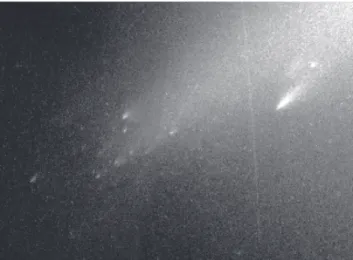
ob-served to be splitting during its 1846 apparition and returned as a double comet in 1852. It was never observed again. More recently, comet LINEAR, D/1999 S4, was observed to completely disrupt as it passed through perihelion in July 2000 (Weaver et al., 2001) (see Fig. 1).
Weissman (1980) compiled records of observations of disrupted or split comets and showed that 10% of dynami-cally new comets from the Oort cloud split, vs. 4% for re-turning long-period comets, and only 1% for short-period comets (per orbit; see also Sekanina, 1982). The splitting events did not show any correlation with perihelion dis-tance, distance from the ecliptic plane, or time of perihelion passage. The statistics suggest that the tendency of cometary nuclei to split may reflect some intrinsic property, such that comets that are likely to split do so early on, and those that are unlikely to split can survive for hundreds or even thou-sands of returns.
Note that splitting events do not always lead to total dis-ruption of the nucleus. For example, comet 73P/Schwass-mann-Wachmann 3 has been observed to shed fragments on at least three perihelion passages, yet still returns every 5.3 yr. Also, since splitting appears to eventually lead to destruction of the cometary nucleus, it cannot explain dormant or ex-tinct nuclei that might be observed as asteroidal objects.
Loss of all volatiles is a slow acting process. Weissman (1980) estimated lifetimes of ~600, 4500, and 4 × 10⁵
re-turns for 1-km-radius water-ice spheres with surface al-bedo = 0 and density of 0.6 g cm–3, for long-period comets
with perihelia of 1, 2, and 3 AU respectively. (Lifetimes for icy spheres in short-period comet orbits with comparable perihelia would be similar though somewhat shorter because of their less eccentric orbits.) However, it is not clear that a comet could sublimate all its volatiles, leaving a coherent, nonvolatile remnant nucleus. Evolving gases would tend to
Fig. 1. Hubble Space Telescope image of comet LINEAR, D/ 1999 S4, on August 5, 2000, showing fragments of the disintegrat-ing nucleus. This long-period comet disrupted close to perihelion at 0.765 AU from the Sun on July 26, 2000 (Weaver et al., 2001).
carry away much of the nonvolatile matter, and any residual material would form an insulating layer that would prevent insolation from penetrating to the volatiles at depth. Thus, total loss of volatiles appears to be an unlikely end state, or one that would not leave a substantial extinct nucleus.
Formation of a nonvolatile crust or mantle on the nucleus surface, first proposed by Whipple (1950), is the one pro-cess that would presumably lead to asteroidlike objects. There are two ways that such crusts may form. First, irradia-tion of comets by galactic cosmic rays and solar protons will sputter away volatiles and transform organic molecules to more refractory forms during the comets’ long storage in the Oort cloud or Kuiper belt (Johnson et al., 1987; Moore et al., 1983; see also Weissman and Stern, 1997, and refer-ences therein). This irradiated crust would extend ~1/ρ m below the nucleus surface, where ρ is the density of the cometary materials in g cm–3. An interesting and unsolved
problem is how such a crust is removed when the comet reenters the planetary region on it first perihelion passage, allowing it to become active.
A second method for forming a cometary surface crust is through the lag deposit of nonvolatile grains, left behind or launched on suborbital trajectories that do not achieve es-cape velocity, as water and more volatile ices sublimate from the nucleus surface during perihelion passage. It is not clear how such large nonvolatile grains, which presumably are too heavy to be lifted off the nucleus by evolving gases, might form. However, if they did, thermal models have shown that
a layer only a few to perhaps 10 cm thick would be suffi-cient to insulate the underlying ices from sublimation (Brin and Mendis, 1979; Fanale and Salvail, 1984; Prialnik and Bar-Nun, 1988).
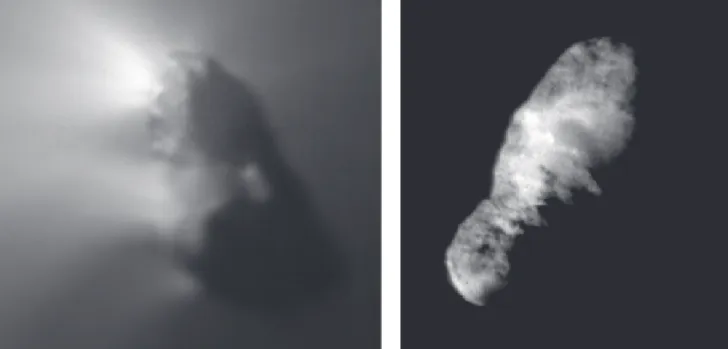
The existence of crusts, or more specifically, inactive areas on cometary nuclei, was shown dramatically by space-craft images of comet Halley in 1986 (Fig. 2) (Keller et al., 1986) and again by images of the nucleus of comet Borrelly in 2001 (Soderblom et al., 2002). Dust jets emanated from distinct and relatively small regions on the nucleus surface. From the Halley images, it was estimated that only 10% of the visible surface, or ~20–30% of the sunlit surface, was active. This agreed well with thermal modeling of the wa-ter production from Halley, which showed that only 30% of the sunlit surface needed to be active to match the total water production rate (Weissman, 1987). At the time of this writing, the Borrelly images are still undergoing analysis, but the apparently active regions are again fairly small. Although one cannot say for certain that the apparently inactive areas in Fig. 2 are not emitting gas (dust emission can likely be ruled out as it would be visible), the Halley and Borrelly images appear to support the idea that com-ets can develop crusts and thus evolve to dormant or ex-tinct objects.
Further support comes from estimates of the active frac-tion of other cometary nuclei. A’Hearn (1988) showed that many Jupiter-family comets have active fractions of only a few percent. For comets 49P/Arend-Rigaux and 28P/
Fig. 2. Composite image of the nucleus of comet Halley (left), taken by the Giotto spacecraft on March 14, 1986, and the nucleus of comet Borrelly (right) taken by the Deep Space 1 spacecraft on September 22, 2001. The Sun is at the left in both images. The Giotto spacecraft approached the nucleus from the darkside at a phase angle of ~107°. Several distinct jets of gas and dust are seen emanating from the dayside of the nucleus. The entire Halley nucleus shape is silhouetted against the bright dust coma. The nucleus is ~16 × 8 × 8 km in diameter. The Borrelly image, taken at a phase angle of ~52°, shows a dark, irregular nucleus ~8 × 4 × 4 km with a highly irregular surface topography and active jets (not visible in this version of the image) originating near the center of the nucleus. Halley image: Copyright H. U. Keller, Max-Planck-Institut für Aeronomie. Borrelly image from Soderblom et al. (2002).
Neujmin 1, both of which are trapped in dynamical reso-nances that have prolonged their lifetimes in the active comets region (Marsden, 1970), the active fractions are esti-mated as only 0.08% and 0.1% respectively. This suggests that comets may slowly age and evolve toward total inac-tivity, either by developing nonvolatile crusts on their sur-faces or by some other as-yet-unrecognized mechanism. Thus, crust formation does appear to provide a mechanism for evolving cometary nuclei to dormant or extinct states.
4. COMETARY DYNAMICS: EVOLUTION
TO ASTEROIDAL ORBITS
Comets have traditionally been divided into two major dynamical groups: long-period (LP) comets with orbital periods >200 yr, and short-period (SP) comets with periods <200 yr. Long-period comets typically have random orbital inclinations while short-period comets typically have incli-nations relatively close (within ~35°) to the ecliptic plane. In the past decade it has become common to divide the SP comets into two subgroups: Jupiter-family comets (JFC), with orbital periods <20 yr and a median inclination of ~11°, and Halley-type comets (HTC), with periods of 20–200 yr and a median inclination of ~45°.
A more formal dynamical definition of the difference between the JFC and HTC comets was proposed by Carusi and Valsecchi (1987) based on the Tisserand parameter. The Tisserand parameter is an approximation to the Jacobi
con-T = 3 Main Belt Q = 0.983 AU 0.0 0.2 0.4 0.6 0.8 Eccentricity e 1.0 0 1 2 3 4 5 6 7
Semimajor Axis a (AU)
q = 1.3 AU
T = 3 T = 2
q = 1.017 AU
stant, which is an integral of the motion in the circular re-stricted three-body problem. It was originally devised to recognize returning periodic comets that may have been perturbed by Jupiter and is given by
T=a aJ/ +2 ( / )(a aJ 1−e2) cos (i) (1)
where aJ is Jupiter’s semimajor axis, and a, e, and i are the comet’s semimajor axis, eccentricity, and inclination respec-tively. T is also a measure of the relative velocity between a comet and Jupiter during close encounters
vrel=vJ 3−T (2)
where vJ is Jupiter’s circular orbit velocity about the Sun. Objects with T close to but smaller than 3 have very slow, and thus very strong, encounters with Jupiter. Objects with T > 3 are not Jupiter-crossing.
Jupiter-family comets have T > 2 while long-period and Halley-type comets have T < 2. Levison (1996) suggested a new nomenclature to recognize this new classification scheme. He proposes that comets with T > 2 be known as ecliptic comets, while comets with T < 2 be known as nearly isotropic comets. We will use this nomenclature in the dis-cussions that follow.
The different dynamical regimes occupied by comets and asteroids are seen in Fig. 3, which is a scatter diagram in semimajor axis and eccentricity of the known asteroids
Fig. 3. Location of all known comets and asteroids (H brighter than 18) on an (a, e) scatter diagram of the inner solar system. Comets are shown by open cir-cles, asteroids by filled circles. Solid lines show the boundaries of the region where objects are Earth-crossing (q < 1.017 AU and Q > 0.983 AU). The dot-dash line is for q = 1.3 AU, which defines the Amor-type (Earth-approaching) objects. Dashed lines show T = 3, the traditional boundary between cometary and asteroidal orbits; the dotted line shows T = 2, the bound-ary between ecliptic and nearly isotropic comets. (Data taken from the Minor Planet Center orbit files for comets and asteroids, March 8, 2001.)
brighter than H = 18 (corresponding to ~1-km-diameter ob-jects) and all known ecliptic comets. The various lines in the diagram depict lines of constant perihelion or aphelion dis-tance for q = 1.017 and 1.3 AU, Q = 0.983 AU, and lines of constant T = 2 and 3. Objects in the center of the main belt have been removed for clarity. The orbital data is taken from the Minor Planet Center file of orbits for March 8, 2001 (cfa-ftp.harvard.edu/pub/MPCORB/MPCORB.DAT and COMET.DAT). Asteroids are plotted as filled circles in Fig. 3; comets are open circles.
The effect of the T = 3 barrier is clearly seen. It is dif-ficult for ecliptic comets to dynamically detach themselves from Jupiter and evolve to orbits with T > 3. The only real exception is comet 2P/Encke (a = 2.217 AU, e = 0.847, i = 11.8°, T = 3.026), which will be discussed below. In total, 11 JFC comets have orbits with T > 3; most are Jupiter-approaching (with aphelia very close to or crossing Jupiter’s eccentric orbit) to the extent that they are still under the gravitational influence of Jupiter. Also, Fig. 3 is slightly misleading as it attempts to plot a three-dimensional func-tion, T(a, e, i) on a two-dimensional (a, e) plane.
Asteroids, for the most part, have T > 3; the Jupiter Tro-jans are of course a notable exception. Historically, the fail-ure to find asteroidal-appearing bodies with T < 3 was used as an argument against the existence of extinct cometary nuclei. However, in the mid-1980s search programs began to find these asteroids; many of these can be seen in Fig. 3. As we will see below, it is now possible to argue on statis-tical grounds which of these objects have a high probabil-ity of being derived from ecliptic comets.
Comets on planet-crossing orbits are transient members of the solar system. Close and/or distant encounters with the giant planets, in particular Jupiter, limit their mean dynam-ical lifetimes to ~0.4–0.6 m.y. (Weissman, 1979; Levison and Duncan, 1997). Thus, they must be continually resupplied from long-lived dynamical reservoirs. The different inclina-tion distribuinclina-tions of the ecliptic and nearly isotropic comets reflect their different source reservoirs. Nearly isotropic com-ets (LP and HTC) are believed to originate from the nearly spherical Oort cloud, the vast cloud of some 1012–1013
com-ets surrounding the solar system at distances of 103–105 AU
(Oort, 1950; for a review see Weissman, 1996a). Ecliptic comets are fed into the planetary system from the highly flattened Kuiper belt of some 109–1010 comets beyond the
orbit of Neptune, extending from ~35 to perhaps several hundred AU (for reviews see Weissman and Levison, 1997; Malhotra et al., 2000). A third reservoir that may supply ecliptic comets to the planetary region is the scattered disk (Duncan and Levison, 1997), icy planetesimals scattered out of the Uranus-Neptune zone and inner Kuiper belt to large semimajor axes, several hundred to ~1000 AU (though with perihelia still close to Neptune’s orbit), but not large enough for them to be captured into the Oort cloud.
Much of the research into cometary dynamics in recent years has had the goal of understanding the structure and evolution of these mostly invisible reservoirs. These reser-voirs were formed at the same time as the planets. Indeed,
they can be viewed as the remnants of planet formation. We discuss the evolution of comets from each of these res-ervoirs to asteroidal orbits below.
4.1. Ecliptic Comets
The observed ecliptic comets have a very flattened incli-nation distribution; the Jupiter-family comets have a median inclination of only 11°. In the last 15 yr, research attempting to explain this inclination distribution has been extremely active. Indeed, attempts to understand these comets led to one of the most important discoveries in planetary science in the twentieth century: the discovery of the Kuiper belt. Historically, the ecliptic comets were thought to origi-nate from nearly isotropic comets that had been captured into short-period orbits by gravitational encounters with the planets (Newton, 1891, 1893; Everhart, 1977). Fernández (1980) argued that this process is too inefficient and sug-gested that a belt of distant icy planetesimals beyond Nep-tune could better serve as the source of most of the ecliptic comets; such a belt was suggested by Kuiper (1951) and later investigated by Whipple (1964). Duncan et al. (1988) greatly strengthened this argument by performing dynami-cal simulations that showed that a cometary source beyond Neptune with a low initial inclination distribution (which they named the Kuiper belt) was far more consistent with the observed orbits of the JFC comets than the randomly distributed inclinations of comets in the Oort cloud (see also Quinn et al., 1990). The first Kuiper belt object, 1992 QB1
(now numbered asteroid 15760), was discovered in 1992 (Jewitt and Luu, 1993). Since that time, more than 560 ob-jects have been discovered in orbits beyond Neptune.
A second potential source of ecliptic comets is the scat-tered disk, predicted by Duncan and Levison (1997). Al-though the scattered disk is related to the Kuiper belt, it is dynamically distinct, consisting of objects in highly eccen-tric and inclined orbits that are typically Neptune-crossing or approaching. Approximately 50 scattered disk objects have now been found. However, once an object leaves the Kuiper belt or the scattered disk, its dynamical evolution is indistinguishable. Thus, for the remainder of this discussion, we will not distinguish between these two source regions. Levison and Duncan (1997, hereafter LD97) have pre-sented the most comprehensive simulations to date of the dynamical evolution of objects from the Kuiper belt. They found that as objects evolve inward from the Kuiper belt or scattered disk, they tend to be under the dynamical control of only one planet at any time, and the Tisserand parameter with respect to that planet is always close to 3. The planet scatters the comets randomly inward and outward. However, the comets can reach maximum eccentricities on the order of only ~0.25 due to the large Tisserand parameter. Thus, the planet can only hand the comets off to the planet directly interior or exterior to it. However, once the comets come under the gravitational influence of Jupiter, they can have much larger eccentricities, even up to 1.0, at which point they can be ejected from the solar system.
LD97 estimated the ratio of active to extinct ecliptic comets by comparing the orbital inclination distribution of simulated JFCs to that of the observed JFCs. LD97 esti-mated the physical lifetimes of JFCs, restricting the analysis to JFCs with perihelion distances <2.5 AU and absolute cometary magnitudes, H10, brighter than 9, which they ar-gued are observationally complete. (The cometary absolute magnitude, H10, is the total magnitude the active comet would have at 1 AU from the Sun and 1 AU from Earth, assuming that cometary brightness varies with heliocentric distance, r, as r–4. Note that this is different from the
tradi-tional H magnitude system for asteroids.)
As described above, the observed JFCs have a very flat-tened inclination distribution with a median inclination of only 11°. However, LD97 showed that the inclinations were even lower when objects were first injected into this popu-lation and subsequently increased as a function of time (see also Levison and Duncan, 1994). This can be seen in Fig. 4. The heavy solid curve in Fig. 4 shows the cumulative incli-nation distribution of the known JFCs, while the top dot-ted curve shows the cumulative inclination distribution of LD97’s simulated comets when they were first injected into the visible JFC region, q < 2.5 AU. As can be seen in the figure, the median inclination of the model is significantly smaller than the observations. A Kolmogorov-Smirnov test shows that the probability that the two distributions are derived from the same parent distribution is only 7 × 10⁻³.
The bottom dotted curve in Fig. 4 shows the inclina-tion distribuinclina-tion that LD97 predicted if the JFCs are in
steady-state dynamical equilibrium and if they remain ac-tive throughout their time in the JFC region. In this case the median inclination is significantly larger than is ob-served. This implies that we are not seeing all the comets in the JFC population, and that the dynamically older com-ets remain undetected or unrecognized as comcom-ets. Alterna-tively, some physical mechanism removes the comets before they reach dynamical maturity.
Indeed, it is possible to match the model to the observa-tions by assuming a simple model for the physical aging of comets. LD97 modeled the effects of physical aging by as-suming that all comets remain active for te years, after which they are permanently extinct. They found good agreement to the observed inclination distribution of JFCs for values of te between 3000 and 25,000 yr. The most likely value is 12,000 yr, or about 1600 perihelion passages, assuming a typical orbital period of ~7.5 yr. The middle dotted curve in Fig. 4 shows the predicted inclination distribution for te = 12,000 yr. The match to the observations is excellent. A Kolmogorov-Smirnov test shows that the probability that the two distributions are derived from the same parent dis-tribution is >0.9.
The fact that LD97 needed to invoke a physical lifetime for comets that is significantly smaller than their dynami-cal lifetime (2.7 × 10⁵ yr, although much of that time is
spent at perihelia >2.5 AU) suggests that there may be a significant number of extinct comets in orbits similar to the JFCs. LD97 estimated the ratio of extinct to active JFCs with perihelion distance <2.5 AU. For values of te between 3000
and 25,000 yr, this ratio is between 7 and 2. If one assumes te = 12,000 yr, then the ratio is 3.5. Based on data from
Fernández et al. (1992), LD97 estimated that there are 108 active JFCs with q < 2.5 AU and H10 < 9 in the solar
sys-tem. Thus, there may be ~380 extinct JFCs with q < 2.5 AU and H10 < 9.
There are several caveats that must be understood before interpreting this result. First, the above estimates assume that all comets become extinct rather than disintegrating. As discussed in the previous section, splitting or disruption may be a common end state for ecliptic comets. Thus, we must assume that the above estimate is an upper limit to the population of extinct JFCs.
Also, LD97’s integrations fail to produce objects with orbits similar to that of comet 2P/Encke. P/Encke is a bright, low-inclination comet whose orbit is distinguished by an aphelion distance of only 4.1 AU, well inside the orbit of Jupiter. Although similar to JFCs in all other respects, 2P/ Encke is dynamically decoupled from Jupiter. LD97 most likely did not produce objects on orbits similar to this comet because their integrations did not include the terrestrial planets or the effects of nongravitational forces (forces from outgassing on the dayside of the rotating cometary nucleus). Therefore, the above estimate of the extinct comets does not include this population.
Harris and Bailey (1998) performed dynamical integra-tions that included the terrestrial planets and nongravi-tational forces and showed that the capture rate into de-0 0 0.2 0.4 0.6 0.8 1 10 20 Steady State te = 12,000 yr First Injected 30 i (degrees) F
ractions with Inclinations <
i
40 50
Fig. 4. The cumulative inclination distribution of Jupiter-family comets with perihelion distances less than 2.5 AU. The bold solid curve is the observed distribution taken from Marsden and Will-iams’(1999) catalog. The top dotted curve shows the cumulative inclination distribution of LD97’s simulated comets when they were first injected into the JFC region with q < 2.5 AU. The bot-tom dotted curve shows the inclination distribution that LD97 predicts if the JFCs are in steady-state equilibrium and if they re-main active throughout their time in the JFC region. The middle dotted curve presents the distribution of LD97’s best-fit model with te = 12,000 yr.
coupled, Encke-like orbits was substantially increased. They find that nongravitational forces, in particular, substantially enhance the capture rate into decoupled orbits, if the non-gravitational forces act in a uniform manner throughout the comet’s dynamical evolution. However, the latter may not be the case as there is evidence for apparent precession of cometary rotation pole orientations and for variations in the nongravitational accelerations (see, e.g., Sekanina, 1991). Also, Weissman (1979) showed that uniformly acting non-gravitational forces lead to predictions for the long-period comet population that are not, in fact, observed.
Finally, the estimate of ~380 extinct JFCs refers to ob-jects that at one time had absolute magnitudes brighter than H10 = 9. Ideally, we would like this estimate to be with re-spect to objects larger than some known size. Relationships that equate H10 with nucleus size have been proposed by Weissman (1990) and Bailey and Stagg (1988) but others have found such relationships poorly founded and unreli-able (Zahnle et al., 1998; Levison et al., 2000).
A new method for estimating the number of extinct JFCs is now possible based on studies of the origin of the NEO population. Bottke et al. (2002) modeled the orbital and ab-solute magnitude distributions of the NEO population, using 138 discoveries or accidental rediscoveries from a single source, the Spacewatch survey (Scotti, 1996), and then cor-rected for observational selection effects. The details of this modeling effort are reviewed by Morbidelli et al. (2002); we will summarize them here.
Bottke et al. (2002) numerically integrated thousands of test particles from five source regions believed to have pro-vided most NEOs to the terrestrial planets region. These source regions are (1) the ν6 secular resonance at ~2.1 AU;
(2) the Mars-crossing asteroid population adjacent to the main belt; (3) the 3:1 mean-motion resonance with Jupiter at 2.5 AU; (4) the outer main-belt population between 2.8 and 3.5 AU; and (5) the Jupiter-family comets. The dynami-cal simulation of the JFCs uses the integrations of LD97.
By comparing the orbital element distributions of hypo-thetical NEOs originating from these five regions to the observed NEO orbital distributions derived from the Space-watch survey, Bottke et al. (2002) estimated the relative importance of each NEO source region. Although there is considerable overlap between the NEOs produced by the individual source regions, particularly for NEOs with semi-major axes <2.8 AU, the JFCs produced NEOs that were largely distinct from the other source regions, with the ex-ception of the outer main belt asteroid source region. JFC-derived NEOs had semimajor axes >2.6 AU and eccentrici-ties >0.55.
Bottke et al. found that ~6 ± 4% of NEOs with a < 7.4 AU, e < 1.0, i < 90°, and 13 < H < 22 are extinct JFCs. (H in this case refers to the standard absolute magnitude system for as-teroids.) The total number of NEOs with H < 18 was found to be ~960 ± 120. These results imply that there are ~61 ± 50 extinct JFCs with H < 18 among the NEO population. If we assume that an extinct comet has an albedo of 0.04, like those measured for cometary nuclei (Fernández, 1999),
we obtain a diameter of 1.7 km for H = 18 (Bowell et al., 1989). Shoemaker and Wolfe (1982) estimated that the cu-mulative cometary nucleus size distribution has the form N(>D) ∝ D–2.2, although Lowry (2001) more recently found
a shallower slope of –1.6; Weissman and Lowry (2002) extended the latter work and found a similar slope of –1.6. In contrast, Fernández et al. (1999) found a slope of –2.65, although the sample they fit is quite small, only nine com-ets. Thus, the number of 1-km-diameter extinct JFCs among the NEOs (q < 1.3 AU) is likely ~140–200 objects. Bottke et al. (2002), using their estimated NEO size distribution of N(>D) ∝ D–1.75, calculated ~150 1-km-diameter extinct
JFCs among the NEOs. If one assumes a uniform perihe-lion distribution vs. heliocentric distance, these numbers compare favorably with the LD97 estimate of ~380 extinct JFCs with q < 2.5 AU (although we do not know if we are talking about the same sized objects).
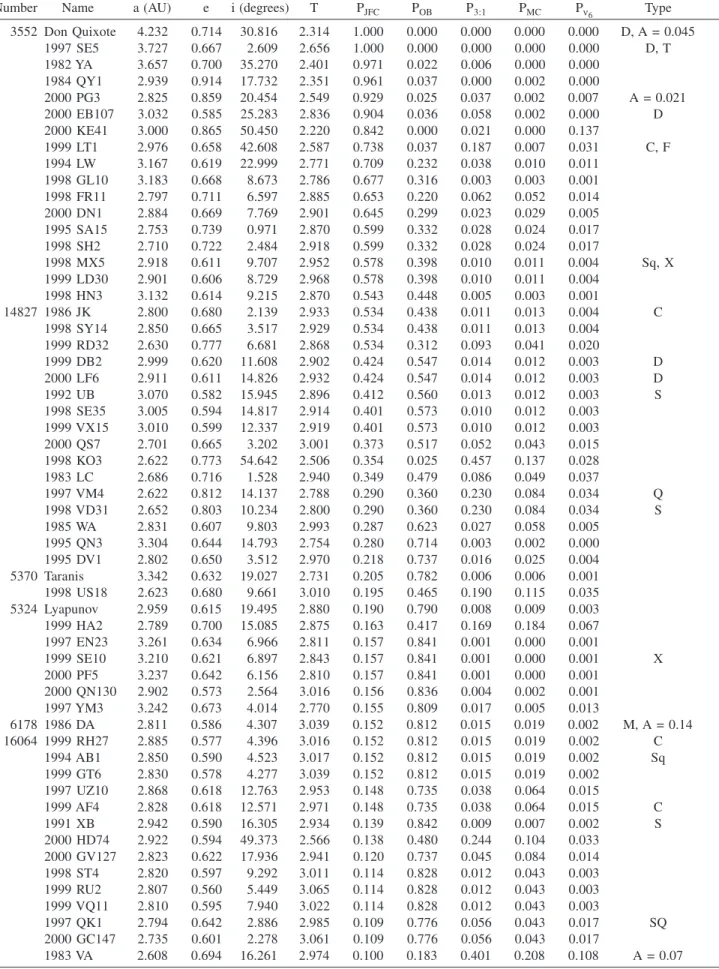
Bottke et al. (2002) also used their model to estimate the probability that any individual known NEO is an extinct comet, based on its semimajor axis, eccentricity, and incli-nation. Taking the list of asteroids from the November 2000 database of T. Bowell (http://asteroid.lowell.edu), Bottke et al. found 57 NEOs with a PJFC > 10% chance of having ori-ginally been an ecliptic comet. These objects are listed in Table 1, in order of decreasing PJFC. In addition to the or-bital elements a, e, and i for each object, Table 1 lists the Tisserand parameter for that orbit, and the probability that the object comes from each of the five source regions used by Bottke et al. (The last column, which refers to the ob-ject’s spectral type and/or albedo, will be discussed in the next section.) Note that as one reads down the table, the most probable source region shifts from the JFC popula-tion to the outer main belt, and then to asteroid regions at successively smaller semimajor axes. Most of the objects in Table 1 have 2 < T < 3. A plot of the (a,e) positions of the 57 objects listed in Table 1 is shown in Fig. 5.
There are several caveats that must be noted with regard to the work of Bottke et al. (2002). First, the results quoted are for Bottke et al.’s best-fit model, and the solution may not be unique. Second, Bottke et al. do not include the nearly isotropic comets as a potential source of NEOs. Third, the integrations of the orbits of the JFCs do not include the ter-restrial planets (which were included for all of the asteroid source-region integrations) or nongravitational forces. The inclusion of the terrestrial planets and nongravitational forces would likely have resulted in more comets being cap-tured to smaller semimajor axes, in particular to orbits dy-namically detached from Jupiter, and this would likely have increased the fraction of NEOs that may have originated from the JFC population.
4.2. Nearly Isotropic Comets
Nearly isotropic comets (NICs) are believed to originate from the Oort cloud. Monte Carlo simulations by Weissman (1979) showed that the typical long-period comet from the Oort cloud makes an average of 5 perihelion passages
TABLE 1. Extinct comet candidates among the NEO population, in order of PJFC probability (Bottke et al., 2002). Number Name a (AU) e i (degrees) T PJFC POB P3:1 PMC Pν
6 Type 3552 Don Quixote 4.232 0.714 30.816 2.314 1.000 0.000 0.000 0.000 0.000 D, A = 0.045 1997 SE5 3.727 0.667 2.609 2.656 1.000 0.000 0.000 0.000 0.000 D, T 1982 YA 3.657 0.700 35.270 2.401 0.971 0.022 0.006 0.000 0.000 1984 QY1 2.939 0.914 17.732 2.351 0.961 0.037 0.000 0.002 0.000 2000 PG3 2.825 0.859 20.454 2.549 0.929 0.025 0.037 0.002 0.007 A = 0.021 2000 EB107 3.032 0.585 25.283 2.836 0.904 0.036 0.058 0.002 0.000 D 2000 KE41 3.000 0.865 50.450 2.220 0.842 0.000 0.021 0.000 0.137 1999 LT1 2.976 0.658 42.608 2.587 0.738 0.037 0.187 0.007 0.031 C, F 1994 LW 3.167 0.619 22.999 2.771 0.709 0.232 0.038 0.010 0.011 1998 GL10 3.183 0.668 8.673 2.786 0.677 0.316 0.003 0.003 0.001 1998 FR11 2.797 0.711 6.597 2.885 0.653 0.220 0.062 0.052 0.014 2000 DN1 2.884 0.669 7.769 2.901 0.645 0.299 0.023 0.029 0.005 1995 SA15 2.753 0.739 0.971 2.870 0.599 0.332 0.028 0.024 0.017 1998 SH2 2.710 0.722 2.484 2.918 0.599 0.332 0.028 0.024 0.017 1998 MX5 2.918 0.611 9.707 2.952 0.578 0.398 0.010 0.011 0.004 Sq, X 1999 LD30 2.901 0.606 8.729 2.968 0.578 0.398 0.010 0.011 0.004 1998 HN3 3.132 0.614 9.215 2.870 0.543 0.448 0.005 0.003 0.001 14827 1986 JK 2.800 0.680 2.139 2.933 0.534 0.438 0.011 0.013 0.004 C 1998 SY14 2.850 0.665 3.517 2.929 0.534 0.438 0.011 0.013 0.004 1999 RD32 2.630 0.777 6.681 2.868 0.534 0.312 0.093 0.041 0.020 1999 DB2 2.999 0.620 11.608 2.902 0.424 0.547 0.014 0.012 0.003 D 2000 LF6 2.911 0.611 14.826 2.932 0.424 0.547 0.014 0.012 0.003 D 1992 UB 3.070 0.582 15.945 2.896 0.412 0.560 0.013 0.012 0.003 S 1998 SE35 3.005 0.594 14.817 2.914 0.401 0.573 0.010 0.012 0.003 1999 VX15 3.010 0.599 12.337 2.919 0.401 0.573 0.010 0.012 0.003 2000 QS7 2.701 0.665 3.202 3.001 0.373 0.517 0.052 0.043 0.015 1998 KO3 2.622 0.773 54.642 2.506 0.354 0.025 0.457 0.137 0.028 1983 LC 2.686 0.716 1.528 2.940 0.349 0.479 0.086 0.049 0.037 1997 VM4 2.622 0.812 14.137 2.788 0.290 0.360 0.230 0.084 0.034 Q 1998 VD31 2.652 0.803 10.234 2.800 0.290 0.360 0.230 0.084 0.034 S 1985 WA 2.831 0.607 9.803 2.993 0.287 0.623 0.027 0.058 0.005 1995 QN3 3.304 0.644 14.793 2.754 0.280 0.714 0.003 0.002 0.000 1995 DV1 2.802 0.650 3.512 2.970 0.218 0.737 0.016 0.025 0.004 5370 Taranis 3.342 0.632 19.027 2.731 0.205 0.782 0.006 0.006 0.001 1998 US18 2.623 0.680 9.661 3.010 0.195 0.465 0.190 0.115 0.035 5324 Lyapunov 2.959 0.615 19.495 2.880 0.190 0.790 0.008 0.009 0.003 1999 HA2 2.789 0.700 15.085 2.875 0.163 0.417 0.169 0.184 0.067 1997 EN23 3.261 0.634 6.966 2.811 0.157 0.841 0.001 0.000 0.001 1999 SE10 3.210 0.621 6.897 2.843 0.157 0.841 0.001 0.000 0.001 X 2000 PF5 3.237 0.642 6.156 2.810 0.157 0.841 0.001 0.000 0.001 2000 QN130 2.902 0.573 2.564 3.016 0.156 0.836 0.004 0.002 0.001 1997 YM3 3.242 0.673 4.014 2.770 0.155 0.809 0.017 0.005 0.013 6178 1986 DA 2.811 0.586 4.307 3.039 0.152 0.812 0.015 0.019 0.002 M, A = 0.14 16064 1999 RH27 2.885 0.577 4.396 3.016 0.152 0.812 0.015 0.019 0.002 C 1994 AB1 2.850 0.590 4.523 3.017 0.152 0.812 0.015 0.019 0.002 Sq 1999 GT6 2.830 0.578 4.277 3.039 0.152 0.812 0.015 0.019 0.002 1997 UZ10 2.868 0.618 12.763 2.953 0.148 0.735 0.038 0.064 0.015 1999 AF4 2.828 0.618 12.571 2.971 0.148 0.735 0.038 0.064 0.015 C 1991 XB 2.942 0.590 16.305 2.934 0.139 0.842 0.009 0.007 0.002 S 2000 HD74 2.922 0.594 49.373 2.566 0.138 0.480 0.244 0.104 0.033 2000 GV127 2.823 0.622 17.936 2.941 0.120 0.737 0.045 0.084 0.014 1998 ST4 2.820 0.597 9.292 3.011 0.114 0.828 0.012 0.043 0.003 1999 RU2 2.807 0.560 5.449 3.065 0.114 0.828 0.012 0.043 0.003 1999 VQ11 2.810 0.595 7.940 3.022 0.114 0.828 0.012 0.043 0.003 1997 QK1 2.794 0.642 2.886 2.985 0.109 0.776 0.056 0.043 0.017 SQ 2000 GC147 2.735 0.601 2.278 3.061 0.109 0.776 0.056 0.043 0.017 1983 VA 2.608 0.694 16.261 2.974 0.100 0.183 0.401 0.208 0.108 A = 0.07
through the planetary region (for perihelia <4 AU) with a mean time of 0.6 m.y. between the first and last passage. Approximately 65% of LP comets are dynamically ejected to interstellar space (primarily by Jupiter), 27% are lost to random disruption (or some other physical mechanism), and the remainder are lost to a variety of processes including loss of all volatiles or perturbation onto a Sun-impacting orbit. The mean semimajor axis of an observed “dynami-cally new” LP comet (a comet passing through the plan-etary region for the first time) is ~22,000 AU (Marsden et al., 1978).
Oort cloud comets have been stored at great distances from the Sun for most of the history of the solar system. However, it is most likely that the Oort cloud comets were formed in the giant planets region (Kuiper, 1951). That is, the comets were formed as icy planetesimals in nearly cir-cular orbits between and beyond the giant planets and are the probable remnants of planetary formation (Duncan et al., 1987; Fernández, 1997). As the giant planets grew, the comets were gravitationally scattered to larger semimajor axes. When the semimajor axes had grown sufficiently, to several thousand AU, perturbations by the tidal field of the galactic disk and by random passing stars scattered the perihelia of the cometary orbits, raising many of them away from the planetary region. Comets from the Oort cloud are currently being fed back into the planetary region by these same galactic and stellar perturbations.
Dynamical modeling of the Oort cloud (Duncan et al., 1987; Dones et al., 2000) suggests that there are two dy-namical regimes within the cloud. The outer, dydy-namically active cloud, as first described by Oort (1950), is approxi-mately spherical and comets there are fed directly into the planetary system by the perturbations of the galactic tide and random passing stars. These are the long-period comets that we see. The outer Oort cloud reaches from ~15,000 to 100,000 AU (in semimajor axis), though as noted above, most observed LP comets have semimajor axes of ~20,000– 30,000 AU. Cometary orbits in the outer cloud have been randomized by stellar and galactic perturbations, with ran-dom inclinations and a mean eccentricity of ~0.7 (Hills, 1981).
The inner Oort cloud stretches from ~3000 to 15,000 AU in semimajor axis (Duncan et al., 1987). The inner cloud is dynamically less active because, being closer to the Sun, it does not experience the tidal effect of the galactic disk and random passing stars. An exception to this occurs if a passing star penetrates the Oort cloud (Hills, 1981, Weiss-man, 1996b), in which case large numbers of comets may be perturbed into the planetary region, resulting in a “com-etary shower.” The best current evidence suggests that we are not presently in a cometary shower (Fernández and Ip, 1991; Weissman, 1993). Because it is not subject to the same external perturbations as the outer cloud, cometary orbits in the inner Oort cloud have not been completely randomized
0.0 0.2 0.4 0.6 0.8 Eccentricity e 1.0 0 1 2 3 4 5 6 7
Semimajor Axis a (AU)
T = 3 Q = 0.983 AU q = 1.3 AU T = 3 T = 2 q = 1.017 AU
Fig. 5. Location on the (a, e) diagram of the 57 extinct comet candidates with PJFC > 10% from Bottke et al. (2002). Twenty candidates with PJFC > 50% are shown by open circles; 37 candidates with 50% > PJFC > 10% are shown by filled circles. Labeled curves are the same as in Fig. 3.
and the inner cloud is believed to be flattened, with inclina-tions relatively close, within ~45° of the ecliptic plane.
Weissman (1996a) estimated a population of 1012 comets
in the outer Oort cloud brighter than H10 = 11 by compar-ing dynamical models with the observed flux of LP comets through the planetary system. Dones et al. (2000) found that the populations of the inner and outer clouds were roughly equal. However, that model assumes that the Oort cloud formed in a galactic environment similar to the one that the solar system is in today. The inner Oort cloud could contain a significantly larger population if the Sun formed in a star cluster or molecular cloud, which seems likely (Fernández, 1997; Eggers, 1999; Fernández and Brunini, 2000). Also, Levison et al. (2001) argued that a massive inner Oort cloud must exist in order to explain the observed Halley-type comet population. Thus, the population of the inner Oort cloud is very uncertain but is thought to be at least a few times 1012
comets.
Galactic tides and stellar perturbations change the peri-helion distances of Oort cloud comets, feeding them into (and out of) the planetary region. As a comet comes through the planetary system for the first time, it receives a random kick in orbital energy that is, on average (if it is Saturn- or Jupiter-crossing), much larger than its binding energy. Thus, depending on the sign of the kick, the comet is either ejected from the solar system or captured onto an orbit with a smaller semimajor axis (and removed from the realm where galactic and stellar perturbations are important). This random walk in orbital energy continues until the comet reaches some dynamical or physical end state.
There are two dynamical paths that an Oort cloud comet can take in order to become a visible comet. Comets from the outer Oort cloud can be perturbed from orbits with peri-helia beyond the orbit of Neptune to periperi-helia inside the orbit of Jupiter. This involves a substantial decrease in the angular momentum of the orbit. Hills (1981; also see Dun-can et al., 1987) showed that the rate of change in a comet’s perihelion distance due to galactic tides is proportional to a2, where a is the orbit semimajor axis. Thus, only orbits
sufficiently distant from the Sun feel the strong tidal effects of galactic and stellar perturbations, and can achieve this direct perturbation into the visible region. This is why the outer Oort cloud is dynamically active and the inner cloud is less so.
If a comet is not perturbed to a perihelion distance in-side Jupiter’s orbit, it will still undergo a random walk in energy due to perturbations by the giant planets, but likely without ever becoming visible. We note that some NICs have been discovered with perihelia beyond Jupiter; these are always dynamically new comets, which are known to be anomalously bright on their first perihelion passage [see Weissman (1996a) for a discussion of possible reasons]. This inability of comets to evolve into the inner-planets re-gion unless they are thrown there directly has been called the “Jupiter barrier” and has been examined by Weissman (1985), Wetherill (1994), and others.
However, comets from both the inner and outer clouds can follow a second path into the visible region. As noted above, comets that are thrown into orbits with perihelia among the giant planets undergo an orbital evolution that can lead to some of them being captured in intermediate-period, Halley-type orbits. Because this evolution occurs relatively far from the Sun, beyond the water ice sublima-tion region, the comets may not be subjected to the same insolation-related physical loss mechanisms as those with perihelia inside the orbit of Jupiter. This dynamical path was first proposed by Everhart (1977) as a possible source of Jupiter-family comets.
As with the ecliptic comets, a diagnostic for the origin of the HTCs is their inclination distribution (Levison et al., 2001; hereafter LDD01). The cumulative inclination distri-butions of LP comets (dotted line), HTCs (dashed line), and JFCs (solid line), taken from Marsden and Williams’ (1999) catalog, is shown in Fig. 6. While the distribution of the LP comets is isotropic, the HTCs are mainly prograde with a median inclination of only 45°, and the JFCs are all pro-grade with a median inclination of only 11°.
The most complete work on the subject of the HTC in-clination distribution was performed by LDD01. They inte-grated the orbits of 27,700 test particles initially entering the planetary system from the Oort cloud. They found that an isotropically distributed Oort cloud does not reproduce the observed orbital element distribution of the HTCs. In order to match the observations, the initial inclination dis-tribution of the progenitors of the HTCs must be similar to the observed HTC inclination distribution. LDD01 was able to match the observations with an Oort cloud that consisted of an isotropic outer cloud and a massive disklike inner
1 0.5 0 –0.5 –1 0 0.2 0.4 0.6 0.8 1 Cosine Inclination F raction <cos(i) JFCs HTCs LPCs
Fig. 6. The cumulative inclination distribution of observed com-ets with perihelia within 1.3 AU of the Sun taken from the cata-log of Marsden and Williams (1999). The solid, dashed, and dotted curves are the JFCs, HTCs, and LPCs, respectively. We only in-clude LPCs with a “quality code” of 1A or 1B. A random distri-bution would be a diagonal line from the lower left to the upper right in this figure.
cloud. Their best-fit model consisted of an inner Oort cloud with a median inclination of only 20°.
However, LDD01’s model predicts too many observed HTCs as compared to the observed number of dynamically new long-period comets. This inconsistency may be related to the fading described in section 3 for the LP comets, though LDD01’s model requires a more severe fading law than has been suggested previously. Thus, the origin of the Halley-type comets remains problematic.
If physical-loss mechanisms do produce extinct LP and HTC nuclei, rather than simply destroying them, it may be possible to find such objects among the asteroid popula-tion. These objects should have Tisserand parameters, T < 2, and semimajor axes outside of the radius of Jupiter’s orbit. They also are likely to be in high-inclination orbits.
It is also important to be able to show that these objects cannot have an asteroidal origin. Bottke et al.’s (2002) in-tegrations show that when objects leaving the asteroid belt cross the orbit of Jupiter, they have T > 2. Further, LD97’s integrations show that objects with T > 2 are unlikely to evolve onto orbits similar to visible HTCs or LP comets.
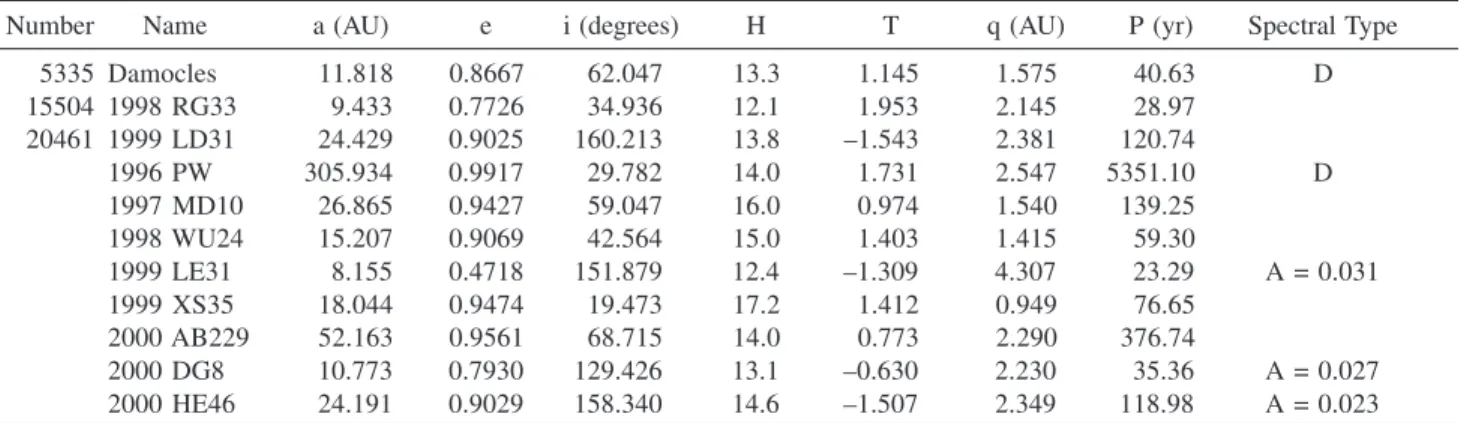
Table 2 lists 11 asteroids from the Minor Planet Center database (July 27, 2001) with semimajor axes >8 AU and eccentricities >0.4. Dynamically, it is most probable that these objects are all derived from NIC-type orbits and not from the asteroid belt. Note the large number of high-in-clination objects among the sample. The median inclina-tion of these objects is 62°, which is close enough to that of the observed HTCs, given the small number of objects in both samples, to suggest that they may be the same.
Given that we believe that the objects in Table 2 came from the Oort cloud, can we conclude that they are extinct comets? Unfortunately not. Weissman and Levison (1997) examined the orbit of 1996 PW and showed that it was al-most certainly derived from the Oort cloud. But they found that the probability of it being an extinct cometary nucleus was roughly equal to the probability of it being an asteroid ejected during the clearing of the planetary zones in the early solar system. Hicks et al. (2000) found D-type colors for 1996 PW, consistent with it being either an extinct
nu-cleus or an outer main-belt asteroid. Weissman and Levison (1997) proposed that ~0.8–2.3% of the Oort cloud popula-tion is likely asteroidal, material ejected from the outer pri-mordial asteroid belt and from dynamical resonances during the late stages of planetary-zone clearing. These objects would most likely be indistinguishable from extinct comets, using Earth-based observations, except perhaps by their spec-tral types (see section 5). Thus we are unable to determine with certainty if an asteroidal-appearing object in a NIC-like orbit is an extinct comet or an asteroid from the Oort cloud.
5. PHYSICAL STUDIES OF COMETARY NUCLEI: COMPARISON
WITH ASTEROIDS
The same techniques that can be used to study and clas-sify asteroids, e.g., BVRI photometry, reflection spectros-copy, thermal IR observations, etc., have now begun to be applied to cometary nuclei. Observations of “bare” comet-ary nuclei are necessarily difficult because they must be performed when the comets are far from the Sun and appar-ently inactive, and thus relatively faint when observed from Earth. For example, a bare nucleus with a radius of 2 km and an albedo of 0.04 would be V magnitude ~20.0, 21.5, and 22.6 at 3, 4, and 5 AU, respectively, at opposition. Also, it is difficult to rule out the presence of unresolved coma in such studies.
Nevertheless, a consistent picture of cometary nuclei has begun to emerge. Nuclei are typically elongated bodies, a few kilometers in radius, with surface albedos of 0.04 ± 0.02 (see Meech, 2002, and references therein; also Fer-nández, 1999). Their visible spectra are typically feature-less and range from gray to very red objects, similar to C-or D-type asteroids (Luu, 1993; see also Fig. 2 in Paper 1). The distribution of rotation periods tends to be similar but somewhat slower than main-belt asteroids; there are no rec-ognized fast rotators among the cometary nuclei. The lat-ter is suggestive of low tensile strengths for the cometary nuclei. Bulk densities for cometary nuclei have only been estimated indirectly, based either on the effect of nongravi-TABLE 2. Asteroids in cometlike orbits with Tisserand parameter < 2.
Number Name a (AU) e i (degrees) H T q (AU) P (yr) Spectral Type 5335 Damocles 11.818 0.8667 62.047 13.3 1.145 1.575 40.63 D 15504 1998 RG33 9.433 0.7726 34.936 12.1 1.953 2.145 28.97 20461 1999 LD31 24.429 0.9025 160.213 13.8 –1.543 2.381 120.74 1996 PW 305.934 0.9917 29.782 14.0 1.731 2.547 5351.10 D 1997 MD10 26.865 0.9427 59.047 16.0 0.974 1.540 139.25 1998 WU24 15.207 0.9069 42.564 15.0 1.403 1.415 59.30 1999 LE31 8.155 0.4718 151.879 12.4 –1.309 4.307 23.29 A = 0.031 1999 XS35 18.044 0.9474 19.473 17.2 1.412 0.949 76.65 2000 AB229 52.163 0.9561 68.715 14.0 0.773 2.290 376.74 2000 DG8 10.773 0.7930 129.426 13.1 –0.630 2.230 35.36 A = 0.027 2000 HE46 24.191 0.9029 158.340 14.6 –1.507 2.349 118.98 A = 0.023
tational forces on the orbit of comet 1P/Halley: 0.2–1.3 g cm–3 (Rickman, 1986; Peale, 1989) or on the tidal
disrup-tion and reassembly of the fragments of comet D/Shoe-maker-Levy 9: 0.6–1.1 g cm–3 (Asphaug and Benz, 1994,
1996). Preferred models of nuclei suggest they are “primor-dial rubble piles” or “fluffy aggregates” (Weissman, 1986; Donn and Hughes, 1986) having received relatively little physical processing since they accreted in the solar nebula 4.5 G.y. ago. The spacecraft images of comets Halley and Borrelly, shown in Fig. 2, are consistent with this descrip-tion. The topography of the nucleus surfaces appears to be chaotic and rough at all scales.
Although none of these properties provide absolute dis-criminators between comets and asteroids, we can test Bottke et al.’s (2002) sample of extinct cometary candidates, listed in Table 1, for consistency with a cometary origin. The final column of Table 1 lists the identified spectral types (and/or measured albedos) of 20 of the candidate comets, drawn from the literature and from personal communica-tions with M. Hicks, R. Whiteley, S. Bus, R. Binzel, and Y. Fernández. We find that those objects with PJFC > 0.5 are dominated by primitive spectral types; six out of seven observed objects are spectral type C, D, F, or low albedo (see below). On the other hand, only 5 out of 13 observed objects with PJFC < 0.5 are primitive types. Thus, Bottke et al.’s dynamical argument for many of these objects being extinct comets is independently substantiated by the spec-tral data. We emphasize that although this is not a proof that these objects are cometary, it is consistent with them having a cometary origin.
Similarly, Fernández et al. (2001) compared measured albedos for 14 cometary nuclei and 10 NEOs with Tisserand parameters <3, and 34 NEOs with T > 3. They showed that all of the comets and 9 out of 10 of the NEOs with T < 3 had low albedos, ≤0.07, while most of the NEOs with T > 3 had albedos >0.15. Again, this is consistent with the T < 3 objects having a cometary origin.
In Table 2 we list the spectral types or measured albe-dos for 5 of the 11 Oort cloud candidates. All of these are either primitive spectral types or low albedo, consistent with a cometary origin. So once again we have a consistent
pic-ture of candidate objects with primitive, possibly cometary, surface types.
Clearly, additional physical studies are required of the other objects listed in Tables 1 and 2 to gain a more com-plete picture of these extinct comet candidates. Although it may not be possible to conclusively identify these bod-ies as cometary using only Earth-based observations, such studies will help to identify the most probable candidates, which might then become the targets of spacecraft missions that will study them in far greater detail.
6. OTHER COMETARY CANDIDATES
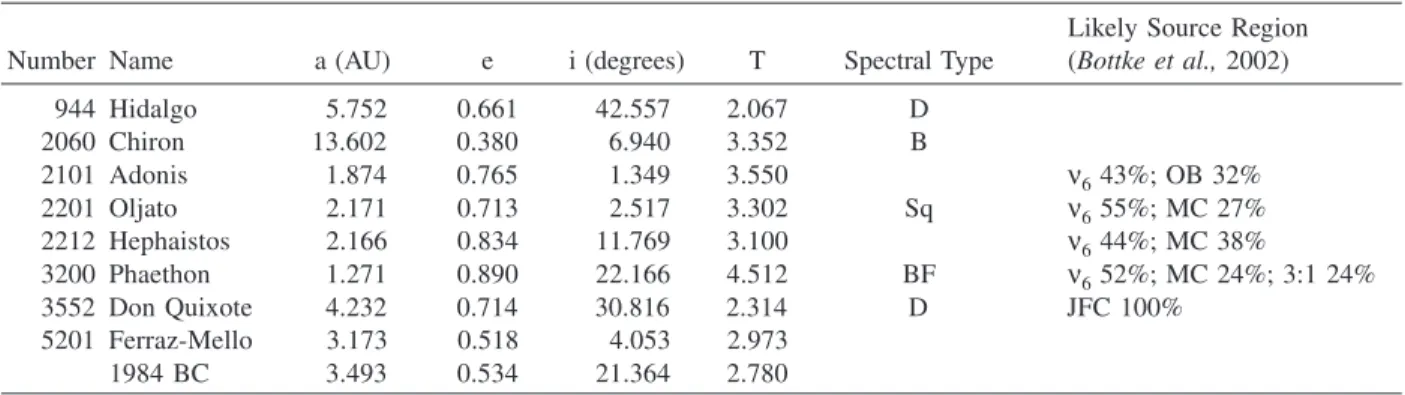
Many asteroids have been suggested as extinct comet candidates over the past two decades, based on their physi-cal or dynamiphysi-cal characteristics. In this section we will ex-amine some of these candidates in greater detail. To begin with, we consider the list of nine “probable” extinct comet candidates in Paper 1, listed in Table 3. In light of current data, how many of these would we still consider to be good candidates?
To begin with, 2060 Chiron, the first Centaur asteroid discovered, has since been found to display cometary activ-ity (Meech and Belton, 1989) and is clearly a comet, likely derived from the Kuiper belt or scattered disk. However, Bottke et al. (2002) find that only one of five NEOs in Table 3, 3552 Don Quixote, likely has a cometary origin. The other NEOs appear to be better explained, at least dy-namically, as having come from the asteroid belt. One of these, 2201 Oljato, is spectral type Sq, suggesting a surface composition similar to ordinary chondrites. Although Oljato has been a popular candidate for an extinct cometary nu-cleus in the past (see Paper 1; also McFadden et al., 1993), both the dynamical and spectral data appear to rule it out. Asteroid 944 Hidalgo, with T = 2.067, is in a dynami-cal regime that would argue very strongly for it being a cometary body, and equally likely for it being derived from the Kuiper belt, Oort cloud, or scattered disk. Asteroids 5201 Ferraz-Mello and 1984 BC are in dynamical regimes where they are possibly extinct JFCs, but without additional physical studies, it is difficult to say for sure.
TABLE 3. Probable extinct comet candidates from Weissman et al. (1989).
Likely Source Region Number Name a (AU) e i (degrees) T Spectral Type (Bottke et al., 2002)
944 Hidalgo 5.752 0.661 42.557 2.067 D 2060 Chiron 13.602 0.380 6.940 3.352 B 2101 Adonis 1.874 0.765 1.349 3.550 ν6 43%; OB 32% 2201 Oljato 2.171 0.713 2.517 3.302 Sq ν6 55%; MC 27% 2212 Hephaistos 2.166 0.834 11.769 3.100 ν6 44%; MC 38% 3200 Phaethon 1.271 0.890 22.166 4.512 BF ν6 52%; MC 24%; 3:1 24% 3552 Don Quixote 4.232 0.714 30.816 2.314 D JFC 100% 5201 Ferraz-Mello 3.173 0.518 4.053 2.973 1984 BC 3.493 0.534 21.364 2.780
Asteroid 3200 Phaethon is an interesting case because it has been identified with the Geminid meteor shower (Whipple, 1983; Williams and Wu, 1993), one of the major regular showers each year. Our expectation is that meteor showers originate from comets; the Geminids is the only major shower definitively identified with an asteroid. Could 3200 Phaethon be an extinct comet nucleus? Its spectral type, BF, is a primitive class, more likely to originate from the middle or outer asteroid belt than from the ν6 resonance, as suggested by Bottke et al. (2002). However, its albedo has been estimated as 0.11–0.17, more typical of a non-primitive asteroid (Veeder et al., 1984; Green et al., 1985). Also, a source of F-type asteroids has been identified close to the 3:1 resonance in the Polana family in the main belt (Doressoundiram et al., 1998). As noted in section 4, the dynamical integrations used by Bottke et al. (2002) to simu-late the JFC evolution did not include the terrestrial plan-ets or nongravitational forces, and this probably precluded them from producing objects in orbits like comet 2P/Encke or even perhaps asteroid 3200 Phaethon. Searches for com-etary activity in 3200 Phaethon have all been negative (Cochran and Barker, 1984; Chamberlin et al., 1996). So we must conclude that the origin of this object remains an open question.
Two interesting objects are comets 107P/Wilson-Harring-ton and 133P/Elst-Pizarro, which are also cataloged as aster-oids 4015 and 7968 respectively. In each case, these objects were briefly observed to display narrow, taillike structures, which have been interpreted by some as cometary outbursts (Fernández et al., 1997; Boehnhardt et al., 1998). Lien (1998) has alternatively suggested that the structures were dust trails resulting from impact events. Both objects have Tisserand parameters greater than 3 (3.084 for P/Wilson-Harrington and 3.184 for P/Elst-Pizarro). In fact, these are the highest values of T for any objects classified as comets, with the exception of 95P/Chiron (which is not Jupiter-crossing). The orbit of Elst-Pizarro is particularly unusual as it is a typical low-eccentricity, low-inclination, main-belt asteroid orbit (a = 3.158 AU, e = 0.165, i = 1.38°). This orbit places it in the Themis collisional family. It is highly im-probable that an extinct comet would evolve to such an orbit. A collision with other Themis family debris seems a more plausible explanation for 7968’s transient activity.
In the case of Wilson-Harrington, the orbit is more typi-cal of a JFC (a = 2.643 AU, e = 0.621, i = 2.78°) but Bottke et al. (2002) assigned it only a 4% probability of having originated from the JFCs. They found the most probable source to be the outer main belt (65%), although that re-sult may again change if more complete integrations of the JFCs (including nongravitational forces) were to be in-cluded in their work. Wilson-Harrington’s spectral type is CF, consistent with a cometary (or an outer main belt) ori-gin, though as noted above, a source of F-type asteroids has also been identified close to the 3:1 resonance in the main belt (Doressoundiram et al., 1998). The case of Wilson-Harrington is problematic because its activity was observed
on only one night, on photographic plates taken for the orig-inal Palomar Sky Survey in 1949, and the object is trailed on both images obtained (see Fernández et al., 1997); no activity was detected on plates taken three nights later. Subsequent searches for cometary activity in 4015 Wilson-Harrington have all been negative (e.g., Chamberlin et al., 1996).
Some researchers have suggested possible links between weak meteoroid streams and Earth-crossing asteroids (Drum-mond 1982). For example, Kostolanský (1998) suggests pos-sible stream identifications with 2102 Tantalus, 5496 1973 NA, and 1996 BT. However, Bottke et al. (2002) did not identify any of these as cometary candidates. Also, the possi-bility that these are extinct comets is generally not supported by taxonomic identifications, where they are available. Either the meteoroid stream identifications are coincidence or per-haps asteroids can be a source of meteoroid streams.
Yeomans (1991) searched for nongravitational motion in the orbits of 12 near-Earth asteroids and reported that he detected such evidence for 1566 Icarus and 1862 Apollo. However, he later showed (Yeomans, 1992) that this was because of the failure to include relativistic terms in the mo-tion of these objects. Since Icarus is spectral type Sq and Apollo is type Q, it would seem unlikely that these could be extinct comets.
7. DISCUSSION
It now appears highly likely that there are a significant number of dormant or extinct cometary bodies among the asteroid population. We now have the tools and the under-standing to begin identifying the most likely cometary can-didates and to follow up with telescopic physical studies that will help to confirm or refute those identifications. In addition, we have the promise of possible low-cost space-craft missions that can study these objects in situ in far greater detail.
The work of Bottke et al. (2002) allows us to identify likely cometary candidates among the NEO population. The most likely candidates, those with PJFC > 50%, all have
Tisserand parameters < 3. It is thus likely that additional asteroids with T < 3 but with q > 1.3 are also dormant or extinct comets. Potential improvements to the work of Bottke et al. will further refine our ability to identify comet-ary candidates through their dynamical properties. These improvements include better integrations of the Jupiter-fam-ily comet population where the terrestrial planets and non-gravitational forces are included, improved integrations of the nearly isotropic comet population, including in particu-lar the Halley-type comets, and improved statistics for the unbiased distribution of NEO orbits, based on increased dis-covery statistics and data from some of the other ongoing NEO search programs.
Additional evidence for extinct comets comes from the discovery of objects in unusual orbits with large semima-jor axes, eccentricities, and/or inclinations, and with T < 2.