http://wrap.warwick.ac.uk
Original citation:Koinova, Maria. (2015) Sustained vs episodic mobilization among conflict-generated diasporas. International Political Science Review .
Permanent WRAP url:
http://wrap.warwick.ac.uk/70873
Copyright and reuse:
The Warwick Research Archive Portal (WRAP) makes this work by researchers of the University of Warwick available open access under the following conditions. Copyright © and all moral rights to the version of the paper presented here belong to the individual author(s) and/or other copyright owners. To the extent reasonable and practicable the material made available in WRAP has been checked for eligibility before being made available.
Copies of full items can be used for personal research or study, educational, or not-for profit purposes without prior permission or charge. Provided that the authors, title and full bibliographic details are credited, a hyperlink and/or URL is given for the original metadata page and the content is not changed in any way.
Publisher’s statement:
Published version: http://dx.doi.org/10.1177/0192512115591641 A note on versions:
The version presented here may differ from the published version or, version of record, if you wish to cite this item you are advised to consult the publisher’s version. Please see the ‘permanent WRAP url’ above for details on accessing the published version and note that access may require a subscription.
Dr. Maria Koinova, Reader in International Relations, Warwick University, United Kingdom
This is the accepted version of the article:
Koinova, Maria, “Sustained vs. Episodic Mobilization among Conflict-generated Diasporas,”
International Political Science Review, online publication July 8, 2015
http://ips.sagepub.com/content/early/2015/07/08/0192512115591641.abstract
Abstract
International Relations is increasingly interested in the transnational connectivity of migrants
with their host-lands and original homelands. Why do conflict-generated diasporas from the
same original homeland and living in the same host-land mobilize in sustained versus episodic
ways? Even if not violent, sustained diaspora mobilization can exacerbate societal tensions, and
be a source of domestic and international insecurity. This article focuses on the sustained
mobilization of Bosnian Muslims versus the episodic mobilization of Croats and Serbs in the
Netherlands in the early 2010s. I argue that a traumatic contentious issue that binds three actors –
diasporas, host-state, and home-state – is central to such mobilization. This issue is the failure of
Dutch peace-keeping forces to protect the Srebrenica enclave in 1995. Migration integration
regimes, threats from radical right parties, host-state foreign policy, and transnational influences
can trigger episodic diaspora mobilization, but not sustain it. The article concludes with
plausibility probes from a cross-country comparison of Bosniaks in Sweden, and a cross-group
Introduction
International Relations is increasingly interested in the dense connectivity of migrants
with their original homelands, host countries, and political processes in various locations.
Interest goes beyond political participation in host societies (Bauböck and Faist 2010). Diasporas
engage with remittances, institutions, interest groups, and party politics in countries of origin and
contribute to their transnationalization (Lyons and Mandaville 2010). They exert radicalizing and
moderate impacts on conflict and peace processes and engage in democratization (Byman et al.
2001, Shain 2002, Adamson 2006, Koinova 2011).
Why do some conflict-generated diasporas mobilize in sustained ways while others do
not, even if they come from the same original homeland and the conflict there has decreased?
Understanding even moderate sustained mobilization is important, because it may create hubs of
discontent and grounds for further domestic or international tensions. It is also important to
understand why some diasporas in a new political environment move on from their traumatic
past, while others continue to exhibit conflict-prone attitudes.
Based on my 2011-2012 study of post-Yugoslav diasporas in the Netherlands, I offer a
social movements perspective on the conditions and mechanisms for sustained diaspora
mobilization. Political opportunities and constraints – such as integration regimes, threats from
radical right parties, host-state foreign policies, and transnational influences – can trigger but not
sustain diaspora mobilization. I argue that a traumatic contentious issue that binds together
diasporas, host-state, and home-state is central to sustained mobilization. In the 2010s, such an
issue existed for Bosnian Muslims (Bosniaks) in the Netherlands, who mobilized in sustained
ways, but not for Croats and Serbs, who did not.1 The article contributes to the transnational
same impact on diaspora mobilization. A traumatic contentious issue deeply embedded in the
domestic politics of both host-state and home-state is a source of durable contention.
This article reviews four clusters of explanations relevant to the puzzle. The central
discussion compares modes of mobilization of the featured diasporas. The conclusions address
the argument’s external validity and examples of cross-country and cross-group comparisons.
Definitions in the Context of Social Movements Approaches
I use Adamson and Demetriou’s (2007) definition of “diaspora”: “a social collectivity
that exists across state borders and that has succeeded over time to: 1) sustain a collective
national, cultural or religious identity through a sense of internal cohesion and sustained ties with
a real or imagined homeland and 2) display an ability to address the collective interests of
members of the social collectivity through a developed internal organizational framework and
transnational links.” Anderson (1998) considers such diasporas “long-distance nationalists.” I do
not essentialize identities, but consider a conglomeration of individuals belonging to different
generations, institutions, networks, families, home-towns, and political orientations who make
homeland-oriented claims (see Brubaker 2005). I distinguish between formal and informal
leaders who control entrepreneurial power. Formal leaders are part of organizations. Informal
leaders operate outside of them, organizing networks with their links to restaurants, shops, and
businesses or social activities.
A major characteristic of “conflict-generated” diasporas is a traumatic identity that often
becomes “frozen” in remote locations. Displaced persons experience painful disruption of their
lives, struggle with adaptation, and long for their homeland (Shapiro 2013). Reification of
towards the original homeland, and prevent post-conflict reconciliation (Shain 2002, Smith and
Stares 2007). The universe of such cases includes the Albanian, Armenian, Bosnian, Chechen,
Croat, Palestinian, Serb, Somali, Tamil, among other diasporas. More recently, scholars argued
that traumatic identities do not always trigger radical behaviors but can be reconciled (Lyons
2006, Hall 2011, Kostic 2012). Displacement can even offer reorientation and reframing of
social identities rooted in conflict and obedience to authoritarian practices (Shapiro 2013
referring to Dauphinee). I take these debates further by seeking to understand variation in
mobilization among diasporas stemming from violent conflict.
“Diaspora mobilization” designates individual and collective actions of identity-based
social entrepreneurs who organize and encourage migrants to behave in a concerted way to make
homeland-oriented claims, bring about a political objective, or contribute to a cause.
Mobilization entails that entrepreneurs have the capacity to harness material and symbolic
resources to reach a collective goal (Tilly 1978). Core mobilization efforts take place through
mobilizing structures of tight identity-based networks rooted in family, neighborhood, and
private ties, often reinforced through wartime refugee experiences. This definition emphasizes
diaspora engagement with the homeland-oriented dimension, not migrants’ orientation towards
the host-state or engagement with “homegrown terrorism.”
Diasporas can mobilize in radical ways by contributing financially to rebel factions,
recruiting soldiers, and staging violent demonstrations and boycotts (Collier and Hoeffler 2000,
Shain 2002, Adamson 2006). They can also act moderately by staging peaceful protests and
campaigns, lobbying, reframing conflict issues, supporting democratic factions, diffusing
democratic ideas and practices, and participating in transitional justice initiatives (Lyons 2006,
moderate category, but differ in how sustained they are.
It is important to speak about moderate mobilization for several reasons. Mobilization
may employ nonviolent means but still be contentious. Tarrow notes that “ordinary people have
power because they challenge power-holders, produce solidarities, and have meaning to a
particular population, groups, situations, and national cultures” (2011:8). Sustained mobilization
indicates that factors not visible to scholars and policy-makers could still aggravate fears among
migrants, endanger their security, and empower extreme right parties to fuel conflicts threatening
their wellbeing. Sustained mobilization, even if moderate, could prevent dissolution of
conflict-generated identities and create hubs of contentious activism.
Some social movement approaches offer insights into sustained mobilization. Social
movements are distinguished from riots, strikes, and other contentious events depending on how
sustained they are. They are “collective challenges, based on common purposes and social
solidarities in sustained interaction with elites, opponents, and authorities” (Tarrow 1998).
Episodic outbursts of contention can emerge when political opportunities and constraints change.
They can be turned into sustained action against “powerful opponents,” if they are based on
"dense social networks and connective structures" and "draw on consensual or action-oriented
cultural frames" that give meaning to collective action (1998:10). Sustained mobilization needs
strategic objectives, not simple targets (Beinin and Vairel 2011). It can develop formal
organizations or operate through informal social ties (Jasper 2005).
Social movement theories are useful for thinking about political opportunities and
constraints, framing and meaning, mobilization of resources, and other aspects of the political
process. A few scholars of transnational diaspora politics have used political opportunity
2013). In previous work I employed these notions to understand comparatively how diasporas
mobilize through different channels (state-based vs. transnational) (Koinova 2014a, 2014b).
Here I focus on sustained vs. episodic mobilization.
Methodology
This study considers mobilization of conflict-generated diasporas during post-conflict
reconstruction of their original homelands. During conflict periods violence in the homeland can
help sustain diaspora mobilization, but during reconstruction there is sporadic violence if any,
and political interest shifts to demobilization, transitional justice, institution-building, and revival
of the economy (Brinkerhoff 2008, Young and Park 2009).
The study uses the “most-similar systems design,” where cases are similar on several
control variables but outcomes are different (“sustained” versus “episodic” mobilization)
(Lijphart 1971). Rigorous comparisons are made when researchers “craft arguments with general
variables or mechanisms, seek out representative variation, and select cases to maximize control
over alternative explanations” (Slater and Ziblatt 2013). The Bosniak, Croat, and Serb diasporas
share a number of elements: country of origin (former Yugoslavia); education and social
backgrounds, value systems, traditions, and culture (Korac 2003); Slavic populations with titular
republics from which new states emerged in the 1990s; participation in guest-worker programs in
Western Europe; migration segments who arrived in the Netherlands (as refugees or voluntarily)
driven by Yugoslavia’s wars. The Netherlands provided the same integration regime for all three
and was not a former colonial power to them. Hence, causal factors could be isolated with
greater precision.
groups who make claims for their original homelands: not groups, segments, or individuals who
are not mobilized. This variable is nominal and dichotomous—“sustained” versus “episodic”
mobilization. Sustained mobilization occurs when organization of claim-making and material
and symbolic resources takes place without interruption to address a common issue. Despite
inevitable competition among individuals, there are common grievances, targets, action-oriented
frames, and formal and informal networks engaged to proactively channel discontent. Episodic
mobilization takes place when claims are made and resources drawn as necessary for specific
events. Grievances may exist, but not be common, and claim-making is mostly reactive. A key
distinguishing factor is the durability of claim-making through perpetuation and interconnection
of initiatives including organized gatherings, public statements, lobbying, books, blogs, and other
activities reported by respondents or captured through secondary analysis. Such activities may
occur during episodic mobilization, but as one-time events or separately from each other.
The independent variable is a “contentious traumatic issue,” an instance of unresolved
conflict of direct relevance to diaspora, homeland, and host-land. The failure of Dutch
peace-keepers to protect Srebrenica in 1995 concerns the traumatic identity of the conflict-generated
diaspora, claims about genocide, and dealing with the past among institutions and policy-makers
in the Netherlands.
This research was conducted in 2011-2012 through a questionnaire for semi-structured
interviews across more than 40 individuals who remain anonymous to protect their privacy.2
Nearly half identified with Bosnian, Croat, or Serb identities; others claimed mixed ethnic and
regional origins, an old Yugoslav identity, or shifting identities over the years.3 Some were
formal leaders of diaspora and religious organizations; others were informally involved. The
nongovernmental organizations. Each interview lasted 45-60 minutes and included open-ended
questions. Data were also derived from secondary sources and participant observation in two
events: the March 2012 Utrecht celebration of 20 years of Bosnia-Herzegovina’s (BiH)
independence, and the May 2012 Amsterdam commemoration of victims of the Omarska
concentration camp in Prijedor.
The Cases in Brief
Serbs, Croats, and Bosnians had experienced uneasy co-existence. The Kingdom of
Yugoslavia (1918-1939) had a multi-ethnic structure riddled by tensions among Serbs and Croats
as titular nations, and Bosnians and other ethnic groups, not officially acknowledged.
Inter-ethnic strife intensified during World War II, but subsided after the Socialist Federal Republic of
Yugoslavia (SFRY) was created in 1945 of six republics with Bosnians, Croats, and Serbs
having equal status. Inter-republican tensions intensified after 1980, leading to SFRY’s violent
disintegration in 1992 and the war in Bosnia-Herzegovina (1992-1995). The Dayton Peace
Accords (1995) started a difficult post-conflict reconstruction riddled by pervasive nationalism.
Three major waves characterize migration to Western Europe (Koinova 2014b). The first
was driven by the postwar need of booming Western economies for labor. By 1981 more than
875,000 Yugoslavs were working in Western Europe, organized in “Yugoslav clubs.” The
second was driven by the SFRY disintegration wars. In the late 1980s and early 1990s men of
military age left to escape the Yugoslav military. Other refugees followed, especially after the
from BiH most numerous. The third wave followed the end of the war in 1995, mostly through
family unification, “chain migration” (Halilovic 2013), and other individual patterns.
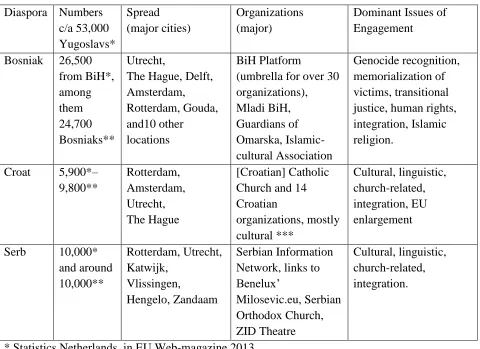
Table 1 is a “snapshot” approach to the 2011-2012 diasporas when this research was
conducted, with a focus on size, spread, organizations, and issues of engagement. The Bosnian
diaspora is larger than the other two. Size is important for mobilization but not a stand-alone
factor. During the Yugoslav disintegration all three diasporas were highly mobilized, but in the
2010s activism dissipated among the Serbs and Croats, not among the Bosniaks. The three
groups live throughout the country with some concentrations in Rotterdam, Amsterdam, and The
[image:10.612.69.543.397.535.2]Hague, and all three have been rather well organized.
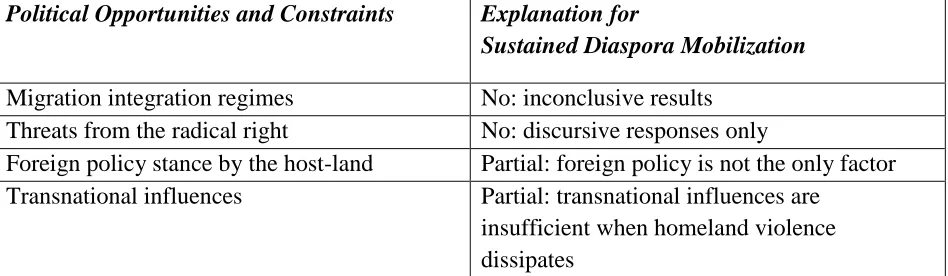
TABLE 1: POLITICALY RELEVANT FACTORS
Political Opportunities and Constraints Explanation for
Sustained Diaspora Mobilization
Migration integration regimes No: inconclusive results Threats from the radical right No: discursive responses only
Foreign policy stance by the host-land Partial: foreign policy is not the only factor Transnational influences Partial: transnational influences are
insufficient when homeland violence dissipates
Alternative Explanations
TABLE 2: COMPARATIVE DIASPORA CHARACTERISTICS
Diaspora Numbers c/a 53,000 Yugoslavs* Spread (major cities) Organizations (major)
Dominant Issues of Engagement
Bosniak 26,500 from BiH*, among them 24,700 Bosniaks** Utrecht,
The Hague, Delft, Amsterdam, Rotterdam, Gouda, and10 other
locations
BiH Platform
(umbrella for over 30 organizations), Mladi BiH, Guardians of Omarska, Islamic-cultural Association Genocide recognition, memorialization of victims, transitional justice, human rights, integration, Islamic religion.
Croat 5,900*– 9,800** Rotterdam, Amsterdam, Utrecht, The Hague [Croatian] Catholic Church and 14 Croatian organizations, mostly cultural *** Cultural, linguistic, church-related, integration, EU enlargement
Serb 10,000* and around 10,000** Rotterdam, Utrecht, Katwijk, Vlissingen, Hengelo, Zandaam Serbian Information Network, links to Benelux’ Milosevic.eu, Serbian Orthodox Church, ZID Theatre Cultural, linguistic, church-related, integration.
* Statistics Netherlands, in EU Web-magazine 2013.
** community estimates: Bosniaks (Valenta and Ramet 2011); Croats (Mulalic et al 2004); Serbs (Serb Diaspora map).
*** Kantoci (2011).
Migration scholars often assert that migrants’ behavior is conditioned by the host-state’s
integration regime, presenting institutional opportunities and constraints for mobilization.
Acquisition of citizenship on a jus soli (place-based) basis is more conducive to integration than
on jus sanguinis (blood lineage) basis (Joppke 1999). Other institutional arrangements such as
Kymlicka 2006, Modood et al. 2006). Scholarship is inconclusive as to how integration affects
migrants’ transnational political mobilization. In one view, clusters of institutional arrangements,
collective identities, and homeland influences contribute to isolation and prompt migrants to
make homeland-oriented claims (Ireland 1994, Koopmans et al. 2005). In another view,
well-integrated individuals, especially from the second generation, are mobilized well (Lewis 2007,
Baser 2012). From a third perspective, transnational engagement depends on the paths of
migrants’ “segmental assimilation” into a host society (Portes and Zhou 1993, Morawska 2004).4
Nevertheless, none address whether mobilization will be episodic or sustained.
The integration regime does not exclusively explain the outcomes of diaspora
mobilization. In the 1990s the Netherlands, in line with many European countries, initially
offered only temporary protection to refugees from former Yugoslavia, but allowed permanent
resettlement over time (Valenta and Ramet 2011). Respondents of all nationalities claimed they
obtained citizenship around 5 years after arrival (see also Al Ali et al. 2001). But they also
shared challenges. The Netherlands initially put the refugees in asylum centers (Korac 2013),
and over time dispersed them among various cities to prevent spatial segregation (Koprivova
2011). The state treated them as subjects of integration policy, and the majority maintained a
thick social boundary (Korac 2003). The first generation was most active to respond to these
circumstances.
A second cluster of explanations features a threat from the rise of radical right parties
across Europe: the parties of Jean-Marie Le Pen in France, Jörg Haider in Austria, and Pim
Fortuyn and Geert Wilders in the Netherlands, among others. The radical right targets minorities
and immigrants as “enemies within the state and outside the nation” (Mudde 2007:71). It
excluding culturally alien migrants (Huysmans 2000:758). Radical right programs portray
asylum as a security concern (Özekim 2013:924). Discursive threats in turn trigger security
dilemmas among the targeted populations. The more durable the attacks, the more one might
expect diaspora entrepreneurs to use homeland-oriented claims.
Scholars have paid little attention to how the radical right affects transnational diaspora
mobilization. I asked diaspora entrepreneurs whether the statements of Geert Wilders, leader of
the Party for Freedom (PVV), affect their mobilization. This party became third-largest after the
2010 general elections, supported a minority coalition government until April 2012, and remains
politically important.
The rise of the PVV did not induce sustained diaspora mobilization. Its impact was
strongest for Bosniaks, attacked on both Muslim and immigration grounds (Croats and Serbs are
immigrants but Christians). Radical right attacks fostered responses that preserved their
conflict-generated identity. But only one Bosnian respondent from the second generation claimed these
events prompted him to join a Dutch political party (R2). Some Bosniaks said they had built
thicker links with other Muslim groups (R1, R3). But it remains unclear whether they did so
because of Islamic faith or in reaction to Wilders. Other interviewees said they strongly disagree
with Wilders, but behave as “good members of Dutch society” and hope their Dutch colleagues
and friends realize how “unsubstantiated his claims” are (Koinova 2014b).
A security dilemma emerged based on painful memories, but reaction among the three
groups was limited to discourse and did not become sustained. Bosniaks made discursive links
between Wilders’ hate speech and that of nationalist leaders during Yugoslavia’s collapse, most
notably indicted war criminal Radovan Karadzic (R2, R11). A respondent argued:
society. They argue: “one can say what one wants.” But … this talk … causes that [Bosniak]
people do not talk about other Dutch politicians, but Wilders. … Bosniaks were earlier murdered
because they are Muslim. Now they are attacked because they are Muslim…” (R1).
Wilders’ speech bothers Serbs and Croats as well (Vitkovic 2012, R13). An interviewee
of Serbian origin drew similar parallels between Wilders’ statements and nationalist rhetoric
during Yugoslavia’s disintegration (R6). But his attacks did not spur political activism. Croats
and Serbs forged nonpolitical associations with peoples from Eastern and Southern Europe, and
occasionally from Latin America (R4, R5).
The foreign policy of a host-state towards the original homeland is the third factor
offering political opportunities and constraints for diaspora mobilization. So far most scholars
have sought to explain foreign policy outcomes of ethnic lobbying. If the host-land government
is receptive to diasporas’ goals, and if diasporas are well organized on foreign policy issues,
promote policies government already favors (“strategic convergence”), or find points of
“permeability of and access to the government,” then lobbying can be successful (Haney and
Vanderbush 1999, Shain and Barth 2003, Rubenzer 2008). Diasporas can even “capture”
host-state policies, and prompt intervention in conflicts abroad (Mearsheimer and Walt 2007).
Little is known about when “foreign policy” becomes a factor inducing diaspora
mobilization, not an outcome of ethnic lobbying. Arguments about Dutch foreign policy help
elucidate the difference between two potential explanatory factors: foreign policy and a traumatic
contentious issue that binds diaspora, homeland, and host-land. Foreign policy is formulated by
states for other states. During the Yugoslav wars the Netherlands participated in peace-keeping
missions, NATO operations, and hosted refugees. Since then it prohibited Yugoslavia’s
the International Criminal Tribunal for the former Yugoslavia (ICTY). This stance prevented
Croatia’s and Serbia’s progress until recently.5Some in the Croatian diaspora organized to lobby
for accession (R4), while Serbs were less organized (R6). But there was no clear relationship
between foreign policy stances and how sustained or episodic mobilization would be.
It is also unclear whether Dutch foreign policy has been strategically convergent or
divergent regarding BiH, but diaspora mobilization has been sustained. The Netherlands has not
supported BiH’s EU accession, more for reasons of failed institution-building than for
noncompliance with the ICTY. But the Netherlands was the fifth largest international donor of
development aid to BiH (EUFC 2007).
A brief counterfactual regarding Dutch foreign policy vis-à-vis Macedonia, another
post-conflict state in the Western Balkans, demonstrates why foreign policy is only a partial
explanation. Foreign aid to Macedonia is focused on generic issues such as implementation of a
peace agreement, education, and rural development (Koinova 2014b). In contrast, foreign aid to
BiH has a sectoral focus on Srebrenica, aiming to ameliorate the effects of Dutch peace-keepers’
failure. Funds were spent on Srebrenica-related aid in addition to governance, human rights,
peace-building and refugee return (EUFC 2007).
Transnational influences from the original homeland can be independence struggles,
intra-ethnic conflicts, foreign occupation, civil wars, and oppressive dictatorships (Koopmans et
al. 2005). They can be specific events, such as onset of violence in the homeland, when diasporas
often radicalize by expanding claim-making to more moderate members. They can be specific
initiatives inaugurated by homeland “diaspora directorates,” or by political parties, and cultural
and religious associations with branches abroad (Hägel and Peretz 2005).
more sustained mobilization by one of them. Yugoslavia’s disintegration was mirrored by the
disintegration of “Yugoslav clubs” and schools in the Netherlands (Vitkovic 2006, Kantoci
2011). Many Yugoslavs abroad became gradually Serbs, Croats, and Bosniaks, after
long-distance association with the emerging homeland nationalist movements (Skrbis 1999:133).
During the war, all groups were highly politicized, with branches of political parties operating on
Dutch territory. In the absence of violence after the war, transnational influences continued, but
less intensely and more focused on diaspora contributions for economic reconstruction with
remittances (R16) and community-related aid (R3). During the 2000s many Croat networks
demobilized (Kantoci 2011), activism was weak among Serbs (R7, R8), but remained sustained
only among Bosniaks.
Transnational influences can also emanate from the international system and its
geopolitical and normative context. Some geopolitical considerations might have favored better
Croatia than Serbia, since Croatia is predominantly Catholic and culturally closer to the
Netherlands, while Serbia was considered the main culprit in Yugoslavia’s wars. Some even
argue that the Dutch were not entirely neutral, but sided with pro-independence factions (R17).
Such an explanation is unsatisfactory, as both diasporas had episodic mobilization, while the
political opportunity structures were relatively open for Croats and closed for Serbs. The
international normative context enabled but did not cause sustained mobilization among
Bosniaks. The ICTY and International Court of Justice declared the 1995 Srebrenica events
“genocide.” The international community further used these events to support initiatives for
constitutional changes in BiH (Nettelfield and Wagner 2014). Yet in the Dutch context, the
peace-keeping failure that enabled the Srebrenica genocide, not the genocide itself that became
Sustained Diaspora Mobilization
I argue that a “traumatic contentious issue” that brings together homeland, host-land, and
diaspora is central to the sustained diaspora mobilization among Bosniaks in the Netherlands.
The failure of the Dutch peace-keeping forces (Dutchbat) to protect the UN enclave of
Srebrenica in 1995 originated in challenges to UN peace-keeping, but became deeply embedded
in Dutch domestic politics. The Bosniak diaspora became locked into a traumatic identity,
exacerbated by homeland transnational influences, where movement to further recognize
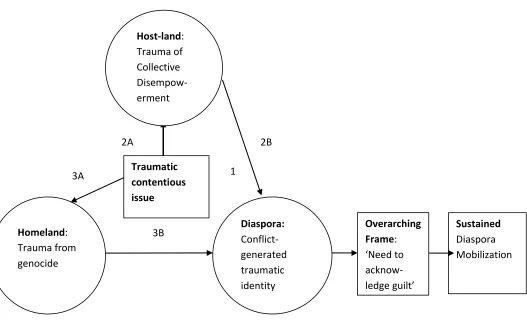
Srebrenica as “genocide” (Nettelfield and Wagner 2014) has been growing. Figure 1 summarizes
[image:17.612.25.552.399.720.2]the political process.
FIGURE 1: SUSTAINED DIASPORA MOBILIZATION
Traumatic contentious issue Diaspora: Conflict-generated traumatic identity Homeland: Trauma from genocide
2A 2B
Host-land: Trauma of Collective Disempow-erment 1 3A
3B Overarching
In July 1995 Bosnian Serb paramilitary forces under command of Ratko Mladic,
currently on trial at the ICTY, overwhelmed the lightly armed Dutchbat, seized the UN
“safe-area” of Srebrenica, inhabited primarily by Bosnian Muslims, and killed about 8,000 men and
boys (Simons 2013). For more than a decade, until rulings by the Dutch Supreme Court in 2013
and a District Court in 2014, the government denied responsibility, emphasizing that Dutchbat
was part of a weak UN-sanctioned mandate.
The failure of Dutchbat to protect Srebrenica had tragic implications on the Bosniak
diaspora (Link 1, Figure 1). Refugees from Srebrenica were not the most numerous (around 500)
compared to Sarajevo (2,753), Zenica (1,919), and Prijedor (1,117) (Mulalic et al. 2007:37). But
their traumatic experience, coupled with killings and torture in concentration camps, were
amalgamated into a traumatic conflict-generated identity among refugees.
The traumatic events became especially important for Bosniaks as they became
embedded in Dutch domestic politics (Link 2A, Figure 1). A mechanism facilitating this
embeddedness was what Zarkov (2002) and Rijsdijk (2012) called “Srebrenica trauma” in Dutch
society. In Zarkov’s words, this was “the overwhelming feeling of Dutch soldiers and Dutch
military stationed in Srebrenica, and the sense of humiliation of the Dutch nation, in the eyes of
the world.” Dutch commitment to human rights norms, international law, and naming and
shaming of noncompliant states sharply contrasted with Dutchbat behavior in Srebrenica, leading
to an increased sense of guilt and need to “recapture the lost sense of international acclaim”
(Subotic and Zarakol, 2012:930-32).
Numerous government and societal initiatives were launched to approach Dutchbat
involvement in Srebrenica. A 2002 investigative report by the Netherlands Institute on War
government to fall (Van den Berg 2010). Political and academic institutions became involved in
inquiries about the peace-keepers (Zarkov 2002). In 2002 the highly rated television series The
Enclave featured the Bosnia war and Dutch involvement (Zarkov 2014). Reconciliation
programs worked through Dutch NGOs such as Inter-church Peace Council Netherlands (IKV),
Press Now, and the Netherlands-Srebrenica Working Group (EUFC 2009).
Nevertheless, for more than a decade the trauma of Dutch society and the Bosnian
refugees offered no foundations for closure (Link 2B, Figure 1). Until the court rulings in 2013
and 2014 there was no official acceptance of guilt or apology. The government resignation aimed
to bring closure to the political debate, not to apologize to the victims. As Van der Berg argues,
questions by survivors were largely ignored, and the official narrative became embedded in
government responses. Public debates slightly opened after emotional meetings between former
Dutchbat soldiers and survivors in 2007 and 2009 (2010:22), but political elites remained closed
(Nobles 2008:3) and far from supportive. Even with the latest decisions, the judiciary, not
political figures ruled in favour of the aggrieved. Thus, the diaspora resentment continued.
The tragic events in Srebrenica became embedded in the relationship between host-state
and home-state (Link 3A, Figure 1), and between home-state and diaspora (Link 3B). Bosniak
elites, institutions, and wider society became increasingly concerned about “genocide denial”
from Republika Srpska, a Serb-dominated part of BiH, and from Serbia’s Tomislav Nikolic in
2012. The Bosniak diaspora participated in a series of transnational activities to counter such
claims, emanating predominantly from BiH, and to spread the “genocide” message to wider
international circles. Bosniak diaspora entrepreneurs had further incentives to organize activities
around an overarching need to “recognize guilt.” This frame gives meaning to collective action
against unapologetic elites, and promote need for genocide recognition.
The Bosniak diaspora resented the lack of interest of Dutch officials in the most
important annual event, the July 11 commemoration of Srebrenica (Koinova 2014b). They also
organized in a targeted way. The major focus of several youth working groups has been to
pursue the genocide recognition of Srebrenica, and even link it to the Armenian genocide
(Respondents 1 and 2). Such appeals have been strengthened by two factors. In 2009 the
European Parliament passed a resolution declaring the Srebrenica events an “act of genocide”
and called on the European Commission to commemorate the anniversary (European Parliament
2009). Diaspora activism increased to broaden appeal through EU lobbying and involvement of
sympathetic politicians in communal events, most notably Emine Bozkurt, representative of the
Dutch Labor Party in the European Parliament.6 In September 2010 she organized with Mladi
BiH and the BiH Platform the first European Parliament conference of the Bosnian diaspora
(Congress of North American Bosniaks 2010) and continued to lobby for BiH reforms (Bozkurt
2012).
Hasan Nuhanovic’s actvism was among the most sustained. Nuhanovic was a UN
interpreter with Dutchbat in Srebrenica. His entire family were handed to Dutchbat and murdered
after seeking refuge in the UN protected area (Nuhanovic 2010). He testified before the ICTY,
wrote a book Under the UN Flag, helped establish the BiH Srebrenica memorial, and forged
close collaborations with transnationally active survivor groups. He also launched a decade-long
“lonely campaign” to “force the Dutch state to accept at least some responsibility for the deaths
of his family members” (Dobbs 2011). His court campaign started yielding substantial results
only in 2011, when a Hague-based appeals court overturned a lower court that acquitted the
considered “historic,” since it ordered the Dutch state to compensate victims’ families, and
demonstrated that “people participating in UN missions are not always covered by the UN flag”
(Bowcott 2013). In a case filed by Mothers of Srebrenica, a 2014 Dutch District Court found the
Netherlands responsible for 300 deaths, but not for another 7,000 people over whom Dutchbat
had no direct control (Boon 2014).
An uneasy relationship remains between the Bosniak community and former Dutchbat
soldiers. A 2014 Facebook photo posted by a former soldier shocked the Bosniaks, as it featured
a soldier lifting three fingers, a Serb paramilitary victory sign. In a meeting of Association of
Srebrenica Survivors with more than 200 people, a discussion was launched to send a protest
letter to the Defense Ministry. Emin Hasanovic reveals that such behavior is not isolated, and the
community wants to signal it will not be tolerated (NPO 01/20/2014).
The focus of diaspora organizations and informal leaders on raising awareness of
Srebrenica is a hub for activism on other traumatic issues. The Islamic-cultural Association of
Bosniaks sends contributions to support war-affected families in BiH (R3). Omarska camp
survivor Satko Mujagic leads initiatives to develop a memorial at the site, and the Facebook
group “Guardians of Omarska” (R12). Although Mujagic’s activism is not directly related to the
Srebrenica genocide or the Dutch government, it operates in a political context where victimhood
claims are sustained through traumatic experiences among related diaspora networks. Book
discussions featuring war memories are common in Amsterdam’s DeBalie Forum. On one
occasion, Hamdija Draganovic, an Omarska and Manjaca camp survivor, mentioned: “in order to
heal, one needs answers,” but he “has not received such answers yet.” Ara Hadzic, a Trnopolje
camp survivor, added, “we have a role as ambassadors” to bring these memories to the Dutch
Episodic Diaspora Mobilization
The absence of a traumatic contentious issue to interconnect diaspora, homeland, and
host-land is visible among the Croats and Serbs in the Netherlands. There has been no unifying
grievance around which diaspora entrepreneurs could rally wider networks, leaving activism
episodic, related to communal and church events and to ICTY developments.
Croat diaspora mobilization is sporadic. Fourteen organizations currently exist to
maintain Croatian identity, but many are inactive (Kantoci 2011), apart from cultural and
educational institutions and a basketball club (R13). Major political organizations, including
branches of Croatian parties, most notably Franjo Tudjman’s HDZ, and Rotterdam radio ceased
to exist by 2008-2010 (Kantoci 2011, R13). Core organizational activities have been carried out
by the Catholic Church, which attracted BiH Croat refugees during the war (R13, R14), and
gathered diaspora contributions for humanitarian projects. The Catholic Church is a major
institution for Croats at home and abroad, even if resented by some for its strong involvement in
politics (R14). Some individuals became active to bring more attention about Croatia to
European institutions and networks (R4). Lobbying involved the Christian Democrats and Green
Left, but was also sporadic (R14).
Mobilization in the Serb diaspora is sporadic too. In 2011 the Serbian Information
Network included dialogue between the Serb diaspora in the European Parliament, and a meeting
with students from the ethnically divided city of Mitrovica in Kosovo (SIN 2013). Some links
were forged with a Brussels-based organization to organize Serbs from Benelux countries (R7),
but the diaspora is not well organized (R7, R8). Current activities fade against the past when
Raznatovic-Arkan was illicitly active (R17), and politicians from Serbia and Krajna visited (Vitkovic 2006).
The Serbian Orthodox Church continues to be an important institution. In cooperation with
diaspora individuals it helped build a monument for Serbian soldiers from World War I (R17).
During the war the Church attracted Serb refugees from BiH and Croatia (R6), engaged the
community in sending aid to Serbia, Krajna and Republica Srpska (Vitkovic 2006), and often
defended Serbian nationalists. Some hesitate to associate with church-related networks, to “avoid
questionable influences” (R6). Many hesitate to organize publicly because of a feeling of
stigmatization, rooted in public perceptions of atrocities and criminality during Yugoslavia’s
wars (Vitkovic 2012).
The most contentious yet episodic mobilization evolved around developments at the
Hague-based ICTY. Its presence on Dutch territory took on a special meaning: ICTY is located
in The Hague, considered by some the “legal capital of the world,” and its proximity gave
opportunities for activism (Koinova 2014b). Diaspora networks were organized especially when
war criminals were indicted, brought to trial, or given verdicts (R8, R9). Large demonstrations
took place when Serbian president Slobodan Milosevic and Croatian general Ante Gotovina were
put on trial, and when Mladic and Karadzic were captured. Of high significance to the homeland,
these events were often coordinated from there or a third location. For example, when Gotovina
was captured, the Dutch-based diaspora did not lead the main effort. Organizers were from
Croatia proper and other Europe-wide Croatian organizations, most notably from Germany (R9).
Similar reports exist among Bosniaks. When activists from BiH were bussed to the Netherlands
to protest against Karadzic, diaspora activists were little prepared to properly field events (R1).
Compared to the other diasporas, Serbian activists have kept a relatively low profile. But a
Unlike the peace-keeper’s failure in Srebrenica, which interlocked issues for all three
actors, ICTY events were contentious, but contextualized in the Netherlands episodically through
the public sphere (Koinova 2014b). Criticism exists that Dutch media cover primarily when
someone is captured, indicted or tried, but present the ICTY mainly in a positive light, despite
worldwide criticism for its politicized conduct (R17). Bosniak diaspora activists considered
ICTY’s work as satisfactory to prosecute war criminals, but were dissatisfied with the “soft
ways” to handle war criminals, including their length of sentences (R2, R15).
In contrast to the Bosniaks, Croat activists voice dissatisfaction that the indicted were not
tried in Croatia. A respondent found that connecting delivery of war criminals with EU
integration is problematic:
“Law and politics need to be separated…. It was a mistake to connect the tribunal to the
EU…. The Croatian government delivered [general] Gotovina… and later paid for his defence.
The government claimed they were forced to do so under pressure, not because they were
convinced he was criminal: “our boys cannot be criminals, they cannot be guilty” (R13).7
Another activist argued that had it not been for the ICTY, full integration of Croats in the
Netherlands could have happened much earlier (R4). Even more dissatisfaction was voiced in the
Serb diaspora, where the ICTY is considered an instrument of great power politics and its
legitimacy strongly questioned (R7). All respondents disapproved of the blurring of international
law and politics and the long time the ICTY took to complete proceedings. One person called it
“a museum of war… with no real effect” (R6). But no sustained action followed.
Conclusions
from the same homeland continue to mobilize in sustained ways during post-conflict
reconstruction, while others do not.A crucial factor for sustained mobilization is an unresolved
traumatic issue that binds diaspora, host-land, and homeland. Dutch peace-keepers’ failure to
protect the Srebrenica enclave in 1995 was not an issue of domestic politics such as the radical
right emergence, which concerned host-land and diaspora but not homeland. It was not an issue
of state-to-state relations such as Dutch foreign policy, which concerned the host-land and
homeland but rarely factored the diaspora. It was also not a simple issue of diaspora response to
transnational political processes. Deeply embedded in the domestic politics of the host-state, the
contentious issue prompted the diaspora to act. Such an issue did not exist for the Serbs and
Croats. They had organized conflict networks during warfare, but mobilized episodically during
the research period.
How do we know such a traumatic contentious issue is not confined to this case?
Controlled comparisons can derive external validity from a universe of cases to which the
original cases belong. I offer plausibility probes for cross-country and cross-group comparisons.
The cross-country comparison engages the same group in a different host-land, the Bosnian
diaspora in Sweden. Unlike the Netherlands, Sweden was not negatively implicated in the
Yugoslav conflict. Studies of post-Yugoslav diaspora attitudes in Sweden refuted an argument
that traumatic identities of conflict-generated diasporas are less reconciliatory than those of
co-nationals in the homeland (Hall and Kostic 2009, Kostic 2012, Hall 2015). Why, then, were
people of the same Bosniak origin more challenged reconciling in the Netherlands? While
further in-depth comparison is due, new research shows that even when mobilizing for
remembrance of the Srebrenica genocide, some cultural initiatives have a reconciling function in
is likely that the absence of a traumatic contentious issue, in which the host-land is directly
implicated, may facilitate closure of war-related traumas.
Cross-group comparison can further shed light on the importance of the host-land’s
involvement in a traumatic issue. Consider some preliminary research on Palestinian
mobilization in the Netherlands and the UK. In numerous narratives of Palestinian diaspora,
Britain is considered the country that created the problem, by permitting the formation of Israel
during its mandate. Thus, Britain is targeted to “take the blame” and apologize (Nabulsi 2006,
Safieh 2010). Although UK-based Palestinian mobilization is not focused on this issue only, but
builds on others related to the Israeli-Palestinian conflict, its salience is high in the UK, not in the
Netherlands. Like in Britain, Palestinian diaspora activists in the Netherlands lobby to change
their host-land’s foreign policy, considered pro-Israeli, and seek to advance homeland-oriented
claims. But in the Netherlands diaspora activism is minimal, much less covered in the media, and
without narratives about historical guilt or need for apology.8 Hence, a traumatic issue linking
the diaspora with the host-land is analytically important.
Finally, this article sheds light on scholarly concerns on how to factor in the “presence
within” liberal states of nonliberal subjects, among them some diasporas. Homeland political
processes influence diaspora mobilization, but little is known about how these influences interact
with the host-state’s political context. I maintain that homeland influences can be magnified
when a traumatic contentious issue connects the diaspora with its host-state. Even if diasporas
are well integrated in liberal societies, the issue remains in the public sphere and is challenged
and contested. Even moderate sustained diaspora mobilization can help further victim-based
approaches in a receptive environment. Unless there is a concerted effort for closure,
Bibliography
Adamson, Fiona (2006). Crossing borders. International Security 31(1):165-199.
Adamson, Fiona (2013). Mechanisms of diaspora mobilization and the
transnationalization of civil war. In Checkel J, ed. Transnational Dynamics of Civil War.
Cambridge: Cambridge University Press.
Adamson Fiona and Demetriou, Madeleine (2007). Remapping the boundaries of ‘state’
and ‘national’ identity. European Journal of International Relations 13, 4 (2007):489–526.
Al-Ali, Nadje et al. (2001). Refugees and transnationalism, JEMS 27 (4):615-634.
Anderson, Benedict (1998). The Spectre of Comparisons. London:Verso.
Banting, Keith and Kymlicka, Will (2006). Multiculturalism and the Welfare State.
Oxford: Oxford University.
Baser, Bahar (2012). Inherited conflicts, Ph.D. dissertation, EUI, Florence.
Beinin, Joel and Vairel, Frederic (2011). Social Movements, Mobilization and
Contestation in the Middle East. Stanford: Stanford University Press.
Boon, Kristen (2014). Mothers of Srebrenica decision (Dutch). Opinion Juris,
http://opiniojuris.org/2014/07/17/mothers-srebrenica-decision-dutch-high-court-holds-netherlands-responsible-300-deaths-1995-massacre/.
Bowcott, Owen (2013). Netherlands to pay compensation over Srebrenica massacre. The
Guardian, September 6.
Bozkurt, Emine (2012), Representative of the Labor Party (NL) in the European
Parliament, author’stelephone interview, June 27.
(1):1-19.
Brinkerhoff Jennifer, ed. (2008). Diasporas and Development. Boulder, CO: Lynne
Rienner.
Collier, Paul and Hoeffler, Anke (2000). Greed and grievances in civil war. World Bank
Policy Research, WP 2355.
Comiteau, Lauren (2011). Court says the Dutch are to blame for Srebrenica deaths. Time
World, July 6.
Congress of North American Bosniaks (2010) August 30, 2010,
http://www.bosniak.org/1st-conference-of-bosnian-diaspora-in-the-european-parliament/.
DeBalie (2014). Scars and dreams (video-stream, Dutch), March 1,
https://vimeo.com/87941799
Dobbs, Michael (2011). Srebrenica and the failures of the UN. Foreign Policy Blog,
October 20,
http://dobbs.foreignpolicy.com/posts/2011/10/20/srebrenica_and_the_failures_of_the_un
EU Framework Contract (EUFC), 2007/2009, No.162297,
http://stocktaking2009.wbif.eu/docs/Draft%20December%202009%20-%20Vol%201%20-%20Main%20report.pdf
Hägel, Peter and Peretz, Pauline (2005). States and transnational actors. European
Journal of International Relations 11(4):467-493.
Halilovic, Hasan (2013). (Re)construction of local identities in BiH Diaspora. In
Emirhafizovic M et al, eds. Migration from Bosnia-Herzegovina, University of Sarajevo.
Hall, Jonathan (2015). Are migrants more extreme than locals after civil war? Journal of
Hall, Jonathan and Kostic, Roland (2009). Does integration encourage reconciliatory
attitudes among diasporas? Center for Global Studies, GMU Paper 7, August.
Haney, Patrick and Vanderbush, Walt (1999). The role of ethnic interest groups in US
foreign policy. International Studies Quarterly 43(2):341-61.
Huysmans, Jeff (2000). The European Union and the securitization of migration. Journal
of Common Market Studies 38(5):751-777.
Ireland, Patrick (2004). The Policy Challenge of Ethnic Diversity. Cambridge, MA:
Harvard University Press.
Jasper Jasper (2005). Social movements.
http://www.jamesmjasper.org/files/Social_20Movements.pdf
Joppke, Christian (1999). Immigration and the Nation-state. Oxford: Oxford University
Press.
Kantoci, Ivan (2011). Croatian organizations in the Netherlands, Lecture delivered (in
Dutch), Symposium “50 Years Croatians in the Netherlands,” Rotterdam, November 12.
Karabegovic, Dzeneta (2014). Što Te Nema? Nationalism and Ethnic Politics
20(4):455-475.
Koopmans Ruud et al. (2005). Contested Citizenship. Minneapolis: University of
Minnesota Press.
Koinova, Maria (2011). Can conflict-generated diasporas be moderate actors in episodes
of contested sovereignty? Review of International Studies 37(1):437-462.
Koinova, Maria (2014a). Why do conflict-generated diasporas pursue sovereignty-based
claims through state-based or transnational channels? European Journal of International
Koinova, Maria (2014b). Diasporas and contextualized transnationalism. In Abazovic,
Dino and Mitja Velikonja (eds), Postyugoslavia. London: Palgrave.
Koprivova, Sarka (2011). The positioning of Bosnian Muslims in the Netherlands, MA
thesis, University of Amsterdam.
Korac, Maja (2003). Integration and how we facilitate it, Sociology 37(1):51-68.
Kostic, Roland (2012). Transitional justice and reconciliation in Bosnia-Herzegovina.
Sociologija 54 (4):649-666.
Lewis, Phillip (2007). Young, British, and Muslim. London: Continuum.
Lijphart, Arendt (1971). Comparative politics and the comparative method. American
Political Science Review 65 (3):682-693.
Lyons, Terence (2006). Diasporas and homeland conflict. In Kahler Miles and Walter
Barbara, eds. Territoriality and Conflict in an Era of Globalization. Cambridge: Cambridge
University Press.
Lyons, Terence and Mandaville, Peter (2010). Think locally, act globally. International
Political Sociology 4(2):124-141.
Mearsheimer, John and Walt, Stephen (2007). The Israel Lobby and Foreign Policy. New
York: Farrar, Straus, and Giroux.
Modood, Tariq et al. (2006). Multiculturalism, Muslims and Citizenship. London:
Routledge.
Morawska, Eva (2004). Exploring diversity in immigrant assimilation and
transnationalism. International Migration Review 38(4):1372-1412.
Mudde, Cas (2007). Populist Radical Right Parties in Europe. Cambridge: Cambridge
Mulalic Lada et al. (2007). Estimates about the numbers of ex-Yugoslav population
regarding place of origin (Dutch), Central Bureau of Statistics, 3rd quarter.
Nabulsi, Karma (2006). Palestinians Register. Nuffield College, Oxford University,
August 2006.
Nettelfield, Lara and Wagner, Sarah (2014) Srebrenica in the Aftermath of Genocide.
Cambridge: Cambridge University Press.
Nobles, Melissa (2008). The Politics of Official Apologies. New York: Cambridge
University Press.
Nuhanovic, Hasan (2011). 15 years after the Srebrenica massacre. Washington Post, July
11.
Özekim, Mehmet (2013). European radical right parties as actors in securitization of
migration. International Journal of Social, Management, Economics, and Business Engineering
7 (8):923-927.
Portes, Alejandro (1997) Immigration theory for a new century. International Migration
Review 31(4):799-825.
Portes Alejandro and Zhou, Min (1993), The new second generation. Annals of the
American Academy of Political and Social Sciences 350:74-96.
Ragazzi, Francesco (2009). Governing diasporas. International Political Sociology
3(4):378-397.
Respondent (Henceforth R) 1 (2012). Bosniak youth activist, author’s interview,
Amsterdam, March 22.
R2 (2012). Bosniak youth activist, author’s interview, Utrecht, March 16.
Helmond, February 10.
R4 (2011). Croat cultural activist, author’s interview, Amsterdam, December 16.
R5 (2012). Intellectual identifying as ‘Yugoslav’, author’s interview, Rotterdam, January
28.
R6 (2012). Serb cultural group leader, author’s interview, Amsterdam, May 28.
R7 (2012). Serb cultural activist, author’s interview, Amsterdam, June 15.
R8 (2012). Activist of Serbian origin claiming Yugoslav identity, author’s interview,
Amsterdam, June 15.
R9 (2011). Activist of Croat background claiming cosmopolitan identity, author’s
interview, The Hague, November 4.
R10 (2012). Governmental organization official, author’s interview, Utrecht, March 16.
R11 (2012). Bosniak activist, author’s interview, Rotterdam, May 21.
R12 (2012). Bosniak, concentration camp survivor, author’s interview, Leiden, January
18.
R13 (2012). Croat activist, author’s interview, Rotterdam, January 24.
R14 (2012). Croat youth activist, author’s interview, Amsterdam, June 1.
R15 (2012). Bosniak activist, charity organization, author’s interview, February 6.
R16 (2011). Academic from Serbian/Yugoslav origin, author’s interview, Amsterdam,
November 26.
R17 (2015). Dutch public intellectual of Serbian descent, author’s email correspondence,
February 2015.
Rijsdijk, Erna (2012). Lost in Srebrenica. Amsterdam: Free University, Published Ph.D.
Rubenzer, Trevor (2008). Ethnic minority interest group attributes and US foreign policy
influence. Foreign Policy Analysis 4(2):169-85.
Safieh, Afif (2010). The Peace Process. London: Saqi Press.
Serbian Information Network (SIN), Website http://www.servie.nu/, accessed in May
2013.
Shain, Yossi (2002). The role of diasporas in conflict perpetuation and resolution, SAIS
Review 22 (2):115-144.
Shain Yossi, and Barth, Aharon (2003). Diasporas and international relations theory.
International Organization 57: 449-479.
Shapiro, Michael (2013). Go east, go west: War’s exilic subjects. Security Dialogue
44(4):315-329.
Simons, Marlise (2013). Dutch peacekeepers are found responsible for deaths. New York
Times, September 6.
Skrbis, Zlatko (1999). Long-distance Nationalism. Aldershot: Ashgate.
Slater, Dan and Ziblatt, Daniel (2013). The enduring indispensability of the controlled
comparison. Comparative Political Studies 46 (10):1-27.
Smith, Hazel and Stares, Paul, eds (2007). Diasporas in Conflict. Tokyo: United Nations
Press.
Sökefeld, Martin (2006). Mobilizing in transnational space. Global Networks 6 (3):
265-284.
Subotic, Jelena and Ayse Zarakol. (2012). Cultural intimacy in International Relations,
European Journal of International Relations 19 (4):915-938.
Press.
Tilly, Charles (1978). From Mobilization to Revolution. Reading, MA: Addison-Wesley.
Valenta, Marko and Ramet, Sabrina, eds (2011). The Bosnian Diaspora. Aldershot:
Ashgate.
Van den Berg, Dion (2010). Rekindling the National Debate, Manuscript.
Vitkovic, Predrag (2006). Changing Identifications (Dutch), MA Thesis, University of
Amsterdam.
Vitkovic, Predrag (2012). Predrag Vitkovic Speaks (Dutch), LIZE Newsletter 21(72):8.
Netherlands Public Broadcasting (NPO) (2014). A Dutchbat-foto shocks the Bosnian
community (audio-stream, Dutch), 20 January,
http://moslimomroep.nl/een-dutchbat-foto-schokt-bosnische-gemeenschap/
Waterbury, Myra (2010). Between State and Nation. London: Palgrave.
Wayland, Sarah (2004). Ethnonationalist networks. Review of International Studies 30
(3):405-426.
Young, Laura and Park, Rosalyn (2009). Engaging diasporas in truth commissions.
Transitional Justice 3 (3):341-361.
Zarkov, Dubravka (2002). Srebrenica trauma. In Zarkov, Dubravka and Cockburn
Cynthia, eds. Postwar Moment. London: Lawrence and Wishart.
Zarkov Dubravka (2014). Cinematic representations of the Bosnian war. In Abazovic
Dino and Velikonja, Mitja, eds. Post-Yugoslavia. London: Palgrave.
1 Bosniaks (Bosnian Muslims) are the most engaged in claim-making about Bosnia-Herzegovina, hence this article
further concentrates on their mobilization.
2 ERC ethical regulations require anonymization of respondents. I referred directly to 17 respondents, but drew
background information from many others.
4 “Segmental assimilation” refers to how migrants adapt to their host society. Some accept the majority culture and
follow an “upward mobility” assimilation path into the middle class. Others reject the culture and follow “downward mobility” into the underclass. Some become “upward mobile” only within their ethnic community (Portes and Zhou 1993).
5 Croatia joined the EU in 2013. The prospects for Serbia’s accession were blocked until April 2013, when Serbia
and Kosovo signed an agreement to normalize relations.
6 Author´s participant observation, Utrecht, March 2012 and Amsterdam, May 2012.
7 Croat activists did not comment on the ICTY acquittal of General Gotovina in 2012, which took place after the
research period. Croatia accepted Gotovina as a hero, while his acquittal was condemned in Serbia and was questioned internationally.