http://wrap.warwick.ac.uk
Original citation:Fernando, W. D. A. and Cohen, Laurie. (2013) Exploring the interplay between Buddhism and career development : a study of highly skilled women workers in Sri Lanka. Work, Employment & Society . ISSN 0950-0170
Permanent WRAP url:
http://wrap.warwick.ac.uk/55496 Copyright and reuse:
The Warwick Research Archive Portal (WRAP) makes this work by researchers of the University of Warwick available open access under the following conditions. Copyright © and all moral rights to the version of the paper presented here belong to the individual author(s) and/or other copyright owners. To the extent reasonable and practicable the material made available in WRAP has been checked for eligibility before being made available.
Copies of full items can be used for personal research or study, educational, or not-for-profit purposes without prior permission or charge. Provided that the authors, title and full bibliographic details are credited, a hyperlink and/or URL is given for the original metadata page and the content is not changed in any way.
Publisher’s statement:
‘The final, definitive version of this paper has been published in
Work, Employment & Society, September 26, 2013 by SAGE Publications Ltd, All rights reserved. © http://dx.doi.org/10.1177/0950017013481084
A note on versions:
The version presented here may differ from the published version or, version of record, if you wish to cite this item you are advised to consult the publisher’s version. Please see the ‘permanent WRAP url’ above for details on accessing the published version and note that access may require a subscription.
Exploring the interplay between Buddhism and career development: a study of highly
skilled women workers in Sri Lanka
By
Dr Weerahannadige Dulini Anuvinda Fernando
Warwick Business School
University of Warwick
Email: [email protected]
(Corresponding Author)
And
Laurie Cohen
Professor of Organisational studies
Nottingham University Business School
Jubilee Campus
Nottingham NG8 1BB
Exploring the interplay between Buddhism and career development: a study of highly
skilled women workers in Sri Lanka
This article adopts a socio cultural lens to examine the role of Buddhism in highly skilled
women workers’ careers in Sri Lanka. While Buddhism enabled women’s career
development by giving them strength to cope with difficult situations in work, it also
seemed to restrict their agency and constrain their career advancement. Based on our
findings, we argue that being perceived as a good Buddhist woman worked as a powerful
form of career capital for the respondents in our sample, who used their faith to combat
gender disadvantage in their work settings.
Introduction
This paper examines the interplay between Buddhism, gender and career. In modernizing
societies, women are participating in the labour market in increasing numbers and aspiring
to high levels in organizations (Budhwar et al. 2005). However, they are at the same time,
charged with preserving national identity (Turner, 2011), through their adherence to
religious rituals (Perera, 1997). Given the widely documented roles played by Christianity
and Islam in legitimizing traditional gender roles (Gaitskell, 1990), we could expect this to be
problematic for women’s career development. However there is little empirical work on
gender, religion and work to help us understand these issues further. Through our study of
highly skilled, socially privileged Buddhist women in Sri Lanka, a country on the threshold of
modernization, where Buddhism is an institutionalized state religion (Ameer, 1992), we
provide new insights into this important area. Given the dearth of attention to the role of
Buddhism in individuals’ careers, our study is exploratory. In contrast to extant
understandings (Anderson, 2006), we argue that faith is seen as a body of knowledge and a
set of social imperatives, which are used flexibly by women in pursuit of their career goals.
Gender, work and religion: the story so far
The literature on gender and religion is divided among studies that for women emphasize an
incompatibility between faith and work, and those which do not reveal this inconsistency.
With respect to the former, monotheistic religions such as Christianity, Judaism and Islam
which privilege women’s roles and responsibilities in the domestic arena (Anderson, 2006)
are seen to inhibit their participation in the labour force. From this perspective women who
are highly religious are less likely to enter the labour force since they strongly favour
to lower levels of involvement in religious activity (Read, 2004). This view confines religion
to mainly the private sphere (Davie, 1990) depicting faith as something people do in their
personal time but which is not related to public activity.
However, a small but growing literature takes issue with this view. For example, in Africa
and America, the church is seen to provide women with opportunities for education and
leadership (Anderson, 2006), encouraging them to achieve (Gifford, 1998; Spinks, 2002).
Furthermore religious affiliation can help women to cope with personal (Griffith, 1997) and
workplace (Constantine et al. 2006) challenges. Finally, the psychological literature on
religion and career highlights the positive effects of religiosity on motivation and career
commitment (Duffy and Bluestein, 2005).
In light of these contrasting views, this exploratory study into Buddhist women’s careers in
Sri Lanka, provide insights into what we see as a more complex relationship between
women's faith and their career enactment.
Women’s careers aspirations
In the literature on career success, in contrast to men whose career aspirations are
characterized by ‘objective’ factors like hierarchical advancement and remuneration,
women’s goals are described in terms of values such as personal accomplishment,
interesting work and recognition (Sturges, 1999; Lirio et al. 2007). Taking issue with this
largely Western literature, studies have shown how South Asian women prioritize
hierarchical advancement (Authors, 2011; Budhwar et al. 2005) and financial security
(Author B et al. 2009). For instance the professional women in Budhwar et al.’s (2005) study
in India sought senior positions in their organisations and were willing to make career-family
While such studies complicate conventional understandings by providing a national
perspective, a small stream of research yields insights into the influences of social class. Like
Budhwar’s ambitious Indian respondents, socially privileged women in North America
(Lapour and Heppner, 2008) and the UK (James, 2008) are seen to aspire for high status
occupations which provide good financial imperatives and clear paths to advancement.
These findings show that women’s career aspirations are not simply a reflection of their
value systems, but are also influenced by factors such as remuneration and social status.
Buddhism, work and women
Buddhism is the oldest religion in the world, originating in Nepal in the sixth century BCE
(Giddens, 2009). A central theme within Buddhism is that nothing is permanent (Schumann,
2007) and that all beings follow a cycle of birth, death and rebirth. Buddhism promotes a
belief in ‘Karma’, that all occurrences are based on the law of cause and effect (Niles, 1999).
One’s fate in this life is shaped by the good and bad deeds committed in previous lifetimes.
Individuals cannot escape the consequences of actions in former existences, but in present
life everybody has a free will to decide how to act (see Schumann, 2007) and these actions
influence their prospects in current and future lifetimes.
Life, according to the Buddha is marked by pain, decay and suffering (Nyanatiloka, 2000),
which can only be eliminated when one escapes the iterative cycle of birth and death
(Schumann, 2007). This can be achieved through moral conduct, intense mental
concentration (meditation) and developing one’s wisdom, defined as realising the
impermanence of everything in life and freeing oneself from all desires (Daniels, 1998). This
review shows how different Buddhism is from other religions prescribing individual
trouble-free life. The latter might be seen as an abdication of personal responsibility
because individuals put gods in charge of their prospects in life rather than taking
responsibility themselves.
Max Weber is one the first scholars to look at Buddhism in the context of work. Weber was
interested in whether non-European civilizations had the religious and cultural resources
necessary for capitalism (as he saw Protestantism as providing in Europe and North
America) (Gellner, 2008). In his examination of the economic ethics of Hinduism and
Buddhism, Weber argued that Buddhism is inconsistent with societies’ capitalist
development (Weber, 1916-1917; Weber et al. 2000). First, he proposed that the notion of
Karma led to people accepting their lot, making them unlikely to seek change. Second, he
suggested that Buddhists concentrate solely on themselves in pursuit of Nirvana, inhibiting
the social interactions necessary for economic development (Schumaan, 2007). Weber’s
(1916-1917) arguments are not without challenge (Schumann, 2007). For example, scholars
argue that ordinary people in Buddhist societies do not detach themselves from material
desires since they have other aspirations apart from reaching Nirvana (Obeyesekere, 1963).
The more general criticism here is that there are gaps between the theory and practice of
Buddhism, and one cannot base speculations about societies’ development on abstract
religious philosophies (Daniels, 1998).
The role of gender in Buddhism is controversial. Although the Buddhist doctrine of rebirth
suggests that there is no male or female per se, but only a single karmic stream (De Silva,
1994), in practice most Buddhists talk and act as if gender really exists (Gross, 2004).
Significantly while the Buddha regarded men and women as equal in their potential for
enlightenment, they were treated unequally. For instance the Buddha was initially reluctant
nuns as companions for monks, a group of women living independently of men was socially
unacceptable, and for such a group safety would be a concern (Sponberg, 1985). However
the Buddha later agreed to a women’s order, ensuring male monks precedence in matters
of salutation (De Silva, 1994) and prohibiting female monks from observing the annual
retreat (vassa) alone. While the former is an explicit example of sexism within the early
practice of Buddhism, the latter is more subtle, implying that women should not wonder
about alone unprotected.
There are very few studies on women’s roles in Buddhism. While Buddhism allows women
to pursue a religious career in contrast to some forms of Christianity and Islam, women can
do this in a regulated context that maintains the conventional gender order (Sponberg,
1985). Nevertheless in most contemporary Buddhist societies, nuns experience equality
with monks, undertaking a variety of duties in Buddhist organisations and with
opportunities for education and travel (Schak, 2008).
Women play major roles in maintaining the rituals associated with Buddhism in Asian
societies. For example, Schak (2008) writes about lay women’s roles such as volunteering,
and philanthropy in Taiwan's Buddhist groups. Significantly however, like the churches in
Africa and America noted earlier (Anderson, 2006) these groups give women the
opportunity to teach and occupy leadership positions leading to the development of work
related skills. Some women are given opportunities to travel abroad to disaster areas where
they can expand their knowledge of the world and their social networks (Schak, 2008): in
Mayrofher et al.‘s (2004) terms their career capital (resources valuable within the social
context individuals’ careers unfolds and thus helps them to progress in their careers). So
Sponberg, 1985), it also allows women gain what Woodhead (2007) would call ‘tactical’
power.
Sri Lankan context
Sri Lanka has a population of about 20 million people, 70% of whom are Buddhists. Minority
religious groups include Christians, Muslims and Hindus. Sri Lanka is characterised by
conventional gender ideologies (Lynch, 1999) extended family relations, intergenerational
caring obligations (Perera, 1991) and social divisions. However the socio-cultural position of
women is favourable when compared to other South Asian countries. There is widespread
acceptance of education and employment for women (Malhotra and DeGraff, 1997), and
the 2009 Labour Force Survey identified 90% of females as literate.
Turning to the Sri Lankan labour market, over 7.0 million people were employed during the
year 2009 (Department of Census and Statistics, 2009): 4.9 million (65%) males and 2.6
million (36%) females, suggesting a male dominated market. Women account for 50% of
clerical jobs, 34.7% of sales jobs and 33.3% of elementary occupations. However, only 2.0%
of women as opposed to 9.6% of men are employed as machine operators, highlighting
occupational gender segregation. Interestingly women comprise 63.2% of the total
professionals in Sri Lanka, but only 20% of senior officials and managers (Department of
Census and Statistics, 2009). Since there do not appear to be shortages in women’s skill sets,
this indicates barriers to women’s advancement in Sri Lankan organisations.
Buddhism is a key social institution in Sri Lanka. All state owned television and radio
channels commence and cease the day with Buddhist prayers, and all days significant to the
life of Buddha are declared as national holidays. Scholars argue that Buddhism forms a core
(Gunawardana, 1990). Buddhist nationalism has been linked to the long civil war in Sri Lanka
between the Sri Lankan government and the mainly Hindu separatist group, the Tamil Tigers
(De Voss, 2007). This war recently saw a military solution; however Buddhist
fundamentalism continues to rise with monks protesting against conversions of Buddhists to
other religions (Deegalle, 2006) and the building of mosques in pre-historic Buddhist cities.
Notably, religion is a compulsory subject in the national curriculum offering students a
choice between Buddhism, Hinduism, Islam and Christianity.
Women play particularly important roles in Buddhist temples where they assume leadership
in temple events and activities. According to Perera (1997) women in Sri Lanka are
expected to transmit the country’s traditions (including those associated with Buddhism) to
future generations. Significantly, Buddhist rituals are also part of most public and private
organisations. Buddhist priests are invited for significant events such as opening a new
branch and commemorating corporate anniversaries and some companies hold religious
ceremonies for their employees (Airforce, 2012). Notably a few private sector companies
also provide religious services for their minority staff members (Ceylon today, 2012) and
host Christmas parties for all employees. However these Christmas parties do not involve
religious rituals or association to the Christian church.
To summarize, Buddhism is seen to have the potential to constrain women’s work and
career although there is also evidence that it can likewise be used for their empowerment.
However our understandings of the relationship between Buddhism and women’s
employment are limited. It is important to explore the role Buddhist faith plays in highly
skilled Sri Lankan women’s careers because Buddhism is an institutionalized state religion in
Sri Lanka in which women have significant responsibilities. Moreover given that Sri Lankan
Buddhist faith has any impact on women’s career advancement (or the lack of it) as the
literature on monotheistic religions suggest (Gaitskell, 1990). In this this paper we examine
whether Buddhism is best conceptualised as a wholly determining set of principles which
leads to particular forms of work and career behaviour for women (e.g. Anderson, 2006) or
an important form of cultural hegemony. We address these issues by examining how highly
skilled Buddhist women in Sri Lanka account for the interplay between Buddhism, gender
and career.
Research Design
Our study is based on one-to-one face-to-face interviews with 21 women who identified
themselves as Buddhists: eight in early career (ages 24-35), six in mid-career (ages 36-45),
and seven in late career (ages 46-60). Ten respondents worked for private organisations in
Sri Lanka at the time of the interview, while eleven were in the public sector. We included
similar numbers of respondents from private and public organisations because of their
contrasting pay structures and organisational cultures. Private organisations in Sri Lanka are
considered to be high payers and to have ‘modern’, western-influenced cultures, where
superiors are addressed by first names, work-life policies are widely available and career
paths are based on individual performance. Public organisations, in contrast, are typically
poor paymasters characterised by traditional bureaucratic cultures and career paths based
on time served (Authors, 2011). Our respondents worked in medicine, finance, banking,
sales and marketing, education and engineering (see Table 1). Notably our sample does not
include self-employed women or those in informal sectors. While acknowledging this
limitation, we restricted our sample to formal organisations because we were particularly
interested in exploring how women enact their careers within these boundaries (reflecting
the careers literature more generally). However we would not wish to imply that careers
Respondents were qualified to graduate level or above. Seventeen were married and had
children, while the four unmarried women were in early career. Respondents were
identified through a snowballing sampling method (Noy, 2008). All of the women were from
Colombo the capital and experienced considerable social privilege living in desirable
neighbourhoods, employing domestic aides and educating their children in leading schools
in the country and/or renowned universities abroad.
In interviews that lasted between two and three hours, women unfolded their career
stories. Notably, we did not directly mention Buddhism. However in response to questions
such as ‘what are the challenges you encountered in your career and how did you deal with
them?’ they talked passionately about how Buddhism helped them to cope with difficult
situations (e.g. .illness and death) while carrying on with work and career. When asked
about important career resources, a number of respondents explained that some ‘external
power’ is necessary to ensure that homes run smoothly, making it possible for them to
focus on their work. Here, women referred to the powers of Hindu gods widely worshipped
by Buddhists in Sri Lanka to intervene in their troubles. Women also spoke of how much of
their time was devoted to participating in Buddhist activities with their families. Thus
Buddhism (entangled with Hindu gods as practiced in Sri Lanka) emerged as a significant
theme in our data. This prompted us to return to our respondents in separate phone or
Skype interviews, to ask them explicitly about the role that Buddhism plays in their work
and career.
All the interviews were conducted in English since it was respondents’ first language. They
were not digitally recorded because the women did not wish to have their voices on
shorthand. This was a challenging process which was practically achieved by pausing after
each answer to write verbatim notes, extending the length of an interview to over three
hours in most cases. Following the interviews the first author completed the transcripts. In
each case this was presented to the interviewee to make sure that everything she said had
been correctly captured. Respondents were also contacted through email, Skype and
telephone for further clarifications. Empirical themes were initially identified during the
data collection itself since data collection and analysis were undertaken in parallel
(Silverman, 2009). The main data analysis technique was template analysis. Following King’s
(2004) approach, we first developed a list of codes representing the key themes. These were
identified in relation to the literature reviewed, the first author’s experience of the context,
and the themes raised by respondents. However we sought out contrasting and minority
views to ensure that our analysis was based on all respondents’ voices rather than just the
dominant majority. Once the initial codes were defined, we allocated sections of data notes
to the appropriate themes. The Nvivo 8 software package was used to facilitate data coding.
The template was modified in the process of coding, using Hammersley and Atkinson’s
(1997) notion of ‘progressive focusing’. We split the dominant themes into subsidiary
categories and amalgamated some subsidiary categories together as the analysis developed.
We read and re-read the contents of each theme and wrote these up as narratives,
retaining verbatim quotations. In other words we produced a ‘coherent story’ of each data
theme (King, 2004). We focused on the relationships and associations between themes
rather than analysing the individual themes alone, gauging overriding patterns and
relationships by reading the data ourselves and trying to understand the ‘big picture’.
Findings
Following the literature reviewed earlier on sexism within the Buddhist order (see Sponberg,
might expect Buddhism to be at odds with high powered, ‘modern’ careers for women.
However our data revealed a much more complex picture which we present in the sections
that follow.
Buddhism and women’s career advancement
Given our interest in how Sri Lankan women accounted for their careers, it is important to
consider, what women sought to achieve in career terms. It is striking that all of our
respondents aspired to reach the highest possible level in their organisational hierarchies:
The day I become a director I would feel that my career has been successful (Dilhari,
46)
Ultimate career success to me would be if I become a top consultant (Roshini, 28)
The women in our sample understood career success as hierarchical advancement (Arthur
et al., 2005). This was essential to enhance not only their own but also their families’ social
statuses (Lapour and Heppner, 2008). In what follows we will explore how these women
accounted for the interplay between religion, gender and work in realising their career
aspirations.
Sixteen respondents explained that Buddhism gave them the strength to cope with difficult
situations in work and life, thus enabling them to pursue their career aspirations
(Constantine et al., 2006). Vandana talked about how living by Buddhist principles of
maintaining perfect control of the mind and emotions at all times (Nyanatiloka, 2000)
helped her get through her working day and gave her the strength to face whatever came in
I have never been out of control – whatever comes in my way I have been able to
accept it and make the best of it. In dealing with my colleagues or customers, I am
able to keep my temper at all times. I never get depressed or angry about anything.
My main motive is to live by Buddhist principles, do the right thing, make an honest
living and do my duty by everybody. This thinking has helped me be happy at both
work and home (Vandana, 38)
Similarly Kishani explained how the law of cause and effect (Payutto and Olsson, 1995) and
the notion of rebirth in Buddhism (Nyanatiloka, 2000) helped her reconcile herself to her
parents’ sudden deaths and to remain steadfast in her career development. Kishani was
able to continue with her work without taking a break since she believed that they would be
reborn in a good place. She found peace in the Buddha’s teaching that nothing in life is
permanent (Payutto and Olsson, 1995), which enabled her to carry on. Two respondents
talked about how Buddhist ideologies of being thankful for what you have (Nyanatiloka,
2000) helped them to cope with family members’ illnesses and to stay focused on pursuing
their career goals.
From quite a different perspective, several women discussed how they looked to Buddhism,
and in particular to the concept of ‘fate’ (Payutto and Olsson, 1995), to explain favourable
and unfavourable career outcomes, implying that individuals would progress in career only
if their fate allowed them to do so. In Kanthi’s words:
I suppose whatever you do and however much you try – you should have career
progress in your fate. Both my sisters were much brighter than me, hardworking than
Kanthi, who worked as a director in the civil service, did not see her sisters’ careers in
teaching as successful or prestigious. In her view, the fact that she ended up as a director in
a government department while her sisters were teachers was not a matter of preference
or aptitude, but rather a matter of fate. Vandana similarly spoke about how career
progression was determined by destiny, regardless of how hard one worked for it. By
placing so much emphasis on fate and destiny in determining career outcomes, these
women were indeed undermining the power of individual agency in shaping individuals’
careers. Dilhari talked about how fate and luck determined her chances of obtaining a
directorship in her organisation:
I don’t know whether I would ever be a director. Anyway I will accept whatever comes
in my way gratefully – you can’t have everything what you want however much you try
– your fate, luck everything plays a part. I am grateful for what I have so far… that’s
what Buddha said to us – ‘be happy with what you have’ (Dilhari, 46)
It is particularly interesting that while we might read this recourse to fate as an abdication
of personal agency, every one of the respondents spoke extensively about how they shaped
their careers through their own actions, typically through strategies like manipulation
(Authors, 2011). For instance, many respondents explained how they ingratiated themselves
with their superiors by giving compliments and doing favours (Appelbaum and Hughes,
1998) in order to enhance their career prospects:
I spent a lot of effort in trying to get close to the Director of our department. Sweet
talked him, and did everything what it takes. You know the director gives his opinion
department – I just wanted to be sure that he nominated my name over others. I
didn’t have to go to this extent since I was the most senior candidate. But I didn’t
want to take any chances anyway (Dilhari, 46)
This excerpt highlights how Dilhari strategically sought to ensure that she was promoted to
assistant director. This is contradictory to her previous statement where she emphasised
that she does not chase after desirable career statuses, but rather accepts any outcome as
part of her fate or karma, in line with the Buddha’s teachings. This theme will be developed
later on in the paper.
This strong sense of personal agency permeated our respondents’ accounts. Four women
from the public sector explained how they attempted to circumvent their organisations’
time-served based career paths by drawing the boards’ attention to their exceptional
performance. Most respondents talked about how they actively competed for the few
senior positions available through networking. These examples indicate that women
certainly believed that they could change their existing statuses through their actions, and
worked hard to improve their circumstances.
A significant way respondents attempted to enhance their careers was praying to Hindu
gods for success. Although Buddhism does not encourage worshipping deities (Obeysekere,
1963), several women attributed success in career to their spiritual relationships with
various Hindu gods. Madhavi who identified herself as a Buddhist deemed the blessings of
goddess Kali as a key resource in her career advancement:
My refuge is Kali amma (a Hindu goddess). She has never once left my side. Some
healthy, and servants don’t take off suddenly. I was extremely lucky to have had no
problems when I started off my career (Madhavi, 48)
In Sri Lankan households characterised by conventional gender divisions of domestic labour
(Lynch, 1999), career women relied on domestic aides to run their households while they
are at work and as Madhavi highlights, depended on Hindu gods to ensure that these aides
did not leave. In this sense gods were seen to not only give women spiritual strength to
manage their lives, but also to practically intervene and make things happen for them.
Indeed it was interesting that our respondents who presented themselves as staunch
Buddhists dipped into Hinduism when they felt that it would be helpful to enhance their
material well-being and career progress (questing in Woodhead’s 2007 terms). Significantly
this is in stark contrast to the Buddha’s teachings which prescribe individual responsibility
for salvation rather than relying on deities (Obeysekere, 1963). Indeed these data highlight
that women are not simply passive recipients of religion but rather active agents in
selectively using religion to nourish and facilitate their sense of personal agency
(Woodhead, 2007).
Being a good Buddhist woman at work
Notwithstanding women’s considerable manoeuvring between the imperatives of Buddhism
and their career aspirations, the importance of presenting themselves as good Buddhist
women, deeply influenced by Buddhist values and maintaining its traditions, was a striking
feature of our data. When asked directly about the role of their faith in career progression,
Buddhism is most honoured supreme power in Sri Lanka. The Buddha represents the
truth. So followers of the Buddha are associated with honesty and good values. (Rupika,
54)
Significantly, this was seen to be important not only in general, societal terms, but was also
crucial at the level of women’s work organisations. In the following extract Natasha
associates religiousness with good moral character, a feature that was seen to open doors
to senior organisational positions in the leading state owned newspaper she worked for:
Bosses are always more partial towards people who know a lot about Buddhism. Such
people are thought to be very good. This is very implicit but it certainly happens at work.
I am a Buddhist but I am not that religious. I think it is absurd to flaunt your faith. But
many people at work do this and I think it certainly helps in their careers. Having your
bosses’ respect is important for promotion. And even insignificant workers in smaller
positions have more respect for people who talk Buddhism at work – so it does help in
leadership positions since people are more likely to embrace what you say (Natasha, 25)
Natasha implies that Buddhism works as a form of cultural hegemony which is important for
acceptance and survival in her organisation. Indeed this somewhat explains the
contradiction in Dilhari’s account above where she drew on Buddhist discourses of fate
(Payutto and Olsson, 1995) to explain her career enactment although she did not necessarily
follow these teachings in practice. In other words, Dilhari appeared to be performing a
culturally appropriate role useful for her acceptance at work. Amongst our respondents
Notably as the data highlight individuals seem to be very much aware of this situation and
thus strategically invoke Buddhist discourses to further their careers. Significantly, women’s
invocation of Buddhist discourses at work indicates that religion is not an activity restricted
to only the private sphere (Davies, 1990).
Kalpana who works in Hospitality Management for a leading private sector company talked
about how women who perform Buddhism conform to the stereotype of the ideal Sri
Lankan woman and are thereby likely to surpass equally qualified but less religious women
in promotion:
I think Buddhist faith is more important for women’s careers than men’s. In Sri Lanka
women are sort of expected to be religious – especially older women. Men are not
really expected to talk about Buddhism all the time and be involved in their temples.
But women are. So Buddhism is an essential element of the ideal Sri Lankan woman.
The woman who fits this ‘ideal woman’ stereotype by going to temple regularly etc.
obviously has more chances of progressing in their organisations. They are going to
be the favourite candidate for a prospective position against other non-religious
women (Kalpana, 36)
Here Kalpana depicts the ‘ideal’ Sri Lankan woman as one who fulfils Buddhist social norms
and conventions. Notably it was not only their behaviours at work that counted, but also the
extent to which women fulfilled their wider social obligations (Radhakrishnan, 2009). For
example, involvement in the temple was a priority and respondents spoke of their frequent
attendance, their financial contributions to monks and chauffeuring elderly relatives to and
from temple activities highlighting how material rewards which resulted from their career
generalised across the Sri Lankan context, she hints at religious based discrimination at work
suggesting that some organisations base selection and promotion on individuals’ faith
rather than work specific criteria. Indeed this again highlights that Buddhism is an important
career resource for Sri Lankans, especially for women (Mayrofher et al. 2004).
Significantly respondents also talked about how being a good Buddhist enabled women to
prosper in male dominated spheres, providing them with much needed credibility and
legitimacy that served as buffers against gender related prejudices:
For the first time our logistics department hired a lady for the position transportation
manager. Everybody knows that this is a job for a man. It involves dealing with
drivers who are quite rough men. But this lady (the new transportation manager)
had a reputation for being a very credible individual and an excellent communicator.
She refers to Buddhist teachings all the time and people respect what she says.
Anyway the management thought that she would be an ideal candidate for this
position because she could influence others to embrace good values and the drivers
are likely to respect her advice since she talks in terms of Buddhism (Nishanya, 36)
Nishanya worked for a private organisation which celebrated all the days significant to the
life of the Buddha encouraging employees to participate in these events. By explicitly
highlighting that her employer recruits spiritual people for positions of leadership so that
they could influence others to embrace good values, leading to less chances of pilfering etc.,
she suggests that her organisation strategically uses Buddhist spirituality to manage
performance (Kamoche and Pinnington, 2012) while simultaneously engaging in faith based
discrimination (Bell et al. 2011). According to Nishanya, such a situation gives women who
Women might choose religion as a buffer against discrimination as opposed to discourses of
equality and women’s liberation since they perceive this as a culturally acceptable way to
wriggle themselves to the top rather than explicitly challenging their subordinated status
and risking isolation in the process (Powell et al. 2009). However by using Buddhism to
combat gender discrimination, we would argue that women are effectively reproducing
their status as the group responsible for safeguarding prevailing traditions and rituals,
including those in the home (Woodhead, 2007).
Discussion
Our data thus present a rich and varied picture of the interplay between Buddhism, gender
and career in Sri Lanka. First, based on the evidence presented, we would argue that
research into this relationship must go beyond considering women as simply passive
recipients of religious doctrines (e.g. Gaitskell, 1990), focusing instead on the ways in which
people draw on and use religion in their daily lives. For instance, rather than attempting to
attain salvation by renouncing attachments (Weber et al. 2000) or devoting their entire lives
to maintaining Buddhist rituals (Schak, 2008) our respondents spoke of how the material
prosperity which resulted from their career success enabled them to fulfil their roles as
good Buddhist women, including donating alms to monks and providing for their extended
family members. Indeed respondents recounted numerous examples of how they
strategically took charge of their career development, using their faith to cope with the
difficult situations they encountered at home and work (Griffith, 1997) and spiritually
invoking Hindu gods when Buddhism failed to provide the particular support they needed to
advance (Woodhead, 2007).
As illustrated, there was at the same time considerable talk of fate and several respondents
choice or action. Thus, there was a significant contradiction in women’s accounts where at
times faith was linked to a strong invocation of personal agency, but in other instances
resulted in an abdication of such agency. We argue that such behaviour was largely
motivated by women’s desire for cultural acceptance (Radhakrishnan, 2009). Indeed in
every case the ‘surrender’ of agency (due to faith) was juxtaposed to examples of highly
strategic behaviour, and descriptions of how women carefully managed the impressions
they made as well as their workplace relationships. Thus what we found was considerable
manoeuvring as women selectively invoked aspects of their Buddhist faith to
support/justify/legitimise their career accounts, while carefully upholding their
self-presentation as ‘good, Buddhist women’. Thus in our data faith was not depicted as a wholly
determining set of principles which led to particular forms of work and career behaviour for
women (e.g. Anderson, 2006) but instead was presented as a body of knowledge and a set
of social imperatives, that were used flexibly by women in pursuit of their career goals.
Indeed this capacity to actively navigate between faith and work could be expected from
socially privileged professional women who have been described as highly ambitious
(James, 2008).
Second, we would argue that for our respondents Buddhism can be seen as a powerful form
of career capital (Mayrofher et al. 2004). Our data shows how women who profess
Buddhism at work are associated with credibility, while those who emphasise their
involvement in temple life are seen as ideal women (Radhakrishnan, 2009). These factors
not only helped respondents climb up their organisations’ hierarchies, but in some cases
also buffered gender discrimination when good Buddhist women were chosen for
leadership positions reserved for male candidates since they were perceived as having the
potential to pass on moral values to their subordinates. So rather than collectively invoking
very public but highly individualistic way in order to create a good impression and to combat
gender discrimination. Given that the former risked disturbing the status quo in
organisations which subordinated women, and also challenged national identity that closely
confirms women’s place in the private sphere (Radhakrishnan, 2009), our respondents
chose to craft their careers within the boundaries placed on them, attempting to draw on
the same factors which contributed towards their marginalisation (Schak, 2008) to their
advantage. However by using religion to combat gender inequalities at work, women
reinstated their status as society’s moral guardians (Perera, 1997) providing spiritual
sustenance and passing on Buddhist traditions both at home and in the workplace. Women
were thus depicted as having significant social obligations, in contrast to men who appeared
to be free to develop their careers without these ancillary concerns. We would argue that
such normative assumptions consolidated the rigidly unequal system of gender
relationships within both work contexts and wider society. These findings make a significant
contribution to the few studies on women in modernising societies which highlight how
women use culturally appropriate discourses to craft acceptable work identities
(Radhakrishnan, 2009; Lynch, 1999) without considering the implications of such actions.
Furthermore respondents’ usage of religion to overcome gender discrimination can be seen
as a new gender management strategy used by women to gain acceptance at work (Powell
et al. 2009).
Third, our findings show how some organisations in Sri Lanka select mainly Buddhist women
for senior positions, thereby potentially leading to faith based discrimination at work. While
we do not claim that our data is representative of the entire Sri Lankan context, we propose
that in this rapidly changing economic and social environment, having good Buddhist
women in senior positions is not only a way of ensuring the highest standards of ethics in
of tradition and legitimacy to this fluid context (Turner, 2012). Indeed scholars have argued
that the quest towards preserving Sri Lanka’s rich cultural heritage inextricably linked to
Buddhism, leads to the superordination of Buddhists in the country and the subordination
of religious minorities (De Votta, 2007). However we need more empirical work to fully
understand this dynamic: particularly case studies of Sri Lankan organisations (those defined
in terms of Buddhist values, those which are not and organisations which are foreign
owned) focusing on how religion impacts on recruitment and selection, promotion, the
uptake of training and other similar issues. We also emphasise that it is important to explore
religious minority women’s accounts of faith and career in countries where a particular
religion is institutionalised and organisations are seen to use a particular faith as a tool to
achieve their long-term goals (Kamoche and Pinnington, 2012). Also significant are Buddhist
men’s accounts of faith and career raising questions about whether indeed Buddhism can
be seen as a form of cultural hegemony for Sri Lankan men, facilitating their career
advancement as we argued it did for women, or are the dynamics between faith and career
different for men? Finally our sample comprises highly skilled, socially privileged women
from Colombo: the capital of the country. It is important to examine whether the same
capacity to actively navigate between faith and career prevails among non-professional
women (Read, 2002) and women from rural areas (Amin and Alam, 2008) who scholars have
described as more religious than professionals living in urban areas. These questions are still
to be answered.
Bibliography
Ameer, A. (1992) ‘The Quest for Cultural Identity and Material Advancement: Parallels and
Contrasts in Muslim Minority Experience in Secular India and Buddhist Sri Lanka’, Journal of
Amin, S. and Alam, I. (2008) ‘Married Women's Employment Decision in Malaysia: Does
Religion Matter?’ Journal of Socio-Economics, 37 (6): 2368-2379.
Anderson, M. L. (2006) Women and Religion, In M.L. Anderson, Thinking About Women:
Sociological Perspectives on Sex and Gender, 7/E. Pearson Higher Education, 232-259.
Appelbaum, S.H. and Hughes, B. (1998) ‘Ingratiation as a political tactic: effects within the
organisation’, Management Decision. 36 (2): 85 – 95.
Arthur, M. B., Khapova, S. N. and Wilderom, C. P. M. (2005) ‘Career success in a
boundaryless career world’, Journal of Organizational Behaviour, 26, 177–202.
Bell, E., Scott, T. and Driscoll, C. (2011) ‘Varieties of organizational soul: the ethics of belief
in organisations’, Organization, 10, 1-15.
Budhwar, P. S. Saini, D. S. and Jyotsna, B. (2005) ‘Women in Management in the New
Economic Environment: The Case of India’, Asia Pacific Business Review, 11(2): 179 – 193.
Ceylon today (2012) Abans staff observes poson poya in unique style. Published on
2012-06-17 16:54:00 Downloadable from
http://www.ceylontoday.lk/22-8109-news-detail-abans-staff-observe-poson-poya-in-unique-style.html
Constantine, M.G., Miville, M.L., Warren, A.K., Gainor, K.A., and Lewis-Coles, M.E.L. (2006)
‘Religion, spirituality, and career development in African American college students: A
Daniels, P.L (1998) ‘Economic change, the environment and Buddhism in Asia’, International
Journal of Social Economics, 25 (6/7/8): 968-1004.
Davie, G. (1990) ‘Believing without belonging: is this the future of religion in Britain’, Social
compass, 37 (4): 455-69.
Department of Census and Statistics (2009) Labour Force Survey: Annual Report. Ministry of
Finance and Planning: Colombo, Sri Lanka.
De Voss, N. (2007) ‘Sinhalese Buddhist nationalist ideology: implications for politics and
conflict resolution in Sri Lanka’, Policy Studies, 40, East-West Center Washington. Available
online from www.eastwestcenterwashington.org/publications
De Silva, S. (1994) The Place of Women in Buddhism: A Talk given to the Midlands Buddhist
Society (UK) on Sanghamittâ Day. Available from
http://www.bhikkhuni.net/library/desilva-place-of-women-buddhism.html.
Duffy, R.D. and Blustein, D.L. (2005) ‘The relationship between spirituality, religiousness,
and career adaptability’, Journal of Vocational Behavior, 7, 429-440.
Gaitskell, D. (1990) Devout Domesticity? A Century of African Women’s Christianity in South
Africa. In C. Walker (Ed.), Women and Gender in Southern Africa to 1945. Cape Town: David
Gellner, D.N. (2008) The uses of Max Weber: legitimation and amnesia in Buddhology, South
Asian history, and anthropological practice theory. In P. Clarke (Ed.), The Oxford Handbook
of the Sociology of Religion, 48-62.
Giacalone, R. A. and Jurkiewicz, C. L. (2003) ‘Right from Wrong: The Influence of Spirituality
on Perceptions of Unethical Business Practices’, Journal of Business Ethics, 46(1): 85–97.
Giddens, A. (2009) Sociology. Cambridge: Polity Press.
Gifford, P. (1998) African Christianity: Its Public Role. London: Hurst & Co.
Griffith, R. M. (1997) God’s Daughters: Evangelical Women and the Power of Submission.
Berkeley: University of California Press.
Gross, R.M. (2004) ‘The dharma of gender’, Contemporary Buddhism, 5 (1): 4.
Gunawardana, R. A. L. H. (1990) The People of the Lion. In Spencer, J. (Ed.), Sri Lanka:
History and the Roots of Conflict. London: Routledge and Kegan Paul, 45–85.
Hammersley, M. and Atkinson, P. (1997) Ethnography: Principles in practice (2nd Eds.),
London: Routledge.
Kamoche, K. and Pinnington, A.H. (2012) ‘Managing people 'spiritually': a Bourdieusian
King, N. (2004) Using templates in the thematic analysis of text. In C. Cassell and G. Symon
(Eds.), Essential Guide to Qualitative Methods in Organisational Research. London: Sage.
James, L. (2008) ‘United by Gender or Divided by Class? Women’s Work Orientations and
Labour Market Behaviour’, Gender, Work and Organization, 15(4): 394-412.
Lapour, A. S. and Heppner, M. J. (2008) ‘Social class privilege and adolescent women’s
perceived career options’, Journal of counselling psychology, 56 (4): 477 – 494.
Lirio, P., Lituchy, T.R., Monserrat, S.I., Olivas-Lujan, M.R., Duffy, J., Fox, S., Gregory, A.,
Punnett, B.J. and Santos, N. (2007) ‘Exploring career-life success and family social support of
successful women in Canada, Argentina, and Mexico’, Career Development International, 12
(1): pp. 28-50.
Lynch, C. (1999) ‘Good girls or juki girls’, Anthropology of Work Review, 19, 18-22.
Malhotra, A. and DeGraff, D.S. (1997) ‘Entry versus success in the labour force: Young
women's employment in Sri Lanka’, World development, 25 (3): 379-394.
Mayrhofer, W., Iellatchitch, A., Meyer, M., Steyrer, J., Schiffinger, M. & Strunk, G. (2004)
‘Going Beyond the Individual: Some Potential Contributions from a Career Field and Habitus
Perspective for Global Career Research and Practice’, Journal of Management Development,
23 (9): 870–884.
Niles, F.S. (1999) ‘Toward a cross-cultural understanding of work-related beliefs’, Human
Noy, C. (2008) ‘Sampling Knowledge: The Hermeneutics of Snowball Sampling in Qualitative
Research’, International Journal of Social Research Methodology, 11 (4): 327 – 344.
Nyanatiloka, (2000) The Buddha’s Path to Deliverance. Angulimala: The Buddhist Prison
Chaplaincy Organisation UK.
Obeyesekere, G. (1963) ‘The Great Tradition and the Little in the Perspective of Sinhalese
Buddhism’, Journal of Asian Studies, XXIX (2): 139-153.
Payutto, P. and Olson, G. (1995) Buddhadhamma. Albany, N.Y: SUNY Press.
Perera, M. (1991) The impact of macro-events on social structure in Sri Lanka. In E. Masino
& S. Stratigos, Women, households and change. United Nations University, United Nations
Press.
Perera, S. (1997) The social and cultural construction of female sexuality and gender roles in
Sinhala society. In Changing gender roles & relations: Women in traditional, colonial and
contemporary times, Colombo, Sri Lanka: CENWOR, 1-17.
Powell, A., Bagilhole, B. and Dainty, A. (2009) ‘How Women Engineers Do and Undo Gender:
Consequences for Gender Equality’, Gender, Work and Organisation. 16 (4): 411– 428.
Radhakrishnan, S. (2009) ‘Professional Women, Good Families: Respectable Femininity and
Read, J. G. (2002) ‘Challenging myths of Muslim women: The influence of Islam on
Arab-American women's labor force participation’, Muslim World, 96, 18–39.
Read, J. G. (2004) ‘Family, religion, and work among Arab American women’, Journal of
Marriage and Family. 66 (4): 1042–1050.
Schak, D. C. (2008) ‘Gender and Buddhism in Taiwan’, Hsuan Chuang Journal of Buddhist
Studies, 9:145-174.
Schumann, J. (2007) Economics in religions: What do original sources say? Unpublished
paper presented at the Religion, Ideology and Global Development: CSI Symposium.
Innsbruck.
Silverman, D. (2009) Doing qualitative research (3rd Ed.), London: Sage.
Spinks, C. (2002) Pentecostal Christianity and Young Africans, In A. de Waal and N. Argenti
(Eds.), Young Africa: Realising the Rights of Children. Trenton, NJ: Africa World Press,
193-206.
Sponberg, A. (1985) Attitudes toward Women and the Feminine in Early Buddhism. In J. I.
Cabezón, (Ed.), Buddhism, Sexuality, and Gender. Albany: Suny Press, 37-61.
Sri Lanka Airforce (2012) News. Available at http://www.airforce.lk/news.php?news=1120.
Sturges, J. (1999) ‘What it means to succeed: Personal conceptions of career success held by
Turner, B.S. (2011) Religion and Modern Society: Citizenship, Secularisation and the state.
New York: Cambridge University Press.
Weber, M., Gerth, H. H. and Martindale, D. (2000) Religions of India: The Sociology of
Hinduism and Buddhism. New Delhi: Munshirm Manoharlal Publishing, Pvt Ltd.
Weber, M. (1916-1917) Die Wirtschaftsethik der Weltreligionen (Dritter Artikel): Hinduismus
und Buddhismus’ Archiv fur Sozialwissenschaft und Sozialpolitik 41(3) 313-744, 42(2):
345-461, 42(3): 687-814.
Woodhead, L. (2007) Gender Differences in Religious Practice and Significance. In The Sage
Handbook of the Sociology of Religion. London: Sage, 550-570. Downloadable from
[image:32.595.71.512.513.769.2]http://eprints.lancs.ac.uk/793/
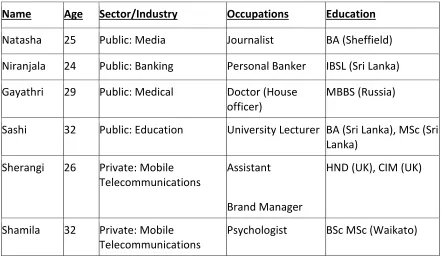
Table 1: Profiles of respondents
Name Age Sector/Industry Occupations Education
Natasha 25 Public: Media Journalist BA (Sheffield)
Niranjala 24 Public: Banking Personal Banker IBSL (Sri Lanka)
Gayathri 29 Public: Medical Doctor (House officer)
MBBS (Russia)
Sashi 32 Public: Education University Lecturer BA (Sri Lanka), MSc (Sri Lanka)
Sherangi 26 Private: Mobile Telecommunications
Assistant
Brand Manager
HND (UK), CIM (UK)
Shamila 32 Private: Mobile Telecommunications
Roshini 28 Private: Manufacturing Engineer BEng (McGill)
Kishani 31 Private: Finance Legal Officer BA (Sri Lanka) LLB (Sri Lanka)
Charka 36 Public: Medical Doctor (Registrar) MBBS (Sri Lanka), MRCP (Sri Lanka) in progress
Irangi 37 Public: Education University Senior Lecturer
BA (Sri Lanka), PhD (Monash)
Vandana 38 Public: Banking Bank Manager IBSL (Sri Lanka), SLIM (Sri Lanka)
Diluni 39 Private: Manufacturing Training & Development Consultant
BSc (Sri Lanka), MBA (Manchester)
Kalpana 37 Private: Hospitality Food & Beverage Manager
BA (Sri Lanka), HCIMA (UK)
Nishanya 36 Private: Garment Manufacturing
Finance Manager ACMA (UK), MBA (Wales) in progress
Swanetha 61 Public: Education Senior Professor BSc (Sri Lanka), PhD (Lancaster)
Rupika 54 Public: Banking Director Bank Operations
BA (Sri Lanka), MSc (LSE)
Kanthi 52 Public:
Government Services
Permanent Secretary for a Cabinet ministry
BA (Sri Lanka), SLAS (Sri Lanka)
Dilhari 48 Public: Finance Assistant Director Statistics
BSc (Sri Lanka), MSc (Warwick)
Madhavi 48 Private: Service based conglomerate
Head of Strategic Planning
LLB (UCL), FCMA (UK), MBA (Sri Lanka)
Devika 46 Private: Finance Director Special Projects
FCMA (UK)
Anouka 49 Private: Medical General
practitioner/ Head of counselling
Acknowledgements
The authors would like to thank Dr Scott Taylor for very kindly commenting on a previous
version of this paper and three anonymous referees for their extremely insightful guidance.
Author biographies
Weerahannadige Dulini Anuvinda Fernando is a research associate at the new Centre for
Professional Work and Careers in the school of Business and Economics, Loughborough
University. Dulini’s PhD was on professional women’s careers in Sri Lanka. Dulini is also
interested in academic careers and professional migrants’ social networks. Dulini holds an
MSc from the London School of Economics (LSE) and BSc degrees from the University of
Lancaster and the University of London. Weerahannadige Dulini Anuvinda Fernando is the
corresponding author and can be contacted at: [email protected]
Laurie Cohen is a Professor of Organizational Behaviour at Nottingham University Business
School. Her research interests include gender and career, careers in emerging forms of
organization, and research methods in the study of career, focusing in particular on
interpretive approaches and the use of narrative. For many years Laurie has also been
involved in a series of studies into perceptions and enactment of work in professional
organizations – focusing mainly on scientific research establishments. She has published in a
variety of journals and edited collections, most recently Journal of Vocational Behavior,
Human Relations and Journal Management Inquiry, and has been supported through a
series of grants from the Economic and Social Research Council and the British Academy.
She is on the editorial boards of Human Relations, Journal of Vocational Behavior,
Management Learning and Management Inquiry. Laurie is currently writing a book on
women’s careers, 1993-2010 and has recently started a new study of successful women