Co-operation between
The European Union
and
The Federal Democratic Republic
of Ethiopia
Draft Joint Annual Report
2007
Annual Report on the Implementation of the ACP-
EU
Conventions and other Co-operation Activities
14 March 2008
Joint Annual Report 2007
Table of Contents
Page
1. Summary……….…1
2.1 Political, Economic and Social Situation……….3
2.1.1 Update on the Political Situation……….3
2.1.2 Update on the Economic Situation………..3
2.1.3 Update on the Poverty and Social Situation………6
2.2 Overview of Past and Ongoing Co-operation……….….8
2.2.1 Transport Sector………...9
2.2.2 Agriculture, Food Security and Natural Resources Management……….11
2.2.3 Macro-Economic Support and Trade...14
2.2.4 Governance and Co-operation with Non-State Actors………..15
2.3 Policy Coherence for Development………16
2.4 Joint EU-Africa Strategy………..…………...17
2.4.1 EU Strategy for Africa………...17
2.4.2 First Action Plan ………...17
2.5 Donor Coordination and Harmonization………..17
2.5.1 Progress during 2007……….17
2.5.2 Outlook………..17
2.5.3 In-field Dialogue between HoD and National Authorising Officer………...18
2.6 Dialogue-in Country with NSAs, Local Authorities and National Parliaments…....18
2.7 Conclusions………...19 3. Annexes:
a) General Annexes
3.a.1 Key Macro-Economic Performance Indicators 3.a.2 Key MDG Indicators
3.a.3 Implementation Status of Selected Projects 3.a.4 Ethiopia's PEFA Scores
3.a.5 Partnerships and Priority Actions of the Lisbon Plan (Narrative and Table) b) Annexes with a Retrospective Character
3.b.1 Financial Situation for 9th EDF and Previous EDFs 3.b.2 Financial Situation for General Budget Lines
c) Annexes with a Prospective Character (See AMP/EAMR Forecast Tables) 3.c.1 Indicative Timetable for Disbursements of 9th EDF and Previous EDFs 3.c.2 Planned EDF Commitments in 2008
1
Joint Annual Report 2007
1. Summary
Positive Evolution of Political, Governance and Economic Dialogue
Developments in 2007 reflect a positive evolution in relations between the Government of Ethiopia, its donor coalition, the EU and Non-State Actors. As to the EU, political relations with Ethiopia continued to improve in the year: in two Article 8 Political Dialogues, issues of economic development, democratization, human rights, and regional security were discussed in a frank and open manner. Importantly, a consensus was reached on the inclusion of migration in the agenda of future Dialogues. The insurgency in Ethiopia’s Ogaden region as well as Ethiopia’s military engagement in Somalia were also discussed. An EU Troika mission visited the Ogaden region in November 2007 and submitted its recommendations to the Government
The continuation of the donors’ dialogue with the Government on governance within the framework of PASDEP was a positive step as well. So was the restoration of the dialogue on economic and external financing issues, inter alia through a restart in June 2007 of meetings of the High Level Forum. The latter was facilitated by an EC-prepared study on the “Financing of PASDEP and the Scaling up of Aid". The Government’s dialogue with the IMF was also revitalized and became more effective in 2007 through Article IV consultations and a productive follow-up policy discussion by the end of the year.
In 2007, the preparation of the Joint Annual Review 2006 and the articulation of the CSP for the 10th EDF provided opportunities for Government/EC consultations with NSAs. In several consultative forums organized by the Government, the Commission and Non-State Actors, NSAs enriched the documents through their timely contributions and by providing substantive comments. NSAs also contributed to discussions on the National Transport Strategy and the Productive Safety Net.
Economic Performance and Poverty Reduction
In 2007 Ethiopia continued on an impressive growth path that is helping to reduce poverty. Economic growth in 2006/7 of 11 %, while helped by favorable weather which led to record cereal crops, was the result of 5 years of impressive increases in public investment, mostly to reduce the country's infrastructure gap and to boost social sector service delivery. Large rises in exports of goods and services and a modicum of foreign private investment also helped to boost growth. Ethiopia’s annual average growth of 11% of the past five years substantially exceeded the Government's target of 7%, and made Ethiopia the fastest growing non-oil producing economy of Africa. Private investment continued its upward trend, reflecting breakthroughs in horticulture, tourism, construction, contracting and services.
The financing of imports associated with Ethiopia's high growth strategy, including the virtual four-fold increase in the cost of fuel imports, was facilitated by rising external assistance, debt relief and private remittances. In 2007 the Government took policy action to mitigate the inflationary impact of high growth, aiming to bring inflation down from 18% to single-digit rates. Inflation abated by year-end but rising agricultural prices continued to cause concern.
Public Finance and Aid Management
Over the years the quality of public finance management in Ethiopia has risen significantly, as attested by Ethiopia's first PEFA Report that was finalised in October 2007. Ethiopia's PEFA scores are in the aggregate well above the average of those of other countries.
2 Poverty Reduction and its Prospects
Programmes for reaching MDGs have come to the half-way point and Ethiopia can point to a significant reduction in monetary and non-monetary poverty. Yet, in 2005 per capita income stood at US $155 only, life expectancy at 51 years and the adult literacy rate was 36%. The progress in the human condition demonstrates the ability of the Government, donors and CSOs to scale up social sector service delivery, with positive results in health, education, water supply and
sanitation. An important result is that population growth fell from 3% in 1995 to 2.5% by 2005; a remarkable development was that fertility in Addis Ababa fell below replacement level.
Donor support for poverty-reducing programmes was facilitated by the Government's launching of sector development programmemes as well as by the Productive Safety Net Programme (PSNP) and the Protection of Basic Services Programme (PBS). The positive results of these programmes – all of them supported by the EC - indicate that external assistance rather than absorptive capacity has become the dominant constraint to scaling up poverty reduction programmes. At the June 2007 HLF Meeting the conclusion was reached that if external assistance prospects for the remaining half of the MDG period were not strengthened, the reaching of MDG goals would be put in jeopardy.
Positive Evolution of Government/EC collaboration
In 2007 the collaboration between the EC and the NAO Office was significantly strengthened. This enabled the commitment of all 9th EDF and previous EDFs' indicative country allocations through releasing funds from old commitments before the set expiry date—30 April 2007. On top of that, agreement on the End-of-Term Review was reached and the document was signed well ahead of time In addition, the preparation of the JAR 2006 and CSP documents was accomplished in a timely and very participatory manner.
Overall Resource Transfer Highly Encouraging
Aggregate disbursements under the EDF and EC Budget Lines showed a sharp uptrend and rose from €122 million in 2005 to €215 million in 2007. When EIB disbursements are added, the total of EDF, Budget Lines and EIB reached €245 million in 2007, nearly double the level of 2005.
Advances in Programme Design, Implementation and Preparation.
High points in Government/EC co-operation include decisive progress in scaling up programmes for direct poverty reduction: several instruments demonstrated their robustness in reaching large numbers of the poor through innovative sector programmes for social sector services delivery. One was the multi-donor financed PBS; the other one the PSNP under which 7.2 million chronically food-insecure people received grants. In 2007 there was also demonstrable progress in scaling up programmes for reducing the infrastructure deficit, through ERA's Roads Sector Policy Support Programme as well through rural infrastructure provision under the PSNP. Advances were also made in providing financial and technical assistance support to NSAs through the Civil Society Fund while, at the same time, NSAs were brought into the review of several sector programmes. Progress was also made in developing EC support for governance strengthening.
Issues and Challenges
The Government and the EC are committed maintaining the encouraging pace of EC/Government co-operation under the 10th EDF. Much of the basis for that was laid in 2007, inter alia through preparatory work towards early follow-up operations in PBS, the PSNP and the Road Sector Policy Support Programme (SPSP). This will not only ensure strong EC contributions to poverty reduction and infrastructure provision but will also help the Government maintain its economic
3 growth agenda through larger resource transfers and capacity building for external trade acceleration. EC support for the multi-donor Democratic Institutions Programmes can help with implementation of the Government’s governance reform agenda.
2.1
Political, Economic and Social Situation
2.1.1 Update on the Political Situation
Political relations with Ethiopia continued to improve in 2007. Two Article 8 Political Dialogues covered economic developments, democratisation, human rights, and regional issues. Discussions were initiated on a possible participation by NSAs in the Article 8 dialogue. A first EU Migration Mission in November 2007 discussed migration issues with the Government, of which the outcome was the inclusion of migration in the Article 8 Dialogue and the establishment of a migration “co-operation platform” in Ethiopia.
The trial of leaders of the main opposition party (the CUD), representatives of civil society and the media ended in 2007. The opposition leaders were declared guilty of charges, but they were pardoned by the President. Most publishing houses were also found guilty and were obliged to close their businesses. This raised concern about freedom of expression in the country. The EU Trial Observer submitted his report to EU Heads of Mission on 28 December 2007 to help them judge whether the trial had been fair, speedy, and transparent.
The Government prepared a new press law in 2007 which a Committee of Parliament finalized by year-end for consideration by Parliament. Preparations for local elections – rescheduled until April 2008 - started in full in 2007. The National Electoral Board of Ethiopia (NEBE) established 22 offices in the country. The Government took a decision to allow domestic but not international observers. Several opposition parties complained about the forced closing of some of their offices, their limited access to the media and arrests of their members. NEBE’s delay in recognising local organisations to carry out civic and voter education was noted with concern.
Government's Policy Dialogue with Donors
The continuation of the governance dialogue with the Government within the framework of PASDEP has been a positive step. Discussions were started on adjustments to institutional mechanisms for monitoring governance performance by bringing civil society into the dialogue, inter alia to facilitate discussion of newly-prepared legislation for civil society. A positive development was also the restoration of the donors’ dialogue with the Government on economic and external financing issues through a restart of meetings of the High Level Forum (HLF) of donors and the Government in June 2007. The latter was facilitated by an EC-prepared study on the financing of PASDEP which served as the basic document for the meeting. The Government’s "non-programme" dialogue with the IMF was also revitalised in 2007 through an Article IV consultation and a responsive follow-up policy surveillance engagement.
Security Concerns
The insurgency in the Ogaden region within Ethiopia, as well as Ethiopia’s military engagement in neighbouring Somalia, dominated the security situation in 2007. An EU Troika mission visited the Ogaden region in November 2007 and submitted recommendations to the Government. The prospect for Ethiopia withdrawing its troops from Somalia hinges on the deployment of an African Union peace-keeping force. Ethiopia’s relations with Eritrea continued to be tense although Prime Minister Meles called for constructive dialogue.
4
2.1.2 Update on the Economic Situation
In 2007 Ethiopia continued on an impressive growth path that is helping to reduce poverty. New data suggest that at 11.1%, Ethiopia's growth surpassed expectations in 2006/7 and continued to become more broadly-based. "Modern" sectors as horticulture, tourism and several industrial
sub-sectors participated increasingly in the country's growth process.
Table 1: Growth in Constant GDP - 2003/04-2007/08 (Percentage)
GDP/Sectors 2003/ 2004 2004/ 2005 2005/ 2006 2006/ 2007 Est 2007/ 2008
GDP at Constant Market Prices 13.6 11.8 10.9 11.1 10.8
Agriculture 17.0 13.5 10.9 9.4 7.5 Of which Crop Production 25.6 19.5 15.0 11.0
Manufacturing 6.6 12.8 10.6 10.5 12.0
Hotels and Restaurants 6.2 11.6 19.5 25.1 Services 6.3 12.8 13.4 13.5 14.0
Source: Ministry of Finance and Economic Development (MoFED) – GDP Data Online
High growth in 2006/7, helped by good weather, followed on from 5 years of impressive increases in public investment spending, mostly to reduce the country's infrastructure gap and to boost social sector service delivery. Large rises in exports of goods and services and a modicum of foreign private investment also helped to boost growth. Over the past five years economic growth in Ethiopia reached an average of somewhat over 11%, substantially exceeding the Government's target of 7% under PASDEP, and making Ethiopia the fastest growing non-oil producing economy of Sub-Saharan Africa. Private investment continued its upward trend with breakthroughs in horticulture, tourism, health and services.
External Financing
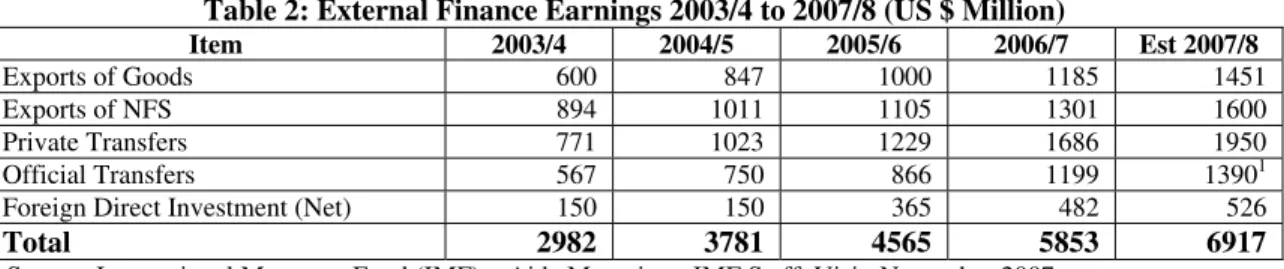
The financing of imports associated with Ethiopia's high growth strategy, as well as the coverage of the virtual four-fold increase in the cost of fuel imports (reaching over US $1 billion in 2007, up from US $460 million in 2004), was over the past five years facilitated by a 150% rise in external assistance, debt relief and by the inflow of private transfers. This diversification of foreign exchange earnings reduced Ethiopia's external financial vulnerability.
Table 2: External Finance Earnings 2003/4 to 2007/8 (US $ Million)
Item 2003/4 2004/5 2005/6 2006/7 Est 2007/8
Exports of Goods 600 847 1000 1185 1451 Exports of NFS 894 1011 1105 1301 1600 Private Transfers 771 1023 1229 1686 1950 Official Transfers 567 750 866 1199 13901
Foreign Direct Investment (Net) 150 150 365 482 526
Total 2982 3781 4565 5853 6917
Source: International Monetary Fund (IMF) – Aide Memoire – IMF Staff Visit, November 2007
While remaining low at a little over 2 months of imports, Ethiopia's reserves of foreign exchange increased by over US $200 million in 2006/7. Thus, the Government concentrated its policy action on mitigating the inflationary impact of high growth, attempting to bring inflation down from 18% in September 2007 to single-digit rates. While non-food inflation abated towards end- 2007 – inter alia the result of more restrictive monetary and fiscal policies – in its consultations with the Government the IMF encouraged the Government to act further if inflation did not subside to single-digit levels. It was recognised that there was need for further study to determine
5 the causes of those food prices increases which coincided with the availability of bumper food crops.
Public Finance Management
Over the years the quality of Public Finance Management (PFM) in Ethiopia has increased significantly, as attested by Ethiopia's first PEFA Report that was finalised in October 20072. This positive record of PFM reform has been supported by the Government's Expenditure Management and Control Programme (EMCP) which is now part of PSCAP, a US $400 million multi-donor-supported capacity building programme for Ethiopia's public sector. PEFA performance Indicators are attached as Annex 3.a.4. Ethiopia's PEFA scores are in the aggregate well above the average of other countries' PEFA exercises.
The PEFA report signals that aggregate fiscal discipline is well ensured by the ability of the Federal Government to adequately forecast primary expenditures and revenues and to keep expenditure arrears under control. But it also brings out the issue of a relatively high amount of extra-budgetary expenditures. As regards the strategic allocation of resources in accord with the priorities of public policy, the report points to significant changes in the original composition of primary expenditures of budget entities at the Federal level, thereby reducing efficiency in the allocation of resources. Lastly, the report brings out that efficiency in service delivery was weakened by the "ineffective predictability in the availability of funds for commitment of expenditures". Inadequate donor practices were seen to have contributed to this problem. A Joint Government-Donor Task Force was set up to elaborate a PFM Strengthening Action Plan.
As regards fiscal developments in 2007, several revenue measures were taken to reverse the downward trend in the tax/GDP ratio3, raising the latter from 10.2% of GDP in 2006 to 11.8% in 2007. This made it possible to increase poverty-reducing spending further from 4.6% to 5% of GDP in FY 2007/8, while keeping the defence spending /GDP ratio down to 1.7, despite an increased international security threat. The fiscal deficit (after grants) rose slightly beyond the red line of 3% of GDP in 2006/7, but measures under the Budget for 2007/08 aim at reducing it to 2.5% or less. This should help with inflation reduction, while a cautious approach to expanding investment should keep capital goods imports within the limits of foreign exchange availability.
Macro-Economic Policy Dialogue and Sector Studies
Managing high growth for poverty reduction while maintaining internal and external financial viability was a key theme in the IMF discussions with the Government. These discussions attest to a welcome resumption of the policy dialogue between the Government and the donor community in which the IMF plays a lead role, as recommended in the High-Level Forum of June 2007. The latter took place on the basis of a well-received EC study on the "Financing of PASDEP and the Scaling up of Aid" which led the DAG and the Government to agree on restructuring the macro-economic policy dialogue and to use subsequent High-Level Forum (HLF) meetings to tackle key sector issues as private sector growth, rural development and governance.
The economic policy interaction between donors and the Government of 2007 illustrates the putting into effect by the Government of key HLF recommendations which places the IMF in a lead position for the macro-dialogue with the Government in the context of an effective "non-programme" relationship in which the IMF consults with DAG members on a monthly basis. The
2 In 2007 a PEFA exercise was also completed for Ethiopia’s Regional Governments.
3 It appears hard to tax growing incomes in the agricultural sector (about one-half of GDP) while new dynamic industry and services sector benefit from tax exemptions.
6 HLF recommendation that the economic growth agenda be more systematically developed by the Government and donors found expression in dialogue on rural development and growth issues which took place in November 2007.
Studies that were completed in 2007 highlight the need for the Government and donors to more effectively address issues in the demographic area and in employment generation. A joint World Bank/Government study of Ethiopia's tourism sector study identified its potential for high growth. Lastly, an EC-financed study led to a National Transportation Strategy and a National Transportation Master Plan for the coming 20 years. These studies should be of use to both the Government and donors in their evaluation of PASDEP implementation, of which the first Annual Performance Review was completed in late 20074.
External Trade and Regional Integration
In 2007, as over the past five years, Ethiopia’s economy increasingly opened up to trade opportunities with the rest of the world. In this period, the export value of goods and non-factor services doubled, against a GDP rise of some 50%. Imports also doubled in this period, most of the increase coming from petroleum product imports and of capital goods, the latter closely related to the Government’s investment programme. Since Ethiopia submitted its Memorandum of the Foreign Trade Regime to the Secretariat of the World Trade Organisation (WTO) in December 2006 the Government has been engaged in the process of Questions and Answers, touching on the results of impact assessment studies for liberalisation of the financial services and telecommunications which were carried out in 20075. As for an Economic Partnership Agreement (EPA), Ethiopia continues to pursue an EPA agreement linking trade and development within a regional framework that fits Ethiopia's trade context.
2.1.3.
Update on the Poverty and Social Situation
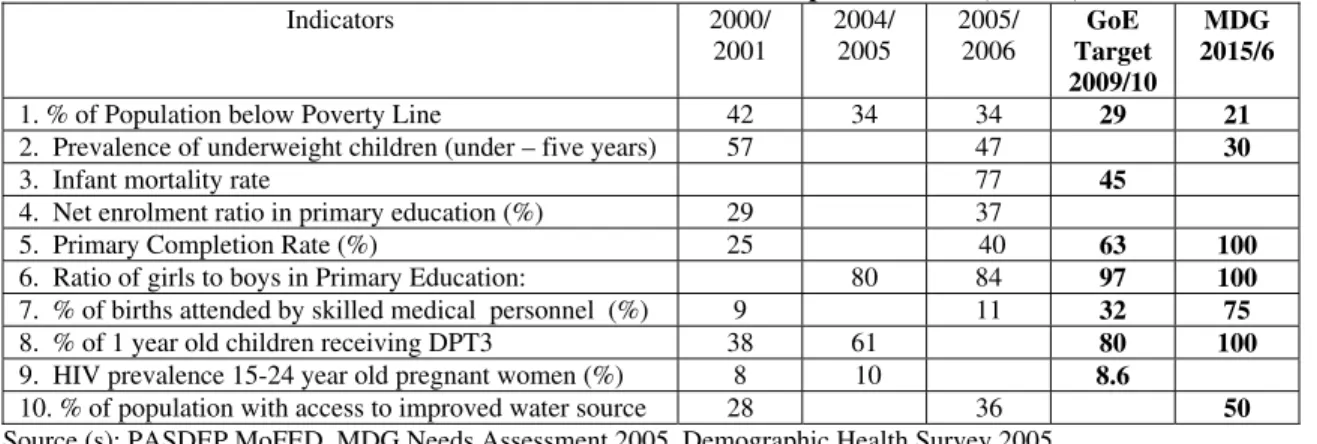
By any measure, most Ethiopians continue to live under very harsh conditions. To illustrate, in 2005 Ethiopia ranked among the bottom ten countries on the UNDP's Human Development Index. In that year per capita income stood at US $155 only, life expectancy at 51 years and the adult literacy rate was 36%. Yet, when stock is taken today, with Ethiopia having reached the half-way point of its programmes for reaching its Millennium Development Goals (MDGs), it is possible to point to significant improvement in Ethiopia’s human development performance since 2000/2001. The Table of Indicators for the Millennium Development Goals attests to this:
Table 3: Indicators for the Millennium Development Goals (MDGs)
Indicators 2000/ 2001 2004/ 2005 2005/ 2006 GoE Target 2009/10 MDG 2015/6
1. % of Population below Poverty Line 42 34 34 29 21
2. Prevalence of underweight children (under – five years) 57 47 30
3. Infant mortality rate 77 45
4. Net enrolment ratio in primary education (%) 29 37
5. Primary Completion Rate (%) 25 40 63 100
6. Ratio of girls to boys in Primary Education: 80 84 97 100
7. % of births attended by skilled medical personnel (%) 9 11 32 75
8. % of 1 year old children receiving DPT3 38 61 80 100
9. HIV prevalence 15-24 year old pregnant women (%) 8 10 8.6
10. % of population with access to improved water source 28 36 50
Source (s): PASDEP MoFED, MDG Needs Assessment 2005, Demographic Health Survey 2005
4 The World Bank and IMF also completed in 2007 their first Joint Staff Assessment of PASDEP.
7 The progress in the human condition that has been achieved over the past five years demonstrates the ability of the Government, CSOs and official donors to scale up social sector service delivery, with positive results in health, reproductive health, education, water supply and sanitation. Importantly, as brought out in 2007 in a seminal joint World Bank/Government study6, progress in education, health and reproductive health service delivery as well as in the availability of contraceptives, brought Ethiopia's annual population growth rate down from 3% in 1995 to 2.5% by 2005, a rate of decline slightly faster than in other Sub-Saharan countries. Significantly, in 2006 fertility in Addis Ababa was estimated at 2.1 children per woman, below replacement level. The mobilisation of rapidly-rising donor support for human development programmes was facilitated by the Government's launching of sector development programmes as well as by the introduction of such multi-donor supported programmes as the PSNP and PBS. The generally positive implementation record of several of these programmes – all of them supported by the EC - indicate that absorptive capacity limitations are no longer the dominant constraint standing in the way of scaling up direct poverty reduction programmes. Several programme reviews in 2007 illustrate this encouraging development.
Under the PBS programme donors have demonstrated successful means of contributing to government implementation of plans to expand people's access to basic services in a de-centralised manner. Notable results include7:
- 2.6 million more children are in primary school compared with two years ago, and the net enrolment in primary grades 1-4 reached almost 80%;
- the number of trained health extension workers reached 17 600, up from only 2 800 two years ago, greatly increasing access to primary health services;
- 18.2 million insecticide treated nets were distributed, reaching 91% of households in Malaria-affected areas, thereby reducing new malaria cases by 53% in two years; - 46% of the rural population has access to drinking water, up from 35% 2 years ago. The PSNP that went into its third year in 2007 is becoming a robust programme for protecting and addressing the development needs of Ethiopia's chronically food insecure people. It has proven to be an effective means of moving away from the emergency food aid system which was largely seen to be of limited transparency and accountability. Despite capacity constraints at the local level, it was possible in 2007 to reach 7.2 million people who qualified under the programme, by providing predictable and timely food and cash transfers. A positive development in 2007 has been that the number of people requiring assistance (involving both emergency aid and support from the PSNP) was estimated at 8.6 million, down by 12% from the 9.8 million in 20068.
As regards the Health Sector Development Programme (HSDP)9, a review in 2007 of its implementation and prospects indicates that reaching MDGs by 2015 will require a dramatic
6 Capturing the Demographic Bonus in Ethiopia: Gender, Development and Demographic Action, WB 2007.
7 Final Aide memoire, JRIS Mission, December 13 2007.
8 Inasmuch as the past four years witnessed significant agricultural growth, it has not yet been possible to determine whether the programme is fully capable of permitting beneficiaries to withstand modest shocks.
8 expansion of health services, the scaling up of high impact interventions and a doubling of expenditure. This excludes the cost of the National Nutrition Programme which was launched in 2007 with EC support and aims at addressing severe nutrition problems in Ethiopia which has the second-highest malnutrition rate in Sub-Saharan Africa.
In the recent World Bank/Government Report that analyses Ethiopia's challenges in the demographic area the issue of population growth is highlighted as follows: "With a population of 78 million in mid-2005 Ethiopia belongs to the 18 most populated countries in the world. Ethiopia has the second-largest population in Sub-Saharan Africa after Nigeria and is expected to grow to 173 million by 2050. Ethiopia will then become one of the 10 most populous countries in the world". The Report then makes the point that the country finds itself on the verge of the second phase of the demographic transition which Ethiopia could go through if fertility would decline substantially more, to be in equilibrium with the declining levels of mortality. The latter could materialise if stronger Government and donor efforts would enable several key programmes to be scaled up, including education and the provision of contraceptive materials. The report comes to a startling conclusion: "about 5 in 10 married women expressed needs for family planning services in 2005, though only 1.5 out of 10 married women currently use contraception,
often due to supply constraints". Meeting these constraints appears to be a major challenge to
both donors and the Government, but recent analysis of the prospects for aid scaling-up reveals the danger that these challenges may not be fully met.
Financing constraints stand in the way of reaching MDGs.
In 2007 concern arose among both donors and the Government that external assistance prospects for the remaining half of the MDG period would put the reaching of MDG goals in jeopardy. An EC-supported study conducted for the High-Level Forum Meeting of the DAG and the Government10 in June 2007 concluded that on needs’ and absorptive capacity grounds Ethiopia had a strong case for requesting a doubling of external assistance over the coming five years. Its conclusion was that external assistance would need to double from the current level to an annual US $3.2 billion by 2010/2011 to help Ethiopia carry out PASDEP’s ambitious High-Case MDG scenario. The latter is the base year of the Gleneagles commitment to raise aid to Africa by 100% by 2010. Annual aid levels of this magnitude should make it possible to substantially expand Government expenditures for non-monetary poverty reduction as well as to finance infrastructure and other programmes for high growth to reduce monetary poverty. If aid were to be raised to US $3.2 billion by 2010/11, this would bring per capita aid provision to Ethiopia to US $38, up from US $26 today as the OECD calculates it11, and would raise Ethiopia’s per capita aid to some 90% of the current SSA average, up from 60% today, and from 29% in 2001.
With a further strengthening of the Government’s management of the Ethiopian economy and democratic governance, Ethiopia’s donor coalition appeared to be willing to raise external assistance levels to slightly over US $2.3 billion by the year 2010/11, some US $900 million short of what it would take for Ethiopia to reach its MDGs. A Survey of Donor Financing Intentions, however, also indicated that a relatively large number of Ethiopia’s donors feel that although they have reached a plateau in their aid programmes for Ethiopia, they could increase their aid provision further if there were significant prospects for the Government to strengthen human rights and democratic governance. It was concluded that further discussions between Ethiopia's donor coalition and the Government were needed to ensure that aid will double in a period when capacity for aid delivery and utilization for reaching MDGs is expanding.
10 Accelerating Development in Ethiopia - A Road Map for Scaling Up External Aid; June 2007.
9
2.2
Overview of Past and Ongoing Co-operation
InterAction between the National Authorising Office and Delegation became more Effective
The Ethiopia 9th EDF End-of-Term Review was completed in 2007, well ahead of the timeframe provided, paving the way for signature of the innovative €150 million Protection of Basic Services (PBS) programme. The10th EDF CSP/NIP 2008-2013 was signed during the EU-Africa Summit in Lisbon on 9th December 2007, following a positive decision of the EDF Committee. In 2007 the Government and the Delegation interacted in a very collaborative and effective fashion which enhanced co-operation between Ethiopia and the EC. An important result has been that it was possible to commit all 9th EDF and previous EDFs’ indicative country allocations through releasing funds from old commitments before the set expiry date— 30 April 2007. In meetings chaired by Ministers and involving high-level EC decision makers and implementing institutions, project implementation bottlenecks were addressed for such projects as Coffee Improvement- IV, Addis Ababa Water Supply, Railway Rehabilitation. Remedial action was identified and taken. Implementation of the €55 million African Union Capacity Building Programme took off gradually and a first progress review took place in July. As to the overall resource transfer, coming from disbursements under EDF Programmes, EC Budget Lines and EIB disbursements, the following highly encouraging picture emerged over the 2005-2007 period (in € mln):
Table 4: EDF/EC/EIB Disbursements to Ethiopia 2005-2007
Category 2005 2006 2007
EDF 118 110 206
Budget Lines 4 26 9
Total EC 122 136 215
European Investment Bank 4 25 29 Total EC, Budget Lines and EIB 126 161 245
Numerous Financing Agreements were signed and became operational. These include agreements for the Protection of Basic Services Programme (€150 million), De-Mining (€8 million), Polio Eradication (€13.2 million), Productive Safety Nets (€38 million ), Water Facility (€16.5 million), Flood Rehabilitation (€7 million), Technical Co-operation II (€3.2 million ) and Civil Society Fund-II (€5.65 million). Moreover, addenda were signed for the Addis-Jimma road project (€60 million additional), and for the Road Sector Policy Support Programme (€7.4 million additional. In 2007 the NAO Office, the Delegation and Implementing Agencies kept up their monthly tripartite project review meetings. This helped in identifying and addressing implementation problems on a timely basis. In 2007 the NAO and the Commission launched a study aimed at improving monitoring systems of EU-financed projects. Three workshops were organized on the monitoring system and on EDF rules and regulations; about 100 people participated. Strengthening the capacity of the NAO Office became a priority in 2007: NAO staff went on short-term training abroad. Better performing office facilities were also made available. In 2007 the NAO assumed more responsibility for issuing payment orders.
Improved Government/EC management of EC-supported development projects
More collaborative management of the EC-supported portfolio of projects in 2007 had its desired effect: it led to acceleration in disbursements to a record €215 million in 2007 which compares with €136 million in 2006. At the same time, the quality of the assistance portfolio improved in terms of its ability to reach many more people with development services than in the years before. In fact, decisive progress could be observed in the scaling up of programmes for direct poverty reduction: several instruments demonstrated their robustness in reaching very large numbers of
10 the poor through innovative sector programmes for social sector services delivery. One such instrument was the multi-donor financed PBS which reached millions of people; the other one was the PSNP under which over 7.2 million chronically food-insecure people received grants in a more timely fashion. In 2007 there was also demonstrable progress in the scaling up of programmes for reducing the country’s infrastructure deficit, through ERA's Roads Sector Policy Programme as well through rural infrastructure provision through the PSNP. Significant advances were also made in the provision of support to NSAs through the Civil Society Fund while, at the same time, NSA were brought into the review of several sector programmes, including the PSNP. Progress was also made in developing EC support for governance strengthening. A summary overview of selected projects; implementation is provided in Annex a.3 but a review of salient developments in the focal sectors is provided below.
2.2.1 Transport Sector
Ethiopia has one of the lowest road densities in Sub Sahara Africa, and very poor connections with its neighbouring countries. This prevents the proper functioning of markets, especially in rural areas, and constitutes an impediment to regional integration. The high priority Government attaches to transport sector development is reflected in PASDEP which sets ambitious targets for reducing the infrastructure gap. As to rail transport, the Governments of Ethiopia and Djibouti decided jointly to upgrade, rehabilitate and give out the operation and management of the Railway system to an Operator on Concession Agreement basis.
In 2007 the EC intensified efforts to ensure improved donor coordination, alignment and harmonization in the roads sector by helping to create a Sector Working Group for the Transport sector under the Development Assistance Group. The EC assumed jointly with ERA its Chairmanship. The EC-financed study to formulate a National Transport Strategy and to elaborate a National Transport Master Plan was completed in 2007. The Master Plan was submitted to a stakeholders workshop in October 2007 and subsequently presented to the Ministry of Transport. It placed RSDP III in an overall transport sector context from which the design of a follow-on Sector Policy Support Programme can benefit.
Roads Sub-Sector
Physical performance by ERA under its Road Sector Development Programme (RDSP) 1997-2007 – a key part of the Government’s efforts to enhance connectivity in the country - has been impressive. This can be seen from the impact which RSDP II (2003-2007) has had on road conditions in Ethiopia. To give only 3 examples, (i) asphalt roads in good condition have risen from 35 to 60% in 2007, (ii) gravel roads in the same condition increased to 45%; and (iii) under RSDP II alone some 30 000 km of community roads were built, over four times the target of 7 500 km. The implementation of the three main EC-financed projects under RSDP also progressed considerably in 2007, with all three roads virtually completed by year-end.
An important step forward in 2007 was the initiation of the €155 million Sector Policy Support Programme (SPSP) for the roads sector, through EC sectoral budget support as financing modality. Following the fulfilment of conditions of the Financing Agreement, the first and the second fixed tranches, totalling €84.8 million, were transferred to the Government in 2007. As to the release of the first Variable tranche, scheduled for end-2007, a review by the Government indicates that virtually all milestones were met by then. To illustrate, the ERA was able to accomplish 96% of its physical targets, reflecting improved programme implementation and strong budget management. In addition to new road construction, ERA’s focus on maintaining the road condition at the “good” level was fully met: in fact performance on disbursements for road maintenance exceeded the target by over 60%. Of special significance is the success which
11 the Government has had in involving the private sector in road sector operations: under RSDP I local contractors had a 20% share of all contracts. This reached 55% under RSDP II and a record 88% of all contracts in 2007, the first year of RSDP III. However, progress was not made in 2007 with including the road fund budget for maintenance in the national budget as a memorandum item, a problem which the recent PEFA assessment already highlighted.
RSDP III covers the 2007-2012 period. Its main objective remains the restoration and expansion of the road network, but with an increased focus on lower category roads, i.e. regional roads. A follow-on SPSP is planned to support the implementation of RSDP III. The latter is larger than its combined predecessors, involving investments reaching €2.7 billion equivalent, with the Government contributing €2.1 billion. Implementation of RSDP III will also benefit from the results of the EC-supported Capacity Building Project which started in 2007 and aims at enhancing the human resources capacity of governmental and private organisations in the roads sector.
Regional Connectivity
The feasibility study for the Mieso-Dire Dawa-Guelile Road progressed in 2007. Is completion is scheduled for 2008. The project involves road works of 387 km and is part of the Government’s programme to improve Ethiopia’s access to the port of Djibouti. Its financing is not foreseen under the 10th EDF. The Government also requested the Commission in August 2007 to consider financing the Togowachelle –Kalabydh road connection which would facilitate transport to Somalia through the Berbara Corridor and provide access to the port of Berbara. The CSP/NIP for the 10th EDF includes the financing of infrastructure works for regional integration, focused on enhanced connectivity with neighbouring countries.
Ethio - Djibouti Railway Rehabilitation
While works for the rehabilitation of the railway line to Djibouti are progressing largely on schedule, the concessioning of railway operations was substantially delayed following withdrawal of the preferred bidder for the concession. As a result, an agreement could not be signed. Both governments remain committed to handover the railway company to a third party through concessioning and have entered into negotiations with a third party.
2.2.2 Agriculture, Food Security and Natural Resources Management
Ethiopia’s agricultural performance appears to have been highly positive over the past four years. In 2007 value added in the sector rose by some 9% and crop production by 11%. Very significantly, cereals production rose by a spectacular 22%, up from 13.4 million tons in 2006 to 16.4 million metric tonnes in 200712. Cereal production in that year reached close to double the pre-drought level of 2003. While good weather helped, Government policy and programmes played an important part and led to better use by farmers of modern agricultural inputs. So did improved infrastructure. To illustrate, ERA constructed over 30 000 km of community roads. The PSNP also helped: over 18 000 km of farm-to-market roads were improved over the past three years. Other infrastructure works involved improvements to some 60 000 hillside terraces and to over 1 million stone bunds, and to maintenance of 35 000 km of rural access roads.
Other high points in agricultural performance reflect the impact of PASDEP's policy re-orientation: thus, part of commercial agriculture, including horticulture, flourished, while, at the same time, giving Ethiopia's agriculture a further export orientation. As to the latter, non-coffee
12 It should be noted that the Crop and Food Security Assessment Mission of December 2007 estimated "total 2007 meher cereal production at about 21.5 million tons, some 7 % above the previous year 's post harvest estimates. It is the fourth consecutive good harvest". The mission estimated production of cereals at 19.9 million tons for 2007/08 production year.
12 exports rose in 2007 to US $602 million, up from US $532 million the year before. The volume of coffee exports rose by 19% in 2007.
Table 5: Agricultural Exports 2005/06-2006/07
Export item 2005/06 2006/07
Quant.('000 MT) Value (mln US$) Quantity (‘000MT) Value (mln US$)
Coffee 148 354 176 424
Oilseeds 266 210 235 188
Chat 22 89 23 93
Hides and skins 9 60 15 77
Pulses 110 37 159 70
Flowers (mln stems) 63 22 136 64 Live animals 33 27 44 37 Other products 78 73
Total 877 1026
Source: National Bank of Ethiopia (NBE) and PASDEP-APR II.
Policy Issues
The resumption of the policy dialogue with the Government became the central focus of a High Level Forum meeting in November 2007 when steps were initiated for its re-structuring. An unresolved policy issue remained the explanation of the 18% rise in food prices which occurred in 2007 at a time when bumper crops of cereals would have expected the opposite. Several reasons were advanced to explain this paradoxical phenomenon, including the availability of increased expendable cash in the hands of PNSN grantees. The issue of food price increases assumed central attention in 2007 because of their impact on national inflation, leading the Government to initiate a detailed study of this problem. The year 2007 saw the emergence in Ethiopia of interest in addressing the country's energy problem through programmes for stimulating the production of raw material for bio-fuels. While the bio-fuels development policy that was formulated by the Ministry of Mines and Energy in 2007 recognises the advantages of fuel source substitution, it also cautions against possible negative environmental and food security effects. As to the latter, there appears to be considerable scope for strengthening the enforcement of environmental impact assessments of investments in bio-fuels development.
Food Security
Because of the large increase in cereal crop production, and following a decision to address emergency caseloads in PSNP Woredas through the contingency budget of the PSNP, the Humanitarian Appeal for food aid assistance reached the lowest level since 1996, involving only 1.4 million people who live mostly in the Somali region and suffered from the effects of flooding.
Table 6: Trends in Cereals Production and Food Security 1966-2006
Pop. Mln
Cereal Prod (Mln tonnes)
Cereal Prod
Per Capita (kg) Benef. DPPC
Appeal (Mln) % of pop. PNSP Benif. Mln Total Benf. (Mln) % of pop 1996 56,4 … … 2,8 4.9 -- 2,8 5.0 1999 61,7 … … 7,2 11.7 -- 7,2 11.7 2000 63,5 … … 10,6 16.6 -- 10,6 16.7 2002 67,2 8.7 129 7,9 11.7 -- 7,9 11.8 2003 69,1 6.3 91 13,3 19.1 -- 13,2 19.1 2004 71,2 9.0 126 7,2 10.1 -- 7,2 10.1 2005 73,0 10.0 136 3,8 5.2 4,8 8,6 11.8 2006 75.1 13.4 178 2,6 3.5 7,2 9,8 13.0 2007 78.0 16.4 210 1.4 1.8 7.2 8.6 11.0
13 Yet, chronic food insecurity and malnutrition remain major problems in Ethiopia: in 2007 close to 8.6 million people – 11% of Ethiopia’s population – required assistance under emergency programmes and the PSNP, double the share of population in 1996.
Food insecurity remains a complex problem in which lack of access to as well as availability and quality of food play an essential role. Weak purchasing power of the poor, imperfections in the marketing system and transport bottlenecks are explanatory factors. Thus, policy against poverty and food insecurity focuses on increasing connectivity and raising incomes of vulnerable groups. The EC intervenes in the rural sector through the EDF and the Food Security Budget Line.
Productive Safety Nets and Food Security Programme
Since 2005 the EC supports this multi-donor programme with €98 million (€60 million from the EDF, €20 million from the Food Security Budget Line and €18 million from the B-envelope). The year 2007 witnessed further progress towards meeting the Programme’s development objectives and demonstrated that the PSNP is becoming an effective means of moving beyond the emergency food aid system. The provision of predictable and timely transfers has improved the development prospects of PSNP beneficiaries, most of which reported they could avoid selling their assets in time of stress, attributing it to the PSNP. Their use of health and education services also increased. In addition, there were significant improvements to rural infrastructure, although not all of these were designed to be permanent.
In 2007 encouraging measures were taken by the Government to enhance programme implementation capacities through recruitment of technical assistants and financial management experts. However, capacity limitations, largely due to staff turnover, handicapped programme delivery. Even so, in 2007 the Government managed to reach 7.2 million people under the programme, by providing them with cash and food transfers: cash grants were given to 4 million beneficiaries, but another 3.2 million preferred food, reflecting higher grain prices. The experience of 2007 indicates a marked improvement in predictability and timeliness of transfers, but further progress is needed. So is improving planning and supervising public works to make productive asset creation a reality. The Government shifted the financial management system to Channel II, thus allowing for more active involvement by MoFED.
The EC undertook a mid-term evaluation of the PSNP in 2007 to assess the status of programme implementation. It concluded that the programme was on track in achieving its core objectives of filling food gaps and protecting household assets. It recommended further improvement to the timeliness of transfers, revision of the cash wage rate to reflect higher grain prices and better logistic support to Woredas for monitoring programme implementation.
Programme reviews in 2007 also identified the need for articulating a longer-term vision of the PSNP. At its start in 2005, the vision of the PSNP was based on the graduation of 5 million chronically food insecure households from food insecurity within 5 years. However, preliminary evidence from the PNSN impact assessment suggests that this target will not be achieved. One reason is the inadequacy of linkages between the Productive Safety Net and other food security programmes. To illustrate, the provision to PSNP beneficiaries of credit packages under the Food Security Grant was limited by the small size of the overall grant, so that only some 25-30% of PSNP households had access to credit packages. The latter is seen as an essential element in the exit strategy out of what otherwise could become an open-ended social protection system. The fine tuning in 2006 of the M&E system will ensure that information on activities under the Federal Food Security Programme is improved.
14 Following several joint programme reviews in 2007, donors and the Government agreed to re-visit the vision of the PSNP. This entails a possible revision of Government policy on food security and a revised design of a third phase of support to the Food Security Programme, which is anticipated to be at least comparable in size to the current PSNP. This process will be led by the Government, in partnership with donors.
Fourth Coffee Improvement Programme
Both the volume and value of Ethiopia's coffee exports is rising significantly, in part reflecting positive results of this programme. The latter, however, has potential for contributing further to supporting the Government's policy of raising incomes of small-scale coffee smallholders through improving the delivery of coffee research results to them. Conserving Ethiopia's and the world's coffee genetic resource base and ensuring a sustained increase in the supply of Coffee Berry disease resistant coffee seedlings is also a key component of the programme.
Since the €15 million Financing Agreement was signed in 2002, the programme faced implementation difficulties, and in 2007 the Commission and the Government reviewed again its status and outlook. This led to the launching of a Programme Management Unit in the Ministry of Agriculture which has the potential for invigorating programme implementation.
Natural Resources Management
Environmental degradation remains a critical issue in Ethiopia. Population growth and commercial investments, including bio-fuel plantations and flower industry projects, could impact negatively on the natural resource base. In 2007 the Commission prepared a Country Environmental Profile which can help in designing coping mechanisms. The Commission and the Government also began preparing a natural resources management project in 2007.
2.2.3.
Macro-Economic Support and Trade
Macro-Economic Policy Dialogue and Analysis
In 2007 the Commission stepped up its contribution to the economic policy dialogue with the Government and towards a strengthening of the knowledge base for the Ethiopian economy. Its efforts covered the areas of: (i) Preparing a Diagnostic Survey of the Ethiopian Economy; (ii) Conducting a Public Expenditure and Financial Accountability (PEFA) study; (iii) Preparing a Report on the Financing of PASDEP and the Scaling up of Aid; and (iv) Participating in the donor dialogue with the Government on trade and private sector development issues.
Diagnostic Survey of the Ethiopian Economy
The Diagnostic Survey served as a basic document for the preparation of the Country Support Strategy and Indicative Programme for the 10th EDF period. It was prepared in collaboration with EU Member States as a basic document for the eventual elaboration of an EU support strategy for Ethiopia. It built on the Government’s work for PASDEP and reviewed key strategies and programmes, stressing the need for enhancing connectivity within Ethiopia and in the Horn of Africa. It recommended stronger internal resource mobilisation by the Government and highlighted favourable key external financial developments, including high levels of external assistance, strong inflows of international NGO contributions and remittances. The latter analysis was followed up by the Government and the IMF which prepared a study on private remittances.
Public Expenditure and Financial Accountability (PEFA) Study
This study was completed in 2007 as a sequence to long-time Government efforts for strengthening public finance management in Ethiopia. It covered both Public Finance Management (PMF) at the Federal and the Regional (sub-national) level. The results of the PEFA
15 exercise are being considered by the Government and will help the Commission in coming to conclusions about Ethiopia's eligibility for receiving Sector Budget Support (SBS) for such programmes as the SPSP II and PBS II. Follow up to the study could also help in considering a possible resumption of General Budget Support (GBS) during the 10th EDF period.
Financing of PASDEP and the Scaling up of Aid
This study which was carried out at the request of the DAG contributed towards the resolution of divergences between values of external assistance inflows as observed by the Government and those reported by the DAC/OECD. The study also identified Ethiopia’s needs for external assistance to reach MDG goals and pointed to steps which donors and Government could take to ensure aid scaling up for reaching MDG goals. A result of the study was also that the DAG and the Government agreed to restructure the macro-economic dialogue and to also use the quarterly High-Level Forum (HLF) meetings to more effectively tackle cross-cutting issues, including those affecting private sector development and governance.
Dialogue with Government on Trade and Private Sector Development issues
In 2007 the Commission and the Government discussed with Member States, USAID, UNDP, and the World Bank key issues of Ethiopia’s WTO accession process and EPA negotiations. The dialogue with EU Member States took place through the network of EU Trade Counsellors. A “Non-Paper on Trade and Investment” was prepared for use by the Government in preparing for the Article 8 Political Dialogue on Economy and Trade. As regards private sector development, both Delegation and EC staff from Brussels participated in a workshop on “Investment Climate and Competitiveness” organised by the World Bank and the Government
Protection of Basic Services (PBS): In November 2007, the Commission was nominated
Co-Chair of the PBS donor group, while it also acted as the Co-Chair of the PBS Social Accountability group. In this capacity, the Commission was actively involved in preparing for and follow-up to the PBS Mid-Term Review (MTR) and the three Joint Review and Implementation Support (JRIS) missions in 2007. The Commission also played a key role in the elaboration of a Concept Paper that serves as a basic document for discussions with the Government on the thrust, composition and timing of PBS II.
2.2.4 Governance and Co-operation with Non-State Actors
Governance
Reflecting shared co-operation objectives of the wider donor community and the Government which are set out in PASDEP, development of support for the justice sector and to strengthen democratic institutions started in 2007. To the extent possible, use will be made of harmonised instruments to ensure joint strategies towards strengthening governance in Ethiopia. Support for the justice sector seeks to strengthen the on-going Justice System Reform programme. The first step is launching a pre-feasibility study to design a programme for implementation in 2009/2010 with funds from the Technical Co-operation Facility (TCF).
Proposals were also formulated in 2007 to strengthen, jointly with other donors, democratic institutions that are key to the consolidation of the democratic transition in Ethiopia. This would take the form of contributing financing to a fund established for this purpose. Work started on the drafting of a Financing Agreement that could lead to a contribution agreement with UNDP for supporting the multi-donor "Democratic Institutions Programme (DIP)".
16 Support for Non-State Actors (NSAs)
Since the Civil Society Fund (CSF) started, two Calls for Proposals and one round of small grants were implemented to support CSOs capacity building and initiatives for strengthened service delivery in the governance area. The CSF contribution under both the Capacity Building and Governance components reached €3 million. The Fund successfully stressed the importance of real partnerships in all projects: around 75% of CSF projects are implemented in partnership with one or more organisations, with 16 projects directly engaging more than 90 organisations. In line with PASDEP, all CSF projects are mainstreaming gender equality in its activities.
A Mid-Term Review (MTR) of the CSF programme was carried out in early 2007 and focused on institutional setups, management procedures and involvement of the different actors. Its generally favourable assessment permitted the signing of the Financing Agreement for Phase II. The Project Steering Committee deliberated in 2007 on what had worked and what had not worked so well in 2007. It concluded that the CSF should focus more on regional development actors and adopt an approach more suitable to the needs and operational contexts of smaller and less-capacitated CSOs, the latter involving a stronger emphasis on capacity building.
Cotonou Task Force (CTF) In the year the CTF reorganised its Secretariat and held a General
Assembly Meeting. The Meeting agreed to consider broadening the participation of civil society groups in the CTF structure and processes, so that it could strengthen its position as a representative body of Ethiopian CSOs engaged in tripartite co-operation and dialogue. The CTF also met with the EU Troika in the framework of the Cotonou Agreement
DAG Civil Society Sub-group
This DAG Sub-group held several meetings in 2007. Charged with mapping out institutional options and strategies for more systematic and structured dialogue on civil society issues, it identified as key issues the legal and institutional framework regulating civil society operations in Ethiopia as well as ways to reinvigorate the dialogue between civil society and Government.
2.3 Policy Coherence for Development
The EC strategy for Ethiopia reflects EU Coherence for Development Commitments, in particular those relating to trade, environment, security, agriculture, food aid, migration and transport. The design of the CSP is consistent with the EU Regional Political Partnership for Peace, Security and Development in the Horn of Africa. Under the 9th EDF, several EU policies impacted on aid delivery in Ethiopia. The EU’s commitments in the Paris Declaration - to scale up aid and to improve its impact and speed of delivery - provided an important backdrop for accelerating progress to meet MDGs by 2015. These commitments were strengthened by the “EU Strategy for Africa" which aims at an effective scaling up of development assistance, and by the “European Consensus" which outlines common strategic objectives shared by Member States.
Ethiopia’s economic growth potential can only be exploited to the full when integrated into both the regional as well as the global economy. EC support for Ethiopia's growth agenda contributes to the economic development of both Ethiopia and the region, and fits the context of promoting Peace and Security in the Horn of Africa. Infrastructure development for strengthening both intra-regional and inter-intra-regional interconnection in the Horn of Africa is a key objective of the EC strategy for developing Ethiopia’s transport sector. In the context of the EU-Africa Infrastructure Partnership, the EC will develop infrastructure and related services as well as interconnections within the Horn and between African regions. The focus will be on enhanced connectivity with neighbouring countries. Additional or co-financing with the Regional Programme and/or the EU-Africa Infrastructure Partnership is aimed at.
17 Duty-free quota access to EU markets under the Everything-but-Arms initiative was an important trade preference, but one which Ethiopia has yet to exploit fully, inter alia because of supply-side constraints. Fostering regional integration through Partnership Agreement (EPA) negotiations is a key objective that is being pursued. In EC regional and pan-African programmes, special emphasis is put on infrastructure and communications as strategic vehicles for regional integration in line with the Africa Strategy.
In January 2007, the EC published guidelines for gender equality which recognize the importance of a balanced mix of men and women in the planning and implementation of EC-supported projects and programmes, as well as the promotion of women's participation in service delivery. The Commission also adopted a Communication “Towards an EU Strategy on the Rights of the Child", which includes as one of the first actions the adoption of an “Action Plan on Children and Development.” Consultations with the Government are ongoing, and their results will guide the EC and the Government in developing a child-centered programme component in Ethiopia. In 2007 the EC discussed migration issues with the Government, of which the outcome was the inclusion of migration in the Article 8 Political Dialogue as well as the establishment of a migration “co-operation platform” in Ethiopia.
2.4
Joint EU-Africa Strategy
2.4.1 EU Strategy for Africa
In line with the EU Strategy for Africa an EU Road Map for aid harmonization was agreed for Ethiopia, and an Annual Action Plan was set out to implement this. The Road Map concentrates on improving coordination of EU programmes, analysis and missions, reforming the DAG, exploring areas for joint initiatives, promoting division of labour, establishing an online database of all EU programmes, establishing a knowledgebase of donors’ studies, raising awareness of co-operation commitments and opportunities, and establishing Action Plans for co-co-operation with the World Bank and the UN. In this way the Strategy’s recommendations for reducing transaction costs, building partners’ capacity and responsibilities and better integrating EU aid have been followed. The Strategy also stresses involvement in areas as governance, interconnecting the economies of Africa, building an environmentally sustainable future, and establishing joint support programmes, all of which have been targeted by EC programmes in Ethiopia in 2007.
2.4.2 First Action Plan
The First Action Plan for the EU-Africa Strategy stresses work on infrastructure, democratic governance and human rights, trade, food security, health, education, the mapping of civil society networks, and the championing of the MDGs. EC work in Ethiopia will cover these issues in 2008. To illustrate, the NIP earmarks significant funding for the Road Sector Policy Programme. A contribution to the multi-donor Democratic Institutions Programme will support democratic governance and human rights. Work on the Trade Capacity Building Programme and financing for the private sector under the multi-donor Engineering Capacity Building Programme will promote trade. Food security will be targeted through co-financing of the PSNP while health and education will receive support under PBS II. Civil society networks are being mapped under an EC-financed study. Finally, the championing of MDGs as a framework for the several initiatives will be promoted by flagging which MDGs are targeted by which programmes in the online Blue Book and pushing the DAG to track MDG progress in its sectoral reports.
18
2.5
Donor Coordination and Harmonisation
2.5.1 Progress during 2007
The EC approached the Division of Labour with the production of an Action Plan, formation of a multi-donor Division of Labor Team, a sensitization campaign to the Government and other donors and the production of a questionnaire to establish comparative advantage as well as criteria and roles for lead and active donors. Other work covered spearheading reform of the DAG to improve donor coordination, the establishment of a Sector Working Group for transport which the EC co-chairs, the establishment of an online Blue Book of EU programmes and their alignment with MDGs and Paris Commitments, the construction of an online knowledge base of studies and strategies and the establishment and implementation of concrete Action Plans for co-operation with the World Bank and UN. Further sensitization to commitments already made appears needed among donors, as is more devolution of power to country offices to implement these and the showcasing of best practice.
2.5.2 Outlook
EU co-operation will continue to be promoted as part of the wider donor harmonisation effort. An EC-prepared questionnaire on comparative advantage will be launched to establish lead and active donors. Once completed, answers to the questionnaire will make it possible to provide a matrix showing proposed donor sectors and financing, which is unfortunately not possible at the present time13. However the online blue Book does provide a comprehensive picture of EU Member States’ present sectoral involvement and financing.14 The EC will push for continued implementation of the reforms to the DAG which it proposed and had agreed by other donors in 2007. Improved sector mapping and dissemination of results, lessons-learned and best practice will also be pursued. The EC-co-chaired Sector Working Group for Transport will strive to be an example of best practice. Tracking of Paris Commitments will continue. So will work with the Government-Donor Harmonisation Task Force to identify which Commitments are not being met and what actions are needed to address this.
The EC supports the Government's collaboration with the DAG and its leadership in aid effectiveness and donor coordination. Present in the Joint DAG Harmonisation Task Force, the Government recently took the initiative to establish Sector Working Groups, which it chairs. Efforts will be made to convince non-EU donors to add their projects to the online Blue Book database. Coordination of analysis and missions will also be pushed to get all donors on board with the EC practice of producing summary tables of these to stimulate co-operation.
2.5.3 In-field Dialogue between HoD and National Authorising Officer
In 2007 the dialogue between the Head of Delegation and the National Authorising Officer (NAO) was cordial and productive. In their periodic meetings key policy and programme issues were discussed and satisfactorily resolved. Of importance was the opportunity for dialogue which arose in the preparations process for the CSP and which led to en early emergence of consensus. More generally, the collaboration between the EC and the NAO Office was significantly strengthened in 2007. This enabled the commitment of all 9th EDF and previous EDFs indicative country allocations. through releasing funds from old commitments before the set expiry date— 30 April 2007. On top of that, agreement on the End-of-Term Review (ETR) was reached, and the document was signed well ahead of the timeframe provided. In addition, the finalization of the JAR 2006 and CSP documents was accomplished in a very participatory manner.
13 the stimulus for the questionnaire was the lack of readily available information on this subject.
19
2.6
Dialogue in country with NSAs, Local Authorities and National Parliaments
Dialogue with NSAs
Reflecting strong Commission and Government efforts, the involvement of CSOs and other economic and social partners showed marked improvement. The preparation in 2007 of the Joint Annual Review and the articulation of the CSP for the 10th EDF provided frequent opportunities for Government/EC discussions with NSAs, in particular with the Cotonou Task Force. In several other consultative forums organized by the Government, the Commission and Non-State Actors, NSAs enriched the discussion and documents through their timely contributions and by providing substantive comments.
In 2007 NSAs were not only consulted on EC/Government strategies and programmes, they participated increasingly in discussions on sector policies and programmes as well. To illustrate, NSAs joined the Government, the Commission and the Ethiopian Roads Authority in November 2007 in a Forum organised to review the EC-financed National Transport Strategy. In addition, for the purpose of jointly reviewing the adequacy of EC programmes in rural development and food security, the Commission organized in 2007, jointly with its NGO partners, a successful Regional Dialogue and Advocacy Forum with regional government institutions, involving representatives from NGOs/CSOs operating in the SNNPR region, SNNPR government institutions, selected Woreda government offices and representatives of the farming community. In 2007 the European Court of Auditors carried out a comprehensive audit on the role of NSA as partners in development co-operation. This multi-country audit focused inter alia on: 'Does the Commission ensure that NGOs/NSAs are involved adequately and effectively in the development co-operation process, including the provision of capacity-building support?' First impressions of the Team appeared to be positive for Ethiopia. Its Report is expected in the first half of 2008.
Dialogue with Local Authorities
In the context of the Commission's support for Ethiopia's de-centralisation process, the Commission involved local authorities in several ways in the economic policy and programme dialogue. To illustrate: (i) Representatives of the SNNPR Regional Government, as well as those of Woreda authorities in the SNNPR region, contributed to a discussion on the Commission's strategy and programmes in rural development and food security; (ii) The Public Expenditure and Financial Accountability (PEFA) Study of 2007 included an evaluation of the quality of public financial management of Ethiopia’s Regional Governments; and (iii) The Joint Budget Annual Reviews conducted in the context of the PBS programme provided repeated opportunities for discussion with representatives of regional governments in forums organised by MoFED.
Dialogue with Parliament
Towards year-end the Government made the CSP/NIP for the 10th EDF available to the Parliament's Standing Budget Committee. The Government also discussed with members of the Joint Parliamentary Assembly, including the Speaker of the House, their interest in becoming better acquainted with Government/EC collaboration in promoting economic growth and reducing poverty in Ethiopia. This interest extends to the Joint Annual Review process.
2.7 Conclusions
The improved collaboration between the EC and the Government which is described in previous Chapters augers well for future co-operation under the 10th EDF. The strengthening of the Article 8 Political Dialogue in 2007 holds promise for a continuation of an issues-oriented policy