warwick.ac.uk/lib-publications
Original citation:
Shi, Q., Zudov, M. A., Morrison, Christopher and Myronov, Maksym. (2015) Spinless
composite fermions in an ultrahigh-quality strained Ge quantum well. Physical Review B
(Condensed Matter and Materials Physics), 91 (24). 241303(R).
Permanent WRAP URL:
http://wrap.warwick.ac.uk/78530
Copyright and reuse:
The Warwick Research Archive Portal (WRAP) makes this work by researchers of the
University of Warwick available open access under the following conditions. Copyright ©
and all moral rights to the version of the paper presented here belong to the individual
author(s) and/or other copyright owners. To the extent reasonable and practicable the
material made available in WRAP has been checked for eligibility before being made
available.
Copies of full items can be used for personal research or study, educational, or not-for-profit
purposes without prior permission or charge. Provided that the authors, title and full
bibliographic details are credited, a hyperlink and/or URL is given for the original metadata
page and the content is not changed in any way.
Publisher statement:
© 2015 American Physical Society
A note on versions:
The version presented here may differ from the published version or, version of record, if
you wish to cite this item you are advised to consult the publisher’s version. Please see the
‘permanent WRAP URL’ above for details on accessing the published version and note that
access may require a subscription.
Spinless composite fermions in an ultrahigh-quality strained Ge quantum well
Q. Shi,1M. A. Zudov,1,*C. Morrison,2and M. Myronov2
1School of Physics and Astronomy, University of Minnesota, Minneapolis, Minnesota 55455, USA 2Department of Physics, University of Warwick, Coventry, CV4 7AL, United Kingdom (Received 5 May 2015; revised manuscript received 25 May 2015; published 10 June 2015)
We report on an observation of a fractional quantum Hall effect in an ultrahigh-quality two-dimensional hole gas hosted in a strained Ge quantum well. The Hall resistance reveals precisely quantized plateaus and vanishing longitudinal resistance at filling factorsν=2/3,4/3, and 5/3. From the temperature dependence aroundν=3/2 we obtain the composite fermion mass ofm≈0.4m
e, wheremeis the mass of a free electron. Owing to large Zeeman energy, all observed states are spin polarized and can be described in terms of spinless composite fermions.
DOI:10.1103/PhysRevB.91.241303 PACS number(s): 73.43.−f,71.10.Pm
Since its discovery in two-dimensional electron gas hosted in GaAs/AlGaAs more than three decades ago [1], the fractional quantum Hall (FQH) effect has been realized only in a select few semiconductor materials [2–7], graphene [8,9], and an oxide [10]. The FQH effect can be conveniently viewed as an integer quantum Hall effect [11] of composite fermions, which perform cyclotron motion in a reduced, effective magnetic field B [12–14]. This motion leads to formation of composite fermion Landau levels, termed levels, which are separated by energyωc=eB/m, where m is the composite fermion effective mass. However, with the exception of CdTe, in all of the above systems FQH states are strongly influenced by spin and/or valley degrees of freedom, due to comparable energy scales. Since these degrees of freedom carry over to composite fermions, the -level spectrum becomes much more complex and cer-tain FQH states are either very weak or not observed at all.
A two-dimensional hole gas (2DHG) in a strained Ge quantum well is a single-valley, single-band material system, with an out-of-plane component of the Land´egfactor which is an order of magnitude larger than for electrons in GaAs [15,16]. As such, strained Ge appears to be one of the simplest systems for investigating FQH physics; owing to large Zeeman energy, the FQH effect should originate entirely from the orbital motion of composite fermions, even in the first excited Landau level. In addition, Ge is interesting in some other aspects. First, due to its diamond crystal structure, the Dresselhaus spin-orbit coupling is absent, while the Rashba spin-orbit parameter is comparable to that in GaAs [17,18], making Ge a unique material for spintronic applications. Second, it has been recently found that in tilted magnetic fields Ge exhibits strong transport anisotropy whose underlying mechanism is not yet understood [19]. Finally, Ge can add new functionalities to Si-based devices and sometimes is even viewed as a candidate for non-Si-based semiconductor technologies [20].
While it is still not entirely clear what material param-eters determine the quality of the FQH effect [21], it is well established that sufficiently high carrier mobility is a prerequisite for its observation. Indeed, even though strained
*Corresponding author: [email protected]
Ge has been successfully used in studies of quantum Hall liquid–insulator transitions [22–24], a rather low hole mobility (μ <105cm2/V s) precluded observation of the FQH effect
in this material system.
In this Rapid Communication we report on a quantum transport measurements in an extremely high quality (μ > 106 cm2/V s) 2DHG hosted in a strained Ge quantum well
[18,25–29]. The Hall resistance reveals plateaus at filling factorsν=2/3,4/3, and 5/3 which are quantized precisely at h/e2ν. Analysis of the temperature dependence of the Shubnikov–de Hass oscillations of composite fermions around filling factor ν=3/2 yields the composite fermion mass of m≈0.4m
e. This value is in good agreement with the theory: at ν=5/3, it translates to the composite fermion cyclotron gap ofωc≈0.07e2/4π 0, where =
√ h/eB is the magnetic length, =16 is the dielectric constant of Ge, and0is the vacuum permittivity. Owing to large Zeeman
energy, all observed FQH states are spin polarized and thus can be described by composite fermions with only orbital degree of freedom.
Our sample is a ≈5×5 mm square fabricated from a fully strained, ≈17-nm-wide Ge quantum well grown by reduced pressure chemical vapor deposition on a relaxed Si0.16Ge0.84/Ge/Si(001) virtual substrate [18,25–29]. Holes are
supplied by a 12-nm-wide B-doped layer separated from the interface by a 30-nm-wide undoped Si0.16Ge0.84 spacer. At
T =0.3 K, our 2DHG has densityp≈2.9×1011cm−2and mobilityμ≈1.3×106cm2/V s. The longitudinal resistance
(Rxx) and the Hall resistance (Rxy) were measured by a low-frequency (a few hertz) lock-in technique in sweeping perpendicular magnetic fields up toB=18 T and tempera-tures down toT ≈0.3 K.
Q. SHI, M. A. ZUDOV, C. MORRISON, AND M. MYRONOV PHYSICAL REVIEW B91, 241303(R) (2015)
0.5
0.4
0.3
0.2
0.1
0.0
Rxx
(k
Ω
)
16 12
8 4
0
B (T)
5
4
3
2
1
0
B
(
dR
xy
/
dB
) (k
Ω
)
b
5/7 9/7
7/9
8/5 7/5 0.5
0.4
0.3
0.2
0.1
0.0
Rxx
(k
Ω
)
40
30
20
10
0
Rxy
(k
Ω
)
T = 0.3 K
ν = 1
2
3
2/3
4/3
5/3 a
8/57/5
7/3 8/3
5/2
N = 1
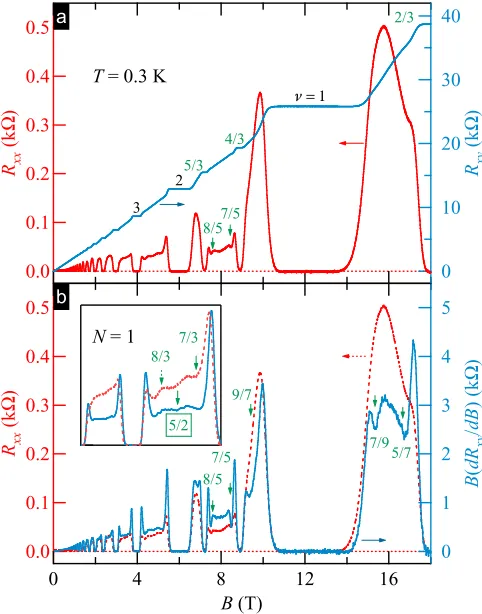
FIG. 1. (Color online) (a) Rxx (left axis) and Rxy (right axis) versusB. (b)Rxx(left axis, dotted line) andB(dRxy/dB) (right axis, solid line) versusB. Integers and fractions next to the traces mark filling factors. Inset showsRxx(B) (dotted line) andB[dRxy(B)/dB] (solid line) in theN=1 Landau level. Vertical arrows are drawn at correspondingν, as marked.
We next examine the applicability of the empirical “re-sistance rule” [30,31] which states that Rxx and Rxy are related asRxx ∼B(dRxy/dB). In Fig.1(b)we presentRxx(B) (left axis, dotted line) andB[dRxy(B)/dB] (right axis, solid line), calculated from the Rxy(B) data shown in Fig. 1(a). Direct comparison reveals excellent agreement between the two quantities over the entire magnetic field range. In addition, B[dRxy(B)/dB] reveals strong minima at ν=8/5 and ν= 7/5, as well as dips nearν =5/7,7/9, and 9/7, indicating developing FQH states at these filling factors. The inset shows the zoomed-in version of same data in the vicinity ofν=5/2. As illustrated by the arrows, very weak minima can be seen nearν=5/2 andν=7/3, whileν=8/3 corresponds to the Rxxmaximum.
To demonstrate the accuracy of the Hall quantization, we construct Fig. 2 showingRxx (left axis) andRxy/RK (right axis), whereRK ≡h/e2≈25.812 k is the von Klitzing con-stant versus the filling factor. Horizontal dotted lines, drawn atRxy/RK =1/ν=1/3,1/2,3/5,3/4,1, and 3/2, accurately match corresponding plateaus in Rxy at both integer and fractionalν, attesting to excellent quality of Hall quantization. Having confirmed quantization at filling factors ν=5/3 andν=4/3, we now examine our data within the framework of composite fermions [12,13]. Aroundν=3/2, composite fermions are formed by attaching two Dirac flux quanta
0.5
0.4
0.3
0.2
0.1
0.0
Rxx
(k
Ω
)
3 2
1
ν
3/2
1
3/4
3/5 1/2
1/3
Rxy
/
RK
T = 0.3 K
ν = 1
2
3 4/3
5/3 2/3
FIG. 2. (Color online) Rxx(left axis) andRxy/RK(right axis) as functions of the filling factorν. Horizontal dotted lines are drawn at
Rxy/RK=1/3,1/2,3/5,3/4,1, and 3/2. Integers and fractions next to the traces mark filling factors.
(2φ0=2h/e) to the empty states in theN =0, spin-up Landau level. Since the density of these states is given byn=(2/ν− 1)p, the composite fermions move in an effective magnetic field B=B−2φ
0n= −3(B−B3/2), where B3/2 is the
magnetic field atν=3/2. Exactly atν=3/2,B=0 and the composite fermions form a Fermi sea with the Fermi energy E
F, determined byn
and the composite effective massm.
Away fromν=3/2, composite fermions populatelevels, separated byωc=e|B|/m. As a result, the FQH states at ν=2−ν/(2ν±1)=5/3,8/5, . . .and 4/3,7/5, . . .can be viewed as integer quantum Hall states of composite fermions atν≡nφ
0/|B| =1,2, . . .and 2,3, . . ., respectively.
In a typical two-dimensional electron gas in GaAs, the Zeeman energy atν=3/2 is of the order of 1 K, which is smaller than the Fermi energy of composite fermions. As a result, the composite fermion system is often only partially spin polarized which results in multiple crossings of spin-up and spin-downlevels leading to suppression of select FQH states. In our Ge sample, a rough estimate of the holegfactor can be obtained by comparing the magnetic field onsets of quantum oscillations at even and odd filling factors. Since the ratio of these onsets is close to 2 [19], the ratio of the cyclotron energy to the spin splitting is about 3, yieldingg≈ (2me/m)/3≈7.4, where we have used the effective hole mass
m≈0.09me[18,26]. We can then estimate the Zeeman energy atν=3/2 as Ez=gμBB3/2≈40 K. Using the composite
fermion effective mass obtained below, we find that this value is about three times larger thanE
F =2π2p/3m
. As a result,
the FQH states are not affected by the spin degree of freedom and the only parameter which determines the-level spectrum is the composite fermion massm. In what follows, we obtain
mfrom the temperature dependence of magnetoresistance in theN=0, spin-up Landau level.
[image:3.608.317.557.68.289.2] [image:3.608.52.293.70.377.2]0.3
0.2
0.1
0 Rxx
(k
Ω
)
11 10
9 8
7
B (T)
-8 -6 -4 -2 0 2 4
B* (T)
3/2
5/3 4/3
1 2 4 6 10
2 4
Rxx
(
Ω
)
3 2
1
1/T (K-1) ν = 5/3
ν = 4/3
ν = 8/5
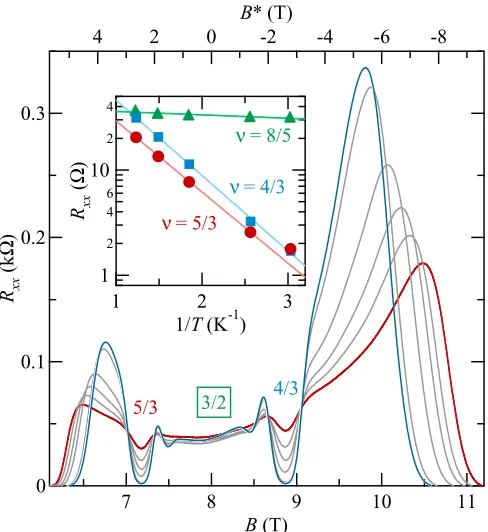
FIG. 3. (Color online) Rxx as a function of B (bottom axis) and B (top axis) in theN =0, spin-up Landau level at different temperatures from T ≈0.3 K to T ≈1.1 K. Inset shows Rxx at
ν=5/3 (circles),ν=4/3 (squares), andν=8/5 (triangles) versus 1/T on a log-linear scale. The fits withRxx∼exp(−ν/2T) (solid lines) generate5/3=3.1 K and4/3=3.3 K.
In Fig.3we presentRxx as a function ofB (bottom axis) andB (top axis) at different temperatures from T ≈0.3 K toT ≈1.1 K. The data reveal that the resistances at theRxx minima atν=5/3 andν=4/3 grow with increasingT in a very similar fashion. This behavior suggests that the energy gaps at these filling factors are close to each other, indicating anticipated full spin polarization of both FQH states. In the inset of Fig.3we present theRxx values atν=5/3 (circles),
ν=4/3 (squares), andν=8/5 (triangles) versus 1/T on a log-linear scale. We find that bothν=5/3 andν=4/3 data can be described reasonably well by exponential dependencies (solid lines), Rxx ∼exp(−ν/2T), with 5/3=3.1 K and
4/3=3.3 K, respectively. In contrast, the Rxx at ν=8/5 shows very weak dependence, indicating a vanishingly small gap (0.1 K).
Theoretically, the energy gap of FQH states at filling factorsν=n/3, where n is an integer, can be estimated as =ω
c≈0.1EC, whereEC=e2/4π 0=41 √
B[T] K is the Coulomb energy. Using this expression we obtain5/3
4/310 K, which is considerably larger than experimental
values. It is well known, however, that finite-thickness effects [32–35] and Landau level mixing [33,36] can reduceω
cand
that the experimental gap will be reduced even further due to the finite width of thelevels . One standard procedure to obtainm andis to extract activation gaps for a series of FQH states and fit the data with=eB/m−[37]. While such a method cannot be reliably applied to our data, it can still give us a crude estimate. Using the two data points,
2 4 101
2 4 102
A
/
T
(
Ω
/K)
1.0 0.8 0.6 0.4
T (K) ν* = 5/2
ν* = 3/2 a
101 102 103
A
/
DT
(
Ω
)
0.8 0.6 0.4 0.2 0
1/B* (T-1) b
FIG. 4. (Color online) (a) Resistance oscillation amplitude A
normalized to temperatureT at ν≈3/2 (circles) andν≈5/2 (squares) as a function of temperature. Solid lines are fits with
A/T∼1/sinh(2π2k
BT /ωc). (b) Resistance oscillation amplitude
Anormalized toDT as a function of 1/B. Solid line is the fit to
A/DT ∼exp(−π/τqωc).
5/3≈3.1 K and8/5≈0.1 K, we obtainm≈0.4meand
≈4.9 K.
Another approach to obtainmis based on the Shubnikov– de Hass analysis using the Lifshitz-Kosevich formula [38,39]. More specifically, theRxxoscillation amplitude is expected to decay with increasingT as
A∼DT =(2π2kBT /ωc)/sinh(2π2kBT /ωc), (1)
where kB is the Boltzmann constant. Such analysis can be most reliably performed atB corresponding to the maxima of Rxx located between the Rxx minima at ν=5/3 (ν= 1) and ν =8/5 (ν=2), as well as at ν=4/3 (ν=2) andν =7/5 (ν=3). These maxima occur near composite fermion filling factorsν=3/2 andν=5/2, respectively, and the amplitudes can be estimated as, e.g., A(ν=3/2)≈ Rxx(ν=3/2)/2−[R(ν
=1)
xx +R(ν
=2)
xx ]/4. Extracted in such a way amplitudes, normalized to T, are presented in Fig. 4(a) as a function ofT on a log-linear scale forν=3/2 (circles) and ν=5/2 (squares). The fits to the data with A/T ∼ 1/sinh(2π2k
BT /ωc) (solid lines) generatem≈0.42meand
m≈0.45m
e for ν=3/2 and ν=5/2, respectively. By extrapolation, we can estimatematν =5/3 asm≈0.41m
e which corresponds toωc≈7.8 K. The-level broadening parameter can be estimated as =ωc−5/3 ≈4.7 K,
which is close to the earlier estimate. Finally, we find that atν=5/3,ω
c≈0.07EC, in reasonable agreement with the theoretical prediction, especially considering that it neglects the effects of finite thickness [32–35] and Landau level mixing [33,36].
Another parameter which can be obtained from the Shubnikov–de Hass analysis is the quantum scattering timeτ
q
which contributes to the decay of the oscillation amplitude as the effective magnetic field is lowered. The functional depen-dence of such a decay is given byA∼DTexp(−π/ωcτq) and
τqcan be obtained from the Dingle plot analysis as illustrated in Fig.4(b). Here, we plot the amplitudeA, normalized by DT as a function of 1/Bon a log-linear scale. The fit with
A/DT ∼exp(−π/ωcτq) yields τq≈1.2 ps. With this value
one can obtain the width of thelevels=τq≈6.2 K, which is reasonably close to earlier estimates. The obtained value ofτ
[image:4.608.53.297.70.336.2] [image:4.608.314.559.71.190.2]Q. SHI, M. A. ZUDOV, C. MORRISON, AND M. MYRONOV PHYSICAL REVIEW B91, 241303(R) (2015)
fermionsτ≈ 10 ps, estimated from the resistivity atν=3/2. It is also lower than the quantum lifetime of 2D holes
≈3 ps, obtained from the Dingle analysis of microwave-induced resistance oscillations (measured in a different, but similar, sample) [26].
In summary, we have observed and investigated the frac-tional quantum Hall effect in an ultrahigh-quality 2D hole gas hosted in strained Ge quantum well. The Hall resistance reveals plateaus atν =2/3,4/3, and 5/3 which are quantized precisely at h/e2ν. From the analysis of the temperature
dependence of the longitudinal resistance in the lowest, spin-up Landau level we determine the composite fermion mass of m≈0.4me. At ν=5/3, this value corresponds to ωc≈ 0.07e2/4π 0, in reasonable agreement with the theory.
Due to large Land´egfactor, all observed fractions represent single-component FQH states which are fully spin polarized
and can be described by the integer quantum Hall effect of composite fermions with only orbital degree of freedom.
We thank J. Jain, S. Kivelson, and B. Shklovskii for discussions and G. Jones, S. Hannas, T. Murphy, and J. Park for technical assistance with experiments. The work at the University of Minnesota was funded by the US Department of Energy, Office of Science, Basic Energy Sciences, under Award No. ER 46640-SC0002567. Q.S. acknowledges support from an Allen M. Goldman fellowship. The work at the Univer-sity of Warwick was supported by EPSRC funded “Spintronic device physics in Si/Ge heterostructures” EP/J003263/1 and Platform Grant EP/J001074/1 projects. Experiments were performed at the National High Magnetic Field Laboratory, which is supported by NSF Cooperative Agreement No. DMR-0654118, by the State of Florida, and by the DOE.
[1] D. C. Tsui, H. L. Stormer, and A. C. Gossard,Phys. Rev. B25, 1405(1982).
[2] S. F. Nelson, K. Ismail, J. J. Nocera, F. F. Fang, E. E. Mendez, J. O. Chu, and B. S. Meyerson,Appl. Phys. Lett.61,64(1992). [3] E. P. De Poortere, Y. P. Shkolnikov, E. Tutuc, S. J. Papadakis, M. Shayegan, E. Palm, and T. Murphy,Appl. Phys. Lett.80, 1583(2002).
[4] K. Lai, W. Pan, D. C. Tsui, S. Lyon, M. M¨uhlberger, and F. Sch¨affler,Phys. Rev. Lett.93,156805(2004).
[5] B. A. Piot, J. Kunc, M. Potemski, D. K. Maude, C. Bet-thausen, A. Vogl, D. Weiss, G. Karczewski, and T. Wojtowicz, Phys. Rev. B82,081307(2010).
[6] T. M. Kott, B. Hu, S. H. Brown, and B. E. Kane,Phys. Rev. B
89,041107(2014).
[7] C. Betthausen, P. Giudici, A. Iankilevitch, C. Preis, V. Kolkovsky, M. Wiater, G. Karczewski, B. A. Piot, J. Kunc, M. Potemski, T. Wojtowicz, and D. Weiss,Phys. Rev. B90,115302 (2014).
[8] X. Du, I. Skachko, F. Duerr, A. Luican, and E. Y. Andrei,Nature (London)462,192(2009).
[9] K. I. Bolotin, F. Ghahari, M. D. Shulman, H. L. Stormer, and P. Kim,Nature (London)462,196(2009).
[10] A. Tsukazaki, S. Akasaka, K. Nakahara, Y. Ohno, H. Ohno, D. Maryenko, A. Ohtomo, and M. Kawasaki,Nat. Mater.9,889 (2010).
[11] K. von Klitzing, G. Dorda, and M. Pepper,Phys. Rev. Lett.45, 494(1980).
[12] J. K. Jain,Phys. Rev. Lett.63,199(1989).
[13] J. K. Jain,Composite Fermions(Cambridge University, Cam-bridge, 2007).
[14] J. K. Jain,Annu. Rev. Condens. Matter Phys.6,39(2015). [15] R. Winkler, M. Merkler, T. Darnhofer, and U. R¨ossler,Phys.
Rev. B53,10858(1996).
[16] R. Winkler,Spin-Orbit Coupling Effects in Two-Dimensional Electron and Hole Systems(Springer-Verlag, New York, 2003). [17] R. Moriya, K. Sawano, Y. Hoshi, S. Masubuchi, Y. Shiraki, A. Wild, C. Neumann, G. Abstreiter, D. Bougeard, T. Koga, et al.,Phys. Rev. Lett.113,086601(2014).
[18] C. Morrison, P. Wi´sniewski, S. D. Rhead, J. Foronda, D. R. Leadley, and M. Myronov,Appl. Phys. Lett.105,182401(2014).
[19] Q. Shi, M. A. Zudov, C. Morrison, and M. Myronov,Phys. Rev. B91,201301(R) (2015).
[20] R. Pillarisetty,Nature (London)479,324(2011).
[21] S. Das Sarma and E. H. Hwang, Phys. Rev. B 90, 035425 (2014).
[22] S.-H. Song, D. Shahar, D. C. Tsui, Y. H. Xie, and D. Monroe, Phys. Rev. Lett.78,2200(1997).
[23] M. Hilke, D. Shahar, S. H. Song, D. C. Tsui, Y. H. Xie, and D. Monroe,Phys. Rev. B56,R15545(1997).
[24] M. Hilke, D. Shahar, S. H. Song, D. C. Tsui, and Y. H. Xie, Phys. Rev. B62,6940(2000).
[25] A. Dobbie, M. Myronov, R. J. H. Morris, A. H. A. Hassan, M. J. Prest, V. A. Shah, E. H. C. Parker, T. E. Whall, and D. R. Leadley,Appl. Phys. Lett.101,172108(2012).
[26] M. A. Zudov, O. A. Mironov, Q. A. Ebner, P. D. Martin, Q. Shi, and D. R. Leadley,Phys. Rev. B89,125401(2014).
[27] Q. Shi, Q. A. Ebner, and M. A. Zudov, Phys. Rev. B 90, 161301(R) (2014).
[28] M. Myronov, C. Morrison, J. Halpin, S. Rhead, C. Casteleiro, J. Foronda, V. A. Shah, and D. Leadley,Jpn. J. Appl. Phys.53, 04EH02(2014).
[29] M. Myronov, C. Morrison, J. Halpin, S. Rhead, J. Foronda, and D. Leadley,Solid-State Electron.110,35(2015).
[30] A. Chang and D. Tsui,Solid State Commun.56,153(1985). [31] W. Pan, J. S. Xia, H. L. Stormer, D. C. Tsui, C. L. Vicente,
E. D. Adams, N. S. Sullivan, L. N. Pfeiffer, K. W. Baldwin, and K. W. West,Phys. Rev. Lett.95,066808(2005).
[32] A. H. MacDonald and G. C. Aers, Phys. Rev. B 29, 5976 (1984).
[33] D. Yoshioka,J. Phys. Soc. Jpn.53,3740(1984).
[34] F. C. Zhang and S. Das Sarma,Phys. Rev. B33,2903(1986). [35] D. Yoshioka,J. Phys. Soc. Jpn.55,885(1986).
[36] I. Sodemann and A. H. MacDonald,Phys. Rev. B87,245425 (2013).
[37] R. R. Du, H. L. Stormer, D. C. Tsui, L. N. Pfeiffer, and K. W. West,Phys. Rev. Lett.70,2944(1993).
[38] R. Du, H. Stormer, D. Tsui, L. Pfeiffer, and K. West,Solid State Commun.90,71(1994).
[39] D. R. Leadley, R. J. Nicholas, C. T. Foxon, and J. J. Harris,Phys. Rev. Lett.72,1906(1994).