http://wrap.warwick.ac.uk/
Original citation:
Poschen, Meik, Procter, Robert N., Voss, Alex, Birkin, Mark and Malleson, Nicolas
(2012) Scoping and business models report. Coventry: University of Warwick.
(Unpublished)
Permanent WRAP url:
http://wrap.warwick.ac.uk/77625
Copyright and reuse:
The Warwick Research Archive Portal (WRAP) makes this work of researchers of the
University of Warwick available open access under the following conditions. Copyright ©
and all moral rights to the version of the paper presented here belong to the individual
author(s) and/or other copyright owners. To the extent reasonable and practicable the
material made available in WRAP has been checked for eligibility before being made
available.
Copies of full items can be used for personal research or study, educational, or
not-for-profit purposes without prior permission or charge. Provided that the authors, title and
full bibliographic details are credited, a hyperlink and/or URL is given for the original
metadata page and the content is not changed in any way.
A note on versions:
The version presented here is a working paper or pre-print that may be later published
elsewhere. If a published version is known of, the above WRAP url will contain details
on finding it.
Scoping and Business Models Report
Meik Poschen, Rob Procter, MeRC
With contributions by Mark Birkin, Alex Voss, Nicolas Malleson
1 Introduction and Aims ...2
2 Approach...2
3
NeISS Project Outreach and Impact ...2
4 Community Scoping ...4
4.1 Research ...4
4.1.1 Interviews ...4
4.1.2 Population Simulation Tool Exemplar ...5
4.1.3 Age & Inequality Exemplar ...5
4.1.4 UK Disability Estimates Exemplar ...6
4.2 Teaching...6
4.1.5
Social Simulation Course ...6
4.3 Policy Decision Makers & Planners ...6
4.1.6 Transport for Greater Manchester (TfGM) ...6
4.2 4.5 Business Organisations ...7
4.2.1
Demographics User Group (DUG)...7
5 Sustainability and Business Models...8
6 Summary and Outlook ...10
1
Introduction and Aims
The aim of this work was to scope the community for needs, raise awareness and encourage adoption of new social simulation models and tools developed in the National e-Infrastructure for Social Simulation (NeISS) and gather findings, establish contacts, and build capacity for future activities.
2
Approach
The NeISS project is strongly embedded within a number of different projects and activities, section 3 sheds some light on its foundations, community and linkage with a focus on general outreach and impact. The business model investigation is aligned with five target user markets shown in Table 1: 1) Research, 2) Teaching, 3) Policy-makers and planners, 4) Public and 5) Business Organisations and is discussed in section 4.
This outreach and community scoping work started with the NeISS exemplars, especially
Epidemiology, SimCity for Real and Ageing and Inequality. The aim of these has been to develop tools within NeISS for a specific application area, driven by the exemplar owners as the domain experts. For our outreach activities this meant liaising closely and to scoping the relevant community and
establishing an understanding of what the general and specific needs for a social simulation infrastructure will be. Three exemplars (Virtual Exhibition Space, Credit crunch and CityDB) are public outreach demonstrators developed by CASA and will be covered briefly under general outreach activities (section 3).
Activities included following up established contacts (Demographics User Group1), establishing new ones (Transport for Greater Manchester2, Oldham Council), and creating and making of training materials (website, videos, Population Simulation tool, Social Simulation Course) to raise awareness, gathering insights on the usefulness of social simulation infrastructure components, evaluating tools and training modules.
3
NeISS Project Outreach and Impact
A number of ESRC-funded projects and activities are connected to NeISS (e.g. MoSeS, GeoVUE and GENeSIS; CASA activities like SurveyMapper and MapTube; TALISMAN; details see below) and have helped to constitute and conceptualise the project, its evolution and the continuation (post-project) of ideas, methods, outputs and tools. This section gives a brief overview of the general outreach and impact created.
The main drivers for NeISS lay in previous work and existing networks and people of research groups at Leeds, London, Stirling, Daresbury and Manchester, and a number of projects and nodes within the National Centre for e-Social Science (NCeSS), funded by ESRC, namely:
• The Modelling and Simulation for e-Social Science (MoSeS,
http://www.ncess.ac.uk/research/geographic/moses/) project and the Centre for Spatial Analysis and Policy (CSAP, http://www.geog.leeds.ac.uk/research/csap), University of Leeds. The foundation for a number of methods and models was laid here and further developed, re-used and refined in GENeSIS, NeISS and TALISMAN.
• The Geographic Virtual Urban Environments (GeoVUE,
http://www.ncess.ac.uk/research/geographic/geovue/) project and the Centre for Advanced Spatial Analysis (CASA, http://www.bartlett.ucl.ac.uk/casa), University College London (UCL). Work on tools such as GMap Creator (and other software:
http://www.bartlett.ucl.ac.uk/casa/latest/software), MapTube (http://www.maptube.org/) and SurveyMapper (http://www.surveymapper.com).
• GeoVUE and MoSeS then became GENeSIS: GENerative E-SocIal Science
(http://www.genesis.ucl.ac.uk/) in a further phase of ESRC funding, with CASA and CSAP as leading centres of expertise in spatial modelling and simulation collaborating even stronger. • The Data Management through e-Social Science (DAMES, http://www.dames.org.uk/) project and
the School of Applied Social Science (http://www.dass.stir.ac.uk/), University of Stirling.
Table 1: NeISS Outreach Areas (Mark Birkin).
• STFC, Daresbury Laboratory (
http://www.daresburysic.co.uk/about-us/campus-partners/daresbury-laboratory.aspx); provider of the Sakai Research Support Portal (http://portal.ncess.ac.uk:8080/portal ; formerly NCeSS portal).
• Manchester eResearch Centre (MeRC, http://www.merc.ac.uk/?q=node/338), successor of the National Centre for e-Social Science (NCeSS) Hub, University of Manchester. Also: The NCeSS e-Infrastructure for the Social Sciences (NeSS) project, managed by the NCeSS Hub and funded by the ESRC.
All of the above became NeISS project partners and most of them have been involved in
complementary activities since then; in this context the following list shows a selection of relevant communities and areas connected to pathways for existing and future outreach and impact:
• The Infrastructure Transitions Research Consortium (ITRC, http://www.itrc.org.uk/) “delivers research, models and decision support tools to enable analysis and planning of a robust national infrastructure system”.
• Research methods and teaching: TALISMAN is a node of the National Centre for Research
Methods (NCRM), funded by ESRC (http://www.geotalisman.org/) and again involving both CSAP and CASA. It is continuing the pathway for impact for research and teaching within the NCRM (http://www.ncrm.ac.uk/) network on methods for geospatial data analysis and simulation. Further development and deployment of NeISS services is planned through the Talisman training programme.
• GEOG2080 teaching: Simulation tools of planning decisions for use with u/g students have been
developed at CSAP (class of 110 students; how to scale this to a social simulation infrastructure and across institutions is being explored).
• PhD project on methods: An ESRC studentship at CSAP (“Geodemographics: Creating a
• PhD project on Health: An ESRC TALISMAN studentship at CSAP is looking into “Modelling the impacts of demographic ageing on the delivery of health care services”.
• Criminology: The JISC funded geocrimedata project (http://geocrimedata.blogspot.co.uk/) is
bridging from academics to practitioners in this research domain by “taking existing geospatial data making it useful for crime analysis”. NeISS models and tools could be further tailored to work with this community.
• Housing (housing benefits): CSAP is working with Leeds City Council on scenarios and
simulations.
• Crowd-Sourcing: A new project collaboration between CASA and CSAP includes Twitter work
and new modelling approaches based on NeISS.
• CASA Conference: CASA regularly (usually yearly) hosts a conference especially aimed at policy
makers and the public in general (free to attend, around 200 attendees on a regular basis). To illustrate how different projects, activities, communities and people are interlinked, here is a more detailed example from Andy Turner (University of Leeds) and Tom Doherty (National eScience Centre, Glasgow) on demographic model development and simulation work involving NeISS, GENeSIS and GridPP (as of March 2012):
“The demographic model development work was largely GENeSIS work. In NeISS we have refactored the code so that the programs will run as part of a ‘Genesis Simulator’ that uses GridPP site data storage and compute elements. We have tested that the system works and have produced individual level demographic simulation results for Leeds … We are currently making some changes to enhance the model and outputs and are preparing data to generate simulation results for England from 1981 to 2011.”
Activities directly connected to other NeISS work packages:
• Transport Scenario: NeISS developed a use case for transport3, which has been used to illustrate the project’s work in a number of user and outreach meetings (e.g. with TfGM).
• SurveyMapper (a free real-time geographic survey and polling tool developed at CASA:
http://www.surveymapper.com/) and as an especially successful example the CreditCrunch
Survey (http://www.surveymapper.com/mapView.aspx?id=2): The Credit Crunch Survey
provided pathways to impact and public outreach examples of research services. Excellent outreach with 22,000 inputs was achieved in providing an early example of crowd sourcing in association with BBC Radio 4.
• CityDB (http://citydashboard.org/ is an endeavour by CASA providing an online City
Dashboard/Database for viewing live data feeds.
• The Virtual Exhibition Space (CASA) is an online space for the display of NeISS outputs. See
http://www.digitalurban.org/2012/02/data-space-agent-based-models-sketchup.html.
4
Community Scoping
4.1 Research
4.1.1 Interviews
Eight telephone interviews were conducted with international social simulation domain experts, with the aim of determining base requirements for the NeISS infrastructure, functionality and data, to scope the social simulation expert domain and to gain insight into potential benefits of using NeISS.
The Social Simulation sub-disciplines covered were social & economic, health, agriculture, environmental, innovation and transport/travel. The experts mostly work with small area or general spatial microsimulation, both static and dynamic. They work nationally and internationally, and are particularly interested in developing and comparing methods, models, outcomes and policies pertaining to social simulation, not only in the academic sector, but also in terms of consulting for policy makers. The following main benefits of a Social Simulation Infrastructure like NeISS were highlighted:
3 Birkin, M., Procter, R., Allan, R., Bechhofer, S., Buchan, I., Goble, C., Hudson-Smith, A., Lambert, P., De Roure, D.,
• Provide web-based access to a general infrastructure and resource for microsimulation, providing generic tools and data input/output functionality.
• It is important to have a usable interface for experts and non-experts from academia and policy decision making/consulting to run microsimulations (using various datasets and algorithms). • Foster comparison of different methods, models and outputs (also internationally long term). • Provide links to resources, documentation (wikis) and publications.
A number of recommendations and potential caveats were also identified:
• Validation of models, methods and algorithms is essential, things have to work as expected and people have to trust the expected outputs.
• The speed with which results can be generated. To satisfy policy makers, being able to generate results in near real-time is important.
• Covering a number of methodologies and datasets would help adoption.
• Access rights policies, IPR, open access and cost models have to be considered.
4.1.2 Population Simulation Tool Exemplar
The NeISS Population Simulation tool
( http://drupals.humanities.manchester.ac.uk/neiss3/content/neiss-population-simulation-guided-simulation) is a guided simulation allowing the user to run through a complete simulation workflow for a selected area of the UK and visualise the results. The simulations are guided in the sense that there are limited variables and therefore pathways to choose, but the actual computation is run live (if a previous result is not already saved); output files are available for download after each step is
completed and the user can go forwards and backwards through the different steps and results, run new selections and go back to completed ones.
The tool was used as a demonstrator across various disciplines and domains. Currently, the simulation uses 2001 Census data, but it is intended to add the recent 2011 Census data when available.
4.1.3 Age & Inequality Exemplar
The Age & Inequality exemplar focuses on using social simulation for studying social inequality and developing methods to forward-project occupational and educational qualification structures in this context (social mobility and inequality: ageing population; changing family structures; educational expansion; immigrant influxes; wellbeing. A workshop on ‘Simulation Analysis of Ageing and
Inequality’ was held at the University of Stirling to present the NeISS approach and to show how social simulation can be useful for this specific domain.
The event was followed up by five telephone interviews with workshop participants to elicit more detailed feedback on potential benefits and impact of social simulation for their research communities. The interviewees use classical quantitative statistical models and mostly longitudinal surveys/data for their research, but none used simulation techniques so far. Three potential audiences in this domain were identified, 1) the largest group would be interested in general outputs as results of social
simulation; 2) a relatively small group of quantitative sociologists/economists interested in the general field; 3) groups interested in methodological issues:
Most workshop participants and interviewees agreed that making the effort to bridge the disciplinary gap between the social simulation community and other domains – especially those already using quantitative statistical methods – would be worthwhile. The following points were emphasised:
• The specific terminology around social simulation and the benefits of using such an approach have to be made clear cross-discipline: What is social simulation? How can social simulation help solving research questions and to what end? It should be presented as an additional means to tackle problems, give indications and present trends, another way of describing social phenomena.
• Validation and transparency of method and results is crucial, a kind of audit trail would be very useful (together with references and documentation) to enable reproducibility of results. At the same time some caveats have been identified:
4.1.4 UK Disability Estimates Exemplar
The NeISS UK Disability Estimates tool
(http://drupals.humanities.manchester.ac.uk/neiss3/content/uk-disability-estimates-methodbox) is based on MethodBox (https://www.methodbox.org/) and provides a Health Survey for England (HSE) 2000 subset which can be used along with a prepared HSE 2001 data subset and cut down Census data info to calculate disability prevalence for 2001 to 2031 in UK districts. The script uses the R statistical programme and is based on the Small Area Estimation work by Dr Alan Marshall (available from
http://www.ccsr.ac.uk/esds/data/).
4.2 Teaching
4.1.5 Social Simulation Course
A five day Social Simulation Course module at the North West and White Rose Doctoral Training Centres (DTC) was run in April/May 2012 (https://sites.google.com/site/socialsimulationcourse/home). The course was primarily aimed at Social Science postgraduates and research staff, and focused on encouraging participants to think through the possibilities for applying social simulation in the context of their own research. The course introduced the methods and techniques of social simulation,
including microsimulation and agent-based modelling, and discussed a number of detailed case studies ranging across the social sciences. See the social simulation module report for details.
4.3 Policy Decision Makers & Planners
4.1.6 Transport for Greater Manchester (TfGM)
NeISS arranged a meeting with TfGM in order to identify and explore possible ways in which the NeISS project might be relevant to TfGM. A follow-up meeting was held in late autumn of 2011 to further discuss mutual interests and benefits of collaboration. Based on this, NeISS contributed a letter of support to TfGM’s successful bid to the DfT’s Local Sustainable Transport Fund (LSTF).
TfGM uses a number of conventional, more static models for transport looking at interventions and developing business cases, but would like to improve decisions making based on more dynamic modelling and simulation. One example would be how to get information/data on people’s travel, how choices are configured and might be influenced by planning and measures. The difficulty lies in building a picture on the micro-level and then putting it into the larger picture to help with decisions. TfGM’s bid to the DfT’s Local Sustainable Transport Fund (LSTF) focused “around the three core themes of active travel, smarter travel information and promotion, and network efficiency”
(http://www.tfgm.com/ltp3/LSTF.cfm. One focus lies in collecting (more) real life data, looking at the ‘softer issues’ and implications. For collaboration with NeISS: “[...] the area of most interest to TfGM at the moment would be exploring how your techniques could help analyse behavioural responses to sustainable travel initiatives [...] one item for discussion would be how we could jointly develop a research proposition for the bid, which could sit alongside the programme over the next 3 years or so.” A number of areas have been identified for TfGM to benefit from NeISS:
• Agent-based modelling would be a useful approach for addressing behavioural patterns; at TfGM Agent-based/Activity modelling is not really applied at the moment, because of its complexity and limited in-house resources.
• TfGM would benefit from insights on how to educate decision makers (the social simulation pilot module for training would be especially useful in this context) on how to configure models and interpret findings. One example would be the congestion charge.
• Potential arrangements for collaboration have been discussed: a) embedding a post-graduate with TfGM, e.g. to use specific simulation methods in a project; good results have been achieved in the past with a PhD student working on a housing market segregation model in the East Leeds Area, and looking at crime.
Further meetings with TfGM to discuss collaboration on the successful LSTF bid are currently being scheduled.
4.1.6.1 Oldham Council (Geographic Information Manager, Corporate Policy and Research)
the small area level and providing the figures to people to use. The interviewee’s research team consists of eight members, in the same unit there is also a public health team with four more people;
additionally there is a separate community safety unit dealing with crime.
What NeISS offers would especially be beneficial to link up certain data sets and services for modelling for, e.g. transport, population change (ethnicity, migration models) and other data. Having projections one to two years in advance would be very useful to be able to react to developments quickly (i.e. for migration) but, at the same time, they need to look at populations with models in a range of 20-25 years. In summary:
• Having a transport scenario simulating around impacts of the extension of the MetroLink in Greater Manchester would be a very worthwhile in order to “challenge the models or challenge some of the economic assumptions that are being used across the whole economic spending pattern”.
• The interviewee could see potential of the NeISS Population Simulation tool. Oldham Council, as other Local Authorities “invest quite a lot every year in surveying the same set of variables (social surveys), so being able to project those ahead reliably” would be very useful. Oldham Council are very interested in topics such as community cohesion (“big issue”), “how people feel about their local areas and crime”, social and digital exclusion, health, mental health and self-reported health as well.
• The NeISS Population Simulation tool is seen as useful as is as a means to compare projections of different areas on various topics like, e.g. smoking. The interviewee tested the tool shortly after the meeting and gave valuable feedback for improvements, especially on clarifying its processes, given values and outputs.
• It was agreed that it would be useful to set up another meeting with the whole team at Oldham Council to have a more focussed discussion on how to develop/adapt models/simulations beneficial for Oldham Council. This could then be used as a proof of concept example to help understand how to create models and deliver a service that will be useful for other Councils and Local Authorities.
4.2 4.5 Business Organisations
4.2.1 Demographics User Group (DUG)
The DUG (see http://www.demographicsusergroup.co.uk/ was set up in1998 to give its member organisations a forum to discuss experiences and good practice on making use of demographic information “to analyse customers, identify markets and avoid risks [...] to target their resources to achieve maximum effect.” We interviewed the founder to get an overview of DUG, to identify business problems that its members are wrestling with, and to come to ideas on how social simulation and NeISS might be of use in this context. This was followed up by a presentation focusing on Retail Planning, Demographics and CMA (customer marketing areas), their scope for modelling and potential value for predicting customer behaviour at the quarterly DUG members meeting in late 2011, which led to a discussion on the possibilities of developing modelling in new areas.
All member companies have teams involved in market analysis, customer analysis and customer insight, which involves holding huge internal customer file information databases. They are also interested in external, government datasets like the Census, on data.gov and movement surveys, and in geo-located data (mapping) in general. Commercial suppliers of data and know-how are also
extensively used. Three main areas can be identified which are common for most:
• Their forecasting is quite mature for applications such as: “Where to locate stores? What should be put in those stores? What are the catchment areas? Who are the competitors? How do we access local markets?”
• Customer database analysis is used to try and identify characteristics of individual customers, based on their past behaviour in order to predict current and future needs. This ranges from financial services to various ‘club cards’ of large retailers to figure out what the customer might be interested in. The notion has changed to the ‘single-customer view’ in the sense that the history of past purchases or financial services is now linked under the individual customer’s profile. • Organising market research surveys is often out-sourced to big market research companies. The
Forecasting and prediction are used in a specific way in this commercial domain as trends are looked at and decisions are made for a quite short-lived cycle; in practice, this means analysing only the next day, the next week or month or at maximum three to six months into the future (predicting sales, turnaround, customer types). The knowledge of housing developments (and therefore new customers) also is a factor. In the case of companies with fewer but bigger stores, additional forecasting in a longer-term sense can be applied to determine if, e.g. a specific region will have demand for such a store over the next 10 years.
A recurring theme in retail, which is becoming more and more important, is being aware of population movement 24/7 (i.e. mobility of the population, residential vs. workplace population, people moving around cities, transport). Over the course of a day, the behaviour by different groups can be identified, for example, starting with residents getting active very early, followed by commuters coming in and using ATMs and going to coffee shops, then disappearing into their workplaces and coming out again at lunchtime to buy things and so on. The interesting point is modelling the ebb and flow of the activities and being able to measure the impact. Mobile phones have become more and more important in this context to acquire data, find hotspots, as is tracking and mapping the bike rides within the London Cycle Hire Schemes. Map mash-ups and in that context areas of classifications are of continued interest. Here, new methods and approaches, ‘plausible models or indicators’ are welcome. Overall it is fair to say that all companies collect rich and important data sets on their own, while also looking into uses of external data. They are very mature in certain areas of analysis, but find themselves in a process of continuous exploration in regard to linking up data sets, making use of new methods and understanding how they can best make sense of the vast amounts of data available and benefit from them.
• Modelling over short time periods is generally needed, longer-term forecasting could be beneficial in cases (specifically for one large retailer).
• New methods and approaches, ‘plausible models or indicators’ for population movement 24/7 in the widest sense (i.e. mobility, residential vs. workplace population, people moving around cities) would be of interest.
• Transport is an important area of interest, like traffic speed, road works, and the general access to areas. NeISS has produced work on transport simulation, which might be adaptable.
• Another issue lies in finding the right datasets out of the huge amount of data, for example, on the data.gov website, but also in regard to the potential that lies within companies’ own ‘big data’ warehouses. This problem has two facets, a) to be able to find a subset of datasets of interest and b) to find better means of access and representation of the data to ‘drill down’ and make sense of it. It would be interesting to see how/if simulation might be able to draw on some of the data.gov data sets and make them more operational.
• In terms of business models, companies do and would buy in services for particular projects or activities they have or which they think might help them. For NeISS, this would mean they would have to see how their needs can be addressed successfully before taking the next step.
• Despite most of the large companies having their own computer centres, one of the distinguishing features about NeISS is that it offers the capability of doing large-scale and complex modelling and forecasting which in our current thinking most clients would not be able to provide themselves.
• The presentation at the DUG meeting provided an overview of urban systems and the scope for modelling. This led to a discussion of the possibilities of developing modelling in new areas, with mention of: temporary phenomena, such as changes in petrol prices, and their consequences for store catchments; recession changing consumers’ behaviour; simple ‘forecasts’ are no longer enough, flagging the importance of econometrics & time series; impacts, ranging from local changes in store opening hours, to opening a 3rd runway at Heathrow; the relationship with behavioural economics; and consumers’ mindsets “people don’t know why”.
5
Sustainability and Business Models
The Software Sustainability Institute has developed a list of possible approaches for sustaining research software. This can serve as a basis for the development of sustainability approaches for NeISS.
software. As services are often composed of a number of different software components, different sustainability options may apply to each of them.
The basic elements of service sustainability are operational support (system administration) and user support (Procter, Poschen and Voss, 2012). If both are in place, it is possible to distinguish a first set of sustainability options by considering who provides each of these elements when a service is maintained in full operational form (see Table 1). In addition, a full sustainability strategy would also have in place a plan for continuing development of tools and resources.
When choosing a sustainability option it is important to think about possible future developments and to ask whether the choice made today precludes other choices being made in the future. That is, choosing an approach should not simply consider a single choice but a potential sequence of options that can lead to a desired outcome.
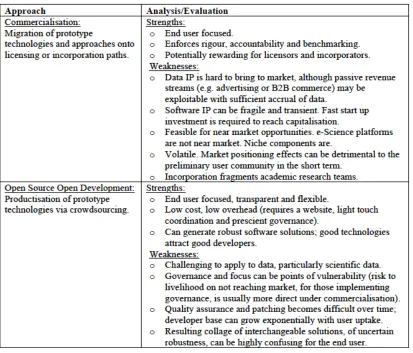
Any given sustainability option is only feasible if a revenue stream can be identified that will generate sufficient funding to cover its costs. The JISC-sponsored Models of Sustainability Workshop (JISC, 2007) produced a set of business models for sustainability. The two categories featured are full commercialisation and open source. Their respective strengths and weaknesses are summarised in Table 2. Of course, a mixed business model, where software is made freely available as open source, but support services are provided at an additional charge to the user has become widely used in the last ten years, as evidenced by the popularity of Linux-based systems. This is the approach that we would follow for NeISS.
A number of service options have been identified, around which business models for NeISS could be developed. They are listed below in order of increasing resource demands. We have matched them to the sectors that our investigations suggest the different service options and business models would be most applicable:
• Support and maintenance: the least expensive option, but dependent on research funding, which many be intermittent, and insufficient to support improvements to existing services and
development of new ones. Making the software available under a standard open source licence allows anyone to re-use it for non-commercial purposes. Community contributions become the main route to further development.
• Hosted services, where simulations are run on NeISS infrastructure: suitable for academic, public and private sectors, where requirements can be met with little or no customisation of services. • Training services (hosted on NeISS or client infrastructure): applicable to all sectors.
• Consulting services (hosted on NeISS or client infrastructure): suitable for public and private sector clients and capable of significant revenue generation.
• Customisation services (hosted on NeISS or client infrastructure): most suitable for private sector clients, such as members of the DUG, requiring bespoke services.
The report from workshop breakout sessions also pointed to the inherent contradictions in relying on academic researchers to take the lead in ‘translation’ i.e., the embedding of prototype services in the wider user community:
“Academia provides an optimal model for the proving of concepts, and can, under specific circumstances, demonstrate that highly integrated approaches are achievable. However, the incentive structure … demands both ongoing reinvention and a measure of isolationism and one-upmanship; the model is developer focused and does little to reward productisation of concepts that have already been proven.”
Transition to a sustainable service marks a change in purpose from one that is primarily research oriented to one that must focus on the provision of a service. For this to be successful, responsibility needs to be handed over to those who have expertise and experience in service provision (Barjak et al., 2013).
Infrastructure resourcing issues for hosted services are explored in detail in the Technical Roadmap report.
some modest levels of further development. However, it would also entail some additional investment of effort in materials to improve their quality and in service enhancements to ensure adequate levels of performance regardless of laod, including probable migration to a cloud infrastructure.
The more business models applicable, the better the opportunity for building a market. On this basis, we believe that NeISS is in a good position to generate sufficient revenue to become sustainable. We expect in the next 12 months to explore the details of these business models with the clients identified in this study.
[image:11.595.96.509.195.548.2]Following on from the pilot social simulation module targeted at DTCs, we conducted a short survey among other DTCs of the market for such a module. The results are reported in the social simulation module report.
Table 2: Business Models for Sustainability (JISC, 2007).
6
Summary and Outlook
Raising awareness, scoping different communities and domains and gathering useful requirements was often a long process, but resulted in a rich picture of how NeISS can be beneficial to users. The NeISS Population Simulation Tool, as well as the collaboration with the exemplars, have been instrumental in generating interest and collaboration within the work of this deliverable and for the project.
A number of contacts could be established and new collaborations started – which opens up routes for further work (further development of the population simulation tool with Oldham Council; collaboration after successful NeISS supported TfGM bid to the LSTF; using and tailoring the social simulation course for more audiences, contexts and locations). Other activities, e.g. with businesses did not result in immediate collaboration opportunities but generated interest from participants, which can be explored further.
spread the word of the usefulness of social simulation and to gather more requirements to improve and develop social simulation tools and evaluate existing infrastructures.
7
Bibliography
Barjak, F., Eccles, K., Meyer, E. T., Robinson, S. and Schroeder, R. (2013). The Emerging Governance of E‐Infrastructure. Journal of Computer‐Mediated Communication.
JISC (2007). Models of Sustainability Workshop. Available at http://www.jisc.ac.uk/whatwedo/programmes/einfrastructure/modelsofsustainability#