www.wjpr.net Vol 7, Issue 08, 2018. 693
A STUDY ON QUALITY OF CURD PRODUCED FROM DIFFERENT
TYPES OF MILK
S. Sharmila*, S. Preetha, M. Dinesh, B. Shrivatasan, Shaik Sadik,
R. Kamalambigeswari, E. Kowsalya and L. Jeyanthi Rebecca
Department of Industrial Biotechnology, Bharath Institute of Higher Education and Research, Chennai, Tamil Nadu-600073.
ABSTRACT
The evolution of human life made his life more modernized. The man ate raw food in the early times. The evolution changed his way of in-taking the food. He started agriculture to have his food and he yielded various types of crops like rice, wheat, maize etc. he used cattle for primary steps of agriculture and cultivation. The cattle which they used for agriculture gave milk later on they considered it has a food which is safe to have and started having milk with the other food materials. At this stage milk came into the food list of human being. The modernization of human being been developed day by day and this factor is responsible for his evolution in food. Curds are a dairy product obtained by coagulating milk in a process called curdling. In this study, different types of cow milk were used for the preparation of curd and its qualities such as taste, texture, protein content and shelf life were analyzed.
KEYWORDS: Milk, curd, fermentation, Taste, texture, protein and shelf life.
INTRODUCTION
Milk and dairy products continue to play an important role in the nutrition of people in many parts of the world. Milk has been shown to be ideal for the growth of microorganisms due to its water, protein, carbohydrate, mineral and vitamin contents, all of which are important to many bacteria.[1] Storage of milk for long periods under refrigeration temperatures has resulted in new quality problems for the dairy industry arising out of the growth and metabolic activities of wild microorganisms at low temperatures. To overcome the
Volume 7, Issue 08, 693-700. Research Article ISSN 2277–7105
Article Received on 21 Feb. 2018,
Revised on 13 March 2018, Accepted on 03 April 2018 DOI: 10.20959/wjpr20188-11807
*Corresponding Author
Dr. S. Sharmila
Department of Industrial
Biotechnology, Bharath
Institute of Higher
Education and Research,
Chennai, Tamil
www.wjpr.net Vol 7, Issue 08, 2018. 694
economical losses fermented milk products came into use. Fermented milks with different names, traditional produced in different countries were reported in prehistoric period and were probably known around the year 2000 BC.[2]
Curd is a fermented dairy product of major importance in Indian subcontinent. From the time immemorial it is being used for its nutritive and therapeutic values.[3] In Ayurveda, use of curd is recommended for curing of ailments like dysentery, dyspepsia and other gastrointestinal disorder. It also improves appetite by stimulating B and T cells of macrophages by lactic acid bacteria.[4] Readily available form of all the nutrients is also present in curd. It alleviates bone problems and a good form of predigested food.[5] Bureau of Indian Standards (1980) defines curd as a product obtained by lactic fermentation of cow or buffalo or mixed milk caused by single or mixed strains of lactic acid bacteria or by alcoholic fermentative yeasts. The preparation of curd includes pasteurization of raw milk, standardization followed by inoculating the standardized milk with starter cultures and incubation at about 37-42oC depending on the types of cultures used.[6] Traditionally, it is produced by boiling cow, buffalo or mixed milk fermented naturally or with previous day’s curd.[7] Because of the natural souring process, wide variations are seen in the quality of market curd.[8] The starter cultures used in curd are not definite and the quality of curd varies according to the culture used. There are reports of wide variations in the physico-chemical, microbial and sensory qualities of yoghurt and yoghurt like products in many countries.[8, 9, 10]
www.wjpr.net Vol 7, Issue 08, 2018. 695
become necessary to identify such cultures, can increase the shelf life of curd traditional produced and preserved under ambient conditions without compromising with the standard quality.
MATERIALS AND METHODS
COLLECTION AND PRESERVATION OF MILK SAMPLES
Different packets of milk samples, such as (S1, S2, S3, S4, S5, S6) were collected from
commercial market and were stored at 4OC.
PREPARATION OF CURD
150 ml of sample in each variant is measured and taken in a separate conical flask for the preparation of curd at the room temperature.
Each milk sample was inoculated with required volume of different inoculum such as lemon, vinegar and yeast to prepare curd.
ANALYSIS OF PROPERTIES OF CURD
Various properties of curd such as taste, texture, water content and protein[14] contents were analyzed as per the standard procedure.
RESULTS AND DISCUSSION
Chemical state of milk proteins and products of their breakdown impart characteristic physical, chemical and sensory properties to most of the dairy products.[15] The flavour of milk product is therefore a combination of aroma, taste and mouth feel.[16] Flavour development occurs due to the release of small peptides and amino acids by proteolysis activity or due to lipolysis.[17]
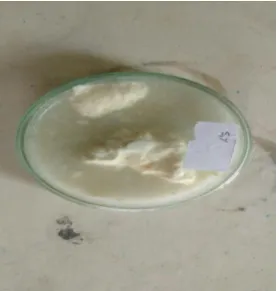
www.wjpr.net Vol 7, Issue 08, 2018. 696 Fig 1: Different types of milk sample.
[image:4.595.124.271.263.410.2]
Fig 2: S1L. Fig 3: S1Y.
[image:4.595.333.473.267.413.2]
www.wjpr.net Vol 7, Issue 08, 2018. 697
[image:5.595.107.488.68.428.2]
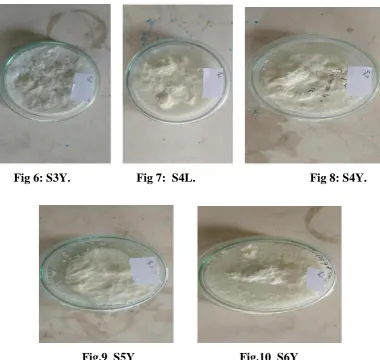
Fig 6: S3Y. Fig 7: S4L. Fig 8: S4Y.
Fig.9 S5Y Fig.10 S6Y
In this work, S1 milk was having more water content among all varieties. S1V and S4V had good shelf life time.
Table 1: Properties of curd prepared from S1 Milk sample.
S.No Inoculum Taste of curd Texture of
curd
Water content
Protein content
Shelf life time (approx)
S1L Lemon Slight bitter Creamy 38ml 0.40 48 hours
S1Y Yeast sweet Mild creamy 60ml 0.40 40 hours
S1V Vinegar Sour Creamy 12ml 0.40 56 hours
Table 2: Properties of curd prepared from S2 milk sample.
S.No Inoculum Taste of curd Texture of
curd
Water content
Protein content
Shelf life time (approx)
S2L Lemon Slight sour and
bitter Pale creamy 17ml 0.31 44 hours S2Y Yeast sour Low creamy 7ml 0.31 42 hours
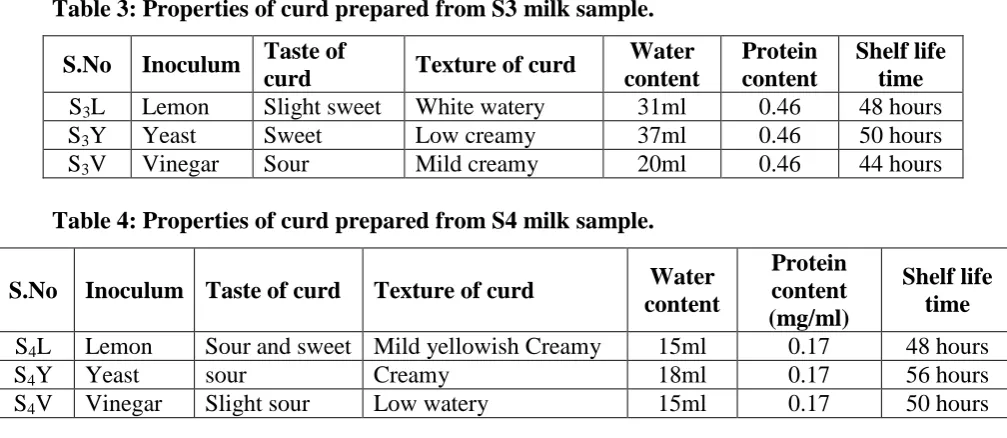
www.wjpr.net Vol 7, Issue 08, 2018. 698 Table 3: Properties of curd prepared from S3 milk sample.
S.No Inoculum Taste of
curd Texture of curd
Water content Protein content Shelf life time
S3L Lemon Slight sweet White watery 31ml 0.46 48 hours
S3Y Yeast Sweet Low creamy 37ml 0.46 50 hours
S3V Vinegar Sour Mild creamy 20ml 0.46 44 hours
Table 4: Properties of curd prepared from S4 milk sample.
S.No Inoculum Taste of curd Texture of curd Water
content Protein content (mg/ml) Shelf life time
S4L Lemon Sour and sweet Mild yellowish Creamy 15ml 0.17 48 hours
S4Y Yeast sour Creamy 18ml 0.17 56 hours
S4V Vinegar Slight sour Low watery 15ml 0.17 50 hours
Table 5: Properties of curd prepared from S5 milk sample.
S.No Inoculum Taste of curd Texture of
curd
Water content
Protein content
Shelf life time (approx)
S5L Lemon Sour and sweet Creamy 18ml 0.28 38 hours
S5Y Yeast sweet Mild creamy 16ml 0.28 44 hours
S5V Vinegar sweet Creamy 17ml 0.28 48 hours
Table 6: Properties of curd prepared from S6 milk sample.
S.No Inoculum Taste of
curd Texture of curd
Water content Protein content Shelf life time
S6L Lemon sweet Yellowish creamy 18ml 0.21 48 hours
S6Y Yeast sweet High watery 20ml 0.21 44 hours
S6V Vinegar mild sour Creamy 11ml 0.21 50 hours
Among all types, S3 milk showed high protein content (0.46 mg/ml) and low protein content was found in S4 milk (0.17mg/ml). S2L and S2V showed bitter taste after fermentation. The shelf life period of curd was found to be maximum in S1 milk inoculated with vinegar and S4 milk (56 hrs) inoculated with yeast and low was found in S5 milk inoculated with lemon (38 hrs). It was also found that the water content of the curd was also varied for the same milk sample after it turned to curd.
CONCLUSION
[image:6.595.46.550.75.294.2]www.wjpr.net Vol 7, Issue 08, 2018. 699 REFERENCES
1. Seo, Dong Mi, So-Young K, Hyun-Ju E, Nam Soo Han. Symbiotic Synthesis of Oligosaccharides during milk fermentation by addition of Leuconostoc starter and Sugars. Journal of Microbiology and Biotechnology, 2007; 17: 1758-1764.
2. Mocanu D, Rotaru G, Botez E, Gitin L, Andronoiu D, Nistor O, Vlasceanu G, Dune A. Sensory evaluation and rheologicl behaviour of probiotic dairy products with Rosa canina L and Glucyrriza glabra L extracts. Innovative Rommanian Food Biotechnology, 2009; 4: 32- 39.
3. Aneja RP, Mathur BN, Chandan RC and Banerjee A. Technology of Indian milk products. 1st edn. Dairy India Publication, New Delhi, 2002.
4. Meydani SN and Ha WK. Immunologic effects of yoghurt. American Journal of Clinical Nutrition, 2000; 71: 861-872.
5. Patel PR and Singh J. Sensory quality assessment of sago based sweetened carrot yoghurt. International Journal of Dairy Science, 2011; 6: 330-334.
6. Tamime AY and Robinson RK Yoghurt: Science and Technology. 2nd edn. CRC Press, New York, 1999.
7. Gandhi DN and Muralidhara S. Dahi and acidophilus milk. Indian Dairyman, 1989; 41: 323-327.
8. Younus S, Masud T and Aziz T. Quality Evaluation of Market Dahi/Yoghurt. Pakistan Journal of Nutrition, 2002;1: 226-230.
9. Obi CN and Ikenebomeh MJ. Studies on the microbiology and nutritional qualities of a Nigerian fermented milk product (Nono). International Journal of Dairy Science, 2007; 2(1): 95-99.
10.El-Bakri JM and El-Zubeir IEM. Chemical and microbiological evaluation of plain and fruit yoghurt in Khartoum State, Sudan. International Journal of Dairy Technology,2009; 4: 1-7.
11.Kansara NM. Animal husbandry in the Vedas. In:(Srivastava) History of Agriculture in India, Concept Publishing Company. New Delhi, 2008; 275.
12.Srinivasan K. Traditional Indian Functional foods. In. John Shi, Chi-Tang Ho, Fereidoon Shahidi (ed.). Functional foods of East, CRC Press: 2011; Florida.
13.Ganguly NC. Carbonation of milk-a process to extend longevity of milk. Indian Dairyman, 2001; 53: 29-31.
www.wjpr.net Vol 7, Issue 08, 2018. 700
15.Sikorski ZE. (2001).Chemical and Functional properties of food proteins, Techomic Publishing Co. Inc, USA, 2001.
16.Gallardo-Escamilla FJ, Kelly AL, Delahunty CM. Mouthfeel and flavour of fermented whey with added hydrocolloids. International Dairy Journal, 2007; 17: 308-315.