REVIEW ON SOLID LIPID NANOPARTICLES
D. Krishna Veni* and N. Vishal Gupta
Department of Pharmaceutics, JSS College of Pharmacy, JSS University, Mysore, India.
ABSTRACT
Solid lipid nanoparticles are the new type of colloidal carrier systems;
these are the substitute to the conventional carriers such as liposome’s,
micro-particles, nanoparticles and micro- emulsions based on natural
macromolecules or synthetic polymers. These consist of an nm range
of spherical solid Lipid nanoparticles spherical in shape, which is
dispersed in water or an aqueous surfactant solution. Solid Lipid
Nanoparticles enhances the oral bioavailability of water insoluble
drugs or poorly soluble drugs. This paper gives an outline of
advantages and disadvantages, production methods, different types,
drug incorporation methods, drug loading capacity and characterization
of SLN’s.
KEYWORDS: Colloidal systems, Oral bioavailability, Solid Lipid Nanoparticles, Water Insoluble Drugs.
INTRODUCTION
Solid Lipid Nanoparticles are the new type of colloidal drug carrier systems that combines
the advantages of liposome’s, polymeric nanoparticles and fat emulsions. Their size ranges
from 50-100 nm. These are consists of the nm range of spherical solid Lipid nanoparticles
and dispersed in water or an aqueous surfactant solution. Feasibility of incorporation of
hydrophilic and lipophilic drugs, easy to manufacture, low cost, easy scale-up, it increases the
oral bioavailability of water insoluble drugs and improved physical stability makes solid
Lipid Nanoparticles a better choice. However, the loading capacity and complexity should be
taken care of.[1-11]
Methods for preparation of SLN’s
Various approaches for preparation of Solid Lipid Nanoparticles are.
Volume 5, Issue 5, 398-413. Review Article ISSN 2277– 7105
*Corresponding Author
D. Krishna Veni
Department of
Pharmaceutics, JSS
College of Pharmacy, JSS
University, Mysore, India. Article Received on 26 Feb 2016,
Revised on 17 March 2016, Accepted on 06 April 2016
1. High pressure Homogenization
2. Ultra Sonification/ high Speed Homogenization
3. Solvent emulsion evaporation technique
4. Solvent emulsion diffusion technique
5. Micro emulsion based method
6. Super critical fluid technique
7. Spray drying method
8. Double emulsion technique
9. Membrane contactor technique
10.Precipitation technique
1. High pressure Homogenization
Used for the manufacturing of Solid Lipid Nanoparticles, extremely powerful and reliable
technique. Homogenizer pushes the liquid with a pressure of around 100 to 2000 bar through
a tiny space in the range of few µ. The fluid accelerates on a very little interval to very high
velocity.
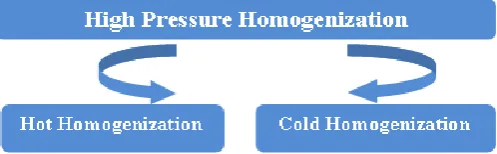
[image:2.595.167.416.450.527.2]Two general approaches of high shear homogenization are described below (Figure 1).
Figure 1: two general approaches for High pressure Homogenizer
1.1Hot Homogenization
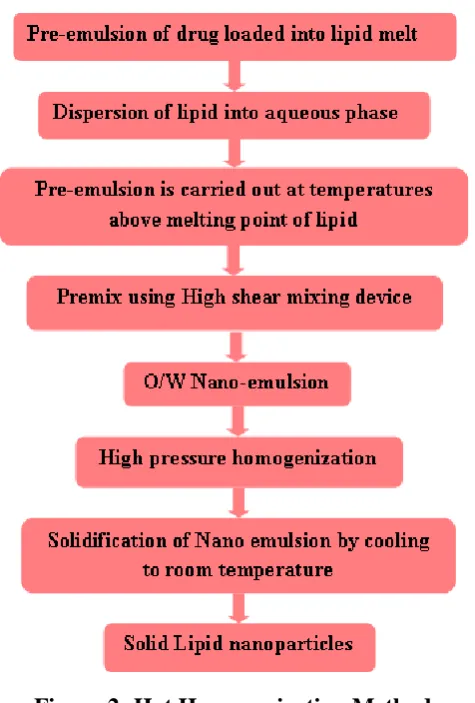
In Hot Homogenization method (Figure: 2) the Drug is dispersed into Lipid melt and this
drug lipid melt is further dispersed into the hot solution of surfactant with high speed stirring.
Pre-emulsion is carried out at a temperature higher than the melting point of the lipid. High
temperature results in lesser particle size. High temperature increases the degradation rate
leading to degradation in particle size, however high homogenization pressure enhances the
Figure 2: Hot Homogenization Method
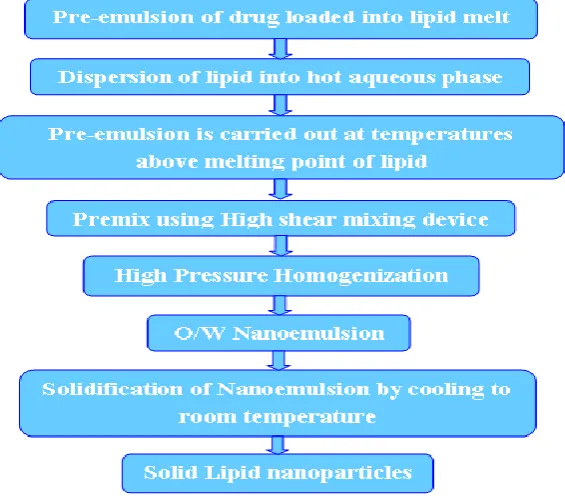
1.2 Cold Homogenization method
To overcome the flaws associated with hot homogenization method, they develop cold
homogenization method. Problems are drug distribution into aqueous phase, drug
degradation, complexity. In this method drug is dispersed into lipid melt and cool the drug
contained lipid melt.
Solid lipid is ground to lipid micro-particles and these lipid micro-particles are dispersed into
cold surfactant solution and produces pre-suspension. The formed pre-suspension is
homogenized at lower than the room temperature. Gravitational force among the molecules is
strong enough to break the lipid micro-particles into SLN’s.
Figure 3: Cold Homogenization Method
2. Ultra Sonification/ High Speed Homogenization
SLN’s are manufactured by Ultra Sonification or High Speed Homogenization. The
combination of both techniques ultra Sonification and high speed homogenization are
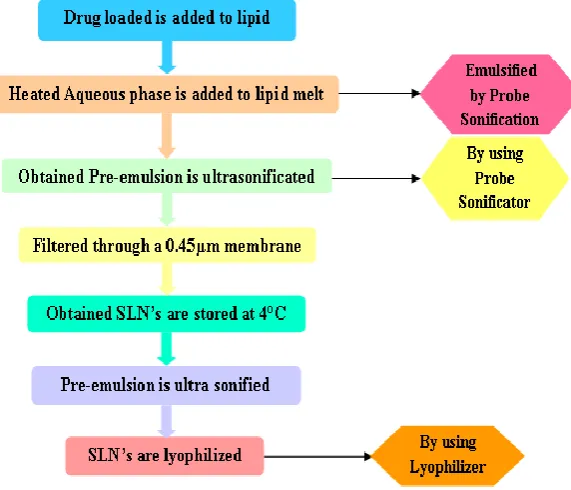
required to get small particle size. Ultrasonification types (Figure: 4) and High Speed
Homogenization process is described below (Figure: 5).[12-27]
Figure 5:: Description of High Speed Homogenization
3. Solvent emulsion evaporation technique
SLN’s are also manufactured by solvent emulsion evaporation method. Lipophilic material
and hydrophilic drug are dissolved in a water immiscible organic solvent and then that is
emulsified in an aqueous phase using high shear homogenizer. To improve the efficiency of
emulsification, the coarse emulsion is passed through the micro fluidizer. The organic solvent
is evaporated by stirring at room temperature and reduced pressure. Nanoparticles dispersion
is formed by leaving precipitants of lipids in aqueous medium giving SLN’s.
4. Solvent emulsion diffusion technique
The solvent used in this technique is miscible with water and this can be executed either in
aqueous or in the oil phase. By this technique the particle size with 20-100nm can be
obtained. Voidance of heat is an advantage in this technique. The process is described below
Figure 6: Description of Solvent emulsion diffusion technique
5. Micro emulsion based technique
This technique is based on micro-emulsions dilution. Micro-emulsions are two phase systems
composed of inner phase and outer phase. Micro-emulsions are prepared by stirring a
transparent mixture at 70-75°C. Micro-emulsions contain low melting fatty acids,
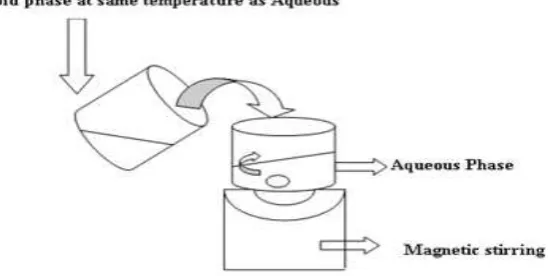
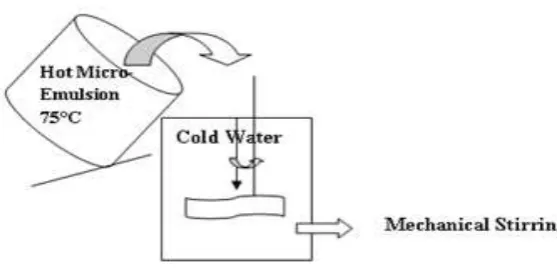
emulsifiers, Co-emulsifiers and water. Hot micro-emulsion is dispersed into water (cold)
under stirring. SLN’s dispersion is used as granulation fluid and it is transferred into solid
products like tablets, capsules, pellets by granulation process.
Step: 1(Figure: 7) and Step 2 (Figure: 8) is described below.
[image:6.595.162.437.595.733.2]Figure 8: Step-2 of Micro emulsion based method
6. Super critical fluid technology
It is a substitute method for preparation of solid lipid Nanoparticles by PGSS (Particles from
gas saturated solutions). It is relatively new method for production of SLN’s and it has the
benefit of solvent less processing. The pressure and temperature of the fluid goes beyond
their respective critical value then the fluid is called as supercritical fluid. Beyond the critical
temperature it is not possible to liquefy a gas by using pressure. SLN’s can be made by RESS
(rapid expansion of super critical carbon dioxide method).
7. Spray drying Method
It is a substitute method to lyophilisation process in order to convert aqueous solid lipid
nanoparticles dispersion into a drug substance. Spray drying method is cheaper than
lyophilisation technique. In this method high temperature causes particle aggregation, partial
melting and shear forces. This method suggests using of the lipids with melting point > 75°C.
The best results are obtained with SLN’s concentration of 20% trehalose in ethanol.
8. Double emulsion method
In this technique, the drug is dissolved in aqueous solution and emulsified in lipid melt. By
adding stabilizer primary emulsion is stabilized. Then the stabilized emulsion is dispersed in
aqueous phase and forms the double emulsion. Then the formed double emulsion is stirred
and isolated by using filtration. This technique avoids the necessity to meet the lipid for the
production of peptide loaded lipid nanoparticles. The surface of nanoparticles can be altered
in order to sterilize them by incorporation of lipid polyethylene glycol derivative.
9. Membrane contactor technique
It is a novel technique for the manufacture of SLN’s. In this technique, the liquid phase is
pressed at temperature higher than the lipid melting point through the membrane pores
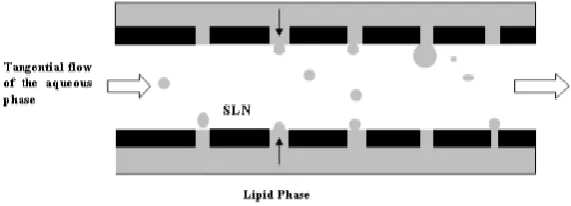
allowing the tiny droplets. In the membrane contactor technique aqueous phase is stirred
continually and circulated tangentially and sweep away the droplets which are formed at the
pore outlet. By cooling the preparation at room temperature SLN’s are formed. To maintain
the required temperature two phases are placed in the thermostatic bath and nitrogen is used
to produce pressure for the liquid phase. The influence of various parameters like velocity,
lipid phase pressure, lipid and aqueous phase temperature, membrane pore size are studied.
For the preparation of polymeric nanoparticles this method is also used. Process of membrane
[image:8.595.146.432.320.423.2]contactor technique is described below in (Figure: 9).
Figure 9: Membrane contactor technique.
10. Precipitation method
In this method glycerides are dissolved into chloroform and form a solution. The formed
solution is emulsified in an aqueous phase. After chloroform evaporation, the lipid will be
precipitated and form nanoparticles.[28-35]
Types of SLN’s
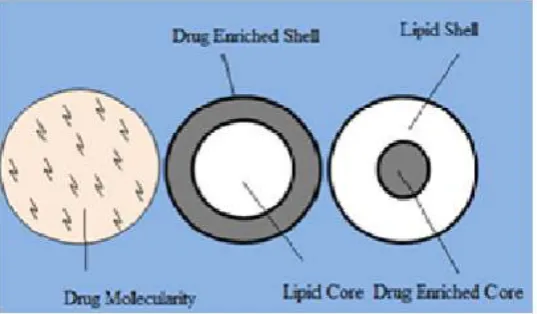
SLN’s are divided into 3types
1. Type-I or Homogenous model
2. Type-II or drug enriched shell model
3. Type-III or drug enriched core model
The types of Solid lipid nanoparticles depends on
The nature of active pharmaceutical ingredient and lipid The solubility of actives
Nature and concentrations of surfactants
1. Homogenous model
The homogenous model is derived from active ingredient solid solution and lipid solid
solution. Solid solution can be obtained when solid lipid nanoparticles are manufactured by
cold homogenization method. The Production of lipid blends having the active ingredient in
molecular dispersed form. After lipid blend solidification, it is ground to minimize or avoid
the active molecules enrichment in different parts of nanoparticles.
2. Drug enriched shell type
This model can be attained when SLN’s are manufactured by hot homogenization method
and the concentration of active ingredient in the lipid melt should be low during the cooling
process of the O/W hot Nano-emulsion. First the lipid will precipitate, leading to a steadily
increase the active molecules concentration in the remaining lipid melt, an outer shell will
solidify and it consists of both lipid and active ingredient. Enhancement of the external area
of the particles causes burst release. In controlled shell model, the active ingredient
percentage assigned in outer shell can be modified by incorporating a co-enzyme Q10.
3. Drug enriched core type
This model can be accomplished when the concentration of active ingredient in the lipid melt
is immense and it is comparatively close to its saturation solubility. In most of the cases
cooling down of hot oil droplets will reduce the solubility active ingredient in lipid melt. The
active ingredient saturation solubility becomes more, precipitation forms leading to the
formation of enriched core model.
Drug Incorporation of SLN’s
[image:9.595.164.433.576.733.2]Drug incorporation techniques are described below (Figure: 10).
Drug incorporation of SLN’s is as follows
1. Drug solubility in the lipid melt
2. Chemical structure and physical structure of solid lipid matrix
3. Miscibility of the drug and lipid melt
4. Polymorphic state of lipid matrix and solid matrix.
Drug incorporation and drug loading capacity
Drug loading size, particle size and size distribution of Solid Lipid Nanoparticles are found to
vary with lipid, emulsifier, and method of preparation.
Factors determining the drug loading capacity in the lipid Solubility of lipid melt
Drug Miscibility in the lipid
Physical and chemical structure of lipid matrix Polymorphic state of lipid material.[36-41]
Characterization of Solid Lipid Nanoparticles
Characterization of solid lipid nanoparticles is a challenging process due to small particle size
and complexity of the system.
Various parameters need to be considered as
1. Particle size and Zeta potential measurement
Photon correlation spectroscopy Electron microscopy
Atomic force microscopy
2. Determination of incorporated drug
3. Invitro drug release
Dialysis tubing Reverse dialysis
4. Rheology
5. Storage stability
6. Crystallization tendency and polymorphic behaviour of SLN’s.
1. Particle size and Zeta potential measurement
Laser diffraction and Photon correlation spectroscopy (PCS) are most robust techniques for
scattering. It measures scattered light fluctuation intensity. This is caused by movement of
particles. This method covers from few Nanometres to above 3µ. To characterize a
Nanoparticles this tool is useful, but it is incapable to identify larger micro particles.
Electron microscopy provides similar to Laser diffraction & Photon correlation spectroscopy.
It gives straight information on the shape of the particles. The physical stability of optimized
SLN’s are dispersed generally >11 months. Zeta potential measurements permit predictions
about colloidal dispersions storage stability.
2. Determination of incorporated drug
The quantity of drug incorporation in SLN’s influences the characteristics of drug release
hence it is important to measure the incorporated drug amount. The incorporated drug amount
per unit weight of nanoparticles is determined after solid lipids and free drug separation from
the aqueous medium. This separation can be done by centrifugation filtration, gel permeation
chromatography or ultra centrifugation. The drug can be assayed by using standard analytical
techniques such as spectroflurophotometry, spectrophotometer, HPLC or liquid scintillation
counting.
3. Invitro drug release
3.1Dialysis Tubing: By using dialysis tubing, invitro drug release can be accomplished. The dispersion of SLN is placed in hermitically sealed pre-washed dialysis tubing. At room
temperature dialysis sac is dialyzed against an appropriate dissolution medium; from
dissolution medium samples are collected at suitable intervals. Samples are centrifuged and
the drug content is analyzed by using suitable analytical method.
3.2Reverse Dialysis: In this reverse dialysis method, a number of tiny dialysis sac containing dissolution medium (1ml) are placed in the dispersion of SLN. Then SLN’s are
replaced into the medium
4. Rheology: Rheology measurements of SLN’s can be performed by using brook field viscometer. Viscosity depends on the lipid content dispersion. As there will be increased
dispersed lipid content, the flow becomes non- Newtonian from Newtonian.
6. Crystallization tendency and polymorphic behaviour of SLN’s: Particles which are in solid state play an important role as it decreases the incorporated drug mobility and it
prevents leakage of the drug from the carrier. Basic techniques to establish particles
physic-chemical state include X-ray diffraction and thermal analysis. Most commonly used
techniques in the thermal analysis are differential scanning calorimetry and thermal
analysis.[42-50]
Polymers used in the preparation of nanoparticles
Polymers which are used in the formulation should be compatible with the body in the terms
of non-toxicity and non-antigenicity. It should be biocompatible and biodegradable. Polymers
used in the preparation of nanoparticles are listed in table 1.
Table 1: List of Polymers used in the preparation of Nanoparticles.
NATURAL POLYMERS SYNTHETIC POLYMERS
Chitosan, Cellulose, Alginates, Carrageenan, Gellan gum, pectin, Starch, Xanthum gum
Poly(acrylic acid), Poly(cyanoacrylates), Poly(amides), Poly (lacticacid), Poly (anhydrides), Poly (Vinyl alcohol), Poly (isobutylcyanoacrylate), Poly(ethylene oxide)
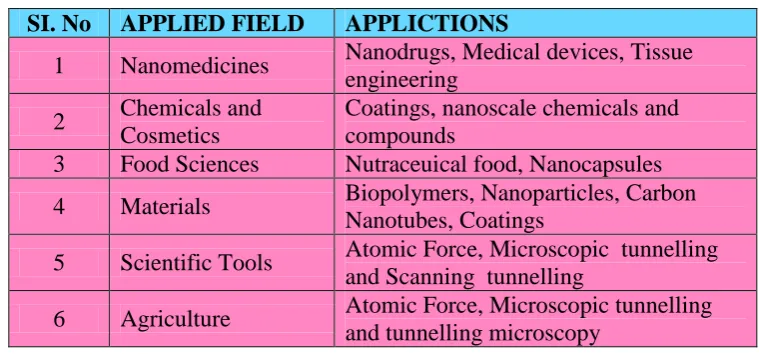
[image:12.595.106.486.449.626.2]Applications
Table 2: Applications of Nanoparticles.
SI. No APPLIED FIELD APPLICTIONS
1 Nanomedicines Nanodrugs, Medical devices, Tissue engineering
2 Chemicals and Cosmetics
Coatings, nanoscale chemicals and compounds
3 Food Sciences Nutraceuical food, Nanocapsules
4 Materials Biopolymers, Nanoparticles, Carbon Nanotubes, Coatings
5 Scientific Tools Atomic Force, Microscopic tunnelling and Scanning tunnelling
6 Agriculture Atomic Force, Microscopic tunnelling and tunnelling microscopy
CONCLUSION
SLN’s are a new type of colloidal drug carrier system combines the advantages of liposome’s, polymeric nanoparticles and fat emulsions due to various benefits including
feasibility incorporation of hydrophilic and lipophilic drugs, manufacturing, low cost, easy
scale up and improves physical stability. Sustained release and the site specific delivery can
state of lipid complexity, presence of the alternative colloidal structure. The suitable
characterization of lipid dispersion requires different analytical methods in addition to the
identification of the particle size. Nanoparticles are used for applications in diagnostics, drug
discovery, delivery and much more in the medical field. These are very complicated systems
with clear benefits and undesired effects over other colloidal carriers.
REFERENCES
1. Priyanka K, Abdul Hasan S. Preparation and Evaluation of Montelukast Sodium Loaded
Solid Lipid Nanoparticles. Journal of Young Pharmacists., 2012; 4(3): 129-37.
2. Hirlekar R, Garse H, Kadam V. Solid Lipid Nanoparticles and Nanostructured Lipid
Carriers: A Review. Current Drug Therapy., 2011; 6(4): 240-50.
3. Cavalli R, Gasco M, Chetoni P, Burgalassi S, Saettone M. Solid lipid nanoparticles (SLN)
as ocular delivery system for tobramycin. International Journal of Pharmaceutics., 2002;
23(2): 241-45.
4. De Boer A, Breimer D. Hepatic first-pass effect and controlled drug delivery following
rectal administration. Advanced Drug Delivery Reviews., 1997; 28(2): 229-37.
5. Muller RH and Souto EB. Oral bioavailability of cyclosporine: Solid lipid nanoparticles
(SLN) versus drug nanocrystals. Int J Pharm., 2006; 317: 82-9.
6. Shidhaye SS, Vaidya R, Sutar S, Patwardhan A and Kadam VJ. Solid lipid nanoparticles
and nano structured lipid carriers- innovative generations of solid lipid carriers. Current
Drug Delivery., 2008; 5: 324-31.
7. Muller RH, Mader K and Gohla S. Solid lipid nanoparticles (SLN) for controlled drug
delivery- a review of the state of the art. Eur J Pharm Biopharm., 2000; 50: 161-77.
8. Radtke M, Souto EB, Muller RH. NLC-the novel generation of solid lipid carriers. Pharm
Tech Europe., 2005; 17: 45-50.
9. Pouton CW. Lipid formulations for oral administration of drugs: non-emulsifying, self
emulsifying and ‘self-micro emulsifying’ drug delivery systems. Eur J Pharm Sci., 2000;
11(2): 93-8.
10.Wasan KM. Formulation and physiological and biopharmaceutical issues in the
development of oral lipid-based drug delivery systems. Drug Dev Ind Pharm., 2001;
27(4): 267-76.
11.Saupe A, Gordon KV and Rades T. Structural investigations on nanoemulsions, solid
lipid nanoparticles and nanostructured lipid carriers by cryo-field emission scanning
12.Venkateshwarlu V and Manjunath K. Preparation and in vitro release kinetics of
clozapine solid lipidnanoparticles. J Controlled Release., 2004; 95: 627-38.
13.P. Ekambaram, A. Abdul hasansathali K. Priyanka. Solid lipid nanoparticles: a review.
Scientific Reviews Chemical Communications., 2012; 2(1): 80-02.
14.C. Shah, V. Shah, U. Upadhyay, solid lipid nanoparticles: a review. Current pharma
research., 2011; 1(4): 351-68.
15.R. Cavalli, M. R. Gasco, P. Chetoni, S. Burgalassi, Solid lipid nanoparticles (SLN) as
ocular delivery system for tobramycin. International Journal Pharm., 2002; 238: 241-45.
16.Shagufta khan, Solid lipid nanoparticles a review. World Journal of Pharmacy and
Pharmaceutical Sciences., 2012; 1: 96-15.
17.Ekambaram, Abdul Hasan Sathali A and Priyanka K. Solidlipid nanoparticles and lipid
nanostructures overview. Scientific Review &Chemical communication., 2011; 2:
216-20.
18.Rawat, Jain MK, Singh A. Studies on binary lipid matrix based solid lipidnanoparticles of
repaglinide, In vitro and in vivo evaluation. Journal of Pharmaceutical Sciences., 2011; 2:
66 -78.
19.Mukherjee S, Ray S, Thakur RS. Solid lipid nanoparticles A modern formulation
approach in drug delivery system. Indian Journal of Pharmaceutical Sciences., 2009; 1:
349-58.
20.Muller RH, Schwarz C, MehnertW, Lucks JS. Production of solid lipid nanoparticles
(SLN) for controlled drug delivery. Proc. Int. Symp Control Release Bioact. Mater., 1993;
1: 480-81.
21.Dingler A, Gohla S. Production of solid lipid nanoparticles (SLN): scaling up
feasibilities. Journal of Microencapsulation., 2002; 19(1): 11-16.
22.Schwarz C, Mehnert W, Lucks J, Müller R. Solid lipid nanoparticles (SLN) for controlled
drug delivery. I. Production, characterization and sterilization. Journal of Controlled
Release., 1994; 30(1): 83-96.
23.Parhi R, Suresh P. Preparation and Characterization of Solid Lipid Nanoparticles-A
Review. Current Drug Discovery Technologies., 2012; 9(1): 2-16.
24.Nilesh J, Ruchi J, Navneet T, Brham PG, Deepak KJ. Jeetendra B,nanotechnology: A safe
and effective drug delivery system. Asian Journal of Pharmaceutical and Clinical
25.Schwarz WC. Mehnert JS, Lucks, Muller RH. Solid lipid nanoparticles (SLN) for
controlled drug delivery Production, characterisation and sterilization. J Control Release.,
1994; 3: 83-96.
26.S.H. Gohla, A. Dingler. Scaling up feasibility of the production of solid lipid
nanoparticles (SLN). Pharmazie., 2001; 56: 61-3.
27.P. Rabinarayan, S. Padilama. Production of Solid Lipid Nanoparticles-Drug Loading and
Release Mechanism. Journal of Chemical and Pharmaceutical Research., 2010; 2(1):
211-27.
28.Lippacher A, Muller RH and Mader K. Investigation on the viscoelastic properties of
lipid based colloidal drug carriers. Int J Pharm., 2000; 196: 227-30.
29.Radtke M, Souto EB, Muller RH. NLC-the novel generation of solid lipid carriers. Pharm
Tech Europe., 2005; 17: 45-50.
30.Pouton CW. Lipid formulations for oral administration of drugs: non-emulsifying, self
emulsifying and ‘self-micro emulsifying’ drug delivery systems. Eur J Pharm Sci., 2000;
11(2): 93-98.
31.Wasan KM. Formulation and physiological and biopharmaceutical issues in the
development of oral lipid-based drug delivery systems. Drug Dev Ind Pharm., 2001;
27(4): 267-76.
32.Siekmann B and Westesen K. Investigations of solid lipid nanoparticles prepared by
precipitation in o/w emulsions. Eur J Pharm Biopharm., 1996; 43: 104-9.
33.Kaiser CS, Rompp H and Schmidt PC. Pharmaceutical applications of supercritical
carbon dioxide. Pharmazie., 2001; 56: 907-26.
34.Gosselin PM, Thibert R, Preda M and Macmullen JN. Polymeric properties of micronized
carbamazepine produced by RESS. Int J Pharm., 2003; 252: 225-33.
35.Gasco MR. Solid lipid nanospheres from warm micronanoparticles emulsions. Pharm
Tech Eur. 1997; 9: 52-8.
36.Boltri L, Canal T, Esposito PA and Carli F. Lipid nanoparticles: evaluation of some
critical formulation parameters. Proc Intern Symp. Control Release Bioact Mater., 1993;
20: 346-7.
37.Muchow M, Maincent P and Muller RH. Lipid nanoparticles with a solid matrix (SLN,
NLC, LDC) for oral drug delivery. Drug Development and Industrial Pharmacy., 2008;
38.Cavalli R Marengo E, Rodriguez L and Gasco MR. Effect of some experimental factors
on the production process of solid lipid nanoparticles. Eur J Pharm Biopharm., 1996; 43:
110-15.
39.Schwarz WC. Mehnert JS, Lucks, Muller RH. Solid lipid nanoparticles (SLN) for
controlled drug delivery Production, characterisation and sterilization. J Control Release.,
1994; 3: 83-96.
40.Sinha Ranjan Vivek, SrivastavaSaurabh, Goel Honey, Jindal Vinay. Solid Lipid
Nanoparticles (SLN’S)-Trends and Implications in Drug Targeting. International Journal
of Advances in Pharmaceutical Sciences., 2010; 2: 212-38.
41.Cavalli ER. Marengo L, Rodriguez, Gasco MR. Effects of some experimental factors on
the production process of solid lipid nanoparticles. Eur J Pharm Biopharm., 1996; 2:
110-15.
42.Gasco MR. Solid lipid nanospheres from warm micronanoparticles emulsions. Pharm
Tech Eur., 1997; 9: 52-8.
43.Cavalli R Marengo E, Rodriguez L and Gasco MR. Effect of some experimental factors
on the production process of solid lipid nanoparticles. Eur J Pharm Biopharm., 1996; 43:
110-15.
44.Freitas C and Muller RH. Spray-drying of solid lipid nanoparticles (SLN TM). Eur J
Pharm Biopharm., 1998; 46: 145-51.
45.Wei Liu, Meling Hu, Wehsuang L, ChengbinXu, HuibiXu. Solid lipid nanoparticles. Int.
J. Pharm., 2008; 1: 141-46.
46.S. Pragati, S. Kuldeep, S. Ashok. Solid Lipid Nanoparticles: A Promising Drug Delivery
Technology. International Journal of Pharmaceutical Sciences and Nanotechnology.,
2009; 2(2): 509-16.
47.Cavalli R, Caputo O and Gasco MR. Preparation and characterization of solid lipid
nanospheres containing paclitaxel. Eur J Pharm Sci., 2000; 10: 305-309.
48.Bhatt Ashvin D, Pethe A M. Lipid Technology- A Promising Drug Delivery System for
Poorly Water Soluble Drugs. International Journal of Pharma Research and
Development., 2010; 1: 1-11.
49.Mueller RH, Solid lipid nanoparticles (SLN) for controlled drug delivery-a review of the
state of the art. Eur. J. Pharm. Biopharm. 2000; 50:161 - 177.
50.Muller RH, Radtke M and Wissing SA. Solid lipid nanoparticles (SLN) and
nanostructured lipid carriers (NLC) in cosmetic and dermatological preparations. Adv