© 2019, IRJET | Impact Factor value: 7.211 | ISO 9001:2008 Certified Journal
| Page 3159
AUTOMATIC SMART MOP FOR FLOOR CLEANING
Harshvardhansinh Parmar
1, Anilkumar Meena
2, Jafarali Bhovaniya
3, Miteshkumar Priyadarshi
41,2,3
Student, Dept. Of Electrical Engineering, GEC Modasa, Gujarat, India
4
Asst. Professor, Dept. of Electrical Engineering, GEC Modasa, Gujarat, India
---***---Abstract –
In the present era, innovation in automation isnow being applied to each and every field. Among this, home automation is a field focusing on making everyday household works simple and automatic for the comfort of human life. The principal point of this paper is to design and develop an automatic smart mop cleaner which can perform mopping task. The proposed system can be controlled by an Android device as well as automatically by using a couple of sensors for mopping the most part of the dirty floors and surfaces i.e., highly polished wooden surfaces, tiles or stones, etc. The robot is able to avoid obstacles and must be capable of mopping the room upon user commands. Mopping section consists of a mop attached to the robot for mopping the floor. It is attached to a small water container from which water is sprayed by a mini water pump in order to make the mop wet. All hardware and software operations controlled by Arduino Mega microcontroller, Bluetooth module has been used for wireless communication between the robot and the user. Also, the couple of sensors (i.e., Bluetooth sensor, IR sensor) are used to avoid the obstacles. According to user convenience, mode of mopping can be selected. i.e., automatic mode or manual mode. This can be helpful in improving the lifestyle of mankind comfortable. The robot can be turned on and off by pressing the external switch which is mounted on the robot.
Key Words: Arduino Mega, Motor Driver IC, Bluetooth module, Ultrasonic sensor, IR sensor, Automatic and manual system, etc…
1. INTRODUCTION
From the very beginning of the human era, cleaning was one of the tedious and time-consuming tasks. Technologies are part of human life and help them in order to complete their tasks. There were many methods are available for cleaning the premises. But those methods were tedious, scary and needed high effort. People using sweep and mop for cleaning the households. It became difficult for working people to find time for cleaning. Most of the people usually using a hand-controlled mop for mopping the floor. So, there might be chances to reduce manpower and human efforts. Using conventional floor cleaner needed a lot of effort and supervision from the user. Because of these difficulties, the existed system was not considered as an efficient method. As the improvement in the innovation of technology, with the help of automation, this task was made much more efficient and easy.
The robotic cleaners have taken major attention in robotics research due to their effectiveness in assisting humans in floor cleaning applications at homes, hotels, restaurants, offices, hospitals, warehouses, and educational institutions, etc. It is an electromechanical machine and used for various purposes in domestic applications. Although devices such as washing machines and dishwashers have served this purpose, it still requires some degree of human input effort. In developing a floor cleaning robot, there are several challenges that one has to come in front, i.e. the method of cleaning, path planning, covering the whole floor surface, cleaning it completely, maintenance so on and so forth. It becomes even more complicated when safety, economy, energy consumption are considered to be at the optimum level. Initially, the main focus was on having a household cleaning device robot.
Basically, the robotic cleaners are classified on their cleaning technique like floor mopping, dry vacuum cleaning, sweeping, etc. Some robotic cleaners are based on simple obstacle avoidance using infrared sensors while some utilize laser mapping technique for navigation. All cleaning and operating mechanism of robotic floor cleaners have their own advantages and disadvantages. For example, robots utilizing mapping technique are relatively faster, and energy efficient but these are costly, while obstacle avoidance based robotic cleaners are relatively less time consuming and less energy efficient due to random cleaning of the floor.
In early, 2010 a new automatic floor cleaner robot “Mint” was developed by Jen Steffen. Detachable clothes were attached for sweeping and mopping purposes. For tracking mint robot used the GPS-like indoor localization system. It depends on the data of one specific sensor and arrangement the development as indicated by it. The most exceptional frameworks made by IROBOT and SCOOBA have utilized data from different sorts of sensors. The smoothness and versatility can depend on distinctive sensors for building the robot self-governing.
© 2019, IRJET | Impact Factor value: 7.211 | ISO 9001:2008 Certified Journal
| Page 3160
do not have the strength or ability to clean. The objectives of the research work are shown below.
The primary objective of this project work is to solve the problems of conventional floor cleaning mops that cannot be used and moved independently and consumes a lot of electric power.
Another object of this work is to provide a floor mopping robot which is portable, requires low maintenance, easy to operate, low cost and overcome the drawbacks of conventional floor mopping.
The overall goal is to design a robot with Microcontroller, IR sensor, Ultrasonic sensor, Bluetooth module, Stepper motors, DC motor, and Mopping mechanism to complete the complex task of cleaning and improve the cited cleaning performance problems.
2. LITERATURE REVIEW
Abhishek Pandey, Anirudh Kaushik, Amit Kumar Jha, Girish Kapse, it had taken a technological Survey on autonomous home cleaning robots that while the robot is cleaning, it avoids steps (or any other kind of drop-off) using four infrared sensors on the front underside of the unit. These cliff sensors constantly send out infrared signals, and robot expects them to immediately bounce back. It performs (and repeats) the sequential actions of backing up, rotating and moving forward until it finds a clear path [1].
Anusha PB, Disha Shetty, Reshma Marina D’Almeida, Shramika, Chaithra Shetty, has discussed the idea of LABVIEW Operated Robotic Vacuum Cleaner that described the concept has proven to be an efficient way of saving time and helping physically disabled people. This system is especially beneficial for working women and user can switch on the device and go for any other work and the cleaner robot will automatically clean the floor by detecting and avoiding the obstacles or hurdles on its way. My-Rio can be easily used to modify and enhance the various capabilities of any robot evolving its capabilities to explore new pathways of working efficiently [2].
Jens-Steffen Gutmann, Kristen Culp Mario, E. Munich Paolo Pirjanian, has discussed the social impact of a systematic floor cleaner that using the Mint cleaner as an example. The product is in operation in several hundreds of thousand homes with very positive feedback from their owners. In this, there are indications that systematic cleaning has utility and that people are comfortable in adapting their homes to accommodate robotic cleaners including setting up accessories that help
the robots navigate. 65% of their survey participants say that they like new technology [3].
Manisha Kukde, Sanchita Nagpurkar, Akshay Dhakulkar, Akshay Amdare, has discussed automatic & manual vacuum cleaning robot that described the efficient floor cleaning with sweeping and mopping operations. And an automatic water sprayer is used which sprays water for mopping purpose. The user can also operate it manually with the help of remote. It reduces labor cost and saves time and also provides efficient cleaning. In automatic mode, the robot operates autonomously [4].
Manreet Kaur and Preeti Abrol [5]: Manual work is taken over the robot technology and many of the related robot appliances are being used extensively also. In this, it represents the technology that proposed the working of the robot for Floor cleaning. This floor cleaner robot can work in any of two modes i.e. “Automatic and Manual”.
Varsha. P.H, Lavanya V, Meghana K, Rohan P S, Sneha R. [6]: This paper described the robot moves autonomously throughout the room. Ultrasonic sensors that are interfaced to the Arduino Mega serves the role for obstacle detection. Moreover, manual control of the robot is established by using the Bluetooth module HC-05 and an application is designed to control the robotic movements. In one sweep simultaneous sweeping and mopping is facilitated.
Prof. Taware R. D., Vaishali Hasure, Puja Ghule, Komal Shelke [7]: This paper described the efficient floor cleaning with Sweeping and mopping operations. This floor cleaner robot works in two modes automatic and manual for user convenience.
Uman Khalid, Haseeb Haider, Tahseen Amin Khan Qasuria in had presented the design, development, and fabrication of prototype smart floor cleaning robot (clear) using IEEE standard 1621. This robot is specially made on the basis of modern technology. Clear has all the features which are required for a vacuum cleaner. It can work automatically and manually [8].
© 2019, IRJET | Impact Factor value: 7.211 | ISO 9001:2008 Certified Journal
| Page 3161
3. BLOCK DIAGRAM
Fig -1: Block diagram of the proposed design
The block diagram of this research work has shown in Fig -1 for a better understanding of the proposed work. Block diagram consists of two parts: one for automatic (robot) and another for the manual (remote) mode. The automatic part is the integration of the power supply (12V), ATmega2560 R3, Bluetooth module, Ultrasonic sensors, IR sensors, etc. ATmega2560 R3 is the core of this system which controls all of the operations and energized with 5V power. ATmega2560 R3 is used because of better features like: it is low power, high-performance microcontroller with 256K-bytes in-system programmable flash memory, 8 K-byte SRAM, 16 analog inputs, 4 UARTs (hardware serial ports), a 16 MHz crystal oscillator, a USB connection, a power jack, an ICSP header, and a reset button. Bluetooth module provides wireless communication between remote and robot and operates at 5V supply and its operating range is 10m. IR sensors used for obstacle detection. If an object appears in the robot way then the Bluetooth sensor detects the object and send a signal to microcontroller and robot change the lane automatically and then start cleaning operation again. 3 motors are used in this system; 2 motors used to drive the wheels, 1 motor used for cleaning action. Stepper motors are used to drive the robot. A4988 IC used to drive the wheel motor because of better features. The power supply consists of one voltage regulator LM7805 3PIN.
Now the second part i.e., a manual mode which is controlled by the user itself and consists of the power supply (12V), ATmega2560 R3, Android device, Bluetooth module. ATmega2560 R3 is the main part of the manual mode, all the signals controlled by a microcontroller and it takes 5V power to work. Bluetooth module is used to transmit and receive the signal. If any hurdle detected in the manual mode then robot changes its lane manually. Bluetooth module has the 10m range and operating frequency of 2.4 GHz. Android phone is used to give the direction to robot and user through phone can control all the operation like; a movement of the robot, Speed, cleaning action to on or off the cleaner, etc.
3. PROPOSED METHODOLOGY
3.1 PATH DEVELOPMENT
Design of the system began with considering the path for cleaning the floor surface. With the assumption that the area in which the robot was to operate was a rectangle, two options for the desired path were identified, a spiral path or a zigzag path. The two patterns of the path were compared against each other while concurrently considering simplicity, effectiveness, completion time, and sensor position.
The operation of the floor cleaning robot during the zigzag pattern would be dependent on the position of the sensors. There are two possibilities to strafe from wall to wall or to drive forwards and perform a 180° turn at each wall (shown in Fig -2). The strafing option, although fast and simple, would require a minimum of one sensor on three sides of the robot and given the hardware provided this was implausible. The option to turn 180 degrees at the wall was relatively complex and slower than the spiral pattern due to the number of operations are required to turn 180 degrees and find the new path across the area.
Fig -2: Movement of the robot[2]
3.2 WORKING OF PROJECT MODEL
[image:3.595.42.285.105.295.2] [image:3.595.315.553.360.547.2]© 2019, IRJET | Impact Factor value: 7.211 | ISO 9001:2008 Certified Journal
| Page 3162
compared with the predefined threshold value so that it can make a decision for its further movement. If any obstacle detected then robot change the lane automatically, it does not stop and starts cleaning action. The automatic motion of the robot involves the zigzag movement of the robot, the zigzag motion occurs when the robot encounters the walls or other objects. A person can wirelessly control the robot using the Android application as well. The robot can be switched between automatic or manual operation at the push of a button on the robot. For user convenience and flexibility automatic water sprayer pump is attached which automatically spray water for mopping, therefore no need to attach wet cloth again and again for mopping. Motor driver IC A4988 has been used to drive the motors and three motors have been used to perform respected operations like to move the robot. In the manual mode, the user operates the robot by itself. Bluetooth module has been used with 10m range for the make system wireless. Bluetooth module HC-05 and application has been designed to transmit and receive the signal to operate the robot. Movement of the robot is controlled by the user itself through the app, therefore, the user can move the robot in the desired direction and perform expected tasks. The app allows the user to control the accessories on the robot thus enabling a judicious use of power and water.
If we select a manual mode then the system connects with a Bluetooth module via Blynk IoT app. This app is run in an Android device that allows the user to transmit command based on user input. Based on these commands the transmitter sends movement commands to the robot. The transmitter is an Android device that allows the user to transmit commands to the robot. On receiving the movement commands from the Android device through Bluetooth receiver the microcontroller decodes them and thus operates the motors in order to achieve the desired motion. Even the sprayer and cleaner mechanism can be controlled by the Android app. This makes floor cleaning a very easy, fast and an effortless process.
“Automatic smart mop” is very simple in construction and easy to operate any persons. The size of the machine is also small and portable, so we can transfer it from one place to another place very easily. It can operate during a power outage period and does not need any human guidance.
3.3 COMPONENTS REQUIRED
12V DC Power unit (Lithium-ion) Microcontroller: ATmega2560 R3
Stepper Motors
Stepper Motor Driver IC A4988
DC Motor (300RPM)
DC Motor Driver IC L298N
IR Sensor
Ultrasonic Sensor
Bluetooth Module (HC-05)
Submersible Mini Water Pump
4. DESIGN METHODOLOGY
4.1 HARDWARE IMPLEMENTATION
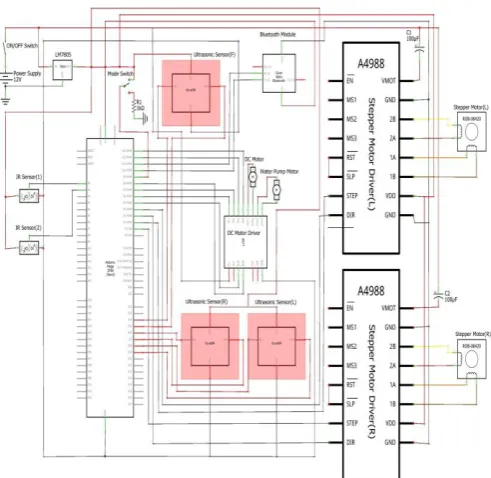
Here an Arduino Mega (ATmega2560 R3) is used as the microcontroller. The circuit consists of a Bluetooth module, an ultrasonic sensor, two A4988 driver ICs, one L298 Driver IC, two Stepper motors, one DC motor for mop cleaner and one water pump motor. The ultrasonic sensor (F) trigger and echo pins are connected to PWM pins 24 & 25 of Arduino respectively. The trigger and echo pins of Ultrasonic sensor (R) and (L) are connected to pins 26,27 and 28,29 of Arduino respectively. Output pins of IR sensors are connected to pins A0 and A1 of Arduino respectively. The TXD and RXD pins of Bluetooth module are connected to pins 10 & 11 of Arduino respectively. The STEP and DIR pins of Stepper Motor driver IC (A4988) for driving the two stepper motors (R) and (L) are connected to pins 1,2 & 3,4 of Arduino respectively. Motor Driver IC (L298) for driving the mop cleaner motor and water pump motor is connected in such a way that the IN1 & IN2 for driving DC motor and & IN3 & IN4 for driving water pump motor are connected to pins 6,7 & pins 12,13 respectively. OUT1 & OUT2 of L298 is connected to DC motor and OUT3 & OUT4 are connected to the water pump motor. ON/OFF switch is connected to 12V DC supply.
Fig -3: Electrical Schematic diagram
4.2 MECHANICAL DESIGN OF ROBOT
[image:4.595.310.556.381.620.2]© 2019, IRJET | Impact Factor value: 7.211 | ISO 9001:2008 Certified Journal
| Page 3163
control is required there, the cotton brush is rotated using DC motor. The robotic base is made out of the acrylic sheet and tank is made out of plastic. The mechanical body consists of many parts i.e. Chassis, Sprinkler system, Scrubbing mechanism, Motor-wheel system.
Fig -4: 3D CAD design of the automatic smart mop
4.3 SOFTWARE DESIGN METHODOLOGY
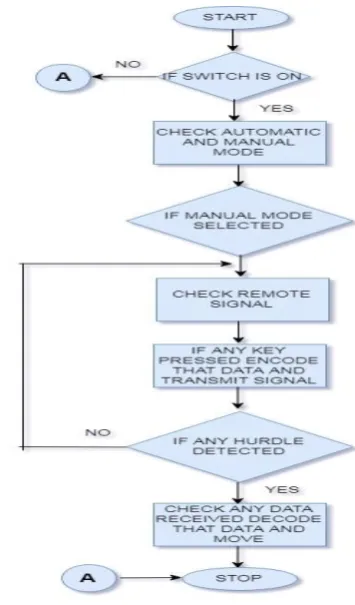
Behavioral approaches are used to autonomously or manually operates and control the mopping robot. ‘Automatic smart mop’ control software is designed using the Arduino IDE. The algorithm is shown in Fig -5 & 6 relates the factors responsible for the autonomous and manual movement with the robot peripheral elements by means of the sequence of events performed by each factor. The algorithm is implemented for studying the robot structure by attributes and relationships among. Finally, the algorithm is generated to visualize where the different system components are distributed among the hardware devices.
Arduino IDE: It is an official Arduino software,
making code compilation too easy that even a
common person with no prior technical knowledge can get their feet wet with the learning process. It is easily available for operating systems like MAC, Windows, Linux and runs on the Java Platform that comes with inbuilt functions and commands that play a vital role for debugging, editing and compiling the code in the environment. A range of Arduino modules available including Arduino Uno, Arduino Mega, Arduino Leonardo, Arduino Micro and many more. Each of them contains a microcontroller on the board that is actually programmed and accepts the information in the form of code. The main code, also known as a sketch, created on the IDE platform will ultimately generate a Hex File which is then transferred and uploaded in the controller on the board. The IDE environment mainly contains two basic parts: Editor and Compiler where former is used for writing the required code and later is used for compiling and uploading the code into the given Arduino Module.
A.
AUTOMATIC MODE:
Fig -5: Flowchart for Automatic mode
B.
MANUAL MODE:
[image:5.595.312.552.100.404.2] [image:5.595.36.288.166.326.2] [image:5.595.357.535.455.758.2]© 2019, IRJET | Impact Factor value: 7.211 | ISO 9001:2008 Certified Journal
| Page 3164
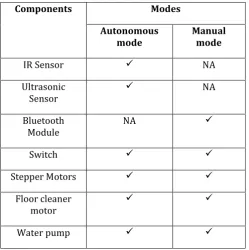
Table -1: Operation of components in different modes
Components Modes
Autonomous
mode Manual mode
IR Sensor NA
Ultrasonic Sensor
NA
Bluetooth
Module NA
Switch
Stepper Motors
Floor cleaner motor
Water pump
5. APPLICATIONS
Home automation is one domain that has been the target of all large and small robotics companies. Soon a time could come when we clean our home using a robot. These could complete the task of cleaning all those rooms, into a few minutes work.
Places like hospitals, restaurants, computer centers, offices, educational institutions, and retirement homes can take advantage of these devices where not much dirt is accumulated and can be cleaned.
6. RESULTS
We had analyzed the main two tasks;
1.
Cleaning time2.
Obstacle detection1) Cleaning time:
The path followed by the robot is in “zigzag” shape, and it gives the best result for the cleaning cycle with less time. The average speed of the robot was 0.60 m2 per second. The
proposed system is capable of cleaning 3.048 m × 3.048 m room within 13 Min.
2) Obstacle detection:
Due to the limitations of the ultrasonic sensor and IR sensor, there are possibilities for minute errors, but it is negligible and comfortable for the operation of the robot. Similarly, a zigzag shape path makes it smooth cleaning without any leftover space other than the obstacle area.
Fig -7: Working model of automatic smart mop
The Blynk IoT app for operating and controlling the robot is shown in Fig -8.
Fig -8: Manually operate the robot through the Blynk IoT app
7. CONCLUSIONS
[image:6.595.38.288.121.372.2] [image:6.595.339.528.333.598.2]© 2019, IRJET | Impact Factor value: 7.211 | ISO 9001:2008 Certified Journal
| Page 3165
long operation and cost-effectiveness. The zigzag motion algorithm used does not require any navigation system and ensures the complete filling of the area. The zigzag motion occurs when the robot encounters the walls or other objects. A person can wirelessly control the robot using the android app as well. The cost of floor mopping robot is significantly reduced to less than 50 to 60 % of the currently available mops in the market. The estimated cost of equipment is INR 5000.
8. FUTURE SCOPE
GSM modules can be added to the domestic robots making them easy to operate and accessible from any part of the world and send a message that, the robot has done the cleaning task. And other sensors can be used for detecting waste and obstacles.
The camera can also be added for navigation purposes. We can also use 2-D mapping to generate a map of the surface to clean it.
XBee Pro 802 series can be used to improve the range of wireless communication.
The mapping and obstacle avoidance could have been well served with a 180 degree LIDAR sensor. These sensors have incredible refresh rates and great accuracy that along with some rotary encoders on the wheels could have plotted an excellent map and kept track of obstacles with ease.
REFERENCES
[1] Abhishek Pandey, Anirudh Kaushik, Amit Kumar Jha,
Girish Kapse, “A Technological Survey on Autonomous Home Cleaning Robots”, “ International Journal of Scientific and Research Publications” Vol. 4, Issue 4, April 2014.
[2] Anusha PB, Disha Shetty, Reshma Marina D’Almeida,
Shramika, Chaithra Shetty, “LABVIEW Operated Robotic Vacuum Cleaner”, “International Journal of Internet of Things” Vol. 6, Issue 2, 2017, pp. 43-46.
[3] Jens-Steffen Gutmann, Kristen Culp Mario, E. Munich
Paolo Pirjanian, “The Social Impact of a Systematic Floor Cleaner”, “Proceedings of the 2012 IEEE International Workshop on Advanced Robotics and its Social Impacts, Technische Universität München, Munich, Germany”, May 21 - 23, 2012, pp. 50-53.
[4] Manisha Kukde, Sanchita Nagpurkar, Akshay Dhakulkar,
Akshay Amdare, “Automatic & Manual Vacuum Cleaning Robot”, “International Research Journal of Engineering and Technology (IRJET)”, Vol. 05, Issue: 02, Feb-2018, pp. 2196-2198.
[5] Manreet Kaur and Preeti Abrol, “Design and
Development of Floor Cleaner Robot (Automatic and Manual)”, “International Journal of Computer Applications (0975 – 8887)”, Vol. 97, No.19, July 2014.
[6] Varsha. P.H, Lavanya V, Meghana K, Rohan P S, Sneha R.
“Sweepy – The Smart Floor Cleaner”, “International Conference on Design Innovations for 3Cs Compute Communicate Control-2018”, pp. 124-126.
[7] Prof. Taware R. D., Vaishali Hasure, Puja Ghule, Komal
Shelke, “Design and Development of Floor Cleaner Robot (Automatic and Manual Mode)-2017 IJRTI” Vol. 2, Issue 4, pp. 57-60.
[8] Uman Khalid, Haseeb Haider, Tahseen Amin Khan
Qasuria, “Smart Floor Cleaning Robot (CLEAR)”, in IEEE standard 2015.
[9] Yunbo Hong, Rongchuan Sun, Rui Lin, Shumei Yu, and
Lining Sun, “Mopping module design and experiments of a multifunction floor cleaning robot”, “Proceeding of the 11th World Congress on Intelligent Control and Automation, Shenyang, China”, June 29 - July 4, 2014, pp. 5097-5102.
[10] M. R. Khan, N. M. L. Huq, M. M. Billah, S. M. Ahmmad,
“Design and Development of Mopping Robot-‘HotBot’”, “5th International Conference on Mechatronics (ICOM’13)” Vol. 53, July 2-4, 2013.
[11]https://www.arduino.cc/en/Tutorial/HomePage?from=
Main.Tutorials
[12]https://howtomechatronics.com/tutorials/arduino/ho
w-to-control-stepper-motor-with-a4988-driver-and-arduino/
[13]https://play.google.com/store/apps/details?id=cc.blynk
![Fig -2: Movement of the robot[2]](https://thumb-us.123doks.com/thumbv2/123dok_us/9359125.438205/3.595.42.285.105.295/fig-movement-of-the-robot.webp)