© 2019, IRJET | Impact Factor value: 7.211 | ISO 9001:2008 Certified Journal
| Page 649
Abstract -
This paper presents comparison between fuzzy logic controller and PID controller over a speed control of separately excited DC motor implementation in MATLAB/SIMULINK. The paper defines the setting steps of a fuzzy logic controller and PID controller to retain constant speed. Nine rules are planned for fuzzy logic controller using membership functions, and the gains of the PID controller are tuned by using Simulink Tuning Tool. Finally, the performance of fuzzy logic controller and PID controller is compared and examined for step input in terms of overshoot, rise time, peak time and settling time.Key Words: DC Motor Speed Control, PID Controller, Fuzzy
Logic Controller, Ziegler-Nichols Method.
1. INTRODUCTION
DC motors have been commonly used in many industrial applications namely electric cranes, electric vehicles, robotic manipulators, and medical tools [1]. In terms of wide, simple, precise, and continuous control characteristic, DC machines such as step motors, DC series connected, DC shunt connected and DC brushless motors are more appropriate than asynchronous machines. However, collector and brush equipment of the dc motors restricts the usage area of these machines.
Electrical connections of the armature winding and the field windings is main classification criteria of the DC machines. In separately excited DC machines, the armature and field winding are electrically separate from each other, and the field winding is excited by a separate DC source [4].
Separately excited motor generally is used in train and automotive traction applications.
In order to control the speed of DC motors, adaptive, proportional (P), proportional integral (PI), proportional derivation integral (PID), neural network controller (NNC) and fuzzy logic controller (FLC) have been developed. The performance of conventional controllers could be degraded due to non-linear characteristics of DC motors such as saturation and friction. Usually, obtaining a better performance for controller depends on more accurate models and tuning parameters of a system [2].
FLC techniques are preferred to control speed of the DC motors, since fuzzy logic controllers are not sensitive to the
accuracy of model of the DC motor, which is difficult to obtain.
DC motor speed control techniques;
Under constant torque region, varying the armature voltage.
Decreasing field flux in order to achieve speed above the rated speed in the constant power region [5].
DC Motor speed control methods;
Controlling the rheostat armature, conventionally.
PID controllers.
Weakening field with constant power controllers
Neural network controllers.
Pulse width modulation using AC-DC step-up and step down converters to control armature voltage.
Under constant torque region, moving average controllers which is non-linear auto regressive [6].
In this paper, after giving dynamical model of the separately excited DC motor and providing basic information about fuzzy logic process, DC motor speed control is carried out by using PID controller and fuzzy logic controller. In order to maintain constant speed under various shaft load, the rules and sets of the fuzzy logic controllers are used and developed by using ‘IF-THEN’ rules, the speed errors are decreased in acceptable values. On the other hand, the gains of the PID controller tuned by using Simulink Tuning Tool. In the last part of the paper, the efficiency of both FLC and PID are compared in terms of settling time and overshoot percentage.
2. MODEL OF SEPARATELY EXCITED DC MOTOR
© 2019, IRJET | Impact Factor value: 7.211 | ISO 9001:2008 Certified Journal
| Page 650
Figure-1: Model of the Separately Excited DC Motor
The mathematical model of the separately excited DC motor is as follows;
(1)
(2)
Friction in rotor can be neglected since it is very small, in this study
(3)
(4)
(5)
Taking Laplace transform of the armature voltage
(6)
(7)
(8)
(9)
After substitution all equation to simplify the motor model, the general transfer function is
(10)
For the overall transfer function of DC motor which is used in this paper is given as;
(11)
Figure-2: Separately Excited DC Motor Block Diagram
DC motor parameters is given in Part IV which is simulation and analysis.
3. CONCLUSIONS
Fuzzy logic method is a mathematical theory which can define a state and direct it to fuzzy logic system.
A fuzzy set A which is nonempty set, in X is described by its membership function
(12)
In fuzzy set A for each x ∈ X, is the degree of membership of element x.
Then A is
} (13)
The union of two fuzzy sets (A ∪ B) is defined with logic OR operator. If a ≥ b, max (a, b) = a, and if b>a, max (a, b) = b
(14)
The intersection of the two fuzzy sets (A ∩ B) is defined with logic AND operator. If a ≤ b, min (a, b) = a, and if a>b, min (a, b) = b
(15)
After describing fuzzy variables, membership functions are assigned to that variables and the rules are adjusted according to each combination of the control variable. These rules are determined by using “If-Then” states, which correlate with input and output variables. Each “If” condition is a suggestion for “Then” as a conclusion.
© 2019, IRJET | Impact Factor value: 7.211 | ISO 9001:2008 Certified Journal
| Page 651
Each input data is converted to degrees of membership searching in one or several MFs by Fuzzification block. The conditions of the rules are determined matching the input data by fuzzification block. Degree of membership is corresponded for each linguistic term which applies to the input variable [13].
Figure-3: Structure of fuzzy logic controller
Rule base can be defined as collection of rules. The rules are composed of “If Then”, “If” can be defined as conditions and “Then” can be defined as conclusion. The rules are implemented, and control signal which depends on the inputs error and change in error which already measured are calculated by computer program.
Control signal of the system which is also non-fuzzy output signal is converted by Defuzzification block from fuzzy signal. The output signal depends on the rules and nonlinearity of the system [6].
The post processing block can be used as an integrator that contains output gain.
The performance of PID controller that based on accuracy of mathematical model of the system, however, a FLC typically inserts the insight and knowledge of a human operator. The process input based on error and change in error can be manipulated by human operator within the shortest possible time. The output of the system (u (t)) is controlled variable of fuzzy controller [2].
4. SIMULATION AND ANALYSIS
In this paper, simulation for DC motor is implemented for parameters as follows; armature inductance (La = 0.02 H),
armature voltage (Va = 200 V), armature resistance (Ra = 0.5
Ω), mechanical inertia (Jm = 0.1 kg.m2), friction coefficient
(MFs) are defined as seen in Figure 4 and Figure 5, respectively. In this study, symmetric triangles are used for MFs.
Figure-4: MFs for input-1
Figure-5: MFs for input-2
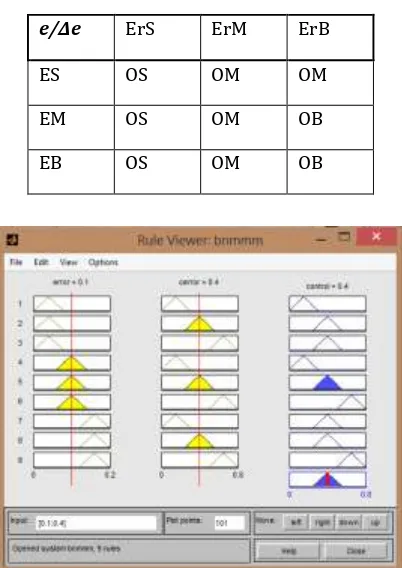
ES - e Small, EM - e Medium, EB - e Big, ErS Small, ErM -Medium, ErB - Big, OS - u(t) Small, OM - u(t) -Medium, OB- u(t) Big.
Figure-6: MFs for output
Figure 6 shows the membership functions of the output which can be defined as conclusion of the system.
© 2019, IRJET | Impact Factor value: 7.211 | ISO 9001:2008 Certified Journal
| Page 652
Figure-7: Fuzzy rules of the system
[image:4.595.63.266.91.276.2]The number of the rules are equal to square power of the number of MFs for input (Table 1). In this study, Mamdani method is used for developing fuzzy inference system. Rule base is needed for developing rules and its relation between input MFs as seen above.
Table -1: Rule Base
e/∆e ErS ErM ErB
ES OS OM OM
EM OS OM OB
EB OS OM OB
Figure-8: Rule viewer
Three dimensional behavior of the controller is depicted in Figure 9.
Figure-9: 3-D view of the FLC response
[image:4.595.332.534.336.509.2]The 2-D relationship between error (input-1) and control (output) is shown below,
Figure-10: 2-D view of the error-control
[image:4.595.61.262.389.673.2] [image:4.595.335.531.539.714.2]© 2019, IRJET | Impact Factor value: 7.211 | ISO 9001:2008 Certified Journal
| Page 653
Figure-12: PID model of the system
The PID controller output for second order system is depicted below,
Figure-13: PID controller response for Step function input
As seen in Figure 14, FLC system was designed in MATLAB/SIMULINK. FLC parameters are carried out by using Fuzzy Logic Toolbox with nine fuzzy rules.
Figure-14: FLC model of the system
FLC response for simulation output of the for second order system is depicted below,
Figure-15: FLC response for Step function input
Figure-16: PID controller step response characteristic
Figure-17: Fuzzy controller step response characteristic
The parameters of PID controller, tuned using Ziegler Nichols method, simulated and the performance of controller can be seen in below, worse than controller which tuned using Simulink Tuning Tool.
Figure-18: Step response of the system with PID controller tuned using Ziegler Nichols Method
Figure-19: PID controller tuned using Ziegler Nichols step response characteristic
© 2019, IRJET | Impact Factor value: 7.211 | ISO 9001:2008 Certified Journal
| Page 654
system. Performance of the FLC just depends on the fuzzy rules
5. CONCLUSION
In this paper, performance of the FLC and PID controller is observed for separately excited DC motor speed control, when input function is step. A system should be designed for less rising time and less overshoot percentage. The performance comparison study between FLC and PID controller whose parameters adjusted using Simulink Tuning Tool which gives better parameters than other tuning methods is carried out. Even though, better tuned PID controller may be provide better performance, the recommended FLC has more benefits, such as better static and dynamic performance, higher flexibility, control, compared with PID controller. Furthermore, it can be seen in Figure 10-11, FLC have provided less overshoot percentage of 4.2 % and lower rising time 2.8386 second, which means FLC has better performance in terms of overshoot percentage, settling time, control performance, and rise time, therefore, FLC design was recommended and implemented.
REFERENCES
1) Ray, A. and Shabbiruddin, F., “Speed Control Techniques Using Fuzzy Logic and Response Surface Methodology,” Int. J.Advance. Soft Comput. Appl., Vol. 4, No. 2, 2012.
2) Tushir, M. and Srivastava, S., “Type-2 Fuzzy Logic Controller Implementation for Tracking Control of DC Motor,” International Journal of Computer Network and Security, Vol. 3, No. 1, 2013, pp. 34-41.
3) Mendel, J. M., “Rule-Based Fuzzy Logic Systems:Introduction and New Directionsr,” Prentice-Hall New Jersey, 2001.
4) Rai, J. N., Singhal, M., and Nandwani, M., “Speed Control of DC Motor Using Fuzzy Logic Technique,” IOSR Journal of Electrical and Electronics Engineering (IOSR-JEEE), Vol.3, No. 6, 2012, pp. 41-48.
5) Ahmed, A., Mohan, Y., and Chauhan, A., “Comparative Study of Speed Control of DC Motor Using PI, IP, and Fuzzy Controller,” International Journal of Advanced Research in Computer and Communication Engineering,
Vol.2, No.7, 2013, pp. 2693-2697.
6) Kumar, S. B., Ali, M. H., and Sinha, A., “Design and Simulation of Speed Control of DC Motor by Using Fuzzy Logic Technique with Matlab/Simulink," International Journal of Scientific and Research Publications, Vol. 4, No. 7, 2014, pp. 1-4 .
7) Kushwah, R., Wadhwani, S., “Speed Control of Separately Excited Motor Using Fuzzy Logic Controller,”
International Journal of Engineering Trends and Technology (IJETT), Vol. 4, No.6, 2013.
8) Lodh, B., “Simulink Based Model for Analysing the Ziegler-Nichols Tuning Algorithm as Applied on Speed Control of DC Motor,” International Journal of Advanced Research in Electrical, Electronics and Instrumentation Engineering (IJAREEIE), Vol.3, No.1, 2014, pp. 6641-6646.
9) Kumar, R., Girdhar. V., “High Performance Fuzyy Adaptive Control for DC Motor” International Archive of Applied Sciences and Technology (IAAST), Vol.3, No.1, 2012.
10)Gaing, L.,Z., “A Particle Swarm Optimization Approach for Optimum Design of PID Controller in AVR System,” IEEE Transactions on Energy Conversion, Vol.19, No.1, 2004, pp. 384-391.
11)Terano, T., “Fuzzy Systems Theory and Its Application, ACADEMIC,1991.
12)Mir.,S.A., Zinger, D.S., Elbuluk, M.E.,”Fuzzy Implemantation of Direcy Self Control of Induction Machines,” IEEE Transaction on Industry Applications,1994, pp. 893-901.