
© 2019, IRJET | Impact Factor value: 7.211 | ISO 9001:2008 Certified Journal
| Page 5299
COMPARATIVE STUDY ON THE CHARACTERISTIC BEHAVIOUR OF
CFDSST, CFDSSAT&CFDSSPT TUBES WITH & WITHOUT EXTERNAL
RINGS
SAJNA C R
1, ANJANA C JAIN
21
P.G Student, Department of Civil Engineering, IIET Engineering College, Nellikuzhy, Kerala, India
2
Assistant Professor, Department of Civil Engineering, IIET Engineering College, Nellikuzhy, Kerala, India
---***---Abstract -
Concrete Filled Tubular steel (CFT) member,which represents a superb deformability due to well-known confined effect between steel tube and concrete, has been used mainly as bridge pier. As a progressive composite member, Concrete Filled Double Skin Steel tubes(CFDSST), which is consist of double skin steel tubes and filled concrete between them, has been proposed.Concrete filled steel columns have high bearing capacity and ductility.Also easy to construction and saving cost. High strength and high stiffness can be effectively provided by aluminium tube columns filled with concrete. It has good appearance, corrosion resistance and easy production. In concrete filled steel columns the weak steel- concrete bonding of the outer tube will take place in the initial elastic stage only. As a result of this the confinement and stiffness of the CFDSST columns were reduced. In order to avoid this problem a study is conducted through the use of external steel ring confinement in CFDSST columns to restrict the dilation of outer steel tube. In this study PVC
tubes are also used instead of aluminium tubes. A series of
axial compression test are to be performed on CFDSST, CFDSSAT and CFDSSPT columns with and without external ring confinement. From the result it was found that, the strength and ductility of CFDSST, CFDSSAT and CFDSSPT specimens were increased with external steel rings when compared with those specimens without external rings. The CFDSSAT specimens was taking more axial load when compared with CFDSST and CFDSSPT column specimens.
Key Words: Concrete-filled double skin steel tubes,
Concrete-filled double skin steel aluminium tubes, Concrete-filled double skin steel pvc tubes, Deflection, Ductility, Load carrying capacity.
1. INTRODUCTION
A column is a vertical structural member intended to transfer a compressive load. Steel columns have good compressive strength, but have a tendency to buckle or bend under extreme loading. This can be due to their length, cross-sectional area, method of fixing and shape of the section.
1.1
CFDSST
Concrete-filled double-skin tubular (CFDST) column is one of the most efficient forms of column construction. CFDSST have been popularly used as individual column elements. Advantages of concrete filled double skin steel tubes include increase in section modulus, enhancement in stability, lighter weight, better damping characteristics and better cyclic performance. It is thus expected that concrete filled double skin steel tubes(CFDSST) have the potential of being used in building structures. The ductility of specimens with circular sections are higher than those of the specimen with square sections. The paper consists of an experimental investigation on the ultimate axial load carrying capacity and ductility of CFDSST, CFDSSAT and CFDSSPT column specimens with and without stiffeners having difference in arrangement of stiffeners
.
1.2
CFDSSAT
Aluminium is widely used as building material in curtain walls, bridges and many other structural applications because of its high strength-to-weight ratio, excellent corrosion resistance, ease of construction, ease of production etc. Aluminium tubes around the concrete eliminate permanent formwork. It has high strength and high stiffness, and as such, construction time can be reduced. It create a more sustain concrete, which creates a more sustainable environment by the use of less concrete. The cavity tubes can be used as power cables, telecommunication lines, drainage pipes etc. Hence, there is a need to investigate the structural performance of concrete-filled double skin steel aluminum tube columns and the comparative study of CFDSST, CFDSSAT and CFDSSPT.
1.3
SCOPE
© 2019, IRJET | Impact Factor value: 7.211 | ISO 9001:2008 Certified Journal
| Page 5300
1.4
OBJECTIVES
To compare and study the strength behavior of CFDSST, CFDSSAT and CFDSSPT columns under axial load condition.
To study the effect of number and spacing of external rings on load carrying capacity of CFDSST,CFDSSAT and CFDSSPT columns under axial load compression.
.To determine the deflection ductility ratio of CFDSST,CFDSSAT and CFDSSPT specimens
2. METHODOLOGY
Literature review.
Carrying out test on materials and arriving at a suitable proportion for M25 mix concrete.
Choosing suitable dimensions for CFDSST,CFDSSAT and CFDSSPT column specimen.
Casting CFDSST,CFDSSAT and CFDSSPT specimens with and without external rings.
Curing of the column specimen for 28 days.
Carrying out the axial loading test in universal testing machine(UTM) of 1000 kN capacity.
Result analysis.
3. PROPERTIES OF MATERIALS
3.1 Cement
Ordinary Portland Cement of grade 53 is used for casting specimens throughout this project.
Table -1:
Properties of cement
Test conducted Result
Specific gravity 3.2
Standard consistency 31.75%
Initial setting time 6%
Fineness 45 minutes
3.2 Aggregates
M sand of proper gradation (particles ranging from 150 microns to 4.75 mm in suitable proportion) was usedfor casting the concrete specimen.
[image:2.595.302.562.223.325.2]Coarse aggregate of size 10mm is used for casting specimen.
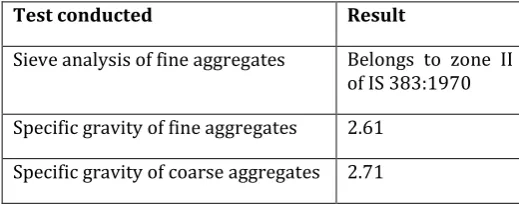
Table -2:
Properties of aggregates
Test conducted Result
Sieve analysis of fine aggregates Belongs to zone II of IS 383:1970
Specific gravity of fine aggregates 2.61
Specific gravity of coarse aggregates 2.71
3.3 Water
Potable water is used for mixing of concrete as well as mortar.
3.4 Admixture
Master Glenium SKY 8233 was used for the concrete mix.It is based on modified polycaboxylic ether.
Table -3: Mix Proportion of M25 grade concrete.
Quantity of materials
(kg/m3) of
concrete
w/c % of admix tures used
Slump (mm)
compres sive strength (N/mm2 )
Cement=408.07
FA=1028.64
CA=915.575
0.42
0.2
140
7
thday
=16.2
28
thday
=26
4. EXPERIMENTAL STUDY
4.1 Details of CFDSST, CFDSSAT and CFDSSPT
A total of eighteen column specimens were casted which includes 6 CFDSST column specimens,6 CFDSSAT column specimens and 6 CFDSSPT column specimens.The mild steel (fy= 250 N/mm2) aluminium alloy (fy= 270
N/mm2) and pvc tubes(fy= 52 N/ mm2) were purchased
© 2019, IRJET | Impact Factor value: 7.211 | ISO 9001:2008 Certified Journal
| Page 5301
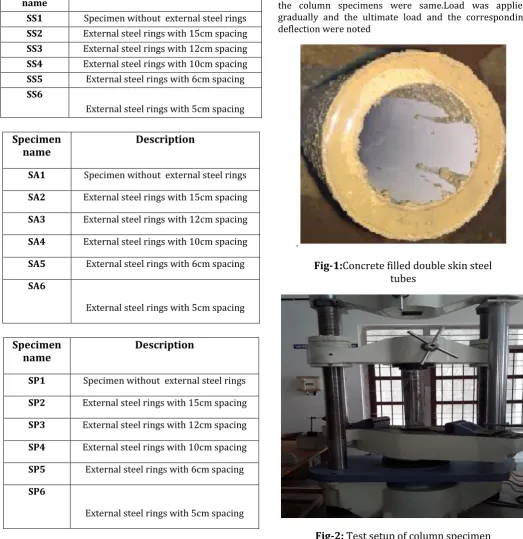
For CFDSST specimens the smaller diameter (76mm) steeltube was placed into larger diameter (114mm) steel tube and the two tubes were connected by small rod using bolted connection. Then the external rings are given by welded connection in different spacings (5cm,6cm,10cm,12cm,15cm).
Table -4:
Details of specimens
Specimen
name Description
SS1 Specimen without external steel rings SS2 External steel rings with 15cm spacing SS3 External steel rings with 12cm spacing SS4 External steel rings with 10cm spacing SS5 External steel rings with 6cm spacing SS6
External steel rings with 5cm spacing
Specimen
name
Description
SA1 Specimen without external steel rings
SA2 External steel rings with 15cm spacing
SA3 External steel rings with 12cm spacing
SA4 External steel rings with 10cm spacing
SA5 External steel rings with 6cm spacing
SA6
External steel rings with 5cm spacing
Specimen
name
Description
SP1 Specimen without external steel rings
SP2 External steel rings with 15cm spacing
SP3 External steel rings with 12cm spacing
SP4 External steel rings with 10cm spacing
SP5 External steel rings with 6cm spacing
SP6
External steel rings with 5cm spacing
4.2
TEST PROCEDURE
All specimens were tested in Universal Testing Machine having load capacity of 1000 KN.The columns were tested under axial loading.Deflector meter were fixed at the bottom part of the UTM axially to measure deflection with respect to applied load.Load was applied axially at an increment of 10 KN. For each load of 10 kN, the deflection were recorded. All specimens were subjected to load up till failure. Testing procedure for all the column specimens were same.Load was applied gradually and the ultimate load and the corresponding deflection were noted
.
[image:3.595.30.554.218.758.2]Fig-1:
Concrete filled double skin steel
tubes
[image:3.595.330.540.262.462.2]© 2019, IRJET | Impact Factor value: 7.211 | ISO 9001:2008 Certified Journal
| Page 5302
5. RESULTS AND DISCUSSIONS
5.1. LOAD Vs DEFLECTION CURVE
Chart-1:
Load vs deflection curve for CFDSST column
specimens
Chart-2:
Load vs deflection curve for CFDSSAT
column specimens
Chart-3:
Load vs deflection curve for CFDSSAT
column specimens
5.2. ULTIMATE LOAD CARRYING CAPACITY
Chart-4: Ultimate loads (kN) for CFDSST
© 2019, IRJET | Impact Factor value: 7.211 | ISO 9001:2008 Certified Journal
| Page 5303
Chart-6: Ultimate loads (kN) for CFDSSPTThe measured ultimate load carrying capacity of stiffened CFDSST column specimens is larger when compared with unstiffened CFDSST column specimens.The ultimate load of CFDSST specimen was 465 kN(external rings are at a spacing of 5 cm).The measured ultimate load carrying capacity of stiffened CFDSSAT column specimens is larger when compared with CFDSST and CFDSSPT column specimens. This increase is due to the increase in bond strength between steel or aluminium tube and in-filled concrete. From the chart -5, we can concluded that the load carrying capacity of CFDSSAT column specimens with steel rings is almost double than that for CFDSSAT column specimens without external steel rings.CFDSSAT can prevent local buckling of steel tube.The ultimate load of CFDSSAT specimen was 504 kN(external rings are at a spacing of 5 cm). The measured ultimate load carrying capacity of stiffened CFDSSPT column specimens is also found to be greater when compared with unstiffened CFDSSPT column specimens.The ultimate load of CFDSSPPT specimen was 445 kN(external rings are at a spacing of 5 cm).
5.2. DEFLECTION DUCTILITY INDEX AND RATIO
Deflection ductility index is the ratio of deflection at ultimate load to the deflection at yield load.
Label Maximum
deflection(mm) Deflection ductility index
Deflection ductility
ratio
SS1 3.7 1.132 1
SS2 6.5 1.35 1.192
SS3 7 1.48 1.307
SS4 7.3 1.52 1.342
SS5 7.3 1.67 1.475
SS6 10 1.63 1.439
Label Maximum
deflection(mm) Deflection ductility index
Deflection ductility
ratio
SA1 3.95 1.218 1
SA2 5.5 1.41 1.157
SA3 4.6 1.47 1.206
SA4 7.32 1.58 1.297
SA5 6.51 1.673 1.373
SA6 10.5 1.812 1.487
Label Maximum
deflection(mm) Deflection ductility index
Deflection ductility
ratio
SS1 3.5 0.962 1
SS2 5 1.012 1.051
SS3 5.8 1.11 1.153
SS4 6.5 1.216 1.264
SS5 7.1 1.252 1.301
SS6 8.4 1.254 1.304
6. CONCLUSIONS
A total of 18 columns( Six CFDSST,Six CFDSSAT,Six CFDSSPT) with and without external rings were tested under axial compressive load.From the result ,the three type specimen were compared in terms of load carrying capacity and deflection ductility.
From the result we can concluded that
Ultimate load carrying capacity of the CFDSST specimen with external steel rings were increased by 81.64% when compared with the specimen without external steel rings..
The measured load carrying capacity of the ring confined CFDSST columns is larger than that of unconfined CFDSST counterparts.
The Deflection-Ductility ratio for CFDSST specimen with external rings is 1.439 times greater that of specimens without external rings ie;there is an increase of 43.9%.
Ultimate load of the CFDSSAT specimen with external steel rings were increased by 85.29% when compared to SA1.
© 2019, IRJET | Impact Factor value: 7.211 | ISO 9001:2008 Certified Journal
| Page 5304
greater that of specimens without externalrings.ie;there is an increase of 48.7%.
Ultimate load of the CFDSSPT specimen with external steel rings were increased by 79.4% when compared to SP1(without steel rings).
The Deflection-Ductility ratio for CFDSSPT specimen with external rings is 1.304 times greater that of specimens without external rings.ie;there is an increase of 30.4%.
The yield strength of aluminium (fy=270 N/mm²) is greater than that of steel(fy=250 N/mm²) and pvc(fy=52 N/mm²).Therefore it might be the reason for the greater load carrying capacity of CFDSSAT specimen when compared with CFDSST & CFDSSPT.
REFERENCES
[1]
Khadim Zuboon Nasser (2012), “Structural Behaviour of Concrete Filled Aluminium Tubular Columns”, Basrah Journal for Engineering Science, pp. 48-59.[2]
Feng Zhou and Ben Young (2009), “Concrete-filled aluminum circular hollow section column tests”, Thin-Walled Structures,Elsevier,
Vol. 47, pp. 1272-1280.[3] J.C.M Ho, C.X Dong, Simplified design Model for Uni-axially Loaded Double Skinned Concrete Filled Steel Tubular Columns With External Confinement, Advanced Steel Construction, Vol.10 No 2(2014), 179-199.
[4] Darshika k. Shah, M.D.Vakil, M.N.Patel, Parametric Study of Concrete Filled Steel Tube Column, IJEDR, Vol.2(2014), 1678-1682.
[5] Feng Zhou and Ben Young (2008), “Test of concrete-filled aluminium stub columns”, Thin-Walled Structures,
![Preparation of monolayers of [MnIII6CrIII]3+ single molecule magnets on HOPG, mica and silicon surfaces and characterization by means of non contact AFM](data:image/gif;base64,R0lGODlhAQABAIAAAP///wAAACH5BAEAAAAALAAAAAABAAEAAAICRAEAOw==)