© 2019, IRJET | Impact Factor value: 7.211 | ISO 9001:2008 Certified Journal
| Page 7624
Automated Automobile Headlighting System
Drishya Innocent
1, Jisha P. S. Kumar
2, Mahima Janardhanan
3, Shikha Rachel Mathew
4,
Ann Mary Alex
51
Student, Dept. of ECE, Mar Baselios College of Engineering and Technology, Kerala, India
2Student, Dept. of ECE, Mar Baselios College of Engineering and Technology, Kerala, India
3Student, Dept. of ECE, Mar Baselios College of Engineering and Technology, Kerala, India
4Student, Dept. of ECE, Mar Baselios College of Engineering and Technology, Kerala, India
5Asst.Professor, Dept. of ECE, Mar Baselios College of Engineering and Technology, Kerala, India
---***---Abstract -
Major road accidents occur at nighttime. About25% of driving is done at night. The poor illumination of headlights accounts for this immense hike of fatal accidents at night. Standard headlamps illuminate the road ahead only in a straight direction making it inconvenient for the owner and the other drivers on road. Another problem arises when the driver is drunk and drowsy and forgets to turn the vehicle at the curves. Here we are developing a miniaturized system which can bring about a solution to these problems. The first section focuses on widening the area of illumination at curved roads thereby preventing the difficulty caused by blind spots. The headlights are mounted on servomotors which rotates and provides a much wider view. A camera sensor is used to capture the image of curved road in advance. The features of the image are extracted and is processed using MATLAB which gives the angle of the road thereby facilitating the movement of servomotor. The second section focuses on reducing accidents caused by drunken and drowsy drivers. An IR sensor with its obstacle detection property is employed here in order to avoid the chances of collision by gradually stopping the vehicle to the side of the road. In addition, we are controlling the vehicle using an android application developed using an open source software known as App Inventor
Key Words: angle, blind spots, camera sensor, servomotor, MATLAB, App Inventor
1.INTRODUCTION
According to National Safety Council Reports, more than 55% of fatal accidents occur at nighttime drivers’ visibility is determined by various factors. Street lights may not be sufficient every time for safe driving[1]. The headlight may not offer proper illumination when the vehicles turn the corner. The degree of illumination in conventional headlights can cause blind spots leading to poor visual performance. With the improvement in car industry throughout the year there was a climb in the quantity of vehicles on street bringing about an unexpected increment in the quantity of street mishaps. Poor perceivability and ill-advised light of the streets at bends and corners result in mishaps. The
prime reason for the greater part of the mishaps happening during the evening is commonly because of the inability to see impediments or the pedestrians crossing the way and the inauspicious response to it. The headlamps assume a pivotal job in the drivers' perceivability and security. The fixed light beam pattern of regular headlamps limits the drivers' perceivability while taking bends and makes vulnerable sides bringing about poor illumination[2]. This paper centers around stretching out the brightening territory to more extensive point in this manner forestalling vulnerable sides and supporting in a more secure driving. Here, we make utilization of Automated Automobile Head lighting System(AAHS) which is a functioning driving security improving framework which can consequently change or modify headlamps for various outside conditions or factors, for example, street conditions, driving conditions and climatic conditions etc. Earlier directional lights utilized mechanical linkages whereas AAHS depends on transducers, electronic sensors and actuators. Correlation made on the light dissemination pattern of headlamps with and without AAHS demonstrates that the latter one doesn't completely enlighten the diverting which blocks the driver from recognizing any hindrances on its way. Accordingly, auspicious identification of any impediment helps in forestalling impacts or mishaps at the curved roads[3].
© 2019, IRJET | Impact Factor value: 7.211 | ISO 9001:2008 Certified Journal
| Page 7625
ended up accessible since the 1950's initially on theextravagant models. Starting in the 2000's there was resurgence in enthusiasm for moving or upgrading the fog light pillar accordingly not exclusively to vehicular steering and suspension elements yet in addition to encompassing climate, perceivability conditions, vehicle speed and street arches[4].
2. PRINCIPLE OF OPERATION
[image:2.595.44.280.405.589.2]Without street lights, the normal light of the headlamps is not sufficient most of the time. In these situations, the driver needs to take care not to dazzle other drivers. During twilight or night, pedestrians are very much in danger on lonely roads because they are seen late or not at all. Another risk at night is generated by animals crossing in front of the vehicle. Like pedestrians they are often seen either late or not at all. Whenever a vehicle approaches an intersection or a roundabout in the darkness, conventional headlamps only illuminate the area ahead. This is one reason why at a right turn, a cyclist coming from left is hard to detect. In a roundabout, the driving dimension often changes in such a fast way that the light does not illuminate the road ahead in time.
Fig -1: Basic block diagram of AFS
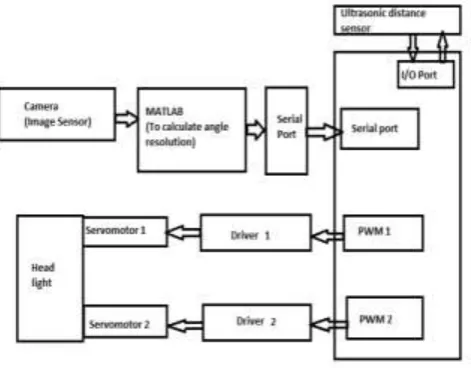
For clear visibility of the road and boundaries at night time on curved street, it is important to show headlight along that route .In this device Camera (photograph sensor ) is used for collecting information related to the corner and that RGB image is converted into HSV plane and from that picture we are going to calculate angle of rotation for headlamp which behaves as an angle sensor. The controller takes this information and is processed by controller unit and accordingly PWM width is updated. The output is fed into the servo motor and the motor rotates headlight horizontally.
2.1
Vertical movement of headlight in response
to the distance obtained:
There are two pins for ultrasonic sensor. One is trigger and second is echo. In order to initiate ultrasonic sensors operation, it needs trigger pulse of 10µs. Proportional to the distance between the vehicles, an echo pulse will be generated with width in response to the trigger pulse. A pulse will be received on echo pin. Distance of obstacle is proportional to ON width of this signal. In accordance with the decrease in distance the speed has to be decreased. With the distance from obstacle, the program will reduce the ON width of PWM. This output is fed to the controller and the controller will accordingly update PWM width to rotate headlight vertically.
Servo PWM= {(150 - (ultrasonic _count - 50)) * 60} +18000; PWM waveform for vertical servo motor relies upon ultrasonic count. Ultrasonic sensor offers minimal width of 50 and maximum width of 200. Now the range becomes 0 to 150 since the limit is shifted to 0 by subtracting 50 from all other values. Obtained count is subtracted from 150 in order to maintain the relationship that headlight angle is up when object is at far distance and headlight should be lowered, if the object is nearer. For ensuring full vertical span of motor is covered, the range of the count is made to thousands by multiplication of 60. The motor is brought to lowermost point by 18000 counts and motor is brought to upper angle by some proportional amount by addition of remaining factor.
2.2 For horizontal turning of head lamps using
camera mounted on servo:
[image:2.595.323.549.566.722.2]The input from camera is processed by controller unit and the PWM width is correspondingly updated . The output is then given to the servo motor. This makes the headlight rotate horizontally. Servo motor desires a PWM pulse of 20ms period, min on time of 1ms and max of 2ms. Servo motor will change its rotation angle as per ON width of PWM as mentioned in the figure below:
© 2019, IRJET | Impact Factor value: 7.211 | ISO 9001:2008 Certified Journal
| Page 7626
[image:3.595.40.279.98.278.2]3. Developed system model
Fig -3: Block diagam of AAHS
3.1 Turning the headlamp in desired direction
AAHS is a system whose development is based on adaptive front lighting system. The camera captures the image of the curved road ahead. The features of the image (such as the radius of curvature, the white line width etc.) are extracted using MATLAB and is given to the microcontroller. Based on this radius, the angle of the road is calculated which in turn generates a PWM signal. The width of the signal depends on the angle obtained from MATLAB. This information is given to the servomotor onto which the headlamp is mounted. This facilitates the movement of headlamp in desired direction. The output of microcontroller also drives the motors attached to the wheels.
3.2 Driver drowsiness detection
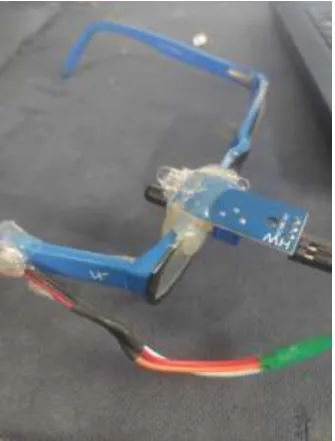
The vehicle is controlled here by using an open source software application known as App Inventor. The vehicle module communicates with the app using a Bluetooth module. The second section focuses on reducing accidents caused by drunken and drowsy drivers. Here we make use of an IR sensor to prevent the possibilities of accidents. There are chances of collision if the driver goes unconscious or is drowsy while driving. To avoid such incidents from happening, an IR sensor is attached to the driver’s spectacles and continuous waves are sent to his eyes. The distance between the sensor and the opened and closed eyelids vary. This in turn provides a trigger to the AAHS system that the driver is likely to sleep. If the eyelid is closed for more than two seconds, the vehicle is designed to stop gradually to the side of the road. In this case the control is directly given to the microcontroller which stops the vehicle thus avoiding the chances of collision.
3.3 Working of LED lights
In usual cases standard headlights shine only in a straight direction. Moreover, they are capable of illuminating only some parts of the road and does not cover the entire area of vicinity. AAHS automatically adjust the road illumination by reacting to steering, speed and elevation of the car.For the drivers on the car as well as for the other drivers on the road, the head lights should angle to the right when the car turns right and to the left when the car turns left. A serious problem
occurs when e visibility is affected to a large extend by the glare from oncoming vehicles. The incidence due to glare is reduced by e use of AAHS as they are directed at the road. Cars equipped the with adaptive headlights make use of electronic sensors to detect vehicle’s speed, that is, how far the steering wheel has s been changed and the yaw of the car. A 30degree range of movement can be provided by a typical adaptive headlamp since they can turn to 15 degrees. When the curves are too sharp or the vehicle takes a turn at a low speed, 15 degrees of sideward movement may not be sufficient. In such cases, additional lighting can supplement the headlights. Tiny reflectors are used to pivot the fog lights to the aspect if the vehicle is equipped with it. If the fog lights are not present within the system, another lamp capable of sideward movement is installed along with the headlamps. If the car’s speed is less than 25 mph (40 km/hour) and it takes a turn, an additional area of 80 degrees can be illuminated with the help of cornering lights. These lights mechanically flip themselves once the car is done with the turning. The present conventional light frameworks do never again give enlightenment inside the correct course on bend streets. Because of this compel, a need to perceive an elective innovation arrangement. The reason for existing is to improve perceivability and guarantee increment in wellbeing and comfort in driving. This requires a bendy front light for vehicles to enlighten road previously inside the evening. Robotized vehicle head lighting contraption (AAHS) improves driving perceivability during the evening consequently accomplishing insurance. AAHS used to gather data identified with corner with assistance of sensor which find the information it is then send to engine to manage headlamps to get legitimate lighting installations pillar which was reasonable for the twisting.
Newly evolved adaptive front-lighting system based on CCD turns into better than the conventional one. This new type of AAHS makes use of CCD image processing technology to collect records of the corner from a distance. And then it adjust the angle of dipped headlights in advance in step with the corner records attained. After that it will fulfill the pre-regulation of headlamps to ensure light coverage place and avoid the lighting fixtures visual "blind spot". This way, it may adapt to corner circumstance in advance via CCD.
© 2019, IRJET | Impact Factor value: 7.211 | ISO 9001:2008 Certified Journal
| Page 7627
Fig -4: Illumination directionA servomotor is used for turing the headlights from left to right or vice versa. Servomotor has a very high output power. It is tiny and light weight. Servo can move 90 degree in each direction. Motor is smaller but works just like the standard kind. The output from the matlab is given to the CP2102 module which is highly integrated USB to UART bridge controller.
4. HARDWARE REQUIREMENTS
1. Computer with MATLAB 2. Micro-controller
3. Bluetooth module 4. L293D module 5. Servomotor 6. IR Sensor 7. CP2102
5. SOFTWARE REQUIREMENTS
Fig -5: Flowchart of AAHS
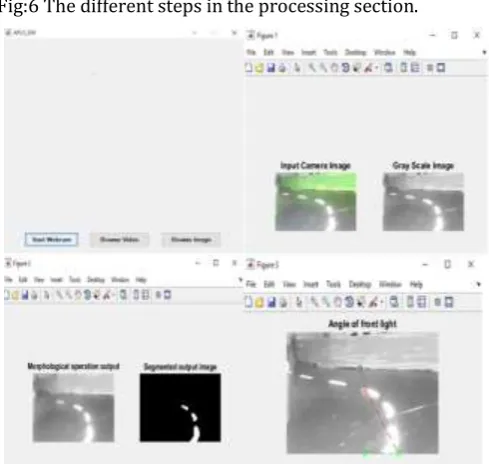
Using MATLAB each frame from the video is first converted from RGB to gray image. Then to this image morphological operations are been done. ie. close function (dilation followed by erosion). The resultant image is then segmented to get a black and white image. With the resultant enhanced white line, we find the angle of curvature. The formula used to find angle in MATLAB is
a1=mod(atan2(det([u;v;]),dot(u,v)),2*pi;
angleout = (a1*30/4-a1);
Since the sensor module deals with infrared, for impediments with intelligent surfaces (white hued), the most extreme range will be higher and for non-intelligent surfaces (dark hued), the greatest range will be lower. This can thus be utilized for recognizing white/dark lines (in line supporter robots) or brilliant/dim articles (in item ID robots) methods of activity 1. Abnormal state mode (ah mode) in abnormal state mode, in the event that there is no impediment, at that point the yield will be low (0v) and amp. recognizing a deterrent will change the yield to high (5v) level. This mode can be empowered, if both the jumpers are associated with ah (set the jumper an on stick 1 and amp. 2, set the jumper b on stick 2 and amp 3. Low dimension mode (al mode) in low dimension mode, on the off chance that there is no impediment, at that point the yield will be high (5v) and amp. recognizing an impediment will change the yield to low (0v) level. This mode can be empowered, if both the jumpers are associated with al (set the jumper an on stick 2 and amp. 3, set the jumper b on stick 1 and amp 2.
6. SIMULATION AND SYSTEM RESULT
[image:4.595.46.250.375.741.2]Here the live video is been processed by MATLAB tool. Fig:6 The different steps in the processing section.
[image:4.595.310.555.500.732.2]© 2019, IRJET | Impact Factor value: 7.211 | ISO 9001:2008 Certified Journal
| Page 7628
Fig -7: Hardware ImplementationFig -8: IR Sensor module mounted on spectacles
8.
CONCLUSION
The developed architecture helps to remove “blind spot” and improve the driver’s visibility at night time. Moving the Headlights horizontally and vertically achieved continuously corresponding to a sensor is achieved. An advantage of the developed headlight system is easily configured to fit in variety of vehicles. The future work mainly concentrates on to invent a comprehensive AFS advantage of the developed headlight system is easily configured to fit in variety of vehicles. The future work mainly concentrates on to invent a
comprehensive AFS system which can be suitable for complex road conditions including road surface water, corner, highway, rural road and urban road and so on.
REFERENCES
[1] Priyanka M Dubal, Dr. Alam N. Shaikh Asst Professor, Department of Electronics Engineering,”Adaptive Front Lighting System for Vehicle” International Journal of Engineering Research in Computer Science and Engineering (IJERCSE) Vol 5, Issue 2, February 2018.
[2] Renton Ma, “Automotive Adaptive Front-lighting System Reference Design” Texas Instruments, SPRUHP3 – July 2013.
[3] Manish Bonde, Kushal Sakure, Ganesh Purane and Trupti A. Joshi “Adaptive Headlight System” International Journal of Informative & Futuristic Research ISSN (Online): 2347-1697, Volume 2, Issue 7 March 2015.
[image:5.595.78.246.384.605.2]