How to Improve the Security Skills of
Mobile App Developers
An Analysis of Expert Knowledge
Charles Weir
Security Lancaster
School of Computing and Communications
Lancaster University, UK
A thesis submitted for the degree of
Masters by Research
The best thing for being sad... is to learn something. That is the only thing that never fails. You may grow old and trembling in your anatomies, you may lie awake at night
listening to the disorder of your veins, you may miss your only love, you may see the world about you devastated by evil lunatics, or know your honour trampled in the sewers of baser minds. There is only one thing for it then – to learn. Learn why the
world wags and what wags it. That is the only thing which the mind can never exhaust, never alienate, never be tortured by, never fear or distrust, and never dream
of regretting. Learning is the thing for you. Look at what a lot of things there are to learn—pure science, the only purity there is. You can learn astronomy in a lifetime, natural history in three, literature in six. And then, after you have exhausted a million
lifetimes in biology and medicine and theocriticism and geography and history and economics – why, you can start to make a cartwheel out of the appropriate wood, or
spend fifty years learning to begin to learn to beat your adversary at fencing. After that you can start again on mathematics, until it is time to learn to plough.
Declaration
This thesis is entirely my own work, and has not been submitted in any form for the
award of a higher degree elsewhere. Ethics approval was granted for this research
according to university guidelines. Some of the ideas in this thesis were the product of
discussion with my supervisors Professor Awais Rashid and Professor James Noble.
This thesis includes materials from the following peer-reviewed published work written
by myself:
Early Report: How to Improve Programmers' Expertise at
App Security?
Weir, C., Rashid, A. & Noble, J. 8/04/2016 Proceedings of the 1st International Workshop on Innovations in Mobile Privacy and Security: Co-located with ESSoS 2016. Aspinall, D., Cavallaro, L., Seghir, M. & Volkamer, M. (eds.). London, UK: CEUR-WS.org, Vol.
1575, p. 49-50
How to Improve the Security Skills of Mobile App
Developers: Comparing and Contrasting Expert Views
Weir, C., Rashid, A. & Noble, J. 7/06/2016 Proceedings of the 2016 ACM Workshop on Security Information Workers. Biddle, R., Chu, B., Lipford, H. & Murphy-Hill, E. (eds.). New York: ACM
Reaching the Masses: A New Subdiscipline of App
Programmer Education
Summary
Much of the world relies heavily on apps. Increasingly those apps handle sensitive
information: controlling our financial transactions, enabling our personal communication
and holding intimate details of our lives. So the security of those apps is becoming
increasingly vital. Yet research shows that those apps contain frequent security and
privacy problems; and that almost all of these issues could have been avoided had the
developers had sufficient motivation, support and knowledge. This lack of developer
knowledge and support is widely perceived as a major threat.
We therefore investigated the skills, approach and motivation required for developers. We
conducted a Constructivist Grounded Theory study, involving face-to-face interviews
with a dozen experts whose cumulative experience totalled over 100 years of secure app
development, to develop theory on secure development techniques. The study identified
that the subdiscipline of app development security is still at an early stage, and found
surprising discrepancies between current industry understanding and the experts’
recommendations. In particular it found that a secure development process tends not to
appeal to app developers; and that the approach of identifying common types of security
problems is too limited to give an effective security solution.
Instead we identified a set of successful techniques we call ‘Dialectical Security’, where ‘dialectic’ means learning by questioning. These techniques use dialogue with a range of
counterparties to achieve app security in an effective and economical way. The security
increase comes from continued dialog, not passive learning.
The novel contribution of our work is to provide:
A grounded theory of secure app development that challenges conventional
processes and checklists, and
A shift in perspective from process to dialectic.
Only by working to develop the Dialectical Security skills of app developers shall we
Acknowledgements
Thank you first to my supervisors, Awais Rashid and James Noble, especially for their
support for writing conference papers, which have led not only to interesting ideas in their
own right but also to suggestions and to ideas from other academics.
Thank you to all those who generously gave time to be interviewed; their wisdom and
insight were essential to this work.
Thank you to my wife, Julia, for her support both academic and practical, and for
originally suggesting this one-year research project.
Thank you to Kayla Friedman and Malcolm Morgan for the Microsoft Word thesis
template used as a basis for the document, and to Gerald Kotonya and Debbie Stubbs for
help changing it and distributing it for Lancaster use.
Thank you to my fellow post-graduate students at Security Lancaster for much help and
support, and especially to Syed Asad Ali Naqvi for his help with the intricacies of
Contents
1 INTRODUCTION ... 1
1.1 State of the Art and Its Limitations ... 2
1.2 Thesis Objectives ... 4
1.3 Novel Contributions ... 5
1.4 Conventions in this Thesis ... 6
1.5 Thesis Overview ... 6
2 RESEARCH PROCESS ... 8
2.1 Introduction ... 8
2.2 Research Philosophy ... 8
2.3 Introduction to Grounded Theory ... 9
2.4 A Brief Overview of Grounded Theory ... 9
2.5 Grounded Theory Step-by-Step ... 10
2.6 The Use of Literature Surveys ... 13
2.7 Incorporating Appreciative Inquiry ... 13
2.8 Research Design ... 15
2.9 About the Author ... 17
2.10 Introduction to the Interviewees ... 18
2.11 Introduction to the Organisations ... 20
2.12 The Interviews... 21
2.13 Analysis of the Interviews ... 22
3 EXISTING RESEARCH ON APP PROGRAMMERS AND SECURITY ... 23
3.1 Two Types of Literature ... 23
3.2 Focus of Existing Research ... 24
3.3 Programmer Motivation ... 24
3.4 How Do Programmers Learn? ... 25
3.5 What Do Programmers Need to Learn? ... 28
4 LEARNING RESOURCES FOR PROGRAMMERS ... 30
4.1 Introduction ... 30
4.2 Security Patterns ... 31
4.3 The Practitioners’ Movement ... 33
4.4 Black Hat Literature ... 33
4.5 What Books Do Programmers Use? ... 34
4.6 Web-Based Information Sources ... 35
5 MOTIVATION AND APPROACHES TO APP SECURITY ... 38
5.1 Why Is Motivation Important? ... 38
5.2 What Motivates Our Interviewees? ... 39
5.3 Reasons for Learning ... 41
5.3.1 Experts’ Reasons for Learning ... 41
5.3.2 Experts’ Reasons for Continued Learning ... 42
5.5 Approach to Teamwork on Security ... 45
5.5.1 Teamwork versus Individual Rigor ... 46
5.5.2 Changing Behaviour - Influencing versus Directing ... 46
5.6 Approach to Implementing Security ... 47
5.6.1 Checklists or Whole System Security? ... 47
5.6.2 Concentrate on Attacker or Stakeholder? ... 48
5.7 Summary and Implications ... 49
6 INTRODUCTION TO DIALECTICAL SECURITY ... 51
6.1 Introducing Dialectic... 51
6.2 Documenting Good Practice ... 53
6.3 Types of Programmer Discussed ... 54
6.3.1 Jane Solo ... 54
6.3.2 Rob Youngcorporate ... 55
6.3.3 Jo Socialnetwork ... 56
6.4 The Techniques of Dialectical Security ... 58
7 TECHNIQUES OF DIALECTICAL SECURITY ... 60
7.1 Technique 1: Brainstorming the Enemy ... 60
7.1.1 Example ... 60
7.1.2 Exploration ... 61
7.1.3 Solution ... 62
7.1.4 Discussion ... 63
7.2 Technique 2: Negotiated Security ... 65
7.2.1 Example ... 65
7.2.2 Exploration ... 66
7.2.3 Solution ... 66
7.2.4 Discussion ... 68
7.3 Technique 3: Cross-Team Security Discussion ... 72
7.3.1 Example ... 72
7.3.2 Exploration ... 73
7.3.3 Solution ... 73
7.4 Technique 4: Security Challenge ... 74
7.4.1 Example ... 75
7.4.2 Exploration ... 75
7.4.3 Solution ... 76
7.4.4 Discussion ... 78
7.5 Technique 5: Automated Challenge ... 79
7.5.1 Example ... 79
7.5.2 Exploration ... 80
7.5.3 Solution ... 80
7.5.4 Discussion ... 82
7.6 Technique 6: Responsive Development ... 84
7.6.1 Example ... 84
7.6.2 Exploration ... 85
7.6.3 Solution ... 87
8.1 Summary of Dialectical Security ... 92
8.2 Discussion of Dialectical Security ... 93
8.2.1 Relationship to Existing Work ... 93
8.2.2 From Processes to Dialectic Cultures ... 95
8.2.3 Patterns of a Different Kind ... 95
8.3 Experience of Grounded Theory ... 96
8.4 Revisiting Objectives ... 96
8.5 Research Validity and Verifiability ... 97
8.5.1 Verifiability ... 98
8.6 Proposals for Future Work ... 98
8.7 Researching Dialectical Security Techniques ... 99
8.8 Researching Teaching Interventions ... 99
8.8.1 A Different Approach ... 99
8.8.2 Games That Teach ... 100
8.8.3 Story Telling ... 100
8.8.4 Adapting Business as Usual Approaches ... 101
8.8.5 Research Agenda ... 101
8.8.6 Evaluating Techniques ... 102
8.9 Conclusion ... 103
REFERENCES ... 104
List of Tables
Table 1: The steps in Grounded Theory... 11
Table 2: Principles of Appreciative Inquiry ... 15
Table 3: The experts interviewed ... 16
Table 4: The organisations represented ... 20
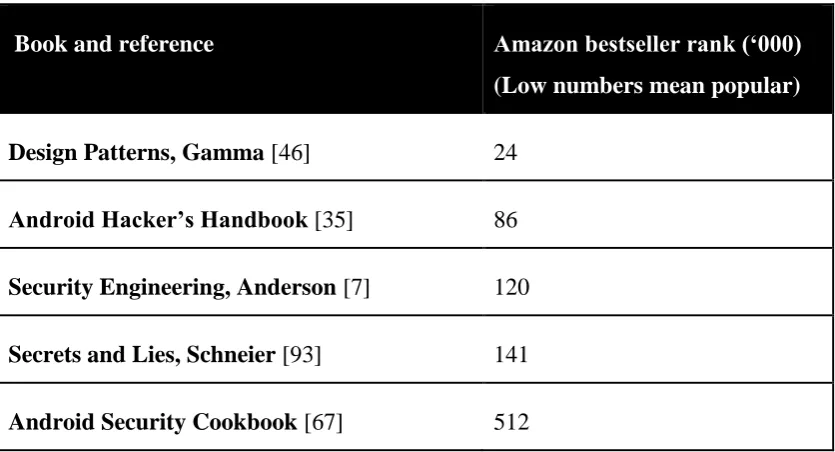
Table 5: Amazon rankings for selected books at January 2016 ... 34
List of Figures
Figure 1: Grounded Theory process... 11
Figure 2: Appreciative Inquiry ... 14
Figure 3: An introduction to the interviewees ... 19
Figure 4: Interview schedule ... 21
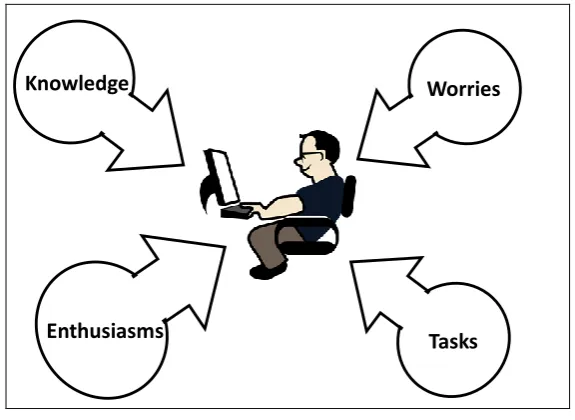
Figure 5: Motivation forces on a programmer ... 39
Figure 6: Reasons for original learning ... 41
Figure 7: Motivation for continued learning ... 43
Figure 8: Recommendations how to motivate app programmers ... 45
Figure 9: Expectation of team interaction ... 47
Figure 10: Preferred approach to app security ... 49
List of Abbreviations and Acronyms
ACM ... Association for Computing Machinery
API ... Application Programming Interface
BCS ... British Computer Society
CA ... Certification Authority
CCS ... Conference on Computer and Communications Security
CHI ... Computer Human Interaction
CISO ... Chief Information Security Officer
CMM ... Capability Maturity Model
CSCW ... Conference on Computer-Supported Cooperative Work
DARPA ... US Defense Advanced Research Projects Agency
EMV ... Eurocard, MasterCard and Visa
ENISA ... European Union Agency for Network and Information Security
ESEC ... European Software Engineering Conference
ESSoS ... International Symposium on Engineering Secure Software and Systems
FIPS ... Federal Information Processing Standards
FSE ... Foundations of Software Engineering Conference
GT ... Grounded Theory
HCC ... Human-Centric Computing
HCI ... Human Computer Interaction
HIDS ... Host-based Intrusion Detection System
HTTPS ... Hypertext Transfer Protocol over SSL
ICSE ... International Conference on Software Engineering
ID ... Identifier
IEEE ... Institute of Electrical and Electronics Engineers
iOS ... iPhone OS
IP ... Intellectual Property
ISO ... International Standardization Organization
ISP ... Internet Service Provider
IT ... Information Technology
JEE ... Java Enterprise Edition
LLVM ... Low Level Virtual Machine
MITM ... Man In The Middle
MOOC ... Massively Open Online Course
MSDN ... Microsoft Developer Network
NFC ... Near Field Communication
OID ... Object Identifier
OOD ... Object Oriented Design
OS ... Operating System
OSSEC ... Open Source HIDS SECurity (an open-source tool)
OWASP .... Open Web Application Security Project
PDF ... Portable Document Format
PIN ... Personal Identification Number
SANS ... SysAdmin, Audit, Network, and Security (an institute)
SIGSAC .... Special Interest Group on Security, Audit & Control
SIGSOFT .. Special Interest Group on Software
SPI ... Software Process Improvement
SQL ... Structured Query Language (for databases)
UML ... Unified Modelling Language (for software design)
WOOT ... USENIX Workshop On Offensive Technologies
1
Introduction
The past ten years has seen a massive growth in the creation and usage of mobile phone
and tablet apps. We use apps to communicate, apps to plan, apps to manage our finances,
apps to do our shopping, and apps to remember all our security information. Increasingly
those apps are handling sensitive information about us: controlling our financial
transactions, enabling our personal communication and social networking and holding the
intimate details of our lives. So the security of those apps is becoming increasingly vital.
Creating our apps are more than 2.9 million app developers, of whom only some 25% are
professionals developing apps for companies [106]. In these apps, cloud-based
connectivity and social networking functionality are making security and privacy issues
fundamentally important. So security expertise – and hence effective security practices –
in those developing such apps is vital.
Yet there is considerable evidence that such expertise is lacking. Analysis of the top five
payment apps by Bluebox [18], a security solution provider, found significant security
failures in each; analysis of a range of Android apps by Enck et al. [39] found privacy
problems in most of them. Both analyses highlighted that it was the choices that the app
programmers had made that were causing the problems; given the same environment and
cloud services they could have chosen problem-free implementations.
Indeed a recent IBM-driven survey of opinions about app security in American
Thus the security of users and data depends vitally on programmers’ security practices.
Therefore, it is important to improve the effectiveness of developers at producing secure
apps. We can choose from three possible research questions to address this, all
worthwhile:
(1) What kinds of security errors do programmers make?
(2) How do we improve the systems and compilers that support the developers in
their work; and
(3) How can we improve the security skills of the app developers themselves?
There has been a good deal of work on the first question such as the
previously-mentioned work by Enck and Bluebox, or work by Xie et al. [112] exploring the reasons
why programmers make security errors. Various projects – including Xie et al.’s IDE
enhancements [111], compiler improvements and libFuzzer’s testing support [66] –
address the second question. Taking the third question, however, there is little
understanding how and why app programmers learn security and what approaches are
likely to work best.
This work examines that third question. In the remainder of this chapter we shall explore
briefly the state-of-the-art, derive research questions and briefly discuss the approach
used, highlight novel aspects of the work and its results, and finally outline the remainder
of the thesis.
1.1
State of the Art and Its Limitations
The study of app programmer education and empowerment involves research on
1. how programmers actually learn,
2. how they can be helped to learn, and
3. what they should learn.
Taking each of these aspects of research, there is a small amount of relevant work on how
app developers learn security. Balebako et al. [10] surveyed and interviewed over 200 app
developers, and concluded most approached security issues using web search, or by
security than those using web search [2]. Yskout et al. [116] tested experimentally the
effect of using security patterns in server design; the results suggested a benefit but were
statistically inconclusive.
Considering how programmers can be helped to learn, two projects, Xie et al. [111] and
Nguyen et al. [77], have both developed prototype IDE-based tools to teach programmers
by detecting possible security flaws in Android developments. One might expect,
however, that the most effective approach would be a prescriptive set of instructions to
programmers what to do, a ‘Secure Development Lifecycle’ such as those promoted by
Microsoft [69] and others. However Conradi and Dyba [26] identified that programmers
have difficulty with, and resist learning from, formal written routines. This conforms to
the author’s own experience; he has never encountered an app development team
voluntarily adopting a process of that kind. That suggests that app developers need to find
a more lightweight, less prescriptive approach.
Considering what programmers need to learn, there is a good deal of general knowledge
available on software security, such as books by Anderson, by Pfleeger and by Schneier
[7,82,93] though these work at a level that is rarely helpful for app developers.
Knowledge useful to developers derives from a variety of sources. There is the security
patterns movement [71], which showed promise but has not been widely adopted [115];
there are books written by software security practitioners (e.g. [55,68]), which tend to be
helpful but are rarely adopted by app programmers – possibly for the reasons identified
by Conradi and Dyba above. Then there are ‘black hat’ books, such as the ‘Android Hacker’s Handbook’ [35], describing possible attacks and sometimes suitable mitigations
for programmers to put against them. These seem to sell well, but work only at a
technical level; they do not address the kind of security or privacy issues that derive from
the app domain rather than the technicalities of app programming.
Lastly there are web question-and-answer sites and operating system specific websites
and books on app security, which are consulted by developers but suffer from the same
problem – as well as, in the case of the question-and-answer sites, doubtful accuracy [2].
Consistent in all this literature, whether the patterns books, the security practitioners, the
plans) and aspects of system design. Each source leaves the development team to make
their own decisions how to achieve those artefacts; there has been little research into how
the teams might do this. Moreover whilst ‘whole system security’ experts such as
Anderson [7] are excellent at driving a holistic, rather than purely technical, view of
software security, they rarely consider the team interactions needed to achieve the results
they need.
Chapter 3 explores the literature on programmer learning in more detail; chapter 4
discusses learning resources available to programmers.
1.2
Thesis Objectives
Our research model assumes a self-motivated development team of one or more
developers who are empowered to make their own decisions on development process,
tools and philosophy. In our experience this model reflects common practice in all but the
most disciplined corporate and organisational cultures. The impact of making their own
decisions is important; it means that techniques which are successful but unattractive or
demotivating for developers are unlikely to be of value, since they will not be adopted.
We are also interested only in individuals and teams working on software that does have
security and privacy implications. Clearly a team creating a stand-alone game with no
external communication will not need to worry about security; so we do not need to
convert the entire developer world into security fanatics. However as the research above
highlights, many more apps have security – and especially privacy – implications than
developers may be aware of, and there is a need to consider how to encourage developers
to address these.
The research question of this thesis is therefore:
RQ1 What techniques and ideas will appeal to development teams and lead to them developing more secure app software?
Our purpose in the research was to generate knowledge about good ways to develop apps
securely. We started the research with no preconceptions as to whether we were looking
We had found few resources indicating how to tackle app development security. Existing literature tended to be negative in approach, listing things the developer must
not do; this contrasts with the kinds of books preferred by developers which tend to
be positive in outlook.
Since we had no initial theory to test, we considered an experimental approach to be
unsuitable. For the same reason we ruled out surveys to test hypotheses. Instead we
wanted to generate theory, based on an exploration of a range expert knowledge of
existing practice. We therefore chose a Grounded Theory (GT) approach [21,47], since
GT has been used extensively for that purpose in Software Engineering research [100].
Our major resource was personal connections and links to industry specialists in app
development, including in secure app development. Thus our Grounded Theory study
used semi-structured interviews over 6 months with a dozen such experts, whose
cumulative experience totalled more than 100 years of secure app development. To
encourage positivity, we used elements of Appreciative Inquiry [27] in our questioning:
the ‘Discovery’ of best practice and the ‘Dream’ of ideal practice.
The original research question leads to a number of further questions:
RQ2 What motivated the experts themselves to learn software security; how did they do so; and how do they continue to learn?
RQ3 What are the most effective techniques to deliver app security?
RQ4 How should we effectively introduce security to app development teams?
These further questions motivate the different questions used in the survey, as discussed
in section 2.12.
1.3
Novel Contributions
From our research we show in chapter 5 that there is little similarity in people’s
motivation to learn software security, nor consensus on how to motivate app developers
to do so. We also find diverging opinions on the use of teamwork and on the best
approach to implementing security. From these findings, by comparison with the history
Furthermore, we show in chapter 6 that developers need to have a wider view of app
security than merely code-level technical issues, and in section 6.1 that the experts’
recommendation is to use ‘dialectic’ techniques, seeking out and responding to challenges from a variety of counterparties. We identify six such techniques of ‘Dialectical Security’, and explore each in some detail in chapter 7.
Finally, in chapter 8, we offer a range of original ‘interventions’ capable of teaching such
techniques even to such a disparate group as solo app developers, and offer possible
research programs to investigate both the techniques of Dialectical Security and the
interventions in more detail.
1.4
Conventions in this Thesis
This thesis covers aspects of best practice for app development teams on both security
and privacy. To save cumbersomeness in the text, we have referred throughout to ‘app security’ to cover both these aspects; where there is a distinction, we make it plain which
to which we are referring. Similarly a decision in the context of the wider goal for the
software might be a ‘commercial decision’ for a profitmaking company, or a ‘political decision’ for a development team in a government department; for convenience this thesis refers to both as a ‘commercial decision’.
This thesis follows the convention of many academic papers in using ‘we’ to refer to the
author working in conjunction with both supervisors; the thesis refers to Charles Weir the
individual in the third person, as ‘the author’.
1.5
Thesis Overview
The following chapters in this work describe the results of the Grounded Theory study.
They explore existing work on the subject; analyse surveys with a dozen experts of
different types in the app security field; highlight the differences between approaches
from different experts; discuss the range of different resources; synthesises six important
techniques for developers to learn; and conclude with suggestions of further work
Chapter 2 introduces the Grounded Theory research method used, explaining the
philosophy used, how the interviewees were chosen, what type of people they were and
how the results were analysed.
Chapter 3 explores existing research literature addressing programmer education and app
security.
Chapter 4 extends the literature review to cover resources available to programmers to
learn about app software security.
Chapter 5 analyses our findings from our interviews, exploring the differences amongst
interviewees on motivation and approach.
Chapter 6 explores the best techniques for app security, highlighting the ‘Dialectical’
nature of good app security; and introduces three personas representing different kinds of
app developer.
Chapter 7 discussing six specific techniques of Dialectical Security, illustrated with
specific examples using the personas, and including detail from the interviews.
Chapter 8 explores possible ways to extend this work, with a vision on approaches to
2
Research Process
2.1
Introduction
This chapter explores the methods used in the research process. It introduces the author
and aims, and outlines the two foundations to the research: Grounded Theory and
Appreciative Inquiry. It also describes the interview process, the interviewees, and the
two forms of information derived from them.
2.2
Research Philosophy
A good starting point is to define the philosophical approach we have as researchers.
Creswell [30] describes four major philosophical stances depending on the aims and
needs of the researcher. Briefly these are positivist, looking for a single objective truth; relativist, rejecting the idea that a single objective truth exists, and looking for a more local truth; action-based, aiming for change as a direct result of the research; and pragmatic, looking for specific social or business benefits as a result of the research.
For the author, the purpose of this research is to provide tools to help with software
development; his experience with software developers led to a wish to find better ways of
doing that job. Therefore, our approach to this research is strictly pragmatic. In particular this means that we use aspects of different methodological approaches as seems likely to
get the most effective results. As discussed in section 1.2, our two key research
2.3
Introduction to Grounded Theory
Grounded Theory (GT) is a systematic methodology to construct theory through the
analysis of data. It originally developed in the US medical field, where the direct value of
discoveries about human social behaviour is high. Glaser’s early works, ‘The Discovery of Grounded Theory’ and ‘Theoretical Sensitivity’ [47,48] contain a good deal of
discussion of the social benefits of the process, and a polemical style against alternatives.
Within 10 years Glaser and Strauss/Corbin [101] were competing for ‘ownership’ of the
technique and the two resulting ‘flavours’ of GT still remain distinct. Both approaches are
positivist in essence, though Glaser’s aim is to `discover' a single overarching theory, while Strauss is more interested in causes and effects [75].
Later still, as the technique was adopted by European researchers, Charmaz [21] tailored
it to support the relativist philosophy [79]. The resulting variant is now known as Constructivist GT, an approach that emphasises the researcher’s impact and the restricted
applicability of any results. In accordance with our pragmatic philosophy, the approach used in this research is Constructivist GT.
Glaser and Strauss/Corbin’s works are strong on justifications and in some cases team
approaches, but less so on practical instructions how to go about making detailed choices
in following the method [45]. However software engineering researchers now have access
to a range of work filling this gap. A good starting point is Hoda et al.’s set of patterns
instructing a novice how to set about a GT research project [54]. Other work in this area
extends basic GT with detailed advice, such as Adolph's ‘Lessons Learned’ [3] and Allan's ‘Critique of Using Grounded Theory’ [6]. Finally Stol et al.’s ‘Grounded Theory
in Software Engineering Research’ [100] provides a detailed and very explicit set of
instructions on how to achieve academic rigour.
2.4
A Brief Overview of Grounded Theory
Traditional science assumes that theories are generated as hypotheses by the researcher,
which are then repeatedly tested against reality [83]. The concept is that random theories
are winnowed by the scientific process to leave only those which match observable and
dependable process, based on textual analysis. Rigorous testing of the theories generated
is expected to happen via other approaches.
The textual analysis is of everything relevant that is available to the researcher. Thus it
might include interview transcripts, survey comments, relevant research literature, field
notes from observation and anything else that can be reduced to text form. This is
summed up in the GT principle all is data.
The process is iterative, with analysis of initial findings from interviews or similar
typically leading to changes in the research thrust and direction, and with every code
written being matched against all the others, a technique called the constant comparative method.
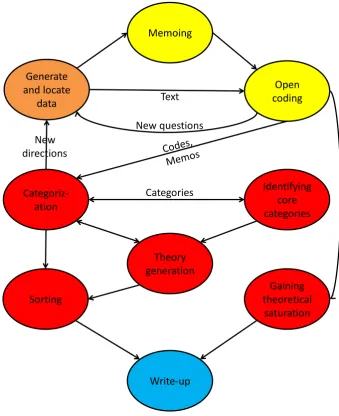
2.5
Grounded Theory Step-by-Step
Write-up Sorting
Generate and locate
data
Categoriz-ation
Open coding
New directions
New questions Text Memoing
Identifying core categories
Gaining theoretical
saturation Theory
[image:25.595.142.482.77.494.2]generation Categories
Figure 1: Grounded Theory process
Table 1 describes each technique in more detail, as follows:
Table 1: The steps in Grounded Theory
Technique Description
Open coding We scan each text line-by-line, highlighting points of interest. We then ‘code’ each to represent specific concepts. We chose the
codes to be similar across documents, so that a given code
represents the same concept throughout the research.
about how the terms may be interrelated. We write these in
separate texts called memos.
In doing this, we are open to new ideas and concepts that may
change and affect our future gathering of data. For example, if
we see concepts emerging, we may explore these in more detail
in future interviews.
Categorisation Gradually, as we assign codes, we will naturally see them appear in groups of related concepts. We name these groups
‘categories’.
Identifying core categories
In traditional Glassarian research, the aim is to find a single
overarching Core Category: the one which covers the most
interesting features in the data. Researchers are encouraged to
look for categories that cover as much of the variation in the data
as possible.
However in this research, we are looking for not one category,
but a number of concepts which can be identified and named
separately; we use the validity criteria for a Core Category to
identify each such concept.
Gaining
Theoretical
Saturation
The data gathering is considered complete when further data
received does not lead to significant new concepts. This is
termed ‘theoretical saturation’.
Theory generation In building a theory, we are looking for relations between
concepts and categories that explain the relations between
concepts and categories.
Sorting To provide a coherent output, we need a narrative. Strauss in particular talks a good deal about the literary aspects of the
narrative, in particular ‘grab’, the relevance to the reader [4]. The
Write-up Here we write up the narrative as a coherent report. We use extensive anonymised quotations from the data sources to
provide rigour, and use illustrations and where appropriate to
convey the information clearly.
2.6
The Use of Literature Surveys
Hoda et al. [54] recommends using existing literature in a different way from other forms
of research. Grounded Theory has a major concern about being biased by existing
thinking. So GT’s original recommendation was to leave any literature survey until after
the main bulk of coding and ideas generation [3]. Hoda et al. disagree with this, pointing
out that literature surveys are often needed due to academic pressures and the need for the
researcher to be up to speed with the subject terminology. They therefore recommend a
short literature survey to begin with, and a longer one once the majority of data has been
coded. The longer survey may itself contribute to the coding and memo generation.
However we have not seen a suggestion that written papers are coded with the same level
of detail that is given to other research data.
Others suggest a similar approach: Allan [6] used a literature survey in advance of GT
work to identify if there were compelling theories already in existence.
We have therefore taken the approach of an initial literature survey to learn nomenclature
and avoid `reinventing the wheel'. A final, post-research survey added further detail in the
context of the discoveries from our interviews. In writing the thesis, we combined the
results of both surveys in chapters 3 and 4.
2.7
Incorporating Appreciative Inquiry
A further important question is how to structure the interviews to get the most helpful
results. Our major concern in discussing security with experts was the danger of a litany
of complaints and major problems they had seen. Much security literature, especially of
the ‘black hat’ variety, amounts to this. We wanted instead to avoid the details of
they reflect on their answers to questions. In this research we did not need to change the
participants (though we believe the reflection involved with answering our questions was
beneficial, and in two cases the interviewees followed up with emails that said as much).
Instead we want to find the means to help change people like the interviewees or those they work with in future – programmers whom we help to learn app security – and so the Appreciative Inquiry method offers a valuable contribution.
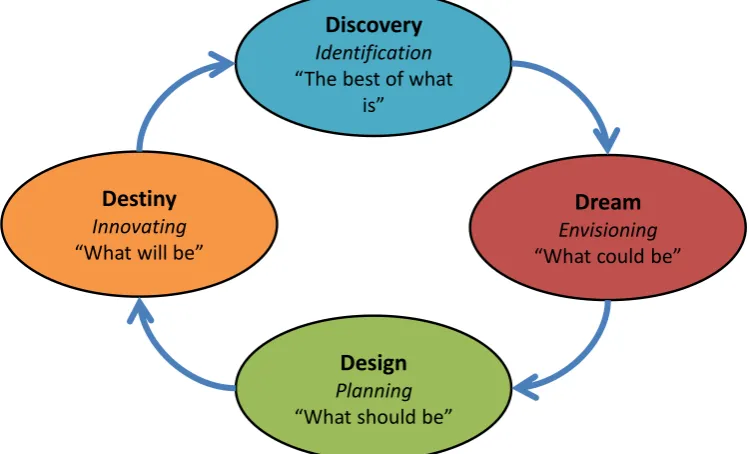
The full Appreciative Inquiry method [28] involves a cycle of four processes, as shown
below.
Discovery
Identification “The best of what
is”
Design
Planning “What should be”
Destiny
Innovating “What will be”
Dream
[image:28.595.130.505.263.490.2]Envisioning “What could be”
Figure 2: Appreciative Inquiry
The Discovery Phase typically concentrates on the positive aspects of the current
situation, encouraging participants to visualise what has worked, and what is now
working – hence the name ‘Appreciative’. The Dream Phase also stresses the positive,
with participants working to establish a shared vision of the future. The Design and
Destiny phases then continue to produce a plan for future change that has buy-in from the
participants.
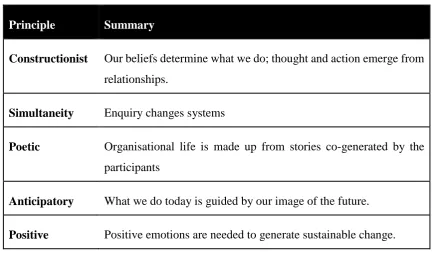
Governing the use of the four phases is a set of five principles, which we may summarise
Table 2: Principles of Appreciative Inquiry
Principle Summary
Constructionist Our beliefs determine what we do; thought and action emerge from relationships.
Simultaneity Enquiry changes systems
Poetic Organisational life is made up from stories co-generated by the participants
Anticipatory What we do today is guided by our image of the future.
Positive Positive emotions are needed to generate sustainable change.
Appreciative Inquiry has been effective in creating organisational change in a large
variety of different organisations [27]. To use it as a research tool requires some changes
that are explored in detail by Reed [89]. In this research, however, we are using aspects of
only the first two phases. Each interview concentrated on Discovery: “What do you do
and have you done in the past that was successful and Dream: “What would you like to see in an ideal world?”
2.8
Research Design
Our main data collection was via semi-structured interviews with software development
specialists. We chose these opportunistically, mainly through their introductions from
former colleagues of the researcher.
It is important to distinguish between the experts interviewed (‘interviewees’) and the
subjects being discussed (‘programmers’). The experts chosen were not at all typical of
app developers; some were not developers at all, and all had more experience working
with software projects than the developer average of six years [118]. However the
interviews suggest that between them the chosen interviewees had worked with a typical
range of programmers.
theory. More important is, of course, whether this achieved ‘theoretical saturation’; we
shall revisit this question in section 8.5. We started with an initial ‘pacing interview’,
analysed that and used the results to direct future interviews.
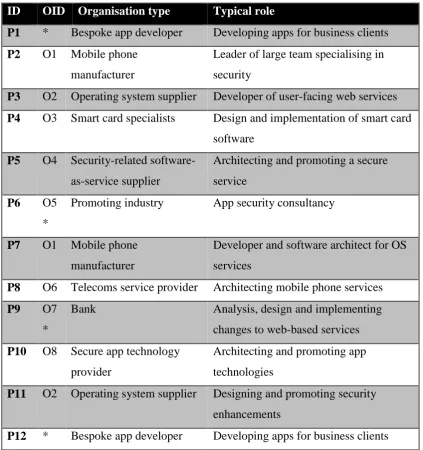
Table 3 below gives an overview of the experts interviewed. For each, we have given an
indication of the nature of the companies they are currently involved with and their
typical role. In two cases we interviewed a second person in a different role in the same
organisation, so the table shows ‘organisation IDs’ (OID). Some were contractors
working for more than one organisation; these are shown with an asterisk in the OID
column and for them the table gives the organisation for which they are currently doing
[image:30.595.106.530.310.761.2]the most work.
Table 3: The experts interviewed
ID OID Organisation type Typical role
P1 * Bespoke app developer Developing apps for business clients
P2 O1 Mobile phone
manufacturer
Leader of large team specialising in
security
P3 O2 Operating system supplier Developer of user-facing web services
P4 O3 Smart card specialists Design and implementation of smart card software
P5 O4 Security-related software-as-service supplier
Architecting and promoting a secure
service
P6 O5 *
Promoting industry App security consultancy
P7 O1 Mobile phone
manufacturer
Developer and software architect for OS
services
P8 O6 Telecoms service provider Architecting mobile phone services
P9 O7 *
Bank Analysis, design and implementing
changes to web-based services
P10 O8 Secure app technology provider
Architecting and promoting app
technologies
All had more than 30 years’ experience in software development, excepting P7 who has around 20 years. All but P1 had at least 5 years’ experience working with secure software
development. Regrettably in terms of diversity but typically of their roles in this industry
[29], all were male.
2.9
About the Author
Constructivist Grounded Theory is a relativist approach, as discussed in section 2.2. It
considers the researcher to be part of the system being analysed. This section, therefore,
introduces the author as a context for the findings.
Charles Weir has experience of over 30 years in commercial software development. He
has worked as a programmer within a large company; as a consultant training and
assisting in a large and varied number of projects; and more recently has run a software
development company for 15 years producing innovative bespoke software for mobile
phones.
A constant theme for his work over the last 25 years has been finding ways to improve
software development. This led to early work on software testing in the 1980s,
involvement in the patterns movement in the 1990s including the authorship of a book
[78], and the introduction of agile development techniques in both his own company and
others.
In the last few years he has led projects implementing payments and mobile ticketing on
mobile phones. Like most applications software developers he had not previously been
involved in software security, and had indeed avoided such projects because of the
perceived commercial risk. The learning process for software security proved painful,
which is what motivated this research.
The research itself led to some surprises for him. Particular was the finding that most app
developers had no interest in security (section 5.1). This was because he had always been
in a situation where it was obvious that unless he got app security right there would be
bad consequences. Specifically, his company was developing apps for a
telecommunications giant, subject to very stringent and tightly worded contracts. If they
resulting cost of future Professional Indemnity Insurance would probably destroy the
company and put everyone out of work. In short, he was scared of the implications, and
put a good deal of effort into ensuring they took a professional and responsible approach
to app security.
Even so, he appreciated that although he knew about that threat, his fellow programmers
would not have realised it if he had not pointed it out. After all, the contractual
obligations and chain of future consequences were not part of their daily programming
job, and many of them would not have been aware of them. Therefore, though he
personally was very concerned when he first started developing apps that had a security
requirement, it required communication to extend that concern to his colleagues.
The second surprise was the wide range of applicability of app security and privacy
questions. To him, one of the first things in a new project was to identify the
non-functional requirements. Before he started the research he had mentally divided apps (and
indeed software generally) into those with security requirements and those without. For
the ones without, he had believed that issues like security and privacy were generally not
of interest to app developers. In the course of this research, he learned from discussions
with academic professionals and security consultants that any apps that hold keys or
passwords, use HTTPs to communicate, hold personal information, send emails, or even
just read or write the file system, are subject to implied security and privacy
requirements. The finding that most of the developers involved in programming such
apps do not appreciate the issues is very concerning.
2.10
Introduction to the Interviewees
We shall be working with these interviewees for the rest of this thesis, so it is worth
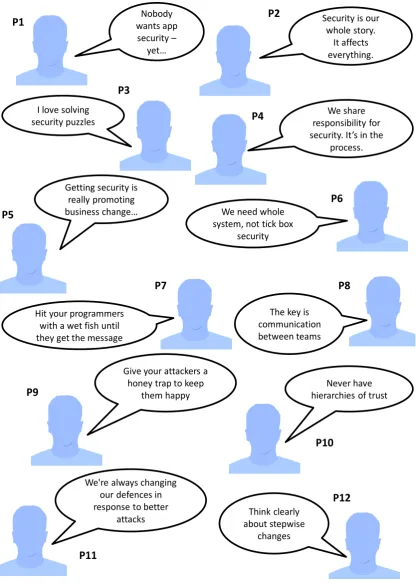
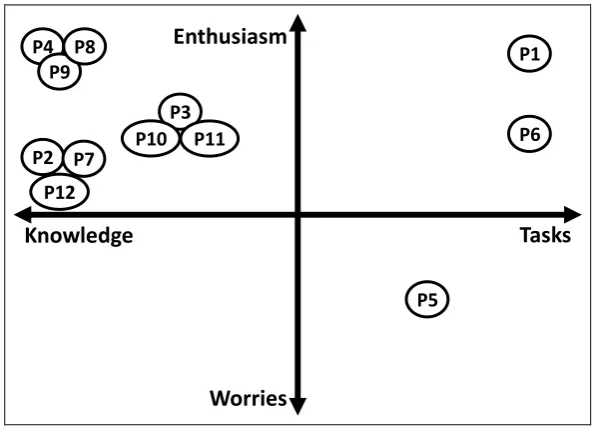
providing a more personal introduction. The illustrations in Figure 3 introduce each more
Nobody wants app
security – yet…
Security is our whole story.
It affects everything.
We share responsibility for security. It’s in the
process. I love solving
security puzzles
Getting security is really promoting business change… P1 P5 P4 P3 P2
Hit your programmers with a wet fish until they get the message
We need whole system, not tick box
security
The key is communication between teams
Give your attackers a honey trap to keep
them happy
Never have hierarchies of trust
We're always changing our defences in response to better
attacks about stepwise Think clearly
[image:33.595.109.526.72.659.2]changes P11 P10 P9 P8 P7 P6 P12
2.11
Introduction to the Organisations
All of the interviewees had one organisation for which they were predominantly working.
In some cases this organisation was probably their only significant recent experience (P2,
P3, P7, P11); others work sometimes or regularly with a variety of other organisations. In
the case of the contractors (P1, P12) their relationship with their main organisation was
for a set period, typically months. The others had been in their current roles for at least
two years.
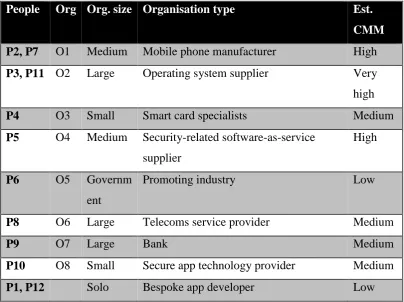
Table 4 shows the organisations involved. It shows an indication of the organisation size
(small for less than 10 staff, medium for less than 1000, large for greater than 1000, or government for a government department), and a subjective estimate of the organisation’s position on a ‘secure software capability maturity model’, such as ISO/IEC 21827:2008
[56]. The organisations varied enormously, from global giants (O1) to companies with
less than a dozen (O3, O8). In the case of solo programmers and smaller companies, we
found the interviewees’ work generally involved relationships with much larger
[image:34.595.114.519.437.739.2]organisations too.
Table 4: The organisations represented
People Org Org. size Organisation type Est. CMM
P2, P7 O1 Medium Mobile phone manufacturer High
P3, P11 O2 Large Operating system supplier Very high
P4 O3 Small Smart card specialists Medium
P5 O4 Medium Security-related software-as-service supplier
High
P6 O5 Governm
ent
Promoting industry Low
P8 O6 Large Telecoms service provider Medium
P9 O7 Large Bank Medium
P10 O8 Small Secure app technology provider Medium
2.12
The Interviews
Figure 4 shows the questions used as a basis for the interviews. The questions are
designed to be open ended, to encourage the interviewee to cover topics from their own
points of view. Drawing on Appreciative Inquiry, they focus on the positive, on things
that have worked and on techniques that help to achieve positive outcomes.
Interview Schedule: Better Approaches to Secure User-facing Software
Introduction – establish context
Please could you tell me something of your own background?
What is your current role, and what do you find yourself doing day-to-day? How did you first get involved with developing secure software?
Exploration
Can you think of a particular triumph in your work? How did you achieve the security aspects of that?
Please could you give examples of a secure system that has gone well? Or not
gone well and been fixed?
How did you initially learn about adding security to software development? How do you learn more now?
What aspects of your team (your work) made them particularly good at secure
software?
What is the most successful technique you have found?
What advantages are there in the development of the app end (browser or
mobile) over the server end?
Clarification
You mentioned [specific technique]. Can you tell me a little more about that?
In many cases interviewees covered answers to later questions in the responses to earlier
ones, or even before any questions were asked. The clarification questions were not
appropriate to all the interviews, so were sometimes omitted. In all cases except P7 the
discussion around the questions took at least an hour and in some cases (P4, P5, P8 and
P9) more than two hours.
2.13
Analysis of the Interviews
Some of the interview questions related to the experts’ analysis of how to achieve secure
app development; others to their own history and ways of learning about secure app
development. Thus we can distinguish two forms of information from the interviews:
information about how the app security experts had achieved their expertise and kept
themselves updated, and information they had about best learning approaches for those
working with them. Since most of the interview content was about this second topic,
treating the interviewees as peers to be consulted rather than subjects to be analysed, in
this thesis we refer to those involved as ‘interviewees’ or ‘experts’.
In this thesis we quote extensively from the interviews. To convey correctly the context
and protect the confidentiality of the interviewees, we have amended the quotations
appropriately: names are changed; square brackets show additions and replacements;
3
Existing Research on App
Programmers and Security
This chapter examines the literature around the main topic of the thesis: what techniques
and ideas will appeal to development teams and lead to them developing more secure app
software. Thus it considers work on programmer motivation, learning and improvement.
3.1
Two Types of Literature
Recall the overall research question for this thesis:
RQ1 What techniques and ideas will appeal to development teams and lead to them developing more secure app software?
We found in researching literature that the existing work on the subject falls into two
different categories: there is literature about programmers, and there is literature for programmers. We realised we need to analyse the two types of literature differently. In
3.2
Focus of Existing Research
As discussed in section 1.1, existing research on the security of software development
focuses on three aspects:
Programmer motivation,
How do programmers learn, and What do programmers need to learn?
The following sections explore each in turn. Throughout this section, we evaluate each
work in terms of the impact and relevance it may have on the research questions we
identified in section 1.2. In line with our pragmatic approach to the research, we comment
on each only in respect of its relevance to those questions.
Clearly while app development has its own environments and cultures, many of the
problems are similar to those in other domains, especially Web UI development, and
desktop application development, and to a lesser extent server development. We have
found literature about programmer motivation relevant only to programmers in general,
and similarly much of the work on how programmers learn is general. There is more
work available specific to app developers on what they need to learn.
Two closely related domains are Web UI software development and workstation software
development. Certainly the study of software security for Web UIs is more mature, and
there has been a good deal of work on specific kinds of security issue, such as cross-site
scripting, that apply to that area. However that is not helpful to this research. On the more
general issues of how to get development teams to deliver better software, we have found
almost no research specific to Web UI or workstation software.
3.3
Programmer Motivation
This and the next section explore writings related to the research question:
RQ2 What motivated the experts themselves to learn software security; how did they do so; and how do they continue to learn?
cited is about motivation to do the job of programming, rather than motivation to change behaviour. There is an implicit assumption that a well-motivated programmer will do a ‘good’ job. Tom DeMarco’s popular book on the subject, ‘Peopleware’ [33], makes the
same assumption.
In this work, we are interested in what makes a well-motivated developer choose a new
form of behaviour: learning about software security.
What Beecham et al.’s survey does in particular is to establish the kinds of things that
motivate programmers. Specifically, they identified that professional programmers tend
to be motivated most by:
Problem solving,
Working to benefit others, and Technical challenge.
Interestingly, a fear of failure is not among the list of motivators. So the classic security
motivation of ‘a terrible thing might happen’ will not tend to have much impact in
encouraging programmers to learn about security. This agrees with the findings of Xie et
al. [112], whose survey interviewed programmers to investigate why they believed they
made security errors; they found a consistent tendency to treat security as ‘someone else’s problem’. Though the results are limited in scope to highly experienced developers in US
companies, it seems reasonable to conclude that the conclusions may apply more widely.
We can conclude that to inspire programmers to become adept at software security will
require emphasis on the benefits to others and the technical challenge of the problems
involved.
3.4
How Do Programmers Learn?
There is relatively little literature on how programmers learn, whether about novices or
professional programmers. Johnson and Senges [59] studied how programmers learned to
function in a complicated organisation, Google. They concluded that the majority of
programmer learning there was peer learning, facilitated by strong corporate standards
Process Improvement (SPI). So, for example, a wide-ranging quantitative study by Dyba
[36] examines learning as one aspect of SPI; it differentiates Exploitation, the dissemination of existing knowledge, from Exploration, the gaining of new knowledge; it concludes that both have a positive effect on productivity but does not explore
mechanisms.
A little-known work by Enes and Conradi [40] used interviews to discover how
professionals, including programmers, acquire their expert knowledge. It concludes that
the preferred learning mechanisms are all informal ones: especially on-the job training
and personal interaction. It also highlights, as an important factor, professional pride in
having ‘expert areas’ of competence. Unfortunately for our purposes, the results include
only a very small sample of programmers (4) in a limited area (Trondheim).
Murphy-Hill et al. explored how developers find new software tools [72]; the research
was more wide-ranging and included both an initial survey and a larger scale, 79
participant, diary-based survey. They concluded the event is relatively rare, and happens
more through joint working than recommendations, though the only solution proposed
was to create a tool recommendation website. Proksch et al. used an extensive and
carefully analysed literature survey to explore such a recommendation site in detail [85];
the result reads as a requirements specification. So far there is little evidence of such
systems being trialled in practice.
In the context of learning about software security, a particularly important finding is that
of Conradi and Dyba [26]. Based on interviews with 21 development team members in 5
Norwegian companies, they analysed carefully the effectiveness of written routines on
software process improvement. They identified that programmers have difficulty with
learning from the output of process improvers, and particularly with learning from formal
written routines. As a result, developers tend to avoid such approaches:
Developers are rather sceptical at using written routines, while quality and technical managers are taking this for granted. This is an explosive combination. (Conradi and Dyba [26])
This suggests an ‘impedance mismatch’ between those who write instructions and
anecdotal evidence and personal experience of the authors tends to confirm the finding in
respect of UK and US developers. We can speculate that security experts tend to think in
terms of complete lists of issues and ways to break software; developers think in terms of
simplest ways to create desired functionality.
Thus though one might expect the most effective approach to teaching security to be a
prescriptive set of instructions to programmers what to do, a ‘Secure Development Lifecycle’ such as those promoted by Microsoft [69] and others, in practice those do not appeal to developers. This conforms to the author’s own experience; he has never
encountered an app development team voluntarily adopting a process of that kind. This
means that for app developers we need to find a more lightweight, less prescriptive
approach.
A different approach to teaching programmers was the ‘patterns’ movement, discussed in
more detail in section 4.2. Yskout et al. tested experimentally the effect of using security
patterns in server design; though the paper states there was no benefit, in fact the results
suggest a benefit but were statistically inconclusive [116].
Recently several teams have investigated how app developers learn security. Balebako et
al. interviewed a dozen app developers in small to medium sized US companies, and
surveyed over 200 US app developers to find out their approach to security and privacy
issues. The survey was carefully constructed to avoid bias, and concluded that most
developers approach these issues using web search, or by consulting peers [10].
Interestingly they also found that security and privacy behaviours were only weakly
correlated.
A survey by Acar et al. [2] also concluded through a survey of nearly 300 successful app
developers worldwide that they learned security through web search and peers. They went
on to use a well-crafted practical experiment with over 50 Android developers to evaluate
the effectiveness of the different ways of learning app security; this produced the
surprising result that programmers using digital books achieved better security than those
using web search.
Two projects, by Xie et al. and Nguyen et al., have developed IDE-based tools to teach
al.’s project is now finished and Nguyen’s has not yet reached the stage where its
effectiveness can be tested. Others, such as Near and Jackson, and Lerch et al. [65,76],
have code analysis tools to detect security defects; these work but provide only limited
feedback to developers. So far we are not aware of any literature analysing the
effectiveness of such approaches.
3.5
What Do Programmers Need to Learn?
In exploring the next research question,
RQ3 What are the most effective techniques to deliver app security?
we may be able to establish what kinds of learning are required from looking at the
security issues found in the past work of programmers.
Enck’s ‘Study of Android Application Security’ [39] used binary code analysis of a large
number of free Android applications. This approach is limited to the kinds of error that
can be found with such analysis. Thus they found misuse of APIs, such as using
cryptographic APIs in ways that reduced the security provided by the cryptography; and
they found access to privacy-sensitive APIs, such as APIs that gave personal information
about the user. They could not find errors such as insecure storage of credentials (in
publicly accessible files, for example) or misuse of insecure network connections (such as
using HTTP where HTTPS was needed). Fahl’s analysis of Android SSL insecurity [42] used a similar approach to analyse apps’ use of secure web connections; again they are
limited to detecting inappropriate use of SSL APIs, which they found in 8% of apps.
Certainly we can conclude from both papers that developers need to be mindful of careful
API usage.
A recent paper by Nadi et al. [74] uses surveys of programmers and of their comments on
discussion pages to examine the reasons why developers had issues using these SSL
APIs. They were asking developers who had had trouble, which for our purposes might
be regarded as sample bias. Unsurprisingly the conclusion could best be summarised as
‘because the APIs are difficult to use’, with the recommended solution being to document
them or to wrap them with libraries or code generation tools; it appears from this paper
Vidas et al.’s paper ‘All Your Droid Are Belong To Us’ [105] takes a different approach,
and examines attacks on Android phones. This is not in the context of app security, but
rather in the context of the whole phone, where apps are seen as potential malware and
the solutions are in terms of OS improvements. Acar et al.’s recent literature survey of
Android app security [1] provides a comprehensive view of the state of the art,
concluding that improvements to APIs and the use of web technologies are helping;
however they do not otherwise address the expertise of developers.
The openness of Android encourages such studies, but iOS gave rise to a smaller number
of similar evaluations such as that of Dai Zovi [31]. Unfortunately for our purposes this
reads more as a summary of the security facilities provided by Apple rather than an
4
Learning Resources for
Programmers
This chapter continues the literature survey by examining learning resources available to
programmers. It explores three different movements that have led to the creation of such
literature: the security patterns movement, the practitioners’ movement and black hat
literature. It then considers other resources available: web-based static sites and video. It
uses rankings to indicate which are most used by developers.
4.1
Introduction
Our final research question in section 1.2 asked:
RQ4 How should we effectively introduce security to app development teams?
To address this we need resources to help programmers to learn. Whereas chapter 3
explores research on how programmers learn; this chapter looks at the resources available
on good practice that may appeal to and benefit programmers.
We identified several categories of such resource as follows:
1. Static literature such as books, e-books and papers;
To evaluate the resources, we need to consider what attributes we need from them. Since
we are looking for learning tools, academic validity though relevant must be matched
against considerations such as ease of access, readability, approachability and didactic
approach. For example, academic papers that are not freely available on the web are
unlikely to be widely used by non-academic programmers, as are books that are out of
print. Similarly books that sacrifice readability for academic rigour or completeness may
be forced on students doing academic courses, but are unlikely to be widely read by
developers if they have the choice of more readable alternatives.
There are many excellent books describing the theory and practice of software security,
such as Gollman’s ‘Computer Security’ [49], Pfleeger ‘Security in Computing’ [82], Schneier ‘Secrets and Lies’ [93] and Anderson ‘Security Engineering’ [7] ; these work at
a level that is not helpful as anything but background reference for a software developer.
Surprisingly few books are targeted at software engineers. Three separate approaches
appear to have led to such material: the security patterns approach, the security
practitioners’ approach, and the black hat approach. We explore each of these in the
following sections.
4.2
Security Patterns
Security patterns are a development from the software design patterns movement first
brought into prominence with the ‘Design Patterns’ book [46], a very popular book with
programmers. This was in turn built on the architectural patterns work by Christopher
Alexander [5]. An important feature of patterns is that they divide up a problem domain
and provide multiple positive solutions. A series of patterns may provide a variety of
competing solutions for the same problem, and the patterns will provide information
(‘forces’) to help practitioners decide which one to use. ‘Design Patterns’ describes a set
of ways to structure object-oriented code, mainly to achieve good partitioning between
components. The term ‘Security patterns’ extended this idea to mean ‘Design patterns associated with software security’.
The security patterns literature shows strong signs of its position as the meeting of two
cultures. The patterns movement authors emphasise the positive aspects of their work