EXPERIMENTAL AND THEORETICAL DEVELOPMENTS IN EXTENDED X-RAY ABSORPTION FINE STRUCTURE (EXAFS) SPECTROSCOPY
Thesis by John James Boland
In Partial Fulfillment of the Requirements for the Degree of
Doctor of Philosophy
California Institute of Technology Pasadena, California
1985
i i
i i i
ACKNOWLEDGEMENTS
I have enjoyed my stay at Caltech and I would like to take this opportunity to thank those who made i t such a pleasant experience. To my thesis advisor, Dr. John D. Baldeschwieler, I owe a great debt of gratitude for his support and encouragement throughout my years at Caltech. John has given me an insight into the worlds of science and business which I will take with me through life. I would also like to thank the members of the JDB group with whom I have worked with over the years. In particular, I would like to thank Dr. Folim G. Halaka who worked closely with me on the EXAFS project. Thanks is also due to our secretary Susan Shaar who typed many boring manuscripts and also to the staffs of the electronics and machine shops for their assistance in times of difficulty.
iv
ABSTRACT
To obtain accurate information from a structural tool i t is necessary to have an understanding of the physical principles which govern the interaction between the probe and the sample under investigation. In this thesis a detailed study of the physical basis for Extended X-ray Absorption Fine Structure (EXAFS) spectroscopy is presented. A single scattering formalism of EXAFS is introduced which allows a rigorous treatment of the central atom potential. A final state interaction formalism of EXAFS is also discussed. Multiple scattering processes are shown to be significant for systems of certain geometries. The standard single scattering EXAFS analysis produces erroneous results if the data contain a large multiple scattering contribution. The effect of thermal vibrations on such multiple scattering paths is also discussed. From symmetry considerations it is shown that only certain normal modes contribute to the Debye-Waller factor for a particular scattering path. Furthermore, changes in the scattering angles induced by thermal vibrations produces additional EXAFS components called modification factors. These factors are shown to be small for most systems.
v
CHAPTER I:
CHAPTER II:
vi
TABLE OF CONTENTS
Acknowledgments •••••••••••..••••.••••.. i i
Abstract
. . .
.
. . . .
. .
.
. .
.
iv Table of Contents . . . . vi List of Illustrations and Figures •••••• ix Introduction to Extended X-ray AbsorptionFine Structure (EXAFS) Spectroscopy •••• References
...
Theory of Extended X-ray Absorption Fine Structure: Single and MultipleScattering Formalisms
1 7
Introduction ••••.••••••••••••••••.•...• 8 The General Formalism
. .
.
. .
.
.
. .
. . .
. .
.
10 The Single Scattering Formalism •••••••• 13 The Multiple Scattering Formalism •••••• 19 Results and Discussion • • • • • • • • • • • • • • • • . 26Appendix A 33
Appendix B 34
References
.
.
. . . .
.
. . .
.
. . .
. .
. . .
.
. .
36 CHAPTER III: Theory of Extended X-ray AbsorptionFine Structure: Final State Interaction Formalism
Introduction •••••••••••••••.••••••••••• 51 Final State Interactions • • • • • . . • • • • • • • • 52 The Jost Function Formalism .•..••••.••• 55 The EXAFS Regime ••••••••••••••••••••••• 60 Analytical Properties of the Jost
vii TABLE OF CONTENTS (continued) CHAPTER IV:
CHAPTER V:
CHAPTER VI:
The Effect of Thermal Vibrations on Extended X-ray Absorption Fine
Structure: Debye-Waller Factors
Introduction ••••••••••••••••••••••••••• 69 The General Formalism •••••••••••••••••• 70 The EXAFS Problem •••••••••••••••••••••• 75 Application to Model Systems ••••••••••• 80 Discussion
References
. . .
.
. . .
.
.
. .
The Effect of Thermal Vibrations onExtended X-ray Absorption Fine Structure: Modification Factors
88
97
Introduction . . • . . . . 111
Formal Considerations •••••••.•.•...••.. 114 EXAFS Modification Factors ••••..•..•••• 121 Application to Model Systems ••••.•.•••• 128 Discussion
References
The Ca1tech Laboratory EXAFS Spectrometer
Introduction
General Description of the
133 146
162
Spectrometer •••••••.••••••••••••••..••. 164
X-ray Source 167
Monochromator System • • • • • • • • • • • . • • • . . . . 170 X-ray Detectors •••••••••••••••••••••••• 172 Spectrometer Performance . . • • . . . • • . • • • 173
Conclusions . . . . 176
viii
TABLE OF CONTENTS (continued)
CHAPTER VII: Data Analysis in Extended X-ray Absorption Fine Structure: Determination of the Back-ground Absorption and the Threshold Energy
Introduction 185
Experimental Approach ••••..••••••.••••• 188 Computational Approach ••••••••••••••••. 191
Discussion 194
References
. . .
. .
. . . .
.
.
.
.
.
. .
. . .
. . . .
. .
.
200 CHAPTER IIX: Identification of Neighboring Atoms inExtended X-ray Absorption Fine Structure
CHAPTER IX:
Introduction ••••.•••••••••••••••••••••• 209 Physical Basis for the Atom
Identification Scheme •••••••••••••••••• 211 Data Acquisition and Analysis •••••••••• 211 Results and Discussion . • • • • • • • • • . • • • • • • 217
References • . • • . • • • • . • • • • • . . . • • • • • . . . • • . 228
Possibility of Bond-Length Determination in EXAFS without the Use of Model Compounds or Calculated Phases
Introduction . . . . 243
Physical Basis for the Method ....•••••• 244 Application to Model Systems ••.•••••.•. 249 Discussion
. . .
. . .
. .
. . .
. .
. . .
. . .
252ix
LIST OF ILLUSTRATIONS AND FIGURES CHAPTER II
Figure 1.
Figure 2.
Figure 3.
Figure 4. Figure 5.
Figure 6.
Figure 7.
Figure 8.
Figure 9.
Figure 10.
Schematic representatrion of the
final state potential •••••••••••••••• 39 Diagrammatic representation of the
first and second order terms in the
expansion of the full T operator ••••• 40 The vectors pertaining to the evaluation of the Green's function ••••.••••••••• 41
The three-atom system . . . • . . • • • • • • • • • •
The most significant scattering paths within the three-atom system •••••••.• Schematic representation of the terms
in the EXAFS expression for the
three-42
43
atom system • • • • • • • • • • • • • • • • • • • • • • • • • • 44
Calculated EXAFS spectra for the
Fe-0-Fe system . . . 45
Calculated EXAFS spectra for the
Cu-s-cu system . . . • • • . . • . . • . . . • . . • • . 46
Representative Fourier transforms of the bridged iron and copper systems ••••.• 47 Peak positions
transform as a bridging angle
in the Fourier function of
48 Figure 11. Relative amplitudes of the peaks in
the Fourier transform as a function
of bridging angle ••••••••.•••••••••.• 49 Figure 12. Amplitude enhancement and the error in
the distance from an analysis of a
~-oxo bridged iron system •••••••••••• 50 CHAPTER IV
Figure 1. The general three-atom system •••••••• 99 Figure 2. The five significant scattering paths
X
LIST OF ILLUSTRATIONS (continued)
Figure 3.
Figure 4.
Figure 5.
Figure 6.
Figure 7.
Figure 8.
Figure 9.
Table I
CHAPTER V
Figure 1.
Figure 2.
Figure 3.
Figure 4.
Figure 5.
Figure 6.
Figure 7.
Figure 8.
Schematic of the normal modes in a
three-atom system of
c
2v symmetry •••• 101Schematic of the normal modes in a
three-atom system of D~h symmetry •••. 102
The symmetrized normal coordinates 103
Calculated Debye-Waller factors as
a function of bridging angle .•••••••• 104
Normal frequencies for BeBr 2 as a
function of bridging angle ••••••••••• 106
Temperature dependence of the
Debye-Waller factor for BeBr 2 ••.••.••....•. 107 Modification in the EXAFS amplitude due
to Teo's assumption •••••••••••••••••• 109
Normal frequencies of vibration for a
series of linear systems ••••••••••••• 110
The general three-atom system 148
The five significant paths in a
system of three-atoms ••.••••••••••••• 149
Schematic of the normal modes of
vibration for a
c
2v system ... 150Schematic representation of the vectors which determine the change in angle due to the displacement of all of the
atoms in a given normal mode ••••••••• 151
Frequencies of the normal modes for
the Br 2
o
system •••••••••••••••••••••• 152Debye-Waller factors for the Br 2o
system • • • . • • • • • • • • • • • • • • • • • • • • • • • • • . . 153
The argument of the hyperbolic sine terms for the double and triple
scattering paths ••••••••••••••••••••• 154
Modulus o: the scattering amplitude
xi
LIST OF ILLUSTRATIONS (continued)
Figure 9. Phase of the scattering amplitude
for oxygen . . . . 156
Figure 10. Amplitude of the individual terms
which contribute to the EXAFS of
the Br 2
o
system at 10 K •••••••••••••• 158Figure 11. Amplitude of the individual terms
CHAPTER VI
Figure 1.
Figure 2.
Figure 3.
Figure 4.
Figure 5.
Figure 6.
CHAPTER VII
Figure 1.
Figure 2.
Figure 3.
Figure 4.
Figure 5.
Figure 6.
which contribute to the EXAFS of
the Br 2
o
system at 300 K ••••••••••••. 160Schematic of the laboratory EXAFS
spectrometer •••••••••••••••.•....•••. 179 A scaled drawing of the laboratory
spectrometer •••••••••••••.••..•...••. 180 The Johansson monochromator
configuration ••••••••••••••..•••..••. 181
Crystal bending apparatus with two
bending moments •••••••••••••••••••••• 182
Schematic of a parallel plate
ionization chamber . . • . . . • • . . . . 183
The copper Ka doublet • • • • • • • • • • • • • • • • 184
Spectral distribution of energies diffracted by the monochromator
at 9500 ev . . . . . . 202 Plot of the absorption as a function
of x-ray energy for a copper foil
Plot of the post-edge absorption as a function of the wavenumber of
203
the photoelectron . . . • . 204
Plot of the original EXAFS and the
calculated background •••••••••••••••• 205
Plot of the EXAFS as a function of
photoelectron wavenumber ••••••••••••• 206
Modulus of the Fourier transform for
xii
LIST OF ILLUSTRATIONS (continued)
Figure 7.
CHAPTER VI II
Figure 1.
Figure 2.
Figure 3.
Figure 4.
Figure 5.
Figure 6.
Figure 7.
Figure 8.
Table I
Table II
Table III
CHAPTER IX
Figure 1.
Table I
The background and the threshold energy determination using the
computational approach ••••••••••••••• 208
The scattering phases for carbon
and oxygen ••••••••••••••••••••••••••• 230
Determination of the threshold energy
for Co(acac} 3 •••••••••••••••••.•••••• 231
Isolated EXAFS spectra ••••••••••••••• 232
Modulus of the k3 weighted
Fourier transform ••••.•..•••••••••••. 234
Total phase from the first-shell peaks
of the Fourier transform .••••••••.••• 236
A comparison of the new windowing
method with earlier methods •••••••••• 237
The EXAFS and the Fourier transform
from the [Co(NH 3 } 6 ]Cl 3 complex ••••••• 238 Phase intercept for a coordination
shell made up of two kinds of atoms 239
The coefficients from the
least-squares fit to the total phase ••••••• 240
The coefficients from the least-squares fit to the total phase
for the amine complex • • • • • • • • . • • • • • • • 241
Calculated phase intercepts for
a two component system •••••••••..•... 242
Plot of the total phase and the
function g 1 (k) as a function of k • • • • 254 The parameters obtained from a
1
CHAPTER I
INTRODUCTION TO EXTENDED X-RAY ABSORPTION
FINE STRUCTURE (EXAFS) SPECTROSCOPY
The term extended x-ray absorption fine structure
(EXAFS) refers to the modulations in the x-ray absorption
coefficient which occur on the high energy side of an
absorption edge. The first experimental observation of
these oscillations was made by Fricke 1 and Hertz2 in 1920.
The observed structure was confined to the near edge
region3, howev€r, and thus could be readily explained by the
theory of Kossel. 4 As experimental measurements improved,
the structure was seen to extend many hundreds of electron
volts past the edge with an amplitude of approximately 10%
of the edge itself. Accordingly, a new description of this
phenomenon was required.
An explanation of the physical basis of the EXAFS
effect in condensed matter was first proposed by Kronig.s
In this case, the EXAFS was described in terms of a
modification of the final state photoelectron or Bloch wave
due to scattering at the boundary of the Brillouin zone.
Since this description depends explicitly on the periodicity
of the solid such an explanation became known as a long
range (LRO) theory of EXAFS. To explain the observation of
EXAFS in molecules Kronig also proposed6 a short range order
(SRO) theory, in which the final state photoelectron wave is
2
realized that the same basic physics could be used to explain the observation of EXAFS in both solids and molecules. Indeed, as late as 1963, there was still a great deal of confusion as to which theory was the most appropriate description of EXAFS. 7 A major source of this confusion was the lack of quantitative comparison between theory and experiment.
It is now generally accepted that, in most instances, a single scattering SRO theory is an adequate description of
EXAFS. The normalized oscillatory component of the
absorption coefficient above a K-edge may be expressed as: X(kl ,. z:ce.rjl2Nj1fj(k,lT)
I
sin(2krj + ej>j krj
(1.1.1) This equation describes the modification of the photoelectron wave, which originates from an absorbing atom which is situated at the origin, and is scattered by Nj neighboring atoms at a radial distance rj away. The amplitude of the EXAFS oscillations is dependent on the ability I fj(TI,k) I of these atoms to backscatter the photo-electron. Note that the EXAFS is expressed in terms of the photoelectron wavenumber k which is defined by k:[2m(hw-E
0 ) ]
1
1
2;h, where flw is the x-ray energy and E3
phase shift due to scattering off both the absorbing and
neighboring atoms. As suggested by Schmidt,9 a term to
account for thermal vibrations and static disorder should be
appended to Eq. (1.1.1). Furthermore, since electrons which
suffer inelastic losses may not contribute to the EXAFS, a
mean -free path damping term must also be included in Eq.
l 10
( . l . l ) .
The present interest in EXAFS began with the work of
sayers, Stern and Lytlell who realized that if Eq. (1.1.1)
is a valid description of the EXAFS, then it should be
possible to invert this expression to obtain the distances
rj. In particular, they showed that a Fourier transform of
Eq. ( l . l . l ) is a form of radial distribution function in which the absorbing atom is located at the origin.
Accordingly, there is a peak in the transform associated
with each shell of atoms surrounding the central atom.
These peaks do not occur at the true shell distances due to
the presence of the phase function 9j(k) in the argument of
each sine wave. Therefore, to obtain distance information
from EXAFS the k dependence of these phase functions must be
known. If in addition, coordination numbers are to be
determined, some information on the scattering amplitudes is
required, together with a knowledge of the Debye-Wallerand
inelastic damping factors. In practice, however, model
compoundsl2 and theoretical calculations 1 3 are used
extensively to extract structural information from EXAFS
4
The increased understanding of the physical basis of the EXAFS effect has been paralleled by a rapid development in the instrumentation used to measure EXAFS spectra. In particular, the advent of synchrotron radiation sources has provided a major impetus for the development of EXAFS as a structural too1. 14 Furthermore, high flux laboratory spectrometers, which utilize rotating anode sources and large crystal monochromators, are now available These advances allow high signal to noise EXAFS spectra to be obtained in an acceptable period of time.
In view of these developments, i t has been our objective to carefully re-examine the physical basis for the EXAFS effect. In Chapter II we have introduced a rigorous scattering formalism for EXAFS, which accounts for the presence of the central atom potential in a quantitative manner. The formalism also demonstrates the close relation-ship between EXAFS and the modulations observed in electron yield experiments. The contribution of multiple scattering processes to the observed EXAFS, which was neglected by earlier workers, is shown to be significant for systems of certain geometries • In such instances, the standard single scattering analysis methods are shown to be no longer valid. However, a careful study of such multiple scattering data should allow bond angles to be determined.
A formalism, which does not explicitly. involve a scattering
III. This
description of scheme allows
5
EXAFS in terms of the overlap between the initial and final states. At sufficiently high energies this description reduces to the standard EXAFS expression, Eq. (1.1.1). Unlike earlier theories, this formalism is valid over the complete energy range and may be used to describe both bound state transitions and shape resonances. Furthermore, the expression for the final state structure is an analytic function of k, and hence, may be used to calculate the damped or imaginary component of the photoelectron wave.
Since multiple scattering effects may contribute significantly to the EXAFS, the simple treatment of the thermal vibration given by Schmidtg is no longer valid. In Chapters IV and V of this thesis we discuss in detail the effects of thermal vibrations on EXAFS. The correlated motion of the atoms involved in the scattering process is explicitly calculated. The manner in which one should analyze such data is also discussed.
6
bond distances from EXAFS data without the use of model
7
References
1. H. Fricke, Phys. Rev. 16, 202 (1920).
2. G. Hertz, Zeit. f. Physik, 3, 19 (1920).
3. A.E. Lindh, Zeit. f. Physik, 6, 303 (1920).
4. W. Kossel, Zeit. f. Physik, 1, 119 (1920).
5. R.L. Kronig,
z.
Physik, 70, 317 (1931).6. R.L. Kronig,
z.
Physik, 75, 468 (1932).7. L.V. Azaroff, Rev. Mod. Phys. 35, 1012, (1963).
8. H. Peterson, Zeit. f. Physik, 80, 528 (1933).
9. V.V. Schmidt, Bull. Acad. Sci. USSR, Ser. Phys. 25, 998 (1961); 27, 392 (1963).
10. M. Sawada, Rep. Sci. Works Osaka Univ. 7, 1 (1959).
11. O.E. Sayers, E.A. Stern and F.W. Lytle, Phys. Rev. Lett. 27, 1204 (1971).
12. P.H. Citrin, P. Eisenberger and B.M. Kincaid, Phys. Rev. Lett. 36, 1346 (1976).
13. P.A. Lee and G. Beni, Phys. Rev. B 15, 2862 (1977).
14. B.M. Kincaid and P. Eisenberger, 1361 ( 1975).
8
CHAPTER II
THEORY OF EXTENDED ~-RAY ABSORPTION FINE STRUCTURE: SINGLE AND MULTIPLE SCATTERING FORMALISMS*
2.1 Introduction
Beginning with Kronig in 1932, a number of short range
order theoriesl-11 have been proposed to explain the
post-edge fine structure--the extended x-ray absorption fine structure or EXAFS--of the x-ray absorption edge (see reviews of this subject by Lee et ~.,12 Sternl3 and With the exception of Lee's recent worklo, all these studies suffer from difficulties in their treatment of the outgoing photoelectron wave, the scattering potential, or the central atom phase shift. Nevertheless, each study arrives at essentially the same expression for the oscillatory component of the K-edge x-ray absorption cross section:
x(k)"' IJ.-IJ.o =-
2,)e.
1)2 lf(rr,2k) I!J.o 1 kr1
xsin[2kr1 + 21i1(k) + ())(k)]. (2.1.1)
where the symbols have the following meanings: k=[2m(flw-E
9
The phase shift due to the central atom potential is 2
o
1 , and u (k) and u0 (k) represent the absorption coefficients in the presence and absence of neighboring atoms in the final state.In the case of polycrystalline samples, the geometric factor (e.rj)2, averages to a constant. Additional terms, to account for thermal effects 1 5 and losses due to inelastic scatteringS, may also be appended to Eq. (2.1.1)
HJ
scattering formalism. In fact , the form of the E XA F
s
expression assumed by Teo 2 8 is incorrect, since i t neglects a geometrical factor which does not average out in polycrystalline materials (see Section 2.5).In this chapter we discuss an approach which separates the single and multiple scattering contributions of the general problem, and develops computational methods applicable to both. A general three-atom formalism is developed and employed in the discussion of two physically significant model systems.
2.2 The General Formalism
The x-ray absorption cross section in the dipole and the one-electron approximations is given by:l6
(2.2.1)
where a is the hyperfine constant, w is the angular photon frequency, and N(w) is the density of final states for the photoelectron. The initial and final states of the system (i and f) are both eigenfunctions of an approximate unperturbed Hamiltonian H:
n
2 Ze2H - - - v2- - + v
- 2m r r (2.2.2)
11
the absorbing or central atom c. A schematic representation
of this final-state potential is shown in Fig. 1. The
potential energy between the atomic sites is assumed to be
constant and represents the zero of energy in the system.
In order to calculate the matrix element in Eq.
(2.2.1), i t is necessary to find the appropriate
eigenfunctions of H. At energies corresponding to bound
K-shell electrons (the only initial state considered here),
the potentials of the neighboring atoms may be ignored, and
the eigenfunction of the resulting Hamiltonian is the usual
hydrogenlike wavefunction:
(
z
)3/2
(rli)=rr"112
ao
exp(-Zr/a0) (2.2.3)Two factors influence the nature of the final state:
the potentials of the neighboring atoms and that due to the
central or absorbing atom. For photoelectrons of
sufficiently high energy (approximately three times the
plasma frequency 6 ), the attractive potential of the central
atom's nucleus, together with the influence of the other
bound electrons (though these are not explicitly considered
here), becomes negligible, and the Schrodinger equation
reduces to:
(2.2.4)
where H0 is the free-particle Hamiltonian. This equation
12
(2.2.5)
where <rlk> are the normalized eigenfunctions of H0 • We
shall use the minus form of Green's and T operators, so that
<rlk> corresponds to the outgoing asymptote of the
scattering process described by <r If>. The description of
the EXAFS phenomenon is thus expressed in terms of the state
of the photoelectron after the scattering process is
complete. Furthermore, this choice of asymptote most
clearly illustrates the close relationship between EXAFS and
the modulations observed in electron-yield type
experi-ments.29
The full T operator may now be expanded in terms of the
operators tj associated with the individual scattering
centers located at r=r·lB J
(2.2.6)
Note that successive scattering by the same potential is not
permitted.
Substitution of the first two terms of Eq. (2.2.6) into
the Eq. (2.2.5) yields an expression which may be
represented graphically as shown in Fig. 2. The first
diagram in this figure represents the simplest single
scattering case: a photoelectron ejected in the direction
i'j, and scattered in some direction R by the atomic
potential at r=rj. A similar interpretation applies to the
13
scattering processes in which the photoelectron is scattered successively by two atomic potentials.
In particular, the third and fourth diagrams in Fig. 2 represent processes for which the second scattering center is the absorbing atom potential. In such instances the scattering path length is identical with that in the corresponding single scattering process. Accordingly, such terms must also be considered within our single scattering theory. The term corresponding to secondary scattering by the absorber was first discussed by Lee 10 and allows a rigorous treatment of the effect of the central atom potential. The approach adopted, however, was not sufficiently general to be readily extended to multiple scattering problems.
2.3 The Single Scattering Formalism
The two single scattering terms of Eq. (2.2.6) may now be substituted into the matrix element in Eq. (2.2.1):
<J-
I
e.
r
I
i>
=
<k
I
e ·
r
I
i/
+
.l)k
I
tjG;e ·
r
I
i>
i+
L
(k It;G;t;G;e ·
r I i) ,(2.3.1)
J
where we have taken the complex conjugate of Eq. ( 2.2.5) and
*
have noted that t(z )=[t(z)]t.
The first matrix on the r:ight-hand side of Eq. (2.3.1) is responsible for the usual unperturbed photoelectric effect (i.e., for 110 ) , and is evaluated in Appendix A with
14
(kle·
rli>=M(k,Z)k·
e,
.
(z
)s'2
M(k, Z)
~
- (2 )'";(;:o
)3 .1T - + k2
ao
(2.3.2)
The remaining terms in Eq. (2.3.1) may be expanded in a complete set of states to obtain:
L
(kI
t;c~e
·
rI
i)J
=
L:f<k
I t;lrt><rtl c;lr>
e ·
r<rli> drdrtJ
(2.3.3)
and
L
(kI
t;c;t;c;e ·
r I i) =L
J<k
It; I r3)(rslc;
I
r2>J J
(2.3.4)
X (r21
t;
I
Yt)(rlI
c;
I
r)e.
r(rI
i) dr drt dr2 drs15
All that remains now is to evaluate matrix elements of the forms:
(r'IGolr>
and(r'lt;!r).
The configuration-space matrix element of the Green's operator are given by the corresponding free-particle Green's function:
e'•lr' -rl
(r'IGolr>=-
2~2
lr'-ri · (2.3.5)Note that
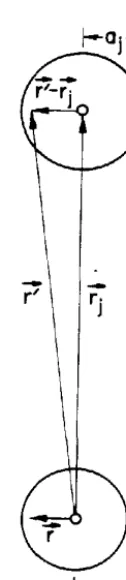
I
rI
in Eq. (2.3.5) is of the order of a0/Z or less while r' is restricted to a domain of radius aj around rj (see Fig. 3). Hence r'"" rj and
I
r'-rl may be expanded as:l9(2.3.6)
Therefore, the Green's function in Eq. (2.3.5) may be approximated by:
(r' I G
0
lr>
~
-2m"' rr" 2 ...!:_ r exp(ik1 • (r'- r)] ,
1
(2.3.7)
the direction of propagation of the photoelectron. The error in making this approximation, aj/rj, is small since the core electrons of the neighboring atoms are responsible for most of the scattering in the EXAFS energy regime.12
16
described in Appendix A, with the results:
(2.3.8)
L
(kI
t;c;t;c;e ·
rI
i) =L
m~~rr)
4
_;.M(k, Z)(e.
1)
J J rj
X (kIt~
I
k;)(k;I t;l
kJ) '
(2.3.9)where
k)
=-krj is the direction of propagation of the back-scattered photoelectron.We may now relate the matrix elements of tj<rj) to those of tj(O) which represent the identical scattering problem, but centered about the origin20
Since only elastic scattering events (i.e., lkl=lkjll are of interest, the matrix elements of tj(O) form an on-shell T matrix which may be expressed in terms of the scattering amplitude fj(9j):21
(2.3.11)
where cosej=R.Rj=R.rj.
17
(3. s) =L:M(k,
z).!.(e ·
1)fJ(eJ)J YJ (2.3.12)
xexp(ikrJ(1-cos81) ] ,
and
(3. 9) = LM(k, Z)
~
(e • 1)!1(rr)J
rJ
(2.3.13)X/0(7r-il1)exp(2ikrJ) ,
where cos(n-ej)=R.R1=-R.rj.
The complete matrix element in Eq. (2.3.1) is the sum of three terms corresponding to the unperturbed
photoelectric effect Eq. (2.3.2): simple scattering by the atom at r=rj Eq. (2.3.12); and secondary scattering by the absorbing atom Eq. (2.3.13):
a.(k) a:
I
(f-I
e ·
rI
i)1
2=
IM(k,Z)k· €+(3.12)+(3.13)12 •(2.3.14)
The above treatment describes the absorption of a single x-ray photon by an absorber-scatterer atom pair. In an EXAFS experiment, however, a large number of such events will occur and the ejected photoelectrons will be scattered into many different directions R. In order to compute the average cross section of such a macroscopic system, it is necessary to average over all such directions R in Eq.
18
(2.3.15)
=
/IM{k,
z)(k · e>
+ (3.12) +(3.13) 12~~·.
The four lowest order terms in rj in this spherical average
are evaluated in Appendix B with the results:
j2
Re[M*(k • e) X (3. 12))~~·
I
"<e·
~y =-jM
2L:
k~Im(exp(2ikr1)/1(rr) + /1(0)],
j2Re[M*(k·
e)x(3.13)]:•=-1Mj
2
~(e~k)
2
xrm{fexp(2ili1) -l]f/rr) exp(2ikr1)}.
(2.3.16)
(2.3.17)
(2.3.18)
(2.3.19)
Note that in summing the above expressions, the forward
scattering term fj(O) in Eq. (2.3.17) cancels with Eq.
19
macroscopic absorption coefficient ~=noa is proportional to
1
j.J. =naao:
tIM
12-L
IMI
2(e. r,)
2 krfJ (2.3.20)
x 1m
{t
1(7T) exp[2i(kr1 + 151)]} ,where n is the number density of absorbing atoms. By convention, the oscillatory component of the EXAFS is normalized to
~
0
•
23 Thus, the final expression for the single scattering EXAFS is obtained:x(k)= j.J.-j.l.p = -
k~-'
(e · r
1)2!f,(7T, k)I
j.l.p Tjx sin(2kr, + 2151 (k)
+
ib(k)] , (2.3.21)where fj(lf,k)=lfj(rr,k)l.exp[i<P{k)]. We must append, onto Eq. (2.3.21), a term which describes the effects of thermal vibrations, the Debye-Waller factor; and also an additional term which accounts for the finite mean-free path of the photoelectron in the bulk. These Debye-Waller factors are discussed at length in Chapters IV and
v.
2.4 The Multiple Scattering Formalism
20
scattering path length. In certain instances, however, the path length may be· comparable to that associated with observable single scattering channels, in which case the multiple scattering contribution will dominate due to the additional scattering amplitudes involved. In general, the important multiple scattering events involve only a small number of atoms in which scattering occurs in the near forward direction. In this work we shall limit our discussion to systems which contain three atoms, the formalism developed, however, may be readily extended to study more complicated systems.
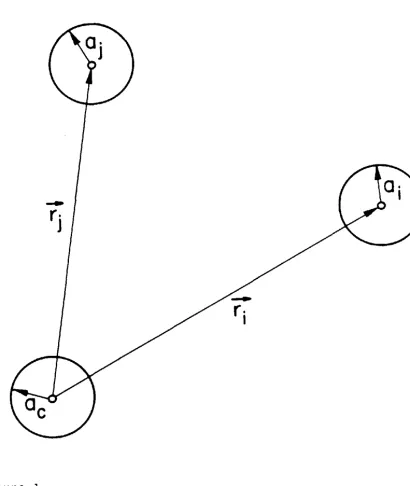
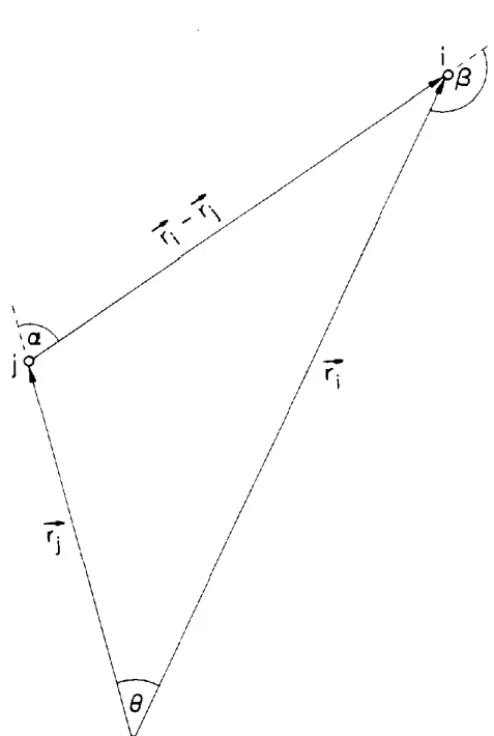
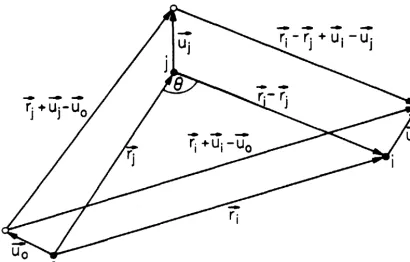
The three-atom system to be considered is shown in Fig. 4. Various scattering paths among these atoms are represented graphically in Fig. 5. Each path corresponds to a term in the expansion of the full Lippmann-Schwinger equation:
(2.4.1)
Low probability-amplitude processes involving long path lengths and/or large scattering angles have been omitted from Fig. 5, but may be treated in a manner similar to that discussed below.
The complete matrix element for the three-atom system, assuming the dipole approximation, may be written as:
(f-Ie.
rI
i) = (kI
e.
rI
i) +L
(kI
t~Goe.
rI
i) +L
(kI
t;c;t~Goe.
rI
i)21
+ (k
I
t;c;t;c;e ·
rI
i) + (kI
t;c~t;c;e·
rI
i) + (kI
t;c;t;c~t;c;e·
rI
i) (2.4.2)The first term in Eq. (2.4.2) corresponds to the unperturbed photoelectric effect, and the subsequent two terms correspond to the single-scattering contributions from atoms i and j. These terms have been treated in detail in the previous section and will not be discussed further here. The remaining terms in Eq. (2.4.2) involve scattering by both neighboring atoms. Of these, the fourth and fifth terms [those corresponding to diagrams (e) and (f) in Fig. 5] are identical by virtue of time reversal symmetry, as are those corresponding to diagrams (g) and (h). The multiple-scattering terms in Eq. (2.4.2) may thus be written as:
(2.4.3)
Each term in Eq. (2.4.3) may now be expanded in complete states and the resulting Green's functions evaluated in the manner described in Section 2.3, where
(r'IGalr>"='-2m rr,. ... 2 _!_exp[ikr 1 • (r'-r)], 1
{2.4.4)
Note that the vector r is localized about the origin, r' is restricted to a radius aj about and k·=kf'·.
22
one or the other of these atoms at the origin for the
purposes of the calculation.
Equation (2.4.3) may now be written as:
2M(k,Z)(e·
r,)
m2(2rr)'(klt•lk )(k lt•lk)r r 1i 4 1 11 tJ J J J I J
+ 2 M(k, Z)(e.
r,)
m3(2.rr) 6(k
I
t•l k' )(k'I
t•l k )(kI
t•l k > y r r Ji6 c I I I 1J I J J JI J I J (2.4.5)
where kij = k(ri-rjl/1 ri-rj
I
= -klj : kn=
kf'n=
-kh: n=i,jand M(k,Z) has been defined in Appendix A.
The matrix elements of t~(rnl associated with the
atomic potential at r=rn may be related to those of tg(o) as
described in Section 2.3.
<kIt; I k.>
=
exp[i(k,-kl ·
r .l<k 1 t~ 1 k.) . (2.4.6)Furthermore, these matrix elements may be expressed in
terms of their respective scattering amplitudes:
(2.4.7)
Substituting Eqs. (2.4.6) and
(2.4.7) into Eq. (2.4.5) and rearranging terms gives:
23
The ave~age x-~ay abso~ption c~oss section fo~ the
th~ee-atom system is p~opo~tional to the mat~ix element in Eq. (2.4.2) ave~aged ove~ all possible di~ections R of the photoelect~on:
]i <t-ie·
rji) 12 dn11=
]iM(k,Z)(e ·
k)
+L
M(k, z)(e · r.) t.<a.)
41T "~•,1 r.,
xexp(2ikr.(l-cosa.)] (2.4.9)
The fi~st th~ee te~ms in Eq. (2.4.2) were evaluated in
Section 2.3, and the results appear in the integ~and on the right-hand side of Eq. (2.4.9).
The methods ~equi~ed fo~ the evaluation of the integ~als in Eq. (2.4.9) have been developed in Appendix B. The results fo~ the lowest order terms in r are:
"'IMI2
(e·r)J
-
drl2 LJ Re{exp[ikr.(l-cosa.)]f.(B.)(e· kl}~
,. .. ,.,J r.,
24
(2.4.12)
(2.4.14)
25
Several cancellations occur in the summation of the terms in Eq. (2.4.9). The non-oscillatory term containing fn(O) in Eq. (2.4.11) cancels with the spherically averaged squared term lfn(O) 12 , by virtue of the optical theorem.
The second term in Eq. (2.4.13) is cancelled by the average of the single scattering cross term arising from atoms i and j. The corresponding term in Eq. (2.4.15) also cancels, but, in this instance, with the average cross terms from the scattering processes shown in diagrams (a) and (e) of Fig. 5.
The expression obtained upon summation of the remaining terms in Eqs. (2.4.10) to (2.4.16) is proportional to the absorption coefficient of the system, and may be normalized to ~
0
=1/3 IM(k,Z) 12 , to yield the expression for the EXAFS:26 processes.
In the case of polycrystalline materials an average over all possible polarization direction must be performed. The x-ray polarization directions in the dot products in Eq.
(2.4.17) may be spherically averaged, with the results:
(2.4.18)
2.5 Results and Discussion
A straightforward derivation of the basic EXAFS equation has been presented. The simplicity of our approach lies in the expansion of the scattering amplitudes of neighboring atoms about the origin. Accordingly, the phase factor reflecting the difference in path length between unperturbed photoemission and various scattering processes arises in a natural manner.
27
scattering processes. Such a sum is required due to the
indistinguishability of the individual events: the ejection
of a photoelectron in some direction R upon ionization is
completely indistinguishable from a process in which the
ejected electron scatters off an adjacent atom and is
subsequently scattered into the same direction K by the
central atom.
Within our formalism, the central atom phase shift
cancels in the interference terms since the direct and
scattered photoelectron waves are both outgoing in nature.
It is thus necessary to include the secondary scattering
term in order to retrieve this phase shift. In the
alternative form of the Lippmann-Schwinger equation [i.e.,
the use of <rlf+> in Eq. (2.2.5)], however, the term
corresponding to the scattered photoelectron is an incoming
wave, and no such cancellation occurs. In this latter
approach, <rlk> corresponds to the incoming asymptote of the
scattering process, and the phase does not expl ic i tl y occur
within the formalism.
An expression for the oscillatory component of the
absorption for the three-atom system has been given in Eq.
(2.4.17). The first term corresponds to the independent
single scattering events by atoms i and j. The second term
results from scattering from atoms i and j, and vica versa.
Note that this term retains a geometrical dependence even
for experiments involving polycrystalline samples [see Eq.
28
angle a is 90°. The expression assumed by earlier workers28 omits this geometrical factor and hence overestimates the contribution of this term to the total EXAFS. The neglection of this factor, however, greatly facilitates the analysis of multiple scattering data. The third term in Eq. (2.4.17) results from a more complex scattering path: the photoelectron scatters sequentially off of atoms j and i, and then off of atom j once again (where we have assumed that
I
r·I
J
<
The cancellation of terms which occurred in Eq. (2.4.9) is of particular significance, since it insures that each term in the EXAFS expression is dependent on the sum of the interatomic distances that it represents. These processes are shown diagrammatically in Fig. 6: the first term in Eq.
(2.4.17) corresponds to the sum of the diagrams 6(a) and 6(b), and the second and third terms correspond to diagrams 6(c) and 6(d), respectively. These diagrams are analogous to those of Fig. 5, but each is the spherically averaged sum of several of the latter diagrams. Note that no scattering is shown by the central atom, since the spherical average of Eq. (2.4.9) projects out the return path to the origin
(shown as a straight 1 ine in Fig. 6).
29
the binuclear complex u-oxo-bis [tetraphenylporphine-iron(III)] and similar compounds} and 2.3 ~ for the copper system. The scattering amplitudes were taken from the International Tables for X-Ray Crystallography, Vol. Iv,25 and the phase shift functions from the parametrizations of Lee et a1. 26 These scattering amplitudes were calculated using the Born approximation. While this is an over-simplification it does not, however, significantly affect the results presented below.
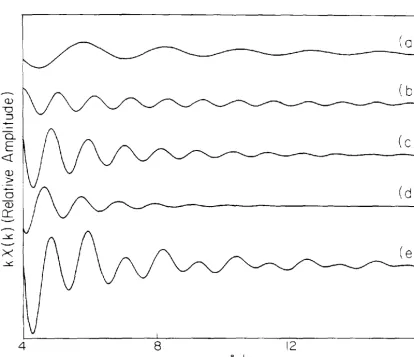
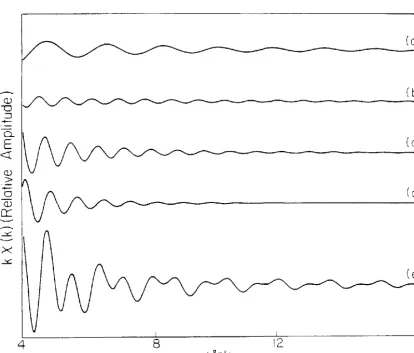
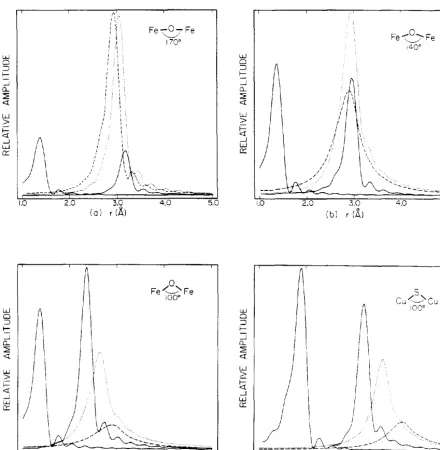
The calculated contribution of each term to the EXAFS at a particular value of the bridging angle (140°) are shown in Figs. 7 and 8. The relative amplitudes of the various terms may be seen from the Fourier transforms in Fig. 9. No corrections were made for damping at large r due to
inelastic scattering, but any such correction would affect the three terms involving the second-shell atom almost equally (the first shell peak would be relatively higher, however). Compared to the second-shell single scattering term, multiple scattering is significant in systems in which the ratio of the scattering power of the first- and second-shell-nearest neighbors is large or when the three atoms are nearly colinear.
30
manner, and hence the effect on the Fourier transform is
similar to that of a Debye-Waller factor.
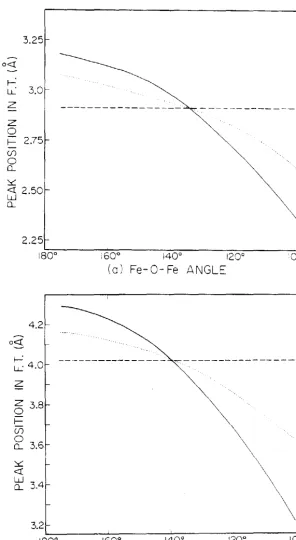
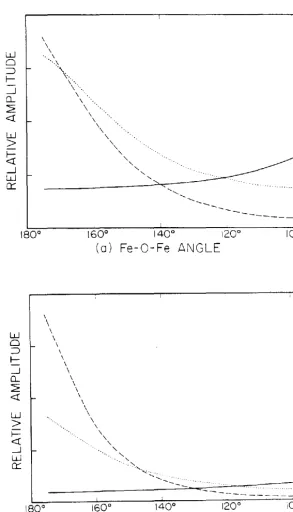
Figures 10 and 11 show the variations of the peak
positions and amplitudes in the Fourier transform as a
function of bridging angle for both the iron and copper
systems. Note that, in Figs. lO(a) and lO(b), there is a
point where the additional phase shift incurred during the
multiple scattering process is exactly offset by the
additional path length involved in that process. This
occurs because, the effect of the scattering phases in the
sine argument of Eq. (2.4.17), is to shift the peaks in
the Fourier transform to smaller distances, since these
phase are largely monotonically decreasing functions of k.26
The condition required for this crossover point is
given by:
l r · l - l r · l - l r · - r·l
= ilr("'·)1 J 1 J "'J (2.5.1)
where 6r(¢jl is the effective displacement of the peak in
the Fourier transform due to the phase of the scattering
amplitude associated with atom j. This quantity, 6r(tl>j), is
independent of the geometry of the system (provided the
phase of the scattering amplitude is independent of the
scattering angle, as discussed earliel:}, and varies over a
limited range for different atom types j. The primary
dependence of the crossover point is on the bond lengths; as
the distances in the system increase, the crossover point
occurs at larger bridging angles.
31
the multiple scattering terms are of particular importance.
As shown in Fig. 11 these terms have large amplitudes at
high angles and, above the crossover point, the
corresponding peaks in the Fourier transform occur at
smaller distance values than does the second-shell single
scattering peak. In general, the three peaks involving the
second-shell atom will be close enough to overlap in the
transform. The presence of the multiple scattering
components will then cause an apparent increase in the
amplitude of the second-nearest neighbor peak in addition to
shifting this peak to anomalously small distances.
Therefore, if an analysis of EXAFS data which contain a
significant multiple scattering contribution, is attempted
using single scattering theory, one would overestimate the
coordination number of the second-shell and underestimate
the distance to that shell. Recently, Co et al.2 7 studied a
series of ~-oxo bridged iron system~ using single scattering
theory, their results are shown in Fig. 12. For a linear
system, Co et al. predict an error in the coordination
number of a factor of four and an underestimation of the
distance by 0.2 ~. These results may be compared directly
with the calculations for the ~-oxo system shown in Figs.
lO(a) and ll(a). Since, when the system is linear, both
multiple scattering components have comparable amplitudes
and clearly dominate the second-shell EXAFS, the position of
the composite second-shell peak may be taken as the average
32
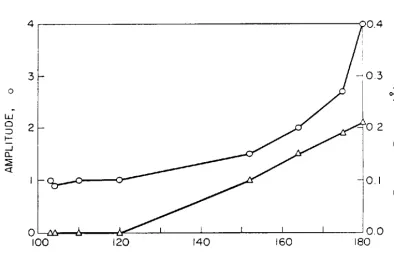
Therefore, we calculate from Fig. lO(a) that the average of the multiple scattering peak positions is smaller than that of second-shell single scattering peak by an amount of 0.21
~. This is in excellent agreement with the observations of Co et al. A similar analysis when applied to the peak amplitudes in Fig. ll(a) yields an overestimation of the second-shell coordination number by a factor of eight. The calculated peak amplitudes are clearly inconsistent with the experimental observations. 27 The origin of this discrepancy is the omission of both the Debye-Waller and inelastic damping factors from the theoretical calculations. Chapters IV and V present a detailed study of the nature of the Debye-Waller factors in EXAFS.
At bridging angles which are smaller than the crossover po in t, the compos i t e second-she 11 . peak w i 11 occur at a larger distance than the second-shell single scattering peak; the effect is less significant, however, since the multiple scattering components have smaller amplitudes in this reg ion.
33
Appendix A
We wish to evaluate the integral
I
=
J<kI
r)e .
r(rI
i) dr (Al)which appears in Eq. (3. 1); where (r I k)
=
(217)"312 x exp(ik · r) and (r I i) = (1T)"112(~a0
)312 exp(-Zr/ a0).Expanding Eq. (Al) in terms of spherical harmonics,
I may be rewritten as
xexp(-Zr/a0)r2dr
jY~'"(Q-)Y
1
(Qr)(r·
e)dP.,,(A2) where dr
=
r2 dr dQr.The angular integration in Eq. (A2) may be performed using the additional theorem for spherical harmonics:
I2
L
f
y~'"(Q~)Y'J'(P.r)(r.
e) dQ,I '"
.,. I 1
= 4;r;;=]; { ;
Yf(P..)Y~'"(n~>jYr'<nr)Y'I'(P.r)dP.,
1
= 4
;r
L
Yf(n.)fi''"(Q~)o,,,o
1
,
1
=r(k ·
e) • (A3), ... 1
Substituting Eq. (A3) into Eq. (A2), the expression for I becomes
I=(21T)-3'24(1T)112(-i)(!}'z<k. e)
x
J-
j1(kr) exp(-Zr/a0)yl dr ,0
(A4)
where it(kr)
=
(kr)"2 sin kr- (kr)"1 cos kr. Making use of the definite integral,1•
x" e·•n dx=
nl iJ.-!n•!> , Re iJ. > 00
the radial integration in Eq. (A4) may be performed to obtain
I=M(k,Z)(k· e),
34
Appendix B
In this appendix, the angular integrals in Eq. (3.16), (3.17), and (3.19) are evaluated.
The first of these corresponds to 1.1. 0, the hypothetical absorption coefficient in the absence of neighboring atoms. Placing
e
along the z direction:l.l.oa: :rrfiMI
2k·
ednk
Lwlzj
2 •'I
<12
=~ cos BksmBkdBkd<b•=3 M k,Z) . The following result is required in Eq. (3. 1 7):
l=J<e·
k)exp(-ik· r1lf(B
1)'!!&.
(e ·
k)
may be expanded in spherical harmonics, and settingr
1 along thez
axis, the azimuthal integrationyields them =0 component in the expansion. Hence:
1=-(e·
t)iJd(cosB,)cosB.exp(-ik· r1)f(B1) , (B1) where cosB.=(k· ;). exp(-ik· r1) and/(81) may be ex-pressed in terms of Legendre polynomials:exp(-ik· r1)=L(21+1)(-i)1j1(kr1)P1(cos8k), (B2)
I
f(B 1)
=
L f,.
1.P,.(cos Bk) , (B3)and
(B4)
Substituting the above into Eq. (B1) yields
~ ~ ~ t . I (
47T )1/2 ( 47T )I/2(47T)I/2
l=fr,(e·r1h(21+1)(-t) 21+ 1 21,+1
3
xj,(kr1
)J,.j
Y~.(nk)Yf(n.)Y~(n,)d(-
cosek), (B5) wherean,
=d(- cos8,)d¢_, andg•
(d¢,/2rr) = 1. The angular integral in Eq. (B5) may be evaluated using the properties of Clebsch- Gordan coefficients24:J
Y~. (nk)Y~(n,)Y~(n,)
lin.[(21'+1) 3 ]
1
'2 1 , 2
35
where ll-l'l :Sl:Sil+l'l and l+l'+1=2n (nan inte-ger). The summation over land l' may be replaced by a single sum that has two components l ± 1. Using the explicit forms of the Clebsch-Gordan coefficients above,
1
=~
(e •7)!
1[<-
i)1•1(;t+
\)il•1(kr1)+(-1)1-1~l~
1
)il-t(krJ)] =~(e•
r
1
}fr[:2l!1 jl-t(kr1)( l+l). (
)~(
•)1-1- 21+1 Jl•tkrJ~ -z . (B6)
Using the asymptotic form of the spherical Bessel func-tion:
I= (e ·
r
1) -1-h[exp(ikr;lf(lT)+
exp(- ikr,)f(O)] .kr, .
Hence:
J2 Re[M"'(k •
e)(3. 12)]~~/
=
-l:
\M \2k~
(e · ri
Im(exp(2ikr1)/(1T)+
f(O)] .J J
The third angular integration necessary is given in Eq. (3.19):
(B7) where fc( 1T -
e
J)= (-
1)1/c(e ,)
=
L
i: (-
~)
1 (41T)[exp(2i1i1) -l]i'';'(nk)Y ;"'(nr1 ) •I m•·l 2zk
Expanding (e •
k)
in spherical harmonics:1
(e·
~>=
41TL:
Yf'(n.)Y~,..(nk).
3 m" •-1
Equation (B7) may be written:
I 1
I'= (-
~)
1
41T
L L L
[exp(2i1i1) - l]Y ;"'(nr,)Yj' (n,)2zk 3 1 m•-1 m'•-1
due to the orthogonality of spherical harmonics. Hence:
!2
Re[M"'(k,
Z)(e • k)(3. 13)]~a
"<e · r )
2} =-
\M
j2 L.. / Im{[exp(2i1i1) -1]/1(1T) exp(2ikr1) ,36
References
*This chapter is based on: J.J. Boland, S.E. Crane and J.D. Baldeschwieler, J. Chern. Phys. 77, 142 (1982).
1. R. de L. Kronig,
z.
Phys. 80, 317 (1931); 75, 191(1932); 75, 468 (1932).
2. H. Petersen,
z.
Phys. 80, 258 (1933).3. A.I. Kosterev, Zh. Eksp. Teor. Fiz. 19, 413 (1949).
4. T. Shiraiwa, T. Ishimura and M. Sawada, J. Phys. Soc. Jpn. 138, 848 (1958).
5. D.E. Sayers, F.W. Lytle and E.A. Stern, Adv. x-ray Anal. 13, 248 ( 1970) •
6. W.L. Schaich, Phys. Rev. 8 8, 4028 (1973).
7. E.A. Stern, Phys. Rev. 8 10, 3027 (1974).
8 • C • A. As h 1 e y and S • Do n i a c h , Ph y s • Rev • 8 11 , 1 2 7 9 ( 1975).
9. P.A. Lee and J.B. Pendry, Phys. Rev. 8 11, 2795 (1975).
10. P.A. Lee, Phys. Rev. 8 13, 5261 (1976).
11. P.A. Lee and G. Beni, Phys. Rev. 8 15, 2862 (1977).
37
13. · E.A. Stern, Contemp. Phys. 18, 289 (1978).
14. L.V. Azaroff, Rev. Mod. Phys. 35, 1012 (1963).
15. V.V. Schmidt, Bull. Acad. Sci. USSR, Ser. Phys. 25, 988 (1961).
16. E. Merzbacher, Quantum Mechanics, 2nd ed. (Wiley, New York) p. 466.
17. J.R. Taylor, Scattering Theory (Wiley, New York, 1972)
p. 16 8.
18. P. Lloyd and P.V. Smith, Adv. Phys. 21, 69 (1972).
19. L.I. Schiff, Quantum Mechanics, 3rd ed. (McGraw-Hill, New York, 1968) 1 p. 338.
20. M. Lax, Rev. Mod. Phys.
23,
287 (1951).21. J.R. Taylor, Ref. 19, p. 43.
22. J.R. Taylor, Ref. 19, p. 54.
23. B.K. Teo, P.A. Lee, A.L. Simons, P. Eisenberger and B.M. Kincaid, J. Am. C.hem. Soc. 99, 3854 (1977).
24. E. Merzbacher, Ref. 16, p. 396.
38
26. P.A. Lee, B.K. Teo and A.L. Simons, J. Am. Chern. Soc. 99, 3856 (1977).
27. M.S. Co, W.A. Hendrickson, K.O. Hodgson and S. Doniach
J. Am. Chern. Soc. 105, 1144 (1983).
28. B.K. Teo, J. Am. Chern. Soc. 103, 3990 (1981).
29. J.J. Barton,
c.c.
Bahr,z.
Hussain,s.w.
Robey, J.G. Tobin, L.E. Klebanoff and D.A. Shirley, Phys. Rev.39
Figure 1.
[image:51.547.57.467.113.599.2]i I I I i I
0
'·)
0'·a r
~
r
+ +\L
+ + + +~
c c c c
t~ G+
I 0
t7
G;
t•G•t:'"G+ c 0 J 0 (G~tT G~ t• G+ t•G+ I 0 J 0 t•G+ t•G+ J 0 I 0Figure 2.
Diagrammatic representation of the first and second order terms in the expansion of the full T operator in Eq.
(2.2.6). The scattering paths shown are those that occur in
41
Figure 3.
[image:53.547.212.275.172.463.2]Figure 4.
42
I
I
I
A
I
I
[image:54.548.140.387.103.471.2]43
lo I lo
'·,Q
r
...-\
lc
lo)
1\L
c)
~
c
a, r;
G;
lbl t~ G~ C) t+G+ c 0 t• G+J 0
'd, t;s;ttG;
e: t•G• t• G•
' I 0 J :J
I I I I I
'9
Q
Q
c'@
c£
f' t• G ... t'• G+ t•G• t•G• t; G"" t• G+ f+G+ t•G• + + + + + + t• G• tG+ r:G• t:'"G•
!g) hi 1, t
1 G0 t1 G0 t1 G0 I
I j Q I Q C 0 I 0 I 0 C Q j Q I Q C O J O I O J O
Figure 5.
The most significant scattering paths within the three-atom system. The operators shown with eaco diagram represent the corresponding term in the exp9nsion of the full T operator in the Lippmann-Schwinger equation [Eq.
44
I~
c•
(a )
(b)
(c)
(d)
Figure 6.
Schematic representation of the terms in the EXAFS
expression for the three-atom system. Note that no
scattering is shown by the central atom since the spherical
Q_
E
<!Q)
>
0
Q)
0:::
><
..OS:.
45
I
-
- - - -
(a)
( b) I
( c )
(d)
(e)
4
8
12
16Figure 7.
[image:57.557.51.466.109.466.2]46
(a)
(b) Q.)
-o
:J
-
Q_E
(c)<r
Q.) >
-
0 (d)Q.)
a:
.cL
><
.cL4
Figure 8.
[image:58.547.47.461.107.460.2]47 Fe-0-Fe Fe~':-Fe "--'' 170" 140°
w.J w.J
0 0
::J ::J
I- f:::
...J ...J
\
~\'
CL CL
:::E ::;;:
<l: <l:
w.J w
> >
I- ~
<l:
/ I \\
...J
j\
...Jw w
a: a: I' \
' ' '
\
1.0 2.0 3.0 4.0 5.0 1.0 2.0 3.0 4.0 5.0
(a) r (A) (b) r (A,)
~
0FeC'Fe
/s,
100" Cu '-___./ Cu
w.J
1\
w II 100c
0 0
::J
I
I
::JI
I
f:::
I-...J
I
I
...JI
I
CL CL
::;;:
I
I
:::E<l:
I
I<l:
I
I .
w.J
I
I
wI
I .
2: >
I-I
~
i=
I
I
I
<(
/
<l:...J
...J w
w
I
0:: II .
a:
I
)
I
/ .·
\~n//',,
__
I /
~
//~
.. ,.. ... ...,-'""""""'"""''""''' ... ~---- ' . .,.,.,_~
1.0 4.0 5.0 1.0 2.0 3.0 4.J 5.0
(c)
:d:'
r (A)Figure 9.
[image:59.548.35.475.72.521.2]o<t:
r-:
LL z
z
0
f---U) 0
o_
:::.::::
i'5
2.50 o_o<(
z
z
0
f---U) 0
o_
:::.::::
<(
w
0..
Figure 10.
48
i60° 140° 120° (a) Fe-0-Fe ANGL::
160° 140° 120° (b) Cu-S-Cu ANGLE
Peak positions in the Fourier transform as a function of bridging angle. The solid curve is the second shell single scattering, while the dotted and dashed curves are the double and triple scattering pathways. (a) Fe system.
[image:60.553.84.380.50.590.2]