Original citation:
Kerr, Andrew, Hartlieb, Matthias, Sanchis, Joaquin, Smith, Timothy and Perrier, Sébastien.
(2017) Complex multiblock bottle-brush architectures by RAFT polymerization. Chemical
Communications, 53 (87). pp. 11901-11904.
Permanent WRAP URL:
http://wrap.warwick.ac.uk/97729
Copyright and reuse:
The Warwick Research Archive Portal (WRAP) makes this work of researchers of the
University of Warwick available open access under the following conditions. Copyright ©
and all moral rights to the version of the paper presented here belong to the individual
author(s) and/or other copyright owners. To the extent reasonable and practicable the
material made available in WRAP has been checked for eligibility before being made
available.
Copies of full items can be used for personal research or study, educational, or not-for-profit
purposes without prior permission or charge. Provided that the authors, title and full
bibliographic details are credited, a hyperlink and/or URL is given for the original metadata
page and the content is not changed in any way.
Publisher statement:
First published by Royal Society of Chemistry 2017
http://dx.doi.org/10.1039/C7CC07241D
A note on versions:
The version presented here may differ from the published version or, version of record, if
you wish to cite this item you are advised to consult the publisher’s version. Please see the
‘permanent WRAP url’ above for details on accessing the published version and note that
access may require a subscription.
Journal Name
COMMUNICATION
Received 00th January 20xx, Accepted 00th January 20xx
DOI: 10.1039/x0xx00000x
www.rsc.org/
Complex multiblock bottle-brush architectures by RAFT
polymerization
Andrew Kerra, Matthias Hartlieba, Joaquin Sanchisb, Timothy Smithc and Sebastien Perriera,b,d *
We describe the synthesis of unique multiblock-brush polymer architectures. The reversible addition fragmentation chain transfer (RAFT) polymerization R-group grafting from approach with addition of CTA ‘shuttle’ is used to access densely grafted bottle-brush copolymers. The combination of this technique with RAFT acrylamide multiblock methodology allows access to block copolymer grafted side chains that can be synthesised in a one-pot process. Instalment of non-functional linker blocks into the backbone gives microstructure control to yield multi-segmented bottle-brushes. The use of both approaches is demonstrated to access highly complex brush macromolecules, incorporating multiblocks along both the polymer backbone and grafted side chains.
The high versatility and functionality of biological macromolecules such as proteins or DNA is ultimately a result of the perfect control over the sequence of these polymers.1 As
synthetic chemists strive to mimic this feature, the control of monomer sequence in synthetic polymers has attracted increasing interest as the arrangement of monomer units has a fundamental effect on the properties and functions of the material.2 The development of new methodologies to yield
sequence controlled polymers or multiblock copolymers has brought the scientific community closer to mimicking the high structural control nature demonstrates. In particular controlled radical polymerisation techniques have proven to be versatile and effective for the synthesis of precise polymeric architectures such as star3, 4, graft5, 6 and multiblocks7-9. An
interesting example of biomacromolecules with a complex structure required for their functionality are mucins, which exhibit a bottle-brush architecture and are responsible for a range of tasks including lubrication.10-13 Recent work has
attempted to mimic these biological structures with synthetic molecular bottle-brushes, often by incorporation of linear ungrafted blocks which possess surface affinity.14, 15
Bottle-brush copolymers can be produced in a variety of ways, however, the grafting from technique is arguably the most versatile, as high molecular weight backbones and high grafting densities can be accessed.16, 17 Besides Atom-Transfer Radical
Polymerization (ATRP),18 which was used extensively to
synthesize bottle brushes,16, 19 Reversible
Addition-Fragmentation chain-Transfer (RAFT)5, 20, 21 or combinations
thereof can be utilized.22-24 Typically low conversions are
required in a radical polymerization process to achieve bottle brushes with low dispersities.18 However, the recently
introduced ‘Shuttle CTA approach’ by Müller and coworkers offers an elegant solution to this problem.25, 26 Adapting this
approach and combining it with a RAFT based multiblock approached as demonstrated by our group, 27 highly complex
macromolecule can be synthesized within short reaction times.28 While motifs like penta-block backbone bottle-brushes
are described in literature,29 they are still far away from the
structural complexity of mucins.30 The aim of this study is to
increase the structural complexity accessible for synthetic bottle brushes, and control their microstructure precisely.
Scheme 1: Schematic representation of the synthetic approach for RAFT bottle-brush polymers.
To use a RAFT-based grafting from approach, a polymeric backbone decorated with CTA groups was synthesized using poly(N-hydroxyethylacrylamide) (pHEAm) as precursor a methyl ester protected CTA to prevent side reactions such as brush-brush coupling (Scheme 1). The high kp of acrylamide
monomers in aqueous conditions allows for high molecular
a. Department of Chemistry, The University of Warwick, Coventry CV4 7AL, U.K.;
b. Faculty of Pharmacy and Pharmaceutical Sciences, Monash University, VIC 3052,
Australia;
COMMUNICATION Journal Name
weights while also maintaining low dispersities and a high livingness.28 Using azoinitiator VA-044 at 44°C, pHEAm with
target DPs of 50, 100 and 500 were synthesised, obtaining narrow dispersities Đ < 1.20 (Table S1).
Subsequently, the pendant alcohol groups were esterified using 2-(((butylthio)carbonothioyl)thio) propanoic acid (PABTC) via EDC / DMAP coupling, which was confirmed via 1H NMR (Figure
S5) and elemental.
The grafting from step was initially performed with
4-N,acryloylmorpholine (NAM) as monomer, which due to its fast
polymerization rate, allows for low initiator concentration while also attaining near quantitative monomer conversions.28 Kinetic
experiments were conducted comparing the chain shuttle approach with a conventional grafting-from methodology (Figure S6). Without shuttle CTA (PABTC), high dispersities and a high Mw shoulder were observable above 70% conversion, whereas with addition of PABTC the GPC trace remains monomodal even at full conversion (Figure S1). The Mn of the
linear shuttle CTA derived chains matches closely the targeted side chain molecular weight and should represent the composition of the grafted side chains on the brush.25
Cleavage of the pNAM side chains from the bottle-brush backbone by hydrolysis of the ester linkage and subsequent SEC analysis can be used to estimate the initiation efficiency of the PolyCTA (Figure S2).31 The cleaved side chains gave Mn SEC =
10,400 g mol-1, which is very close to the Mn theo. =
10,180 g mol-1, suggesting close to quantitative initiation
efficiency.
In order to visualize the synthesized polymers, AFM of bottle brushes with a backbone DP of 100 and 500, respectively was measured. N-butyl acrylate (nBA) with a DP of 50 was used as side chain to enable sample preparation. While short DP100 backbones appeared as globular species, the longer DP500 gave the desired cylindrical structures with a length of approximately 125nm matching expectations (Figure S3, S4).
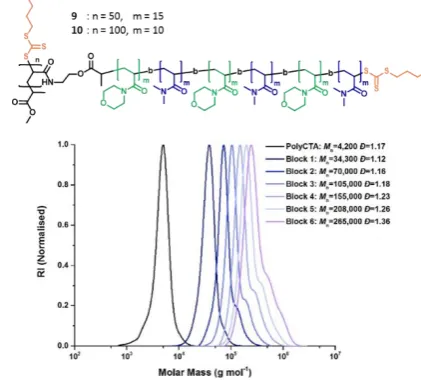
Figure 1: Schematic representation of the grafting from polymerisation to generate a hexablock side chain bottle-brush polymers 9, 10 and SEC traces of the chain extensions to yield polymer 9.
To test the limits of the technique we attempted to continually chain extend the grafts of the bottle-brush to high monomer
conversions until a loss of control was observed. The monomers NAM and dimethylacrylamide (DMA) were polymerised in alternating order targeting a short DP of 15 per block (Figure 1) to rapidly synthesise a hexablock brush structure within 12 h reaction time.
By SEC analysis the molecular weight distribution of the bottle-brush shifts to higher molecular weight after each chain extension with an increasingly large high molecular weight shoulder which is attributed to accumulating bimolecular terminations (Figure SC). Despite this shoulder, the overall dispersity remains reasonably low with Đ=1.36 after 6 chain extensions, at which point no further blocks were attempted due to the substantial bimodality of the GPC trace. No low molecular weight tail as observed in linear multiblock synthesis, caused by the formation of dead chains is present which is attributed to the unlikeliness of termination of all grafted chains in one bottle-brush molecule.
The shuttle CTA derived chains can clearly be seen to chain extend for each block to form a hexablock linear polymer in solution (Figure S9). It would be expected to represent the same composition as the grafted chains of the bottle-brush, and indeed, after removal of the linear polymer by fractional precipitation and subsequent hydrolysis of the bottle-brush side chains an identical molecular weight distribution to that of the linear polymer is observed (Figure S8). Attempting the same procedure in the absence of the shuttle CTA rapidly leads to loss of the control of the polymerisation (Figure S11).
A similar hexablock side chain off a longer DP100 PolyCTA backbone was synthesised with excellent control by SEC analysis (final block Đ=1.18). To aid control of the polymerisation the amount of shuttle CTA was increased to 2 equivalents per grafted CTA, which lowered the cross coupling between brushes but leads to substantial linear polymer side products (Figure S9B). Additionally, the procedure was attempted with a DP500 backbone, however significant brush coupling was observed even with the addition 4 equivalents of shuttle CTA (Figure S12), therefore this approach is limited to relatively short backbones.
Using the same general synthetic approach as described for multi-block side chains, we further attempted to use the multiblock methodology to obtain alternative backbones that could yield novel polymeric architectures. It is known that the grafting density has a large impact on bottle-brush properties such as the stiffness of the backbone32 and the chain
entanglement molecular weight.33 By using a multiblock
approach, sequences of ungrafted linker chains can be placed periodically throughout the brush backbone, which alters the flexibility of the overall macromolecule while the grafting density in brush subunits remains high. This architecture could be considered similar to that of naturally occurring mucins, a key component of mucus responsible for its gel-like properties. NAM was used as the non-functional monomer as its polymerisation behaviour in block copolymerisations is well established.27 A backbone consisting of alternating block of
[image:3.595.56.267.493.683.2]By using a di-functional CTA linked by the ‘R’ group, two blocks can be polymerised simultaneously in an outwards symmetric fashion, which enabled a nonablock polymer to be quickly synthesised in just 5 steps (11, Mn = 34,700, Đ = 1.18) (Figure
S15, S10) followed by functionalization of pHEMA blocks using PABTC. The subsequent grafting from step using NAM as the side chain monomer proceeded as expected with excellent control by the addition of 0.5 equivalents shuttle CTA (Figure S13) to yield a bottle-brush of Mn = 181,000 and Đ = 1.29
[image:4.595.44.286.202.443.2]containing 5 separate brush segments connected by 4 DP20 pNAM blocks.
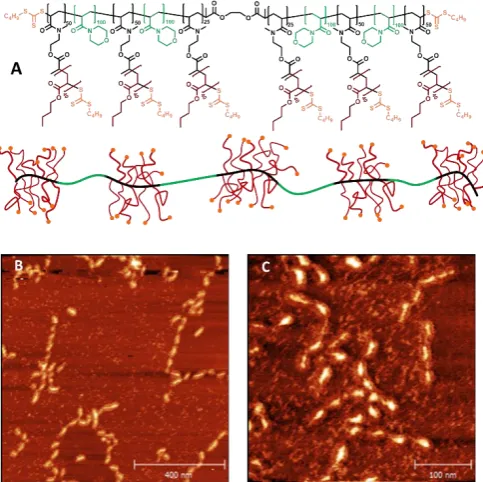
Figure 2: A – Structure of the multiblock backbone brush copolymer 14. B and C - AFM images of the sample prepared by dipping a mica substrate into a dilute polymer solution.
While successful, the use of short DP20 block linkers may have minimal effect on the flexibility of the brush in comparison to the bulky bottle-brush segments. The linker blocks would also only be several nanometres in size, which make it challenging to image the macromolecule and identify individual brush regions by AFM. Therefore, a nonablock with larger DP100 pNAM linkers and DP50 brush segments was synthesised using the same procedure but with an alternative alcohol functional acrylamide monomer (SI) polymerizing at faster rate (Figure S14). A backbone with a total DP of 650 was accessed (13, Mn =
84,700 and Đ = 1.25), and used to synthesise bottle-brushes with n-butylacrylate side chains by the shuttle CTA RAFT technique (14, Figure 2A).
Imaging of compound 14 by AFM showed the appearance of the expected ‘sausage string’ like structure with a clear tendency for the bottle-brushes to be linked with individual segments in the expected size range (Figure 2B, 2C and S17). This analysis provides a unique way of confirming the effectiveness of RAFT acrylamide multiblock chemistry, where AFM can be used to image macromolecules directly and visualize the individual block regions.
Once conditions for the introduction of multiblocks into the backbone and side chain had been established, the combination
of the two approaches into one bottle-brush molecule was attempted to push the limits of structural complexity in the system. The nonablock backbone with short DP20 pHEAM was selected as the total number of brush units is equivalent to the DP100 backbone which had already been successfully used for the grafting from of a hexablock side chain. With one pot polymerisation conditions a pentablock side chain of pNAM/pDMA was grafted from the multiblock backbone 11. The dispersity of the nonablock PolyCTA Ð = 1.33 remains approximately constant throughout each block extension indicating good control of the polymerisation.
Figure 3: Schematic representation and SEC analysis for the grafting from of pentablock side to synthesise compound 15.
Theoretically this polymer possesses a structure consisting of five separate brush regions each composed of pentablock copolymer grafts, and therefore contains 29 separate polymeric domains, including spacers, within a single molecule (Figure 3).
Conclusions
In this work we demonstrate the application of multiblock RAFT acrylamide polymerisations for the synthesis of bottle-brush copolymers and show its effectiveness to access complex architectures. In grafting from polymerisations the full consumption of monomer is very challenging, however by the combination of rapidly propagating acrylamides and the addition of shuttle CTA this is achievable while still maintaining good control over the polymerization process. This allows multiple blocks of acrylamide monomers to be grafted from the side chain of a precursor in a one pot process to access advanced core-shell like systems.
[image:4.595.298.548.202.361.2]COMMUNICATION Journal Name
of biomimetic macromolecules analogue to complex naturally occurring bottle-brush molecules. Further investigations will focus on the application of these polymers for biomedical purposes and on probing their performance as lubricants.
Acknowledgement
The Royal Society Wolfson Merit Award (WM130055; SP), the Monash-Warwick Alliance (SP; JS), the German Research Foundation (DFG) (GZ: HA 7725/1-1; MH) and Lubrizol (AK) are acknowledged for funding.
Conflicts of interest
There are no conflicts to declareNotes and references
1. C. M. Dobson, Nature, 2003, 426, 884-890.
2. J.-F. Lutz, M. Ouchi, D. R. Liu and M. Sawamoto, Science, 2013, 341, 1238149.
3. R. T. Mayadunne, J. Jeffery, G. Moad and E. Rizzardo,
Macromolecules, 2003, 36, 1505-1513.
4. X. Zhang, J. Xia and K. Matyjaszewski, Macromolecules, 2000, 33, 2340-2345.
5. J. F. Quinn, R. P. Chaplin and T. P. Davis, J. Polym. Sci., Part
A: Polym. Chem., 2002, 40, 2956-2966.
6. G. Moriceau, G. Gody, M. Hartlieb, J. Winn, H. Kim, A. Mastrangelo, T. Smith and S. Perrier, Polym. Chem., 2017, DOI: 10.1039/C7PY00787F.
7. N. G. Engelis, A. Anastasaki, G. Nurumbetov, N. P. Truong, V. Nikolaou, A. Shegiwal, M. R. Whittaker, T. P. Davis and D. M. Haddleton, Nat Chem, 2017, 9, 171-178.
8. J. Zhang, G. Gody, M. Hartlieb, S. Catrouillet, J. Moffat and S. Perrier, Macromolecules, 2016, DOI:
10.1021/acs.macromol.6b01962.
9. A. Kuroki, I. Martinez-Botella, C. H. Hornung, L. Martin, E. G. L. Williams, K. E. S. Locock, M. Hartlieb and S. Perrier,
Polymer Chemistry, 2017, 8, 3249-3254.
10. R. Bansil and B. S. Turner, Curr. Opin. Colloid Interface Sci., 2006, 11, 164-170.
11. J. An, A. Dėdinaitė, A. Nilsson, J. Holgersson and P. M. Claesson, Biomacromolecules, 2014, 15, 1515-1525. 12. A. Dėdinaitė, Soft Matter, 2012, 8, 273-284.
13. B. Zappone, G. W. Greene, E. Oroudjev, G. D. Jay and J. N. Israelachvili, Langmuir, 2008, 24, 1495-1508.
14. X. Liu, A. Dedinaite, M. Rutland, E. Thormann, C. Visnevskij, R. Makuska and P. M. Claesson, Langmuir, 2012, 28, 15537-15547.
15. X. Banquy, J. Burdynska, D. W. Lee, K. Matyjaszewski and J. Israelachvili, J. Am. Chem. Soc., 2014, 136, 6199-6202. 16. S. S. Sheiko, B. S. Sumerlin and K. Matyjaszewski, Prog.
Polym. Sci., 2008, 33, 759-785.
17. R. Verduzco, X. Li, S. L. Pesek and G. E. Stein, Chem. Soc.
Rev., 2015, 44, 2405-2420.
18. K. L. Beers, S. G. Gaynor, K. Matyjaszewski, S. S. Sheiko and M. Möller, Macromolecules, 1998, 31, 9413-9415. 19. D. Neugebauer, Polymer, 2015, 72, 412-421.
20. J. Bernard, A. Favier, T. P. Davis, C. Barner-Kowollik and M. H. Stenzel, Polymer, 2006, 47, 1073-1080.
21. A. Nese, Y. Kwak, R. Nicolaÿ, M. Barrett, S. S. Sheiko and K. Matyjaszewski, Macromolecules, 2010, 43, 4016-4019. 22. K. Huang, D. P. Canterbury and J. Rzayev,
Macromolecules, 2010, 43, 6632-6638.
23. Z. Li, K. Zhang, J. Ma, C. Cheng and K. L. Wooley, J. Polym.
Sci., Part A: Polym. Chem., 2009, 47, 5557-5563.
24. S. C. Radzinski, J. C. Foster and J. B. Matson, Polym.
Chem., 2015, 6, 5643-5652.
25. Z. Zheng, J. Ling and A. H. Müller, Macromol. Rapid
Commun., 2014, 35, 234-241.
26. Y. Wang, Z. Zheng, Z. Huang and J. Ling, Polym. Chem., 2017, 8, 2659-2665.
27. G. Gody, T. Maschmeyer, P. B. Zetterlund and S. Perrier,
Nature communications, 2013, 4.
28. G. Gody, T. Maschmeyer, P. B. Zetterlund and S. Perrier,
Macromolecules, 2014, 47, 3451-3460.
29. T. Krivorotova, P. Radzevicius and R. Makuska, Eur. Polym.
J., 2015, 66, 543-557.
30. J. Perez-Vilar and R. L. Hill, J. Biol. Chem., 1999, 274, 31751-31754.
31. B. S. Sumerlin, D. Neugebauer and K. Matyjaszewski,
Macromolecules, 2005, 38, 702-708.
32. S. Rathgeber, T. Pakula, A. Wilk, K. Matyjaszewski and K. L. Beers, J. Chem. Phys., 2005, 122, 124904.