Application of Heuristic (1-Opt Local Search) and
Metaheuristic (Ant Colony Optimization) Algorithms
for Symbol Detection in MIMO Systems
Kiran Khurshid
1, Safwat Irteza
2, Adnan Ahmed Khan
1, S. I. Shah
31Electrical Engineering Department, National University of Sciences and Technology, Islamabad, Pakistan 2
Military College of Signals, National University of Sciences and Technology, Islamabad, Pakistan
3Iqra University, Islamabad, Pakistan
E-mail: [email protected]
Received July 2, 2011; revised August 4, 2011; accepted August 15, 2011
Abstract
Heuristic and metaheuristic techniques are used for solving computationally hard optimization problems.
Local search is a heuristic technique while Ant colony optimization (ACO), inspired by the ants’ foraging
behavior, is one of the most recent metaheuristic technique. These techniques are used for solving
optimiza-tion problems. Multiple-Input Multiple-Output (MIMO) detecoptimiza-tion problem is an NP-hard combinatorial
op-timization problem. We present heuristic and metaheuristic approaches for symbol detection in multi-input
multi-output (MIMO) system. Since symbol detection is an NP-hard problem so ACO is particularly
attrac-tive as ACO algorithms are one of the most successful strands of swarm intelligence and are suitable for
ap-plications where low complexity and fast convergence is of absolute importance. Maximum Likelihood (ML)
detector gives optimal results but it uses exhaustive search technique. We show that 1-Opt and ACO based
detector can give near-optimal bit error rate (BER) at much lower complexity levels. Comparison of ACO
with another nature inspired technique, Particle Swarm Optimization (PSO) is also discussed. The simulation
results suggest that the proposed detectors give an acceptable performance complexity trade-off in
compari-son with ML and VBLAST detectors.
Keywords:
Spatial Multiplexing System, 1-Opt, ACO, Multi-Input Multi-Output Systems, Symbol Detection
1. Introduction
One of the major impairment of the wireless communi-cation channel is fading and the performance of radio channels is mainly governed by fading. Traditional mo-bile radio channel has always suffered from the detri-mental effects of multipath fading but fortunately the use of multiple antennae at both ends of wireless channel helps mitigate the impairing effects of fading; MIMO wireless antenna systems provide an increase in capacity without the need for additional spectrum or power. The relevant information-theoretic analysis reveals that sig-nificant performance gains are achievable in wireless communication systems using a MIMO architecture em-ploying multiple antennas [1].
This architecture is suitable for higher data rate mul-timedia communications [2].
In order to exploit all the benefits offered by the MIMO
systems both the transmitter and the receiver need to be optimally designed. However, a problem encountered in the design of receivers for MIMO systems is the detec-tion of data from noisy measurements of the transmitted signals. In realistic scenarios, due to noise, the receiver can make occasional errors. Therefore, designing a re-ceiver which has the property that the probability of error is minimal is appealing, both from a practical and a theoretical point of view. But such designs tend to result in computationally complex receivers. We want compu-tationally feasible receivers that give good performance.
and heuristic approach. Approximate algorithms are those which quickly find a suboptimal solution which is within a certain range of the optimal one. Probabilistic algorithms are those which provably yield good average runtime behaviour for a given distribution of the problem instances. Heuristic algorithms work reasonably well on many cases, but for them there is no proof that it is al-ways fast.
The local search heuristics iteratively search a better solution in the neighborhood of the current solution until no better solution exists and thus a local optimum is reached. The variable depth search (VDS) is known to be a generalization of the local search methods. The VDS was applied by Lin and Kernighan to the travelling sales- man problem (TSP) and graph partitioning problem (GPP).
ACO, a meta-heuristic approach, is a popular branch of swarm intelligence. The goal of swarm intelligence is the design of intelligent multi-agent systems by taking inspiration from the collective behaviour of social insects such as ants, termites, bees, wasps, and other animal so-cieties such as flocks of birds or fish schools. Examples of “swarm intelligent” algorithms other than ACO are those for clustering and data mining inspired by ants’ cemetery building behaviour [3,4], those for dynamic task allocation inspired by the behaviour of wasp colo-nies [5], and particle swarm optimization [6].
ACO was first introduced by Marco Dorigo and col-leagues in the early 1990s [7,8]. The foraging behaviour of real ant colonies is exploited in artificial ant colonies for the search of approximate solutions to discrete opti-mization problems, to continuous optiopti-mization problems, and to important problems in telecommunications, such as routing and load balancing.
In this paper, we have merged the optimization tech-niques and the symbol detection problem. 1-Opt and ACO based algorithms are applied to NP-hard problem in the area of wireless communications.
Earlier, particle swarm optimization (PSO) has been successfully applied to the MIMO detection for the first time in [9].
The problem is to detect symbols from a composite signal, received at multiple receivers, transmitted from multiple transmitters. In this paper we discuss uncoded MIMO systems. Though coded MIMO schemes offer better performance than separate channel coding and modulation scheme by fully exploring the trade off be-tween multiplexing and diversity [10], its hardware com-plexity can be significant, especially for wide band sys-tem with higher number of transmitter and receiver an-tennas. Also, it is easier to implement traditional channel coding schemes (Convolution code, Turbo code) for data rates of hundreds of Mbps.
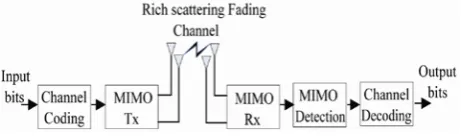
Uncoded MIMO system, also called spatial multi-plexing, is shown in Figure 1.
There are many MIMO detection technologies for spa-tial multiplexing [11]. These can be categorized as linear and non-linear detection methods. Zero-forcing (ZF) and Minimum Mean Squared Error (MMSE) are examples of linear detection method while Maximum Likelihood (ML) and Vertical Bell labs Layered Space Time (VBLAST) detectors [12,13] are two famous non-linear MIMO de-tection methods. Non-linear detectors give better per-formance but are computationally complex as compared to linear detectors.
We report ACO assisted MIMO detection algorithm with a reasonable performance complexity trade off and to the best of authors understanding this is first success-ful attempt to optimize MIMO detection using ACO meta-heuristic.
The remainder of this paper is organized as follows. In Section 2, the MIMO system model is introduced. Brief overview of existing detectors is given in Section 3. Fun-damentals of 1-Opt and ACO are explained in Section 4. Proposed detection schemes are described in Section 5. Simulation parameters and results are discussed in Section 6. The computational complexity is calculated in Section 7. Concluding remarks can be found in Section 8.
2. Mimo System Model
2.1. Notation and Channel Model
A MIMO channel with Nt transmitters and Nr receivers is typically represented as a matrix H of dimension Nr ×
Nt, where each of the coefficients [H]i,j represents the transfer function from the jth transmitter to the ith re-ceiver.We denote the signal or symboltransmitted from the jth transmitter xj. With this notation, the matrix model of the channel is
= +
y Hx n (1)
[image:2.595.308.539.637.705.2]where n is a vector of additive noise, and y is an Nr × 1 complex received vector. H is a complex matrix repre-senting the Rayleigh flat fading channel. Each coefficient hij shows the complex path gain between the jth transmits and ith receive antenna. Assuming the presence of a rich
scattering environment, the columns of H are independ-ent and independ-entries hij are modelled as independent zero mean complex Gaussian random variables with unit variance. x is a Nt × 1 complex transmitted vector. n is an Nr × 1 complex noise vector whose components ni are modelled as zero mean independent complex Gaussian random variables with variance σ2
per real dimension.
2.2. Problem Formulation
The optimum receiver that is capable of detecting the transmitted data vector x while minimizing the probabil-ity of making an erroneous decision, assuming equally likely uncoded transmit symbols, is the Maximum-Like- lihood (ML) detector [14].
Assuming the additive noise n to be white and Gaus-sian, the ML detection problem can be expressed as the minimization of the squared Euclidean distance to a tar-get vector y
2 arg min
*
t
H N x χ
= −
∈
x y x (2)
Optimal ML detection scheme needs to examine all 2bNtsymbol combinations (b is the number of bits per symbol). It performs exhaustive search, i.e. the enumera-tion of all possible soluenumera-tions and choosing the one that minimizes the objective function of (2).
A naive implementation of this search strategy results in a prohibitive complexity, as the number of candidate solutions increases exponentially with the problem size.
We present two approaches, 1-Opt and ACO algo-rithm assisted wide band spatial multiplexing systems symbol detector that views the MIMO symbol detection issue as a combinatorial optimization problem and try to approximate the near optimal solution iteratively.
3. Some Existing Mimo Detectors
3.1. Linear MIMO Detectors
Linear receivers are the class of receivers for which the symbol estimate ˆx is given by a transformation of the received vector y of the form
( )
ˆ Wyx Q=
where W is a Weighting matrix that may depend on H and Q is a quantizer (also called slicer) that maps its ar-gument to the nearest signal point in ANt (using Euclidian distance). A is the modulation symbol and Nt is the total number of transmitters.
1) Zero-Forcing (ZF): ZF receiver is a low-complexity linear detection algorithm. The ZF algorithm at-tempts to null out the interference introduced from
the matrix channel by directly inverting the channel with the weight matrix [15].
Zero-Forcing (ZF) outputs
ˆˆ ( ZF)
x=Q x
ˆZF
x =H†Y
Where H† denotes the pseudo-inverse of H and xˆZF is rounded to the nearest integer in the constellation from which x is selected. The ZF notation comes from the fact that this receiver attempts to force the cross correlation between the estimation error e, e =xˆZF−x, and the transmit vector x to zero.
The ZF-receiver is a linear receiver in the sense that it behaves as a linear filter, separating the different data streams to perform independent decoding on each stream, hence eliminating multistream interference. The problem with this scheme is degraded performance due to the fact that the AWGN n loses the “whiteness” property; it be-comes enhanced and correlated across the data streams. Moreover, the ZF-receiver provides only Nr − Nt + 1 diversity order out of a maximum possible Nr order di-versity in a Nt × Nr MIMO system [1]. On the bright side, the ZF-receiver has a polynomial complexity.
2) Minimum Mean Squared Error (MMSE):A drawback of ZF is that nulling out the interference without con-sidering the noise can boost up the noise power sig-nificantly, which in turn results in performance deg-radation. To solve this, MMSE minimizes the mean squared-error, i.e. J
( )
W = E{
(
x−xˆˆ) (
* x−x)
}
, with respect to W [16,17].3.2. Non-Linear MIMO Detectors
at the beginning of each decoding stage are ordered in terms of decreasing signal-to-interference noise ra-tio (SNR), and the symbol with the highest SNR is selected for decoding.
2) ML Detector: Maximum Likelihood detector is opti-mal but computationally very expansive. Since it uses exhaustive search technique, it is not practical to use ML in large MIMO systems.
4.
Fundamentals of 1-OPT and ANT Colony
Optimization (ACO)
Local search algorithms start from some initial solution and iteratively try to improve the current solution by searching, within a pre-specified neighborhood, for bet-ter solutions. A neighborhood structure is used to specify the solutions’ neighborhood. Local search algorithms have been observed to be efficient in practice. The as-sumption that local optima are easy to obtain has never been challenged.
1-optlocal search is defined by the solutions that can be reached by changing a single element in the current solution. Their algorithms are often called k-opt local search. The basic concept is to search a portion of large (k-opt) neighborhood while keeping a reasonable amount of computation time.
ACO is an attractive technique that is very effective in solving optimization problems that have discrete and finite search space. Since the optimal MIMO detection problem involves a search process across the finite num-ber of possible solutions, ACO is an ideal candidate to solve this problem.
4.1. Ants and Natural Optimization
ACO algorithms belong to the class of metaheuristics [19-21]. The term metaheuristic, first introduced in [22], derives from the composition of two Greek words. Heu-ristic derives from the verb heuriskein which means “to find”, while the suffix Meta means “beyond, in an upper level”.
Ants are social insects. They live in colonies and their behaviour is governed by the goal of colony survival rather than being focused on the survival of individuals. The behaviour that provided the inspiration for ACO is how ants can find shortest paths between food sources and their nest. When searching for food, ants initially explore the area surrounding their nest in a random manner. While moving, ants leave a chemical pheromone trail on the ground. Ants can smell pheromone. When choosing their way, they tend to choose, in probability, paths marked by strong pheromone concentrations. As soon as an ant finds a food source, it evaluates the
quan-tity and the quality of the food and carries some of it back to the nest. During the return trip, the quantity of pheromone that an ant leaves on the ground may depend on the quantity and quality of the food. The pheromone trails guide other ants to the food source. It has been shown in [23] that the indirect communication between the ants via pheromone trails known as stigmergy en-ables them to find shortest paths between their nest and food sources.
4.2. ACO Metaheuristic
In analogy to the biological example, ACO is based on the indirect communication of a colony of artificial ants mediated by artificial pheromone trails
An ant is a simple computational agent, which prob-abilistically builds a solution by iteratively adding solu-tion components to partial solusolu-tions by taking into ac-count 1) a priori available heuristic information on the problem instance being solved i.e. problem-specific greedy heuristic (desirability function), and 2) artificial pheromone trails which change dynamically at run-time to reflect the ants’ collective search experience [24].
ACO uses exploratory-exploitive approach. It is easy to see that, as the search progresses, deposited phero-mone dominates ants’ selectivity, reducing the random-ness of the algorithm. Therefore, ACO is an exploitive algorithm that seeks solutions using information gathered previously, and performs its search in the vicinity of good solutions. However, since the ant’s movements are stochastic, ACO is also an exploratory algorithm that samples a wide range of solutions in the solution space.
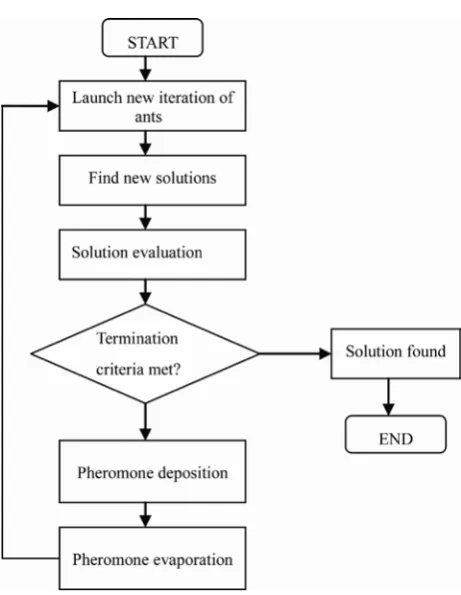
A flow chart depicting the structure of ACO algorithm is shown in Figure 2 (given at the end).
5. Proposed Mimo (1-Optzfml & ACO Based)
Detectors
In 1-Opt local search ZF, the initial guess is taken from ZF. A ZF initial solution estimate is used to define the radius of search. Constellation points around the ZF so-lution are searched using 1-Opt local search.1-optlocal search is defined by the solutions that can be reached by changing a single element in the current solution. Func-tion (2) is used to find out the minimum Euclidian dis-tance. First y is computed and then a ML search around the neighborhood of y is performed. The bits of received symbol are changed to get the neighbors of the symbol. Each of the Nt symbol generates a neighbor list, then a joint ML search over reduced constellations is per-formed.
Figure 2. Flow chart depicting the structure of ACO algo-rithm.
symbol. 2 × 2 MIMO is considered so there are four neighbors in this case. ZF initial guess is taken and then four neighbors are generated using 1-Opt technique. ML search is performed to find Minimum Euclidean distance of y and its neighbors. Solution vector is the one with minimum Euclidean distance.
The major challenge in designing ACO based MIMO detector is the selection of effective fitness function which is problem dependent and perhaps is the only link between the real world problem and the optimization algorithms. The basic fitness function used by this opti-mization algorithm to converge to the optimal solution is (2).
The first stage in designing our ACO-based MIMO detector involves the selection of ACO parameters that fit the optimization problem. We define the solution vector to be Sopt. Sopt has length equal to Nt. In this algorithm we assume BPSK modulation scheme so each element ofSoptcan take two values. A total of 2Nt solu-tions are possible for BPSK scheme. Every ant builds a solution vector in each iteration. This building process is accomplished via Ntjumps inside a 2×Ntsolution table, (soltable). Higher modulation schemes can also be used. If QPSK is used the table size would increase to 4×Nt and possible solution would be 4Nt.
Choice of initial solution Sint plays a vital role in the
fast convergence of the optimization algorithm to a suit-able solution. We therefore, make a start with the ZF or VBLAST input to the proposed detection algorithm. The first row of the soltable corresponds to the entries of ini-tial solution, Sint while the second row is the compliment of the first row i.e. Sint. If Sintl = −1 then Sintl = +1.
The ants move inside the soltable to find the optimal solution. In each jump, the ant selects (based on a desir-ability function and pheromone concentration) either the initial solution element or its complement. After each iteration, pheromone deposition and evaporation takes place. Any solution (out of the 2Nt possible solutions) can be formed by selecting Ntelements from this table, one element from each column.
The ants start at Sintand move cyclically down the vector selecting the best element at each stage. Using the desirability function the ants decide whether to select element from Sint or Sint. Desirability function for initial position of ant starting at a particular instance j is defined as
( )
( )
int
1 2
D j
S j
=
+ (3)
int
S can either correspond to solution vector of ZF or V-BLAST.
Equation (3) reflects the fact that when Sint
( )
j =0,( )
int
S j and Sint
( )
j are equally likely to be chosen. As the ant moves along the elements of the solution vector, the desirability function at the (j + i)th stage can be rede-fined as follows:(
)
(
)
( )int int
1 i
2 j i | l |
l C
D j
S ∈ S
+ =
+ + +
∑
(4)where C is a set of positions where the ant had previ-ously selected Sint element values. The desirability function ensures that if at the jth position ant selects element from Sint then at the (j+i)th position probabil-ity of selecting another element from Sint decreases. The purpose of such desirability function is that ant should not deviate significantly from initial solution.
Pheromone deposition is also done in a 2×Nt table. Each entry of first row of pheromone table corresponds to the entry of Sint while second row entries correspond to Sint. Initially all the entries in the table are unity i.e.; equal amount of pheromone is deposited. In our algo-rithm if an ant produces a good solution only then it is allowed to deposit pheromone. Good solution is deter-mined from the fitness function. Deposition and evapora-tion rate are inversely proporevapora-tional to the number of it-erations.
The proposed detection algorithm is summarized be-low
[image:5.595.56.287.76.374.2]input to algorithm instead of keeping random values. Step 2. Create a 2×Nt soltable, whose first row contains elements of Sint and second row Sint.
Step 3. Create a 2×Ntpheromone table, PT(m,n) = 1 ∀, m,n = 1 (initialization).
Step 4. Decide the starting position of ants i.e. st(1), (2)
st ,,st(N). Step 6.
For iteration 1: itr{ for move = 0: Nt −1{
(
)
(
)
(
)
(
)
(i) (i)
(i)
2, mod
mod i 1, ,
Move
p PT st move Nt
D st move Nt N
= +
× + ∀ =
This is the probability with which ant i selects Sint elements. It is evaluated for all ants.
Selected elements and the index of the selected loca-tions in PT are stored in two separate arrays, sol and Tr. “sol” is later used for checking whether the result is good or not while Tr constitutes the trail for ant.
}
Step 7. If f (sol(i)) > f (Sint)
Step 7.1. Pheromones are deposited:
( )
( )
PT Tr =PT Tr + ∆PT
Change in pheromone table:
( )
(
(
(i))
)
Deposition rate DR * f ;
PT sol Nt
∆ =
Step 8. Evaporation of pheromones:
(
,)
(
,) (
1 ER)
PT m n =PT m n × − ER= evaporation rate.}
In the pheromone table, the trail with the highest pheromone concentration and its corresponding values from Sint and S int provide the final solution Sopt.
6. Simulation Parameters and Results
Aim of the proposed 1-Opt ZFML and ACO based MIMO detector is to lower the complexity level as much as possible, therefore the parameters are selected ac-cordingly.
In ACO based MIMO detector we have used only one ant i.e., no. of ant, N = 1, number of iterations, itr are MIMO system dependant. i.e. 4 iterations if Nt = 4. DR = 5/itr, ER = 9/itr. We have considered 3 × 3 and 4 × 4 (Nt
× Nr ) MIMO systems.
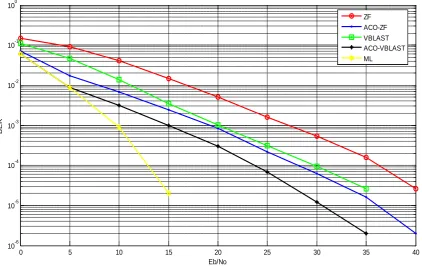
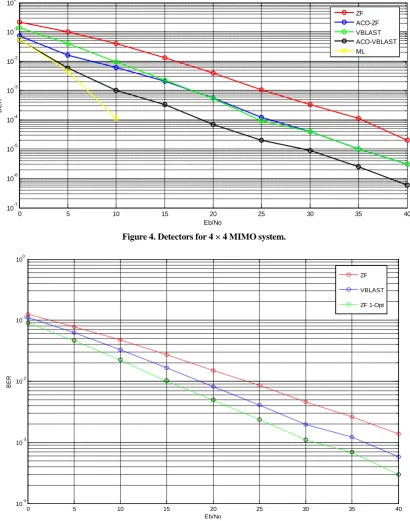
Figures (shown at the end) present the bit error rate (BER) versus Eb/No(SNR) performance of proposed de-tectors.
Figure 3 presents the BER versus Eb/No performance of proposed ACO based MIMO detector compared with ML and VBLAST detectors for 3 × 3. At 10–3 BER, the proposed ACO-VBLAST algorithm (with VBLAST as initial guess) result in 5-dB enhanced performance as compared to VBLAST while ACO-ZF algorithm (with ZF as initial guess), result in 8 dB gain compared to ZF.
0 5 10 15 20 25 30 35 40
10-6 10-5 10-4 10-3 10-2 10-1 100
Eb/No
BER
ZF ACO-ZF VBLAST ACO-VBLAST ML
[image:6.595.89.512.437.703.2]Figure 4 presents the BER versus Eb/No performance of proposed ACO based MIMO detector compared with ML and VBLAST detectors for 4 × 4. At 10–3 BER, the proposed ACO-VBLAST algorithm result in 5-dB en-hanced performance as compared to VBLAST while ACO-ZF algorithm result in 7-dB gain compared to ZF.
Figure 5 presents the BER versus Eb/No performance
of proposed 1-Opt ZFML detector compared with the VBLAST detector. At 10−3 the 1-Opt ZFML gives 6 dB enhanced performance and complexity is also reduced by 8% as compared to VBLAST.
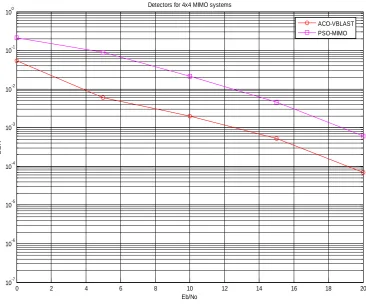
Figure 6 shows the comparison between ACO and PSO techniques for 4 × 4 MIMO system. Initial guess is taken from VBLAST and BPSK modulation scheme is
0 5 10 15 20 25 30 35 40
10-7 10-6 10-5 10-4 10-3 10-2 10-1 100
Eb/No
BER
[image:7.595.91.503.184.429.2]ZF ACO-ZF VBLAST ACO-VBLAST ML
Figure 4. Detectors for 4 × 4 MIMO system.
0 5 10 15 20 25 30 35 40
10-4 10-3 10-2 10-1 100
Eb/No
BER
ZF
VBLAST
ZF 1-Opt
[image:7.595.93.504.185.707.2]0 2 4 6 8 10 12 14 16 18 20 10-7
10-6 10-5 10-4 10-3 10-2 10-1 100
Eb/No
BER
Detectors for 4x4 MIMO systems
[image:8.595.116.483.85.389.2]ACO-VBLAST PSO-MIMO
Figure 6. ACO and PSO detectors.
used in both the cases. The parameters for PSO [17] are
Np = 4, Nitr = 2, μvel = 2. At 10–3 BER ACO gives 6 dB improved performance.
7. Computational Complexity
Now we examine the computational complexity of the reported ACO and 1-Opt ZFML MIMO detectors and compare it with ML and VBLAST detectors. The com-putation complexity of ML and VBLAST has been cal-culated in [25].
The computational complexity is computed in terms of the Nt, Nr and the constellation size M.
Computational complexity of ML is Nr (Nt+1) MNt while complexity of VBAST is
4 5 2 3 7 2 1
2 3 2 3
VBLAST Nt Nr Nt Nr Nt N Nt r γ = + + + + +
In case of ZF, the pseudo-inverse of matrix (HHH)–1 HH takes 3 2
4Nt +2N Nt rmultiplications [9]. Complexity of ZF is
3 2
4 2
ZF Nt N Nt r
γ = +
Complexity of PSO is [9]
(
μ)
PSO Np N Nt r vel Nitr
γ
=
+
Complexity of proposed detector as seen from algorithm is
( )
ACO NA Nt
γ =
Pheromone update requires μp additional multiplications per iteration
(
)
ACO NA Nt p
γ = +µ
This procedure is repeated Nitr times to give the near- optimal BER performance
(
)
ACO NA Nt p Nitr
γ = +µ
The proposed detector takes initial solution as ZF or VBLAST detectors’ output therefore, it is added to the complexity of ACO algorithm i.e. γACO to get the re-sultant complexity of ACO based MIMO detector. It can be seen that ZF-ACO for 3 × 3 MIMO system gives a bit better performance than VBLAST at a reduced complex-ity level of 28% while ACO-VBLAST gives better per-formance than VBLAST at a cost of 9% increase in complexity. For 4 × 4 system ZF-ACO has 42% less complexity than VBLAST. While ACO-VBLAST gives better performance than VBLAST at a cost of around 4% increase in complexity level.
In case of 1-Opt ZFML the computational complexity
is
(
)
Nt nM M . Where Mn is the neighbors list. So the total complexity of 1-Opt ZFML= +
(
)
Ntn
M M .
Compared to ML that performs a coarse search over the complete search space the 1-Opt ZFML used a re-duced constellation.
8. Conclusions
In this paper, 1-Opt and Any Colony Optimization as-sisted symbol detection in a spatial multiplexing system is reported. It has been shown that the metaheuristics and heuristics can be applied to optimize the symbol detec-tion problem. The resistance to being trapped in local minima, convergence to reasonable solution in fewer iterations and exploratory-exploitive search approach makes ACO a suitable candidate for real-time wireless communications systems. 1-Opt and ACO based MIMO detectors use a simple model and have lesser implemen-tation complexity. For larger number of antennas and higher modulation schemes the proposed detectors are expected to give near optimal results with much lower complexity level as compared to the ML detector and VBLAST detectors.
9. References
[1] A. Paulraj, R. Nabar and D. Gore, “Introduction to Space- Time Wireless Communications,” Cambridge University Press, New York, 2003.
[2] S. Aon Mujtaba, “TGn Sync Proposal Technical Specifi-cation,” 2005.
http://www.tgnsync.org/techdocs/11-04-0889-06-000n-tg nsyncproposal-technical-specification.doc
[3] G. J. Foschini and M. J. Gans, “On Limits of Wireless Communications in a Fading Environment When Using Multiple Antennas,” Wireless Personal Communications, Vol. 6, No. 3, 1998, pp. 311-335.
[4] E. Lumer and B. Faieta, “Diversity and Adaptation in Populations of Clustering Ants,” In: J. A. Meyer and S. W. Wilson, Eds., Proceedings of the Third International Conference on Simulation of Adaptive Behavior: From Animals to Animats, Vol. 3, MIT Press, Cambridge, 1994, pp. 501-508.
[5] M. Campos, E. Bonabeau, G. Theraulaz and J.-L. Deneu- bourg, “Dynamic Scheduling and Division of Labor in Social Insects,” Adapt Behavior, Vol. 8, No. 3, 2000, pp.
83-
[6] J. Kennedy and R. C. Eberhart, “Particle Swarm Optimi-zation,” Proceedings of the 1995 IEEE International Conference on Neural Networks, Vol. 4, IEEE Press, Piscataway, 1995, pp. 1942-1948.
[7] M. Dorigo, V. Maniezzo and A. Colorni, “Positive Feed-back as a Search Strategy,” Technical Report 91-016, Dipartimento di Elettronica, Politecnico di Milano, 1991. [8] H. Bolcskei, D. Gesbert and C. Papadias, “Space-Time
Wireless Systems: From Array Processing to MIMO Communications,” Cambridge University Press, New York, 2005.
[9] A. A. Khan, M. Naeem and S. I. Shah, “A Particle Swarm Algorithm for Symbols Detection in Wideband Spatial Multiplexing Systems,” GECCO-07, 2007.
[10] L. Zheng and D. Tse, “Diversity and Multiplexing: A Fundamental Tradeoff in Multiple Antenna Channels,” IEEE Transaction on Information Theory, Vol. 49, No. 5,
May 2003, pp. 1073-1096
[11] A. Goldsmith, S. A. Jafar, N. Jindal and S. Vishwanath, “Capacity Limits of MIMO Channels,” IEEE Journal on Selected Areas in Communications, Vol. 20, No. 5, June 2003.
[12] G. J. Foschini, “Layered Space-Time Architecture for Wireless Communication in a Fading Environment When Using Multiple Antennas,” Bell Labs Technical Journal, Vol. 1, No. 2, 1996, pp. 41-59
[13] F. Glover and G. Kochenberger, “Handbook of Metaheu-ristics,” Kluwer Academic, Norwell, 2002.
[14] S. Verdu, “Multiuser Detection,” Cambridge University Press, New York, 1998.
[15] M. Dorigo, V. Maniezzo and A. Colorni, “Ant System: Optimization by a Colony of Cooperating Agents,” IEEE Transactions on Systems, Man, and Cybernetics, Part B: Cybernetics, Vol. 26, No. 1, 1996, pp. 29-41.
[16] S. Haykin, “Adaptive Filter Theory,” 3rd Edition, Pren-tice-Hall, Upper Saddle River, 1996.
[17] A. Sayed, “Fundamentals of Adaptive Filtering,” Wiley- IEEE Press, Piscataway, 2003.
[18] V. Tarokh, H. Jafarkhani and A. R. Calderbank, “Space- Time Block Codes for Orthogonal Designs,” IEEE Trans- actions on Information Theory, Vol. 45, No. 5, 1996, pp.
1456-1466.
[19] C. Blum and A. Roli, “Metaheuristics in Combinatorial Optimization: Overview and Conceptual Comparison,” ACM Computing Surveys, Vol. 35, No. 3, 2003, pp. 268-
308.
[20] J. Handl, J. Knowles and M. Dorigo, “Ant-Based Clus-tering and Topographic Mapping,” Artificial Life, Vol. 12, No. 1, 2006, pp. 35-62.
[21] H. H. Hoos and T. Stützle, “Stochastic Local Search: Foundations and Applications,” Elsevier, Amsterdam, 2004.
[22] F. Glover, “Future Paths for Integer Programming and Links to Artificial Intelligence,” Computers & Opera-tions Research, Vol. 13, No. 5, 1986, pp. 533-549.
Argen-tine Ant,” Journal of Insect Behavior, Vol. 3, No. 2, 1990,
pp. 159-168
[24] M. Dorigo and T. Stutzle, “Ant Colony Optimization,” MIT Press, Cambridge, 2004.