WAYS TO IMPROVE THE EFFICIENCY OF THE DESIGN COMPONENTS OF A COMPUTER SYSTEM
Odessa National Polytechnic University, Institute of Computer Systems, Odessa, Ukraine
ARTICLE INFO ABSTRACT
In the work are considering promising areas of systems design electronic
different research directions in this area are combined into meaningful channel modeling electronic devices and the monolithic integrated circuits. Integration of mathematical physics, electrodynamics, the theory of electrical ci
systematic way to build physical and mathematical models of high
nanotechnology electronics. Mathematical models allow circuit (topological) analysis consideri structural (morphological) properties the object of design. Under this type of system model can solve the problem of electromagnetic, thermal, radiation and informational compatibility of computer systems and their components.
Copyright © 2016, Kudrya and Sytnikov. This is an open access article distributed under the Creative Commons Att use, distribution, and reproduction in any medium, provided the original work is properly cited.
INTRODUCTION
The current level of information and communication technologies means facing the problem of synergy. Use a variety of natural phenomena in monolithic integrated circuit technology is the dominant feature of which is the introduction of nanotechnology, photonics and spintronics will become more significant. Typically, design of components constructed on the basis the classical theory of electrical circuits. This theory meets the practical needs of designers in the early stages of electronics. However, a number of tasks associated compaction basic components of integrated circuits, increasing speed and problems of electromagnetic, thermal, radiation, radioactive and biological compatibility (Kudrya, 2013; Clerk Maxwell, 1892; Malkov, 2007; EMC, 2016; Directive, 2004; Radio-Electronics. com, 2016) does not fit into the classical Kirchhoff equations. For these reasons, the aim of this work is to develop a system of physical and mathematical models of electronic devices and their components, which
raising the quality level of adequacy CAD modern electronics, including nanotechnology monolithic integrated circuits
Timeliness and intended audience
Today, the problem of developing physical and mathematical models of components for computer systems unduly paid little
*Corresponding author: Kudrya, V.
Odessa National Polytechnic University, Institute of Computer Systems, Odessa, Ukraine
ISSN: 0975-833X
Article History:
Received 23rd January, 2016
Received in revised form 08th February, 2016
Accepted 05th March, 2016
Published online 26th April,2016
Key words:
System design, Integrated circuits, Nanotechnology electronics, CAD, Computer components, Communicator.
Citation: Kudrya, V. and Sytnikov, V. 2016. “Ways to improve the efficiency of the design components of a computer system
Current Research, 8, (05), 29252-29256.
RESEARCH ARTICLE
WAYS TO IMPROVE THE EFFICIENCY OF THE DESIGN COMPONENTS OF A COMPUTER SYSTEM
*
Kudrya, V. and Sytnikov, V.
Polytechnic University, Institute of Computer Systems, Odessa, Ukraine
ABSTRACT
In the work are considering promising areas of systems design electronic
different research directions in this area are combined into meaningful channel modeling electronic devices and the monolithic integrated circuits. Integration of mathematical physics, electrodynamics, the theory of electrical circuits, systems engineering, integral equations and matrix theory allowed a systematic way to build physical and mathematical models of high
nanotechnology electronics. Mathematical models allow circuit (topological) analysis consideri structural (morphological) properties the object of design. Under this type of system model can solve the problem of electromagnetic, thermal, radiation and informational compatibility of computer systems and their components.
is an open access article distributed under the Creative Commons Attribution License, which use, distribution, and reproduction in any medium, provided the original work is properly cited.
information and communication technologies means facing the problem of synergy. Use a variety of natural phenomena in monolithic integrated circuit technology is the dominant feature of which is the introduction echnology, photonics and spintronics will become more significant. Typically, design of components constructed on the basis the classical theory of electrical circuits. This theory meets the practical needs of designers in the early stages However, a number of tasks associated components of integrated circuits, increasing speed and problems of electromagnetic, thermal, radiation, Kudrya, 2013; Clerk 2016; Directive, 2004; ) does not fit into the classical Kirchhoff equations. For these reasons, the aim of this work is to develop a system of physical and mathematical models of electronic devices and their components, which would allow raising the quality level of adequacy CAD modern electronics, including nanotechnology monolithic integrated circuits.
Today, the problem of developing physical and mathematical er systems unduly paid little
Odessa National Polytechnic University, Institute of Computer
attention. The gap between the experimental and the theoretically grounded methods to create
techniques and technologies is unproductive way in various fields of human activity, including his most important information and communication field. On these grounds specified topic can be considered sufficiently relevant, and one that meets the needs of both the leading countries and international corporations that manufacture electronic means. Proposed in the work systems approach and system analysis so voluminous that it lay out within the theses impossible. However, the main provision
contained in the monograph author of the thesis, which can convey as follows.
Methods of designing
Methods of designing computer systems and their components contain significant deficiencies. Among them, the weaknesses such as the lack of systematic, structured and continuity of individual stages of design occupy a leading position. If the early "low frequency" phases of electronics deficiencies virtually no manifestoed, at high frequencies and the signal processing speeds are significantly inhibit the development of information and communication technologies. Technology of production of high-frequency information and communication tools: a very high frequency
ultrahigh {300 ... 3000} MHz (UHF) and microwa
GHz (UHF) bands today sharply discordant methods of design,
International Journal of Current Research Vol. 8, Issue, 04, pp.29252-29256, April, 2016
INTERNATIONAL
Ways to improve the efficiency of the design components of a computer system
WAYS TO IMPROVE THE EFFICIENCY OF THE DESIGN COMPONENTS OF A COMPUTER SYSTEM
Polytechnic University, Institute of Computer Systems, Odessa, Ukraine
In the work are considering promising areas of systems design electronic products. A wide range of different research directions in this area are combined into meaningful channel modeling electronic devices and the monolithic integrated circuits. Integration of mathematical physics, electrodynamics, rcuits, systems engineering, integral equations and matrix theory allowed a systematic way to build physical and mathematical models of high-frequency, including nanotechnology electronics. Mathematical models allow circuit (topological) analysis considering structural (morphological) properties the object of design. Under this type of system model can solve the problem of electromagnetic, thermal, radiation and informational compatibility of computer
ribution License, which permits unrestricted
The gap between the experimental and the theoretically grounded methods to create objects of new techniques and technologies is unproductive way in various fields of human activity, including his most important - information and communication field. On these grounds specified topic can be considered sufficiently relevant, and one eets the needs of both the leading countries and international corporations that manufacture electronic means. Proposed in the work systems approach and system analysis so voluminous that it lay out within the theses impossible. However, the main provisions of solving this problem contained in the monograph author of the thesis, which can
Methods of designing computer systems and their components contain significant deficiencies. Among them, the weaknesses he lack of systematic, structured and continuity of individual stages of design occupy a leading position. If the early "low frequency" phases of electronics deficiencies virtually no manifestoed, at high frequencies and the signal gnificantly inhibit the development of information and communication technologies. Technology of frequency information and communication tools: a very high frequency - {30... 300} MHz (VHF), ultrahigh {300 ... 3000} MHz (UHF) and microwave - {3... 30} GHz (UHF) bands today sharply discordant methods of design, INTERNATIONAL JOURNAL OF CURRENT RESEARCH
and so the commitment to eliminate this contradiction is the content of the monograph and it seems quite relevant.
New research results
The paper presents new methods of analysis, which, in addition to the classic circuit design procedures, laid down algorithmic methods systemic reflection of electromagnetic interference and other natural phenomena. In other words, research aimed at improving technological procedures manufacture components adequately reflected by their morphological structure in the design process. Modeling of information and communication tools in these frequency bands encountering the need to use models as concentrated and distributed in space as components and signals. In this system, strict accounting methods of electromagnetic influences communicators and not standalone components exist. Therefore clarification of objectives of the work is the development of physical and mathematical models, different systematic analysis of the impact of electromagnetic interference and other factors that affect the reliability, speed, energy consumption and information security. In other words, the study aims to analysis and synthesis of chain models that will allow you to create new or modify existing simulation system considering internal and external electromagnetic state. Examples of systems analysis, as illustrated, can be used to account for existing and future natural phenomena inherent in the implementation of the functions of computer components, including nanotechnology and biochips, photonics and spintronics monolithic integrated circuits. Considering that such software as Micro Cap 9, Or CAD 16, EWB, MaltiSim 7, MatLab R2008b - Simulink - do not have adequate procedures for calculating electromagnetic effects on device performance object design, this work can be regarded as certain scientific achievement in the development of new more advanced models that could form the basis of improved information and communication CAD tools and their components.
Synergy effects components
Thus, the definition of the object of research, stem and methods laid down at its core. In particular, this systematic analysis method that can simulate various physical phenomena that describe the complex system. Within the framework of methodology development of mathematical models was based on the use of various theories: mathematical physics in solving boundary value problems; matrix theory to describe the system of mathematical models; electromagnetic field theory and integral equations for calculating the parameters of the communicator; systems engineering theory and structuring of material objects, etc. The essential difference between the proposed innovations is the development of systematic methods for analyzing high-speed electronics. Modern micro-and nanotechnology are not sufficiently serious systemic methods provided by comprehensive electronic design tools (structural and logical, Schematic Design and Technology.) It is clear that this problem in full, at the moment, is not solved. To solve large-scale scientific formulated technical problem more research is indicated in (Kudrya, 2013). These studies made and structured as follows.
A. Physics mathematical modeling in nanotechnology
Consider the scope, mathematical tools, design of complex information and communication facilities that work out
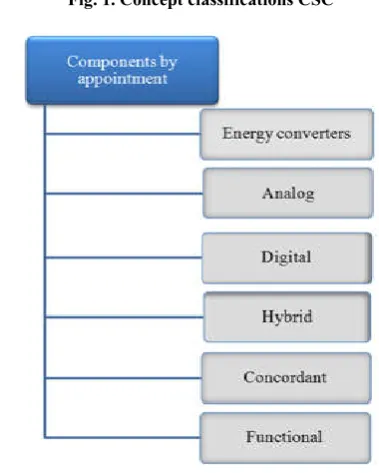
[image:2.595.309.561.191.289.2]information, and the relationship between the physical, mathematical models and production technologies. The accumulation of these factors that accompany the life cycles of the components of a computer system makes certain chaos, the removal of which will increase the effectiveness and appropriateness of scientific and technical activities. Classification of components of computer systems would be best done by generalizing areas: appointment; technology, physical, mathematical models, Fig. 1. As part of this concept for each of the areas, in turn, made the internal classification. Classification by purpose shown in Fig. 2.
Fig. 1. Concept classifications CSC
Fig. 2. Classification of components of computer systems by appointment
Which class did not belong to the components they act as the functional power converter or the form and content of information:
1. Energy converters within which to distinguish between consumers and energy sources. Among them should be allocated active (unilateral conversion) and reactive (converters that can collect and return the same type of energy). Unilateral irrevocably converters convert one form of energy to another, and bilateral - making a different kind of energy can play it performing inverse transformation (eg, batteries, or reactive components); 2. Analog designed to handle continual signals;
3. Digital - for processing digital as binary and non-binary, that is, the level of quantized pulse signals;
4. Hybrid that process switching and analog signals, such as analog-to-digital and digital-to-analog converters;
[image:2.595.333.523.305.542.2]5. Matching: energy an efficiency coefficient of with close to 1; Signal efficiency of 0.5, for which energy problems sidelined
6. Functional converters whose main task
basic mathematical operations and implement complex algorithmic calculation that characterized multiplace operations (8), including switching and converting (like current - voltage and vice versa).
Principles of various discrete functional transformers as based on a rigid logic, and the signal processing
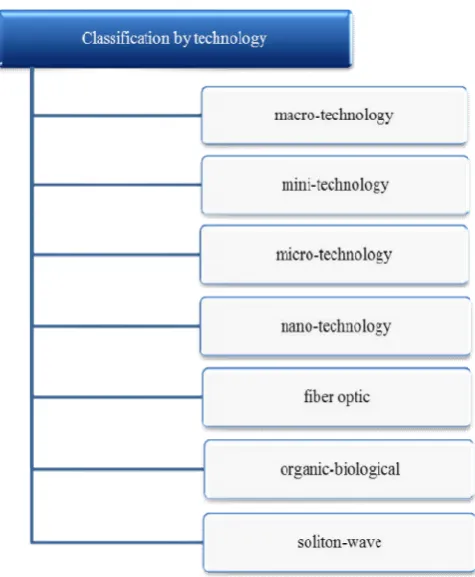
predetermined algorithm (reprogramming microprocessor or microcontroller). By manufacturing technology, Fig. 3, CSC distinguish the following positions:
1. Agrotechnological- the classic version development technologies such components are large. These include resistive resistance, coil inductive capacitors, strip lines, electron beam devices, electron tubes, devices on to surface waves traveling, devices wit
acoustic waves, elements waveguides (tee bridges, couplers and combiners power, etc.);
2. Mini technology - making individual a mini assemblies of several different types of electronic components, including semiconductor diodes and transistors. Collections flooded dielectric compound; 3. Micro technology - the manufacture of individual
chips, with punctuation distances that make up 10 meters and optical semiconductor devices
photodiodes etc.
4. Nanotechnologies involve allowing the distance reduce the size of atoms (12 nanometers) and molecules (9-10 meters);
5. Fiber optic devices technology development for the treatment of light streams and their generation (laser similar devices) are characterized by nano to femto size as in the previous case, the individual atoms and their components in such technologies can be used, as they have different energy states, spins etc;
6. Organic-biological technologies related to both the development with biochip and reconstructive medicine. This type of techno
developing sensory, storage, diagnostic and intelligent biochips;
7. Soliton-wave and neutrino string as technology of the future, aimed at constructing an experimental study of the universe as part of micro- to macrocosm.
Based on an analysis of existing theoretical knowledge can be identified and also following the hierarchy of physical mathematical models (Fig. 4) CSC:
1. Classical laws of interaction of power charges (Coulomb, Lorentz, Ampere, etc.) and their carriers; 2. Theory of electrical circuits and long lines;
3. Theory of electrical circuits and long lines (equation Kirhґofa, telegraph, basic components);
4. Macro electrodynamics (Maxwell's equations in differential and integral forms);
5. Quantum electrodynamics (Schrodinger equation); 6. Bioinformational models that reproduce the mental
processes of memory living creatures and plant life (structure of DNA molecules and biological neurons).
: energy an efficiency coefficient of with close to 1; Signal efficiency of 0.5, for which energy problems
converters whose main task - to perform any basic mathematical operations and implement complex algorithmic calculation that characterized multiplace , including switching and converting (like
f various discrete functional transformers as based on a rigid logic, and the signal processing (9), for a predetermined algorithm (reprogramming microprocessor or By manufacturing technology, Fig. 3, CSC
the classic version development technologies such components are large. These include resistive resistance, coil inductive capacitors, strip lines, electron beam devices, electron tubes, devices on to surface waves traveling, devices with surface acoustic waves, elements waveguides (tee bridges, couplers and combiners power, etc.);
making individual a mini assemblies of several different types of electronic components, including semiconductor diodes and lections flooded dielectric compound;
the manufacture of individual chips, with punctuation distances that make up 10 6 meters and optical semiconductor devices - light and
Nanotechnologies involve allowing the distance to reduce the size of atoms (12 nanometers) and
Fiber optic devices technology development for the treatment of light streams and their generation (laser similar devices) are characterized by nano to femto case, the individual atoms and their components in such technologies can be used, as they have different energy states, spins etc;
biological technologies related to both the development with biochip and reconstructive medicine. This type of technology aimed at developing sensory, storage, diagnostic and intelligent
wave and neutrino string as technology of the future, aimed at constructing an experimental study of
to macrocosm.
of existing theoretical knowledge can be identified and also following the hierarchy of physical
laws of interaction of power charges (Coulomb, Lorentz, Ampere, etc.) and their carriers;
circuits and long lines;
of electrical circuits and long lines (equation Kirhґofa, telegraph, basic components);
electrodynamics (Maxwell's equations in
[image:3.595.316.554.50.339.2]Quantum electrodynamics (Schrodinger equation); models that reproduce the mental processes of memory living creatures and plant life (structure of DNA molecules and biological neurons).
Fig. 3. The classification of information and communication technology facilities for manufacturing
Fig. 4. Classification for physico
It should be noted that the choice of a particular model of analysis should not depend on the speed or operating frequency processing information, and the ratio of the shortest wavelength range of the electromagnetic field, which is the source currents and charges in the volume component, and its maximum size. Removing this limitation that is inherent with existing CAD CSC depends on the development of models that allow Preliminary analysis of structures (morphology).
Estimation of design in terms of potential electromagnetic compatibility required for the election of an adequate mathematical model in which calculated schematic characteristics. Development of appropriate sets of algorithms is one of the problems is solved only in part
and requires further study.
The classification of information and communication gy facilities for manufacturing
Classification for physico-mathematical models
It should be noted that the choice of a particular model of analysis should not depend on the speed or operating frequency processing information, and the ratio of the shortest wavelength the electromagnetic field, which is the source currents and charges in the volume component, and its maximum size. Removing this limitation that is inherent with existing CAD CSC depends on the development of models that allow
ctures (morphology).
[image:3.595.315.554.383.572.2]B. Model electrodynamics of high-frequency electronic devices
The proposed concept of nan technological modeling electronics, as a result of splitting of the electronic device in its individual parts, distinguished by their functional of its parts. A function of energy transfer describes space temporal descriptors and executed a communicator and power conversion functions in its other form or state - the components that described temporal descriptors. The developed model is presented in the aggregate a closed system of homogeneous equations descriptors. It is shown that this concept can be applied to construct models for components whose operation is based on other natural phenomena in physics, chemistry, biology-based selection "windows" energy interchange. These fantastic devices can be created artificially or naturally guided "self-development" getting set properties and intelligence.
C. Communication device nanotech articles and models
Between the component compounds are quite large compared to the size of the lumped compositional elements that are combined together conductors. These dimensions, due to increased frequency of data processing, can be commensurate with the length of the electromagnetic wave size that they generate themselves like antennae. For these reasons, the analysis performed by of the communicator of electromagnetic field theory. The geometrical dimensions and material parameters of communicator allowed defining its parameters. The result of computation is representing as coefficient matrix that connects impacts and response. It is clear that both methods of analysis and its results significantly vary with the ratio of the length of the electromagnetic wave to the characteristic dimensions of the component. Overall, at this stage, developed mathematical models of the communicator that can be applied in various operating modes.
D. Component equations of functional transformers
Systematic research methods allowed built physical and mathematical models of components, different accounting effects of electromagnetic interference and other significant factors on its characteristics: reliability, speed, energy consumption and information security. The novelty of the results is due to synergistic research various manifestations of natural phenomena and processes. Built models allow coordinate system and abnormal processes that shape and affect the characteristics of computer systems and components. Primarily these include macro electrodynamics, quantum, thermal, electrical circuits, radiation and radioactive processes.
E. Development of algorithms for automated adaptive
simulation
This chapter has developed a number of new methods for the analysis of electrical circuits that are designed for the analysis of high-speed digital and analog electronic means, including electronic nanotechnology. These methods differ substantially from those that form the basis of modern computer simulation. In particular, they modeled not only the topology and morphology also object modeling, which allows minimizing the harmful effects of electromagnetic interaction between the components and communicator.
F. Development of diagnostic procedures in technology
design and manufacturing nano products
In the final chapter of a study that shows the possibility of implementation of research results into production. The systems approach to designing components of high-frequency electronics yielded a number of new technological methods and techniques of diagnosis Nan-schemes under development their design.
Conclusion
Summing up, we can add that in the mathematical model of system analysis and communication devices for physical energy (electromagnetic) parameters as values that reflect the physical and mathematical model of the communicator at different levels of its idealization. For each level of idealization developed methods and algorithms for optimal analysis of electromagnetic processes that characterize drains energy in localized and interpenetrating the energy environments. As part of this approach are developed fundamentally new principles modeling of electromagnetic offs as dependent as sources of reactive and active power. The formulated problem of electrodynamics as determined by the flow of the electric and magnetic induction communicator with surfaces and components based on the distribution of spatial - time descriptors for their morphologically-independent parts. Are considered various methods for solving these problems is to determine the electromagnetic parameters of communicator that are used in chain and electromagnetic circuits of simulate electromagnetic internal and external conditions. Are considered various methods for solving these problems is to determine the electromagnetic parameters of communicator that are used in chain and electromagnetic circuits of simulate electromagnetic internal and external conditions. Research results are confirmed by numerous computer-simulation experiments and calculations.
REFERENCES
Babak V. Signal processing: Textbook, V. Babak. and V. Handetskyy., E. Shryufer, K .: Lybid, 1999. - 496 p. Bondarenko, M.F. 2004. Computer discrete mathematics, M.F.
Bondarenko, NV Belous AG Rutkas, Kharkiv "Smith", 408 p.
Clerk Maxwell, J. 1892. A Treatise on Electricity and Magnetism, 3rd ed., vol. 2. Oxford: Clarendon, 1892. Directive 2004/108/EC of the European Parliament and of the
Council of 15 December 2004 on the approximation of the laws of the Member States relating to electromagnetic compatibility, (Electronic resource)
http://eur-lex.europa.eu/legal-content/EN/TXT/?uri= CELEX:32004 L0108
Electromagnetic compatibility (EMC)/http://ec.europa.eu /growth/single-market/european-standards/harmonised-standards/electromagnetic-compatibility/index_en.htm Last update: 02/12/2015
EMC, Society, (Electronic resource) http://www.emcs.org/# Last Updated: 01/12/2016
Kudrya, V. 2013. Modeling of nanotechnology electronic means. Monograph (text, electronic resource), Odessa National Academy of Food Technologies - Kherson. Oldie Plus, - 780 p. - Access (via catalogs National Library of Ukraine Vernadsky): http://nbuv.gov.ua/
Malkov, N. 2007. Electromagnetic compatibility of radio electronic means: studies. Manual, N. Malkov, A. Pudovkin. - Tambov: Univ Thumb. state. tehn. University Press, 2007. - 88 p. - 100 copies. - ISBN 978-5-8265-0659-2.
Radio-Electronics.com – What is EMC: Electromagnetic Compatibility. (Electronic resource) Last access 2016. http://www.radio-electronics.com/info/circuits/emc-emi/tutorial-basics-summary.php