COMPARATIVE STUDY OF MECHANICAL PROPERTIES OF DIRECT CORE BUILD
1
Dr. Manoj Kumar, A. D., *
,2Dr. Manikantan
5Dr. Shino P Mathew
1,3
Department of Prosthodontics, Including Crown & Bridge and Implantology,
Hospital,
2
Department of Prosthodontics, Including Crown &
Amrita Vishwa Vidyapeetham, Amrita University
4Private Practitioner, Trivandrum, Kerala
5
Department of Orthodontics, Sree Mookambika Institute of Dental Sciences
6
Department of Prosthodontics, Including Crown & Bridge and Implantology,
Amrita Vishwa Vidyapeetham, Amrita University
ARTICLE INFO ABSTRACT
Background & Objectives: core must
conducted to evaluate certain mechanical properties of commonly used materials for direct core build up, including visible light cured composite, polyacid modifi
ionomer, high copper amalgam, and silver cermet cement. Methods:
Standard test specimens were prepared. A Universal testing machine at different cross was used to determine all the four mechanical properties. Mean compressive
tensile strength, flexural strength, and elastic modulus with standard deviations were calculated. Multiple comparisons of the materials were also done.
Results:
strength were observed. Visible light cured composite showed relatively high compressive strength, diametral tensile strength, and flexural strength compared to the other tested materials. Amalgam showed highest value for elastic modulus
except for elastic modulus. Conclusion
materials
stability and greater probability of clinical success.
Copyright © 2017, Dr. Manoj Kumar et al. This is an open
use, distribution, and reproduction in any medium, provided
INTRODUCTION
A core build-up is a restoration placed in badly broken down tooth to restore the bulk of the coronal portion of the tooth to facilitate subsequent restoration by means of an indirect extra
coronal restoration (Combe et al., 1994; Saygili
2002). Compressive and tensile strength of core materials are thought to be important because core usually replace a large bulk of tooth structure and must resist multidirectional forces
for many years (Nicholls, 1974; Yetlram et al
are usually retained by pins, posts, and/or bonding system to
*Corresponding author: Dr. Manikantan, N. S.
Department of Prosthodontics, Including Crown & Bridge and Implantology, Amrita School of Dentistry, Amrita Vishwa Vidyapeetham, Amrita University Cochin, Kerala.
ISSN: 0975-833X
Vol.
Article History:
Received 12th September, 2017 Received in revised form 03rd October, 2017
Accepted 15th November, 2017 Published online 31st December, 2017
Citation: Dr. Manoj Kumar, A. D., Dr. Manikantan, N. S., Dr. Brijesh Shetty build-up materials”, International Journal of Current Research
Key words:
Core build-up materials, Mechanical properties, Compressive strength, Diametral tensile strength, Flexural strength, Elastic modulus.
RESEARCH ARTICLE
COMPARATIVE STUDY OF MECHANICAL PROPERTIES OF DIRECT CORE BUILD
Dr. Manikantan, N. S.,
3Dr. Brijesh Shetty,
4Dr. Dhanya
Dr. Shino P Mathew and
6Dr. Sreeprabha G Mohan
t of Prosthodontics, Including Crown & Bridge and Implantology, K.V.G. Dental College and
Hospital, Sullia, Karnataka State, India
t of Prosthodontics, Including Crown & Bridge and Implantology, Amrita School of Dentistry,
Amrita Vishwa Vidyapeetham, Amrita University Cochin, Kerala
Private Practitioner, Trivandrum, Kerala
Sree Mookambika Institute of Dental Sciences, Kulasekharam, Tamil nad
t of Prosthodontics, Including Crown & Bridge and Implantology, Amrita School of Dentistry,
Amrita Vishwa Vidyapeetham, Amrita University, Cochin, Kerala
ABSTRACT
Background & Objectives: The strength greatly influences the selection of core material because core must withstand forces due to mastication and para-function for many years. This study was conducted to evaluate certain mechanical properties of commonly used materials for direct core build up, including visible light cured composite, polyacid modified composite, resin modified glass ionomer, high copper amalgam, and silver cermet cement.
Methods: All the materials were manipulated according to manufacturer’s recommendations and Standard test specimens were prepared. A Universal testing machine at different cross
was used to determine all the four mechanical properties. Mean compressive
tensile strength, flexural strength, and elastic modulus with standard deviations were calculated. Multiple comparisons of the materials were also done.
Results: Considerable differences in compressive strength, diametral tensile stre
strength were observed. Visible light cured composite showed relatively high compressive strength, diametral tensile strength, and flexural strength compared to the other tested materials. Amalgam showed highest value for elastic modulus. Silver cermet showed less value for all the properties except for elastic modulus.
Conclusion: Strength is one of the most important criterions for selection of a core material. Stronger materials better resist deformation and fracture provide more equitable stress distribution, greater stability and greater probability of clinical success.
open access article distributed under the Creative Commons Attribution provided the original work is properly cited.
up is a restoration placed in badly broken down tooth to restore the bulk of the coronal portion of the tooth to facilitate subsequent restoration by means of an indirect extra
-Saygili and Sahmali, . Compressive and tensile strength of core materials are thought to be important because core usually replace a large bulk of tooth structure and must resist multidirectional forces
et al., 1976). Cores lly retained by pins, posts, and/or bonding system to
Department of Prosthodontics, Including Crown & Bridge and Implantology, Amrita School of Dentistry, Amrita Vishwa Vidyapeetham, Amrita University
facilitate their retention, and to restore the tooth to the ext ent to support a crown or bridge
1995). Several dental materials have been used for core build up procedures, some as direct and some as indirect, such as custom cast post and core (Saygili
materials used for direct core build
amalgam, visible light cured resin composite, auto cured titanium containing composite, polyacid modified composite, resin modified glass ionomer, and silver cermet cement. Most of these materials were not specially developed for this purpose, but as a consequence of propertie
release, pleasing colours, adhesion to tooth structure, fast setting rates, choice of curing mechanism, and handling properties, they have found application as core build
International Journal of Current Research
Vol. 9, Issue, 12, pp.63444-63448, December, 2017
Dr. Manoj Kumar, A. D., Dr. Manikantan, N. S., Dr. Brijesh Shetty et al. 2017. “Comparative study of mechanical properties of direct core
International Journal of Current Research, 9, (12), 63444-63448.
COMPARATIVE STUDY OF MECHANICAL PROPERTIES OF DIRECT CORE BUILD-UP MATERIALS
Dr. Dhanya Balakrishnan,
Dr. Sreeprabha G Mohan
K.V.G. Dental College and
Amrita School of Dentistry,
Cochin, Kerala
Kulasekharam, Tamil nadu
Amrita School of Dentistry,
Cochin, Kerala
The strength greatly influences the selection of core material because function for many years. This study was conducted to evaluate certain mechanical properties of commonly used materials for direct core
build-ed composite, resin modifibuild-ed glass
All the materials were manipulated according to manufacturer’s recommendations and Standard test specimens were prepared. A Universal testing machine at different cross -head speed was used to determine all the four mechanical properties. Mean compressive strength, diametral tensile strength, flexural strength, and elastic modulus with standard deviations were calculated.
Considerable differences in compressive strength, diametral tensile strength, and flexural strength were observed. Visible light cured composite showed relatively high compressive strength, diametral tensile strength, and flexural strength compared to the other tested materials. Amalgam . Silver cermet showed less value for all the properties
is one of the most important criterions for selection of a core material. Stronger equitable stress distribution, greater
ribution License, which permits unrestricted
facilitate their retention, and to restore the tooth to the ext ent to support a crown or bridge (Huysmans and Van derVarst, Several dental materials have been used for core build-up procedures, some as direct and some as indirect, such as
Saygili and Sahmali, 2002). The materials used for direct core build-up includes high copper t cured resin composite, auto cured titanium containing composite, polyacid modified composite, resin modified glass ionomer, and silver cermet cement. Most of these materials were not specially developed for this purpose, but as a consequence of properties such as fluoride release, pleasing colours, adhesion to tooth structure, fast setting rates, choice of curing mechanism, and handling properties, they have found application as core build-up
INTERNATIONAL JOURNAL OF CURRENT RESEARCH
procedures (Cattani-Lorente et al., 1999; Kerby et al., 1997). Although many studies have compared fracture loads of simulated cores in various geometric configurations often on extracted teeth, the strength of core materials have rarely been
compared (Combe et al., 1994; Saygili and Sahmali, 2002;
Nicholls, 1974; Arcoria et al., 1989). In view of the
development of newer materials in the market, clinician often has uncertainties regarding the choice of best materials to achieve optimum results. A comparative evaluation of mechanical properties of direct core -build materials would help the clinician to choose better products.
MATERIALS AND METHODS
Materials
Details of all five materials are given in (Table 1). This list includes two composite materials specifically developed as core build up material (Z-100 Restorative and Dyract) and one of the most commonly used material in clinical practice resin modified GIC (Vitremer). The two other products were a silver cermet (Hi-Dense XP) and silver amalgam (shofu).
Properties measured
The specimen dimensions for each property were selected according to ISO 4049 (international standards organization, 1992). Compressive strength and diametral tensile strength were measured for cylindrical specimens, 3x6 (d.h.). Flexural strength and Elastic modulus were measured for rectangular specimens, 25x2x2 ( l.b.h.). Specimens were stored at 37±1°C prior to testing. Ten specimens were made and tested for each group. Data were analyzed by Kruskal Wallis test and Mann-Whitney ‘U’ test, with statistical package for social science (SPSS) version 11.5 for windows.
Measurement of properties
All tests were carried out on an Instron universal testing machine (Series IX, model 1011, UK). Compressive and flexural strength were determined at a-cross head speed of 0.5 mm/min. diametral strength was carried out at 1mm/min. Diametral tensile strength was calculated from the formula
T = 2F/π DL
Where F is the maximum applied load (N); D is the mean diameter of the specimen (mm) and L the length (height) of specimen (mm).
Flexural strength was calculated from the following equation:
σ = 3Fl/2bh2
where F is the maximum load exerted on the specimen; l is the
distance (mm) between the supports ± 0.01 mm; b is the width
(mm) of specimen immediately prior to testing; and h is the
height (mm) of specimen measured immediately prior to
testing. The experimental variables of specimen size, shape, testing configuration, fabrication procedure, temperature, humidity, storage time, storage temperature, strain rate, and set time were all standardized in this study. All specimens were treated identically throughout this study, which was based on ADA Specification No. 27. Thus, comparisons among materials were appropriately made. In this study, core materials were compared at a single short setting time, but various types of material differ in their setting mechanisms. Some materials, such as glass ionomers, continue to mature for extended periods. Thus, the comparison was valid only for the 24-hour setting time. However, cores may have to resist loads soon after placement, the effects of increased curing over time are small in comparison to the large differences among materials, and established specifications recommend 24-hour test times.
RESULTS
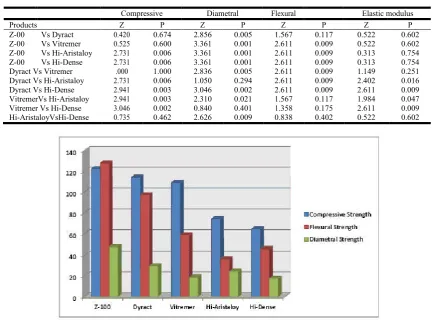
Statistical analysis for the strength of core materials was performed, and the mean valve with its standard deviation was calculated for each material. The Kruskal Wallis test (H) and Mann-Whitney ‘U’ TEST (Z), with statistical package for social science (SPSS) version 11.5 for windows was used. Here the Kruskal Wallis test (H) was used to compare the four properties for each material. The Mann -Whitney ‘U’test was used for multiple comparison of four properties among five different materials and the significance was found at 5% confidence level. Compressive strength, elastic modulus, diametral tensile strength, flexural strength data and results of the statistical analysis data are given in (Table 2, 3, 4, 5). Compressive strength, diametral tensile strength, flexural
strength and elastic modulus varied among different core build-up materials. Visible light cured composite (Z-100) had relatively high compressive strength, diametral tensile strength, and flexural strength compared to the other tested materials. The compomer (Dyract) and resin modified glass ionomer (Vitremer) showed good mechanical properties except in terms of elastic modulus. Amalgam (Hi-Aristaloy) showed highest elastic modulus value compared to the other materials tested. Cermet glass ionomer (Hi-dense) showed less value for all the mechanical properties except in terms of elastic modulus (Table 6).
DISCUSSION
[image:2.595.71.529.484.574.2]Considerable differences in compressive and diametral tensile strengths were discerned among core materials. The strongest material was 2 times stronger than the weakest material in compression, and 3 times stronger in dimetral tension and 4 time stronger in flexural strength (Fig. 1).
Table 1. Materials used for study
Sl. No. Product Manufacturer Material type Batch No 1 Z-100 3M ESPE Dental Products Visible light cured 20040706
Restorative composite
2 Dyract Dentsply De Trey Gm bH Polyacid modified 6064204 composite (Compomer)
3 Vitremer 3 MESPE AG Dental Resin modified glass 20040329 products Seefeld-Germany ionomer cement
Table 2. Comparison of compressive strength
Product Mean SD H P (n=8) (MPa)
Z-100 122.25 36.78 Dyract 114.27 17.14
Vitremer 109.13 16.18 20.56 0.001 vhs HI-Aristaloy 74.29 25.65
[image:3.595.43.278.172.245.2]HI-Dense 64.63 24.92
Table 3. Comparison of diametral tensile strength
Product Mean SD H P (n=8) (MPa)
Z-100 47.62 8.19 Dyract 29.62 9.98
Vitremer 18.58 3.04 28.20 0.001 vhs HI-Aristaloy 24.12 4.34
[image:3.595.35.284.272.344.2]HI-Dense 17.45 3.20
Table 4. Comparison of flexural strength
Product Mean SD H P (n=5) (MPa)
Z-100 128.07 32.81 Dyract 97.42 6.89
Vitremer 58.73 9.98 18.96 0.001 vhs HI-Aristaloy 36.40 21.62
HI-Dense 45.70 9.88
Table 5. Comparison of elastic modulus
Product (n=5) Mean (GPa) SD H P Z-100 16.44 7.14
Dyract 10.81 0.97
Vitremer 11.86 1.41 8.76 0.067hs HI-Aristaloy 17.28 3.93
HI-Dense 16.49 2.87
Such large difference might reasonably be expected to have clinical significance. Minimum strength needed for core materials are unknown, but many of materials tested did not meet the dimetral tensile strengths required by the American Dental Association Specifications for direct filling resins (24 and 34 MPa for type I and type II materials, respectively (Programs of the Council on Dental Materials, 1977). Compressive strength is considered to be a critical indicator of success because a high compressive strength is necessary to
resist masticatory and parafunctional forces (Grorge C. Cho et
al., 1999; Miyawaki et al., l993). Tensile strength is important
because dental restorations are exposed to tensile stresses from oblique or transverse loading of their complex geometric forms. Diametral tensile testing is a common method for measuring tensile strength of brittle materials because it avoids some of the difficulties inherent in direct and flexural tensile
testing (Levartovsky et al., 1994; Huysmans et al., 1992).
Amalgam has been considered to be the material of choice for cores. Both mechanical tests and Finite element analyses have indicated that amalgam cores have superior performances in comparison to resin composite cores (Huysmans and Van
derVarst, 1995; Huysmans and Van der Varst, 1993; Kovarik et
al., 1992). In fatigue testing, amalgam cores have deformed
less, produced smaller marginal gaps and applied lesser stresses to tooth structure than resin composite cores (Huysmans and
Van der Varst, 1993; Kovarik et al., 1992; Huysmans and Van
derVarst, 1995). Amalgam cores are certainly to be preferred to glass ionomer, resin-modified glass ionomer, or glass ionomer
cermet cores (Miyamoto et al., 1989; Dewald et al., 1990;
Arcoria et al., 1989). The dark colour of amalgam may not be
aesthetic, but it is easy to differentiate from tooth structure
during tooth preparation (Netti et al., 1988). Unfortunately,
the relatively slow set of amalgam delays rotary preparation of
Table 6. Multiple comparison of compressive strength, diametral strength, flexural strength and elastic modulus
Compressive Diametral Flexural Elastic modulus
Products Z P Z P Z P Z P
Z-00 Vs Dyract 0.420 0.674 2.856 0.005 1.567 0.117 0.522 0.602 Z-00 Vs Vitremer 0.525 0.600 3.361 0.001 2.611 0.009 0.522 0.602 Z-00 Vs Hi-Aristaloy 2.731 0.006 3.361 0.001 2.611 0.009 0.313 0.754 Z-00 Vs Hi-Dense 2.731 0.006 3.361 0.001 2.611 0.009 0.313 0.754 Dyract Vs Vitremer .000 1.000 2.836 0.005 2.611 0.009 1.149 0.251 Dyract Vs Hi-Aristaloy 2.731 0.006 1.050 0.294 2.611 0.009 2.402 0.016 Dyract Vs Hi-Dense 2.941 0.003 3.046 0.002 2.611 0.009 2.611 0.009 VitremerVs Hi-Aristaloy 2.941 0.003 2.310 0.021 1.567 0.117 1.984 0.047 Vitremer Vs Hi-Dense 3.046 0.002 0.840 0.401 1.358 0.175 2.611 0.009 Hi-AristaloyVsHi-Dense 0.735 0.462 2.626 0.009 0.838 0.402 0.522 0.602
[image:3.595.40.283.373.434.2] [image:3.595.81.520.459.779.2]amalgam cores and has limited its use. However Developments
and advances in non-y2 amalgams and the new concepts of
bonding dental amalgam to tooth structures have helped to ensure that amalgam remains one of the materials widely used
for core build up procedures in posterior teeth (Varga et al.,
1986; Staninec, 1989). Glass-ionomer based materials were markedly weaker than the resin composite and amalgam materials (Tables 2 and 3). Although some mechanical properties of resin-modified glass-ionomer materials only deteriorate slowly over time, the dimensional stability of resin
modified materials can be poor (Cooley et al., 1990; Mitra and
Kedrowski, 1994; Nicholson et al., 1992). Sliver
‘reinforcement” did not improve the strength of Hi-dense Silver glass ionomer in comparison to a conventional glass ionomer. Although some mechanical properties of glass ionomer and resin-modified glass ionomer materials only deteriorate slowly over time, the dimensional stability of resin-modified materials
can be poor (Nicholson et al., 1992; Anstice and Nicholson,
1992). Glass ionomers are also less fatigue-resistant than resin
composites (Miyamoto et al., 1989); thus, the role of glass
ionomers and glass ionomer based materials as cores must be questioned.
The results of our study indicate that, on the basis of strength alone, some resin composites may be used as alternative to amalgam cores. Resin composites have several practical advantages. They can be translucent and tooth-coloured, thus, they do not darken teeth. They can also be selected for colour contrast against tooth structure, to facilitate tooth preparation for crowns. They can be bonded to teeth using dentinal adhesives. For convenience, either light initiated or auto -curing materials can be selected. As they set quickly, core and
tooth preparations can be completed using rotary
instrumentation without delay (Grorge et al., 1999; Miyawaki
et al., l993). However, resin composites also have some disadvantages. Light-cured materials may not undergo complete curing if insufficient light intensity or curing time is used, too great a thickness is applied, or if they are reaching the end of their shelf lives. Although excellent adhesion to tooth structure can be achieved with dentinal bonding agents, the
long-term stability of such bonds is unknown (Grorge et al.,
1999; Miyawaki et al., l993; Tjan et al., 1993; Tam et al.,
1991). Resinous materials may be less physically and dimensionally stable than amalgam. Sorption of water, after impression making and before casting cementation, can
compromise seating (Arcoria et al., 1989; Oliva and Lowe,
1986). One crown retention study showed that crowns cemented to resin composite cores were more retentive than
crowns cemented to similar amalgam cores (DeWald et al.,
1987). That result could be attributed to slight swelling of the composite resulting in tighter fitting castings. Alternatively differences in core surface roughness might account for that finding.
Conclusion
Strength is not only one criterion for selection of core material, but it is crucial. Stronger core materials better resist deformation and fracture provide more equitable stress distributions, reduced probability of tensile or compressive failure, greater stability, and greater probability of clinical success. If other parameters are considered to be equal, the strongest core material is indicated. Although the perfect core material does not yet exist, the results of our study and other prior studies indicate that both amalgam and resin composites
may be indicated for use as core materials in specific clinical situations.
REFERENCES
American Dental Association Certification Kerby RE, Knobloch L, Thakur A. 1997. Strength properties of visible-light cured resin-modified glass-ionomer cements.
Operative Dentistry, 27:79-83.
Anstice HM. and Nicholson JW. 1992. Studies of light-cured
glass-ionomer cements. J Mat Sci Mat Med., 3:447-51.
Arcoria CJ, DeWald JP, Moody CR. and Ferracane JL. 1989. A comparative study of the bond strengths of amalgam and
alloy-glass ionomer cores. J Oral Rehabilitation, 16:301-
Cattani-Lorente MA, Dupis V, Moya F, Payan T. and Meyer TM. 1999. Comparative study of the physical properties of a polyacid-modified composite resin a resin-modified glass
ionomer cement. Dental Materials, 15:21-32.
Combe EC, Shaglouf A-MS, Watts DC. and Wilson NHF. 1994. Mechanical properties of direct core build -up
materials. Dental Materials, 15:158-165.
Cooley RL, Robbins JW. and Barnwell S. 1990. Dimensional
stability of glass ionomer used as a core material. J
Prosthet Dent., 64:651-53.
Dewald JP, Arcoria CJ. and Ferracane JL. 1990. Evaluation of
glass -cermet cores under cast crowns. Dent Mater,
6:129-32.
DeWald JP. Moody CR, Ferracane JL. and Cotmore JM. 1987. Crown retention: a comparative study of core type and
luting agent. Dent Mater, 3:-1-3.
Grorge C. Cho, Leslie M. Kaneko, Terence E. Donovan and Shane N. 1999. White. Dimetral and compressive strength
of dental core materials. J Prosthet Dent., 82:272-6.
Huysmans MC, Van der Varst PG, Schafer R, Peters MC, Plasschaert AJ. and Soltesz U. 1992. Fatigue behavior of
direct post-and-core-restored premolars. J Dent Res.,
71 :1145-50.
Huysmans MC. and Van der Varst PG. 1993. Finite element analysis of quasistatic and fatigue failure of post and cores.
J Dent., 21 :57-64.
Huysmans MC. and Van derVarst PG. 1995. Mechanical longevity estimation model for post -and-core restorations.
Dent Mater, 11 :252-7.
Kovarik RE, Breeding LC. and Caughman WF. 1992. Fatigue life of three core materials under simulated chewing
conditions. J Prosthet Dent., 68:584-90.
Levartovsky S, Kuyinu E, Georgescu M. and Goldstein GR. 1994. A comparison of the diametral tensile strength, the flexural strength, ard the compressive strength of two new core materials to a silver alloy -reinforced glass-ionomer
material. J Prosthet Dent., 72:481-5.
Mitra SB. and Kedrowski BL. 1994. Long-term mechanical
properties of glass -ionomers. Dent Mater, 10:78-82.
Miyamoto S, Takagawa T, Nozaki A, Yanaka N, Nakamura Y, Imai y, et. 1989. Study on fatigue toughness of dental materials. 1. Compressive strength on various luting
cements and composite resin cores. J Jpn Prosthodont Soc.,
33:966-76.
Miyawaki H, Taira M. Toyooka H, Wakasa K. and Yamaki M. 1993. Hardness and fracture toughness of commercial core
composite resins. Dent Mater J., 12:62-8.
Netti CA, Cunningham DE. and Latta GH. 1988. Tensile strengths of composite core materials containing added
colorants. J Prosthet Dent., 59:547-52.
restored symmetric restoration. J Prosthet Dent., 31:179-84.
Nicholson JW, Anstice HM. and McLean JW. 1992. A preliminary report on the effect of storage in water on the properties of commercial light-cured glass ionomer
cements. Br Dent J., 173:98-101.
Oliva RA. and Lowe JA. 1986. Dimensional stability of
composite used as a core material. J Prosthet Dent.,
56:554-61.
Programs of the Council on Dental Materials, Instruments and Equipment. American National Standards Institution/ American Dental Association Specification 27 for direct filling resins. Chicago: American National Standards Institution/American Dental Association; 1977.
Saygili G. and Sahmali SM. 2002. Comparative study of the
physical properties of core materials. Int J Periodontics
Restorative Dent., 22:355-363.
Staninec M. 1989. Retention of amalgam restorations.
Undercuts versus bonding. Quintessence Int., 20:351-374.
Tam LE, Pulver E, McComb D. and Smith DC. 1991. Physical
properties of light-cured lining materials. Oper Dent.,
16:210-7.
Tjan AH, Dunn JR. and Lee JK. 1993. Fracture resistance of amalgam and composite resin cores retained by various
intradentinal retentive features. Quintessence Int.,
24:211-7.
Varga J, Matsumara H. and Masuhara E. 1986. Bonding of
amalgam filling to tooth cavity with adhesive resin. Dent
Mater J., 5: 158-164.
Yetlram AL, Wright KW. and Pickard HM. 1976. Finite element stress analys is of the crowns of normal and
restored teeth. J Dent Res., 55:1004-11s.