EFFECT OF MAITLAND MOBILIZATION VERSUS MULLIGAN (SNAGS) MOBILIZATION ON HEAD
REPOSITIONING ACCURACY (HRA), PAIN AND FUNCTIONAL
CHRONIC NECK PAIN
*,1
Keyur M. Patel
1
Senior Lecturer, Vinayaka Institute of Physiotherapy,
2Principal, Ashok & Rita Patel Institute of Physiotherapy
3
Junior Lecturer, Vinayaka Institute of Physiotherapy,
ARTICLE INFO ABSTRACT
Background:
methods are used to treat patient with neck pain. In chronic neck pain patients have impaired neck proprioception. Manual therapy has evidence in improving neck propriocep
neck pain. There is no study found in comparing two spinal manipulative therapies on neck proprioception.
Objective:
(SNAGs) on head repositioning accuracy (HRA), pain and functional disability in chronic neck pain patient.
Method:
The 3 groups are 1) Maitland mobilization, 2) Mulligan (SNAGS) and3) Conventional treatment group. All the groups given different exercise and t
and they are statistically an Result:
difference of 1.38 and shows statically significant improvement (p=0.00). For HRA Maitland to SNAGs group and Maitland to conventional shows highly sig
Neck Functional Disability Maitland group (p=0.00). Conclusion:
conventi
reducing the patient symptoms. But Maitland mobilization is significant in reducing the patient symptoms when it compared with conventional therapy and SNAGs mobil
Copyright©2016, Keyur M. Patel et al. This is an open access article distributed under the Creative Commons Att distribution, and reproduction in any medium, provided the original work is properly cited.
INTRODUCTION
The International Association for the Study of Pain (IASP) in its classification of chronic pain defines as pain perceived anywhere in the posterior region of cervical spine from the superior nuchal line to the first thoracic spinous process. Another type of classification proposed by IASP is based on duration of neck pain according to which chronic neck pain has duration of 3 months or more. (International association for the study of pain, 2004)It is the second largest cause of disability affecting up to 70% of individuals at some point in their lives
*Corresponding author: Keyur M. Patel,
1
Senior Lecturer, Vinayaka Institute of Physiotherapy, Bakrol Anand, Gujarat
ISSN: 0975-833X
Article History:
Received 23rd February, 2016 Received in revised form 14th March, 2016 Accepted 07th April, 2016 Published online 20th May,2016
Key words:
Chronic neck pain, Maitland mobilization, SNAGs,
HRA,
Copenhagen Neck Functional Disability.
Citation: Keyur M. Patel, Dr. M. Balaganapathy and
head repositioning accuracy (HRA), pain and functional disability in patients with chronic neck pain Journal of Current Research, 8, (05), 31144-31149.
RESEARCH ARTICLE
EFFECT OF MAITLAND MOBILIZATION VERSUS MULLIGAN (SNAGS) MOBILIZATION ON HEAD
REPOSITIONING ACCURACY (HRA), PAIN AND FUNCTIONAL DISABILITY IN PATIENTS WITH
CHRONIC NECK PAIN - A RANDOMIZED CONTROLLED CLINICAL TRIAL
Keyur M. Patel,
2Dr. M. Balaganapathy and
3Hinal M.
Senior Lecturer, Vinayaka Institute of Physiotherapy, Bakrol-388315 Anand, Gujarat
Rita Patel Institute of Physiotherapy, CHARUSAT University, Changa
Vinayaka Institute of Physiotherapy, Bakrol-388315 Anand, Gujarat
ABSTRACT
ground: Spinal mobilization is commonly used in the treatment of chronic neck pain. Various methods are used to treat patient with neck pain. In chronic neck pain patients have impaired neck proprioception. Manual therapy has evidence in improving neck propriocep
neck pain. There is no study found in comparing two spinal manipulative therapies on neck proprioception.
Objective: objective of this study is to find out effect of Maitland mobilization versus mulligan (SNAGs) on head repositioning accuracy (HRA), pain and functional disability in chronic neck pain patient.
Method: 63 patients was randomly allocated by lottery method and equally allocated into 3 groups. The 3 groups are 1) Maitland mobilization, 2) Mulligan (SNAGS) and3) Conventional treatment group. All the groups given different exercise and treatment given for 3 WEEKS (5 session / week) and they are statistically analysed by ANOVA.
Result: When comparison pain between Maitland group and Conventional group shows a mean difference of 1.38 and shows statically significant improvement (p=0.00). For HRA Maitland to SNAGs group and Maitland to conventional shows highly significant (p<0.05), and for
Neck Functional Disability all group shows highly significant with higher improvement shown on Maitland group (p=0.00).
Conclusion: In this study the patients were treated with Maitland mobilization, SNAGs and conventional therapy in 3 groups, respectively. All three exercises are statistically significant in reducing the patient symptoms. But Maitland mobilization is significant in reducing the patient symptoms when it compared with conventional therapy and SNAGs mobil
is an open access article distributed under the Creative Commons Attribution License, which distribution, and reproduction in any medium, provided the original work is properly cited.
The International Association for the Study of Pain (IASP) in its classification of chronic pain defines as pain perceived anywhere in the posterior region of cervical spine from the superior nuchal line to the first thoracic spinous process. Another type of classification proposed by IASP is based on duration of neck pain according to which chronic neck pain has International association for the It is the second largest cause of disability affecting up to 70% of individuals at some point in their lives
Senior Lecturer, Vinayaka Institute of Physiotherapy, Bakrol-388315
causing high socioeconomic consequences in terms of health expenses and loss in working days. The reported point of prevalence varies from 5% to 35% in different countries, although the most common point prevalence is 10% to 15%.
(Bovim et al., 1994; Hoy et al.,
is somewhat higher in females as compared to males. In India reported prevalence is 6%. (
2009)The cervical spine is distinct and most mobile part of the vertebral column. It has three main functions; pr
to the head, permits motion of head in all directions and protects the structures like spinal cord, nerves and vertebral artery passing through it. (Grant
normal Lordotic curvature of cervical spine (30
the other spinal curvatures in lower spine provides a shock International Journal of Current Research
Vol. 8, Issue, 05, pp.31144-31149, May, 2016
INTERNATIONAL
Dr. M. Balaganapathy and Hinal M. Patel, 2016. “Effect of Maitland mobilization versus mulligan (SNAGS) mobilization on sitioning accuracy (HRA), pain and functional disability in patients with chronic neck pain - A randomized controlled clinical trial
EFFECT OF MAITLAND MOBILIZATION VERSUS MULLIGAN (SNAGS) MOBILIZATION ON HEAD
DISABILITY IN PATIENTS WITH
A RANDOMIZED CONTROLLED CLINICAL TRIAL
Patel
388315 Anand, Gujarat
CHARUSAT University, Changa-388421 Anand, Gujarat
388315 Anand, Gujarat
Spinal mobilization is commonly used in the treatment of chronic neck pain. Various methods are used to treat patient with neck pain. In chronic neck pain patients have impaired neck proprioception. Manual therapy has evidence in improving neck proprioception patient with chronic neck pain. There is no study found in comparing two spinal manipulative therapies on neck
effect of Maitland mobilization versus mulligan (SNAGs) on head repositioning accuracy (HRA), pain and functional disability in chronic neck pain
and equally allocated into 3 groups. The 3 groups are 1) Maitland mobilization, 2) Mulligan (SNAGS) and3) Conventional treatment reatment given for 3 WEEKS (5 session / week)
When comparison pain between Maitland group and Conventional group shows a mean difference of 1.38 and shows statically significant improvement (p=0.00). For HRA Maitland to nificant (p<0.05), and for Copenhagen all group shows highly significant with higher improvement shown on
In this study the patients were treated with Maitland mobilization, SNAGs and onal therapy in 3 groups, respectively. All three exercises are statistically significant in reducing the patient symptoms. But Maitland mobilization is significant in reducing the patient symptoms when it compared with conventional therapy and SNAGs mobilization.
ribution License, which permits unrestricted use,
socioeconomic consequences in terms of health expenses and loss in working days. The reported point of prevalence varies from 5% to 35% in different countries, although the most common point prevalence is 10% to 15%. ., 2010) The reported prevalence is somewhat higher in females as compared to males. In India
(Joseph henry Leonard et al.,
The cervical spine is distinct and most mobile part of the vertebral column. It has three main functions; provides stability to the head, permits motion of head in all directions and protects the structures like spinal cord, nerves and vertebral
Grant, 2002; Bovim et al., 1994) The
normal Lordotic curvature of cervical spine (30-40) along with the other spinal curvatures in lower spine provides a shock
INTERNATIONAL JOURNAL OF CURRENT RESEARCH
absorption mechanism and helps the body to maintain its centre
of gravity. (Panjabi and White, 2001; Neumann et al., 2002)
The superficial and deep muscles of cervical region plays an important role in stabilizing the cervical spine in all positions
of head. (Deborah et al., 2004) Cues received from the visual,
vestibular and cervical proprioceptive system are responsible for orientation of the head with respect to the trunk in three dimensional space so during movement signals change continuously due to changes in muscle length, visual scene and multiarticular surfaces of the cervical vertebrae. (Humphreys
and Irgens, 2002; Heikkila and Wenngren, 1998; Revel et al.,
1994) It is now well known that the proprioceptive function is
more refined in neck as compared to the low back.(Susan et al.,
2014; Persjolander et al., 2008) It is measured by head
repositioning accuracy (HRA). Recent evidences suggests that commonly the chronic neck patients & specifically whiplash subject shows signs of dysfunctional neck proprioception when measured by standing balance and posture or by Head Repositioning Accuracy. (Humphreys and Irgens, 2002;
Heikkila and Wenngren, 1998; Revel et al., 1994) According to
Heikkila et al. for understanding the morbidity of neck pain,
particularly after non- contact whiplash trauma, the most significant factor may be the proprioceptive dysfunction. There
is now increasing evidence that dysfunction of
mechanoreceptors, particularly in deep muscles, ligaments, and joints of the neck, is the main cause. (Heikkila and Wenngren, 1998) The general hypothesis for this study is there is a dissociation or dysfunction of the integrated visual, vestibular and proprioceptive systems of the neck due to trauma and/or continuing mechanical problems in chronic neck pain subjects. In particular, the loss of coordinated head, eye and upper limb movement may result in altered afferent information from vestibular, neck and visual afferents to corresponding motor neurones in the neck, visual apparatus and upper limbs. Various neck-posture reflexes which regulate these functions such as the vestibulocollic, cervicocollic, optokinetic and tonic neck reflexes may be affected and aberrant sensory information may continue to maintain dysfunctional motor loops. (Per
sjolander et al., 2008; UlrikRoijezon, 2009; Teng et al., 2007)
There is also evidence that dysfunction of the cervical proprioceptive system may influence both the oculomotor and vestibular systems, producing detrimental effects on the visual
and vestibular systems. (Susan A. Reid et al., 2014; Panagis,
2009)Unfortunately, there is limited research on the effectiveness of manual therapy on neck proprioception.
For this study Null hypothesis were
1. There is no difference between the pre and post outcome
measures within groups of subjects with chronic neck pain.
2. There is no difference between the pre and post outcome
measures between groups of subjects with chronic neck pain.
MATERIALS AND METHODS
Total 345 subjects of neck pain in Charotar region, Gujarat, India were screened by taking inclusion and exclusion criteria in consideration. The study was then performed on 63 subjects who meet the inclusion criteria. The inclusion criteria was non-specific chronic neck pain (>3 months), males and females
with age between 30 to 50 years, NPRS ≥6, willingness to participate in the study as a volunteer. Exclusion criteria was radiating pain with weakness, paraesthesia and decreased deep tendon reflex in upper limb, Rheumatologic disorders, Ankylosing spondylitis, any history of recent trauma or surgery around neck and active treatment in past one month (medical).All the subjects who were ready to participate and fit for the study were informed about the procedure and purpose of the study and written consent was taken from each subject prior to the study. The pre-treatment baseline assessment was
done on 0th day by the investigator other than primary
investigator. The subjects were randomly allocated on the basis of close envelope lottery method into three equal groups that is Maitland mobilization, Mulligan (SNAGs) mobilization and Conventional treatment group. Post treatment blinded assessment was then taken after 3 weeks. This study was approved by Ethical Committee (AIRP/IRB/14/028).
Group 1
Maitland mobilization
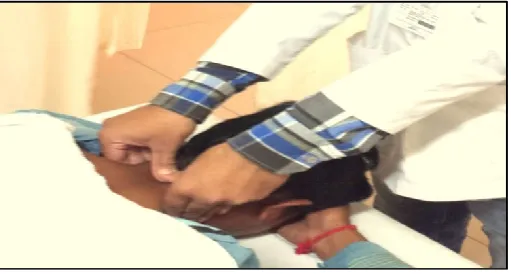
The physiotherapist palpates the neck to find the three most dysfunctional joints and then perform passive joint
mobilization to those joints (as described by Maitland et al.). A
[image:2.595.308.564.422.559.2]passive joint mobilization is where the therapist uses their thumbs to rhythmically apply pressure to a vertebra usually in a posterior to anterior direction. Procedure was performed three times for 30 seconds to dysfunctional joints. After mobilization subject had to perform same exercises as conventional group.
Figure 1. Maitland mobilization
Group 2
Mulligan SNAGS (Sustained Natural Apophyseal Glides) mobilization
Figure 2. Mulligan (SNAGs) mobilization
Group 3
Conventional treatment
1. Isometrics of neck (2sets x 10 reps)
2. Scapula stabilizer exercises (2sets X 10 reps)
3. Deep neck flexor strengthening (2sets X 10 reps)
4. Active neck movement in all direction (10 reps)
Outcome measure
Head Repositioning Accuracy: (Humphreys and Irgens,
2002; Susan A. Reid et al., 2014; http://www.rehab
measures.org/Lists/RehabMeasures/PrintView.aspx?ID=11 56)
Minimal clinically important difference wasstill not
[image:4.595.47.282.341.594.2]established. But for this study 25% difference from base line was considered as an improvement. For HRA, subjects were seating, with the laser mounted helmet, facing a paper target, against the white wall 90 cm away. To eliminate visual cues, subjects’ vision was occluded using black eye belt. Subjects were asked to find, and then memorize, their straight forward, head position.
Figure 3.Head Repositioning Accuracy
This was recorded on the paper target as the ‘neutral’ position. Subjects were asked to move their head maximally in each of extension, left rotation, right rotation and flexion, coming back to the ‘neutral’ position after each maximal head movement. Each movement was repeated 5 times, followed by a 2-minute break and then 5 repetitions of the next movement. Each movement was required to take place over 2 seconds, and all movements were recorded on the paper target. A deviation from the neutral after active head displacement was calculated in centimetres after the procedure as Head Repositioning Error (HRE).
0-10 Numeric Pain Rating (Rachel Tappan et al., 2013; Pietrobon et al., 2002)
MCID is raw change of 3 points or 27% (percent of raw in total = 3 points/11 points) is required for meaningful change.
Copenhagen Neck Functional Disability Scale (r=.89) (Jordan A, Manniche et al., 1998)
MCID was still not established. But difference of 30% from base line was taken as an improvement.
Data analysis
The response variables were found to be consistent with a normal distribution, so parametric statistics were used. Means, standard deviations, and 95% confidence intervals were calculated for all outcome measures and p value < .05 considers as significant level. Comparisons of groups at baseline and after 3 weeks were conducted with One-Way Analysis of Variance (ANOVA), and data were analysed in SPSS Version 20.
Total 63 participants were selected for this study and randomly allocated in three different groups. Group 1 Maitland, Group 2 Mulligan (SNAGs) and last Group 3 Conventional.
RESULTS
In this study both males and females were almost present in all three groups with mean age in Maitland mobilization 38.7, Mulligan mobilization 39.66 and conventional group 39.3.
Table 1. ANOVA
Outcome measures
Group Group Mean difference
p-value
Pain Maitland Mulligan 0.66 0.28
Conventional 1.38 0.00* Mulligan Conventional 0.71 0.24 Copenhagen Neck
Functional Disability
Maitland Mulligan 2.57 0.01* Conventional 7.28 0.00* Mulligan Conventional 4.71 0.00*
Head Repositioning Error
(FLEXION)
Maitland Mulligan 2.07 0.00* Conventional 1.20 0.09 Mulligan Conventional 0.86 0.28
Head Repositioning Error
(EXTENSION)
Maitland
Mulligan 0.4 0.05* Conventional 2.69 0.00* Mulligan Conventional 2.72 0.00*
Head Repositioning Error
(RIGHT ROTA.)
Maitland
Mulligan 1.73 0.05* Conventional 3.30 0.00* Mulligan Conventional 1.56 0.09
Head Repositioning Error
(LEFT ROTA.)
Maitland
Mulligan 1.84 0.02* Conventional 3.95 0.00* Mulligan Conventional 2.10 0.00*
*. The mean difference is significant at the 0.05 level.
[image:4.595.308.560.456.686.2]MCID selected for pain was 3 points raw change. All three groups showed more than 3 points improvement which suggests meaningful change (Graph – 1).
Graph 1 - Pain
The selected MCID for Head Repositioning Error was at least 25% from baseline. For flexion HRE all three groups showed significant change (Graph - 2). For extension, right rotation and left rotation both Maitland and Mulligan mobilization groups showed meaningful change except the conventional group (Graph – 2)
Graph 2 – Head Repositioning Error
For Copenhagen Neck Functional Disability MCID selected was 30% from the baseline and only conventional treatment group doesn’t show 30% improvement according to MCID selected (Graph- 3).
Graph 3 – Copenhagen Neck Functional Disability Scale
DISCUSSION
The study was a randomized controlled clinical trial to find out the effect of Maitland mobilization versus Mulligan mobilization on Head Repositioning Accuracy, pain and functional disability in patients with chronic neck pain. The data analysis revealed that all three groups showed significant improvement in reducing the patient’s symptoms. But Maitland mobilization showed significant improvement in reducing patient’s symptoms when compared with Conventional treatment and Mulligan mobilization. On comparing Maitland Mobilization group with conventional treatment group, clinically as well as significant improvement at p value < 0.05 (p=0.007) was seen in pain with mean difference of 5 and 3 respectively. In other study a significant reduction in reported pain was experienced by the symptomatic exercise versus symptomatic non exercise group and there wasn’t any control group. In the present study comparison was done between three groups and result suggested that Maitland group shows significant improvement. (Humphreys and Irgens, 2002) For Head Repositioning Accuracy, when two manual therapies
were compared Maitland group had shown greater
improvement in HRE than Mulligan group in post treatment after 3 weeks. The decrease in HRE found in flexion was 6.94 cm, in extension 6 cm, in right rotation 7.2 cm and left rotation 7.2 cm which constitutes a clinically significant change (Graph - 2). This indicates that Maitland approach is clinically beneficial in treating chronic neck pain subjects. Another study was done on effect of proprioceptive exercise on symptomatic group for 4 weeks and compared with non-symptomatic group and they recruited Sixty-three subjects and 56 subjects completed the 4-week study. And found that Active HRA was significant in reducing neck pain subjects in comparison with control subjects (ANOVA, p < 0.001). At 4-weeks, the
symptomatic exercise group demonstrated significant
improvement in HRA in all active movements compared to the other groups (ANOVA, p < 0.001). (Humphreys and Irgens,
2002; Susan A. Reid et al., 2014) But this study done
proprioceptive exercises and compared with asymptomatic group so there was difficult to say that this treatment help in improve HRE. When comparing the other study they used CROM for measuring the HRE but they found that neither SNAGs nor Maitland mobilization had meaningful effect on joint position sense in cervicogenic dizziness also they found that CROM not sufficient sensitive to detected the small changes that occur with HRE. They suggested that using head-mounted laser to measure HRE may be more accurate and sensitive. In our study we used head-mounted laser to measure
HRE. (Susan A. Reid et al., 2014)
SNAGs was 9 and conventional was 4 respectively. In all 3 groups we found that in Copenhagen Neck Functional Disability’s one component (question number 15- do you feel that neck pain will influence your future?) all the subjects had fear about again neck pain can occur.
Future recommendations
A long duration of study with a proper follow-up can be
done.
Sophisticated three-dimensional, ultrasound, motion
analysis systems are available for measuring real-time head positioning as well as calculating differences in active head displacement with repeated movements.
Conclusion
In this study, the subjects were treated with Maitland
mobilization, Mulligan (SNAGs) mobilization and
conventional treatment in 3 groups, respectively. All three exercises are statistically significant in reducing the subject symptoms. But Maitland mobilization is significant in reducing the subject symptoms when it is compared with conventional therapy and SNAGs mobilization.
Conflict of Interest
The author reports no conflict of interest.
REFERENCES
Bovim G, Shrader H, Sand T. Neck pain in general population.
Spine, 1994; 19:1307-1309
Bovim G, shrader H, Sand T. Neck pain in general population.
Spine, 1994;19:1307-1309
Deborah L. Falla, Gwendolen A. Jull, et al. subject with neck
pain demonstrate reduced electromyography activity of deep cervical flexor muscles during performance of the
craniocervical flexion test. Spine, 2004;29(19):2108-2114.
Grant r. physical therapy of cervical spine and thoracic spine.
3rd. new York: Churchill livingstone: 2002.267-72.
Heikkila H, Wenngren BI. Cervicocephalic kinesibility, active range of cervical motion, and oculomotor function in
patient with whiplash injury. Arch Phys Med and Rehab.,
1998:79(9):1089-1094
Hoy D.G., M. Protani, et al. The epidemiology of neck pain.
Best practice & research clinical rheumatology,
24(2010)783-792.
Humphreys B.K., P.M. Irgens; The effect of a rehabilitation exercises program on head repositioning accuracy and reported levels of pain in chronic neck pain subjects.
Journal of Whiplash and Related Disorders, vol 1(1)2002.
International association for the study of pain(IASP). Task force for taxonomy. Pain terminology. Seattle: IASP;2004.
Jordan A, Manniche C et al. The Copenhagen neck functional
disability scale: a study of reliability and validity. Journal
of manipulative and physiological thera.
21(8):520-527(1998).
Joseph henry Leonard et al, development and evaluation of
neck pain and functional limitation scale a validation study
in the Asian text, Indian Journal of Medical Sciences, vol
63,issue: 10(2009).
Neumann DA. Kinesiology of the musculoskeletal system- foundation for physical rehabilitation, St Louis, Mosby. 2002: page no. 276.
Panagis, lana: chiropractic manipulative therapy and proprioceptive neck exrcises for the treatment of chronic mechanical neck pain and its effect on head repositioning
accuracy. Journal of Manipulative and physiological
Therapeutics, 2009
Panjabi MM and White AA. Biomechanics in the
musculoskeletal system.1st edition. Churchill livingstone,
new York.2001.
Per sjolander, peter Michaelson et al. Sensorimotor
disturbances in chronic neck pain—Range of motion, peak velocity, smoothness of movement, and repositioning
acuity. Manual Therapy, 13 (2008) 122–131.
Pietrobon R, Coceytaux RR et al standard scale for
measurement of functional outcome for cervical pain or
dysfunction-systematic review. Spine, (phila Pa1976). 2002
mar 1:27(5):515-22.
Rachel Tappan, Eileen Tseng et al. measures the subjective
intensity of pain for numeric pain rating scale. Rehabilitation measures database 2013.
Rehabilitation measures database.http://www.rehabmeasures. org/Lists/RehabMeasures/PrintView.aspx?ID=1156 Revel, M., Minguet, M., Gergoy, P., Vaillant, J. and Manuel,
J.L. Changes in cervicocephalic kinesthesia after a proprioceptive rehabilitation program in patients with neck
pain: A randomized controlled study. Arch Phys Med
Rehabil., 75 (8), 895-899 (1994)
Susan A. Reid, MMedSc(Phty),Robin Callister, PhD Effects of Cervical Spine Manual Therapy on Rangeof Motion, Head
Repositioning, and Balance inparticipants With
Cervicogenic Dizziness: A Randomized Controlled Trial Physical Medicine and Rehabilitation 2014
Teng, C.C., Chai, H., Lai, D.M. and Wang, S.F. Cervicocephalic kinesthetic sensibility inyoung and middle-aged adults with or without a history of mild neck
pain.Man Ther., 12 (1), 22-28.2007
UlrikRoijezon. Sensory function in chronic neck pain. Objective assessments and a novel method for neck
coordination exercises. Department of community
medicine and rehabilitation physiotherapy, Umea
university, Sweden PhD. Dissertation, 2009