CHANGE OF SPEED OF BIOCHEMICAL PROCESSES IN THE
1
Alexander Sh. Neduva,
1
Tehnobridzh - M, Moscow, Russian Federation, 117 321, Passage Marina
2
Moscow State University of Food
3
National Research Nuclear University MEPhI
Federation
ARTICLE INFO ABSTRACT
Electric fields depending on tension render on biosystem as the activating and inhibiting influence. In article the effects found in cages and microbes’ communities which arise under the influence of electrostatic field, tension of 4
seconds which the period without influence of the field within 2 hours followed are described. The electrostatic block has been installed out of the bioreactor. Microbes mix continuously c
between the bioreactor and the external block with electrostatic processing. All cycles of tests of advanced production were compared to control system (without electrostatic processing). At recirculation of 50% and the fixed parameter of the phy
received acceleration of oxidation of an intracellular substratum to 40% in comparison with oxidation in control system. On the basis of the received experimental results it is offered to use electrostatic fields for acceleration of the second stage of biosynthesis of antibiotics, for optimization of processes of oxidation of organic pollution in bioreactors at biochemical sewage treatment.
Copyright ©2016, Alexander Sh. Neduva et al. This
unrestricted use, distribution and reproduction in any medium, provided the original work is properly cited.
INTRODUCTION
The bioenergy equilibrium which was established in the nature provides existence of life on Earth. Technogenic load on natural resources from economic activity of the person leads to the shift of this equilibrium and threatens destruction of all life cycle. One of the mechanisms of self-purification of water resources and maintaining of bioenergy equilibrium are oxidizing reactions with participation of hydrogen peroxide which is formed in natural systems under the influence of
physic-chemical processes. Lightning discharges and
continuous influence of space radiation belong to the strongest physical processes. As a result, the hydrogen peroxide concentration in surface water according to data (Shtamm
al., 1991) reaches 0.003-0.34 mg/L. The formed hydroge
peroxide under the influence of physical fields and various
*Corresponding author: Lidia O. Nikiforova,
Moscow State University of Food Production, Moscow, Russian Federation, 125-080, Volokolamskoye Highway, 11
ISSN: 0975-833X
Available online at http://www.journal
Article History:
Received 23rd September, 2016 Received in revised form 12th October, 2016
Accepted 19th November, 2016 Published online 30th December,2016
Citation: Alexander Sh. Neduva,Lidia O. Nikiforova and Andrew Yu. Nikiforov,
field”, International Journal of Current Research, 8, (1 Key words:
An electrostatic field,
Activity of respiratory enzymes, Biochemical reaction speed, Activation of enzymes.
The accepted reductions: ESF – electrostatic field,
EWT – electrostatic water treatment.
RESEARCH ARTICLE
CHANGE OF SPEED OF BIOCHEMICAL PROCESSES IN THE ELECTROSTATIC
Alexander Sh. Neduva,
2,*Lidia O. Nikiforova and
3Andrew Yu. Nikiforov
M, Moscow, Russian Federation, 117 321, Passage Marina Grove
of Food Production, Moscow, Russian Federation, 125
Highway, 11
National Research Nuclear University MEPhI (Moscow Engineering Physics Institute),
Federation
,
115 409, Kashirskoye Highway, 31
ABSTRACT
Electric fields depending on tension render on biosystem as the activating and inhibiting influence. In article the effects found in cages and microbes’ communities which arise under the influence of electrostatic field, tension of 4 - 20 kV/m and the fixed time spent of cages in the field within 30 seconds which the period without influence of the field within 2 hours followed are described. The electrostatic block has been installed out of the bioreactor. Microbes mix continuously c
between the bioreactor and the external block with electrostatic processing. All cycles of tests of advanced production were compared to control system (without electrostatic processing). At recirculation of 50% and the fixed parameter of the physical field depending on a cellular mycelium received acceleration of oxidation of an intracellular substratum to 40% in comparison with oxidation in control system. On the basis of the received experimental results it is offered to use electrostatic s for acceleration of the second stage of biosynthesis of antibiotics, for optimization of processes of oxidation of organic pollution in bioreactors at biochemical sewage treatment.
This is an open access article distributed under the Creative Commons Att and reproduction in any medium, provided the original work is properly cited.
The bioenergy equilibrium which was established in the nature provides existence of life on Earth. Technogenic load on natural resources from economic activity of the person leads to the shift of this equilibrium and threatens destruction of all life purification of water resources and maintaining of bioenergy equilibrium are oxidizing reactions with participation of hydrogen peroxide which is formed in natural systems under the influence of
ghtning discharges and
continuous influence of space radiation belong to the strongest physical processes. As a result, the hydrogen peroxide
concentration in surface water according to data (Shtamm et
0.34 mg/L. The formed hydrogen peroxide under the influence of physical fields and various
Moscow State University of Food Production, Moscow, Russian 080, Volokolamskoye Highway, 11
radiations breaks up to radicals
processes of oxidation in water ecosystems are limited to concentration of the dissolved oxygen which is the limiting stage of chain reactions. Important physical factor influencing biological systems are also physical fields that are cre
result of using different equipment. At impact of an electrostatic field on water systems emergence of hydrogen peroxide is also fixed, but besides sensors fix also ozone
presence (Churmasova et al.,
parallel causes formation and selection of the gas phase
(Nikiforova et al., 2014), containing molecular
et al., 2008). Molecular hydrogen
the reactions of a catabolism caused by existence of a hydrogenase and the complete tsi
bacteria for obtaining energy (Berezov and Korovkin, 1998). Moving on this chain, the electron gradually loses energy and joins molecular oxygen. On five molecules of
oxidized in the course of respiration one molecule it for a biomass increase. Molecular
design metabolism. Therefore there is a prospect of use of this technology in food productions for gain in yield of a main Available online at http://www.journalcra.com
International Journal of Current Research
Vol. 8, Issue, 12, pp.43568-43579, December, 2016
INTERNATIONAL
OF CURRENT RESEARCH
Lidia O. Nikiforova and Andrew Yu. Nikiforov, 2016. “Change of speed of biochemical processes in the electrostatic , 8, (12), 43568-43579.
ELECTROSTATIC FIELD
Andrew Yu. Nikiforov
Grove, 40, Building 1, of. 402
w, Russian Federation, 125-080, Volokolamskoye
(Moscow Engineering Physics Institute),
Moscow, Russian
Electric fields depending on tension render on biosystem as the activating and inhibiting influence. In article the effects found in cages and microbes’ communities which arise under the influence of 20 kV/m and the fixed time spent of cages in the field within 30 seconds which the period without influence of the field within 2 hours followed are described. The electrostatic block has been installed out of the bioreactor. Microbes mix continuously circulated between the bioreactor and the external block with electrostatic processing. All cycles of tests of advanced production were compared to control system (without electrostatic processing). At sical field depending on a cellular mycelium received acceleration of oxidation of an intracellular substratum to 40% in comparison with oxidation in control system. On the basis of the received experimental results it is offered to use electrostatic s for acceleration of the second stage of biosynthesis of antibiotics, for optimization of processes of oxidation of organic pollution in bioreactors at biochemical sewage treatment.
under the Creative Commons Attribution License, which permits
radiations breaks up to radicals OH∙
и ROO∙
. However processes of oxidation in water ecosystems are limited to concentration of the dissolved oxygen which is the limiting stage of chain reactions. Important physical factor influencing biological systems are also physical fields that are created as a result of using different equipment. At impact of an electrostatic field on water systems emergence of hydrogen peroxide is also fixed, but besides sensors fix also ozone
et al., 2014). The electric field in formation and selection of the gas phase 2014), containing molecular hydrogen (Fihri hydrogen in the course of oxidation in the reactions of a catabolism caused by existence of a hydrogenase and the complete tsitokhromny chain is used by bacteria for obtaining energy (Berezov and Korovkin, 1998). Moving on this chain, the electron gradually loses energy and joins molecular oxygen. On five molecules of hydrogen oxidized in the course of respiration one molecule it is spent for a biomass increase. Molecular hydrogen is used also in design metabolism. Therefore there is a prospect of use of this technology in food productions for gain in yield of a main INTERNATIONAL JOURNAL OF CURRENT RESEARCH
product, for example, of alcohol, and also to use this technology at production of the active material of an antibiotic. At present, methods of activating the respiratory enzymes are studied insufficiently. Technologies of activation of
intracellular processes under the influence of an electric field of low energy are also poorly studied. Therefore information in technical literature on this subject is not enough. All data submitted in this work were obtained for the first time. The purpose of researches consisted in studying of influence of an electric field on mechanisms of activation of cell-like enzymes and optional versions of their inhibition.
MATERIALS AND METHODS
For carrying out researches the distilled water was used with
kinematic viscosity ν = 1.0017x10⁻⁶ m2s-1 at a temperature of
20 0.01 and an indicator pH 6.15 0.01. When carrying out
researches were installed sensors of dissolved oxygen concentration, concentration of molecular hydrogen and temperature of intercellular water. Experiments were conducted in parallel in three samples. Results were statistically processed with application of T-criterion of Styyudent. Equalities of average values in two selections were checked. Data are presented in article as average values. The cultures purity was assessed in all phases of the study. Chemical reactants of the brand "clear for the analysis" were used (Russia). Hydrogen peroxide does not possess a charge; it allows getting freely through a membrane into a cage. Therefore concentration of hydrogen peroxide measured in intercellular water on a spectrofluorometer Shimadzu RF-1501 (Japan) at a radiation wavelength 563 nanometers and a wavelength of emission of 587 nanometers (Seaver and Imlay, 2001). A hydrogen peroxide concentration in the solution volume was determined by FOX-by the method based on change of coloring of ksilenovy orange at the wavelength of 560 nanometers (Gay and Gebicki, 2002).
Technical characteristics of the electrostatic unit
The electrostatic field was created by two stainless steel plates with dimensions (0.05 x 0.1) 0.001 m. The distance between
the plates varied from 0.020 m to 0.6
±
0.001 m. A constantvoltage U = 450
±
0.1V was maintained on the plates.Frequency – 50 hertz. The residence time of the solution in an electrostatic field was changed from 3 to 120 0.01 seconds. A diagram of the proposed method and device with an
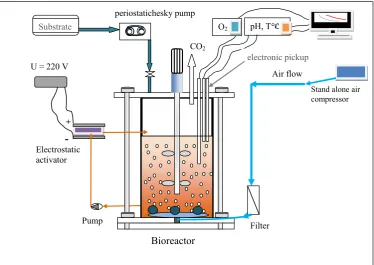
electrostatic unit and auxiliary equipment is shown in Figure1.
Constant voltage was provided by the stabilizer and rectifier (position number 2). Necessary air volume moves the
compressor through aeration system which provides
concentration of the dissolved oxygen not less than 2.4 mg/L. (position number 5). The sensors transmit information to the computer system (sensor kit and computer system management – position number 9). The software allows obtaining in real time the necessary information about the rate of cellular respiration and the amount of oxygen consumed. Besides, sensors registered time of emergence of molecular hydrogen and atomic oxygen.
Characteristics of sampling sites
In order to characterize the community structure association of different organisms, forming a closely integrated community it was developed sampling device. Sampling devices were
installed on the two networks in parallel and allows you to explore the properties of water and to conduct microscopy. Biomass sampling device has a curved profile designed to minimize disruption of boundary layer effects. Inserting with nozzles for sampling from a common conduit had a length of 1 m. Tubing was fabricated from high density polyethylene (HDPE). Further automatic sampling of a biocenosis was established. Within 3 months automatic system was scans the readings from the sensors, and then carried out a mathematical treatment of the results.
Biological and physic-chemical analytical methods
Biological samples and duplicates from the water gathered in sterile containers for physical, chemical and microbiological analysis through the taps for sampling. Measurements were carried out for 3 months, 2 times a day. In all the figures shows the average results for the analyzed period. All parameters (Table 1) were obtained by a subsequent analysis of discrete water samples. Analyses were performed in the Russian accredited laboratory drinking water and wastewater. Bacterial
cultures were incubated at 36 for 48 h and 22 for 72 h.
Colonies counted after this period of time according to Russian Standard Methods. Counting the total number of colonies of heterotrophic organisms, species identification of the colonies was performed using standard microbiological test-plates 3МTMPetrifilmTM Aqua (AQHC). To speed up the analysis of cell suspensions and micro particles used flow cytometer (Analyzer CyFlow ML). The sensitivity of the device ( 100 y. e. by FITC and 50 y. e. by PE). The analyzer was equipped with a built in camera with access to a common monitor for visual inspection. Water was collected in sterile 50 ml tubes. The mixture was stirred and incubated for 15 min in the dark prior to measurement. Data were processed and analyzed using the software. The submersible flow cytometer analyzing microbial cells in the water, it was operated continuously for up to two months. The temperature of the aqueous medium and the pH value was measured by a portable appliance model
8690, the pH range 0.00-14.00, accuracy 0.05 pH at 25 ,
temperature compensation from 5 to 50 , accuracy 0.3 .
Replaceable pH electrode module (Model VZ 86P9AZ). Experiments were performed in triplicate. The results were statistically processed using the Student t-test. Verifiable equality of the average values in two samples. The data presented in the article is of average values. We used analytical grade chemicals brands (Russia). The content of hydrogen peroxide was determined by FOX-method based on xylenol orange color change at a wavelength of 560 nm (Gay and Gebicki, 2002).
Definition of the inhibiting concentration of substances in an aqueous medium
concentration took the lowest concentration that completely inhibited the growth of bacteria.
Microscopy analysis
The study used a confocal laser scanning microscopy
(CLSM).This method of optical of optical three-dimensional (3D) surface profiling with high resolution was used to quantify biomass coverage. Each sample was examined in five random fields of view, and the relative amount of biomass is
calculated by the method of (Fish et al., 2015). In assessing the
biological diversity of species within the system under study used the concept of the importance of the species. By understanding the significance we classified value of abundance and biomass. To calculate the diversity and evenness of biocenosis used - Shannon's index (Shannon and Weaver, 1963).
Identifiers strains
Culture media were tested for microbial contamination by incubation under appropriate conditions. Plates or tubes were
incubated at least for 18 hours at 37 , or incubation
conditions, which are applied to the medium in accordance with a specific standard. The test microorganisms were tested for compliance with ISO 11133-1. Working cultures were prepared as a pure culture at the stationary phase of growth in non-selective broth cultures of the reference source. For the detection and the enumeration of coli forms applied the general
recommendations ISO 4831: 2006. To count the
microorganisms are able to grow and form colonies in a solid
medium after aerobic incubation at 30 using the method of
horizontal ISO 4833-1:2013. Used is Catalog to the reference
strains listed by the Handbook of Culture Mediafor Food and
Water Microbiology (ISO/CD 11133:2009, Annex E). Identifiers strains recommended for use the WFCC and the WDCM (Table 2).
The relevance of the study of the biological action of weak electrostatic fields
Currently there insufficient research results on the influence of physical fields on humans and biota. As a result there are differences in the standards of safety and protection of the population. Extensive studies in Russia on effects of electromagnetic fields (EMF) on human health were carried
out in 60-70 years of the 20th century (Phillips and Adler,
1978). Studies of biological action of EMF focused mainly on the effect of the electric component. Big clinical material on the negative impact a magnetic and electromagnetic field was received. In Europe and the United States as the maximum attention is paid to the effects of electromagnetic fields on humans. Research results in 80 years on the effects of EMF on the monitor showed that, among other violations in the functional state of the human body, the most pronounced violations of the hormonal and immune systems. Based on these results it has been developed regulatory standards. As the technical standards of safety monitors are well-known Swedish TSO92 / 95/98/99, and MPR II. As part of the electromagnetic fields of the standard MPR II corresponds to the Russian sanitary norms SanPiN 2.2.2.542-96 - Hygienic requirements to video display terminals, personal computers and machines to the organization work. Human exposure to electrostatic fields was paid to less attention. At the moment, the cause of
differences in the regulations of various countries in the area of valuation and forecasting of negative impact on human rights are a high rate of introduction of new radiation sources. Currently the current level of the harmful effects of physical fields determined: by the time of contact with the source, radiation intensity at a certain distance, engineering and technical protection measures. The values of the level of the electrostatic field in the Russian controlled companies only (Occupational safety standards system. Electrostatic fields, 1994). GOST 12.1.045 sets acceptable levels of electrostatic fields, depending on the residence time of the staff in the workplace and requirements for control. Standard voltage level electrostatic fields in Russia and Germany are shown in Table
3 (ICNIRP; Balodis et al., 1999). Comparison of the values
shows that there is a fairly sharp difference in approaches. This shows that there exists an underestimation of impacts energy of the electrostatic field on the human body. Many scientists, who study the impact on the human body of modern small-sized electronic means, agree that these funds are biologically unsafe.
Method of control of composition and structure of a liquid phase of complex mixes
Currently, it is proved that monodisperse particle aggregation
plays an important role in colloidal systems (Bunkin et al.,
2012). Impact of ESF on water biosystems leads to emergence of micro bubbles in a cage and on a membrane surface. Technology of GC/MS is able to recognize substances not only at low concentration, but also at the trace level. Researches were conducted on Gas Chromatograph-mass spectrometer
Agilent 7890A. This device is characterized by
a chromatography combination to mass spectrometry. At implementation of analyses the Flow Splitting technology which has equipped the device was used. Use of Agilent 7890A allowed fixing retention time repeatability and retention index accuracy. The software of fixing of times (Retention Time Locking) and developed by Nikiforov A. to the basic program the additional program for function of monitoring in case of origin and course of process of aggregation on solid nanoparticles, allowed to receive results with the minimum deviations from different systems irrespective of the operator. It gave the chance quicker and more precisely to identify optimum peak symmetry, get better integration of target peaks and to reduce risks of obtaining doubtful results when carrying out researches or at failure in the control system of parameters of all complex of the equipment. Full automatic equipment and use of electronic and pneumatic management allowed installing at the same time 6 programs which were supported by 16 control paths. The scattering coefficient was calculated according to the formula (Fabelinskii, 1981).
RESULTS AND DISCUSSION
Impact of physical fields on cell populations causes different responses. The methods of the analysis existing now allow investigating dependences of reactions by cell-like dynamic system on power influence of physical fields. Now the cage is considered from the point of view of cybernetics as the high-organized system self-regulating on the optimum mode of
functioning (Foerster, 1967; Wiggins, 2003). Enzymes in a
Bioreactor
Filter
+
-
U = 220 V
Pump Electrostatic activator
Substrate
periostatichesky pump
O2 pH, T
electronic pickup
CO2
Air flow
[image:4.595.118.493.52.317.2]Stand alone air compressor
Figure 1. The bioreactor with electrostatic activation of microbial biomass
0 5 10 15 20 25 30
8 9 10 11 12 13 14
R
edoks-p
otenti
a
l, rH
2
Intensity of the physical field, kV / m
1 - 10 ppm 2 - 240 ppm
1 2
Cell
+
Control cabinets is the electrostatic unit
Electrostatic activator
-
H2
O2+H2O2+O3
7 14 kV/m
14 20 kV/m
20 kV/m
[image:4.595.118.493.250.710.2]O+O3
Figure 2. Influence of intensity of the physical field on concentration of molecular
0 1 2 3 4 5 6 7 8 6
9 12 15 18 21 24 27 30 33 36 39 42
T
he
r
ate
of
co
n
su
m
pti
o
n of th
e
su
b
str
ate
,
m
g / g
b
iom
a
s
s
h
Time after disconnecting the electrostatic field, h
[image:5.595.177.404.80.256.2]1 2
Figure 3. fDependence of oxidation rate of a cell-like substratum (glucose) after shutdown of an electric field: 1 – Control system and 2 – system with electrostatic processing of cell-like biomass
0 2 4 6 8 10 12 14 16 18
28 30 32 34 36 38 40 42
Co
ncentrat
ion of cell-like w
e
ig
ht
(
mg /
L
)
[image:5.595.181.399.322.491.2]Electrostatic intensity (kV / m)
Figure 4. Dependence of growth of cells of biomass on tension of the field
0 2 4 6 8 10 12
0,0 0,2 0,4 0,6 0,8
Th
e
c
once
nt
ration
of
bi
omas
s
, g /
L
The concentration of hydrogen peroxide, mkg / ml 1 2
[image:5.595.158.416.551.747.2]0 20 40 60 80 100 120 140 160 180 200 22,5
23,0 23,5 24,0 24,5 25,0 25,5 26,0 26,5
Te
m
pe
rature
of
inte
rcellul
a
r wat
er
,
0 С
Time after cage getting out of electrostatic field, sec 1
[image:6.595.155.415.88.276.2]2
Figure 6. Dynamics of increase in temperature of intercellular water after switching off of electrostatic processing: 1 – Control system
and 2 – system with electrostatic processing of cell-like biomass
0 10 20 30 40
4,5 5,0 5,5 6,0 6,5 7,0 7,5
S
peed of endogenous breat
h of
cages
,
mg О/
g bio
ma
ss
h
[image:6.595.173.403.334.516.2]Tension of the electrostatic field, kV / m
Figure 7. Dependence of speed of endogenous breath of cages on tension of the physical field
0 4 8 12 16 20 24 28 32 36 40 44
120 140 160 180 200 220
T
he vol
ume o
f c
ell-li
k
e stru
cture in th
e zo
ogle
yn
y
kh
co
ng
es
tions
(cm
3 )
Tension of the ESF (kV / m)
1
2
[image:6.595.166.396.572.738.2]0 5 10 15 20 25 10
15 20 25 30 35 40 45 50
Tension ESF (kV/m)
Sp
eed
o
f i
ntrace
llul
a
r
d
is
in
teg
rat
io
n
o
f
g
lu
cose, mkg/
[image:7.595.136.463.64.491.2]h
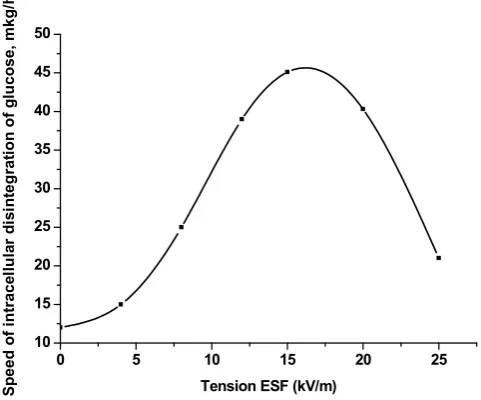
Figure 10.Dependence of speed of intracellular disintegration of glucose from tension ESF
a
Control system12-17 nm
25-32 nm gas phase After electrostatic processing
b
Control system
[image:7.595.168.409.559.759.2]After electrostatic processing
Figure 9: Influence of ESF on increase in speed of formation of a strangulation
at the time of cell division (diplococcic of Streptococcus pneumonia) (a) and
From cybernetics positions response reflects integral reaction of all cell population which is present at the environment limited by this volume, for example a fermenter. Based on ideas of cybernetics of stability of the composite cell-like dynamic systems, there is an opportunity to reveal regularities of releasers of power influence of physical fields. As a result of researches there is an opportunity to define a complex of algorithms which will allow defining risk factor from impact of the physical field on activation of cell-like biochemical processes. At such approach it is possible to consider not only the processes happening in a cage but also changes which can be used in biotechnological processes when receiving necessary, for example dosage forms (antibiotics).
Results of researches
All the results of the research presented in this paper are based on experimental results and model described in the work
(Nikiforov et al., 2015), and were a continuation of the study
of changes of biochemical processes under the influence of electrostatic field. Previously, it was found that, depending on the tension of the electrostatic field in the cells are fixed the appearance of molecular oxygen or ozone, and hydrogen peroxide (Fig. 2). In addition to the compounds of oxygen can appear and molecular hydrogen. This will inevitably lead to a change in the activity of intracellular enzymes and appearance of new intermediate products of metabolism in the form of new organic compounds. The resulting total rate of intracellular processes can both increase and decrease. The dependencies presented in figure 3, allow us to trace changes of intracellular rates of oxidation of glucose in the control system and the system with electrostatic treatment of the cell mass. The flow of substrate into the cell leads to increase the rate of its oxidation in the first hour is almost the same as in the control system and the system with EWT. After two hours of receipt of the substrate in a cage, a decrease in the speed of oxidation in
0 200 400 600 800 1000 1200 1400 1600
20,0 20,1 20,2 20,3 20,4
T
empe
rature of
a b
oun
dary layer
(
0 C
)
Time after shutdown ESF, c
[image:8.595.147.416.84.285.2]T = 200C±0,01
Figure 11. Kinetics of the boundary layer temperature changes a cage - an aqueous medium
0 5 10 15 20 25
3,6 3,8 4,0 4,2 4,4 4,6 4,8
Conc
e
n
tra
tion
o
f o
x
yg
e
n
(м
k
g
/mL
)
Tension of ESF (kV/m)
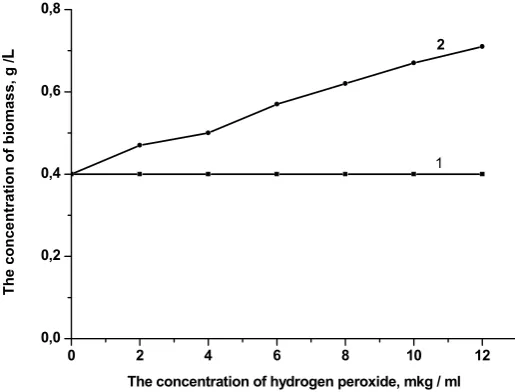
[image:8.595.155.413.355.545.2]cells control system and in the cells after within 30 minutes EWT speed biochemical oxidation is saved. And note that speed during 30 minutes has a constant value. It is not typical for natural processes. Therefore, we should expect changes in the functioning of enzymes and changes in the chemical composition of the cytoplasm of the cell. After 2.5 hours there is a sharp increase in the rate of intracellular oxidation in the system with the EWT, which the authors explain the emergence of new organic compounds. Oxidation rates have high values; therefore, new low-molecular organic compounds appeared. Authors consider that new organic compounds after oxidation by ozone or molecular oxygen of products of metabolism, characteristic of natural processes appeared. In control system such intracellular oxidizing processes could not happen because of lack of the strong oxidizer. Therefore, there is a gradual decrease of speed due to reducing the concentration of free substrate. In system with EWT falloff of speed which makes 15 mg/ h while in control system reduction of speed for this time term makes about 5 mg/ h from 4 to 7 hours is observed. Authors consider that it is bound to emergence of the substances inhibiting biochemical processes. Thus, at influence of an electrostatic field the speed of intracellular biochemical reactions not only increases, but also duration of intracellular oxidation increases. At the same time also metabolism products on the mechanism not inherent in natural regularities are oxidized. Quick reduction of speed of biochemical oxidation shows that emergence of new classes of organic compounds can cause toxication of a cage or an organism. The main conclusion consists that the maximal speed of processes of oxidation of an intracellular substratum is reached in four hours after shutdown of ESP. Within the next three clocks speed decreases by 1.6 times. The appearance of additional concentrations of low-molecular organic compounds leads to increase of the cell-like weight (Fig. 4). The maximal increase of cages is recorded at strength 10 kV / m and made 25% of an increase in control system. Sensors recorded emergence of hydrogen peroxide in intercellular water. At low values of concentration hydrogen peroxide is observed increase in growth rate of biomass (Fig.5). Authors explain increase in an increase of biomass with the fact that for decrease in the toxicity caused by hydrogen peroxide strengthening need of increase in synthesis of peroxidases appears. Decrease in an increase of biomass at further increase in a field gradient is caused by emergence already in a cell of hydrogen peroxide and ozone. The strength is higher, the concentration in a cage of these toxiferous connections increases quicker.
After shutdown of ESF increase in activity of intracellular biochemical processes leads to selection of thermal energy, and sensors fix increase temperature of intercellular water to 3
℃ during 120 sec. (Fig. 6). Increase in temperature of
intercellular water gives the grounds to claim that cages use oxygen in system with EWT more intensively. It also explains increase in an increase of the cell-like weight (Fig. 4). Therefore, in cages after influence of an electric field intracellular energy can not only change, but also change metabolism. Our results show that after influence of a weak electric field changes in cell-like metabolism are registered. Use as a nutritious substratum of glucose showed that in cages other substances can be oxidates except reference substances also. Emergence of lactic acid in cages after EWT was defined. Besides, sensors made record of emergence of an acetone. Concentration of an acetone in 10 minutes reached 0.012 mkg /g of cell-like weight. After the 10th second finding of cages in
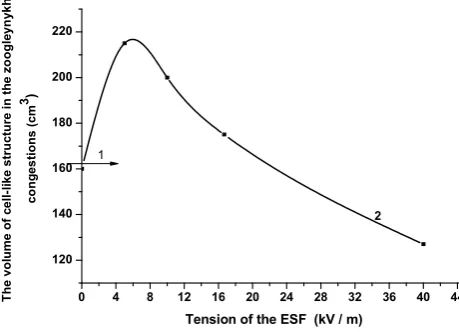
ESP the speed of endogenic respiration increases to 40% at strengths of an electric field of 4-5 kV / m, further increase in strength leads to inhibition of cellular respiration (Fig. 7). Change of a power engineering of cell-like suspension leads to expansion or compression of structure of a zoogleyny congestion or mycelium (Fig. 8).
Discussion of results
The dependence of oxidation rate of a substratum after shutdown of an electric field presented in the figure 3 allows to carry out comparison of two systems and to reveal an opportunity of increase in use by cages of the energy which is had as a result of influence of an electric field. In control system of a cage keep activity within two clocks, in system with electrostatic processing within four clocks. The maximal speeds differ twice. Lack of receipt of new portions of a substratum gives cages in control system to a reference state in 3.5 hours. In system with electrostatic processing stabilization occurs in 8 clocks. The different amount of energy is reported to cell-like suspension depending on strength of ESF. Therefore there were defined values of this size which exert positive impact on biochemical activity of cell-like biomass (Fig. 4). The received dependence of an increase of cell-like biomass on a field gradient allows determining effectiveness of use by biosystem of padding energy through change of concentration of cages. The maximal increment was received in system which was at strength of ESP in 10 kV / m. Spectrochemical researches confirmed an opportunity, both activations, and deactivation of biochemical activity depending on environment conditions that will be coordinated with results
of researches in work (DeLaney et al., 2007). Dynamics of
change of temperature of intercellular water which was recorded by sensors after shutdown of an electric field confirms the hypothesis of positive impact of ESF stated by authors at strength of 10 kV / m. The power characteristic of this field creates the favorable conditions for functioning of cell-like mechanisms and causes increase in catalytic activity of enzymes that was recorded at measurements of oxidation rate of an intracellular substratum. Increase in an increase of biomass in system with EWT will be coordinated with literary data in which also energy of the physical field was spent for increase in biomass (Bajpai and Margaritis, 1986). Further increase in power influence leads to decrease of speed of cell fission. Dependence of speed of endogenic respiration of cell-like biomass on electrostatic intensity allows calculating positive influence of energy of the physical field on cell-like weight. Calculations showed that the maximal increase in
speed is reached at
⃗
≅ 6 kV/m and makes 37%, at⃗
= 10kV/m small depressing is observed and the speed of endogenic
respiration decreases in comparison about speed at value
⃗
≅6 kV/m by 10,6%, but exceeds respiration speed in comparison with control system for 26,4% (Fig. 7). Emergence in hydrogen peroxide cytoplasm in low concentration leads to acceleration of cell-like division as it is a cell-like metabolite and plays an important role in updating of structure of a cage. The received dependence of an increase of cell-like biomass on concentration of hydrogen peroxide will be coordinated with literary data in which participation of hydrogen peroxide in
power intracellular processes (Gamalya et al., 1996) is proved.
hydrogen after influence of ESF promotes acceleration of biochemical oxidation of a substratum and increase in body height of biomass in aerobic conditions that was also shown in work (Hambourger, 2008). It will be coordinated with the experimental datas and other researchers who proved presence
at microorganisms of vodorodaktiviruyushchy system
(Cammack, 1999; Tard et al., 2005). The recorded presence of
molecular hydrogen promotes activation of biochemical intracellular processes as before molecular hydrogen is formed, always at first appears atomic which a carrier of electrons is.
Integral proteins make a ground mass of membranous proteins. Also important structural component of membranes is water which carries out a crucial role in stabilization of membranous systems. Reaction of membranes to external influence rather composite, but with small amplitudes of deformation with a sufficient degree of accuracy reversible can consider as thermodynamic. As the membrane is isotropic along a surface, density of a potential energy of elasticity is function of deformation of the relative change of a surface area. Increase in cooperative energy in cell-like biomass after influence of ESF leads to a cubic dilatation of structure in microbial community. After completion of influence of ESF loss of intercellular water is observed (Fig. 6). Dependence of a restoring time of cell-like structure on electrostatic intensity proves structural deformation and shift of intercellular water in the direction of an aqueous medium.
Formation and stability of gas bubbles on the surface of a cell
Questions formation and stability of gas bubbles on the solid surface, and in particular on the cell surface are treated in a
number of papers (Simonsen et al., 2004; Matsumoto and
Tanaka, 2008).The energy barrier near the membrane is considerably lower than in the bulk that contributes to the formation and evolution of gas bubbles (Ljunggren and Eriksson, 1997). Origin and allocation of gas phase due to the presence of the metastable state of the thin layers of water near
the membrane (Deryagin et al., 1986). The released gas
bubbles on the cell membrane surface, include molecular hydrogen and oxygen, which are stabilized ions of salts, present in the aqueous medium (Matsumoto and Tanaka, 2008;
Bunkin et al., 2009). Gradually, however, observed their
amalgamation to the size in diameter of 500-700 nm. Past measurements of the diameters of bubbles through 18-24 hours showed that virtually diameters remain stable. But after 70-78 hours, a decrease vesicle diameter, the authors explain the processes beginning of dissolution of molecular oxygen and molecular hydrogen in an aqueous environment.
Influence of the gas phase created after influence of ESP on the speed of division of bacteria
As a result of the physical and chemical processes caused by energy of ESP in boundary layers (an aqueous medium – a bacterial cell) the gas phase comprising oxygen, molecular hydrogen and ozone is allocated (Ljunggren and Eriksson, 1997). Selection of a gas phase in boundary layers is caused by
a difference of the interfacial tension (Deryagin et al., 1986).
Emergence in an aqueous medium of micro bubbles, their further integration and concentrating on border a cage - the aqueous medium leads to a rupture of microbial congestions (Fig. 9). As a result the specific surface area of this bacterial congestion increases that promotes increase in speed of intake
of nutrients. Thus, cell-like weight in the course of further body height has an opportunity to quicker use nutrients from a substratum or an aqueous medium (Fig. 10). These necessary substances (body height factors) are used after division by bacteria to the initial size. The observed changes of temperature of a border layer the cage Wednesday and concentration of the dissolved oxygen in intercellular space, also create the favorable conditions for increase in speed of formation of a strangulation of a cell-like wall at cell division (Fig. 11 and 12).
New comparative impact assessment ESF
The use of UV lamps in offices and for water disinfection, the use of computer equipment and cell phones affect the
condition of the people (Novikov et al., 2010). Weak physical
fields and radiation can lead to deviations in the behavior of biological objects (Anderson, 1993; Trukhan, 2009). Therefore, this problem can be solved only when you receive a vast array of experimental data on various biological objects (Adey, 1993; Shein and Kharlanov, 2006). The mechanism of biological activity under the influence of weak physical fields is complex and requires a combination of studies of different specialists: physicists, biologists, ecologists, physicians (Qin
et al., 2005). Results of researches in this direction concentrate, but to show in what the biophysical mechanism so far now consists it isn't possible (Truhan and Anosov, 2004).
Conclusion
Weak physical fields are ecologically significant factor
influencing many cellular processes (Qin et al., 2005).
Researchers have shown that live organisms have high sensitivity to physical fields. Frequency and amplitude range of physical fields in the nature is rather big. For health of the person frequencies have ecological value industrial (50–60 Hz) and communication (70–80 Hz). Authors assumed that it is possible to draw a parallel between reactions of the person and microbes’ communities as by researches it is shown that there are many cumulative biological effects at all levels of the organization of live systems at influence of physical fields (Tokalov and Gutzeit, 2004). Therefore it is possible to use these frequencies of physical fields, for example, for activation of microorganisms in the course of cultivation of antibiotics. Also reaction of microorganisms to influences of physical fields with such frequency can be used for acceleration of technological processes in productions of food. Authors were based on comparison of series of biological changes in parameters of speed of endogenous breath, biochemical oxidation, and changes in dynamics of enzymatic processes. This approach has allowed finding communication of biochemical and physical and chemical processes with tension of electrostatic field. In this methodological approach comparison of data of the microscopic analysis to the time spent of cellular weight in electrostatic field is rather informative.
Basic results
1. It is established that change of tension of ESP leads either to increase, or to decrease of the activity of cages, division speed, to change of the chemical composition of products of metabolism.
in which the operating parameter is influence frequency.
Conclusions and Future prospects
The results of pilot studies presented in article show that the new tendency in use of physical fields with small energy has
ample opportunities to solve certain problems in
biotechnology, pharmaceutical and ecological processes. Use of electrostatic fields for activation or inhibition of cages (for example, cancer) and aerobic microbes’ communities in water systems represents the promising direction which allows to consider in each case the possibility of increase in efficiency of biochemical processes in this system. Researchers have shown that work with microbes’ communities in aerobic conditions has a number of advantages as it allows calculating rates of increase in enzymatic activity and periods which provide restoration of cellular mechanisms or the beginning of death of a cage. It is especially important in systems of monitoring of biotechnological processes. The presented results on the speed of consumption and oxidation of an organic substratum show that cages after stay within 30 seconds in electrostatic field use oxygen more intensively. It proves that energy of the physical field in certain conditions can be used by cages and microorganisms in intracellular exchange processes. It leads to biomass building acceleration that can be used in biotechnological productions. These can explain that water natural objects and artificial constructions (bioreactors) contain more active strains and microbes’ communities in the conditions of intensive influence of Technogenic objects. Technogenic influence and physical fields cause formation of ozone, atomic oxygen, hydrogen peroxide and molecular hydrogen in cytoplasm of cages. These connections depending on concentration and the time spent in cytoplasm promote or to increase in growth rate of biomass, or cause inhibition of intracellular processes. At oxidation of this hydrogen energy which can be used in intracellular processes will be emitted. However what enzymatic reactions will accelerate or will be slow to depend as well on existence of other factors. The combination of all natural factors at present of time, perhaps, can result also in negative results, for example mutations of cells. The results received in the conducted researches allow
determining duration of processing and necessary
concentration of a coagulant on installations of treatment facilities when carrying out process of dehydration of rainfall.
Compliance with Ethical Standards
Experimental procedures
All work cells biomass was carried out in accordance with national and international guidelines.
Conflict of interest
The authors declare that they have no conflict of interest. Ethical approval: This article does not contain any studies with human participants or animals performed by any of the authors.
REFERENCES
Adey, W.R. 1993. Biological effects of electromagnetic fields,
J. Cell Biochemist, 51(4): 410-416.
Anderson, L.E. 1993. Biological effects of extremely
low-frequency electromagnetic fields in vivo studies, J.
American Industrial Hygiene Association, 54(4): 186-196. Bajpai, P.K., Margaritis, A. 1986. Effect of temperature and
pH on immobilized Zymomonas mobilis for continuous
production of ethanol. Biotechnol. Bioeng., 28(6): 824-828
Cross Ref. 18 FEB 2004|DOI: 10. 1002/bit.260280608 Balodis, V.A., Kolodynski, A., Auce, Z., Bruvere, R.,
Feldmane, G., Heisele, O. and Tjarve D. 1999. The effect of electromagnetic radiation from the Skrunda RLS on organisms. Proceedings Int. Seminar on effects of EMF on
the Living Environment. Imaning, Germany, October 4-5:
259-267. ICNIRP, 2000
Berezov, T. T., Korovkin B.F. 1998. Biologicheskaya khimiya,
Meditsina, Moscow. ISBN: 5-225-02709-1
Bunkin, N.F., Shkirin A.V. and Kozlov V.A. 2012. Cluster structure of dissolved cas nanobubbles in lonic aqueous
solution. Journal chemical &engineering, June 24 to 29.
Bunkin, N.F., Suyazov, N.V., Shkirin, A.V., Ignatiev P.S. and Indukaev, K.V. 2009. Experiment on the interferometer
phase microscopy. J.Chem.Phys., 13(130): 134308-134320
Cammack, R. 1999. Bioinorganic chemistry: Hydrogenase
sophistication. Nature, Jan, 21: 397(6716), 214-215. DOI:
10.1038/16601
Churmasova, L.A., Nikiforova, L.O., Kuznetsov, A.L. 2014.
Effect of electrostatic field on distilled water. Chemical
engineering, 5: 200-204.
DeLacey A.L., Rousset, M., Cammack, R., Femandez, V.M. 2007. Activation and inactivation of hydrogenase function and the catalytic cycle: spectroelectrochemical studies.
Chem. Rev., 107(10): 4304-4330.
Deryagin B. V., Dukhin S. S., Rulev N. N. 1986. Mikroflotation: Water purification, enrichment. М: Chemistry.
Fabelinskii, I.L. 1981. Molecular Scattering of Light. Plenum Press: New York. DOI 10.1007/978-1-4684-1740-1_2; Fihri, A., Artero, V., Razavet M., Baffert C., Leibl W. and
Fontecave M. 2008. Cobaloxime-based photocatalytic
devices for hydrogen production. Angew. Chem. Int. Ed.,
47: 564-567.
Fish, K.E., Collins, R., Green, N.H., Sharpe, R.L., Douterelo, I., Osborn, A.M. and Boxall, J.B. 2015. Caracterisation of the physical composition and microbial community
structure of biofilms within a model full-scale drinking
water distribution system. PLoS ONE, 10(2) (2015):
e0115824 http://dx.doi.org/10.1371/journal.pone.0115824
Foerster, H. 1967. Computation in Neural Nets. BIOSYSTEMS,
1(1): 47–93
Gamaley, I.A., Klyubin I.V. 1996. Hydrogen peroxide as a
signaling molecule. Cytology, 38(12): 1233-1247.
Gay C, Gebicki J.M. 2002. Perchloric acid enhances sensitivity and reproducibility of the ferric-xylenol orange peroxide
assay. Anal Biochem., 304: 42−46.
Hambourger, M., Gervaldo, M., Svedruzic, D., King, P.W., Gust, D., Ghirardi, M., Moore, A.L. and Moore, T.A. 2008.
FeFe-Hydrogenase-Catalyzed H-2 production in a
photoelectrochemical biofuel cell. Am. Chem. Soc., 130:
2015-2022. ISO/CD 11133:2009, Annex E.
ICNIRP. Effect of electromagnetic fields on the environment. Proceedings. Int. seminar on effects of electromagnetic
fields on the living environment. Ismaning, Germany,
1999; October 4 and 5. ICNIRP 10/ 2000.
ISO 4831: 2006. Microbiology of food and animal feeding stuffs - Horizontal method for the detection and enumeration of coli forms - Most probable number technique.
ISO 4833-1:2013. Microbiology of the chain – Horizontal method for the enumeration of microorganism. Part 1: Colony count at 30 °C.
Kim, T. H., Park, C. and Kim S. 2005. Water recycling from desalination and purification process of reactive dye manufacturing industry by combined membrane filtration, J. Cleaner Prod., 13(8): 779-786.
Ljunggren, S., Eriksson, J. C. 1997. The lifetime of a colloid-sized gas bubble in water and the cause of the hydrophobic
attraction. Colloids and Surfaces A: Physicochemical and
Engineering Aspects, 129-130: 151–155 DOI: 10.1016/S0927-7757(97)00033-2
Matsumoto, M., Kotaro, T. 2008. Nano bubble—Size
dependence of surface tension and inside pressure. Fluid
Dynamics Research, July–August, 7–8 (40):546-553.
Nikiforov, A.Yu., Nikiforova, L.O. and Budaeva, V.A. 2015.
Influence of an electric field on biosystems. Modern
scientific potential – 2015, February-march, 31: 31-39. ISBN 978-966-8736-05-6, DOI: 10.17686/sced_rusnauka_ 2015-1404.
Nikiforova, L.O., Kuznetsov, A.L., Nikiforov, A.Yu., Mousse, S.R. and Budaeva, V.A. 2014. Examination of action of the electrostatic field on water solutions containing sulfates
and chlorides of heavy metals. Chemical engineering, 11:
641-645. DOI:10.17686/sced_ rusnauka_2014-1436 Novikov, V.V., Ponomarev, V.O., Novikov, G.V., Kuvichkin,
V.V., Kulikova, E.V. and Fesenko, E.E. 2010. The effects and molecular mechanisms of the biological action of weak
magnetic fields and ultra. Biophysics, 55(4): 631-638.
Phillips, J.B., Adler, K. 1978. Directional and discriminatory responses of salamanders to weak magnetic fields. In:
Animal Migration Navigation and homing. Springer-Verlag, Berlin, pp. 325-333.
Qin, C., Evans J.M., Yamanashi W.S., Sherlang B.I. and
Foreman R.D. 2005. Effects on rats of low intensity and
frequency electromagnetic field stimulation on thoracic spinal neurons receiving noxious cardiac and esophageal
inputs. Neuromodulation, 8(2): 79-85.
Shannon, C.E., Weaver, W. 1963. The mathematical theory of
communication. University of Illinois Press, Urbana, 117
pp.
Shein, A.G., Kharlamov, A.V. 2006. The transverse acoustic oscillations cells and the influence of electromagnetic
waves of low intensity. Biomed. Technology and
Electronics, 4: 15-20.
Shtamm, E.V., Purmal, A.P. and Skurlatov, Yu. I. 1991. The role of hydrogen peroxide in a natural aqueous
environment. Russian Chemical Reviews, 60 (11):
2373-2411.
Simonsen, A.C., Hansen, P.L. and Beate Klösgen. 2004. Nanobubbles give evidence of incomplete wetting at a
hydrophobic interface. Journal of Colloid and Interface
Science, 1(273): 291-299
Tard, C., Liu, X., Ibrahim, S.K., Bruschi, M., De Gioia, L., Davies, S.C., Yang, X., Wang, L-S., Sawers, G. and Pickett, C.J. 2005. Synthesis of the H-cluster framework of
iron-only hydrogenase. Nature, 433 (7026): 610-613. DOI:
10.1038/nature03298
Test microorganisms for commonly used culture media (giving information on the culture medium, culture conditions, test microorganisms, culture collection number of test organisms and the expected reactions.
Tokalov, S.V. and Gutzeit, H.O. 2004. Weak electromagnetic fields (50 Hz) elicit a stress response in human cells.
Environmental Research, 2(94): 145-151.
Truhan, E.M. and Anosov, V.N. 2004. The vector potential and biological activity of weak fields. Physics of the interaction of living objects with the environment: Coll. scientific.tr. /Ed. Bingo VN. M.: MILTA, 71-86.
Trukhan., E.M. 2009. Impact of weak electromagnetic fields
on biological activity of water phase.Computer studies and
modeling, 1(1): 101-108.
Voeikov, V.L. 2006. Fundamental Role of Water in
Bioenergetics. Biophotonic and coherent systems in
biology. N.Y.: Springer, p. 89–104.
Wiggins, S. 2003. Introduction to Applied Nonlinear Dynamical Systems and Chaos. Springer-Verlag New York. DOI 10.1007/b97481, Hardcover ISBN 978-0-387-00177-7, Softcover-ISBN 978-1-4419-1807-9, Series ISSN 0939-2475.