CAUSE AND CONSEQUENCE OF DISABILITY IN KENYA: AN INTERROGATION OF DEVOLUTION AS
ADDRESSED BY THE KENYAN CONSTITUTION AND ITS
Machakos University College, Kenya, P.O Box 139
ARTICLE INFO ABSTRACT
This paper presents the interrelatedness between poverty and disability in Kenya.
disability through malnutrition, poor health care and poor living conditions. This leads to secondary disabilities for people who are already disabled. Disabled people in Kenya are among the poorest due to stigmatization and discrimination a
the community. This paper reviews the legal framework on disability in Kenya by focusing on the Kenyan constitution and the Disability act of 2003 in order to assess their impact in improvi lives of the disabled people in Kenya. Section one defines and gives a background of disability in Kenya. Section two presents a review of legal documents on disability in Kenyan and an assessment of their implementation. Section three discusses edu
four discusses transition and employment for people with disabilities and section five forms the conclusion.
Copyright©2017, Dr. Pamela Muriungi. This is an open access article distributed under the use, distribution, and reproduction in any medium, provided the original work is properly cited.
INTRODUCTION
Though disability is hard to define, the working definition for this paper is a long term impairment leading to social and economic disadvantages, denial of rights and limited opportunities to play an equal part in the life of the community. Poverty is both a cause and consequence of disability in that both reinforce each other contributing to increased vulnerability and exclusion of disabled persons. Disability impacts negatively on the individual’s chances of going to school and consequently on participation in
and paid employment. Some of the common causes of disability include poor nutrition, limited access to vaccination programmes and health and maternity care, congenital diseases, inadequate information about the causes of impairment, accidents among others as shown in Figure 1. Disability increases the isolation and economic strain in families. Children with disability are more likely to die young or to be neglected. Persons with disabilities experience worse socio-economic outcomes than people without disabilities such as less education, worse health outcomes, less employment and higher poverty levels. The limited access to education coupled with lack of employment drives them deeper into poverty and
*Corresponding author: *Dr. Pamela Muriungi, Machakos University College, Kenya, P.O Box 139
ISSN: 0975-833X
Article History:
Received 20th November, 2016
Received in revised form
05th December, 2016
Accepted 25th January, 2017
Published online 28th February,2017
Key words: Disability, Poverty, Transition.
Citation: Dr. Pamela Muriungi.2017. “Cause and Consequence of Disability in Kenya: An
Constitution and its Impact on Disability Mainstreaming
RESEARCH ARTICLE
CAUSE AND CONSEQUENCE OF DISABILITY IN KENYA: AN INTERROGATION OF DEVOLUTION AS
ADDRESSED BY THE KENYAN CONSTITUTION AND ITS IMPACT ON DISABILITY
MAINSTREAMING
*
Dr. Pamela Muriungi
Machakos University College, Kenya, P.O Box 139-0100, Machakos
ABSTRACT
This paper presents the interrelatedness between poverty and disability in Kenya.
disability through malnutrition, poor health care and poor living conditions. This leads to secondary disabilities for people who are already disabled. Disabled people in Kenya are among the poorest due to stigmatization and discrimination as they cannot fully participate in the economic and social life of the community. This paper reviews the legal framework on disability in Kenya by focusing on the Kenyan constitution and the Disability act of 2003 in order to assess their impact in improvi lives of the disabled people in Kenya. Section one defines and gives a background of disability in Kenya. Section two presents a review of legal documents on disability in Kenyan and an assessment of their implementation. Section three discusses education for the disabled persons in Kenya. Section four discusses transition and employment for people with disabilities and section five forms the conclusion.
is an open access article distributed under the Creative Commons Attribution License, which use, distribution, and reproduction in any medium, provided the original work is properly cited.
disability is hard to define, the working definition for this paper is a long term impairment leading to social and economic disadvantages, denial of rights and limited opportunities to play an equal part in the life of the se and consequence of disability in that both reinforce each other contributing to increased vulnerability and exclusion of disabled persons. Disability impacts negatively on the individual’s chances of going to school and consequently on participation in social life Some of the common causes of disability include poor nutrition, limited access to vaccination programmes and health and maternity care, congenital diseases, inadequate information about the causes of among others as shown in Figure 1. Disability increases the isolation and economic strain in families. Children with disability are more likely to die young or to be neglected. Persons with disabilities experience worse without disabilities such as less education, worse health outcomes, less employment and higher poverty levels. The limited access to education coupled with lack of employment drives them deeper into poverty and
Machakos University College, Kenya, P.O Box 139-0100, Machakos.
this makes it more and more difficult to break out of the vicious circle of poverty. According to Dee (2006), literacy rates among the disabled are considerably lower than the rest of the population. This is because only approximately 1 children with disabilities in developing countries receive an education. Boys with disabilities attend school more frequently than girls with disabilities (United Nations, 2006) the access to reproductive health among people with disabilities is minimal and as a result they suffer greater vulnerability to reproductive health care.
Background of disability in Kenya
There is no current data on the situation of people with disabilities in Kenya. Although some figures are available, they do not give an accurate picture of the number of disabled people living in the country. According to WHO (2006), 10% of every population is disabled and applying this to the Kenyan population of approximately thirty si
to three million disabled people. Kenya’s earliest efforts for organized care and provision of special needs education dates back to the late 1940s with much involvement of the religious institutions like the Salvation Army, the A
Methodist and the PCEA churches. These religious institutions established schools for children with disabilities where they had mission centers.
International Journal of Current Research
Vol. 9, Issue, 02, pp.47238-47242, February, 2017
INTERNATIONAL
Cause and Consequence of Disability in Kenya: An Interrogation of Devolution as addressed by the Kenyan Constitution and its Impact on Disability Mainstreaming”, International Journal of Current Research, 09, (02), 47238-47242.
CAUSE AND CONSEQUENCE OF DISABILITY IN KENYA: AN INTERROGATION OF DEVOLUTION AS
IMPACT ON DISABILITY
Machakos
This paper presents the interrelatedness between poverty and disability in Kenya. Poverty causes disability through malnutrition, poor health care and poor living conditions. This leads to secondary disabilities for people who are already disabled. Disabled people in Kenya are among the poorest due s they cannot fully participate in the economic and social life of the community. This paper reviews the legal framework on disability in Kenya by focusing on the Kenyan constitution and the Disability act of 2003 in order to assess their impact in improving the lives of the disabled people in Kenya. Section one defines and gives a background of disability in Kenya. Section two presents a review of legal documents on disability in Kenyan and an assessment cation for the disabled persons in Kenya. Section four discusses transition and employment for people with disabilities and section five forms the
ribution License, which permits unrestricted
this makes it more and more difficult to break out of the According to Dee (2006), literacy rates among the disabled are considerably lower than the rest the population. This is because only approximately 1-2% of children with disabilities in developing countries receive an education. Boys with disabilities attend school more frequently than girls with disabilities (United Nations, 2006) the access to ductive health among people with disabilities is minimal and as a result they suffer greater vulnerability to reproductive
Background of disability in Kenya
There is no current data on the situation of people with ough some figures are available, they do not give an accurate picture of the number of disabled people living in the country. According to WHO (2006), 10% of every population is disabled and applying this to the Kenyan population of approximately thirty six million would translate to three million disabled people. Kenya’s earliest efforts for organized care and provision of special needs education dates back to the late 1940s with much involvement of the religious institutions like the Salvation Army, the Anglican, catholic Methodist and the PCEA churches. These religious institutions established schools for children with disabilities where they
INTERNATIONAL JOURNAL OF CURRENT RESEARCH
Source: UN Figures in overcoming obstacles to the integration of disabled people, UNESCO, (1995).
[image:2.595.58.271.245.451.2]Figure 1. Causes of impairments
Figure 2. Vicious circle of poverty and disability
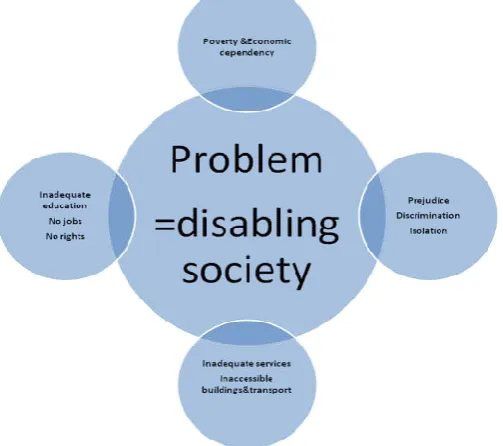
The management of these schools has however been taken over by the ministry of education. However the attitude of the society has remained negative towards disability and this has led to restrictions in the environment that hamper the progress of persons with disabilities as explained by the social model on disability.
Figure 3. Social Model of disability
The social model on disability maintains that though a person’s disability poses some limitations, most times the surrounding society and environment are more limiting than the disability itself. According to the social model of disability,disability is caused by the way the society is organised. The society has put barriers that disable people with impairments.If the barriers that restrict life choices for disabled people are removed,they can live independently in the society with choice and control over their own lives. The barriers created by the society are not only physical but they also represent attitudes based on prejudice and the inability to access equal opportunities in the society.Unfotrunately the society tries to change people with disability to fit into the’’ normal” society instead of changing the environment and the attitudes of the society.
Legal framework on disability in Kenya
The government of Kenya has adopted a number of policies and laws pertaining to persons with disabilities. Kenya is a democratic state and democracy is incomplete when a certain percentage of the population is unable to undertake its responsibilities of nation building by being full participants in nation development. The poverty levels which persons with disabilities face are higher compared to the rest of the society mainly because disability undermines an individual’s ability to interact in educational, economic, social or even political arenas. Poverty breeds disability and disability breeds more poverty. Breaking this poverty trap calls for conscious and concerted efforts by the society to ensure and effect the rights of persons with disabilities and especially the right to education since education is a key means to poverty alleviation, personal growth and development.
The Kenya National Commission on Human Rights (KNHCR) has the core mandate of protecting and promoting human rights. Disability is a central human rights issue and persons with disabilities expect and require that their exercise of human rights should be promoted and protected on an equal basis with their non disabled peers. The government of Kenya is committed to the protection and provision of equal opportunities to persons with special needs. The government has developed a number of policy guidelines dating back to 1964.These include: committee on care and rehabilitation of the disabled child (1964).This resulted in the formulation of session paper No.5of 1968 which recommended that children with mild handicaps be integrated to learn in regular schools. Then there was the Kenya Education Commission of 1964, the National Education Commission on Education Objectives and Policies (NCEOP) (1976), the Kamunge Report (1988) and the Koech Report of (1999)and the task force on Special Needs Education (Kochung Report) of 2003.
The Person’s with Disability Act, 2003
[image:2.595.40.292.557.780.2]Persons with disabilities are to be subject to terms and conditions of the employment together with compensation and privileges save for the fact that they are to be exempted from paying taxes. In as far as education for persons with disabilities is concerned; the act is categorical that no person or learning institution shall deny admission to a person with disability to any course of study by reason only of such disability. Itfurther recommends that special schools and institutions be established to cater for formal education, skills development and self reliance. However the act is lacking in that it lacks the acknowledgement of ‘’youth with disabilities’’ as a specific category of people with unique needs .The act also uses a charity based approach rather than a rights based approach in addressing issues affecting the youth with disabilities. For instance instead of addressing education as an issue of human rights, the persons with disabilities act takes a charity approach by stating that the government should make provisions for assistance to students with disabilities in the form of scholarships, loans, fee subsidies and other forms of support in both public and private institutions. The act is also silent about what should happen in circumstances when such a person cannot afford the cost of education. The persons with disabilities act also lack a strong evaluation and implementation framework. Further the act lacks clarity with regard to the categorization of disability. This is because the act defines disability as physical, sensory, mental or other impairment, including any visual, hearing, learning or physical incapability, which impacts adversely on social, economic or environmental participation. It is important to note that the nature of societal attitudes play an important role in determining the rights, roles and responsibilities accorded to people with disabilities.
The Kenyan constitution 2010
The enactment of the Kenyan constitution 2010 provides numerous gains for persons with disabilities. Some of these gains include non-discrimination as provided for in article 27(4) and (5), recognition of the Kenyan sign language, Braille and other forms of communication, an expansive bill of rights as well as affirmative action measures to ensure representation and participation of persons with disabilities. Article 54 specifically focuses on the rights of persons with disability providing a list of specific rights including the right to be treated with dignity and respect. The constitution also creates specific rights of access to educational institutions and to public places, transport and information. It contains the right to use Kenyan sign language, Braille and other means of communication as well as access to materials and devices to overcome the constraints arising from the disability. Further the constitution confirms that it is the duty of the state to ensure progressive implementation of the principle that persons with disability should occupy 5% of positions in employment. The organizations for persons with disability need to take advantage of this latest legal tool to ensure that this representation becomes a reality. The constitution has strongly focused on issues of equity targeting discrimination faced by various marginalized groups including persons with disabilities. The constitution prohibits all forms of discrimination on the grounds of disability. The constitution also prohibits employers from paying employees differently for work of equal value. However, though the Kenyan constitution provides a better framework and enhanced rights for persons with disabilities for protection against discrimination under Article 27, their lives remain marked by
experiences of discrimination, prejudice, stigma and discriminatory attitudes towards disability which prevail even within families. The discrimination which persons with disabilities experience within families has far reaching consequences for their ability to participate equally in other areas of life. This includes in particular access to education. Some parents are unwilling to send their children with disability to school due to preconceptions about their disability and this leads to the conclusion that access to employment for persons with disabilities is limited. The low educational status, prejudice among the employers regarding the capacity of persons with disabilities and lack of accommodation in the workplace have contributed greatly to lack of employment opportunities for persons with disabilities. Further the Kenyan constitution addresses the rights of persons with albinism yet this category of persons with disability continue to face severe problems arising from prejudice and superstition as a result of failure to make reasonable accommodation for their particular health and social needs. Albinism is a subject of significant superstition in Kenya which in some cases has led to violence against those with the condition. Persons with albinism continue to face serious problems in accessing education due to the school’s failure to take steps to accommodate their visual impairment. The categorization of persons with albinism as blind has the effect of denying them access to appropriate health care which addresses their particular problem of photo-sensitivity.
Education for the Disabled Persons in Kenya
Special needs education started in Kenya after the Second World War. It was only offered in special schools until the 1970s when units and integrated programmes were initiated. Over the years, special education has continued to expand and includes the following categories:
Learners with hearing impairments Learners with visual impairments Learners with physical handicaps Learners with cerebral palsy Learners with epilepsy
Learners with down’s syndrome Learners with autism
Learners with mental retardation
Learners with emotional and behavior disorders Learners with learning disability
Learners who are gifted and talented
Learners with speech and language difficulties Learners who are deaf-blind
Learners who are living in difficult circumstances(the orphans, street children, children from pastoralist communities, children heading households, displaced/refugee learners)
Provision of special education services is hampered by a number of challenges. According to a report by UNDP (2005),
these challenges include among others; inadequate data on children with special education needs and disabilities, lack of proper guidelines on mainstreaming special education at all levels in the country, lack of appropriate tools and skills for early identification and assessment, inadequate physical infrastructure and teaching/learning materials appropriate for learners with special needs together with Inadequate skilled manpower and inappropriate placement for children with special needs. Achieving the right to education for children with disabilities is necessary so as to realize the Jomtien and Dakar declarations on education and the millennium development goal on education for all (EFA) by 2015. The current legal and policy framework governing education does not adequately address the education for children with disabilities and there is therefore need to put in place positive measures to facilitate access to education for children with disabilities. According to Moest (2003) only a small percentage of children with disabilities attend school in Kenya. Though the free primary education initiative (FPE) has generally enhanced education, the same cannot be said of children with disabilities. There is absence of specific curriculum for teaching children with intellectual disabilities and this constitutes discrimination. The ministry of education quality assurance and standards division does not regularly inspect special schools. This makes it difficult for them to come up with recommendations to enhance provision of education to children with disabilities. There is still stigma attached to persons with disabilities. In line with the international human rights norms, all human beings have the right to education. The disabled persons have the right of access to education on an equal basis with their non-disabled peers. The quality of education for persons with disabilities should be equal to that of persons without disabilities while at the same time meeting the special needs of persons with disabilities.
They have the right to be educated in the same schools and follow same curricula. The education programme should however be adapted to the special needs of the person with disability so as to engage the maximum potential of that person. The cost of providing educational services for learners with special needs constitutes the greatest limiting factor to increased enrollment, retention and transition of such learners within the educational programmes. This is compounded further by the fact that majority of learners with special needs come from poor families. Such families find it difficult to participate in cost sharing where it is required and this makes the quality of education to be compromised. Education is the primary vehicle through which marginalized and persons with disabilities can lift themselves out of poverty. People with disabilities face particular challenges in education and training. Many are denied access to basic literacy and numeracy skills. Moest (2003) estimates that 98% of children with physical or mental impairments in developing countries do not attend school and that less than 10% of all disabled children attend school.
Transition and employment for persons with disabilities
Transition refers to the opportunities that are available for young disabled persons for participation and development of capabilities which enables them to fulfill future expectations. Transition into adulthood is closely linked to gaining access to employment, maintaining a home and becoming appropriately involved in the community and experiencing satisfactory personal and social relationships. The fact education for persons with disabilities lags behind compared to the education of regular learners implies that transition rates from primary to secondary school is very low. Transition from secondary to the university is even worse .Mugo(2010) carried out an analysis the performance of students in the university entry exam (KCSE) over the period 2005-2007 in order to find out the probable number of students who were joining the university from high school .Table 1.2 shows the results of the analysis.
The competitive university entry has averaged B+ over recent years. The data suggests that out of a total of 149 students only one could have automatically joined the university representing a transition rate of only 0.7%. Like education, employment and economic independence is a basic entitlement for persons with disabilities. Youth with disabilities lack access to the job market and they are often faced with a lot of challenges. They are also poorly equipped for the job market and lack the necessary life skills. According to Mugo(2010) this is occasioned by the fact that only less than 10% of disabled youth are able to access education and even when they do, most of the special schools maintain traditional aims of special education in terms of control, containment and care which outweigh the objectives of a balanced curricular. The problem of employment for youth with disabilities is further magnified by the existing job market in Kenya which is marked by high rates of unemployment. In a setting where young people with disabilities have to compete with those regarded as able bodied in an already saturated job market, the disabled youth are likely to lose out. The majority of jobs also require physical strength and high sensory capacity which the disabled youth do not possess. Though the Kenyan constitution has strongly focused on equity issues, the labor law reforms that have been undertaken in Kenya have not had much to do with employment of persons with disabilities. An analysis of the labor law reforms by ILO (2004) concluded that reforms of the employment act, the wages and regulations of the employment act and the trade dispute acts had openly neglected persons with disabilities.
Conclusion
[image:4.595.154.439.70.125.2]Disability and poverty are often intertwined. Poverty often leads to disability and disability often leads to poverty. Yeo & Moore (2003) maintain that even though poverty does not necessarily cause disability and disability does not necessarily cause poverty, the relationship between the two is very strong. People with disabilities are at risk of being and remaining among the poorest as a result of illiteracy, unemployment and limitation in social contact, exclusion from political and legal
Table 1. Performance of students at THB (2005-2007)
A A- B+ B B- C+ C C- D+ D D- E Total
2005 0 0 0 2 3 9 14 14 9 2 0 0 53
2006 0 0 1 3 4 12 8 15 7 4 0 0 54
2007 0 0 0 1 3 4 12 10 8 4 0 0 42
Total 0 0 1 6 10 25 34 39 24 10 0 0 149
processes as well as limited access to resources. Lack of mental and body functioning may deprive the individual access to subsistence, education and social participation. Certain environmental conditions such as lack of access to proper nutrition, healthcare and proper medication are all possible causes of disability.
REFERENCES
Barnes, C. and Mercer G. 1999. Exploring disability.A sociological introduction.Polity press.cambridge.
Dee, L. 2006. Improving transition planning for young people
with special education needs.Madenhead .Open University
Press.
Elwan, A. 1999. Poverty and disability. Social protection
discussion paper NO.9932.Human development Network.
The World Bank.
Government of Kenya (GoK 2002. The children act,
2001.Nairobi.Government printer.
Government of Kenya (GoK) 2004. Kenya Gazette
Supplement, The persons with disabilities Act, 2003.
Nairobi. Government printer
Government of Kenya (Government of Kenya (GoK) 2010.
Constitution of the republic of Kenya, published August 2010.Nairobi.Government printer.
ILO 2004. Employment of people with disabilities. The impact of legislation: Geneva: ILO.
Moest 2003. Report of the task force on implementation of free primary education. ministry of education.nairobi.
Mugo, J.K. and Oranga, J. 2010. Testing youth transitions in Kenya: Are young people with disabilities falling through
the cracks? Recoup, University of Cambridge.
UNDP & Government of Kenya 2005 .Millennium Development Goals: progress report for Kenya
United Nations, 2006.Convention on the rights of persons with
disabilities. Geneva.
Yeo, R. 2005. Disability, poverty and the new development
agenda.KAR.