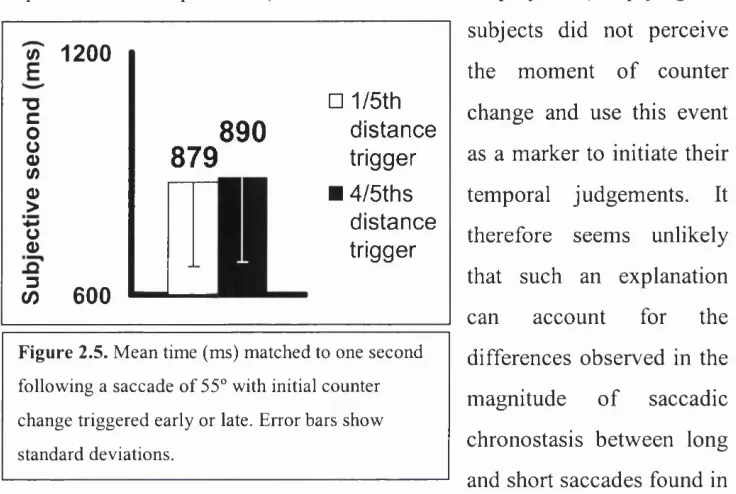
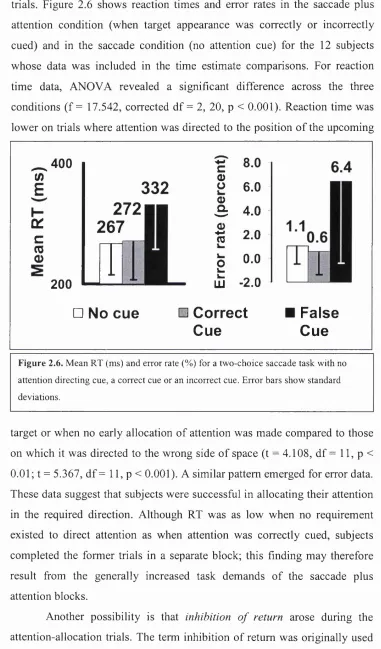
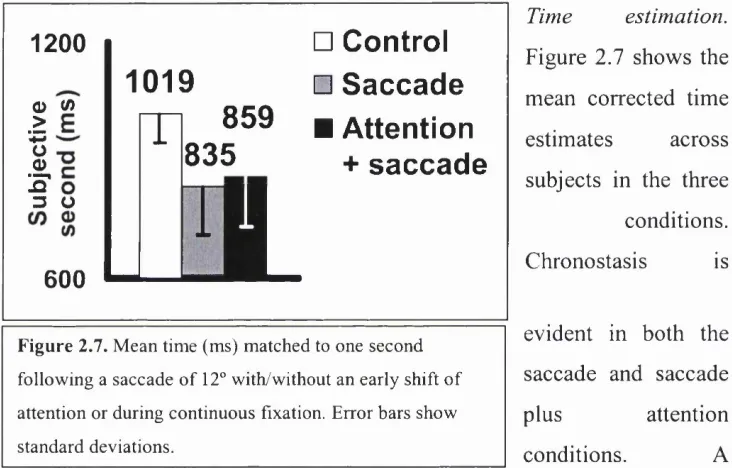
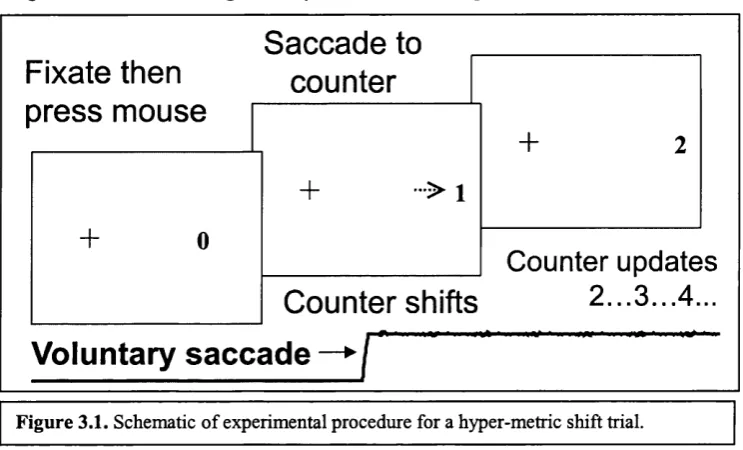
Temporal illusions
subsequent to movement
Kielan Nicholas Yarrow
Submitted for the degree of Ph.D
(Neurological Studies)
from the University of London
ProQuest Number: 10014439
All rights reserved
INFORMATION TO ALL USERS
The quality of this reproduction is dependent upon the quality of the copy submitted.
In the unlikely event that the author did not send a complete manuscript and there are missing pages, these will be noted. Also, if material had to be removed,
a note will indicate the deletion.
uest.
ProQuest 10014439
Published by ProQuest LLC(2016). Copyright of the Dissertation is held by the Author.
All rights reserved.
This work is protected against unauthorized copying under Title 17, United States Code. Microform Edition © ProQuest LLC.
ProQuest LLC
789 East Eisenhower Parkway P.O. Box 1346
Abstract
When saccadic eye movements are made to a silently ticking clock,
observers sometimes think that the second hand takes longer than normal to
move to its next position. For a short period, the second hand appears to
have stopped; then, suddenly, it ticks on. This phenomenon is o f intuitive
interest as an experience that many people recognise, and formed the
starting point o f the research described here. A comparison methodology
was employed in which subjects judged the perceived duration of a visual
stimulus relative to that o f subsequent stimuli. The duration of the first
stimulus varied across trials, permitting the derivation o f a matched time at
which subjects felt the stimuli to be of equal duration. When the first
stimulus was fixated immediately after a saccade, lower matched times were
obtained relative to constant fixation conditions, indicating that subjective
time had been stretched out. This effect is termed saccadic chronostasis.
The methodology permitted accurate quantification o f saccadic chronostasis
under various task conditions. Manipulations explored include movement
size, movement type (saccades of various types, hand/arm movements), the
nature o f the stimulus that is to be judged and its relationship to other
perceptual objects. Key results include the illusion’s dependency upon both
saccade size and the continuity o f certain components o f the visual scene.
Similarities and important differences emerged when the paradigm was
extended to arm movements (manual chronostasis). Chronostasis offers a
novel insight into the integration o f action and perception, with implications
for theories o f perceptual continuity across movements. It is an illusion of
time, and must be dealt with by theories that seek to explain temporal
perception, but also has more general relevance when considering the
manner in which conscious experience emerges from a sequence of sensory
T able o f con ten ts
Title page... 1
Abstract...2
Table of contents...3
Publications, collaborations and acknowledgements... 5
Chapter 1. Introduction... 6
Chapter 2. Saccadic chronostasis... 22
Chapter 3. Image discontinuities destroy saccadic chronostasis. 52 Chapter 4. Saccadic chronostasis and moving stimuli... 80
Chapter 5. Registration/dissociation between saccadic chronostasis and motor timing/tactile stimulation... 105
Chapter 6. Manipulations o f saccade type and post-saccadic stimuli... 130
Chapter 7. Manual chronostasis... 157
Chapter 8. General discussion... 186
References... 217
Appendix A. The modified binary search algorithm...235
Appendix B. Timing issues in visual basic...241
List of Tables Table 6.1 MOBS parameters for experiment 6a... 134
Table 6.2 Mean standard deviations for experiment 6a...139
Table 8.1 Comparison of experimental manipulations...186
List of Figures Figure 1.1 Schematic o f SET internal clock model...9
Figure 2.1 Schematic of experimental procedure ( la ) ... 27
Figure 2.2 Mean subjective seconds (la )... 30
Figure 2.4 Mean subjective seconds (Ib )... 35
Figure 2.5 Mean subjective seconds (le )... 39
Figure 2.6 Mean reaction time and error rates (Id )... 43
Figure 2.7 Mean subjective seconds ( Id ) ... 45
Figure 2.8 Mean subjective seconds (la and Id, subgroup)... 46
Figure 3.1 Schematic of experimental procedure (2a)... 58
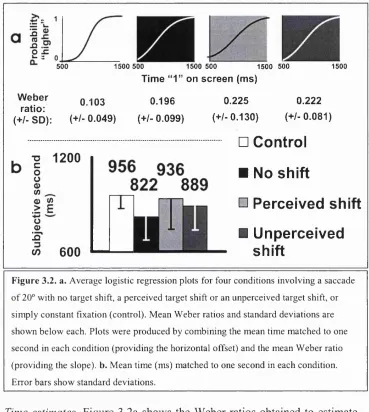
Figure 3.2 Mean subjective seconds and Weber ratios (2a)... 6?
Figure 3.3 Mean subjective seconds (2b)... 69
Figure 3.4 Mean subjective seconds (2d)... 73
Figure 4.1 Schematic o f motion/chronostasis interaction Accounts... 81
Figure 4.2 Mean subjective seconds (3a)... 88
Figure 4.3 Mean localisation errors (3b)... 93
Figure 4.4 Mean continuity points (3 c)... 99
Figure 5.1 Schematic of experimental procedure and predictions (4a)... 108
Figure 5.2 Mean subjective seconds (4a)... 114
Figure 5.3 Mean tap contact times (4a)... 115
Figure 6.1 Mean subjective duration estimates (5a)... 137
Figure 6.2 Schematic o f arousal based account o f chronostasis. 140 Figure 6.3 Mean subjective seconds (5b)... 147
Figure 6.4 Mean subjective seconds (5c)... 151
Figure 7.1 Schematic of experimental procedure (6a)... 160
Figure 7.2 Examples o f signal recordings (6a)... 164
Figure 7.3 Mean subjective seconds (6a)... 165
Figure 7.4 Mean subjective seconds (6b)... . 171
Figure 7.5 Block by block subjective seconds, by subject (6c).. 178
Figure 7.6 Overall subjective seconds, by subject (6c)... 179
Figure 7.7 Mean subjective seconds (6c)... 18?
Figure 8.1 Schematic showing perceived position based on a flattened internal representation of eye position.... 193
Publications, collaborations and
acknowledgements
Experiments la, Ib, le, Id, 2a and 2b bave previously been published in the
following article:
Yarrow K, Haggard P, Heal R, Brown P, Rothwell JCE (2001). Illusory
perceptions of space and time preserve cross-saccadic perceptual continuity.
Nature 414: 302-305.
Experiment 6a was conducted in collaboration with Lisa Webster, and has
also been included in her final project contributing towards the degree of
MSc (Clinical Neuroscience; UCL).
Experiment 6c was conducted in collaboration with Helen Johnston, and
will also be included as part of her thesis for the degree o f PhD
(Psychology; UCL)
I would like to thank my primary supervisor. Professor John C Rothwell, for
providing the vital seed for this research while granting me the freedom to
explore my own ideas, make my own mistakes, and hopefully learn from
them. I would also like to thank my secondary supervisor. Dr Patrick
Haggard, for numerous enlivening discussions. Both have shown a light
touch while remaining available. Thanks also to Dr Kai V Thilo for
Chapter 1 : Introduction
The accurate representation of time is a fundamental requirement for
humans. It underlies both perception within a dynamic environment and the
production o f co-ordinated behaviour. Timing is ubiquitous, woven into the
fabric of sensory and motor processes, whether it is explicitly
represented/controlled or arises indirectly as an emergent property o f a
given system. Despite its central role, time perception is not as well
understood as sensory modalities like vision and touch, perhaps because we
lack an obvious dedicated organ for its measurement. The research to be
described in the bulk of this thesis relates to a particular illusion o f timing
that occurs in the context o f movement and may therefore shed light upon
perception in dynamic contexts. This illusion has not been described
previously, so no substantial body of work is available to summarise at this
point. The handful of experiments that appear o f most direct relevance are
dealt with in greater detail in the experimental chapters that follow. Here, a
selective review o f previous timing-related research is presented to provide
some general orientation for the reader.
The retrospective/prospective distinction in interval timing.
Estimating the length of a given interval of time may occur in two
fundamentally different contexts; the retrospective and prospective
paradigms. Experiments investigating retrospective duration judgements
typically involve misleading subjects by engaging them in some task before
surprising them by asking them to estimate the length o f time for which they
have been occupied with it. Hence each subject can provide only a single
data point. In prospective duration judgements, the subject knows in
advance that their task is to judge the passage of time in some manner. This
approach is generally preferred because it permits numerous trials to be
conducted with a single subject. There is considerable evidence that
retrospective and prospective duration judgements are carried out by
perceived time to stimulus time differs for these tasks, with long durations
being underestimated under conditions of retrospective timing. Additionally,
timing in the two conditions is differentially affected by variables like
processing difficulty and stimulus complexity. In general, retrospective
timing is best explained by models that view timing as indirect, an inference
based on the perception and processing of events (Block, 1990). Examples
include memory storage models (Omstein, 1969) where perceived time
relates to the storage size of memories encoded in a given interval, and
memory change models (e.g. Block and Reed, 1978) where changes in
environmental context, shifts in processing requirements and so forth relate
to perceived duration. These models tend to be rather vague. They have
little obvious relevance to the tasks used in forthcoming experimental
chapters, so will not be further discussed here.
C haracteristics o f p ro sp ective interval timing. Prospective timing has been studied using a considerable variety o f tasks. Following Allan’s
(1979) broad ranging review, four broad classes can be considered. In verbal
estimation, the subject perceives a stimulus of a given interval and reports
its length in absolute terms. In production, the experimenter states an
interval verbally and the subject produces that interval, by pressing a key for
example. In reproduction, the subject is presented with a stimulus o f a given
interval, then produces it. In comparison, the subject perceives two or more
intervals (often, but not necessarily, in rapid succession) and makes some
forced-choice relative judgement about their lengths. Note that both
production and reproduction overlap with studies of motor timing, reviewed
in a later section.
In general, prospectively assessed subjective duration has two
established properties. Firstly, the function relating perceived time to
stimulus time (the psychophysical law for time perception) is monotonie,
most likely a power function with an exponent very close to 1 or a simple
linear function (Allan, 1979). Hence the timing system is both flexible (in
with mean perceived time equalling objective time (Malapani and Fairhurst,
2002). With very fine grain analysis, reproduced time may however exhibit
a systematic oscillation relative to a purely linear function, perhaps
indicative o f underlying discreteness in timing (Collyer, Broadbent, and
Church, 1992).
A second key finding is that a positive relationship exists between
variability in time judgements and the time being judged (Weber’s law
applied to timing). Specifically, the relationship appears to be linear
between the standard deviation of subjective time and mean subjective time,
although once again more fine-grained analysis may yield step-like
deviations from strict linearity (Kristofferson, 1980). This finding is often
referred to as the scalar property (e.g. Gibbon and Church, 1990).
Aside from these general findings, there are a large number of non
temporal factors that influence time judgements (the following summary
being by no means exhaustive). The order of stimulus presentation can have
a very marked effect on judgements, most notably in comparison
methodologies, a bias known as the time order error (Allan, 1979;
Hellstroem, 1985). A related phenomenon that nonetheless appears to have
some distinctive qualities is the tendency o f an initial stimulus (SI) to
shorten the perception of a subsequent stimulus (S2) when S i ’s duration
falls in a critical range just below that of S2 (Allan and Gibbon, 1994;
Sasaki, Suetomi, Nakajima, and ten Hoopen, 2002). Such “time shrinking”
has been demonstrated only for unfilled auditory stimuli demarcated by
clicks, but other contextual illusions have been found for vision. Rose and
Summers (1995) for example have reported that the first square light
stimulus in a sequence of four is overestimated in duration, as is the final
such stimulus. High frequency trains of “arousing” clicks can result in both
a general overestimation of the duration o f subsequent stimuli and a specific
frequency-dependent modulation (Treisman, Faulkner, Naish, and Brogan,
1990). Stimulus properties themselves are also important for perceived
duration. Auditory stimuli are generally judged to be longer than visual
1998). Filled intervals tend to be judged longer than unfilled intervals
(empty periods marked by events at either end) and the intensity and nature
of a filled interval (or the events marking an unfilled interval) can influence
perceived duration. Higher level factors have also been found to influence
the perception o f time. Multitasking manipulations intended to reduce the
availability of attentional resources tend to lead to an underestimation o f the
passage of time (e.g. Burle and Casini, 2001; Macar, 2002). Finally, the
amount o f time between the perception and report of a stimulus can have an
effect, with temporal representations appearing to shrink over time
(Wearden, Parry and Stamp, 2002).
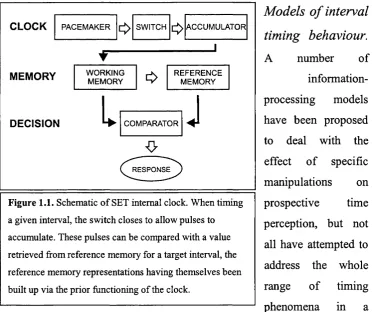
CLOCK PACEMAKER SWITCH ACCUMULATOR
MEMORY
DECISION
WORKING MEMORY
REFERENCE MEMORY
COMPARATOR ^
RESPONSE
M odels o f interval tim ing behaviour.
A number of
information-
processing models
have been proposed
to deal with the
effect o f specific
manipulations on
prospective time
perception, but not
all have attempted to
address the whole
range o f timing
phenomena in a
single framework (Allan, 1979). For those that have, the dominant template
has been the pacemaker-accumulator internal clock (Treisman, 1963). A
timer sends out pulses that, when a switch is closed, amass in a temporary
store and can subsequently be compared with values stored in long-term
memory. The basic architecture of the model deals well with the
psychophysical law, and specific instantiations can handle scalar variability. Figure 1.1. Schematic o f SET internal clock. When timing
a given interval, the switch closes to allow pulses to
accumulate. These pulses can be compared with a value
retrieved from reference memory for a target interval, the
reference memory representations having themselves been
One such instantiation is the temporal information-processing model
developed in scalar expectancy theory (SET; Gibbon, 1981). The SET
model posits a number o f specialised components, with temporal
information passing between them. A schematic is presented in Figure 1.1.
It has gained considerable support from both animal and human timing
studies (Allan, 1998) although controversy remains regarding the specific
mathematical formalisations that best describe its functioning at each level
(e.g. Rodriguez-Girones and Kacelnik, 2001).
Recently, attempts have been made to map the influence o f the
previously discussed non-temporal factors onto the components of such a
model (e.g. Franssen and Vandierendonck, 2002). A major focus has been
the role o f the pacemaker, which is assumed to vary its rate based on arousal
levels. This proposal allows the model to cope with effects like those of
high frequency trains o f clicks, increases in body temperature and stimulus
intensity, and changes in modality (i.e. auditory compared to visual), all of
which increase time estimates (or decrease reproduction times) in a manner
consistent with increased pacemaker speed (Fenton-Voak, Edwards,
Percival, and Wearden, 1996; Treisman, 1963; Wearden et al, 1998;
Wearden and Fenton-Voak, 1995). Regarding higher level attentional
factors, two broad approaches are taken to incorporating these effects. In the
“flickering switch” approach, multitasking leads to division o f attention,
with the switch only closing when attention is directed to the timing task.
This approach implies a fundamentally serial process, and can be identified
with bottleneck theories o f attention (e.g. Fashler, 1994). The second
approach posits the existence o f an additional component, an “attentional
gate” lying between the switch and the accumulator that permits only a
proportion o f emitted pulses through, depending upon allocation of attention
to the timing task. Hence the theory draws on graded resource sharing
approaches to dual-task performance (e.g. Wickens, 1984). The value o f this
additional component (i.e. its additional explanatory power relative to the
incumbent increase in model complexity) is a matter of ongoing debate
There has also been interest in mapping the various clock
components onto brain structures, despite continuing objections that the
model lacks neural plausibility. Patient studies implicate the basal ganglia
and lateral cerebellum as key regions for timing (Meek and Benson, 2002;
Hazeltine, Helmuth and Ivry, 1997). In general, both parkinsonian and
cerbellar patients are impaired at both sensory and motor timing tasks.
Pharmacological interventions in animals again suggest the basal ganglia
(Meek, 1996) with dopaminergic agonists seeming to selectively increase
the speed o f the pacemaker. Administration during the test phase of an
experiment in which an animal has been conditioned to respond at a given
time causes the animal to immediately begin responding earlier, with a
gradual return to correct responding as reference memory values are slowly
re-established. Removing the drug then causes late responding, until
reference values are once again recalibrated at the new pacemaker rate. For
dopiminergic antagonists, the whole pattern is reversed. Pharmocological
studies are less clear cut in humans, but imaging experiments offer mixed
support for the involvement o f these areas along with the supplementary
motor area, dorsolateral preffontal cortex, anterior cingulate cortex and right
parietal cortex (Macar, Lejeune Bonnet, Ferrara, Pouthas, Vidal, and
Maquet, 2002; Rao, Mayer, and Harrington, 2001). The manner in which
the clock model’s components are implemented in these neural regions is,
however, hotly debated (Lewis, 2002). Related models have been proposed
that eschew the pacemaker-accumulator architecture and its cognitive “black
box” approach in favour of a clear physiological basis. One example, the
striatal beat frequency model proposed by Matell and Meek (2000) shares
many of the psychological properties of SET but suggests a timing
mechanism based on the striatum’s ability to detect coincident patterns of
cortical oscillations. As yet, this model and various other contenders to the
throne of biological plausibility have not generated as much research as SET
and it is still unclear what kind of model will eventually provide the best
M o to r timing. While all action evolves over time, it is reasonable to contrast motor acts that are explicitly timing based with those that are
simply well co-ordinated. Although there is clear crossover between some
o f the previously discussed methods used to assess interval timing (i.e.
production, reproduction) and motor timing, the latter has typically been
assessed in the context of repetitive (rhythmic) action generation rather than
the estimation o f discrete intervals. Broadly, two approaches dominate this
literature (Schoener, 2002). To characterise crudely, dynamical approaches
focus on coupled oscillatory mechanisms and tend to view timing as an
emergent physiological/mechanical property (Kugler and Turvey, 1987). By
contrast, information-processing approaches posit timekeepers rather like
that discussed in the previous section. For the sake of continuity, brevity,
and relevance to the discrete timing task employed in the experimental
chapters that follow, the focus here is on the information-processing
approach.
The tapping paradigm . The most commonly employed task in motor timing is synchronised tapping, with or without continuation. Subjects tap
along with a metronome at a given frequency {synchronisation). They may also be required to continue to tap at the same rate when the metronome has
stopped {continuation). Both phases clearly require an internal representation of time; subjects do not simply react in the synchronisation
phase, in fact showing a tendency to slightly anticipate the metronome
(discussed in the following section). Continuation, however, offers an
opportunity to study motor timing in the absence o f sensory feedback that
might provide corrective cues. The paradigm was introduced by Stevens
(1886) but was revived in the 1970s to provide the basis o f the Wing-
Kristofferson model (Wing and Kristofferson, 1973, reviewed in Wing,
2002). The model was inspired by the observation that the length of a
reproduced interval tends to have a negative correlation with those intervals
produced immediately before and after it. It provided a formal mathematical
timekeeper and a motor implementation delay) with the two processes
operating as independent sources of variability. Hence the timekeeper
provides a central signal for the initiation of each tap, with finger movement
processes producing a (variable) delay before the tap actually occurs. In
general, the autocorrelation pattern predicted by the model is well
conformed to, although alternative analyses of tapping data have produced
some inconsistent results (e.g. Ding, Chen and Kelso, 2002). The Wing-
Kristofferson model permits clock variability and motor variability to be
dissociated and quantified and has been widely employed for this purpose.
As predicted from the previous discussion o f scalar timing, clock variability
increases linearly with the interval that is being reproduced while motor
variability remains constant.
Motor timing studies lead quite naturally to a consideration of more
complex rhythmic production, permitting speculation regarding the
uniqueness of any clock component (i.e. does the production o f a complex
rhythm depend upon a single clock or a hierarchy of clocks with similar
operating principles). One finding that suggests the existence of more than
one clock (aside from the general ubiquity of timed operations in human
behaviour) is that variability decreases when taps are made with two hands
rather than just one (Helmuth and Ivry, 1996). This variability decrease
arises in the clock itself, not processes of motor implementation, as indexed
by decomposition based on the Wing-Kristofferson model. Ivry and
Richardson (2002) have therefore suggested a multiple timer model in
which effectors are controlled by separate clocks. When bimanual tapping is
performed, the output of the two clocks is centrally gated and summed for
comparison with a combined threshold before simultaneous movement
commands are sent to both hands. This process yields a prediction of
decreased variability relative to reliance on a single clock, conforming well
with data. It should be noted, however, that an alternative account based on
increased sensory reafferent information is also plausible (Brewing,
Interaction o f tim ing systems. Introducing the idea of separate clocks highlights the related issue of the independence of motor and perceptual
timing. The distinction between motor and purely perceptual indices of
interval timing was blurred by the rather general treatment provided in the
earlier sections on duration judgements. In general, different methods can
give rise to quite different results (Allan, 1979) but where perceptual and
motor timing have been explicitly compared there is good evidence for a
common mechanism. The previously mentioned patient studies, for
example, have often found similar impairments for both types o f task.
Manipulations considered to affect pacemaker rate tend to influence both
perceptual and motor tasks in the predicted manner (e.g. Treisman et al,
1990; Treisman, Faulkner and Naish, 1992). Correlations have also been
found to be high for performance measures on sensory and motor timing
tasks (e.g. Keele, Pokomy, Corcos and Ivry, 1985, although in this study the
correlation was unpredictably reduced when only the clock variance
component of the motor task was used). Interestingly, these correlations
extend to motor tasks with explicit timing goals but not those where timing
emerges naturally from cyclical movement production. Hence sensory
timing correlates with both tapping and circle drawing with pauses inserted
between each circle, but not continuous circle drawing performed at a pre
specified rate (Zelaznik, Spencer and Ivry, 2002). For explicitly timed
actions, however, common timing mechanisms are implicated in perceptual
and motor timing. The research areas show considerable overlap, and motor
timing researchers have posited just as wide a variety of alternative models
as their sensory counterparts when considering the clock component of
timing variability, again with varying degrees o f neural plausibility (e.g.
Rosenbaum, 2002).
P oin t estimation, successiveness and su bjective simultaneity. A quite separate research tradition from that investigating interval timing has
instead looked at the perception of simultaneity and successiveness.
and numerous studies have investigated various types of (typically visual)
persistence, be it at a purely sensory or a more abstract “informational” level
(e.g. Loftus and Irwin, 1998). The once popular perceptual moment model,
which posited a centrally defined, fixed interval of around 100 ms over
which integration occurred, has not been well supported (Patterson, 1990).
However, there is some evidence that there may be a very brief discrete
interval ( «25 ms) operating as a quantal building block for most cognitive
operations and perhaps relating to the pulse rate of an internal clock (e.g.
Burle and Bonnet, 1999; Collyer, Broadbent, and Church, 1992). Reaction
time distributions, for example, appear to cluster at multiples o f such an
interval (Poppel, 1997).
Tem poral order judgem ents. While the general issues o f sensory persistence and information integration have been studied with a variety of
methods, the temporal order judgement paradigm has been crucial for the
investigation of subjective simultaneity and successiveness. Here, two short
duration stimuli are presented in close temporal proximity and the subject is
required to make a judgement about their order. The method indexes the
perception o f successiveness, and requires that the two stimuli be different
from one another, or presented at different spatial locations, in order to
permit a judgement to be made. Hence while this method clearly relates to
the situation in which subjects are required to judge whether identical
stimuli yield a single as opposed to two distinct percepts, temporal order
judgements imply the discrimination of order rather than the sensory
integration/differentiation o f events. In this sense they reflect mechanisms
of relative timing, rather than being a measure o f low-level sensory acuity.
It is perhaps not surprising, then, that thresholds for successful temporal
order judgements are largely consistent across sensory modalities (requiring
around 30 ms offset between stimuli for 75% correct performance) whereas
give rise to very different thresholds for different senses (Hirsh and
Sherrick, 1961)/
As well as asking how close together in time two identical but
spatially separate stimuli have to be to permit discrimination o f their order,
it is possible to use the temporal order paradigm to estimate any bias for
perceiving one stimulus to have occurred before the other. This is most
obviously relevant when the stimuli differ in some manner. A number of
factors, such as stimulus intensity and attentional allocation, can affect order
judgements within a modality (Jaskowski, 1999; Shore, Spence and Klein,
2001). A particularly striking finding is that judgements about events from
different modalities often exhibit strong biases that are variable between
subjects but fairly constant for a given observer (Spence, Shore and Klein,
2001; Stone, Hunkin, Porrill, Wood, Keeler, Beanland, Port, and Porter,
2002). This finding leads naturally to a consideration o f how signals
processed via different sensory organs with correspondingly different neural
pathways are ordered internally, and how this internal ordering manifests
itself in consciousness.
The representation o f order. Conscious awareness o f order is not a pure reflection of processing time, because tasks which can be considered to
reflect speed of sensory processing (i.e. simple reaction time) dissociate
from temporal order judgement tasks. A stimulus which gives rise to a more
rapid reaction time is not necessarily perceived to have occurred first when
paired with one that yields a slower reaction time (Jaskowski, 1999;
Jaskowski and Verleger, 2000). Nonetheless, there are results from
alternative paradigms that would seem to suggest that awareness of an event
can directly reflect underlying differences in the location and timecourse of
neural processing, even within a single sensory modality. When a coloured
stimulus moves back and forth in rapid alternation and changes colour at the
same frequency as it changes direction, subjects perceive the two changes
(in direction and colour) to be simultaneous when the colour change actually
precedes the motion change by around 80 ms (Moutoussis and Zeki, 1997a).
This effect can also be obtained indirectly by measuring colour-contingent
motion after-effects to rotating stimuli, where the phase relationship
between a given colour and a given direction o f motion is varied
systematically for the adapting stimulus (Arnold, Clifford and Wenderoth,
2001).^ There is also evidence that motor control in synchronisation tasks
reflects processing times in a fairly direct manner. When subjects tap in
synchrony with a metronome, their taps tend to anticipate the metronome’s
beats (see Aschersleben, 2002, for an overview). This error is explicable if
subjects are actually attempting to align the auditory sensation with the
tactile feedback from each finger tap, given that tactile transmission times
are probably greater (although this conclusion rather depends upon which
component of the brain response is considered relevant). Although other
interpretations have been offered, this simple hypothesis predicts much of
the relevant data, including the synchronisation error’s dependency on
tapping effector and other manipulations of sensory feedback (Aschersleben
and Prinz, 1995).
The interpretation o f ordering phenomena in terms o f neural delays,
sometimes known as the Paillard-Fraisse hypothesis, is therefore well
established. To give one classic and rarely disputed example, the Pulfhch
effect arises when a pendulum moving from left to right and vice versa is
observed with one eye covered by a light-attenuating filter. Under these
circumstances, the pendulum appears to follow an elliptical path with an
illusory component of motion in depth. The effect can be explained by the
difference in transmission latency for dim compared to bright stimuli, given
that binocular depth arises in part from relative differences in the position of
an object’s image on the retina of each eye. The covered eye’s image is
transmitted more slowly, yielding a difference in position (given the
pendulum’s motion). This shift appears to be transformed into depth
information by space-time tuned neurones in striate cortex (Anzai, Ohzawa,
and Freeman, 2001).
O bjections to the P aillard-F raisse hypothesis. There are, however, a number of reasons for doubting the processing delay hypothesis’ broader
validity. Dennett and Kinsboume (1992) provide a thorough discussion of
the logical pitfalls o f considering the conscious experience o f the ordering
o f events to be a simple reflection of the physical ordering of events. They
argue that this reasoning reflects incorrect assumptions that effectively posit
a single re-presentation o f incoming information to an internal observer (the
Cartesian theatre model). They raise the important point that information
need not be neurally represented according to what it physically represents
(and indeed cannot be in the case of features like colour); hence temporal
order need not be maintained in any simple isomorphic fashion. They
suggest a multiple drafts model in which consciousness emerges over time
based on the current state of the entire distributed system, with room for
considerable reinterpretation (realignment) when arriving at any conclusion
about the ordering o f events. In this sense, they emphasise that the
interpretation an observer gives will depend upon the sum o f currently
available information, rather then being an immediate on-line reflection of
the arrival order o f sensory messages. To bolster their claims, they discuss
experimental situations in which sensory stimuli appear to influence
conscious perception before their presentation, logically impossible if we
accept both on-line consciousness and the laws o f cause and effect. To take
one example, somatosensory saltation arises when two successive taps to the
same skin location are followed by a third tap to a different position with an
appropriate delay. Instead of a veridical perception, observers report that the
second tap was delivered at a spatial position between the two stimulation
sites (Geldard and Sherrick, 1986). Hence, the delivery of the third tap
been experienced before the third tap is delivered. It is difficult to explain this result without applying a framework similar to the multiple drafts
model. Note that this theory is not identical to simply stating that there is a
fixed delay from stimulation to consciousness in order to take account o f the
longest processing delay that might reasonable arise. This position is
tenable, if we accept that many behavioural responses can arise before (or
without) conscious awareness, but still implies an ultimately singular
consciousness. Dennett and Kinsboume (1992) instead suggest that
consciousness may arise quite rapidly, but is subjected to a continuous
revision process that rarely gives rise to subjective discontinuity despite
having settled on a variety o f mutually incompatible interpretations at
different times.
To this broad ranging account it is also possible to add a number of
related objections to the processing delay hypothesis. Firstly, at what neural
point is a decision about the order of arrival of signals made (especially
given the time-smeared nature o f neural representation)? Taking the
illustration of an interview conducted over a satellite link to represent
discussion between two neural areas (representing, say, visual motion and
colour) it is immediately apparent that both parties will feel that the other is
delayed relative to themselves (Nishida and Johnston, 2002). Arguing in
favour of the immediate emergence o f conscious awareness from each
region as it processes information cannot sidestep the issue that some other
region or regions must make the actual decision about order. A related point
relates to the general ability o f the brain to predict, or take account of the
properties o f the physiological system it uses/controls (Mueller,
Aschersleben, Koch, Freund, and Prinz, 1999). This capacity for inverse
computation appears vital for the control of action (Wolpert and
Ghahramani, 2000). Why are we suddenly unable to take account when
considering neural delays in the ordering of events?
emerges when subjects must identify the position o f a moving stimulus at a
specific moment in time. In a typical experiment, the empty interior o f a
continuously moving black ring is filled with a flash at a given moment.
Observers have the clear experience that the moving ring was slightly ahead
of the stationary flash (which consequently fails to fill the entire ring). In the
decade since the illusion’s (re)discovery it has attracted a great deal of
research interest and a large number o f alternative explanations (reviewed in
Krekelberg and Lappe, 2001; Nijhawan, 2002). The first explanation
proposed was that o f motion extrapolation: the visual system predicts the
position of a moving object based on its prior trajectory to overcome
processing delays and achieve co-ordinated movement (Nijhawan, 1994).
This theory fails to explain why the effect persists when the flash initiates
the movement cycle, disappears when the flash occurs at the end of the
movement cycle and reverses when the ring changes direction at the
moment the flash occurs (in all cases, only subsequent motion appears relevant in producing an effect). Perhaps the most common explanation has
been in terms o f processing delays for the flashed stimulus relative to the
moving one (e.g. Baldo and Klein, 1995). However, the illusion emerges in
contexts where a processing delay is not obvious (e.g. when a stationary
stimulus continuously changes colour relative to a flashed colour patch;
Sheth, Nijhawan, and Shimojo, 2000) and is not reduced by giving the flash
a temporal head start in a flash initiated paradigm (Eagleman and
Sejnowski, 2000). A third explanation suggests that information about the
moving stimulus is integrated in a time window following the flash before
determination o f the subsequent conscious experience (Eagleman and
Sejnowski, 2000). However, this account fails to deal with findings that the
effect is modified when the nature of the flash changes (e.g. for luminance
manipulations; Patel, Ogmen, Bedell, and Sampath, 2000). There are other
accounts and variants, but it is fair to say that none currently explain all the
data. What emerges clearly from these studies, however, is that the
relationship between physical events and mental sequencing is complex, and
solutions employed by the brain in differing contexts. The forthcoming
experimental chapters describe a new illusion that will hopefully prove
Chapter 2. Saccadic chronostasis
When voluntary saccadic eye movements are made to a silently
ticking clock, observers sometimes think that the second hand takes longer
than normal to move to its next position. Take the situation in which we
glance at our watch or at a large digital clock like those commonly found in
railway stations. For a short period, the second hand appears to have
stopped; then, suddenly, it ticks on. It is as if the image o f the clock were
frozen for just a moment following a saccade. This phenomenon is of
intuitive interest as an experience that most people recognise, yet has been
little discussed in the scientific literature.
There have been attempts to link the stopped clock phenomenon to
temporal illusions occurring under static viewing conditions. Rose and
Summers, for example, demonstrated that for a sequence o f four rapidly
presented square light patches, the first square was perceived to be on screen
for longer than was actually the case (Rose and Summers, 1995). In their
standard paradigm, in which the latter three squares were presented for 666
ms each with a 100 ms inter-stimulus interval, the first square needed to be
presented for only around 450 ms to appear o f equal duration to the second.
A similar effect was obtained across manipulations o f inter-stimulus
interval, stimulus size and stimulus contrast. However, this illusion occurs
under conditions of continuous fixation, in contrast to the classic stopped
clock sensation; no attempts have been made to generalise it to the post-
saccadic situation.
When judgements of a temporal nature have been studied in the
context o f saccades, illusory biases have again emerged. In an early report,
subjects were asked to judge whether a horizontal sinusoidal test grating
presented for 5 ms arrived before, during or after a 6° saccade of
approximately 30 ms duration. (Volkmann and Moore, 1978). Stimuli were
presented in the area traversed by the saccade, at a variety o f contrasts
relative to an equiluminant background. For stimuli presented after the onset
observers showed a strong bias towards judging the stimulus to have arrived
during the saccade. They were still as likely to respond “during” as “after”
200 ms after the saccade had ended. For the single observer tested with
stimuli also occurring prior to the saccade (and additionally given the
“before” response option) these stimuli were also judged to have occurred
during the saccade more often than would be expected, while the previous
pattern was repeated for stimuli arriving after the saccade. Oddly, while
stimuli arriving shortly before the saccade were judged to occur during it,
those actually arriving during the saccade were typically judged to have
arrived before it, preventing the tidy conclusion that times o f occurrence for
these stimuli were drawn inwards towards the saccadic event.
More recently, Deubel, Irwin and Schneider (1999) have obtained
temporal biases under similar conditions. In two experiments, they had
subjects make either reactive saccades to a peripheral target (left or right) or
delayed saccades one second after a central cue that indicated direction (6“
in both cases). An open circle appeared on screen for 20 ms at a time
ranging from 450 ms before the saccade to 250 ms after it. The circle was
located at one o f three locations: the initial fixation point, the saccade target
point, or the opposite point (the alternative saccade target). Six subjects
judged whether their gaze had been on the central fixation point or the
saccade target point when the circle appeared. Subjects showed shifted
response curves when the circle appeared at the saccade target; they often
incorrectly felt that they were already looking at the saccade target even
when the circle appeared well before their saccade. The effect was less
marked when the circle appeared opposite the target, and nearly absent
when it appeared at the initial fixation point. However, in these experiments
the whole psychometric curve was simply shifted towards negative circle-
saccade asynchronies. Subjects showed no tendency to claim that they were
still looking at the central fixation point when the circle appeared after their saccade, a result that would complement the over-attribution o f post
saccadic stimuli to the “during” category in Volkmann and Moore’s
asked and the response categories available to subjects may explain these
anomalous findings.
The results of the previous two studies appear somewhat
contradictory and are challenging to interpret given their methodological
differences. Additionally, their relevance to the stopped-clock illusion is not
immediately apparent, given that these studies have dealt with temporal
order judgements relating to the instant o f occurrence o f very briefly
presented stimuli. When the clock stops we feel that a period of time has
been stretched out, not that an instantaneous time marker has been shifted.
This is not to deny that the underlying mechanisms might be common, but
rather to suggest that alternative methodologies may yield results that are
easier to interpret.
Only recently have attempts been made to look directly at the effects
of saccadic eye movements on the perceived duration of a stimulus
presented for a prolonged duration following the completion o f the saccade,
a situation analogous to that in which the stopped clock illusion is typically
experienced. Brown and Rothwell (1997) asked subjects to make self-paced
60° saccades towards a numerical LED display that mimicked a digital
second hand. Subjects judged whether the time for which they saw the first
digit was greater or less than the time that subsequent digits were displayed.
In reality, all digits were displayed for one second. They found that when
saccades began just before a switch o f digit (meaning that the eyes alighted
on their target around about or just after a change) subjects tended to judge
the first digit to have been displayed for longer than subsequent digits. This
finding represents a simple laboratory demonstration o f the ubiquitous
stopped clock illusion. Hereafter, this effect will be referred to as saccadic chronostasis.
The methodology employed by Brown and Rothwell has the virtue
o f being extremely true to the conditions under which saccadic chronostasis
is typically experienced. However, it does not allow for the quantification of
effect size (the degree to which the first digit is “stretched out”) and,
illusion. To this end, a new methodology is introduced here in which the
change of counter digit is triggered by the saccade in a consistent manner.
Brown and Rothwell speculated that the perception o f the first digit viewed
was being extended back in time following a saccade. Assuming that this
backward extension was towards the beginning o f the saccade or some
specific pre-saccadic event, this would imply that the size o f the saccadic
chronostasis illusion ought to be influenced by the size o f the saccade.
Experiment la addressed this question.
Experiment la
Methods.
Participants. Initially, 10 subjects completed the experiment. Using the variance of their data, a power calculation was carried out to estimate the
sample size required to detect an effect of 60 ms as a planned comparison
between the long and short saccade conditions (a = 0.05, ^ = 0.2, power = 0.8).’ Consequently 20 further subjects were tested, giving a total of 30
subjects (18 male, mean age 28.2, SD 7.4).
Apparatus. Subjects sat before a 14” CRT colour monitor refi*eshing at 60 Hz. Eye to screen distance, which varied between conditions (25 or 66 cm)
was maintained using an adjustable chin rest. Horizontal eye movements
were recorded using AC electro-oculography (D150 amp: Digitimer; band
pass filtered 0.032-30 Hz) and sampled at 200 Hz. Electrodes were placed
on the outer canthus of each eye. Stimuli were black on a white background,
subtending approximately 0.5®. They consisted o f a cross and/or a digital
counter, initially set to “0” and counting through the digits “ 1” to “4”. The
experiments were controlled by a PC interfaced with a 12 bit A/D card
Design. A repeated-measures 2 x 2 factorial design was employed. The first factor eye status compared a voluntary saccade to constant fixation (the control). The second factor screen distance manipulated saccade size (22° or 55°); control conditions were conducted with the counter at matched
eccentricity (±11° or ±27.5°). Four blocks of data were recorded in each
condition. For counterbalancing purposes, screen distance order was
counterbalanced across subjects, while blocks were alternated (control then
saccade) for the eye status factor. Hence each subject received four
repetitions of a control block followed by a saccade block at one screen
distance, then at the other.
Procedure. In the saccade conditions, subjects fixated a cross on one side of the screen, initiated the trial with a mouse key press then made a voluntary
saccade to a target “0” on the other side. Eye movement triggered a change
o f digit to a “ 1” when the saccade had travelled one fifth of the distance to
target. The “ 1” remained on screen for 400-1600 ms; subsequent digits
(“2”,”3”) remained on the screen for 1 s each, culminating in the appearance
o f a “4”. Figure 2.1 shows a schematic of this process. Subjects indicated
whether the time they saw the “ 1” was longer or shorter than that for the
subsequent digits. Saccade start/end points were calculated automatically
using a velocity criterion; difference values between sample n and sample n-
3 were compared to thresholds based on background signal noise. Trials
where the first saccade recorded did not exceed 90% o f the total distance
recorded (summed across all detected saccades) were excluded on line and
repeated immediately. Additionally, trials were rejected if the algorithm was
unable to generate realistic start/end points for technical reasons, such as an
excessively noisy signal or an attempt to saccade during the initial period
assigned for background noise assessment. In control (constant fixation)
trials, subjects simply fixated a “0” at equivalent eccentricity that changed
to become the judged digit (“ 1”) 500 ms after the subject’s mouse key press.
Direction of saccade (saccade conditions: left to right and vice versa) or
position of the counter (control conditions: left or right) alternated every
trial.
+ 1 1°
Eye
signal
- 1 1“
Counter
shows
Duration
Voluntary saccade
0
Variable 1 second 1 second
Figure 2.1. Schematic o f experimental procedure (22° saccade).
In all conditions, the computer controlled the duration of the first
digit by a modified binary search (MOBS; Tyrrell and Owens, 1988)
procedure that “homed in” on a single matched estimate (low boundary 400
ms, high boundary 1600 ms, initial presentation random 800-1200 ms). The
MOBS procedure worked by maintaining two boundaries. On each trial, the
subject’s response determined whether the value that was currently being
tested replaced the low or high boundary. If they responded “less than” the
current value replaced the lower boundary and vice versa. The next value
was then selected as the midpoint between the two updated boundaries.
Checks ensured that boundaries could be pushed out again in response to
persistent responding (i.e. following a lapse of judgement). Details of the
Visual Basic procedure used to implement the MOBS in this and later
experiments are presented in Appendix A. Details of general programming
methods used to ensure accurate timing are presented in Appendix B. The
search terminated following five reversals of choice by the subject,
concluding the block and yielding a single estimate equal to the midpoint of
the final boundaries. Blocks were consequently of variable length, typically
6-20 trials excluding those rejected. In the saccade conditions, each estimate
was corrected post hoc to match the time the “ 1” was on screen following target foveation by subtracting the average time the eye was in motion
following the triggered change of digit (averaged across all four blocks).
The experiment took around one hour to complete.
Statistical analyses. Standard parametric tests (repeated-measures ANOVAs and t-tests) were used to assess differences in the dependent variable (mean
of four matched estimates derived from the MOBS procedure) across
conditions. Alpha was set at 0.05. For validation purposes, alternative
estimates were obtained in some conditions using logistic regression.
Logistic regression is a technique that can be used to fit a sigmoidal
regression line to data for which the dependent variable is a dichotomy. A
logit (loge odds) transformation is used to provide a continuous linear
variable to which a regression line can be fitted. The resultant regression
equation can be used to determine the value o f the independent variable at
which each o f the original dichotomous dependent variable’s outcomes are
equally likely to occur. Given the equation:
(1) In(odds) = a + bx
Where a is the intercept and b the slope, then rearranging to solve for x (the independent variable) for a probability of 0.5 (equivalent to odds o f 1 or
In(odds) of 0) gives:
(2) X = -a/b
Trial-by-trial data were entered into a logistic regression analysis with first digit presentation time as the independent variable and response (0 or 1 for “less than” or “more than”) as the dependent variable.^ Where the regression
was significant, the point o f subjective simultaneity (equivalent to the
estimated time matched to one second derived from the MOBS) was
calculated in the above manner. These values could be adjusted to represent
the time the “ 1” was on screen following target foveation in the same
manner as for those derived from the MOBS.
Results and discussion.
Saccade characteristics. Across all subjects, the 22° saccades took an average o f 72 ms to complete (range 54-105 ms), while the 55° saccades
lasted an average o f 139 ms (range 106-214 ms). Hence the average
difference in completion times between the two conditions was 67 ms.
These values are reasonable for saccades o f these sizes (Collewijn,
Erkelens, and Steinman, 1988).^ Within subjects, saccades were made with
fairly reproducible time courses (mean standard deviation across saccades 9
ms for the short saccades, 16 ms for the long saccades). Subjects often
exhibited small corrective saccades typically beginning 80-180 ms after
their first saccade landed, a commonly reported finding. Based on manual
inspection of saccade traces, such corrective saccades occurred 75 percent
of the time for long saccades and 69 percent of the time for short saccades, a
difference that was small but significant (t = 3.042, d f = 29, p = 0.005). In
all cases, time estimates were corrected to the point at which the large initial
saccade landed.
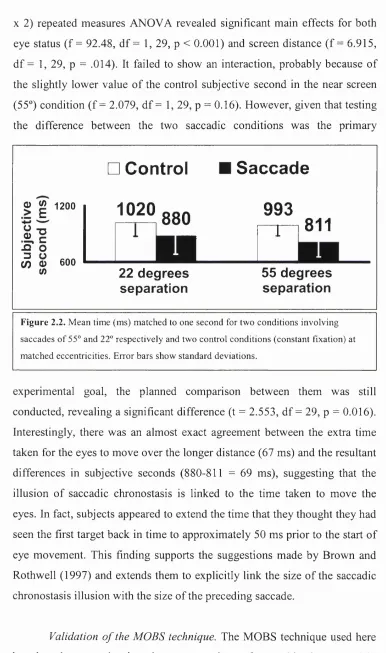
Time estimates. Figure 2.2 shows the mean corrected time estimates across subjects in all four conditions. These estimates will commonly be referred to
as subjective seconds, being the time matched to subsequent one-second intervals. Subjects thought they had seen the initial digit for one second
when their gaze had been on the target for only 880 ms (22° saccade
condition) or 811 ms (55° saccade condition). Control conditions gave very
different values that were close to veridical time perception. A two-factor (2
^ These authors conducted a thorough analysis o f four subjects’ eye movement data for voluntary saccades recorded with a scleral sensor coil. They found the linear function
duration = 2.7 x amplitude + 23 ms provided an excellent fit for symmetrical saccades
X 2) repeated measures ANOVA revealed significant main effects for both
eye status (f = 92.48, df = 1, 29, p < 0.001) and screen distance (f = 6.915,
df = 1, 29, p = .014). It failed to show an interaction, probably because of
the slightly lower value of the control subjective second in the near screen
(55°) condition (f = 2.079, df = 1, 29, p = 0.16). However, given that testing
the difference between the two saccadic conditions was the primary
□ Control
0
) ^
1200II
(/) 0) 600
(/)
1020
.8 8 0
it
Saccade
993
-
1-1
811
22 degrees
separation
55 degrees
separation
Figure 2.2. Mean time (ms) matched to one second for two conditions involving
saccades o f 55° and 22° respectively and two control conditions (constant fixation) at
matched eccentricities. Error bars show standard deviations.
experimental goal, the planned comparison between them was still
conducted, revealing a significant difference (t = 2.553, df = 29, p = 0.016).
Interestingly, there was an almost exact agreement between the extra time
taken for the eyes to move over the longer distance (67 ms) and the resultant
differences in subjective seconds (880-811 = 69 ms), suggesting that the
illusion of saccadic chronostasis is linked to the time taken to move the
eyes. In fact, subjects appeared to extend the time that they thought they had
seen the first target back in time to approximately 50 ms prior to the start of
eye movement. This finding supports the suggestions made by Brown and
Rothwell (1997) and extends them to explicitly link the size of the saccadic
chronostasis illusion with the size of the preceding saccade.
relatively few trials. However, the procedure is based on heuristic reasoning
and lacks a solid foundation in statistical theory (Treutwein, 1995). As a
step towards validating its use, the results obtained from each subject using
the mean average of four MOBS blocks were compared to those obtained by
subjecting the same data to logistic regression analyses. Initially, this
analysis was conducted for both saccading conditions. Regression lines
were significant for 20/30 subjects in the long saccade condition and 21/30
subjects in the short saccade condition, permitting the derivation of
subjective seconds by this alternative method for around two thirds of the
1
_ 0.9 0)
0.8 U)
^0 06
o
2 - 0 . 4
^
0.22
^ 0.1
- I - - - r
I m i l I
Infodds) = 0.0073X -6.676
I I I III I I I I
500 600 700 800 900 1000 1100 1200 1300 1400 1500 Time "1" appears on screen (ms)
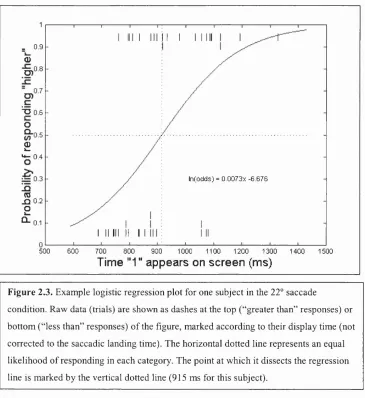
Figure 2.3. Example logistic regression plot for one subject in the 22° saccade
condition. Raw data (trials) are shown as dashes at the top (“greater than” responses) or
bottom (“less than” responses) o f the figure, marked according to their display time (not
corrected to the saccadic landing time). The horizontal dotted line represents an equal
likelihood o f responding in each category. The point at which it dissects the regression
line is marked by the vertical dotted line (915 ms for this subject).
sample. An example logistic regression line is plotted for one subject’s data
in the short saccade condition in figure 2.3. Given that a number of subjects’
higher trial requirement than MOBS, from which four separate estimates
had been derived. This was true even given that the tendency o f the MOBS
procedure to deliver many trials near to the subjects’ decision thresholds
ought to minimise the number of trials required (Rosenberger and Grill,
1997). Traditional non-adaptive approaches such as the method of constant
stimuli would probably require many more data points.
For the subjects whose data was well fitted, subjective seconds
derived using the two techniques’ estimates were compared. In the long
saccade condition, the correlation between the mean MOBS estimate and
that derived from logistic regression was an impressive 0.986, yielding
almost identical mean subjective seconds of 764 and 766 ms respectively.
For the short saccade condition, the correlation was even higher at 0.995,
with subjective seconds o f 875 and 876 ms. The two techniques therefore
appear to yield very similar results. Note that while subjective seconds are
once again smaller in the long saccade condition for these sub-samples, data
across the conditions is less suitable for comparison given that the groups
were not identical, with only 15 subjects contributing data to both.
Relevance o f corrective saccades. It has been noted that the proportion o f trials on which corrective saccades were made was not
identical between the long and short saccading conditions. It is possible that
corrective saccades (or their absence) may have some part to play in the
experience o f saccadic chronostasis. Because logistic regression can be
employed post-hoc, it permitted a weak test of this hypothesis. Those trials
on which subjects had made corrective saccades were entered into a separate
logistic regression. Within a given condition, estimates were derived if a
subject:
1) Produced significant regressions both for all trials taken together, and
for only those trials on which corrective saccades had been made.
After applying these criteria, data was available for comparison from 9
subjects in the long saccade condition and 14 subjects in the short saccade
condition. In their complete data sets, these subjects produced corrective
saccades on 73 percent and 72 percent o f trials respectively. If the presence
o f corrective saccades influenced saccadic chronostasis, it seems reasonable
that excluding those trials on which only a single saccade occurred from the
regression analysis ought to alter the resultant subjective second estimates.
In fact, no such difference could be detected. For the long saccade
condition, mean subjective seconds were 765 ms with all data included and
762 ms when only trials with corrective saccades were considered. For short
saccades, these values were 853 ms and 855 ms. Neither difference was
significant. Although this post-hoc analysis is far from ideal (the
manipulation would be expected to have a limited influence and probably
lacked power, making a failure to obtain a difference difficult to interpret) it
does at least suggest that the presence of later corrective saccades makes
little difference to the experience of saccadic chronostasis.
Experiment lb
The results o f Experiment la appeared to demonstrate that saccadic
chronostasis occurred as a result o f eye movements that provided new
detailed information about a visual object. This information was judged to
have been gained at a time some 50 ms prior to the beginning o f the
saccade, giving the impression of a stretched percept. However, it is
possible that it was not the eye movement itself, but rather the related
uncertainly about the time of onset for the “1” that gave rise to the illusion.
Saccadic chronostasis might not be saccadic at all, in the sense o f being
directly tied to the production o f a movement, but rather be a special case of
time uncertainty about objects in shifting visual scenes. To test this theory.
Experiment lb attempted to produce chronostasis in a situation where,
rather than the eyes moving to a counter, the counter moved towards the