ISSN Online: 2157-9415 ISSN Print: 2157-9407
DOI: 10.4236/ss.2018.98029 Aug. 14, 2018 243 Surgical Science
The Difference of the Impact of Elective
Cholecystectomy Surgery in the
Immune Response
Rosamaria Rodrigues Gomes, Manoel Messias Lima Neto, Ayrton Silva Alves,
Cristiane Monteiro da Cruz
Medical School, Centro Universitário Cesmac, Maceió, Brazil
Abstract
Introduction: The inflammatory response is essential to initiate the healing process, and in this response there is an increase in white blood cells and pro-inflammatory compounds. C reactive proteins (CRP), together with the blood leukocyte count, have been used to study the immune response. Due to the risk of infection and exacerbated inflammatory response of the patients undergoing surgical procedure, it is relevant to investigate the pre and post-operative inflammatory response of those individuals. Objective: To deter-mine the difference in the impact of elective cholecystectomy surgery on the patient’s immune response. Methods: The present study was cross-sectional, where a group included patients who underwent elective cholecystectomy procedure. Patients who were pregnant, under 18 years, of indigenous com-munities or with other conditions that depress the immune system, as well as those on immunosuppressive medications, were excluded. Results: CRP and leukocyte counts indicated a mean increase of 5.97-fold (95% CI 3.76 to 8.34, SD 6.98) and 1.97-fold (95% CI 1.71 to 2.24, SD 1.97) respectively, both being evaluated before and after surgery. Discussion: In the present study, to avoid a possible methodological bias, it was chosen to evaluate the patients submit-ted to videolaparoscopic cholecystectomy only and the hypothesis was con-firmed that there is an increase in CRP and leukocyte count as a response to surgical trauma. Conclusion: There was an elevation of the inflammatory markers in patients submitted to surgical trauma when comparing the exams collected in the preoperative period and after the surgical aggression.
Keywords
Cholecystectomy, Inflammation, Leukocytes, C-Reactive Protein How to cite this paper: Gomes, R.R., Neto,
M.M.L., Alves, A.S. and da Cruz, C.M. (2018) The Difference of the Impact of Elective Cho-lecystectomy Surgery in the Immune Re-sponse. Surgical Science, 9, 243-247. https://doi.org/10.4236/ss.2018.98029
Received: March 28, 2018 Accepted: August 11, 2018 Published: August 14, 2018
Copyright © 2018 by authors and Scientific Research Publishing Inc. This work is licensed under the Creative Commons Attribution International License (CC BY 4.0).
DOI: 10.4236/ss.2018.98029 244 Surgical Science
1. Introduction
There are two major concerns when we subject the patient to surgical aggres-sion: the severe systemic inflammatory response syndrome (SIRS) and infection, both are accompanied by the mobilization of massive amounts of immature neutrophils from the bone marrow into the circulation, triggering a cascade of reactions, which results in the synthesis of pro-inflammatory compounds [1].
The early immune response in surgical trauma is associated with the activa-tion of innate immunity. C-reactive protein (CRP) is an acute phase inflamma-tory marker produced in the liver and, like white blood cell count, has been used as a study tool in assessing the immune response of patients undergoing surgical trauma. It has been seen that the greater the tissue damage caused by the proce-dure, the greater the elevation of this marker in plasma [2].
The inflammatory response, secondary to surgical trauma or not, associated with the activation of innate immunity, aims at reducing tissue damage, remov-ing dead cell debris and initiatremov-ing the healremov-ing process [3]. The patient submitted to the surgical process must be accompanied with caution, since this individual will present mechanisms that will hamper the recovery process [4]. Thus, it is relevant to investigate the pre and postoperative inflammatory response in pa-tients submitted to the surgical procedure.
2. Research Design and Methods
The study was carried out at Hospital Maceió, Rua José Silveira Camerino, 815 Pinheiro Maceió/AL, 82-32152550, it was approved by the Ethics and Research Committee (CAAE: 69233317.2.0000.0039) and is a cross-sectional difference study. The sample presents a total of 36 patients who underwent elective chole-cystectomy surgery. Pregnant women, those under 18 years of age, indigenous people and those with other pathologies that depress the immune system (such as cancer, AIDS, systemic lupus, rheumatoid arthritis and renal failure) were ex-cluded, as well as those immunosuppressive medications (oral or venous corti-costeroids, azathioprine, cyclosporine, mycophenolate mofetil and methotrex-ate).
Statistical Method
The statistical analysis was descriptive, and the 95% confidence interval for each estimated point was calculated.
3. Results
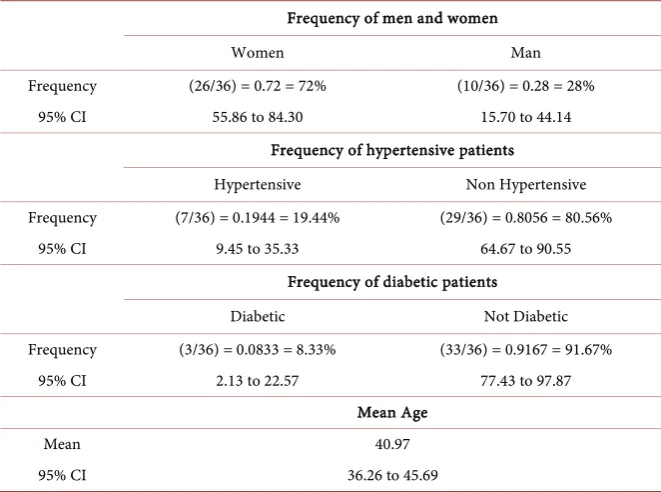
Among the evaluated patients, the mean age obtained was 40.97 years (95% CI 36.26 to 45.69), with a predominance of females (72% female, 95% CI 55.86 to 84.3; 27.78% male, 95% CI, 15.7 to 44.14), with only 3 diabetic patients (8.33%, 95% CI 2.13 to 22.57) and 7 hypertensive patients (19.44%, 95% CI 9.45 to 35.33) (Table 1).
DOI: 10.4236/ss.2018.98029 245 Surgical Science was a mean increase of 5.97 times the CRP (95% CI 3.76 to 8.34 and SD: 6.98), comparing pre and post-surgical an average increase of 1.97 times (95% CI 1.71 to 2.24 and SD: 1.97) and a mean peak of 13,535 u/L (95% CI 11,824 to 15,246 and SD: 5057) in the leukocyte count, also being evaluated before and after sur-gery (Table 2 and Table 3).
4. Discussion
Patients who undergo a surgical procedure exhibit elevation in inflammatory markers such as C-Reactive Protein (CRP) and white blood cell count. Accord-ing to [5], CRP is one of the markers that allows a direct quantification of the
Table 1. Sociodemographic and clinical characteristics of the participants.
Frequency of men and women
Women Man
Frequency (26/36) = 0.72 = 72% (10/36) = 0.28 = 28%
95% CI 55.86 to 84.30 15.70 to 44.14
Frequency of hypertensive patients
Hypertensive Non Hypertensive
Frequency (7/36) = 0.1944 = 19.44% (29/36) = 0.8056 = 80.56%
95% CI 9.45 to 35.33 64.67 to 90.55
Frequency of diabetic patients
Diabetic Not Diabetic
Frequency (3/36) = 0.0833 = 8.33% (33/36) = 0.9167 = 91.67%
95% CI 2.13 to 22.57 77.43 to 97.87
Mean Age
Mean 40.97
[image:3.595.207.538.255.501.2]95% CI 36.26 to 45.69
Table 2. Pre and post-operative leukocyte count.
Leukocyte count
Pre-operative leukocytes Post-operative leukocytes
Mean 7271.11 13,535.55
95% CI 6504.78 to 8037.44 11,824.22 to 15,246.90
Standard deviation 2264.91 5057.88
Table 3. Pre and post-operative CRP count.
CRP count
Pre-operative CRP Post-operative CRP
Mean 1.97 5.97
95% CI 1.71 to 2.24 3.76 to 8.34
[image:3.595.209.539.535.612.2]DOI: 10.4236/ss.2018.98029 246 Surgical Science acute phase inflammatory response. In this study, the values of CRP were in-creased approximately five times postoperatively, while in the present study the values found were similar, with an increase of 5.97 times after the surgical ag-gression.
According to [2], post-surgical values of CRP reached a mean peak of 27 mg/L, while post-surgical values of leukocytes reached an average peak of 11,000 u/L disagreeing with the present study where values were around of 13,535 u/L, both in patients submitted to the cholecystectomy procedure. Reference [2] and
[6] they considered a possible bias that was to have used a heterogeneous sample regarding the type of surgical aggression.
In the present study, in order to minimize this bias, it was chosen to study the patients submitted to elective surgery of laparoscopic cholecystectomy and it was verified that these presented an increase in the measurements of CRP and leu-kocyte count, confirming that the surgical trauma triggers inflammatory activity, according to the literature.
Another important issue observed in this study was the predominance of women who underwent cholecystectomy. According to [7], cholecystolithiasis predominates in women in a ratio of 2:1 and some factors contribute to this, such as the use of oral contraceptives and multiple gestations, conditions not observed in this study.
The present study aimed to compare the inflammatory response of the abetic patient to the non-diabetic one, since it is known that the patient with di-abetes mellitus has a compromised immune system due to the disease, however, because the sampling technique was for convenience, there were no diabetic pa-tients in sufficient numbers for comparison with statistical significance.
5. Conclusion
There was an elevation of the inflammatory markers PCR and leukocyte count in patients submitted to the surgical trauma of the videolaparoscopic cholecys-tectomy when comparing the exams collected in the immediate preoperative pe-riod and after 24 hours of the surgical aggression.
Acknowledgements
We, M.M.L.N. and A.S.A., would like to thank our mentor for pushing and helping us in every single step of this study. You have made us come this far and you have taught us a great deal, for that we are extremely grateful.
Conflicts of Interest
The authors declare no conflicts of interest regarding the publication of this pa-per.
References
DOI: 10.4236/ss.2018.98029 247 Surgical Science Infection. Central European Journal of Immunology, 39, 532-537.
https://doi.org/10.5114/ceji.2014.47741
[2] Watt, D.G., Horgan, P.G. and Mcmillan, D.C. (2015) Routine Clinical Markers of the Magnitude of the Systemic Inflammatory Response after Elective Operation: A Systematic Review. Surgery, 157, 362-380.
https://doi.org/10.1016/j.surg.2014.09.009
[3] (1992) American College of Chest Physicians/Society of Critical Care Medicine Consensus Conference: Definitions for Sepsis and Organ Failure and Guidelines for the Use of Innovative Therapies in Sepsis. Critical Care Medicine, 20, 864-874. https://doi.org/10.1097/00003246-199206000-00025
[4] Lontchi-Yimagou, E., Sobngwi, E., Matsha, T.E. and Kengne, A.P. (2013) Diabetes Mellitus and Inflammation. Current Diabetes Reports, 13, 435-444.
https://doi.org/10.1007/s11892-013-0375-y
[5] Floros, T., Philippou, A., Nardakostas, D., Mantas, D. and Koutsilieris, M. (2016) The Growth Endocrine Axis and Inflammatory Responses after Laparoscopic Cho-lecystectomy. HORMONES, 15, 73-80.
[6] Kulkarni, O.P., Lichtnekert, J., Anders, H.J. and Mulay, S.R. (2016) The Immune System in Tissue Environments Regaining Homeostasis after Injury: Is (Inflamma-tion) Always Inflammation? Hindawi Publishing Corporation Mediators of In-flammation, Cairo.
[7] Borges, M.C., Takeuti, T.D., Terra, G.A., Ribeiro B.M., Rodrigues-Júnior, V. and Crema E. (2016) Perfil Imunológico de Mulheres Submetidas à Colecistectomia Lalparoscópica Convencional e por Portal Único. Arquivos Brasileiros de Cirurgia Digestiva, 29,164-169.
http://www.scielo.br/scielo.php?script=sci_arttext&pid=S0102-67202016000300164 &lng=en.%20http://dx.doi.org/10.1590/0102-6720201600030009