ISSN Online: 1947-3826 ISSN Print: 1949-2421
DOI: 10.4236/cn.2019.111001 Jan. 24, 2019 1 Communications and Network
Acceleration of Homomorphic Arithmetic
Processing Based on the ElGamal Cryptosystem
Takuma Jogan
1, Tomofumi Matsuzawa
2, Masayuki Takeda
21Department of Information Sciences, Graduate School of Tokyo University of Science, Tokyo, Japan 2Department of Information Sciences, Tokyo University of Science, Tokyo, Japan
Abstract
In recent years, opportunities for using cloud services as computing resources have increased and there is a concern that private information may be leaked when processes data. The data processing while maintaining confidentiality is called secret computation. Cryptosystems can add and multiply plaintext through the manipulation of ciphertexts of homomorphic cryptosystems, but most of them have restrictions on the number of multiplications that can be performed. Among the different types of cryptosystems, fully homomorphic encryption can perform arbitrary homomorphic addition and multiplication, but it takes a long time to eliminate the limitation on the number of homo-morphic operations and to carry out homohomo-morphic multiplication. Therefore, in this paper, we propose an arithmetic processing method that can perform an arbitrary number of homomorphic addition and multiplication operations based on ElGamal cryptosystem. The results of experiments comparing with the proposed method with HElib in which the BGV scheme of fully homo-morphic encryption is implemented showed that, although the processing time for homomorphic addition per ciphertext increased by about 35%, the processing time for homomorphic multiplication was reduced to about 1.8%, and the processing time to calculate the statistic (variance) had approximately a 15% reduction.
Keywords
ElGamal Cryptosystem, Homomorphic Cryptosystem, Delegating Computation
1. Introduction
With the recent development of cloud services, there has been a growing trend of outsourcing computational tasks. This gives rise to the important security is-How to cite this paper: Jogan, T.,
Matsu-zawa, T. and Takeda, M. (2019) Accelera-tion of Homomorphic Arithmetic Processing Based on the ElGamal Cryptosystem. Com- munications and Network, 11, 1-10.
https://doi.org/10.4236/cn.2019.111001
Received: December 21, 2018 Accepted: January 21, 2019 Published: January 24, 2019
Copyright © 2019 by author(s) and Scientific Research Publishing Inc. This work is licensed under the Creative Commons Attribution International License (CC BY 4.0).
http://creativecommons.org/licenses/by/4.0/
DOI: 10.4236/cn.2019.111001 2 Communications and Network sue of protecting privacy, since personal information is being transferred. To solve the problem, homomorphic cryptosystems capable of computing plaintext by the manipulation of ciphertexts have attracted attention.
Homomorphic cryptosystems include additive homomorphic encryption that can perform only homomorphic additions such as Paillier encryption and lifted-ElGamal encryption, and multiplicative homomorphic encryption that can perform only homomorphic multiplications such as RSA encryption and El-Gamal encryption [1] [2] [3]. In addition, homomorphic cryptosystems that can perform both homomorphic addition and homomorphic multiplication are called fully homomorphic encryption (FHE) [4]. FHE has high convenience, but there is a problem that its processing speed is very slow.
Therefore, in this paper, we propose a system capable of both homomorphic addition and homomorphic multiplication based on the ElGamal cryptosystem by unifying the random number part normally included in ElGamal ciphertext with all ciphertexts. However, this situation raises concerns about a decline in security compared to the ordinary ElGamal cryptosystem. Hence, in the state other than homomorphic computation, it is in the form of ordinary ElGamal ciphertext. To accomplish this, we replace the value of r included in ElGamal ciphertext into constants or random numbers.
The rest of the paper is organized as follows. Homomorphic Cryptosystem is introduced in Section 2. In Section 3, ElGamal Cryptosystem is introduced. In Section 4, Fully Homomorphic Encryption is introduced. We propose an arith-metic processing method that can perform an arbitrary number of homomor-phic addition and multiplication operations based on ElGamal cryptosystem in Section 5. Section 6 shows results of two experiments. Sections 7 - 9 draw dis-cussion, future work, and conclusions.
2. Homomorphic Cryptosystem
A homomorphic cryptosystem can perform the addition and multiplication of plaintext by the manipulation of ciphertexts. When ciphertext Enc m
( )
1 ,( )
2Enc m for plaintext m m1, 2 are given, Enc m m
(
1 2)
can be obtained with-out plaintext or a secret key, where is a binary operator such as addition or multiplication.3. ElGamal Cryptosystem
The ElGamal cryptosystem is a public key cryptosystem based on the premise that a discrete logarithm problem of a group with a large order is difficult. El-Gamal cryptosystem consists of three components: the key generator, the en-cryption algorithm, and the deen-cryption algorithm.
Key generation
DOI: 10.4236/cn.2019.111001 3 Communications and Network
(
mod)
x
h g≡ q
The public key is
(
G q g h, , ,)
and the secret key is x. EncryptionTo encrypt a message m G∈ , we randomly select r∈
{
0, , q−1}
andcompute 2
1, 2
c c ∈G as follows.
(
)
1 r mod
c ≡g q
(
)
2 xr mod
c ≡mg q
The ciphertext is
(
c c1, 2)
. DecryptionTo decrypt a ciphertext
(
)
2 1, 2c c ∈G , we compute m G∈ as follows.
(
)
2
1
mod
xr
x xr
c mg m q
c = g =
The plaintext is m.
4. Previous Rsearch
Fully Homomorphic Encryption
FHE is capable of arbitrary operations such as the addition and multiplication of plaintext by the manipulation of ciphertexts. When plaintext is encrypted, it adds constant noise according to security parameters. This noise increases with each homomorphic operation, and if the noise becomes too large, it becomes impossible to decrypt the ciphertext into the original plaintext. In particular, when homomorphic multiplication is performed, noise increases greatly. Thefore, developers created somewhat homomorphic encryption (SHE), which re-stricts the number of homomorphic multiplications. Then, in 2009, Gentry pro-posed Bootstrap as a method to reduce ciphertext noise in SHE. This makes it possible to take restrictions on SHE and implement FHE. However, Bootstrap is not practical from the viewpoint of processing speed because it greatly increases the number of calculations.
Since then, studies such as a method called packing for encrypting plural plaintexts into one ciphertext and a scheme for reducing noise of ciphertext without using Bootstrap are progressing [5] [6]. These have greatly improved the performance, but there is still a problem with processing speed.
Bootstrap
Bootstrap reduces noise accumulated in ciphertext by homomorphic opera-tion. FHE makes the decipherability difficult to realize by adding noise to the ciphertext as the basis for security. This noise increases with each iteration of homomorphic operation, and if it exceeds a certain threshold value it can not decode correctly.
de-DOI: 10.4236/cn.2019.111001 4 Communications and Network coding is stored. With this approach, Gentry realized the configuration of FHE.
5. Proposed Method
5.1. Overview
In this paper, we propose a method capable of both homomorphic addition and homomorphic multiplication based on the ElGamal cryptosystem. In the pro-posed method, the random number part normally included in ElGamal cipher-text is unified with all ciphercipher-texts. This allows for both homomorphic addition and homomorphic multiplication. However, since this situation raises concerns about a decline in security compared to the ordinary ElGamal cryptosystem, in the state other than homomorphic computation, it is in the form of ordinary ElGamal ciphertext. Hereafter, the form of the ciphertext at the time of homo-morphic operation is called “an arithmetic form”, and the form of the ciphertext in other case is called “a stored form”.
5.2. System Configuration
We propose a delegating computation model in which encrypted data are transmitted from the user to the cloud, and the cloud performs arithmetic processing on those encrypted data.
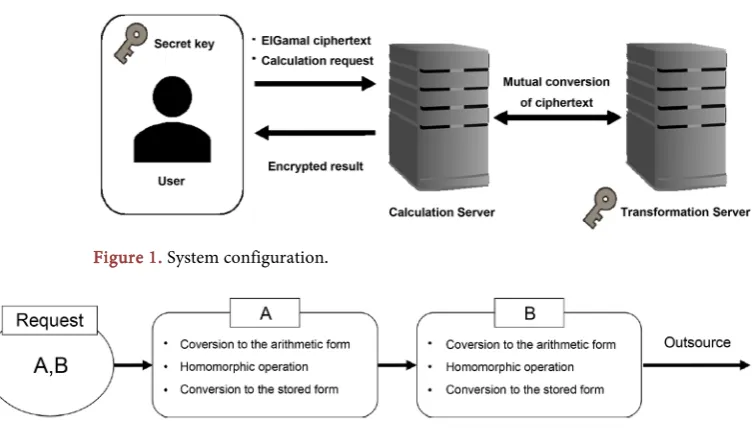
It is assumed that the cloud includes a calculation server and a transformation server. The calculation server performs arithmetic operations such as statistical processing in the encrypted state, and the transformation server replaces the value of r included in ElGamal ciphertext into constants or random numbers (Figure 1). Also, it is assumed that the user and the transformation server can safely share the secret key.
Figure 1 shows the system’s processing flow. First, the user transmits ElGamal ciphertexts that are stored form, to the calculation server, and the calculation server stores the data. Upon receiving the calculation request from the user, the calculation server exchanges data with the transformation server to convert the stored form of the ElGamal ciphertexts into the arithmetic form of the ElGamal ciphertexts. Then, the calculation server performs processing according to the calculation request by homomorphic operations, and obtains the calculation re-sults of the encrypted state. Then, the calculation server exchanges data with the transformation server to converts the arithmetic form of the ElGamal ciphertexts into the stored form of the Elgamal ciphertexts. Finally, the stored form of the encrypted operation result is transmitted to the user, and the user decrypts it using a secret key to obtain the calculation result. If multiple processing contents are included in the calculation request, the same procedure is repeated (Figure 2).
We assume the roles of the user, the calculation server, the transformation server, the constraints imposed, and the functions as follows.
User
DOI: 10.4236/cn.2019.111001 5 Communications and Network
Figure 1. System configuration.
Figure 2. Process flow of the calculation request.
• Encrypt the plaintext and send the encrypted data to the calculation server • Have a secret key
Calculation Server • Can not get the plaintext
• When encrypted data are transmitted to the transformation server, they are multiplied by a random number
• Do not collaborate with the transformation server • Do not have a secret key
Transformation Server • Can not get the plaintext
• When plaintext are transmitted to the calculation server, it is multiplied by a random number
• Do not collaborate with the calculation server • Have a secret key
5.3. Homomorphism
In the arithmetic form of ciphertext, we unify the value of r included in ElGamal ciphertext by all ciphertexts. As a result, the arithmetic form of the ciphertext sa-tisfies both additive homomorphism and multiplicative homomorphism.
Given ciphertexts c1=
(
c c11, 12)
=(
g m gr, 1 xr)
, c2=(
c c21, 22)
=(
g m gr, 2 xr)
where m m1, 2∈G.Additive Homomorphism
Compute ciphertext for m m1+ 2 as follows.
(
)
12 22 1 xr 2 xr 1 2 xr
c +c =m g +m g = m m g+
Then, using c11=c21=gr, output
(
g m m gr,(
1+ 2)
xr)
. Multiplicative HomomorphismDOI: 10.4236/cn.2019.111001 6 Communications and Network
(
)
212 22 1 xr 2 xr 1 2 xr
c c =m g ∗m g = m m g
Then, compute 2
11 21 r
c c =g and output
(
2(
)
2)
1 2 ,r xr
g m m g .
5.4. Conversion Processing of Ciphertext
We show the method of mutual conversion between the arithmetic and the stored forms of ciphertext.
Conversion from Stored to Arithmetic Form
Given
(
c ci1, i2)
=(
g m gri, i xri)
where i∈q,m Gi∈ , ri is a random num-ber:1) The calculation server generates a random number α ∈i G and sends
(
ci1,αi ic2)
to the transformation server.2) The transformation server decrypts the received ciphertexts:
2
1
i
i xr
i i i i
i i
x xr
i
c m g m
c g
α α α
= =
3) The transformation server generates ciphertexts from αi im and random number r G∈ and send them to the calculation server. r is generated while encrypting α1 1m, and the same r is used for encryption of αi im i
(
=2,3,)
.Also, when multiple processing contents are included in the calculation request, a different r is used for each processing content:
(
c ci′ ′ =1, i2)
(
gr,αi im gxr)
4) The calculation server removes the random number αi from the received ciphertexts and computes
(
r, xr)
i
g m g .
Conversion from Arithmetic to Stored Form
Given
(
c ci1, i2)
=(
g m gr, i xr)
where i∈q,m Gi∈ , r is a constant number:1) The calculation server generates a random number β ∈i G and sends
(
ci1,βi ic2)
to the transformation server.2) The transformation server decrypts the received ciphertexts:
2
1
xr
i i i i
i i
x xr
i
c m g m
c g
β β β
= =
3) The transformation server generates ciphertexts from βi im and random number r Gi∈ and sends them to the calculation server:
(
c ci′′ ′′ =1, i2)
(
gri,βi im gxri)
4) The calculation server removes the random number βi from the received ciphertexts and computes
(
ri, xri)
i
g m g .
6. Experiment
6.1. Overview
DOI: 10.4236/cn.2019.111001 7 Communications and Network scheme of FHE is implemented was used. HElib is an open source library pub-lished by IBM and available in C ++. Also, implementation of the proposed me-thod was done in C.
Experiment 1
We measure the processing time of homomorphic addition and homomor-phic multiplication. We also measured the processing time of mutual conversion of the ciphertext between stored and arithmetic forms.
Experiment 2
We computed the variance of 1000 - 10,000 data items and measured the processing time. We converted the stored form to arithmetic form, performed statistical processing, and converted the arithmetic form to a stored form. Then, we measured the time taken for this series of flows.
6.2. Experiment Environment
The experimental environment was as follows. • OS: Ubuntu 18.04.1 LTS
• CPU: Intel(R) Core(TM) i7-4790 CPU @ 3.60 GHz • Memory: 4 GB
• Compiler: gcc 7.3.0, g++ 7.3.0 • Library: NTL-11.0.0, GMP-5.0.4 • Security: 1024 bit
6.3. Dataset
As an experimental data set, we used the “Adult” labeled dataset provided by UCI. This data set contains 32,561 data items divided by 14 attributes such as age, gender, race, etc. In the experiment, we used the age attribute.
6.4. Results
Experiment 1We measured the processing time for homomorphic addition and homomor-phic multiplication (see Table 1). In homomorphic addition and homomorphic multiplication of HElib, it is not the processing time required for homomorphic operation between packed ciphertexts. It is the processing time of homomorphic operation per ciphertext calculated by dividing the processing time by the num-ber of slots.
Experiment 2
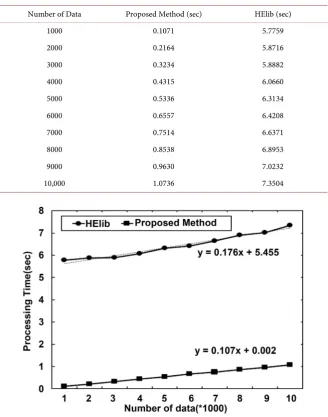
We measured the processing time taken to calculate the variance by homo-morphic operations. Table 2 and Figure 3 show the transition of the processing time when the number of data items changes from 1000 to 10,000 in increments of 1000.
DOI: 10.4236/cn.2019.111001 8 Communications and Network
Table 1. Processing time (homomorphic addition, homomorphic multiplication, and conversion).
Homomorphic Content Proposed Method (μsec) HElib (μsec)
Homomorphic Addition 0.4834 0.3579
Homomorphic Multiplication 1.0774 61.2303
Conversion to stored form 28.9767 ×
[image:8.595.210.539.214.632.2]Conversion to arithmetic form 73.7447 ×
Table 2. Processing time (variance).
Number of Data Proposed Method (sec) HElib (sec)
1000 0.1071 5.7759
2000 0.2164 5.8716
3000 0.3234 5.8882
4000 0.4315 6.0660
5000 0.5336 6.3134
6000 0.6557 6.4208
7000 0.7514 6.6371
8000 0.8538 6.8953
9000 0.9630 7.0232
10,000 1.0736 7.3504
Figure 3. Transition of the processing time (variance).
DOI: 10.4236/cn.2019.111001 9 Communications and Network about 1.8%.
Experiment 2
We measured variance was obtained using 1000 - 10,000 data items and we measured the processing time. In Figure 2, the respective approximate straight lines are obtained, where the value of the vertical axis is y and the value of the horizontal axis is x, HElib is represented by y=0.176x+5.455, and the pro-posed method is represented by y=0.107x+0.002.
8. Future Work
We need to improve the security of the proposed method in which we convert from a stored form to an arithmetic form before the homomorphic operation. In arithmetic form, the value of r included in the ElGamal ciphertext
(
g mgr, xr)
is unified in all ciphertexts. Therefore, when ElGamal ciphertexts
(
)
(
)
1 11, 12 r, 1 xr
c = c c = g m g , c2=
(
c c21, 22)
=(
g m gr, 2 xr)
where1, 2
m m ∈G, are
given, they satisfy the following.
22 2
12 1
c m
c = m
Since the ratio of the plaintext can be obtained from the ratio of the cipher-texts, if any plaintext is deprived in any way, all the plaintexts will leak out. However, when converting to a stored form again and converting it to an arith-metic form from it, the value of r is unified in all ciphertexts, but it can be changed to a value different from the value of r before conversion.
9. Conclusion
In this paper, we propose the acceleration of homomorphic arithmetic processing based on the ElGamal cryptosystem and present experiments, evaluation, and discussion. The results of experiments comparing the proposed method with HElib showed that, although the processing time for homomorphic addition per ciphertext increased by about 35%, the processing time for homomorphic mul-tiplication was reduced to about 1.8%, and the processing time to calculate the statistic (variance) had approximately a 15% reduction.
Conflicts of Interest
The authors declare no conflicts of interest regarding the publication of this pa-per.
References
[1] Paillier, P. (1999) Public-Key Cryptosystems Based on Composite Degree Residuos-ity Classes. Proceedings of the EUROCRYPTO’99, Lecture Notes in Computer Science, 1592, 223-238. https://doi.org/10.1007/3-540-48910-X_16
DOI: 10.4236/cn.2019.111001 10 Communications and Network
[3] Elgamal, T. (1985) A Public-Key Cryptosystem and a Signature Scheme Based on Discrete Logarithms. IEEE Transactions on Information Theory, 31, 469-472.
https://doi.org/10.1109/TIT.1985.1057074
[4] Gentry, C. (2009) A Fully Homomorphic Encryption Scheme. Doctoral Disserta-tion, Stanford University, Stanford.
[5] Smart, N.P. and Vercauteren, F. (2010) Fully Homomorphic Encryption with Rela-tively Small Key and Ciphertext Sizes. PKC, 420-443.
https://doi.org/10.1007/978-3-642-13013-7_25