Precocious S-Phase Entry in Budding Yeast Prolongs Replicative State and
Increases Dependence Upon Rad53 for Viability
Julia M. Sidorova
1and Linda L. Breeden
Fred Hutchinson Cancer Research Center, Seattle, Washington 98109 Manuscript received August 30, 2001
Accepted for publication November 5, 2001
ABSTRACT
Precocious entry into S phase due to overproduction of G1 regulators can cause genomic instability. The mechanisms of this phenomenon are largely unknown. We explored the consequences of precocious S phase in yeast by overproducing a deregulated form of Swi4 (Swi4-t). Swi4 is a late G1-specific transcriptional activator that, in complex with Swi6, binds to SCB elements and activates late G1-specific genes, including G1 cyclins. We find that wild-type cells tolerate Swi4-t, whereas checkpoint-deficientrad53-11cells lose viability within several divisions when Swi4-t is overproduced. Rad53 kinase activity is increased in cells overproduc-ing Swi4-t, indicatoverproduc-ing activation of the checkpoint. We monitored the transition from G1 to S in cells with Swi4-t and found that there is precocious S-phase entry and that the length of S phase is extended. Moreover, there were more replication intermediates, and firing of at least a subset of origins may have been more extensive in the cells expressing Swi4-t. Our working hypothesis is that Rad53 modulates origin firing based upon growth conditions to optimize the rate of S-phase progression without adversely affecting fidelity. This regulation becomes essential when S phase is influenced by Swi4-t.
P
ROPER integration of cell cycle transitions with investigate these mechanisms using budding yeast as a model system.DNA metabolism is crucially important for cell
sur-Swi4 is a late G1-specific transcriptional activator, which, vival and error-free propagation of a cell’s genetic
mate-in complex with Swi6, bmate-inds to SCB elements ( Menden-rial. Cells that are unable to adjust the cell cycle clock
hallandHodge1998) in the promoters of numerous upon receiving DNA damage are known to lose viability
late G1-specific genes (Iyeret al.2001). The activity of and/or compromise the fidelity of genetic transmission
the Swi4/Swi6 complex gives rise to the concerted burst (Foiani et al.2000). In the absence of any genotoxic
of transcription of the G1 cyclin genesCLN1andCLN2 treatment, genomic stability can be negatively affected
and of a number of other genes, which promote the by relaxation of the control over the transition between
transition to S phase (NasmythandDirick1991;Ogas G1 and S phases. For example, forced entry of some
qui-et al. 1991). Swi4-t, a C-terminally truncated and stabi-escent cells into S phase upon c-mycor cyclin E
overpro-lized form of Swi4, is unable to interact with Swi6 and duction is known to result in genomic rearrangements
cannot form the Swi4/Swi6 complex (Andrews and (FelsherandBishop1999;Maiet al.1999;Sprucket al.
Moore1992;Primiget al.1992;SidorovaandBreeden 1999). Loss of Rb or ectopic expression of cyclin D1 in
1993). However, unlike the full-length Swi4 (Baetzand tissue culture cells can increase gene amplification
fre-Andrews1999), the truncated Swi4-t is capable of bind-quencies (Donehower1997). In budding yeast,
inacti-ing to promoters independently of Swi6 (Andrewsand vation of the B cyclin inhibitorSIC1, which causes earlier
Moore1992;Primiget al.1992;SidorovaandBreeden activation of the S-phase cyclin/CDK complexes and
1993), and when overexpressed from theGALpromoter earlier entry into S phase (Schwob et al. 1994), leads
(GAL::SWI4-t), it deregulates the transcription of target to an elevated rate of chromosome loss (Nugrohoand
genes (BreedenandMikesell1994). Swi4-t can cause Mendenhall1994). Overexpression of G1 cyclinsCLN1
a precocious entry into S phase similar to the checkpoint orCLN2, whose levels are rate limiting for the G1-to-S
mutant of Rad53 in cells that receive DNA damage in transition, is synthetically lethal with mutations in the
G1 (SidorovaandBreeden 1997). DNA damage checkpoint kinase geneMEC1and causes
Rad53, a kinase conserved from yeast to humans, is in-an increased level of chromosome loss (Vallen and
volved in coordinating DNA metabolism with cell cycle Cross1995, 1999). The mechanisms of genomic
insta-transitions (Weinert 1998;Foianiet al. 2000). In the bility induced by relaxation of control over the G1- presence of DNA damage in G1 and G2, Rad53 is most to-S transition remain largely unknown. We sought to likely recruited to the damage recognition and
pro-cessing complex (Foianiet al.2000) via Mec1-phosphor-ylated Rad9 (Emili1998;Sunet al.1998;Vialardet al. 1998;Durocheret al. 1999). Rad53 is phosphorylated
1Corresponding author:Fred Hutchinson Cancer Center, 1100
Fair-view Ave. N, Seattle, WA 98109. E-mail: [email protected] and activated in a Mec1 kinase-dependent manner (Navas
trp1 ade5. Mating tester strains BY26 and BY27 areMATahis1 et al.1996;Sanchezet al.1996;Sunet al.1996). Activated
andMAT␣his1, respectively. Rad53 and Mec1 phosphorylate specific targets, which
The plasmid pBD1168 is a YCp50 vector withGAL::SWI4-t can delay cell cycle transitions and induce DNA repair and was described previously (SidorovaandBreeden1993). (Allenet al.1994;SidorovaandBreeden 1997;Hu- pBD1411 and pBD1948 were described before (Tyers et al. 1993;EpsteinandCross1994). The plasmid pBD2385 has anget al. 1998; Pellicioliet al. 1999; Sanchez et al.
been described previously (SidorovaandBreeden1993) and 1999;Bashkirovet al.2000;Kiharaet al.2000). Rad53
is a Ycp50 with the GAL promoter-driven SWI4 gene. The is also important for monitoring DNA damage and
nu-plasmid pBD2972 is a kind gift of Dr. S. Elledge and contains cleotide shortages within S phase (PaulovichandHart- theRNR1open reading frame under the control of theGAL well1995;Navaset al.1996). Rad53 prevents firing of promoter on a 2-mTPR1shuttle vector (Desanyet al.1998).
Growth conditions:All rich (YEP) and minimal (YC) media origins when DNA replication is encumbered by
dam-and growth conditions were as described before (Breeden
age (SantocanaleandDiffley1998;Shirahigeet al.
andMikesell1991). Cultures used for elutriation were grown 1998;TerseroandDiffley2001) and potentially
stabi-in YC-ura glucose media and then stabi-inoculated stabi-into YEP media lizes stalled replication forks (Lopeset al. 2001). Rad53 with 2% raffinose and grown to OD660⫽1.5–1.8. To induce also blocks premature metaphase-to-anaphase transi- Swi4-t, galactose was added 80–100 min before the zero time point of the experiment (this induction time included the tion in cells with incompletely replicated DNA (Allen
time in the elutriator). The zero time point was the time when et al.1994). Finally, Rad53 is an essential gene (Zheng
the unbudded eluted cells were placed in the 30⬚incubator. et al. 1993) whose role in the unperturbed cell cycle
This time was ample to fully induce Swi4-t overexpression, is most likely involved in S-phase progression control which takesⵑ30 min (J. Sidorova, unpublished results), and (Desanyet al.1998;Dohrmannet al.1999). Along with ensured that these cells had high levels of Swi4-t from the very beginning of G1 phase. For␣-factor synchrony experiments, a Mec1, Rad53 may act during S phase to remove the
culture at OD660 ⫽ 0.2 was typically arrested by incubation Sml1-mediated inhibition of ribonucleotide reductase
with 5 mg/liter of␣-factor for 1 hr 45 min. Cells were released (Zhaoet al.1998).
from the arrest by filtration or by addition of Pronase E (Sigma, In this study, we demonstrate that Swi4-t overexpres- St. Louis) to a final concentration of 10 mg/liter.dbf4-1strains sion can cause precocious entry into S phase in the absence were arrested at 37⬚ for 2.5–3 hr and released into the cell of exogenous DNA damage. We also show that Swi4-t cycle by shifting back to 25⬚.
FACS analysis:FACS analysis was done exactly as described overexpression results in a loss of viability in
combina-before (SidorovaandBreeden1997) except that cells were ana-tion with an allele ofRAD53that is defective in
check-lyzed on a Calibur Analyser (Becton Dickinson, San Jose, CA). point function (rad53-11). Analysis of S phase inRAD Elutriation:Elutriation was performed in a J-6B centrifuge andrad53-11strains overexpressing Swi4-t suggests that (Beckman, Fullerton, CA) using a JE-5.0 rotor and a 40-ml cham-Swi4-t prolongs the replicative state of cells and may ber (Beckman). The chamber was loaded with cells at 3500 rpm and 28 ml/min flow rate. Flow rate was then increased to 35 increase the frequency of replication initiation. We
pro-ml/min and the chamber was equilibrated with fresh media. pose that excessive origin firing can result in stalling of
Small G1 cell fractions were harvested in fresh media by fur-forks due to depletion of resources such as dNTPs or
ther increasing the flow rate from 35 ml/min to 55 to 60 ml/ histones. In the absence of Rad53, stalled forks are not min in 3- to 5-ml/min increments. The size of cells in these stable enough to resume replication when resources are fractions was determined using a Z2 Particle Count and Size Ana-lyzer and the data were analyzed using the AccuComp version replenished, and there is no signal to inhibit further origin
2.01 software (Beckman Coulter, Miami). firing. Combined, these deficiencies lead to lethality. In
Nocodazole execution point measurements:To determine other words, during a normal S phase, Rad53 serves
the nocodazole execution point, elutriated G1 cells were al-as a pacemaker, coordinating S-phal-ase progression with lowed to progress through the cell cycle. Aliquots (5 ml) of this growth conditions. By preventing excessive origin firing, culture were taken every 10 min, transferred to culture tubes it minimizes the effects of precocious S-phase entry im- with nocodazole (final concentration 12 mg/liter), and incu-bated at 30⬚for 2 hr on a roller drum. After 2 hr these cells were posed by hyperactive Swi4-t.
treated with 1% sodium azide and sonicated and the cell num-bers were counted. As expected, cells treated with nocodazole before the first anaphase were arrested in the first cycle (Jacobs
MATERIALS AND METHODS
et al.1988). Cells that had passed this transition divided once and arrested in metaphase of the second cycle. Thus, the
Strains and plasmids:The yeast strain BY2006MATaura3 leu2
final cell concentration after the nocodazole treatment was trp1 his3has been described (SidorovaandBreeden 1997).
dependent upon the proportion of cells that had traversed BY2390 is aura3derivative of BY2007MATaura3 leu2 trp1 his3
the first anaphase and become nocodazole resistant at the time rad53-11::URA3 (Sidorova and Breeden 1997). BY2912 and
point when the aliquot was taken. Percentage of nocodazole-BY2913 were derived from BY2006 and BY2390, respectively,
resistant cells at each time point was calculated using these by integration ofEscherichia colidam methylase on a pRS305
vec-cell concentration data. In addition, aliquots of vec-cells were tor into the endogenousLEU2locus (Friedmanet al.1995).
taken every 10 min from the untreated growing culture. These BY2887 and BY2888 are isogenic to BY2006 and BY2390,
re-samples were also arrested by 1% sodium azide, and cell con-spectively, except they carry arad52::LEU2disruption. BY2914
centration and proportion of budded cells were determined isMATaura3 lys2 leu2 trp1 pep4::HIS3 prb1⌬1.6Rwith the
en-in each sample. dogenousRAD53gene tagged with the HA tag (Emili1998).
MATlocus heterozygosity loss measurements:These mea-BY2226 MATa ura3 leu2 trp1 his3 mec1-1::HIS3 and BY2227
surements were done essentially as described (Roseet al.1990), MATaura3 leu2 trp1 his3 rad9⌬::LEU2were described before
of theMATalleles will mate as haploids.RAD/rad53-11 hetero-zygous diploids were constructed by mating BY2006MATa
ura3 leu2 trp1 his3(SidorovaandBreeden1997) and BY2918 MAT␣ura3 leu2 his3 ade rad53-11::ura3::LEU2.Diploids were transformed with the empty vector pYES2 or with theGAL:: SWI4-tpBD1168 plasmid and were grown in YC-ura media with 2% raffinose and 2% galactose for about eight generations. Of these cells, 5⫻106were mated with the equal number of cells of either one of the mating tester strains, BY26 or BY27. Upon plating, mated cells gave rise to prototrophic colonies. A sepa-rate control was included with only RAD/rad53-11 and no mating tester strains. NeitherRAD/rad53-11diploids nor mat-ing tester strains alone gave rise to prototrophic colonies at a measurable frequency (⬎10⫺6). Loss of heterozygosity was calculated as the number of mating events per milliliter of culture divided by the number of viable cells per milliliter of culture, and it was typicallyⵑ10⫺4. The average numbers and average deviation of five measurements are reported.
Rad53 kinase assay:Immunoprecipitation of HA-Rad53 and kinase assays were done as described before (Sidorova and
Breeden1997) with 12CA5 mouse monoclonal antibodies to
the HA epitope, except that no exogenous substrate was added to the kinase reaction.
Hemi-methylation analysis:Hemi-methylation analysis was done as described (Friedmanet al.1995, 1997). A constitutively expressedE. colidam methylase gene on a pRS305 plasmid ( Fried-manet al.1995) was integrated into the endogenousLEU2locus of yeast strains. These strains did not show a growth disadvantage compared to the parental strains, andGAL::SWI4-t overexpres-sion had the same phenotype in the methylated strains as in the parental strains. DNA was digested overnight withDpnI andEcoRI and loaded onto 0.8% agarose gels. Southern blot-ting and hybridization with the ARS607 probe were performed on GeneScreen membranes (New England Nuclear, Boston) according to the manufacturer’s recommendations. The probe
Figure1.—Overexpression of Swi4-t is lethal inrad53-11or for the ARS607 region maps to chromosome VI coordinates
mec1-1mutants, but not inrad9⌬mutants. (A) Wild-type (BY2006), from 202,454 to 203,480 (http://www-genome.stanford.edu/
rad53-11(BY2390),mec1-1(BY2226), andrad9⌬(BY2224) strains Saccharomyces/) downstream of the ARS607 ARS consensus
se-were transformed with the empty vector (Ycp50),GAL::SWI4-t quence. In a hemi-methylated or unmethylated DNA, this probe
plasmid (pBD1168),GAL::CLN1plasmid (pBD1141), orGAL:: preferentially hybridizes to aDpnI-resistantEcoRI-digested
frag-CLN2plasmid (pBD1948) and streaked onto selective plates ment ofⵑ3.0 kb (DpnIR). Full methylation of DNA allows this
with galactose. (B) Therad53-11strain carryingGAL::SWI4-t fragment to be further digested by DpnI. In this case, the
was transformed with either the empty vector p414GAL1 or probe hybridizes mostly to a DpnI-sensitive (DpnIS), EcoRI/
theGAL::RNR1plasmid (pBD2972). The strains were grown DpnI-digested fragment ofⵑ1.0 kb.
on selective media plates with galactose. (C) 105, 0.33⫻105,
Two-dimensional gel electrophoresis:We followed the
pre-and 104of cells of the wild-type (BY2006),rad52⌬(BY2887), viously described procedures for the DNA isolation and
two-rad53-11(BY2390), andrad53-11 rad52⌬(BY2888) strains car-dimensional gel electrophoresis of replicative intermediates
ryingGAL::SWI4-tplasmid (pBD1168) were spotted onto
selec-(Friedman andBrewer 1995). The isolated DNAs were
di-tive media plates with galactose. gested withNheI for rARS replicative intermediates and
re-solved as follows. The first dimension separation was through 0.4% agarose at 1 V/cm for 20 hr at room temperature, and
eliminate the methyl methanesulfonate-dependent de-the second dimension was run in 1% agarose at 5 V/cm for
lay of the G1/S transition (SidorovaandBreeden1997). 5 hr at 4⬚. To visualize ARS608, DNAs were digested withXhoI
To explore whether combining these two genetic deter-and resolved in 0.4% agarose at 1 V/cm for 24 hr in the first
dimension and in 0.8% agarose at 2.7 V/cm for 15 hr at 4⬚. minants in one background will result in a complete The probe for rARS maps to chromosome XII coordinates elimination of this delay, we introduced three different 460,050–460,777. The probe for ARS608 maps to chromosome SWI4alleles under control of theGAL1promoter into VI coordinates 213,306–214,317.
arad53-11strain. These alleles encoded wild-type Swi4 and two of its truncated derivatives lacking 140 or 280 amino acids from the C terminus. We found that overex-RESULTS
Neither the full-length Swi4 nor a shorter truncation of 140 amino acids compromised the strain’s viability (data not shown).
Vallen andCross(1995, 1999) have previously re-ported that high levels of either of the G1 cyclins, Cln1 or Cln2, are lethal in combination with the checkpoint-deficientmec1allele in the BF264-15D background. Since CLN1andCLN2levels increase upon induction of Swi4-t (BreedenandMikesell1994), we examined whether these cyclins were sufficient to cause lethality in the A364arad53-11strain and whetherGAL::SWI4-twas le-thal to amec1strain in the A364a background. Overex-pression of Swi4-t did lead to poor viability withmec1-1. However,GAL::CLN1orGAL::CLN2did not abolish col-ony formation inrad53-11ormec1-1strains (Figure 1A).
Figure 2.—GAL::SWI4-t induces Rad53 kinase activity. A These results suggest that the lethality caused by Swi4-t wild-type strain (BY2914) with a HA-tagged Rad53 was trans-in the A364a background cannot be attributed entirely formed with the empty vector pYES2 (top) or with theGAL:: SWI4-tplasmid (pBD1168, bottom). The cells were grown in to G1 cyclin overproduction.
selective media with raffinose and then diluted into fresh me-Mec1 and Rad53 are required for all three DNA
dam-dia with galactose to induce Swi4-t expression. Aliquots were age checkpoints in G1, S, and G2 phases of the cell cycle
taken immediately before galactose was added and every hour (Foianiet al.2000). Rad9, on the contrary, is predomi- for 6 hr. Rad53 was immunoprecipitated with HA antibodies nantly required for the G1 and G2 checkpoints (Navas and allowed to autophosphorylate in the presence of [␥-32PO4] ATP. Products of the kinase reactions were resolved on an et al.1996). We found that Swi4-t overexpression had
SDS polyacrylamide gel and autoradiographed. Positions of no effect on the viability of arad9⌬strain (Figure 1A).
the modified and unmodified forms of Rad53 are marked by The fact that Swi4-t is lethal in themec1-1andrad53-11 lines on the right.
but not in therad9background suggests that functions of Mec1 and Rad53 that do not overlap with Rad9’s
function are critical for protection against Swi4-t. Re- Swi4-t induces Rad53 kinase activity and speeds up the G1/S transition:DNA damage or stalled replication sponse to disruptions in DNA replication is one such
function (Foianiet al.2000). forks cause modification and activation of the Rad53 kinase. This modification results in the appearance of If the lethal effect of Swi4-t onrad53cells is associated
with the way the S phase progresses in these cells, we would a low-mobility form of Rad53 on protein gels (Allenet al.1994;Sanchezet al. 1996;Sunet al. 1996). Figure 2 anticipate that gene products important for proper
S-phase progression might have synthetic phenotypes shows the state of Rad53 immunoprecipitated out of wild-type cells harboring vector control plasmid orGAL::SWI4-t when overproduced in a GAL::SWI4-t rad53-11 strain.
RNR1, the large subunit of ribonucleotide reductase and grown in galactose. An unmodified, high-mobility form of Rad53 remains the predominant form of this that is an important and perhaps limiting component
of an S-phase cell, rescues the lethality of GAL::SWI4-t kinase in vector control cells throughout the time course. In contrast, after 2 hr of galactose induction of rad53-11cells when overexpressed (Figure 1B).
Interest-ingly,RNR1is a target of Swi4in vivo(Iyeret al.2001) Swi4-t, there is a detectable accumulation of the low-mobility form of Rad53. Since typically only the unmodi-andRNR1is transcribed at a higher level when Swi4 or
Swi4-t is overexpressed (data not shown). fied form of Rad53 is readily detectable during a normal cell cycle (Sunet al.1996;J. Sidorova, data not shown), The presence of Swi4-t could generate some kind
of damage during replication, which could evoke the this increased presence of the low-mobility, modified form of Rad53 upon induction of Swi4-t suggests that Rad53-dependent checkpoint and necessitate repair.
In-deed,RAD52, which is critical for DNA recombination these cells are undergoing a Rad53-mediated check-point response.
and repair (Sunget al.2000), has a synthetic phenotype
with rad53-11 GAL::SWI4-t. The rad52deletion exacer- Swi4 is a critical activator of the G1/S transition, and Swi4-t is a hyperactive form that deregulates transcrip-bates Swi4-t-induced lethality inrad53-11cells while
hav-ing no measurable effect on RAD53 cells (Figure 1C). tion of G1 cyclins (Breeden and Mikesell 1994). As such, Swi4-t overproduction is expected to affect the In addition, long-term Swi4-t overexpression results in
an increase in chromosome instability as judged by the G-to-S transition. However, it is less evident that Swi4-t may affect S-phase progression. We used centrifugal elu-loss of heterozygosity of theMATlocus. ARAD/rad53-11
heterozygous diploid strain overexpressing Swi4-t shows triation to examine cell cycle progression in Swi4-t cells with or without functional Rad53. Swi4-t was induced about a threefold higher frequency of allele loss events
Figure 3.—GAL::SWI4-tspeeds up budding and S-phase onset in elutriated G1 cells. (A) Wild-type (BY2912) or rad53-11 (BY2913) cells were transformed withGAL::SWI4-t(pBD1168) or empty vector (Ycp50) and grown in rich medium with raffinose, galactose was added for 20–40 min, and small G1 cells were harvested by centrifugal elutriation in fresh YEP media with raffinose and galactose. Fractions of identical cell size distribution were collected and allowed to progress through the cell cycle. Samples were taken from these cultures every 10–15 min and the percentage of budding cells was determined. (B) Wild-type strain fractions andrad53-11strain fractions obtained by elutriation were subjected to FACS analysis. Mean cell volumes at the corresponding time points are indicated to the right of the profiles.
GAL::SWI4-t on the cell cycle. The fractions collected initiation of budding of the controlvs.Swi4-t cells (Fig-ure 3A). As with control cells, the budding induced by from the elutriator were allowed to progress through
the cell cycle and sampled at 10-min intervals. Overex- Swi4-t was accompanied by an earlier entry into S phase as determined by FACS (Figure 3B), indicating that pression of Swi4-t did not change the kinetics of cell
growth in G1 (data not shown), but it caused cells to bud these events remain coupled in the Swi4-t cells.rad53-11 cells carrying Swi4-t reproducibly exited G1 at a smaller at a smaller size than controls. For example,GAL:SWI4-t
cells achieved 50% budding at the average mean volume size than control cells. However, the volume difference betweenGAL::SWI4-tand vector cells was less dramatic of 17.4 fl, while the vector control cells were 50%
bud-ded at the average mean volume of 24 fl. Direct compari- than in the case of the wild-type cells (20 fl vs. 23 fl; see also Figure 3, A and B). We also found that elutriated son of fractions of cells with identical starting size
TABLE 1
Timing of the G1-to-S and metaphase-to-anaphase transitions
Starting 50% budding 50% nocodazole resistance Time between Strain mean volume (fl) (G1/S transition, min) (metaphase-to-anaphase transition, min) the transitions
RAD/vector 15.62 57 134 77
RAD/GAL::SWI4-t 15.67 34 120 86
rad53/vector 16.84 62 143 81
rad53/GAL::SWI4-t 16.72 46 ⬎200a ⬎154
Cells of the genotypes indicated were grown in raffinose and then galactose was added 20 min prior to the elutriation. G1 cells of the indicated size were harvested and their passage through the cell cycle was followed. Cell number and percentage of budded cells were determined at each time point. After 40 min, aliquots of each culture were removed every 10 min and in-cubated with 12 mg/liter of nocodazole for 2 hr. These cells were counted and the percentage of cells that had passed the nocodazole execution point and were able to divide once was calculated.
arad53-11 GAL::SWI4-tcells did not exceed 50% nocodazole resistance within the time frame of the experiment.
than their wild-type counterparts. Budding was slower region can be followed as a transient state of hemi-methylation, because hemi-methylated DNA is resistant and 1N DNA persisted for a longer time in these cells
(Figure 3B). to cleavage by theDpnI restriction enzyme. To compare
GAL::SWI4-tand vector cells, elutriated G1 cells of the Comparison of budding indices of the synchronized
GAL::SWI4-tand vector cells indicates thatGAL::SWI4-t two strains were followed as they progress through G1 and S, but were arrested in anaphase by adding micro-cells may spend more time as budded micro-cells (Figure 3A).
Moreover, the FACS data (Figure 3B) suggest that while tubule inhibitor nocodazole (Figure 4A). Alternatively, we employed␣-factor synchronization (Figure 4, B–D). GAL::SWI4-tcells traverse the G1-to-S transition earlier
than controls, they spend a longer time completing S This method induces a higher degree of synchrony but the first G1-to-S transition is very rapid.
phase. InGAL::SWI4-tcells, the fraction of cells with 2N
DNA content gradually rises between 60 and 140 min Consistent with previous observations, in elutriated wild-type G1 cells arrested before anaphase by nocodazole, with no indication of progression into the next cell
cycle. In contrast, the control cells show no pausing at the onset of S phase and replication through the ARS607 region as assayed byDpnI resistance occurred earlier in the 2N or near 2N DNA stage and proceed rapidly
into the next cycle. To address this in more detail, we GAL::SWI4-tcells than in controls and just as efficiently, as indicated by the sharp increase of hemi-methylation obtained elutriated populations of cells with identical
starting size and monitored their progression between level (Figure 4A). However, despite the earlier onset of replication, the hemi-methylated state of the ARS607 locus G1 and G2 phases. Swi4-t cells budded 23 min earlier
than controls (Table 1). However, the execution of ana- persisted at a high level for a longer time in GAL:: SWI4-tcells than in controls.
phase, as measured by the acquisition of 50% resistance
to the microtubule-destabilizing drug nocodazole, oc- Using the␣-factor synchronization we observed a rapid G1-to-S transition in bothGAL::SWI4-tand vector cells (Fig-curred only 14 min earlier in Swi4-t cells compared to
controls (Table 1). Hence, it appears that Swi4-t cells ure 4B). This was expected because ␣-factor-arrested cells exceed the critical size needed for the transition spend more time between the end of G1 phase and
anaphase.rad53-11cells overexpressing Swi4-t also expe- into S phase and thus exit G1 very quickly upon release. Nonetheless, the hemi-methylation assay showed that rienced an extension of this interval (Table 1).rad53-11
GAL::SWI4-t cells were less efficient in completing the while bothGAL::SWI4-tand vector control cells started to accumulate newly replicated, hemi-methylated DNA cell cycle, since the number of nocodazole-resistant cells
never exceeded 50%. This suggests that theseGAL::SWI4-t in the early ARS607 locus at about the same time, GAL::SWI4-t cells carried hemi-methylated DNA for a cells do not undergo premature mitosis due to mutation
inRAD53. longer time than vector controls (Figure 4, C and D).
Inrad53-11cells, induction of hemi-methylation was low Extended replicative state in cells expressing Swi4-t:
The extension of the interval between G1 and anaphase due to a low basal level of methylation, precluding a definitive interpretation of results.
in cells overexpressing Swi4-t suggests that Swi4-t may
slow or impair DNA replication. To follow the replica- The hemi-methylation studies suggest that Swi4-t over-expression can result in both an earlier appearance and tion more directly, we employed hemi-methylation
anal-ysis (Friedman et al. 1997). We used the strains that a prolonged presence of nascent DNA in the ARS607 region in wild-type cells. However, it is also possible that constitutively expressE. colidam methylase, which
Figure4.—GAL::SWI4-textends the interval during which nascent DNA can be detected by hemi-methylation analysis. (A) The wild-type (BY2912) strain transformed with the empty vector (Ycp50) or with GAL::SWI4-t(pBD1168) was elutriated as described for Figure 3. Mean volumes of the starting cultures were 16.4 fl for both wild-type strains. These cultures were allowed to progress into S phase, and after 40 min nocodazole was added to the final concentration of 12 mg/liter to prevent escape into the second cell cycle. Samples were taken every 10 min to isolate DNA and methylation state of nascent DNA was followed by digesting withDpnI andEcoRI. The Southern blots ofEcoRI,DpnI-digested DNA were hybridized with probes to the ARS607 region and quantified. The DpnI resistance was determined as a ratio of the DpnI-resistant (DpnIR) to the sum of the Dpn I-resistant andDpnI-sensitive (DpnIS) DNA. TheDpnI resistance at time point 0 was set equal to 1 unit, so that the fold induction ofDpnI resistance could be compared for the indicated strains. (B–D) The wild-type (BY2912) strain transformed with the empty vector (pBD1129) or withGAL::SWI4-t(pBD1168) was synchronized in late G1 by incubating with␣-factor for 105 min. Galactose was added 30 min before the release. Cells were released from the arrest by filtration and resuspended in fresh media with raffinose and galactose. Aliquots of cultures were taken at 10-min intervals and analyzed by FACS (B) and hemi-methylation analysis (C). Southern blot hybridizations to ARS607 region DNA are shown (C), and quantitation of these data is shown in (D). Hemi-methylated DNA is resistant toDpnI digest, giving rise to a largeEcoRI-EcoRI fragment (DpnIR), and fully methylated DNA is sensitive toDpnI digest, giving rise to a smallerEcoRI-DpnI-digested (DpnIS) fragment.
after one round of replication, for example, due to a of the hemi-methylated state in DNA upon Swi4-t overex-pression correlates with the prolonged replicative state change in the nascent chromatin structure.
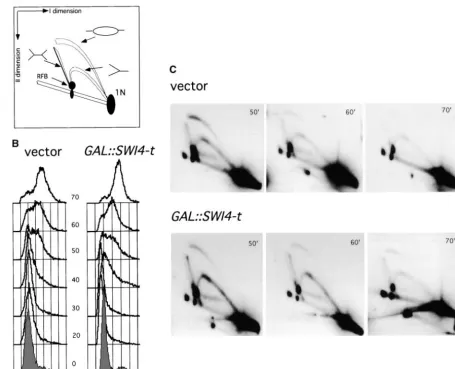
Figure5.—GAL::SWI4-textends the window of activity of the ribosomal ARS in wild-type cells. (A) Diagram depicting the migration patterns of replication intermediates of ribosomal DNA through 2D gels. (B) A wild-type (BY2006) strain transformed with the empty vector (Ycp50) or withGAL::SWI4-t(pBD1168) was synchronized with␣-factor. Galactose was added 30 min be-fore the release. Cells were released from the arrest by adding Pronase E (Sigma) to the final concentration of 10 mg/liter and aliquots of cultures were taken at specified times for FACS analysis (B) and 2D gel analysis (C). The DNAs were digested with the NheI restriction enzyme and resolved in two dimensions. Gels were subjected to Southern blotting and hybridization and probed for the ribosomal ARS locus as specified inmaterials and methods.
Friedman and Brewer 1995). In these gels, bubble- (Figure 5C). In addition to bubble- and Y-shaped mole-cules, two other types of replicative intermediates can shaped intermediates arise from origin firing within the
given DNA fragment. Y-shaped intermediates are gener- be detected in rDNA during replication. Leftward-mov-ing forks that stall at thereplicationforkbarrier (RFB) ated either when forks are initiated distally and passively
replicate through the monitored fragment or when the show up as a dot of increased intensity on the Y arc ( Lins-kensandHuberman1988;Breweret al.1992). In addi-replication bubble is positioned asymmetrically within
the fragment and one fork completes its replication tion, at later stages of replication, converging forks form X-shaped, Holliday junction-like intermediates, which before the other. To quantify replicative intermediates,
signal intensities from bubbles or Ys can be normalized migrate separately from simple Ys (Figure 5, A and C). Thus, the rDNA cluster provides an opportunity to mon-to that of the double-stranded DNA, which migrates as
a spot in front of the replicating molecules (1N DNA, itor accumulation of the regular early (bubble) and late (Y) intermediates, including the stalled and converged Figure 5A; Ivessaet al.2000).
Using this assay, we first followed replication through replicative forks.
To follow replication, cells were synchronized in late the ribosomal gene cluster on chromosome XII, which
spans 1000–2000 kb of 9-kb repeats of rDNA each contain- G1 by␣-factor. The highest levels of replicative interme-diates in the wild-type cells were detectable at 50 min ing an ARS sequence (rARS). Replication intermediates
Figure6.—GAL::SWI4-tincreases the levels of replicative intermediates detectable inrad53-11cells. Arad53-11(BY2390) strain transformed with the empty vector (Ycp50) or withGAL::SWI4-t(pBD1168) was treated as described for the wild-type strain in the legend to Figure 5. Samples of cells were taken every 10 min to determine DNA content by FACS. (A) Note thatGAL::SWI4-t cells are slightly ahead of the vector controls in S-phase progression. (B) DNAs isolated from these cultures at the times specified were digested with theNheI restriction enzyme and resolved in two dimensions as in Figure 5. The arrow points to the X-shaped intermediates prominent in therad53-11 GAL::SWI4-tcells. (C) A shorter exposure of the two-dimensional gel from an independent experiment is shown to compare the abundance of the RFB-stalled forks in therad53-11vectorvs. rad53-11 GAL::SWI4-tcells. Positions of RFB-stalled forks and of 1N DNA are marked by arrows. (D and E) Autoradiograms of rARS replicative intermediates of therad53-11BY2390 strain with the empty vector orGAL::SWI4-twere quantified, and the signals in bubbles and Ys (D) or in the RFB-stalled fork (E) intermediates were normalized to the signal in 1N DNA and plotted. The average of two measurements is presented.
detect higher levels of Y intermediates inGAL::SWI4-t titation of these gels confirms the observation that the presence ofGAL::SWI4-tresults in about twice as many cells compared to controls, suggesting that replicative
intermediates persist for a longer time in these cells. In Ys and RFB-stalled forks (Figure 6, D and E). Thus, the two-dimensional gel analysis suggests that replicative forks rad53-11cells, the effect of Swi4-t overexpression was
more pronounced (Figure 6). Therad53-11 GAL::SWI4-t are present on rDNA for an extended time inGAL::SWI4-t cells. In addition, the levels of bubble intermediates cells maintained higher levels of bubbles, Ys, and stalled
and converged forks than did therad53-11vector con- evident in a fixed amount of DNA are two- to threefold higher inrad53-11 GAL::SWI4-tcells than in controls at trols (Figure 6B). Figure 6C shows a repeat of this
experi-ment with a lighter exposure so that the levels of the the earliest time point (see Figure 6, B and D). These data suggest that the ribosomal ARS fires more fre-RFB-stalled forks inrad53-11 GAL::SWI4-t vs. rad53-11
rad53-11andGAL::SWI4-tmay influence origin firing S phase (Friedmanet al.1997;Yamashitaet al.1997). As seen in Figure 7A, both inRADand inrad53-11cells, frequency:We next followed replication of a single copy
origin, ARS608, whose firing frequency is variable and GAL::SWI4-textended the window of time during which limited to a narrow window of time in the first half of the large bubble intermediates (marked by arrows) were detectable in ARS608 DNA by at least 10 min. Y interme-diates inGAL::SWI4-tcells were also more prevalent late in S phase.
Interestingly, we also observed a difference between the relative amounts of Y and bubble intermediates in RADandrad53-11cells. An important difference between the rARS and ARS608 is the fact that the latter is a single-copy ARS and it is replicated either actively, if it fires, or passively from the nearby ARS607. Thus, the bubble-to-Y ratio is a good indicator of the firing efficiency of ARS608 (Friedmanet al.1997;Yamashitaet al.1997). As Figure 7B shows, the maximal detectable firing fre-quency of ARS608 was reproducibly increased about twofold inrad53-11cells. The quantification also showed that in bothRADandrad53-11cells, Swi4-t overexpres-sion did not lead to a significant increase in the ARS608 bubble-to-Y ratio during the peak activity of this ARS. Overall, the 2D analysis indicates that bothrad53-11and GAL::SWI4-t contribute to the increase in origin firing although these contributions are manifested differently. Whilerad53-11shifts the distribution toward early inter-mediates,GAL::SWI4-textends the window of time dur-ing which the intermediates are detectable.
To further address the effects of Swi4-t, we asked whe-ther it can suppress replication initiation mutations.DBF4 is an essential gene required for initiation but not elonga-tion of replicaelonga-tion throughout S phase (Johnston and Thomas1982;BoussetandDiffley1998;Donaldson et al.1998). dbf4-1is a temperature-sensitive mutation, which reduces the Dbf4/Cdc7 complex kinase activity (Kiharaet al.2000) and prevents replication initiation at the nonpermissive temperature (JohnstonandThomas 1982). We found that Swi4-t, but not the full-length Swi4, improved the growth of the dbf4-1 strain at the semi-permissive temperature of 33⬚ (Figure 8A). We then arrested theGAL::SWI4-t and vector cells at the begin-ning of S phase by shifting them to 37⬚, induced Swi4-t expression, and then shifted them back to the permis-sive temperature. FACS analysis showed that thedbf4-1
and ARS608 DNA in cells carryingGAL::SWI4-tsuggests that some replicative forks in these regions were slowing or stalling. Another interpretation of this result is that Swi4-t may cause an extension of the window of time within which origins fire and/or an increase in the fre-quency with which they fire. Support for the notion that Swi4-t may increase efficiency of at least some origins is rendered by the fact that Swi4-t overexpression partially suppresses the temperature sensitivity of thedbf4-1strain and speeds up the course of S phase indbf4-1cells. Dbf4 is involved in initiation of DNA replication (Johnston andThomas1982), and one may expect that the con-sequences of partial Dbf4 inactivation could be counter-acted by upregulating origin firing.
The cellular response to Swi4-t involves Rad53. Rad53 is required for viability, and when hyperactivated in re-sponse to DNA damage, it slows down S-phase progres-sion by inhibiting origin firing (Santocanaleand
Diff-Figure 8.—GAL::SWI4-t partially suppresses temperature ley1998;Shirahigeet al.1998;TerseroandDiffley
sensitivity of thedbf4-1strain. (A) Adbf4-1(BY479) strain trans- 2001). Swi4-t overexpression leads to the activation of formed with the empty vector (Ycp50),GAL::SWI4(pBD2385),
the Rad53 kinase.rad53-11checkpoint mutant cells are orGAL::SWI4-t(pBD1168) was streaked onto selective media
not able to tolerate overexpression of Swi4-t and lose plates with galactose and grown at 33⬚. (B) Thedbf4-1(BY479)
strain with the empty vector (Ycp50) or withGAL::SWI4-t(pBD- viability within three to five divisions. These observations 1168) was grown at 25⬚ in YEP media with raffinose and ar- suggest that Swi4-t overexpression invokes a checkpoint rested before S phase by incubation at 37⬚for 2.5 hr. Galactose
response. Our data indicate thatrad53-11 GAL::SWI4-t was added 30 min prior to the release. The cultures were
re-cells do not enter into or progress through S phase any leased from the arrest by shifting back to 25⬚. Aliquots of these
cultures were taken every 15 min and subjected to FACS analysis. faster thanRAD GAL::SWI4-tcells. However,rad53-11in combination with Swi4-t results in a further increase in the levels of both early (bubble) and late (stalled and cells that overexpressed Swi4-t completed S phase
sig-converged forks) rDNA replicative intermediates com-nificantly faster than controls, suggesting that Swi4-t may
pared to controls. rad53-11 also results in a significant increase initiation indbf4-1cells (Figure 8B).
increase in the firing frequency of ARS608. This latter observation is consistent with the previous report by DISCUSSION Shirahigeet al. (1998) made with arad53-1 allele of RAD53, but differs from the study of ARS301 in a Swi4-t is a hyperactive derivative of the late G1-specific
rad53-21strain where no increased firing was found ( San-transcriptional activator Swi4. When overexpressed, it
tocanaleet al.1999). This discrepancy is probably due causes Swi4 target genes to be ectopically expressed at
to differences between theseRAD53alleles. Only a subset all stages of the cell cycle. In this study, we demonstrated
ofRAD53 mutations suppresses the temperature-sensi-that it can cause precocious entry into S phase. In
addi-tive initiation defect ofdbf4-1, and rad53-21is syntheti-tion, we observed that even though GAL::SWI4-t cells
cally lethal with dbf4-1 at the permissive temperature can enter S phase earlier than normal cells, they spend
(Desanyet al.1998;Dohrmannet al.1999;Kiharaet more time between the end of G1 and anaphase.
Hemi-al.2000). methylation analysis suggests that Swi4-t overexpression
We propose a simple interpretation of the data pre-leads to an extension of the time during which nascent
sented in this study, which is that bothGAL::SWI4-tand DNA is generated in a given region. If that is the case,
rad53-11affect initiation of replication, albeit to a differ-it could result from DNA reduplication or from gap
fill-ent extfill-ent. In a normal cell, Swi4 activity is rate limiting ing or strand break repair, or any combination thereof.
for S-phase entry (McInernyet al.1997). Elevating Swi4 2D gel analysis specifically suggests that Swi4-t
overex-activity with a stable, constitutively produced form of Swi4 pression correlates with a prolonged presence and/or
in-may not only erroneously signal the cell to enter S, but creased abundance of replicative intermediates. A higher
may also signal its capacity to replicate at a high rate. level of replicative forks could be detected in rDNA in
This could lead to an increase in the number of replica-GAL::SWI4-tcells as compared to vector cells. Also,
bub-tive forks concurrently present on DNA. When the den-ble and Y intermediates were detectaden-ble for a longer time
sity of forks is elevated above what a given growth condi-in ARS608 DNA condi-inGAL::SWI4-t cells.
tion can support, this puts strain on the cell. Elevated The fact that we could detect an extended window of
increase torsional stress on DNA, or make other key com- however, this locus is certainly not the only one that dif-fers between these strains. Inmec1andrad53cells, Sml1-ponents of the replication machinery rate limiting. The
mediated inhibition of the ribonucleotide reductase is consequences of these adversities may be transient
stall-not relieved (Zhao et al. 1998) and thus dNTP levels ing or slowing of fork movement.
may be limiting. In theVallenandCrossstudy (1999), Rad53 plays a critical role in mitigating the effects of
the lethality of G1 cyclin overexpression to themec1 mu-Swi4-t on replication. In a RADcell, forks that stall or
tants could be explained by a concomitant decline in the slow down may recruit Rad53. By stabilizing these forks
mRNA level of the large subunit of the ribonucleotide with the replicative machinery assembled on them, Rad53
reductase Rnr1 (Vallenand Cross1999), which fur-allows most of them to resume replication when supplies
ther depletes dNTP pools. In our case, however, Swi4-t are replenished (Desanyet al.1998;Lopeset al.2001).
overproduction is lethal torad53-11cells even though Stalled forks “marked” with activated Rad53 send a
sig-it upregulatesRNR1transcription (J. Sidorova, unpub-nal inhibiting further origin firing and thus prevent
fur-lished data), andSML1is inactivated (Paulovichet al. ther accumulation of replicative intermediates and the
1997). Hence, Rnr1 is not likely to be the cause of the unproductive spending of origins. Thus, the excessive
fir-Swi4-t-induced lethality, even though it can mitigate the ing promoted byGAL::SWI4-tis neutralized. Inrad53-11
lethal consequences of Swi4-t overproduction, when it, cells, this protective mechanism is deactivated, leading
too, is overexpressed. Moreover, suppression of the le-to the accumulation of many unstable replicative
inter-thality of GAL::SWI4-t can also be achieved by overex-mediates, which may require disassembly and
process-pression ofSRL1(J. Sidorova, unpublished data), and ing through a recombination pathway to complete
repli-thus it is not specific toRNR1.SRL1, whose function is un-cation (Rothsteinet al.2000). In agreement with this,
known, is another Swi4-activated gene (Iyeret al.2001), the defect in recombination caused by arad52disruption
and likeRNR1, it can suppress the lethality of therad53 further exacerbates Swi4-t-induced lethality inrad53-11
deletion when highly overexpressed (Desanyet al.1998). cells, but has no detectable effect onRAD53Swi4-t cells.
All these observations suggest that the Swi4-t-induced There is growing evidence that abundance of stalled
lethality cannot be tracked to one Swi4-t target gene and forks during replication may contribute to genome
desta-may instead result from altered expression of many targets. bilization. For example, mutations in the rDNA-specific
A dividing eukaryotic cell faces intrinsic challenges helicase, Pif1, decrease the number of stalled forks, and
that arise from its ability to initiate DNA replication this is correlated with a decrease in the amount of rDNA
from many loci throughout the genome. It seems that breakage and a reduction in the number of rDNA circles
for an efficient S phase, it may be critically important to (Ivessaet al.2000). Our work suggests the possibility that
adjust origin-firing efficiency depending on the cellular cells that experience precocious S phase due to a
hyper-resources as well as to have a negative feedback con-activation of a G1-to-S transition regulator acquire
geno-stantly monitoring the progress of replication. mic instability precisely because these regulators promote
We thank members of the Breeden lab for support and discussions
an increase in the number of stalled replicative forks.
and Bonny Brewer for critical reading of the manuscript. Thanks are
Finally, a number of hypotheses can be entertained to
due to Steve Elledge, Andrew Emili, and Bonny Brewer for strains
explain the mechanism by which hyperactive Swi4-t
sig-and plasmids. This work was funded by grant GM-41073 from the
nals S-phase entry. Similar to other transcription factors, National Institutes of Health to L.B. J.S. was supported by the Leuke-a DNA-bound Swi4-t could promote initiLeuke-ation of replicLeuke-a- mia and Lymphoma Society Fellowship.
tionin cis(Van de Vliet1999). An interesting possibility is raised by the recent report byMaseret al.(2001), which
finds enhanced binding of mammalian E2F1 near active LITERATURE CITED replication origins. This and other findings (Royzman
Allen, J., Z. Zhou, S. Wolfram, E. C. FriedbergandS. J. Elledge,
et al. 1999) imply that transcriptional activators impor- 1994 The
SAD1/RAD53protein kinase controls multiple
check-tant for the G1-to-S transition could have a direct role points and DNA damage-induced transcription in yeast. Genes Dev.8:2416–2428.
in DNA replication control.
Andrews, B. J., andL. A. Moore, 1992 Interaction of the yeast Swi4
It is also possible that the effect of Swi4-t on S-phase and Swi6 cell cycle regulatory proteinsin vitro. Proc. Natl. Acad. progression is mediated by the altered expression of Swi4 Sci. USA89:11852–11856.
Baetz, K., andB. Andrews, 1999 Regulation of cell cycle
transcrip-target genes. Two critical transcrip-targets of the Swi4 activator,
tion factor Swi4 through auto-inhibition of DNA binding. Mol.
which are rate limiting for the G1-to-S transition, are the Cell. Biol.19:6729–6741.
G1 cylinsCLN1andCLN2. Overproduction ofCLN1or Bashkirov, V. I., J. S. King, E. V. Bashkirova, J. Schmuckli-Maurer
andW.-D. Heyer, 2000 DNA repair protein Rad55 is a terminal
CLN2is lethal in combination withmec1and, to a lesser
substrate of the DNA damage checkpoints. Mol. Cell. Biol.20:
degree,rad53mutations in some backgrounds (Vallen 4393–4404.
andCross1995, 1999). However,CLNoverproduction Bousset, K., andJ. Diffley, 1998 The Cdc7 protein kinase is re-quired for origin firing during S phase. Genes Dev.12:480–490.
is not sufficient to kill eithermec1-1orrad53-11cells in
Breeden, L., andG. Mikesell, 1991 Cell cycle-specific expression
the A364a background. This difference may be attrib- of the SWI4 transcription factor is required for the cell cycle
regulation ofHOtranscription. Genes Dev.5:1183–1190.
Breeden, L., andG. Mikesell, 1994 Three independent forms of element in theSWI4,CLN3,CDC6andCDC47promoters activates regulation affect expression ofHO,CLN1andCLN2during the M/G1-specific transcription. Genes Dev.11:1277–1288. cell cycle ofSaccharomyces cerevisiae. Genetics138:1015–1024. Mendenhall, M., andA. Hodge, 1998 Regulation of Cdc28
cyclin-Brewer, B. J., D. LockshonandW. L. Fangman, 1992 The arrest dependent protein kinase activity during the cell cycle of the yeast of replication forks in the rDNA of yeast occurs independently Saccharomyces cerevisiae.Microbiol. Mol. Biol. Rev.62:1191–1243. of transcription. Cell71:267–276. Nasmyth, K., andL. Dirick, 1991 The role of SWI4 and SWI6 in
Desany, B. A., A. A. Alcasabas, J. B. BachantandS. J. Elledge, the activity of G1 cyclins in yeast. Cell66:995–1013.
1998 Recovery from DNA replicational stress is the essential Navas, T. A., Y. SanchezandS. J. Elledge, 1996 RAD9and DNA function of the S-phase checkpoint pathway. Genes Dev.12:2956– polymerase £ form parallel sensory branches for transducing the
2970. DNA damage checkpoint signal inSaccharomyces cerevisiae.Genes
Dohrmann, P. R., G. Oshiro, M. TecklenburgandR. A. Sclafani, Dev.10:2632–2643.
1999 RAD53regulatesDBF4independently of checkpoint func- Nugroho, T. T., and M. D. Mendenhall, 1994 An inhibitor of tion inSaccharomyces cerevisiae. Genetics151:965–977. yeast cyclin-dependent protein kinase plays an important role in
Donaldson, A. D., W. L. FangmanandB. J. Brewer, 1998 Cdc7 ensuring the genomic integrity of daughter cells. Mol. Cell. Biol. is required throughout the yeast S phase to activate replication 14:3320–3328.
origins. Genes Dev.12:491–501. Ogas, J., B. J. AndrewsandI. Herskowitz, 1991 Transcriptional
Donehower, L. S., 1997 Genetic instability in animal tumorigenesis activation ofCLN1,CLN2, and a putative new G1 cyclin (HCS26) models. Cancer Surv.29:329–352. by SWI4, a positive regulator of G1-specific transcription. Cell
Durocher, D., J. Henckel, A. R. FershtandS. P. Jackson, 1999 66:1015–1026.
The FHA domain is a modular phosphopeptide recognition mo- Paulovich, A. G., andL. H. Hartwell, 1995 A checkpoint
regu-tif. Mol. Cell4:387–394. lates the rate of progression through S Phase in S. cerevisiae in
Emili, A., 1998 MEC1-dependent phosphorylation of Rad9p in re- response to DNA damage. Cell82:841–847.
sponse to DNA damage. Mol. Cell2:183–189. Paulovich, A. G., R. U. Margulies, B. M. GarvikandL. H.
Hart-Epstein, C. B., andF. R. Cross, 1994 Genes that can bypass the well, 1997 RAD9,RAD17, andRAD24are required for S phase CLN requirement for Saccharomyces cerevisiae cell cycle START. regulation inSaccharomyces cerevisiaein response to DNA damage.
Mol. Cell. Biol.14:2041–2047. Genetics145:45–62.
Felsher, D. W., andJ. M. Bishop, 1999 Transient excess of MYC Pellicioli, A., C. Lucca, G. Liberi, F. Marini, M. Lopeset al., 1999 activity can elicit genomic instability and tumorigenesis. Proc. Activation of Rad53 kinase in response to DNA damage and its Natl. Acad. Sci. USA96:3940–3944. effect in modulating phosphorylation of the lagging strand DNA
Foiani, M., A. Pellicioli, M. Lopes, C. Lucca, M. Ferrariet al., polymerase. EMBO J.18:6561–6572.
2000 DNA damage checkpoints and DNA replication controls Primig, M., S. Sockanathan, H. AuerandK. Nasmyth, 1992 Anat-in Saccharomyces cerevisiae. Mutat. Res.451:187–196. omy of a transcription factor important for the start of the cell
Friedman, K. L., andB. J. Brewer, 1995 Analyis of Replication Inter- cycle inSaccharomyces cerevisiae.Nature358:593–597.
mediates by Two-Dimensional Agarose Gel Electrophoresis. Academic Rose, M. D., F. WinstonandP. Hieter, 1990 Methods in Yeast
Ge-Press, San Diego. netics.Cold Spring Harbor Laboratory Press, Cold Spring
Har-Friedman, K. L., M. K. Raghuraman, W. L. Fangmanand B. J. bor, NY.
Brewer, 1995 Analysis of the temporal program of replication Rothstein, R., M. Benedicte, andS. Gangloff, 2000 Replication initation in yeast chromosomes. J. Cell Sci.19(Suppl.): 51–58. fork pausing and recombination or “gimme a break.” Genes Dev.
Friedman, K. L., B. J. BrewerandW. L. Fangman, 1997 Replication 14:1–10.
profile of Saccharomyces cerevisiae chromosome VI. Genes Cells Royzman, I., R. J. Austin, G. Bosco, S. P. Bell andT. L.
Orr-2:667–678. Weaver, 1999 ORC localization in Drosophila follicle cells and
Huang, M., Z. ZhouandS. J. Elledge, 1998 The DNA replication the effects of mutations in dE2F and dDP. Genes Dev.13:827–840. and damage checkpoint pathways induce transcription by inhibi- Sanchez, Y., J. Bachant, H. Wang, F. Hu, D. Liuet al., 1999 Control tion of the Crt1 repressor. Cell94:595–605.
of the DNA damage checkpoint by Chk1 and Rad53 protein
Ivessa, A. S., J.-Q. ZhouandV. A. Zakian, 2000 The Saccharomyces kinases through distinct mechanisms. Science286:1166–1171. Pif1p DNA helicase and the highly related Rrm3p have opposite
Santocanale, C., andJ. F. X. Diffley, 1998 A Mec1-0 and Rad53-effects on replication fork progression in ribosomal DNA. Cell dependent checkpoint controls late-firing origins of DNA replica-100:479–489.
tion. Nature395:615–618.
Iyer, V. R., C. E. Horak, C. S. Scafe, D. Botstein, M. Snyderet al.,
Santocanale, C., K. SharmaandJ. F. X. Diffley, 1999 Activation 2001 Genomic binding sites of the yeast cell-cycle transcription
of dormant origins of DNA replication in budding yeast. Genes factors SBF and MBF. Nature409:533–538.
Dev.13:2360–2364.
Jacobs, C. W., A. E. M. Adams, P. J. SzaniszloandJ. R. Pringle,
Schwob, E., T. Bohm, M. D. MendenhallandK. Nasmyth, 1994 1988 Functions of microtubules in the Saccharomyces
cerevis-The B-type cyclin kinase inhibitor p40SIC1controls the G1 to S iae cell cycle. J. Cell Biol.107:1409–1426.
transition in S. cerevisiae. Cell79:233–244.
Johnston, L. H., andA. P. Thomas, 1982 A further two mutants
Shirahige, K., Y. Hori, K. Shiraishi, M. Yamashita, K. Takahashi
defective in initiation of the S phase in the yeast Saccharomyces
et al., 1998 Regulation of DNA-replication origins during cell-cerevisiae. Mol. Gen. Genet.186:445–448.
cycle progression. Nature395:618–621.
Kihara, M., W. Nakai, S. Asano, A. Suzuki, K. Kitadaet al., 2000
Sidorova, J., andL. Breeden, 1993 Analysis of the SWI4/SWI6 pro-Characterization of the yeast Cdc7p/Dbf4p complex purified
tein complex, which directs G1/S-specific transcription in Saccha-from insect cells. Its protein kinase activity is regulated by rad53p.
romyces cerevisiae.Mol. Cell. Biol.13:1069–1077. J. Biol. Chem.275:35051–35062.
Sidorova, J., andL. L. Breeden, 1997 Rad53-dependent
phosphory-Linskens, M. H. K., and J. A. Huberman, 1988 Organization of
lation of Swi6 and down-regulation ofCLN1 and CLN2 transcrip-replication of ribosomal DNA in Saccharomyces cerevisiae. Mol.
tion occur in response to DNA damage inSaccharomyces cerevisiae. Cell. Biol.8:4927–4935.
Genes Dev.11:3032–3045.
Lopes, M., C. Cotta-Ramusino, A. Pellicioli, G. Liberi, P. Plevani
Spruck, C. H., K. A. WonandS. I. Reed, 1999 Deregulated cyclin
et al., 2001 The DNA replication checkpoint response stabilizes
E induces chromosome instability. Nature401:297–300. stalled replication forks. Nature412:557–561.
Sun, Z., D. S. Fay, F. Marini, M. Foiani, andD. F. Stern, 1996 Spk1/
Mai, S., J. Hanley-Hyde, G. J. Rainey, T. I. Kuschak, J. T. Paulet
Rad53 is regulated by Mec1-dependent protein phosphorylation
al., 1999 Chromosomal and extrachromosomal instability of the
in DNA replication and damage checkpoint pathways. Genes Dev. cyclin D2 gene is induced by Myc overexpression. Neoplasia1:
10:395–406. 241–252.
Sun, Z., J. Hsiao, D. S. Fayand D. F. Stern, 1998 Rad53 FHA
Maser, R. S., O. K. Mirzoeva, J. Wells, H. Olivares, B. R. Williams
domain associated with phosphorylated Rad9 in the DNA damage
et al., 2001 Mre11 complex and DNA replication: linkage to
checkpoint. Science281:272–274. E2F and sites of DNA synthesis. Mol. Cell. Biol.21:6006–6016.
Sung, P., K. M. TrujilloandS. VanKomen, 2000 Recombination
McInerny, C. J., J. F. Partridge, G. E. Mikesell, D. P. Creemer
Tersero, J. A., andJ. F. X. Diffley, 2001 Regulation of DNA replica- Tel1-dependent hyperphosphorylation and interacts with Rad53 after DNA damage. EMBO J.17:5679–5688.
tion fork progression through damaged DNA by the Mec1/Rad53
checkpoint. Nature412:553–557. Weinert, T., 1998 DNA damage and checkpoint pathways:
molecu-lar anatomy and interactions with repair. Cell94:555–558.
Tyers, M., G. TokiwaandB. Futcher, 1993 Comparison of the
Saccharomyces cerevisiaeG1cyclins: Cln3 may be an upstream activa- Yamashita, M., Y. Hori, T. Shinomiya, C. Obuse, T. Tsurimotoet
al., 1997 The efficiency and timing of initation of replication tor of Cln1, Cln2 and other cyclins. EMBO J.12:1955–1968.
Vallen, E. A., andF. R. Cross, 1995 Mutations inRAD27define a of multiple replicons of Saccharomyces cerevisiae chromsome potential link between G1cyclins and DNA replication. Mol. Cell. VI. Genes Cells2:655–665.
Biol.15:4291–4302. Zhao, X. L., E. G. D. MullerandR. A. Rothstein, 1998 A
suppres-Vallen, E. A., andF. R. Cross, 1999 Interaction between the MEC1- sor of two essential checkpoint genes identifies a novel protein dependent DNA synthesis checkpoint and G1 cyclin function in that negatively affects dNTP pools. Mol. Cell2:329–340.
Saccaromyces cerevisiae.Genetics151:459–471. Zheng, P., D. S. Fay, J. Burton, H. Xiao, J. L. Pinkhamet al., 1993
Van de Vliet, P. C., 1999 Roles of Transcription Factors in DNA Repli- SPK1is an essential S-phase specific gene ofSaccharomyces cerevisiae cation.Cold Spring Harbor Laboratory Press, Cold Spring Har- that encodes a nuclear serine/threonine/tyrosine kinase. Mol.
bor, NY. Cell. Biol.13:5829–5842.
Vialard, J. E., C. S. Gilbert, C. M. GreenandN. F. Lowndes, 1998