Minjie Gao1*, Lu Gao1*, Guang Yang1, Yi Tao1, Van S Tompkins2, Xiaosong Wu1, Hongwei Xu3, Fenghuang
Zhan3, Jumei Shi1
1Department of Hematology, Shanghai Tenth People’s Hospital, Tongji University School of Medicine, Shanghai,
China; 2Department of Pathology, University of Iowa Carver College of Medicine, Iowa, USA; 3Department of
Inter-nal Medicine, University of Iowa Carver College of Medicine, Iowa, USA. *Equal contributors.
Received March 30, 2014; Accepted April 14, 2014; Epub May 15, 2014; Published June 1, 2014
Abstract: The efficacy and safety of lenalidomide maintenance therapy after ASCT in patients with MM has been
in question. In order to address the issue, we conducted a meta-analysis of two randomized double-blind placebo-controlled studies encompassing 1074 patients treated with lenalidomide or placebo maintenance therapy after ASCT. The predominant clinical outcomes of interest were overall survival (OS), progression-free survival (PFS),
and adverse events. There was a marked benefit in PFS with lenalidomide (Odds Ratio [OR] = 2.5, 95% confidence interval [CI] = 1.93 to 3.24). There was statistically non-significant tendency toward benefit in OS with lenalidomide (OR = 1.21, 95% CI = 0.65 to 2.24). For adverse events, more patients in lenalidomide treatment arm experienced neutropenia (OR = 4.88, 95% CI = 3.67 to 6.50), infection (OR = 2.82, 95% CI = 1.67 to 4.73), hematologic cancers (OR = 3.31, 95% CI = 1.30 to 8.41), and solid tumors (OR = 2.24, 95% CI = 1.01 to 4.98). No significant differences were seen with deep vein thrombosis (OR = 2.15, 95% CI = 0.92 to 5.06), peripheral neuropathy (OR = 1.50, 95% CI = 0.53 to 4.25), thrombocytopenia (OR = 1.05, 95% CI = 0.12 to 9.54), and anemia (OR = 1.36, 95% CI = 0.02
to 83.86). Based on these results, we conclude that lenalidomide maintenance therapy for patients with MM after ASCT was effective in the improvement of PFS. However, treatment-related adverse events must be close monitored.
Although there was a trend for increased OS with lenalidomide, there was no statistically significant difference in OS
between lenalidomide maintenance therapy arm and placebo maintenance therapy arm. Therefore, longer follow-up and additional high quality RCTs were needed to evaluate the effects of lenalidomide maintenance on OS.
Keywords: Lenalidomide, multiple myeloma, maintenance therapy, meta-analysis
Introduction
Multiple myeloma (MM) is an incurable disease characterized by the accumulation of clonal
plasma cells in the bone marrow [1]. It is the
second most common hematological
malignan-cy, and accounts for about 1% of all new cancer
incidence and mortality [2, 3]. High-dose che
-motherapy with autologous stem-cell trans-plantation (ASCT) is a standard frontline
treat-ment for MM [4]. Unfortunately, most patients
with MM relapse or exhibit disease progression after transplantation. Therefore, maintenance therapies have been added in attempt to
improve overall survival (OS) [5]. Traditional
chemotherapy (eg. low-dose melphalan), inter-feron, and prednisone have been used for
maintenance therapy, but their long-term use is
limited by marked toxicity and modest efficacy [6]. Thalidomide maintenance therapy has been
shown to be effective at improving
progression-free survival (PFS) [7-11]. However, long-term
thalidomide use is plagued by severe neuropa-thy and does not improve OS in patients who achieved a complete response or a very good partial response or who had chromosome 13 deletion. Thalidomide maintenance therapy may even be detrimental in patients with
high-risk cytogenetics [6]. The oral, immunomodula
lower than induction and its favorable toxicity
profile [12, 13].
Yang B et al [14]. performed a meta-analysis
examining the efficacy and safety of lenalido
-mide for MM, using seven trials. Their meta-analysis demonstrated that lenalidomide thera-py increased PFS in patients with newly
diagnosed MM, but didn’t significantly improve
OS. Notably, lenalidomide doses and treatment regimens differed between trials in this meta-analysis. Perhaps a deeper problem, though, was that the types of MM patients were differ-ent, including those ineligible for transplanta-tion, with untreated symptomatic MM, with newly diagnosed, relapsed or refractory MM, nonprogressive MM after transplantation, etc. Furthermore, subgroup analyses to examine
the efficacy and safety of lenalidomide on these
different MM patients were not performed. These factors may have contributed to the marked heterogeneity in most of their out-comes. Therefore, it has remained unclear whether lenalidomide maintenance therapy prolongs the time to disease progression and improves OS after ASCT in patients with MM. To this end, herein we report our attempt to clarify
the relative benefits and risks of lenalidomide
maintenance therapy after ASCT in MM patients. We reviewed the literature to identify randomized controlled trials (RCTs) that exam-ined lenalidomide maintenance therapy after
ASCT in patients with MM and identified two
[12, 22]. We then performed a combined analy
-sis of these trials in an attempt to clarify the
relative benefits and risks of lenalidomide
maintenance therapy after ASCT in patients with MM.
Methods
Search strategy
We used PubMed, the Cochrane Library, the ClinicalTrials.gov registry, and conference pro-ceedings from each of the American Society of Hematology, the American Society of Clinical Oncology, and European Hematology Associ- ation to locate all relevant studies published up to March 2014. Search terms included “lenalid-omide or revlimid” and “myeloma”, with ‘the related articles’ function in PubMed to identify other potentially relevant articles. All the refer-ences of retrieved articles were also evaluated. Data was collected only from published, peer-reviewed papers.
Selection criteria
Only phase 3 RCTs that compared lenalidomide maintenance therapy with placebo mainte-nance therapy after ASCT for patients with MM were included. The treatment strategy and the criteria used for selecting patients needed to be reported, as did clinical outcomes or safety of the treatments. The eligibility of each study was assessed independently by two inves- tigators.
Data extraction and methodological quality assessment
[image:2.612.87.522.70.252.2]The quality of trials was evaluated by two inde-pendent reviewers by examining the adequacy
of the allocation generation, allocation conceal-ment, double blinding, data analysis, dropouts, power analysis and other risk of bias. Two reviewers performed data extraction indepen-dently based on selection criteria. If a disagree-ment arose, agreedisagree-ment was achieved through consultation with a third reviewer.
Statistical analysis
For each trial, the effect of lenalidomide main-tenance treatment was expressed as overall
response (OR) with 95% CI. Both the fixed
effects model and random effects model were used to calculate the pooled OR. Heterogeneity was assessed by the Cochrane Q test.
Statistically significant heterogeneity was con
-sidered as P < 0.05 or I2 statistic > 50%. The
random effects model was selected when
het-erogeneity was significant. The publication bias
was determined by funnel plot. Revman soft-ware (5.2) was used to perform all calculations.
Results
Literature search results
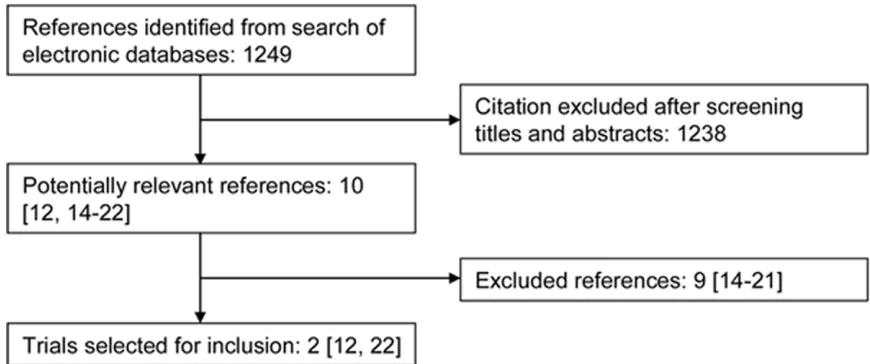
Our initial search identified 1249 references, of
which 10 trials were considered potentially rel-evant by title and abstract. Among them, two papers were excluded because lenalidomide
was used as salvage treatment [15, 16]. Two
studies were excluded because patients with MM didn’t receive ASCT before lenalidomide
maintenance treatment [17-19]. One was
excluded because it included
donor-lympho-cyte infusion treatment [20]. Others were
excluded because patients with MM received nonmyeloablative allogeneic stem cell trans-plantation instead of ASCT before lenalidomide
maintenance treatment [21] or a comparison of
lenalidomide maintenance therapy with
place-bo maintenance therapy was not done [22]. In total, two trials [12, 23], including 1074
patients, fulfilled the criteria for this meta-anal
-ysis (Figure 1).
Description of included trials
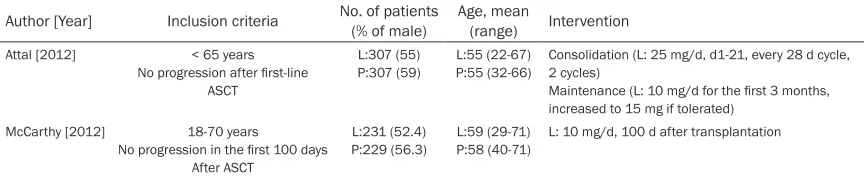
An outline of the two trials was provided in Table 1, and their methodological quality was summarized in Table 2. Both trials were
pub-lished in 2012. Both reported the efficacy and
safety of lenalidomide maintenance therapy after ASCT in patients with MM, double blinding of the participants and outcome assessors, used intention-to-treat analysis, and described power analysis. Only Attal et al. Reported the
number of dropouts (7%), which was accept
-able. Neither trial described the methods of allocation generation and allocation conceal- ment.
After ASCT
[image:3.612.90.522.85.173.2]L: lenalidomide; P: placebo; ASCT: autologous stem-cell transplantation; d: day.
Table 2. Methodological quality assessment of included trial
Author [Year] Location generationAllocation concealmentAllocation blindingDouble analysis Drop-outData analysis Other risk of biasPower
Attal [2012] France, Belgium, Switzerland
Unclear Unclear Double blinded
ITT 7.0% Yes An increased incidence of second primary make lenalidomide unable to maintain a long time
McCarthy [2012] United States Unclear Unclear Double
blinded ITT N/A Yes Patients in the placebo arm could cross over to lenalido-mide arm
[image:3.612.91.527.219.310.2]Survival
From the two trials, 1053 patients were evalu-able for PFS. The pooled OR of PFS was 2.50
(95% CI = 1.93 to 3.24, P < 0.00001), showing
marked benefit of lenalidomide maintenance for improving PFS, with no statistically signifi
-cant heterogeneity (P = 0.54, I2 = 0%, Figure 2).
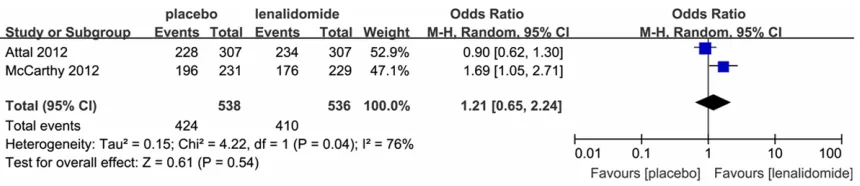
Both trials were eligible for analysis of OS (1074 patients). Although there was a trend toward increased OS with lenalidomide, a random-effects statistical model revealed that there
was no statistically significant difference in OS
between lenalidomide maintenance therapy arm and placebo maintenance therapy arm (OR
= 1.21, 95% CI = 0.65 to 2.24, P = 0.54). Significant heterogeneity existed between the two trials (P = 0.04, I2 = 76%, Figure 3).
Adverse events
The incidence of adverse events was reported in both trials. As shown in Figure 4, we found
significant differences between lenalidomide
and placebo arms, with more patients in the lenalidomide arm experiencing greater
inci-dence of neutropenia (OR = 4.88, 95% CI = 3.67 to 6.50), infection (OR = 2.82, 95% CI = 1.67 to 4.73), hematologic cancers (OR = 3.31, 95% CI = 1.30 to 8.41), and solid tumors (OR =
2.24, 95% CI = 1.01 to 4.98). No significant dif
-ferences between lenalidomide and placebo arms were seen with deep vein thrombosis (OR
= 2.15, 95% CI = 0.92 to 5.06), peripheral neu
-ropathy (OR = 1.50, 95% CI = 0.53 to 4.25), thrombocytopenia (OR = 1.05, 95% CI = 0.12 to 9.54), or anemia (OR = 1.36, 95% CI = 0.02 to
83.86). Among all the adverse events, signifi
-cant heterogeneity was seen only with throm-bocytopenia (P < 0.0001, I2 = 93%) and anemia
(P = 0.0001, I2 = 93%).
Discussion
The efficacy and safety of lenalidomide mainte
-nance therapy after ASCT in patients with MM has been in question. In order to address the issue, we conducted a meta-analysis of two randomized double-blind placebo-controlled studies encompassing 1074 patients treated with lenalidomide or placebo maintenance
therapy after ASCT. We confirmed that lenalido
-mide maintenance therapy markedly improved PFS. However, this did not translate into an
evi-dent benefit, as OS was not significantly
improved. Notably, there was significant hetero
-geneity of OS in these trials, which may have emerged for several reasons. First was poten-tial difference in patient factors, such as cyto-genetic abnormalities. A detailed analysis of patient population characteristics in relation to
[image:4.612.90.524.69.162.2]OS benefit should be investigated. The second
Figure 2. Pooled odd ratios of progression-free survival in the comparison of lenalidomide maintenance therapy arm and placebo maintenance therapy arm.
[image:4.612.94.524.213.306.2]was the difference in induction and consolida-tion therapy before transplantaconsolida-tion. Whether lenalidomide was effective as maintenance therapy after already having been used during induction or/and consolidation therapy needed be investigated. Additionally, the discontinua-tion of maintenance therapy in the Attal et al. Trial and the early study unblinding and cross-over in the McCarthy et al. Trial may also have contributed to the heterogeneity.
It was possible that the increase in adverse events also contributed to the observed lack of
OS benefit with lenalidomide therapy after
ASCT. The difference between the lenalidomide
and placebo maintenance arms was not signifi
-cant for deep vein thrombosis, peripheral neu-ropathy, thrombocytopenia, and anemia. However, neutropenia, infection, hematologic cancers and solid tumors events were more fre-quent in those receiving lenalidomide mainte-nance therapies. These were serious adverse events that should be carefully monitored at regular intervals through blood counts and tumor biomarkers. Perhaps OS could be improved through earlier intervention against these adverse events.
While not without limitations, our stringent, combined analysis contributes to our under-standing of lenalidomide as a maintenance therapy. The most obvious limitation was that only two studies met the inclusion criteria. Also, our work was only based on aggregate study, not on analysis of individual patient data, and is therefore limited in time-to-event analyses. Nevertheless, the several strengths of our meta-analysis outweigh the limitations. First, the quality of a meta-analysis is always subject to the quality of the included studies and the studies used in our meta-analysis were select-ed basselect-ed on strict criteria and were both of high quality. Both trials were large RCTs that reported double blinding of the participants and outcome assessors and used an intention-to-treat analysis and described power analysis.
Second, the efficacy and safety outcomes were defined similarly in both the individual trials
included in our meta-analysis. Furthermore, the
present study was the first systematic review to
evaluate specifically the efficacy and safety of
lenalidomide maintenance therapy after ASCT in patients with MM.
In summary, we showed that lenalidomide maintenance therapy for patients with MM after ASCT improved PFS. However, treatment-related adverse events must be closely moni-tored and longer follow-up and additional high quality RCTs were needed to evaluate the effects of lenalidomide maintenance on OS. Acknowledgements
This study was supported by Grants from the National Natural Science Foundation of China (No. 81372391, 81071856, 81228016 and 81250110552), Shanghai Science and Tech- nology Program (No. 12410705100), and Shanghai Tenth People’s Hospital Funds (No. 040113015).
Disclosure of conflict of interest
None.
Address correspondence to: Dr. Jumei Shi, De- partment of Hematology, Shanghai Tenth People’s
Hospital, Tongji University School of Medicine, 301
Yanchang Road, Shanghai 200072, China. Tel: +86-21-66306764; Fax: +86-21-66301051; E-mail: [email protected]; Dr. Fenghuang Zhan, Depart-
ment of Internal Medicine, University of Iowa Carver College of Medicine, Iowa, USA. Tel:
+1-319-384-0066; Fax: +1-319-353-8377; E-mail: [email protected]
References
[1] Hajek R, Okubote SA and Svachova H. Myelo-ma stem cell concepts, heterogeneity and plasticity of multiple myeloma. Br J Haematol 2013; 163: 551-564.
[2] Tan D, Chng WJ, Chou T, Nawarawong W,
Hwang SY, Chim CS, Chen W, Durie BG and Lee JH. Management of multiple myeloma in Asia:
resource-stratified guidelines. Lancet Oncol
2013; 14: e571-e581.
[3] Ferlay J, Shin HR, Bray F, Forman D, Mathers C and Parkin DM. Estimates of worldwide burden of cancer in 2008: GLOBOCAN 2008. Int J Can-cer 2010; 127: 2893-2917.
post-transplant maintenance treatment of multiple myeloma. Semin Oncol 2013; 40: 602-609.
[7] Attal M, Harousseau JL, Leyvraz S, Doyen C, Hulin C, Benboubker L, Yakoub AI, Bourhis JH, Garderet L, Pegourie B, Dumontet C, Renaud M, Voillat L, Berthou C, Marit G, Monconduit M, Caillot D, Grobois B, Avet-Loiseau H, Moreau P and Facon T. Maintenance therapy with thalid-omide improves survival in patients with mul-tiple myeloma. Blood 2006; 108: 3289-3294.
[8] Spencer A, Prince HM, Roberts AW, Prosser IW, Bradstock KF, Coyle L, Gill DS, Horvath N, Reynolds J and Kennedy N. Consolidation ther-apy with low-dose thalidomide and predniso-lone prolongs the survival of multiple myeloma patients undergoing a single autologous stem-cell transplantation procedure. J Clin Oncol 2009; 27: 1788-1793.
[9] Barlogie B, Pineda-Roman M, van Rhee F, Haessler J, Anaissie E, Hollmig K, Alsayed Y, Waheed S, Petty N, Epstein J, Shaughnessy JJ, Tricot G, Zangari M, Zeldis J, Barer S and Crow-ley J. Thalidomide arm of Total Therapy 2 im-proves complete remission duration and sur-vival in myeloma patients with metaphase cytogenetic abnormalities. Blood 2008; 112: 3115-3121.
[10] Lokhorst HM, van der Holt B, Zweegman S, Vel-lenga E, Croockewit S, van Oers MH, von Dem BP, Wijermans P, Schaafsma R, de Weerdt O, Wittebol S, Delforge M, Berenschot H, Bos GM, Jie KS, Sinnige H, van Marwijk-Kooy M, Joosten P, Minnema MC, van Ammerlaan R and Sonneveld P. A randomized phase 3 study on the effect of thalidomide combined with adria-mycin, dexamethasone, and high-dose mel-phalan, followed by thalidomide maintenance in patients with multiple myeloma. Blood 2010; 115: 1113-1120.
[11] Morgan GJ, Gregory WM, Davies FE, Bell SE, Szubert AJ, Brown JM, Coy NN, Cook G, Russell NH, Rudin C, Roddie H, Drayson MT, Owen RG, Ross FM, Jackson GH and Child JA. The role of maintenance thalidomide therapy in multiple myeloma: MRC Myeloma IX results and meta-analysis. Blood 2012; 119: 7-15.
[12] McCarthy PL, Owzar K, Hofmeister CC, Hurd DD, Hassoun H, Richardson PG, Giralt S, Stadt-mauer EA, Weisdorf DJ, Vij R, Moreb JS,
Cal-2012; 366: 1770-1781.
[13] Richardson PG, Schlossman RL, Weller E, Hideshima T, Mitsiades C, Davies F, LeBlanc R, Catley LP, Doss D, Kelly K, McKenney M, Mech-lowicz J, Freeman A, Deocampo R, Rich R, Ryoo JJ, Chauhan D, Balinski K, Zeldis J and Anderson KC. Immunomodulatory drug CC-5013 overcomes drug resistance and is well tolerated in patients with relapsed multiple myeloma. Blood 2002; 100: 3063-3067.
[14] Yang B, Yu RL, Chi XH and Lu XC. Lenalidomide treatment for multiple myeloma: systematic re-view and meta-analysis of randomized con-trolled trials. PLoS One 2013; 8: e64354.
[15] Minnema MC, van der Veer MS, Aarts T, Em-melot M, Mutis T and Lokhorst HM. Lenalido-mide alone or in combination with dexametha-sone is highly effective in patients with relapsed multiple myeloma following allogene-ic stem cell transplantation and increases the frequency of CD4+Foxp3+ T cells. Leukemia 2009; 23: 605-607.
[16] Coman T, Bachy E, Michallet M, Socie G, Uzu -nov M, Bourhis JH, Lapusan S, Brebion A, Vigouroux S, Maury S, Francois S, Huynh A, Lio-ure B, Yakoub-Agha I, Hermine O, Milpied N, Mohty M and Rubio MT. Lenalidomide as sal-vage treatment for multiple myeloma relapsing after allogeneic hematopoietic stem cell trans-plantation: a report from the French Society of Bone Marrow and Cellular Therapy. Haemato-logica 2013; 98: 776-783.
[17] Dimopoulos MA, Delforge M, Hajek R, Kropff M, Petrucci MT, Lewis P, Nixon A, Zhang J, Mei J and Palumbo A. Lenalidomide, melphalan, and prednisone, followed by lenalidomide maintenance, improves health-related quality of life in newly diagnosed multiple myeloma patients aged 65 years or older: results of a randomized phase III trial. Haematologica 2013; 98: 784-788.
[18] Usmani SZ, Sexton R, Hoering A, Heuck CJ,
Nair B, Waheed S, Al SY, Chauhan N, Ahmad N, Atrash S, Petty N, van Rhee F, Crowley J and Barlogie B. Second malignancies in total thera-py 2 and 3 for newly diagnosed multiple
[19] Palumbo A, Hajek R, Delforge M, Kropff M, Pe-trucci MT, Catalano J, Gisslinger H, Wiktor-Je-drzejczak W, Zodelava M, Weisel K, Cascavilla N, Iosava G, Cavo M, Kloczko J, Blade J, Beksac M, Spicka I, Plesner T, Radke J, Langer C, Ben YD, Corso A, Herbein L, Yu Z, Mei J, Jacques C and Dimopoulos MA. Continuous lenalidomide treatment for newly diagnosed multiple myelo-ma. N Engl J Med 2012; 366: 1759-1769.
[20] El-Cheikh J, Crocchiolo R, Furst S, Ladaique P, Castagna L, Faucher C, Granata A, Oudin C, Le-marie C, Calmels B, Stoppa AM, Schiano DCJ, Duran S, Chabannon C and Blaise D. Lenalido-mide plus donor-lymphocytes infusion after al-logeneic stem-cell transplantation with re-duced-intensity conditioning in patients with high-risk multiple myeloma. Exp Hematol 2012; 40: 521-527.
[21] Kneppers E, van der Holt B, Kersten MJ, Zweegman S, Meijer E, Huls G, Cornelissen JJ, Janssen JJ, Huisman C, Cornelisse PB, Bruijnen CP, Emmelot M, Sonneveld P, Lokhorst HM, Mutis T and Minnema MC. Lenalidomide main-tenance after nonmyeloablative allogeneic stem cell transplantation in multiple myeloma is not feasible: results of the HOVON 76 Trial. Blood 2011; 118: 2413-2419.
[22] Palumbo A, Gay F, Falco P, Crippa C, Monte-fusco V, Patriarca F, Rossini F, Caltagirone S, Benevolo G, Pescosta N, Guglielmelli T,
Bring-hen S, Offidani M, Giuliani N, Petrucci MT, Mus -to P, Liberati AM, Rossi G, Corradini P and Boc-cadoro M. Bortezomib as induction before autologous transplantation, followed by le-nalidomide as consolidation-maintenance in untreated multiple myeloma patients. J Clin Oncol 2010; 28: 800-807.