Original Article
Design of a
ProDer f
1 vaccine delivered by the MHC
class II pathway of antigen presentation and analysis
of the effectiveness for specific immunotherapy
Zhiming Liu1,2, Yuxin Jiang1, Chaopin Li1
1Department of Medical Parasitology, Wannan Medical University, Wuhu 241002, Anhui, China; 2Department of
Clinical Laboratory, Affiliated Nanjing Jiangbei Hospital, Medical College of Southeast University, Nanjing 210048,
China
Received June 11, 2014; Accepted July 21, 2014; Epub July 15, 2014; Published August 1, 2014
Abstract:Dermatophagoides farinae (Der f 1) is one of leading cause for allergic asthma, and allergen-specific immunotherapy (SIT) is currently recognized as the only etiological therapy to ameliorate asthmatic symptom. The current study was designed on the major histocompatibility complex (MHC) class II pathway, invariant chain (Ii)-seg-ment hybrids as vaccine basis to explore the efficacy of Der f 1 hybrid vaccine by virtue of Ii as carrier in enhancing the protective immune response to asthma. Initially, we engineered a fused molecule, DCP-IhC-ProDer f 1, to deliver ProDer f 1 antigen via specific dendritic cell-targeting peptides to dendritic cells (DCs). Then the DCP-IhC-ProDer f 1 was immunized to the asthmatic models of murine induced by ProDer f 1 allergen. The findings showed that the cytokine repertoire in the murine model was shifted after SIT, including stronger secretion of IFN-γ and IL-10, and a decreased production of IL-4 and IL-17. ELISA determination revealed that the hybrid displayed weak IgE and IgG1 reactivities, and IgG2a levels were elevated. Furthermore, DCP-IhC-ProDer f 1 treatment inhibited inflammatory cell infiltration in the lung tissues. Our results suggest that the DCP-Ihc-ProDer f 1 may be used as a candidate SIT against asthma.
Keywords:Dermatophagoides farinae, major histocompatibility complex, specific immunotherapy, dendritic cell, invariant chain
Introduction
Allergic asthma is the most common type I hypersensitivity, characterized by chronic
air-way inflammation, mucus production, and air -way hyperresponsiveness [1, 2]. The group 1 allergens of House dust mites (HDMs) are the prevalent causes of asthma and responsible for IgE-mediated sensitization, which is a potent risk factor for developing allergic diseases, including asthma [1, 3, 4]. Patients allergic to HDMs (> 80%) may have IgE antibodies against the group 1 mite allergen Der f 1 derived from the Dermatophagoides farinae (D. farinae), one of the HDM species [5, 6].
Although the origin of asthma remains unclear, it is well acknowledged that asthma attack is associated with imbalanced Th1/Th2 paradigm [7], marked by the predominance of type 2 cytokines secreted by Th2 cells. However, some
studies demonstrated that certain CD4+ T cell subsets also play pivotal roles in pathogenesis of asthma, including regulatory T (Treg) cells and Th17 cells [8-12]. For example, Treg cells are critical players in controlling the develop-ment of asthma and allergy via several mecha-nisms [10, 13], and IL-17 secreted by Th17 was also proved to be an indirect role in airway
inflammation through stimulating fibroblasts to produce inflammatory mediators [14].
Allergen specific immunotherapy (SIT) is the sole allergen-specific, causative treatment of
ProDer f
1 vaccine design
Major histocompatibility complex (MHC) class II
molecules are recognized work efficiencies in antigen presentation for initiating the specific
immune response [17]. In this process, the invariant chain (Ii), a type II integral membrane protein, acts as a chaperone for preventing self-peptide binding to MHC II in the endoplas-mic reticulum (ER) [18, 19]. With the occur-rence of proteolyzed degradation of Ii in lyso-somes/endosomes, the class II-associated invariant chain peptide (CLIP) is replaced by an antigen peptide [20].
Previous studies reported that the linkage of Ii-Key to antigen or related epitope was capable of enhancing MHC class epitope charging and Th cell activation [18, 21-24]. The Ii-Key hybrids are composed of the Ii moiety linked to the N-terminus of an MHC class II epitope via a simple polymethylene as a bridge [23]. The novel technique for the induction of T helper (Th) cell activity has drawn growing attention [18, 25, 26]. Crameri et al. [18] described that Ii-allergen hybrids targeting to the MHC class II pathway enhanced CD4+ T cell proliferation,
increased IFN-γ and IL-10 secretion, but
decreased IL-4 and IL-5 production.
Apart from the Ii-Key, some of the Ii segments also have a potential immune function, such as
the first 110 amino-acids of Ii (IhC) [18] and the
DN (Asn-Asp) segment [17]. Hypothetically, IhC would promote epitopes in ProDer f 1
associa-tion with MHC charging and enhance specific
immune responses. Therefore, we tentatively constructed such hybrid to analyze its ability to treat the murine asthmatic model after SIT. The hybrid consists of dendritic cell peptide (DCP, FYPSYHSTPQRP) for binding fused allergen to the surface of DC [27, 28], IhC for enhancing epitope charging from fusion protein with MHC class II, and ProDer f 1 allergen.
Materials and methods
Cloning and construction of the hybrids
We cloned DCP cDNA fragment through anneal using complementary synthetic oligonucleoti- des (Table 1). The cDNA fragment was used to encode a hypothetical peptide sequence FYPSYHSTPQRP (GenBank No. AJ544526.1). The DCP fragment was inserted into the BamH I-Xho I-digested pET28a to create recombinant vector pET28a-DCP. We also cloned the IhC1-110 coding fragment (GenBank No. K01144.1) by
PCR using specific primers (Table 1).The PCR product was digested with Bgl II/Spe I and cloned into BamH I/Spe I digested pET28a-DCP to generate the recombinant pET28a-DCP-IhC vector. The full-length ProDer f 1 coding
sequence was amplified by PCR using the spe
-cific primers (Table 1). Subsequently, the ampli-con was digested with BamH I/Xho I and insert-ed into the pET28a-DCP, pET28a-DCP-IhC
vectors to create recombinant plasmids pET- 28a-DCP-ProDer f 1, pET28a-DCP-IhC-ProDer f 1, respectively(Figure 1). Nucleotide
sequenc-es were identified by sequencing.
Expression and purification of the recombinant antigens
The recombinant plasmids, pET28a-ProDer f 1, pET28a-DCP-ProDer f 1 and pET28a-DCP-IhC-ProDer f 1 were transfected into E. coli expres-sion strain BL21 (DE3). Antigen expresexpres-sion was
induced by 1 mmol/L
isopropyl-β-thiogalacto-pyranoside (IPTG). The total protein was
puri-fied under denaturing conditions with Ni2+
-chelate affinity chromatography with Ni2+-NTA His.Bind® Resins (Invitrogen, Carlsbad, CA, USA). Eluted protein was dialyzed into 1000 vol-umes of 1× PBS (pH7.2) at 4°C. The proteins were assessed by SDS-PAGE using 12.5% poly-Table 1. Primers used in this project
Primers Sequences Restrict site
DCP-F 5’-GATCTTTTTATCCGAGTTATCATAGTACTCCTCAGCGGCCTGGATCCACTAGT-3’ Bgl II, BamH I, Spe I DCP-R 5’-TCGAGACTAGTGGATCCAGGCCGCTGAGGAGTACTATGATAACTCGGATAAAA-3’ Xho Ι, Spe I, BamHI
IhC-F 5’-GAAGATCTATG GATGACCAGCGCGACC-3’ Bgl II
IhC-R 5’-GGACTAGTGGATCC CCCCTGGGGCAGGGCTCC-3’ Spe I, BamH I
ProDer f 1-F 5’-TATGGATCCCGTCCAGCTTCAATCAAAACT-3’ BamH I
ProDer f 1-R 5’-GGCCTCGAGTCACATGATTACAACATATGG-3’ Xho I
acrylamide gel and Coomassie-blue staining. Protein concentration was measured by the Bradford protein assay according to the ma- nufacturer’s instructions (Sangon Biotech, Shanghai, China).
Western blot
In order to detect the hybrids prepared
previ-ously, 5 μg of total soluble proteins were boiled
for 10 min in SDS buffer containing 5%
β-mercaptoethanol (β-ME) and separated by
12.5% SDS-PAGE, and then transferred onto a nitrocellulose membrane (EMD Millipore, Billerica, MA, USA), and the membranes were subjected to immunoblotting with anti-rabbit His6-tag polyclonal antibodies (Sangon Biotech, Shanghai, China).
Animals and immunization
BALB/c female mice, aged 8 to 10 weeks, were obtained from the Animal Center for Com- parative Medicine, Yangzhou University (Lic- ense No. SCXK 2007-0001) and bred under conventional pathogen-free conditions. Food and water were supplied ad libitum. The proto-col was approved by the Animal Research Ethics Board of Wannan Medical College. Fifty mice were randomly divided into four groups (n = 10 for each), i.e. PBS group, asthma group, DCP-ProDer f 1 group, DCP-Ihc-ProDer f
1 group, and ProDer f 1 group. Mice were
sensi-tized with intraperitoneal injection of 10 μg rel
-evant allergen in 100 μl PBS (pH7.2) containing 2% (W/V) Al(OH)3 at day 0, 7 and 14,
[image:3.612.91.522.73.238.2]respec-Figure 1. Schematic diagram of hybrids for expressing ProDer f 1, DCP-ProDer f 1 and DCP-IhC-ProDer f 1. [His]6-tag is used to purify hybrids.
[image:3.612.336.520.292.506.2]ProDer f
1 vaccine design
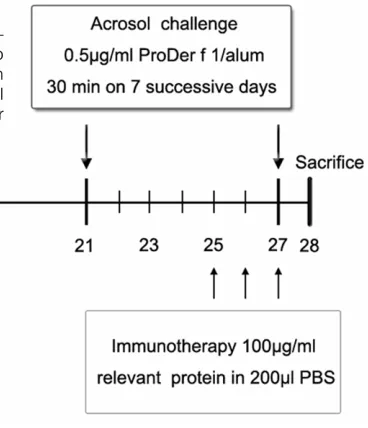
tively. The PBS groups were exclusively treated with PBS. The mice in asthma, DCP-ProDer f 1, DCP-Ihc-ProDer f 1 and ProDer f 1 groups were exposed daily for 30 min to nebulized ProDer f
1 (0.5 μg/ml) from day 21 to 27. The PBS
groups were challenged by nebulized inhalation of PBS instead. After model development, the mice in DCP-ProDer f 1, DCP-Ihc-ProDer f 1 and
ProDer f 1 groups underwent ASIT via intraperi-toneal injection of DCP-ProDer f 1,
DCP-Ihc-ProDer f 1 and ProDer f 1 (100 μg/ml), respec
-tively in dose of 200 μl. SIT was performed daily
for 30 min prior to aerosol inhalation on day 25 to 27. PBS group were treated both intraperito-neal injection and nebulized inhalation of PBS. Asthma group were devoid of management. 24
h after the final inhalation challenge, the serum and the bronchoalveolar lavage fluid (BALF)
were collected according to previous descrip-tion [29], and were stored at -80°C for further analysis (Figure 2).
Measurement of antibodies in sera and cyto-kines in BALF
ELISA was performed to measure the serum levels of IgE, IgG1 and IgG2a as well as levels of
IFN-γ, IL-4, IL-10, and IL-17 in BALF, according to
the manufacturer’s protocol (R&D Systems, Minneapolis, MN, USA).
Histopathologic analysis of the pulmonary tissues
The mouse lung tissues were fixed in 4% neu
-tral formalin and embedded in paraffin, and the paraffin sections were cut into 5 μm thickness
using a microtome. The pulmonary sections were put onto poly-L-lysine-coated slides and stained with hematoxylin and eosin (HE). The
inflammatory changes were microscopically
assessed based on the extent of eosinophils
infiltration, epithelia damage, and edema in the
lung.
Statistical analysis
The statistical data for each group were expressed in mean ± SD and analyzed using the GraphPad Prism software version 5.0 (GraphPad Software, Inc., San Diego, CA, USA). Differences between groups were analyzed using the one-way analysis of variance and Dunnett comparison. Differences were
consid-ered to be statistically significant when P <
0.05. Results
Expression and purification of hybrids
The pET28a vector was modified by inserting
the sequences encoding for ProDer f 1,
DCP-ProDer f 1, and DCP-IhC-ProDer f 1. The har-vested plasmids pET28a-ProDer f 1,
[image:4.612.93.287.73.257.2]pET28a-DCP-ProDer f 1, and pET28a-DCP-IhC-ProDer f 1 were used to transfect E. coli BL21 (DE3).
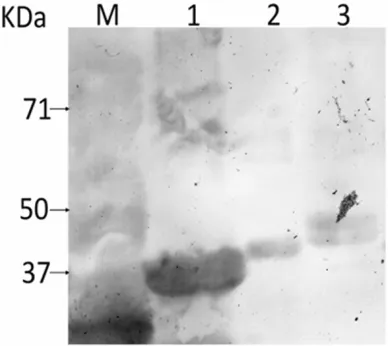
Figure 3. SDS-PAGE analysis of purified recombinant proteins expressed in E. Coli BL21. M: Protein marker (kD); Lane 1: DCP-Ihc-ProDer f 1; Lane 2: DCP-ProDer f 1; Lane 3: ProDer f 1.
[image:4.612.93.287.333.506.2]After 5 h induction with 1mmol/L IPTG, the amplicons were collected and subjected to fur-ther analysis. ProDer f 1, DCP-ProDer f 1, and DCP-IhC-ProDer f 1 were purified to homogene
-ity by nickel affin-ity chromatography under
denaturing conditions. The purified hybrids
were generated to migrate as a single band, respectively on SDS-PAGE (Figure 3). The bands were recognized with rabbit polyclonal antibo-dies raised to [His]6 (Figure 4). Subsequently, the hybrids were refolded by seccessive dialy-sis and against decreasing concentrasions of urea.
Modulatory potency of DCP-Ihc-ProDer f 1 in sensitized murine model with ProDer f 1 al-lergen
To assess the potential utility of the hybrid DCP-Ihc-ProDer f 1 in modulating the immune response, ELISA was performed to measure
the level variation in IL-4, IL-10, IL-17 and IFN-γ
in BALFs, as well as in serum IgE, IgG1 and IgG2a.
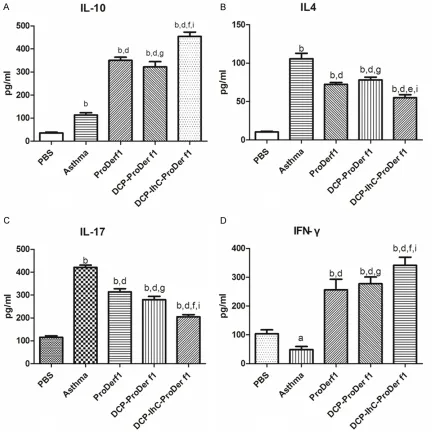
Compared with the asthma group (105.7 ± 16.21 pg/ml), mice vaccinated with
DCP-Ihc-Figure 5. The levels of IL-4, IL-10, IL-17 and IFN-γ in BALF. Note: Compared with PBS group, aP < 0.05, bP < 0.01;
Compared with asthma group, cP < 0.05, dP < 0.01; Vs. the ProDer f 1 group, eP < 0.05, fP < 0.01, gP > 0.05; Vs. the
[image:5.612.91.523.75.507.2]ProDer f
1 vaccine design
ProDer f 1 produced a lower level of IL-4 (55.08 ± 8.6 pg/ml) (P < 0.01), ProDer f 1 (72.53 ± 4.9 µg/ml) (P < 0.05), and DCP-ProDer f 1 (78.31 ± 7.84 pg/ml) (P < 0.01) (Figure 5B). Similar trends were seen regarding the levels of IL-17 (P < 0.01) (Figure 5C). Conversely, the mice immu-nized by DCP-Ihc-ProDer f 1 generated higher
level of IFN-γ (341.6 ± 28.17 pg/ml) than asth -ma group (48.75 ± 10.82 pg/ml), ProDer f 1 group (256.2 ± 37.38 pg/ml) and DCP-ProDer f
1 (277.6 ± 23.38 pg/ml) group (P < 0.01) (Figure 5D). Similarly, such trends were also seen regarding the levels of IL-10 (P < 0.01, Figure 5A). However, there was no statistical difference between ProDer f 1 and DCP-ProDer f 1 groups by the levels of cytokines, including
IL-4, IL-10, IL-17 and IFN-γ (P > 0.05).
[image:6.612.96.523.73.211.2]The measured serum IgE, IgG1 and IgG2a anti-body suggested that the level of IgE (35.26 ±
Figure 6. Level of specific IgE, IgG1 and IgG2a in sera of mice Note: Vs. PBS group, aP < 0.01, bP < 0.05; Vs. the asthma
[image:6.612.90.524.273.507.2]group, cP < 0.01, dP < 0.05; Vs. the ProDerf 1 group, eP < 0.01, fP < 0.05, gP > 0.05; Vs. the DCP-ProDer f 1 group, hP < 0.01, iP < 0.05.
5.02 µg/ml) in DCP-Ihc-ProDer f 1 group was
significantly lower than that of the asthma
group (67.56 ± 13.09 µg/ml, P < 0.01),
DCP-ProDer f 1 group (48.09 ± 5.29 µg/ml, P <
0.05) and ProDer f 1 group (50.02 ± 5.75 µg/ ml, P < 0.05) (Figure 6A). Moreover, The IgG1 level in the DCP-Ihc-ProDer f 1 group (26.48 ± 3.53 µg/ml) were also significantly decreased
compared to asthma group (61.51 ± 8.9 µg/ ml, P < 0.01), ProDer f 1 group (38.68 ± 3.64 µg/ml, P < 0.01) and DCP-ProDer f 1 (35.09 ± 4.12 µg/ml, P < 0.05) (Figure 6B). In contrast,
significant higher IgG2a level was found in the DCP-Ihc-ProDer f 1 group (51.9 ± 5.06 µg/ml) than asthma group (24.95 ± 4.71 µg/ml, P <
0.01), the ProDer f 1 group (35.29 ± 3.77 µg/ ml, P < 0.01) and the DCP-ProDer f 1 group (39.54 ± 2.70 µg/ml, P < 0.05) (Figure 6A). However, there was no statistical difference between the ProDer f 1 and the DCP-ProDer f 1 groups (P > 0.05) concerning the levels of IgE, IgG1, and IgG2a (Figure 6A-C).
Pathological change in pulmonary tissues
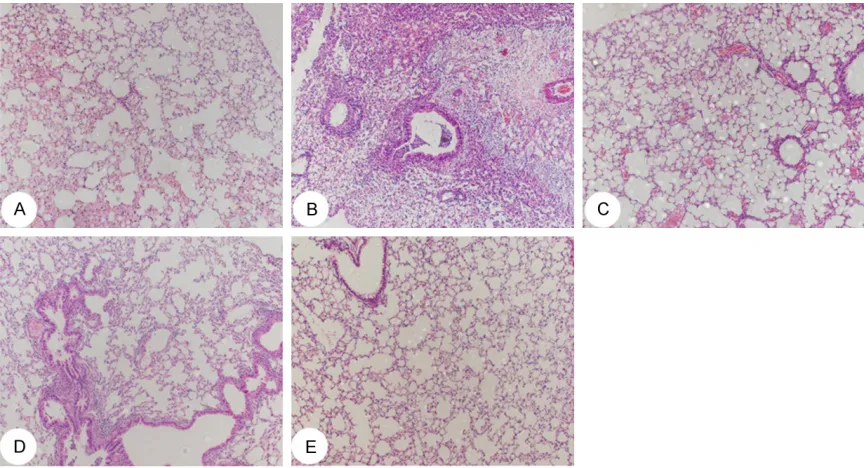
Histological examination of the lung tissues obtained from the mice of asthma group
showed intensive peribronchial inflammatory infiltration, submucosal airway wall thickening,
overt hypertrophied bronchial epithelial cells, and notable epithelial shedding (Figure 7B). Yet, the negative controls exhibited minimal
peribronchial cellular infiltration and airway wall
thickening (Figure 7A). Alleviated inflammatory
symptoms were found in mice immunized by
ProDer f 1, DCP-ProDer f 1and DCP-Ihc-ProDer f 1 (Figure 7C-E).
Discussions
Recurrent aeroallergen exposure may boost
the production of allergen-specific IgE antibod -ies [30] and facilitate degranulation and
release of inflammatory mediators as well as pro-inflammatory cytokines from mast cells
and basophils[31].
Allergen SIT is the only disease-modifying treat-ment for allergy with long-lasting effects [32]. DCs are also crucial players in the immunoregu-latory mechanisms underlying successful SIT [33]. In an attempt to enhance the allergen pre-sentation of ProDer f 1 via MHC II pathway to make SIT more effective, we assessed the power of a hybrid DCP-IhC-ProDer f 1 allergen
as vaccine. Ii plays multiple roles in the MHC-II processing pathway, and has been shown that truncated forms of Ii through physical interac-tion with MHC-II molecules that were fused to
allergens can induce efficient antigen presen -tation [18, 34] and increase immune respons-es [17]. Previous studirespons-es have provided that fused DCP-antigen can be presented to T cells,
and induce potent antigen-specific T cell activa
-tion [28], for which we verified hybrid
DCP-IhC-ProDer f 1 as vaccine for SIT. The results
dem-onstrated superior efficacy of rectifying the
imbalance of Th1/Th2 by the hybrid to that with ProDer f 1 and DCP-ProDer f 1, and that the
fused allergen induced a strong IFN-γ secretion
of Th1-type cytokines and reduced IL-4 secre-tion of Th2- type cytokine, as well as inhibited IL-17 production of Th17-type cytokines.
IL-10 appears to be an important cytokine in successful SIT [35]. Previous study has shown that SIT for HDM is accompanied by increases in IL-10 production by peripheral CD4+CD25+ Treg cells, following stimulation with Der p 1 allergen [36]. Exclusive of shifting the balance of T-lymphocyte subsets from a Th2- towards a
Th1-phenotype with major production of IFN-γ
and decreased production of IL-4, increase of IL-10 produced by CD4+CD25+ Treg cells also
coexists in SIT [37, 38]. Our findings revealed that the levels of IFN-γ and IL-10 were higher in
DCP-Ihc-ProDer f 1 group than those in ProDer f 1 and DCP-ProDer f 1 groups. Nevertheless,
the IL-4 level was significantly lower as com -pared with the previous two groups. This is
associated with IFN-γ suppressing IL-4 synthe -sis required for IgE production and an increased IL-10 secretion inhibiting IgE production [39]. These results are consistent with the previous work by Martinez-Gomez et al. that Immu-
notherapy with modified Fel d 1 could enhance
protection against anaphylaxis, as indicated by lower levels of IL-4 and increased IL-10 levels [40].
Furthermore, measurement of IgG1 and IgG2a revealed that IgG1 level was strikingly down-regulated in DCP-Ihc-ProDer f 1 group, whereas IgG2a level was markedly raised compared to
other experimental groups. These findings sug -gest that the hybrid DCP-Ihc-ProDer f 1 has the potential to modify the imbalance of Th1/Th2 cells characterized by suppression of IL-4, and
ProDer f
1 vaccine design
with the therapeutic principles for allergic disorders.
In conclusion, we found that the DCP-Ihc-Pro- Der f 1 is more effective than other allergens in reversing an allergen-induced Th2-skewed immune response, and DCP-Ihc-ProDer f 1 is a potent vaccine in preventing allergic pulmonary
inflammation through lowering specific IgE lev -els. However, further studies are necessary to
verify the safety and efficacy of the
DCP-Ihc-ProDer f 1 as a useful vaccine for SIT. Acknowledgements
This work was supported by the Grants from National Natural Science Foundation of China (No. 81270091, No. 81172790 and No. 30872367) and Natural Science Foundation of Anhui Province of China (No. 070413088). Disclosure of conflict of interest
None.
Address correspondence to: Dr. Chaopin Li, De- partment of Medical Parasitology, Wannan Medical University, Wuhu 241002, Anhui, China. Tel: +86 553-393-2587; Fax: +86 553-393-2589; E-mail: [email protected]
References
[1] Thomas WR, Hales BJ and Smith WA. House dust mite allergens in asthma and allergy. Trends Mol Med 2010; 16: 321-328.
[2] Asher MI, Montefort S, Bjorksten B, Lai CK, Strachan DP, Weiland SK and Williams H. Worldwide time trends in the prevalence of symptoms of asthma, allergic rhinoconjunctivi-tis, and eczema in childhood: ISAAC Phases One and Three repeat multicountry cross-sec-tional surveys. Lancet 2006; 368: 733-743. [3] Platts-Mills TA, Erwin EA, Heymann PW and
Woodfolk JA. Pro: The evidence for a causal role of dust mites in asthma. Am J Respir Crit Care Med 2009; 180: 109-113; discussion 120-101.
[4] Chruszcz M, Chapman MD, Vailes LD, Stura EA, Saint-Remy JM, Minor W and Pomes A. Crystal structures of mite allergens Der f 1 and Der p 1 reveal differences in surface-exposed residues that may influence antibody binding. J Mol Biol 2009; 386: 520-530.
[5] Chruszcz M, Pomes A, Glesner J, Vailes LD, Osinski T, Porebski PJ, Majorek KA, Heymann PW, Platts-Mills TA, Minor W and Chapman MD. Molecular determinants for antibody
bind-ing on group 1 house dust mite allergens. J Biol Chem 2012; 287: 7388-7398.
[6] Heymann PW, Chapman MD and Platts-Mills TA. Antigen Der f I from the dust mite Derma-tophagoides farinae: structural comparison with Der p I from Dermatophagoides pteronys-sinus and epitope specificity of murine IgG and human IgE antibodies. J Immunol 1986; 137: 2841-2847.
[7] Hansen G, Berry G, DeKruyff RH and Umetsu DT. Allergen-specific Th1 cells fail to counter-balance Th2 cell-induced airway hyperreactivi-ty but cause severe airway inflammation. J Clin Invest 1999; 103: 175-183.
[8] Gaffen SL and Hajishengallis G. A new inflam-matory cytokine on the block: re-thinking peri-odontal disease and the Th1/Th2 paradigm in the context of Th17 cells and IL-17. J Dent Res 2008; 87: 817-828.
[9] Zhao J, Lloyd CM and Noble A. Th17 responses in chronic allergic airway inflammation abro-gate regulatory T-cell-mediated tolerance and contribute to airway remodeling. Mucosal Im-munol 2013; 6: 335-346.
[10] Palomares O, Yaman G, Azkur AK, Akkoc T, Ak-dis M and AkAk-dis CA. Role of Treg in immune regulation of allergic diseases. Eur J Immunol 2010; 40: 1232-1240.
[11] Shi YH, Shi GC, Wan HY, Jiang LH, Ai XY, Zhu HX, Tang W, Ma JY, Jin XY and Zhang BY. Coex-istence of Th1/Th2 and Th17/Treg imbalances in patients with allergic asthma. Chin Med J (Engl) 2011; 124: 1951-1956.
[12] Schmidt-Weber CB, Akdis M and Akdis CA. TH17 cells in the big picture of immunology. J Allergy Clin Immunol 2007; 120: 247-254. [13] Akbari O and Umetsu DT. Role of regulatory
dendritic cells in allergy and asthma. Curr Opin Allergy Clin Immunol 2004; 4: 533-538. [14] Molet S, Hamid Q, Davoine F, Nutku E, Taha R,
Page N, Olivenstein R, Elias J and Chakir J. IL-17 is increased in asthmatic airways and in-duces human bronchial fibroblasts to produce cytokines. J Allergy Clin Immunol 2001; 108: 430-438.
[15] Linhart B and Valenta R. Vaccines for allergy. Curr Opin Immunol 2012; 24: 354-360. [16] Ball T, Linhart B, Sonneck K, Blatt K, Herrmann
H, Valent P, Stoecklinger A, Lupinek C, Thal-hamer J, Fedorov AA, Almo SC and Valenta R. Reducing allergenicity by altering allergen fold: a mosaic protein of Phl p 1 for allergy vaccina-tion. Allergy 2009; 64: 569-580.
[18] Crameri R, Fluckiger S, Daigle I, Kundig T and Rhyner C. Design, engineering and in vitro eval-uation of MHC class-II targeting allergy vac-cines. Allergy 2007; 62: 197-206.
[19] Schutze MP, Peterson PA and Jackson MR. An N-terminal double-arginine motif maintains type II membrane proteins in the endoplasmic reticulum. EMBO J 1994; 13: 1696-1705. [20] Busch R, Rinderknecht CH, Roh S, Lee AW,
Harding JJ, Burster T, Hornell TM and Mellins ED. Achieving stability through editing and chaperoning: regulation of MHC class II pep-tide binding and expression. Immunol Rev 2005; 207: 242-260.
[21] Kallinteris NL, Wu S, Lu X, von Hofe E, Hum-phreys RE and Xu M. Linkage of Ii-Key segment to gp100(46-58) epitope enhances the pro-duction of epitope-specific antibodies. Vaccine 2005; 23: 2336-2338.
[22] Humphreys RE, Adams S, Koldzic G, Nedelescu B, von Hofe E and Xu M. Increasing the potency of MHC class II-presented epitopes by linkage to Ii-Key peptide. Vaccine 2000; 18: 2693-2697.
[23] Kallinteris NL, Lu X, Blackwell CE, von Hofe E, Humphreys RE and Xu M. Ii-Key/MHC class II epitope hybrids: a strategy that enhances MHC class II epitope loading to create more potent peptide vaccines. Expert Opin Biol Ther 2006; 6: 1311-1321.
[24] Adams S and Humphreys RE. Invariant chain peptides enhancing or inhibiting the presenta-tion of antigenic peptides by major histocom-patibility complex class II molecules. Eur J Im-munol 1995; 25: 1693-1702.
[25] Hanson HL, Kang SS, Norian LA, Matsui K, O’Mara LA and Allen PM. CD4-directed peptide vaccination augments an antitumor response, but efficacy is limited by the number of CD8+ T cell precursors. J Immunol 2004; 172: 4215-4224.
[26] Sette A and Fikes J. Epitope-based vaccines: an update on epitope identification, vaccine design and delivery. Curr Opin Immunol 2003; 15: 461-470.
[27] Caminschi I and Shortman K. Boosting anti-body responses by targeting antigens to den-dritic cells. Trends Immunol 2012; 33: 71-77. [28] Curiel TJ, Morris C, Brumlik M, Landry SJ,
Fins-tad K, Nelson A, Joshi V, Hawkins C, Alarez X, Lackner A and Mohamadzadeh M. Peptides identified through phage display direct immu-nogenic antigen to dendritic cells. J Immunol 2004; 172: 7425-7431.
[29] Li C, Jiang Y, Guo W and Liu Z. Production of a chimeric allergen derived from the major aller-gen group 1 of house dust mite species in Ni-cotiana benthamiana. Hum Immunol 2013; 74: 531-537.
[30] Niederberger V, Ring J, Rakoski J, Jager S, Spit-zauer S, Valent P, Horak F, Kundi M and Valen-ta R. Antigens drive memory IgE responses in human allergy via the nasal mucosa. Int Arch Allergy Immunol 2007; 142: 133-144.
[31] Bischoff SC. Role of mast cells in allergic and non-allergic immune responses: comparison of human and murine data. Nat Rev Immunol 2007; 7: 93-104.
[32] Jutel M and Akdis CA. Immunological mecha-nisms of allergen-specific immunotherapy. Al-lergy 2011; 66: 725-732.
[33] Escobar A, Aguirre A, Guzman MA, Gonzalez R, Catalan D, Acuna-Castillo C, Larrondo M, Lopez M, Pesce B, Rolland J, O’Hehir R and Aguillon JC. Tolerogenic dendritic cells derived from do-nors with natural rubber latex allergy modulate allergen-specific T-cell responses and IgE pro-duction. PLoS One 2014; 9: e85930.
[34] Sanderson S, Frauwirth K and Shastri N. Ex-pression of endogenous peptide-major histo-compatibility complex class II complexes de-rived from invariant chain-antigen fusion proteins. Proc Natl Acad Sci U S A 1995; 92: 7217-7221.
[35] Nouri-Aria KT, Wachholz PA, Francis JN, Jacob-son MR, Walker SM, Wilcock LK, Staple SQ, Aalberse RC, Till SJ and Durham SR. Grass pol-len immunotherapy induces mucosal and pe-ripheral IL-10 responses and blocking IgG ac-tivity. J Immunol 2004; 172: 3252-3259. [36] Jutel M, Akdis M, Budak F, Aebischer-Casaulta
C, Wrzyszcz M, Blaser K and Akdis CA. IL-10 and TGF-beta cooperate in the regulatory T cell response to mucosal allergens in normal im-munity and specific immunotherapy. Eur J Im-munol 2003; 33: 1205-1214.
[37] Akdis M and Akdis CA. Mechanisms of aller-gen-specific immunotherapy: multiple sup-pressor factors at work in immune tolerance to allergens. J Allergy Clin Immunol 2014; 133: 621-631.
[38] Verhagen J, Blaser K, Akdis CA and Akdis M. Mechanisms of allergen-specific immunother-apy: T-regulatory cells and more. Immunol Al-lergy Clin North Am 2006; 26: 207-231, vi. [39] Akdis CA, Blesken T, Akdis M, Wuthrich B and
Blaser K. Role of interleukin 10 in specific im-munotherapy. J Clin Invest 1998; 102: 98-106. [40] Martinez-Gomez JM, Johansen P, Rose H,