Running a microprogram
on Rikke-MathiLda
This paper describes how to Load and execute a microprogram on Rikke and MathiLda.
DAIMI MD-41, October 1980 FLemming Wibroe
Computer Science Department AARHUS UNIVERSITY Ny Munkegada - OK 8000 Aarhus C - DENMARK
I
I
I
I
I
I
I
I
I
I
I
I
I
I
I
I
I
I
I
I
I
I
I
I
I
I
I
I
I
I
I
I
I
I
I
I
I
I
1. PhysicaL configuration ••••••••••••••••••••••••••••••• 2. The microprogram ••••••••••••••••••••••••••••••••••••• 2
2.1. Preparation ••••••••••• -.... ••••••••• •••••• •••••••• 2 2.2. Structure of the microprogram .~ •••••••••••••••••• 3 3. Microprogramming Rikke ••••••••••••••••••••••••••••••• 4 3.1. BCPL-Library functions ••••••••••••••••••••••••••• 4 3.2. ExampLe •••••••••••••••••••••••••••••••••••••••••• 6 3.3. Microcoded Library functions ••••••••••••••••••••• 7 4. Microprogramming MathiLda •••••••••••••••••••••••••••• 8
4.1. BCPL-Library functions ••••••••••••••••••••••••••• 8 4.2. ExampLe •••••••••••••••••••••••••••••••••••••••••• 12 4.3. Microcoded Library functions ••••••••••••••••••••• 14 5. Interactive execution of a microprogram •••••••••••••• 15
6. Restrictions on microprograms •••••••••••••••••••••••• 16
Appendix
A. References ••••••••••••••••••••••••••••••••••••••••••• 18
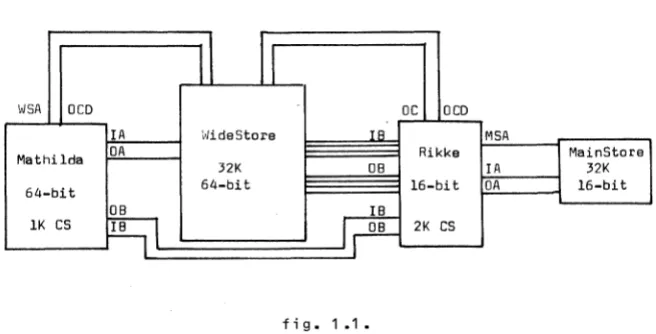
The machine configuration i~ as foLLows:
Configuration
JI
II
WSA OCD DC OCD
IA ;videStore 18 MSA
Mathilda OA Rikke MainStore
32K DB IA 32K
64-bit 64-bit 16-bi t OA 16-bit
~
18lK CS
~
f?L
2K CSfig. 1.1.
80th Rikke and MathiLda are connected to a 32K 64-bit memory caL-Led WideStore(WS). Data is transferred between Rikke an WS through 8 16-bits dataports, 4 for reading and 4 for writing, where a speciaL writeoperation from Rikke aLLows writing of individuaL 16-bit groups in WS [6].
Data is transferred between MathiLda and WS through 2 64-bits dataports.
WS is controLLed through OC/OCD-ports on Rikke, and through WSA/OCD-ports on MathiLda, detaiLs are given in [6].
Rikke and MathiLda can communicate directLy through 2 16-bits dataports IB/OB.
[image:6.415.39.367.149.316.2]Preparation of a microprogram for Rikke or MathiLda is done using the assembLers and simuLators on the DEC-10 [1J.
The foLLowing exampLe shows how to get the binary microprogram to the Rikke fiLe-system.
Assuming the DEC-10-fiLe ADD.LUI is a source fiLe of a micropro-gram for MathiLda:
The assembLer wiLL produce 2 fiLes: ADD.LPT
ADD.PTP
a Listning of the program the binary microprogram If the program is to be simuLated Ly executed on MathiLda, the ADD.MTS instead of ADD.PTP.
on the DEC-10 instead of actuaL-assembLer wiLL produce the fiLe
To be executed on MathiLda, the fiLe ADD.PTP must now be transpor-ted to the Rikke fiLe-system, where it must reside in a directory with the extension .MAT ( e.g under the name ADD.MAT ) [2J.
This can be done in two ways:
1. Punch the fiLe on the DEC-10 papertape puncher, and use the command 'readptr ADD.MAT' to read it into a directory on Rikke.
2. Use the transmission-system between DEC-10 and Rikke to transmit the fiLe. The transport must be initiated on both machines:
on Rikke on DEC-10
readdec ADD.MAT
copy RIKOUT:
=
ADD.PTP/IThe "II" after ADD.PTP is neccessary because of the DEC-10 fiLe-format for binary fiLes, and because the transmission system can be used to send text-fiLes too.
So we have:
assembLer
ADD.LUI
I \
ADD.LPT ADD.PTP I I v ADD.MAT
DE C-1 0
fiLe-transmission Rikke
The communication between a BCPL-program and a user microprogram
can be done through the Library functions, described in the next
sections:
This standard communication demands the parameters to be setup in
a vector, pvec, and has the foLLowing conventions about entry and
exit from the user microprogram:
At entry:
LR[LRP] DS VS
pvec, pvec!O pve c ! 1
the address of the parameter , 1. pa r a me t e r
, 2. parameter
vector
At ex i t :
DS
RB+1
resuLt, the contents of DS is written back
to the caller
must be used to return from the microprogram.
This indicates, that the vaLue of RBP before
exit must be the same as at entry, so the RB-stack must be used carefuLLy.
The RA-stack can be used freeLy.
Origin:
To avoid overwriting of system-microcode the origins for user
microprograms must be greater than:
on Rikke on Mathilda
1024 (decimaL>, 100 (decimaL>,
400 (hexadecimaL) 64 (hexadecimaL)
An exampLe of a microprogram for MathiLda that obeys these ruLes
is the foLLowing ADD.LUI:
LOU ISE VERSION 1.7. PDP-10 17 OCTOBER 1980 ADD.LUI PAGE 1
LINENO CS ADDRESS
0: 1 : 2 : 3 : 4: 5:
6 : 7 :
8: 9: 10: 11 : 12 : 13 : 14:
************************************************************ • ADD: PROGRAM TO ADD 2 INTEGERS
• 3-9-80 FLEMMING WIBROE
**************************-**********************************
*RADIX 16
*ORIGIN = 109
109 ADD: 10 A 10B 10C LR:=DS AS:=VS DS:=AL ALF:=A+B ; ; RB+1
1 PARAMETER 2 PARAMETER DS=RESULT RETURN
************************************************************
*ENTRY=ADD
A microprogram can either be Loaded and caLLed under controL from a user BCPL-program, or from an interactive system-program. The interactive execution wiLL be described in section [5], here we describe how to handLe a microprogram from a user BCPL-program. The way in which microprograms are executed, differs somewhat on Rikke and MathiLda, primariLy because Rikke is host for I/O-nucLeus and the OCODE-machine, and secondariLy because of the difference in datapath-width, 16-bit for Rikke and 64-bit for Math iLda.
We start by describing how to run a microprogram on Rikke.
The Library is named "RCSLib.REL" and is Located in directory ">SysAdmin>SysUser>RikCS", together with the GET-fiLe "RikHdr.GET". These 2 fiLes must be Linked to CurrentDirectory before use.
RCSLib contains the foLLowing functions: SetupRikkeCS[siLence]
LoadRikkeCS[fiLename]
DefineRikkeEntry[entry,offset] CaLLRikkeCS[entry,pvec]
ResetRikkeEntry[entry] ResetRikkeCS[]
RikHdr.GET contains the gLobpLs corresponding to these functions, 200-210, and the manifests used to communicate the resuLts of the functions.
~~!~QBi~~~£~[§i1~D~~]
This routine must be caLLed before any Load of microcode to initiate system-tabLes etc. The vaLue of siLence must be NOSILENCE or SILENCE. If siLence=SILENCE, the warnings reported by any of the routines in RCSLib wiLL be suppressed. The errors detected by any of the routines wiLL aLways be reported regard-Less of si Lence.
LoadRi kkeCS[fnJ
--~-i~~~~T~n;-which Loads the microcode on fiLe fn.MIC in Current-Directory. If the microprogram contains any VALUE-statements, these wiLL be executed by LoadRikkeCS.
The resuLt of the function is:
NOTFOUND fn.MIC is not in CurrentDirectory.
or format-error, sum-error or EOF on fn.MIC. eLse an entry-point 'entry', which can be used by
CaLLRikkeCS[entry,pvecJ
In any of the two first cases, LoadRikkeCS dispLays an ap-propiate message on the consoLe before returning.
~§fiD~Bi~~~Eu!r~[~u!r~,Qff~~!J
In the current assembLer [1J it is onLy possibLe to specify one entrypoint by "*ENTRY=nn". If, in a Large microprogram, an aL-ternative entrypoints is desired, this function can be used to define a new entrypoint to be nn+offset.
The resuLt of DefineRikkeEntry is: NOGOOD
eLse
offset does not specify an entrypoint insi-de the microprogram, referenced by 'entry' as LoadRikkeCS.
&s11Bi~~~g§[~u!r~,e~§£J
CaLLs the microcode, identified by 'entry'. pvec is the address of a communication-area in WideStore, which must be aLLocated from the caLLing BCPL-program.
pvecli must contain the i'th parameter to the microprogram
[2.2 J.
The resuLt of CaLLRikkeCS is NOGOOD
eLse
'entry' does not identify a Loaded microprogram the resuLt of the microprogram, i.e the contents of DS upon exit.
B~~~!Bi~~~ED!r~[~u!r~J
If 'entry' is the resuLt from LoadRikkeCS[fnJ, this routine discards the microcode, specified by 'entry', i.e disabLes
caL-Li~g of the microcode and aLLows Loading of new microcode in the
same ControLStore Locations. Rea~.tBjkkil.cS[J
--Discards aLL Loaded microcode.
The foLLowing is an exampLe of a program, which can Load and caLL the program ADD.MIA. This program is a Rikke equivaLent of ADD.LUI [2.2].
RIKADD.BCPL: get "SysHdr" get "RikHdr"
manifest $( NUMBPARAMS Let StartO be
$(S
Let add,pvec,res = 0,0,0
2 $)
Load[ "RC SL i b ", Cur rent Direct ory]
II
initiate BCPL/microcode communication: SetupRikkeCS[NOSILENCE]II
Load the microcode: add:=LoadRikkeCS["ADD"] switchon add into $(swcase NOTFOUND
case NOGOOD GiveUp["Load aborted"] endcase
1/ BCPL-Library
II
microcode LibraryII
Load the LibraryII
Load ADD.MICdefauLt $)sw
end case /I Loaded ok
II
initiate pvec:pvec:=NewVec[NUMBPARAMS-1] pvec!0:=PromptN["1. operand - "] pvec!1 :=PromptN["2. operand - "] /I perform caLL:
res:=CaLLRik~eCS[add,pvec]
if res=NOGOOD then GilleUp["caLL aborted"]
II
dispLay resuLt:OutF[ConsoLe,"resuLt of %N+%N 1/ cLean up
ReturnVec[pvec,NUMBPARAMS-1] $)S
%N*n",pvec!0,pvec!1,res]
Microcoded Library functions can be used from a user microprogram via the XTERNAL decLaration [1J.
On Rikke 2 functions are avaiLabLe, the entry-points are specified in hexadecimaL addresses:
WSREAD 21 read a 16 -b i t word from WideStore. The address must be in AS,
the resuLt is on lB.
Destroys: AS(1S)S, I B, IBD, ALF, OCD and OC. WSWRITE 22 w r i t e a 16 -b i t word to WideStore.
The address -must be in AS,
and the va L ue to w r i t·e in LR[LROPJ. Destroys: AS(1S)S, OB, OB D, OCD and OC.
For both functions, the AS-address is a 16-bit-word address, as used by the OCODE-machine, so addresses passed as parameters from a BCPL-program can be used immediateLy ( remember WideStore is a 64-bit memory). WSREAD and WSWRITE wiLL do the actuaL conversions to 64-bit-word addresses and the seLection of the correct port-number.
This has as consequence, that WSREAD and WSWRITE onLy can be used in the OCODE-machines address-space, the Lowest haLf of WideStore, 64K 16-bits words, which equaLs 16K 64-bits words.
Routines to access the upperhaLf of WideStore must be suppLied by the user microprograms.
The routines are caLLed as subroutines, using the RA-stack, e.g ST ART:
AS:
= •••
CONTINUE: VS:=IBRA! R-WSREAD
The routines for Loading and caLLing a microprogram in MathiLda are basicaLLy identicaL to those of Rikke, however there are some differences due to;
- the asynchrounous operation of the caLLing and the caLLed processor
- the difference in datapath-width
Point 1 Leads to a sLightLy different caLLing-sequence, whereas point 2 gives some compLications, when communicating parameters and resuLts.
The Library is named "MCSLib.REL" and is Located in di rectory ">SysAdmin>SysUser>MatCS", together with the GET-fiLe "MatHdr.GET". These 2 fiLes must be Linked to CurrentDirectory before use.
MCSLib contains the foLLowing functions; SetupMatCSCsiLence]
LoadMatCSCfiLename]
DefineMatEntryCentry,offsetJ MatParVec[n]
SetMa~Par[pvec,i,v3,v2,v1,vO]
,eturnMatVec[pvec] CaLLMatCS[entry,pvec] ResetMatEntry[entry] ResetMatCS[]
InMat64[buf] OutMat64[buf] MatDA[] MatSA[]
MatDeadStart[]
MatHdr.GET contains the gLobaLs corresponding to thes~ functions, 110-130, and t~e manifests used to communicate the resuLts of the functions.
~~tYB~~!~§[~il~D£~]
The purpose of this routine is to initiaLise the communication between Rikke and MathiLda, and to initiaLise the tabLes on Rik-ke administering the MathiLda ControLStore. The vaLue of siLen-ce must be NOSILENCE or SILENCE.
Before SetupMatCS is caLLed, MathiLda must be deadstarted. To estabLish a communication between Rikke and MathiLda, a microprogrammed monit~r, which can Load and execute user micro-programs, must be Loaded. SetupMatCS Loads this communic.tion monitor.
The monito~ contains microprogrammed Library functions as described in section 4.3, and assures, that the conventions for communication from section "2.2 are obeyed. The text of the cur-rent (27J10-80) communication monitor can be found in appendix B.
As with SetupRikkeCS, siLence=SILENCE suppresses the warnings given by any of the routines in MCSLib, the errors are aLways reported.
LoadMatCS[fn]
--A-f~~~tio~, which Loads the microcode on fiLe"fn.MAT in
Current-Director-y. If the microcode contains any VALUE-statements, these .wiLL be executed by LoadMatCS.
The result of the function is:
NOTFOUND fn.MAT is not in CurrentDi rectory.
NOGOOD an overwrite of existing microcode was attempted, or format-error, sum-error or EOF on fn.MAT eLse an entry-point 'entry', which can be used by
CaLLMatCS[ent~y,pvec]
In any of the two first cases, LoadMatCS dispLays anappropiate message on the consoLe before returning.
QgfiD~~~!5D!r~[~U!r~,Qfl~~!] equivaLent to DefineRikkeEntry MatParVec[n]
--DeLi~e~s-a vector, pvec, of size 4*n, such that pvec rem 4 O.
§~!~~!E~r[B~~£,i,~~,~~,~l,~Q]
EquivaLent to
$( Let k = (i-1)*4
pvec!(k+3),pvec!(k+2),pvec!(k+1),pvec!k:=v3,v2,v1,vO
$)
R~!YrD~~!~~£[e~~£]
Returns the vector aLLocated by MatParVec.
of the communi'cation area in WideStore as seen from Rikke: Because of the difference in datapath-width on Rikke and Mathil-da, this communication-area is treated in a special way:
1. Parameters are seen as 64-bits words from Mathilda, but must be handled as 4 16-bits words from Rikke.
2. The address of a parameter is a 64-bits word address from Mathilda and a 16-bits address from Rikke, so rikaddress=4*mataddress.
3. As a consequence of this, each parameter, which must be setup from Rikke, consists of 4 16-bits words, where the address of the first word must be divisible by 4.
The call pvec:= MatParVec[n] allocates a communication vector in WideStore of size-4;~;-s~ch that pvec rem 4 = O.
The pvec must now be initialised as follows: pvec!O bit 1 5 ••• 0 of 1 • parameter pvec!1 bit 31. .16 of 1. pa rameter pvec!2 bit 47 •• 32 of 1 • parameter pvec!3 bit 63 •• 48 of 1. parameter pvec!4 bit 1 5 ••• 0 of 2. parameter pvec!5 bit 31. .16 of 2. parameter pvec!6 bit 47 •• 32 of 2. parameter pvec!7 bit 63 •• 48 of 2. parameter pvec!8 bit 1 5 ••• 0 of 3. parameter
After the call CallMatCS[entry,pvec], the conventions of section 2.2 means that upon entry to the microprogram
LR DS VS
pvec/4, 1.parameter: 2.parameter:
the address of the parameter vector pvec!3::pvec!2::pvec!1::pvec!0 pvec!7::pvec!6::pvec!5::pvec!4
CallMatCS(entry,pvec) does not wait for any result from the Mathilda microprogram, it merely starts execution and waits only for the Mathilda monitor to reply with an accept of the call to ensure that the microprogram is started, and then returns to the calling BtPL-program with the result ACCEPTED.
The result from the microprogram, the content of DS, can then be obtained by calling InMat64.
If 'entry' does not identify a loaded microprogram, or pvec rem 4 \=0, NOGOOD is returned.
~~~~!~2!5D!r~[~Dl[~J
If 'entry' is the result of LoadMatCS[fnJ, this routine discards the microcode, specified by 'entry', i.e disables calling of the microcode and aLLows Loading of new microcode in the same Con-troLStore Locations.
ResetMatCS[J
--Di~~~rd~ aLL Loaded microcode.
!D~2!Q~[t2!!!J
Reads a 64-bit words, send from Mathilda through the direct con-nection between Rikke and MathiLda, to the 4-word vector 'buf' such that:
buf!O buf! 1 buf!2 buf!3
bit 15 ••• 0
bit 31 •• 16
bit 47 •• 32 bit 63 •• 48
This routine is used after CaLLMatCS to wait for the resuLt of the MathiLda microprogram.
Note: MathiLda sends the word in 4 * 16-bits, so 'buf' need not be divisibLe by 4, as with pvec.
Q!:!!.~2!.Q~[t2y!J
Writes a 4*16-bits word to MathiLda through the direct connec-tion in the same format as InMat64. If Mathilda is not ready to read from Rikke, Rikke wiLL be hung up.
~2!Q8[J
A boolean functions, MathiLda Data AvaiLabLe, which is true, if MathiLda has send a word to Rikke through the direct connection, and Rikke has not read this value yet.
MatSA[J
--A-boolean function, MathiLda has read direct connection. MatDeadSta rt[]
MathiLda Space AvaiLabLe, which is true, if the Last word send from Rikke through the
--If--M~thilda' is in a weLLdefined state after having executed a
user microprogram, it can be deadstarted from a BCPL-program by calling this routine, i.e unLoad the communication monitor and the user microprograms, and return controL to the bootstrap-Loader.
This routine shouLd be caLLed upon normaL exit from the user BCPL-program.
The foLLowing is an exampLe of a program, which can Load and caLL the program ADD.LUI[2.2].
MATADD .BCPL: get "SysHdr" get "MatHdr"
manifest $( NUMBPARAMS Let Start () be
$(S
Let add,res 0,0 and pvec = 0 and buf = vec 3
2 $)
Load[ "MCSL i b ", Cur rent Di rect ory]
II
initiate BCPL/microcode communication: SetupMatCS[NOSILENCE]II
Load the microcode: add:=LoadMatCS["ADD"] switchon add into $(swcase NOTF OUND case NOGOOD defauLt $)sw
GiveUp["Load aborted"] endcase
endcase
/I initiate communi cation ,area: pvec:=MatParVec[NUMBPARAMS] SetMatPar(pvec,1,0,0,1,0) SetMatPar(pvec,2, 0,0,0,1)
II
pe r for m caL L:res:=CaLLMatCS[add,pvec] switchon res into
$(sw
case NOGOOD GiveUp["caLL aborted"] endcase
/I BCPL-Library
II
microcode LibraryII
Load the Library/I Load ADD.MAT
II
Loaded okII
a vector of size 8II
1. pai-II
2. pa r65536
1
case ACCEPTED defauLt
endcase
II
MathiLda started$)sw
GiveUp["system-error"]llshouLd not occur end case
$)S
II
wait for MathiLda unt i L Mat DA[] do$(
$)
II
Do some sensibLe work. This Loop need not be here,II
since InMat64 wiLL.wait for MathiLda.II
read the resuLtInMat64(buf)
II
the resuLt in 'buf'II
dispLay resuLt:OutF[ConsoLe,"resuLt: %U: :%U: :%U: :%U*n",buf !3,buf !2,buf!1 ,buf !O]· 1/ clean up:
ReturnMatVec(pvec) Mat DeadSta rt []
The foLLowing 4 functions are avaiLabLe in the standard com-munication monitor, and can be used from the user microprograms via the XTERNAL decLaration. The addresses are given in hexa-decimaL:
WSREAD 8
WSWRITE 9
RIKREAD A
RIKWRITE 8
read a 64-bit word from WideStore. The address must be in AS,
the resuLt is on lB.
Destroys: ALF, WSA, OCD, IA
write a 64-bit word to WideStore. The address must be in AS,
and the vaLue to write in LRCLROPJ. Destroys: ALF, WSA, OCD, OA
read a fuLL 64-bit word send from Rikke by OutMat64.
The resuLt is on AL. Requires: LRIP=LROP
Destroys: CA, ALF, LRCLRPJ, IB write a fuLL 64-bit word to Rikke, to be recieved by InMat64.
The vaLue to write must be in VS. Destroys: CA, VS, 08
The AS-addresses for WSREAD and WSWRITE are 64-bits-word WideStore addresses, so these two functions can be used to access the whoLe WideStore.
If the user onLy wants to Load and caLL a simpLe microprogram, i.e a program which onLy communicate with the caLLing BCPL-program and onLy give one vaLue, a word, as its resuLt, this can be done with the programs "Rikke" and "MathiLda".
They consists of respectiveLy "RCSLib" and "MCSLib" together with some input/output routines, and a microprogram cataLog.
The commands they accept are: Load
caLL
name: Load a microprogram from fiLe name.MIC (Rikke) or n a me. MAT (Ma t h i L d a) •
name caL L asks
of the for the
microprogram number of
'name'. The program parameters and the parameters.
For Rikke, the parameters can onLy be given in decimaL.
For MathiLda they can be given as: e.g
decimaL 102 16-bit
hexadec. XA7B42C 64-bit octaL 0713132 64-bit binary B101001 64-bit
The resuLt of the microcode caLL is dispLayed in decimaL, and for MathiLda in hexadecimaL too. deLete name discards the microprogram 'name'. If 'name'=aLL
aLL Loaded microprograms are discarded. List
heLp end
gives a List of aLL caLLabLe microprograms. type a heLp text on the ConsoLe.
terminate the program. In case of MathiLda, a MatDeadStart[] wiLL be executed.
The exampLe-programs ADD.MIA and ADD.LUI can both be executed by these two programs.
The two programs reside in SystemDirectory, and are invoked as normaL systemprograms by typing their name [2].
When run~ing a microprogram on Rikke or MathiLda, the enVlronment must be obeyed, especiaLLy on I/O-nucLeus and the OCODE-machine both are [3],[4], and therefore (possibLy) uses the same etc. as the user microprogram.
some ruLes about Rikke, since the microprogrammed regi sters, masks
Both Rikke and MathiLda must be Left in a normaLised state, when the user microprogram terminates. This means:
MA[O] MA[1 ] MAP
B SS
LA[O] PA [1 ] LAP PGS CUALF A+B
LB[O] PB[O] LBP CM PHD] PAP NOMASK FULLMASK PB P = 0
(11 ••• 111) (00 ••• 000)
If any of these are omitted, the processor ( Rikke or MathiLda) wiLL probabLy die, when trying to execute the next microprogram, which on Rikke is the OCODE-machine itseLf.
On the other hand, the user microprograms may aLso assume, that both Rikke and MathiLda are normaLised, when entering the micro-program.
On MathiLda a user microprogram can use aLL the resources in the machine, the register groups, pointers etc, with the exceptions as mentioned above, and assume that the vaLues are unchanged, when re-entering the microprogram from the BCPL-system, except for the foLLowing, which are used by the Library routines and the com-munication monitor:
ALF AS IB OCD CA DS IB WSA CB VS OA LRP OC OB
LR [1 ]
SA
On Rikke the user microprograms are more restricted. The I/O-nucLeus and the OCODE-machine uses some permanent resources, and these must not be changed by the user microprograms. These are:
WACO]
WA[11 ]-WA[13] WB[O] 0-15
=
WB[2]WB[4J - WB[7J MB:5-9 MB:12-14 LA:14-15,
the OCODE-machine registers used by I/O-nucLeus
0,1,2,3",14,-1 , the constants used by the disk-controLLer
used for OCODE-decoding used by the disk-controLLer
MainStore:
MS: 0-256 used by I/O-nucleus
Apart from these, the I/O-nucleus and the OCODE-machine uses some resources, when running, so these cannot be assumed to be un-changed, when re-entering a user microprogram. The following resources are not used, and can be assumed to be left unchanged by the I/O-nucleus and the OCODE-machine:
ALSG [5] - [15] BSSG [5] - [15] CASG [5] - [15] LA [5] - [13] MA [5] - [15]
P A [5] - [1 5]
PMSG [5] - [15] MSASG[5] - [15] The free WA-groups I/O-nucleus also uses needed, it must be BCPL-program:
AVDSG [5] - [15] BMSG [5] - [15] CBSG [5] - [15 J LB [5] - [1 5J MB [1 J - [4] PB [5J - [15J PGSG [5J - [15J WB [8J - [15J
must not be used uncontrolled, since the these for device-records. If a WA-group is allocated and deallocated by the calling
group := AllocDB[J DeAllocDB[groupJ
II allocate II deallocate
For both Rikke and Mathilda, using VALUE-statements on any of the above permanent resources or the resources concerning the nor-malised machine, will of course have disastrous consequences too. Furthermore it should be noted, that VALUE-statements are executed by LoadRikCS and LoadMatCS, see 3.1 and 4.1, and that this ex-ecution uses some pointers and registers, when initialising the register-group and pointers.
This means, that all the microcode for a user microprogram should be loaded, before calling any of the microcode, if the microcode assumes any register-group or pointer to be left unchanged by the BCPL-system.
[1]: I.H.S¢rensen, E.KresseL:
Rikke-MathiLda microassembLers and simuLators D A I M I M D - 2 8, Dec em b e r 1 977
[2]: J.K.Kjrergaard and FLemming Wibroe The RIKKE-BCPL system
DAIMI MD-38, September 1980 [3]: E.KresseL, I.H.S¢rensen
The I/O-nucLeus on RIKKE-1 DAIMI MD-21, October 1975 [4]: O.S¢rensen
The emuLated OCODE-machine for the support of BCPL DAIMI PB-45, April 1975
[5]: P.Kornerup,B.Shriver
A description of the MATHILDA system DAIMI PB-52, September 1980
[6]: J.K.Kjrergaard
The RIKKE-MATHILDA WideStore DAIMI MD-42, November 1980 [7]: J.K.Kjrergaard, I.H.S¢rensen
The RIKKE-BCPL compiLer DAIMI MD-36, August 1980 [8]: J.K.Kjrergaard, I.H S¢r~nsen
The RIKKE editor
The foLLowing is moni t or as of LikeLy to change unchanged.
the source text for the MathiLda communication
27/10-80. The text, and thereby the addresses is
in the future, but the functions shouLd remain
The source text of the Rikke and MathiLda bootstrap Loaders can be found in [1].
LOUISE VERSION 1.7. PDP-1C 27 OCTOBER 1980 12:38:53 LOMER.LUI P ~GE 1
lDENO ADDRESS
" 2, 3, 4' 5, 6' 7, S, 9, 10: 11: 12: 13: 11.: 15: 16: 17: 18: 19: 21: Z2 :
23: 24: 25: 26: 27: 28; 29: 30: .3<': 33: ;$4: 35: 36: 37; 38: 39; 40: 41: 42: 43: 44: 45: 46: 47: 48: 49: 50: 51: 52: 53: 54: 10 11
"
13 14 15 16 17 18 19 1A"
H'"
1E 1F 20 21 12 13 l4MATH lL DA M ICR O-PR OG RAMS RU N-Tl ME ~NV IRONMENT
9-2-79: E xe c: LR [OJ un~ h ~nged, LRP=:l
LR[1J =: poulter to parameter
*0=16
CSLOAD
(B-1
CONTROl" AND PAR~r~ETER TRAtJSfER MDULE.
UPON ACTIVATIOI; OF USER IHCRO-PROGRAfolS lR os
"
R-READ R-READ SA• START-ADDRESS
.LOAD-COUNT
.fIRST WORD
IF C8 THEN RB+l .RETURN TO [He
R-READ ."EXT WORD R-NEWLOAO
USER-SPECIfIED FIRF·WARE FUNCTioN AUTOMATICALLY EXEC: ; AS,LR:=AL; VS:=ALLOS; OS:=1A AS;=AL VS:"DS RA! RA! RB! RA!
CALLING SYSTEI1 ROUTINE, AS TO BE THE RESULT OF THE
LRPC LRP+1 SA:=SB SETALf+1
IF KA TH E ~ HERE
R~R E AD • ST ART~ AO OR E S S
R~RE AD • PARAMETER VECTOR R-WRITE .ACCEPT TO RIKKE
R~f"EMR E AI> .1.PARAMETER
R~~IE MR E AD .2.PARAMETER IF KA THEN HERE
SA R-WRITE R-EXEr
LOUl5E V·ERSlOIJ 1.7. poP-tO 27 OCTOBER 1980 12 :38: 57 LOADER.LUI LIIUl(; C5
55: 56: 57: Sb: 5'1: 6G: 61: 62:
63: 25
64: 26
65: n
66: 28
67: "l9
6.'): 2A
69; 70; 71:
72: 73:
74: 28
75: 2e
76: ';:0
77:
7;;:
79:
80:
81:
82: 2E
83: 2F
84: 30
85: 31
86: 87: 88: 89: 90:
91: 32
92: 33
93: 34
94: 35
95: 96, 97: '18: 99: 100 101 102 103 104 105 106 107 10S 109 110 111 112 113
LIBRARY ROUTlI~ES
READ A fULL 64 BIT WORD SEIIIO fRO~1 A BePL PROGRAr1 ON RIKKE /lLLOS
'"
LR : ~ I r, ; (A-1, IBA
WR1TE A FULL 64 Ell WORD re· /I IHPL PROGRAM ON RIKKE WRIH.: eA:=
V5,OB:"V$,<16; CA-1, OBA
WIOESTGRE REA[) FUNCTlOt;: IA:=WS[AS] SETALFB
rlEr~ READ:
"
WSA:=SB,IAA, OeD:=.5 OCAtWIPESTORE WRITE ROUTINE: WS[AS] :=LR
~1EMWRI TE:
"
OA::AL
SETAUB IOSA:=S8, OCD:;:: OCA1, SElALFA pAA1
lHESE ROUTlNES A CALLABLE THROUGH A TABLE:
*0=8 RUREAD: RIKWRllE: WSREAO: WSWRlTE:
"ENTRY = EXEC
ASSEMBLY CORRECT
I f IBDA THEN HERE+t ELSE HERE
IF C/. THEN HERE+1 ELSE R-2 RA+1
IF OBSI, THEN HERE+1 ELSE HERE
IF CIt THEN RA+1 ELSE HERE-1 NOT OeSA THEN HERE IF 1 AO~ THEN RA+1 ELSE HERE IF NOT OCS~ THEN HERE
I f NOT OaSA THEN HERE RA+1
R-READ R-WRITE R-MEMAEAD
PAGE 2
Micro
Archives
4-30
Wibroe, Flemming.
Running a microprogram on Rikke-Mathilda /
Flemming Wibroe.-- Aarhus, Denmark:
Com-puter Science Department, Aarhus
Univer-sity,
1980.
(DAIMI; MD-41)