STP 21-24-SMCT
HEADQUARTERS
DEPARTMENT OF THE ARMY
Common Tasks
Skill Level 2, 3, and 4
Soldier’s Manual of
DISTRIBUTIONRESTRICTION:Approvedforpublicrelease; distributionisunlimited.
This publication is available at Army
Knowledge OnLine (
www.us.army.mil
) and
the General Dennis J. Reimer Training and
Doctrine Digital Library at
*STP 21-24-SMCT
Distribution Restriction: Approved for public release; dis tribution is unlimited.
*This manual supersedes STP 21-24-SMCT, 1 October 1992.
i
Soldier Training Publication Headquarters
No. 21-24-SMCT Department of the Army
Washington, DC, 31 August 2003
SOLDIER'S MANUAL OF
COMMON TASKS
Skill Levels 2, 3, and 4
TABLE OF CONTENTS
Page
PREFACE... vi
Chapter 1. Introduction... 1-1
Chapter 2. Training Guide ... 2-1
Chapter 3 Skill Levels 2, 3, and 4 Tasks... 3-1
Skill Level 2
Subject Area 1: Individual Conduct and Laws of War
181-101-2023 Enforce the Uniform Code of Military Justice
(UCMJ)... 3-1 181-105-2001 Enforce the Law of War and the Geneva and
Hague Conventions... 3-7 181-105-2002 Conduct Combat Operations According to the
Law of War ...3-11 224-176-2426 Enforce Compliance with Media Ground Rules...3-13 331-202-1050 Enforce Compliance with the Code of Conduct ...3-15 805C-PAD-2503 Enforce Compliance with the Army's Equal
Opportunity and Sexual Harassment Policies ...3-17
Subject Area 2: First Aid
ii
Subject Area 3: Nuclear, Biological, and Chemical
031-503-1023 Protect Yourself from Nuclear, Biological, and Chemical Injury/Contamination When Changing Mission-Oriented Protective Posture Gear ... 3-38 031-503-2001 Identify Chemical Agents Using M256-Series
Chemical Agent Detector Kit ... 3-43 031-503-2023 Measure Radiation Dose Rate and Total Dose ... 3-47 031-503-3002 Conduct Unmasking Procedures... 3-50 031-503-3004 Supervise the Crossing of a Contaminated Area ... 3-52 031-503-3005 Submit an NBC 1 Report... 3-55 031-503-3008 Implement Mission-Oriented Protective Posture ... 3-57 031-503-3010 Supervise the Employment of Nuclear, Biological,
and Chemical Markers ... 3-59 031-503-4002 Supervise Unit Preparation for a Nuclear,
Biological, and Chemical Attack ... 3-62 031-506-1053 Report Nuclear, Biological and Chemical
Information Using NBC 4 Report... 3-65 031-506-2061 Conduct a Mask Fit Test ... 3-67
Subject Area 4: Survive (Combat Techniques)
061-283-6003 Adjust Indirect Fire ... 3-70 071-326-0608 Use Visual Signaling Techniques... 3-79 071-326-5704 Supervise Construction of a Fighting Position... 3-101 071-326-5705 Establish an Observation Post ... 3-103
Subject Area 5: Navigate
071-329-1019 Use a Map Overlay ... 3-106
Subject Area 20: Casualty Reporting and Handling
805C-PAD-2060 Report Casualties... 3-114
Subject Area 21: Defense Measures
071-430-0002 Conduct a Defense by a Squad ... 3-118
Subject Area 22: Unit Operations
071-326-5502 Issue a Fragmentary Order ... 3-123 071-326-5503 Issue a Warning Order ... 3-125 551-88N-0002 Prepare for Unit Move ... 3-127
Subject Area 23: Security and Control
301-371-1200 Process Captured Materiel... 3-131
Subject Area 25: Equipment Checks
091-CLT-4029 Supervise Preventive Maintenance Checks and
Services ... 3-135 101-92Y-0003 Enforce Compliance with Supply Discipline
iii 101-92Y-0004 Enforce Property Accountability Policies... 3-140 101-92Y-0005 Enforce Compliance with Property Accountability
Policies ... 3-152 101-92Y-0006 Inspect Equipment for Accountability, Cleanliness,
and Serviceability... 3-170
Subject Area 27: Risk Management
850-001-2000 Employ Accident Prevention Measures and Risk Management Process ... 3-171
Subject Area 28: Administration/Management
805C-PAD-2044 Recommend Individual for Award ... 3-172 805C-PAD-2145 Counsel a Soldier on the Contents of a
Noncommissioned Officer Evaluation Report and NCOER Checklist ... 3-175 805C-PAD-2146 Prepare the Rater's Portion of a
Noncommissioned Officer Evaluation Report... 3-177 805C-PAD-2402 Provide Input on Personnel Actions Affecting
Subordinates... 3-181 805C-PAD-2407 Recommend Disciplinary Action for a Soldier ... 3-184 805C-PAD-2461 Maintain Accountability of Personnel (Status
Report) ... 3-186 805C-PAD-2472 Prepare a Duty Roster ... 3-188
Skill Level 3
Subject Area 1: Individual Conduct and Laws of War
805C-PAD-3238 Enforce the Equal Opportunity Program ... 3-190
Subject Area 4: Survive (Combat Techniques)
052-192-4053 Supervise Minefield Breaching Operations ... 3-195 071-410-0012 Conduct Occupation of an Assembly Area ... 3-197 071-420-0021 Conduct a Movement to Contact by a Platoon... 3-200 071-430-0028 Consolidate a Unit... 3-202 071-430-0029 Reorganize a Unit ... 3-204
Subject Area 5: Navigate
071-332-5000 Prepare an Operation Overlay ... 3-206
Subject Area 19: Crowd Control
191-378-4302 Form Squad-Size Riot Control Formations ... 3-224
Subject Area 21: Defense Measures
052-195-3066 Direct Construction of Nonexplosive Obstacles ... 3-232 071-410-0019 Control Organic Fires ... 3-247
441-091-3000 Supervise the Implementation of Air Defense
iv
Subject Area 22: Unit Operations
071-326-3013 Conduct a Tactical Road March ... 3-256 071-326-5805 Conduct a Route Reconnaissance Mission... 3-260 071-332-5021 Prepare a Situation Map ... 3-263 071-720-0015 Conduct an Area Reconnaissance by a Platoon .... 3-264 101-92Y-0002 Plan Tactical Re-Supply Operations ... 3-269 301-371-1150 Identify Intelligence and Electronic Warfare (IEW)
Assets ... 3-281 551-88M-0001 Lead a Convoy Serial/March Unit... 3-286 551-88N-0003 Plan Unit Move... 3-289
Subject Area 23: Security and Control
191-379-4407 Plan Convoy Security Operations ... 3-291 301-371-1052 Protect Classified Information and Material... 3-297 805C-PAD-3594 Store Classified Information and Materials... 3-305
Subject Area 24: Enemy Personnel
191-379-4450 Supervise Handling of Enemy Personnel and
Equipment at Squad Level ... 3-307
Subject Area 27: Risk Management
850-001-3001 Control Mission Safety Hazard... 3-311
Subject Area 28: Administration/Management
805C-PAD-3147 Prepare the Senior Rater's Portion of a Noncommissioned Officer Evaluation Report
(NCOER)... 3-312
Skill Level 4
Subject Area 2: First Aid
081-831-1047 Supervise the Implementation of Preventive
Medicine Policies ... 3-315 081-831-1055 Ensure Unit Combat Lifesaver Requirements Are
Met ... 3-326
Subject Area 4: Survive (Combat Techniques)
071-326-5775 Coordinate with an Adjacent Platoon ... 3-335 101-CLT-0198 Supervise Tactical Feeding Operation ... 3-338
Subject Area 19: Crowd Control
191-379-5400 Form the Platoon into a Riot Control Formation ... 3-341
Subject Area 21: Defense Measures
071-430-0006 Conduct a Defense by a Platoon... 3-359
Subject Area 22: Unit Operations
v 151-357-0001 Supervise CSS Functions During Platoon
Operations ... 3-370 151-357-0002 Coordinate Combat Service Support (CSS)
Operations ... 3-373 159-200-2020 Integrate Threat Capabilities into Mission
Planning. ... 3-376 181-101-4001 Conduct a Search/Seizure ... 3-378 551-721-4326 Perform Duties as Convoy Commander ... 3-384
Subject Area 23: Security and Control
191-379-4408 Plan Security for a Command Post (CP) ... 3-384
Subject Area 26: Crime Prevention
191-379-4425 Implement the Unit's Crime Prevention Program ... 3-394
Subject Area 27: Risk Management
850-001-4001 Integrate Risk Management into Mission Plans ... 3-396
Subject Area 28: Administration/Management
805C-PAD-4359 Manage Soldier's Deployment Requirements ... 3-397 805C-PAD-4550 Prepare a Standing Operating Procedure (SOP) ... 3-401 805C-PAD-4597 Integrate Newly Assigned Soldiers ... 3-403
Appendix A Proponent or Agency Codes...A-1
Appendix B Guide to Forms ...B-1
Glossary ... Glossary-1
vi
PREFACE
This manual is one of a series of soldier training publications that support individual training. Commanders, trainers, and soldiers will use this manual and STP 21-1-SMCT, Soldier's Manual of Common Tasks, Skill Level 1, to plan, conduct, sustain, and evaluate individual training of common tasks in units.
This manual contains a common task training plan for skill levels (SL) 1 through 4 and task summaries for SL 2 through SL 4 critical common tasks that support unit wartime missions. This manual is the only authorized source for these common tasks. Task summaries in this manual supersede any common tasks appearing in MOS-specific soldier's manuals.
Training support information, such as reference materials, is also included. Trainers and first-line supervisors should ensure SL 2 through SL 4 s oldiers have access to this publication in their work areas, unit learning centers, and unit libraries.
This manual applies to both active and Reserve Component soldiers. Unless this manual states otherwise, masculine pronouns do not refer exclusively to men.
The proponent of this publication is the Commander, United States Army Training and Doctrine Command (TRADOC), with the Commander, United States Army Training Support Center (ATSC) designated as the principle publishing, printing and distribution agency. Proponents for the specific tasks are the Army schools and agencies as identified by the school code, listed at appendix A, consisting of the first three digits of the task identification number. All comments, suggestions and recommended changes to this publication should be submitted as follows: Record any comments or questions regarding the task summaries contained in this manual on a DA Form 2028 (Recommended Changes to Publications and Blank Forms) and send it to the respective task proponent with inform ation copies forwarded to: Commander, U.S. Army Training and Doctrine Command, ATTN: ATTG-I, Fort Monroe, VA 23651-5000, and Commander, U.S. Army Training Support Center, ATTN: ATIC-ITSC-CM, Fort Eustis, VA 23604-5166.
REPRODUCIBLE FORMS
vii reproducible forms. Where online access is not available, the soldier's unit must obtain hard copies of these forms
SPECIAL NOTE FROM THE STAFF CONCERNING THE REVISED SMCT
Experienced trainers will notice that, in addition to numerous new tasks in the revised SMCT, there are many tasks for which the skill level has been lowered from that in the past. This reflects results from the recent survey of approximately 19,000 enlisted soldiers, their commanders, and senior leaders, to determine who was actually performing certain tasks, and the amount of learning that was actually filtering down in the “one room schoolhouse” of the working Army. When it was established that a significant percentage of soldiers were performing those tasks at skill levels that were above their own, it was decided to lower the task designation, giving trainers —and the Army—the full advantage of accelerated learning at every level. This SMCT, if anything, reflects back to its users a faithfulness to this spirit of Army training from whom it derived, an allegiance and gratitude to the profession and legacy of every United States Army soldier.
Thank you.
United States Army Training and Doctrine Command
1-1 Chapter 1
Introduction
1-1. GENERAL INTRODUCTION
This manual contains the critical common tasks for skill levels 2, 3, and 4. Mastering the performance of these tasks will help the individual soldier fight better and survive on the battlefield, and perform across the full spectrum of operations. Each soldier must be able to perform all critical common tasks for his or her own skill level and below. The individual soldier shares responsibility with the trainer to sustain the skills and knowledge required to perform all critical common tasks.
a. Individual Soldiers. To ensure you can perform each task, have another soldier or your supervisor periodically evaluate your performance using the task summaries. If you have questions about how to perform a task or which task to perform, ask your first-line supervisor. The first-line supervisor knows how to perform each task and can direct you to the appropriate training materials. You should also check the Reimer Digital Library for new training materials. It is your responsibility to use these materials to maintain your proficiency.
b. Trainers. If you are a supervisor and trainer and have soldiers working for you, you must train them to do the tasks for their skill level and below. Commanders and trainers should use the Soldier’s Manual of Common Tasks (SMCT), military occupational specialty (MOS) specific soldier’s training publications (STPs), and mission training plans (MTPs) to establish effective training plans and programs which integrate individual and collective tasks.
1-2. SMCT AND SUPPORT OF BATTLE-FOCUSED TRAINING
a. Overview.The SMCTs document the common tasks by skill level on which all soldiers must be trained and evaluated. These documents assist leaders in identifying the strengths and weaknesses of the soldiers in their unit and provide a means for evaluating the effectiveness of the units individual training program. Evaluation results also tell leaders where to concentrate training to improve unit readiness and help soldiers develop professionally.
1-2
(1) Tasks selected for leader’s assessments include, but are not limited to, individual tasks that—
(a) Support the units mission essential task list (METL).
(b) Support other non-METL unit tasks as shown in the MTP.
(c) Are identified by higher headquarters for inclusion in planned individual training.
(d) Were rated as substandard on previous training feedback, such as the common task test (CTT) or annual general inspections.
(e) Are relevant to the soldier’s MOS but not required in his current duty assignment.
(2) Leaders may conduct their assessment—
(a) Before, during, or after individual skills training.
(b) As part of MTP training.
(c) On the job.
(d) At specially prepared test sites or in a battlefield scenario.
(e) During training or job breaks.
(f) After hours in the barracks.
(g) During special squad or individual competitive events.
(3) The leader’s assessment evaluates the combat effectiveness of soldiers and the unit. Commanders can use this evaluation to correct training deficiencies and plan unit training. Commanders can also use the results for personnel actions (such as preparing enlisted evaluation reports, making recommendations for promotions , and other personnel management decisions).
c. Common Task Test (CTT). The CTT is a hands -on test to evaluate proficiency on critical combat and survival tasks. A new CTT is fielded each year, based on STP 21-1-SMCT and STP 21-24-SMCT. Refer to AR 350-1 for details on test administration and scoring. Units may administer the CTT
any time during the test period. CTT evaluations should be integrated with training exercises to conserve resources and improve realism. For example, units could test soldiers on CTT tasks during—
• MTP evaluations and other collective training activities. • Weapons qualification.
• Gas chamber training.
• Stations in a soldier battlefield course or military stakes competition.
1-3 effectiveness of the training program. Leaders also consider CTT results when preparing enlisted evaluation reports and recommending soldiers for promotion.
1-3. SMCT FEATURES
a. Common Task Training Plan. The common task training plan (chapter 2) lists, by skill level, the critical common tasks for which all soldiers are responsible. It indicates where each task is first taught to standard and how often training on the task is required to sustain proficiency. Leaders should use this information to develop a comprehensive unit training plan.
b. Task Summary. Each task summary documents the performance requirements of a critical common task. The summaries provide the soldier and the trainer with the information necessary to evaluate the critical tasks. The task summaries use the following format:
• Task Title. The task title identifies the action to be performed. • Task Number. A ten-digit number identifies each task. The first three digits of the number represent the proponent code for that task. (A list of the proponent codes is given in appendix A.) Include the entire ten-digit task number, along with the task title, in any correspondence relating to the task.
• Conditions. The task conditions identify all the equipment, tools, materials, references, job aids, and supporting personnel the soldier needs to perform the task. This section identifies environmental conditions that can alter task performance (such as visibility, temperature, or wind). This section also identifies specific cues or events (such as a chemical attack or
identification of an unexploded ordnance hazard) that trigger task performance.
• Standard. A task standard specifies the requirements for task performance by indicating how well, completely, or accurately a product must be produced, a process must be performed, or both. Standards are described in terms of accuracy, tolerances, completeness, format, clarity, number of errors, quantity, sequence, or speed of performance.
1-4
criteria for acceptable task performance. The soldier is rated (GO/NO GO) on each specific action or specific product produced. As indicated in the
Evaluation Guidance subsection, the soldier must score a GO o n all (or each specified) performance measure to receive a GO on the task.
• References. This section identifies references that provide more detailed and thorough explanations of task performance requirements than that given in the task summary description. This section identifies resources the soldier can use to improve or maintain performance.
Additionally, task summaries can include safety statements, environmental considerations, and notes. Safety statements (danger, warning, caution) alert users to the possibility of immediate death, personal injury, or damage to equipment. Notes provide additional information to support task
performance.
c. Training Support. This manual includes the following that provide additional training support information.
• Appendix A (Proponent School and Agency Codes )—lists the task proponents and agency codes (first three digits of the task number) with addresses for submitting comments concerning specific tasks in this manual.
• Appendix B (Guide to Forms)—explains the use of various SMCT training and evaluation forms and, in the online version, provides links to the forms.
• Glossary—lists abbreviations and acronyms and their definitions.
• References —lists all reference materials cited in the task summaries by type, identification number, title, and date.
1-4. CONDUCTING COMMON TASK TRAINING AND EVALUATION a. Role of the Commander. As a commander, you must ensure that your training plan prepares the unit for the full spectrum of operations. The plan should enable your soldiers to develop and sustain proficiency on the MOS-specific and common tasks for their skill level. Use critical common task summaries to evaluate your soldiers' proficiency on those tasks critical to your unit mission. An effective training program converts unproductive time into effective training time. This will upgrade the skills of individual soldiers and promote the development of junior leaders. To develop an effective unit training program we reiterate, from the STP 21-1-SMCT, the following seven-step approach—
Step 1. Set the objectives for training.
Step 2. Plan the resources (personnel, time, funds, facilities, devices, training aids).
1-5 Step 5. Manage risks, environmental and safety considerations.
Step 6. Conduct the training. Step 7. Evaluate the results.
b. Role of the Trainer. Although training is everyone’s business, you, the NCO, are the key to training the individual soldiers assigned to your unit. You should be the first to recognize which tasks each soldier can or cannot perform. You must ensure each soldier takes steps to master these tasks. This manual will assist you, the trainer, in doing what trainers do best—train. To train effectively, you must perform the following functions.
(1) Plan the training. You can usually integrate or conduct training for specific common tasks concurrently with other training or during slack periods. Use the Common Task Training Plan in chapter 2 to identify the critical common tasks for which each soldier is responsible.
(2) Prepare yourself. Get training guidance from your chain of command on when to train, what to train, and what resources are available. Know the training objectives for each task and ensure you can perform the task. Gather the necessary training references for each task, as listed in the task summary.
(3) Obtain the resources. Gather the required resources and prepare the training site according to the conditions statement and the evaluation preparation section of the task summary. Ensure equipment needed to complete the task is operational. Coordinate the use of training aids and devices.
(4) Train the soldiers. Show the soldiers how to do the task to standard and explain each step. Give each soldier at least one chance to perform the task.
(5) Evaluate the soldiers. Evaluate how well the soldiers perform. You may conduct the evaluation during individual training or while evaluating individual performance during the conduct of unit collective tasks. Use the Common Task Training Plan to determine how often to check soldiers to ensure they maintain proficiency.
(6) Record the results. Record the GO/NO GO results in the leader book. You may use DA Form 5165-R; see the Guide to Forms (appendix B) at the end of this publication. Do not make written entries directly on the evaluation guides in the SMCT.
(7) Retrain and reevaluate. Work with soldiers until they can perform the task to specific soldier’s manual standard.
2-1 Chapter 2
Training Guide
2-1. COMMON TASK TRAINING PLAN
The Common Task Training Plan provides information to help the trainer plan, prepare, train, evaluate, and monitor individual training in units. It lists, by general subject area and skill level, the critical common tasks soldiers must perform, the initial training location, and a suggested frequency of training. The training location column uses brevity codes to indicate where the task is first taught to standards. If the task is taught in the unit the word “UNIT” appears in this column. “SD” indicates tasks trained via self-development media. If it is taught in the training base, the brevity code (BCT, OSUT, AIT) of the resident course appears. Brevity codes and resident courses are listed below.
ANCOC Advanced NCO Course
BNCOC Basic NCO Course
PLDC Primary Leadership Development Course BCT Basic Combat Training
OSUT One Station Unit Training
AIT Advanced Individual Training
UNIT Trained in/by the Unit SD Self-Development Training
The sustainment training column lists how often (frequency) soldiers should train on the task to ensure they maintain their proficiency. This information is not a requirement, but rather a guide the commander can use to develop a comprehensive unit training plan. The commander, with the unit trainers, is in the best position to determine on which tasks and how often soldiers need training to maintain unit readiness.
Frequency Codes
AN Annually
SA Semi-Annually
2-2
Common Task Training Plan
Task Number Title
Training Location
Sustainment Training Frequency
Skill Level 1
Subject Area 1. Individual Conduct and Laws of War
181-101-1013 Comply with the Uniform
Code of Military Justice (UCMJ)
BCT/OSUT AN
181-105-1001 Comply with the Law of
War and the Geneva and Hague Conventions
BCT/OSUT AN
224-176-1425 Interact with News Media BCT/OSUT AN
331-202-1049 Comply with the
Requirements of the Code of Conduct
BCT/OSUT AN
805C-PAD-1245 Support Unit and Family
Readiness Through the Army Family Team Building (AFTB) Program
BCT/OSUT AN
805C-PAD-1391 Comply with the Army's
Equal Opportunity and Sexual Harassment Policies
BCT/OSUT AN
Subject Area 2. First Aid
081-831-1000 Evaluate a Casualty BCT/OSUT AN
081-831-1003 Perform First Aid to Clear
an Object Stuck in the Throat of a Conscious Casualty
BCT/OSUT AN
081-831-1005 Perform First Aid to
Prevent or Control Shock
BCT/OSUT AN
2-3
Common Task Training Plan
Task Number Title
Training Location
Sustainment Training Frequency
081-831-1008 Perform First Aid for Heat
Injuries
UNIT AN
081-831-1025 Perform First Aid for an
Open Abdominal Wound
UNIT AN
081-831-1026 Perform First Aid for an
Open Chest Wound
UNIT AN
081-831-1032 Perform First Aid for
Bleeding of an Extremity
BCT/OSUT AN
081-831-1033 Perform First Aid for an
Open Head Wound
BCT/OSUT AN
081-831-1034 Perform First Aid for a
Suspected Fracture
BCT/OSUT AN
081-831-1042 Perform Mouth-to-Mouth
Resuscitation
BCT/OSUT SA
081-831-1044 Perform First Aid for Nerve
Agent Injury
BCT/OSUT QT
081-831-1045 Perform First Aid for Cold
Injuries
UNIT AN
081-831-1046 Transport a Casualty BCT/OSUT AN
081-831-1053 Practice Individual
Preventive Medicine Countermeasures
BCT/OSUT SA
Subject Area 3. Nuclear, Biological, and Chemical (NBC)
031-503-1013 Decontaminate Yourself
and Individual Equipment Using Chemical
Decontaminating Kits
2-4
Common Task Training Plan
Task Number Title
Training Location
Sustainment Training Frequency
031-503-1015 Protect Yourself from NBC
Injury/Contamination with Mission-Oriented
Protective Posture (MOPP) Gear
BCT/OSUT AN
031-503-1017 Respond to Depleted
Uranium
BCT/OSUT AN
031-503-1018 React to Nuclear
Hazard/Attack
BCT/OSUT AN
031-503-1019 React to Chemical or
Biological Hazard/Attack
BCT/OSUT AN
031-503-1035 Protect Yourself from
Chemical/Biological Contamination Using Your Assigned Protective Mask
BCT/OSUT AN
031-503-1036 Maintain Your Assigned
Protective Mask
BCT/OSUT AN
031-503-1037 Detect Chemical Agents
Using M8 or M9 Detector Paper
BCT/OSUT AN
Subject Area 4. Survive (Combat Techniques)
052-192-1042 Perform Self-Extraction
From a Mined Area
AIT QT
052-192-1242 Locate Mine and Booby
Trap Indicators by Visual Means
AIT AN
071-326-0502 Move Under Direct Fire BCT/OSUT SA
071-326-0503 Move Over, Through, or
Around Obstacles (Except Minefields)
2-5
Common Task Training Plan
Task Number Title
Training Location
Sustainment Training Frequency
071-326-0510 React to Indirect Fire While
Dismounted
BCT/OSUT SA
071-326-0511 React to Flares BCT/OSUT SA
071-326-0513 Select Temporary Fighting
Positions
BCT/OSUT SA
071-326-3002 React to Indirect Fire While
Mounted
UNIT AN
071-326-5703 Construct Individual
Fighting Positions
BCT/OSUT SA
071-331-0815 Practice Noise, Light, and
Litter Discipline
BCT/OSUT SA
071-331-1004 Perform Duty as a Guard BCT/OSUT AN
071-410-0002 React to Direct Fire While
Mounted
UNIT AN
071-710-0006 Plan Use of Night Vision
Devices
UNIT SA
093-401-5040 React to Unexploded
Ordnance Hazards
UNIT SA
551-88M -0005 Operate a Vehicle in a
Convoy
UNIT SA
Subject Area 5. Navigate
071-329-1006 Navigate from One Point
on the Ground to Another Point While Dismounted
BCT/OSUT SA
071-329-1030 Navigate from One Point
on the Ground to Another Point While Mounted
2-6
Common Task Training Plan
Task Number Title
Training Location
Sustainment Training Frequency
Subject Area 6. Communicate
113-571-1022 Perform Voice
Communications
BCT/OSUT SA
113-600-2001 Communicate Via a
Tactical Telephone
BCT/OSUT AN
113-637-2001 Communicate Via a
Tactical Radio in a Secure Net
BCT/OSUT AN
Subject Area 7. See
071-331-0804 Perform Surveillance
Without the Aid of Electronic Devices
UNIT SA
071-730-0014 Identify Combat Vehicles UNIT SA
Subject Area 8. Hand Grenades and Land Mines
071-325-4401 Perform Safety Checks on
Hand Grenades
BCT/OSUT SA
071-325-4407 Employ Hand Grenades BCT/OSUT SA
071-325-4425 Employ an M18A1
Claymore Mine
BCT/OSUT QT
Subject Area 9. M16-Series Rifle
071-008-0007 Engage Targets with an
M16-Series Rifle Using an AN/PAS-13 Series Thermal Weapon Sight
BCT/OSUT AN
071-311-2025 Maintain an M16-Series
Rifle
BCT/OSUT SA
2-7
Common Task Training Plan
Task Number Title
Training Location
Sustainment Training Frequency
071-311-2028 Unload an M16-Series
Rifle
BCT/OSUT SA
071-315-2308 Engage Targets with an
M16-Series Rifle Using a Night Vision Sight AN/PVS-4
BCT/OSUT QT
Subject Area 10. M240B Machine Gun
071-000-0005 Prepare a Range Card for
a Machine Gun
UNIT SA
071-025-0001 Maintain an M240B
Machine Gun
AIT QT
071-025-0003 Load an M240B Machine
Gun
AIT QT
071-025-0004 Unload an M240B Machine
Gun
AIT QT
071-025-0007 Engage Targets with an
M240B Machine Gun
AIT QT
Subject Area 11. M249 Machine Gun
071-010-0006 Engage Targets with an
M249 Machine Gun
BCT/OSUT AN
071-312-4025 Maintain an M249 Machine
Gun
BCT/OSUT QT
071-312-4027 Load an M249 Machine
Gun
BCT/OSUT AN
071-312-4028 Unload an M249 Machine
Gun
BCT/OSUT AN
Subject Area 12. M60 Machine Gun
071-312-3025 Maintain an M60 Machine
Gun
2-8
Common Task Training Plan
Task Number Title
Training Location
Sustainment Training Frequency
071-312-3027 Load an M60 Machine Gun UNIT SA
071-312-3028 Unload an M60 Machine
Gun
UNIT SA
071-312-3031 Engage Targets with an
M60 Machine Gun
UNIT SA
Subject Area 13. MK19 Machine Gun
071-030-0001 Maintain an MK19 Machine
Gun
UNIT AN
071-030-0004 Engage Targets with an
MK19 Machine Gun
UNIT AN
071-030-0005 Load an MK19 Machine
Gun
UNIT AN
071-030-0006 Unload an MK19 Machine
Gun
UNIT AN
071-030-0007 Perform a Function Check
on an MK19 Machine Gun
UNIT AN
Subject Area 14. Caliber .50 M2 Machine Gun
071-022-0001 Maintain a Caliber .50 M2
Machine Gun
UNIT QT
071-022-0003 Load a Caliber .50 M2
Machine Gun
UNIT QT
071-022-0004 Unload a Caliber .50 M2
Machine Gun
UNIT QT
071-313-3454 Engage Targets with a
Caliber .50 M2 Machine Gun
2-9
Common Task Training Plan
Task Number Title
Training Location
Sustainment Training Frequency
Subject Area 15. M136 Launcher
071-054-0001 Prepare an M136
Launcher for Firing
BCT/OSUT AN
071-054-0002 Restore an M136 Launcher
to Carrying Configuration
BCT/OSUT AN
Subject Area 16. M203 Grenade Launcher
071-311-2125 Maintain an M203 Grenade
Launcher
BCT/OSUT QT
071-311-2127 Load an M203 Grenade
Launcher
BCT/OSUT QT
071-311-2128 Unload an M203 Grenade
Launcher
BCT/OSUT QT
071-311-2129 Correct Malfunctions of an
M203 Grenade Launcher
BCT/OSUT QT
071-311-2130 Engage Targets with an
M203 Grenade Launcher
BCT/OSUT QT
Subject Area 17. M4 Carbine
071-100-0003 Engage Targets with an
M4 or M4A1 Carbine
UNIT AN
071-100-0004 Maintain an M4 or M4A1
Carbine
UNIT AN
Subject Area 18. 9-mm Pistol
071-004-0001 Maintain an M9 Pistol UNIT AN
071-004-0003 Load an M9 Pistol UNIT AN
071-004-0004 Unload an M9 Pistol UNIT AN
071-004-0006 Engage Targets with an
M9 Pistol
2-10
Common Task Training Plan
Task Number Title
Training Location
Sustainment Training Frequency
Subject Area 19. Crowd Control
191-376-4121 Use a Riot Baton BCT/OSUT QT
191-376-4122 Position Yourself in Riot
Control Formations
BCT/OSUT QT
Subject Area 20. Casualty Reporting and Handling
101-515-1997 Inter Isolated Remains
(After Receiving Authorization)
BCT/OSUT SA
101-515-1998 Evacuate Isolated
Remains
BCT/OSUT SA
101-515-1999 Recover Isolated Remains BCT/OSUT SA
Subject Area 21. Defense Measures
052-191-1361 Camouflage Yourself and
Your Individual Equipment
BCT/OSUT QT
052-191-1362 Camouflage Equipment UNIT SA
191-376-4114 Control Entry to and Exit
from a Restricted Area
BCT/OSUT SA
301-371-1000 Report Intelligence
Information
BCT/OSUT AN
301-371-1050 Implement Operations
Security (OPSEC) Measures
2-11
Common Task Training Plan
Task Number Title
Training Location
Sustainment Training Frequency
Skill Level 2
Subject Area 1. Individual Conduct and Laws of War 181-101-2023 Enforce the Uniform
Code of Military Justice (UCMJ)
PLDC AN
181-105-2001 Enforce the Law of War and the Geneva and Hague Conventions
UNIT AN
181-105-2002 Conduct Combat Operations According to the Law of War
UNIT AN
224-176-2426 Enforce Compliance with Media Ground Rules
UNIT SA
331-202-1050 Enforce Compliance with the Code of Conduct
UNIT AN
805C-PAD-2503 Enforce Compliance with the Army's Equal Opportunity and Sexual Harassment Policies
PLDC QT
Subject Area 2. First Aid
081-831-0101 Request Medical Evacuation
PLDC AN
081-831-1054 Evacuate Casualties PLDC SA
081-831-9000 Implement Preventive Medicine Measures (PMM)
2-12
Common Task Training Plan
Task Number Title
Training Location
Sustainment Training Frequency
Subject Area 3. Nuclear, Biological, and Chemical (NBC)
031-503-1023 Protect Yourself From Nuclear, Biological, and Chemical (NBC) Injury/Contamination When Changing Mission-Oriented Protective Posture (MOPP) Gear
UNIT SA
031-503-2001 Identify Chemical Agents Using M256-Series Chemical Agent Detector Kit
UNIT SA
031-503-2023 Measure Radiation Dose Rate and Total Dose
UNIT SA
031-503-3002 Conduct Unmasking Procedures
UNIT SA
031-503-3004 Supervise the Crossing of a Contaminated Area
UNIT SA
031-503-3005 Submit an NBC 1 Report
UNIT SA
031-503-3008 Implement Mission-Oriented Protective Posture (MOPP)
UNIT SA
031-503-3010 Supervise the
Employment of Nuclear, Biological, and
Chemical (NBC) Markers
2-13
Common Task Training Plan
Task Number Title
Training Location
Sustainment Training Frequency
031-503-4002 Supervise Unit Preparation for a Nuclear, Biological, and Chemical (NBC) Attack
UNIT AN
031-506-1053 Report NBC Information Using NBC 4 Report
UNIT SA
031-506-2061 Conduct a Mask Fit Test
UNIT QT
Subject Area 4. Survive (Combat Techniques)
061-283-6003 Adjust Indirect Fire UNIT QT
071-326-0608 Use Visual Signaling Techniques
PLDC SA
071-326-5704 Supervise Construction of a Fighting Position
PLDC AN
071-326-5705 Establish an Observation Post
PLDC AN
Subject Area 5. Navigate
071-329-1019 Use a Map Overlay UNIT QT
Subject Area 20. Casualty Reporting and Handling
805C-PAD-2060 Report Casualties UNIT SA
Subject Area 21. Defense Measures 071-430-0002 Conduct a Defense by a
Squad
2-14
Common Task Training Plan
Task Number Title
Training Location
Sustainment Training Frequency
Subject Area 22. Unit Operations
071-326-5502 Issue a Fragmentary Order
PLDC QT
071-326-5503 Issue a Warning Order PLDC QT
551-88N-0002 Prepare for Unit Move UNIT QT
Subject Area 23. Security and Control 301-371-1200 Process Captured
Materiel
UNIT AN
Subject Area 25. Equipment Checks 091-CLT-4029 Supervise Preventive
Maintenance Checks and Services (PMCS)
PLDC QT
101-92Y-0003 Enforce Compliance with Supply Discipline Procedures
PLDC SA
101-92Y-0004 Enforce Property Accountability Policies
PLDC SA
101-92Y-0005 Enforce Compliance with Property
Accountability Policies
PLDC SA
101-92Y-0006 Inspect Equipment for Accountability, Cleanliness, and Serviceability
2-15
Common Task Training Plan
Task Number Title
Training Location
Sustainment Training Frequency
Subject Area 27. Risk Management
850-001-2000 Employ Accident Prevention Measures and Risk Management Process
PLDC QT
Subject Area 28. Administration/Management
805C-PAD-2044 Recommend Individual for Award
PLDC QT
805C-PAD-2145 Counsel a Soldier on the Contents of a Noncommissioned Officer Evaluation Report and NCOER Checklist
PLDC QT
805C-PAD-2146 Prepare the Rater's Portion of a Noncommissioned Officer Evaluation Report (NCOER)
PLDC AN
805C-PAD-2402 Provide Input on Personnel Actions Affecting Subordinates
PLDC QT
805C-PAD-2407 Recommend
Disciplinary Action for a Soldier
PLDC AN
805C-PAD-2461 Maintain Accountability of Personnel (Status Report)
UNIT SA
2-16
Common Task Training Plan
Task Number Title
Training Location
Sustainment Training Frequency
Skill Level 3
Subject Area 1. Individual Conduct and Laws of War 805C-PAD-3238 Enforce the Equal
Opportunity Program
BNCOC QT
Subject Area 4. Survive (Combat Techniques) 052-192-4053 Supervise Minefield
Breaching Operations
UNIT SA
071-410-0012 Conduct Occupation of an Assembly Area
BNCOC SA
071-420-0021 Conduct a Movement to Contact by a Platoon
BNCOC SA
071-430-0028 Consolidate a Unit BNCOC SA
071-430-0029 Reorganize a Unit BNCOC SA
Subject Area 5. Navigate
071-332-5000 Prepare an Operation Overlay
BNCOC QT
Subject Area 19. Crowd Control 191-378-4302 Form Squad-Size Riot
Control Formations
UNIT AN
Subject Area 21. Defense Measures
052-195-3066 Direct Construction of Nonexplosive Obstacles
UNIT AN
2-17
Common Task Training Plan
Task Number Title
Training Location
Sustainment Training Frequency
441-091-3000 Supervise the Implementation of Air Defense Measures
UNIT AN
Subject Area 22. Unit Operations
071-326-3013 Conduct a Tactical Road March
BNCOC QT
071-326-5805 Conduct a Route Reconnaissance Mission
UNIT QT
071-332-5021 Prepare a Situation Map
UNIT QT
071-720-0015 Conduct an Area Reconnaissance by a Platoon
UNIT QT
101-92Y-0002 Plan Tactical Resupply Operations
BNCOC SA
301-371-1150 Identify Intelligence and Electronic Warfare (IEW) Assets
BNCOC AN
551-88M-0001 Lead a Convoy Serial/March Unit
UNIT SA
551-88N-0003 Plan Unit Move UNIT SA
Subject Area 23. Security and Control
191-379-4407 Plan Convoy Security Operations
2-18
Common Task Training Plan
Task Number Title
Training Location
Sustainment Training Frequency
301-371-1052 Protect Classified Information and Material
UNIT AN
805C-PAD-3594 Store Classified Information and Materials
UNIT AN
Subject Area 24. Enemy Personnel 191-379-4450 Supervise Handling of
Enemy Personnel and Equipment at Squad Level
UNIT AN
Subject Area 27. Risk Management
850-001-3001 Control Mission Safety Hazard
UNIT QT
Subject Area 28. Administration/Management
805C-PAD-3147 Prepare the Senior Rater's Portion of a Noncommissioned Officer Evaluation Report (NCOER)
2-19
Common Task Training Plan
Task Number Title
Training Location
Sustainment Training Frequency
Skill Level 4
Subject Area 2. First Aid 081-831-1047 Supervise the
Implementation of Preventive Medicine Policies
UNIT AN
081-831-1055 Ensure Unit Combat Lifesaver Requirements Are Met
UNIT SA
Subject Area 4. Survive (Combat Techniques)
071-326-5775 Coordinate with an Adjacent Platoon
ANCOC QT
101-CLT-0198 Supervise Tactical Feeding Operation
UNIT QT
Subject Area 19. Crowd Control
191-379-5400 Form the Platoon into a Riot Control Formation
UNIT SA
Subject Area 21. Defense Measures
071-430-0006 Conduct a Defense by a Platoon
ANCOC QT
Subject Area 22. Unit Operations 091-CLT-3009 Supervise Maintenance
Operations
ANCOC QT
101-92Y-0001 Supervise Supply Activities
2-20
Common Task Training Plan
Task Number Title
Training Location
Sustainment Training Frequency
151-357-0001 Supervise CSS Functions During Platoon Operations
ANCOC AN
151-357-0002 Coordinate Combat Service Support (CSS) Operations
ANCOC AN
159-200-2020 Integrate Threat
Capabilities into Mission Planning
ANCOC QT
181-101-4001 Conduct a Search/Seizure
ANCOC SA
551-721-4326 Perform Duties as Convoy Commander
UNIT SA
Subject Area 23. Security and Control 191-379-4408 Plan Security for a
Command Post (CP)
UNIT SA
Subject Area 26. Crime Prevention 191-379-4425 Implement the Unit's
Crime Prevention Program
UNIT AN
Subject Area 27. Risk Management
850-001-4001 Integrate Risk Management into Mission Plans
ANCOC QT
Subject Area 28. Administration/Management 805C-PAD-4359 Manage Soldier's
Deployment Requirements
2-21
Common Task Training Plan
Task Number Title
Training Location
Sustainment Training Frequency
805C-PAD-4550 Prepare a Standing Operating Procedure (SOP)
ANCOC SA
805C-PAD-4597 Integrate Newly Assigned Soldiers
UNIT QT
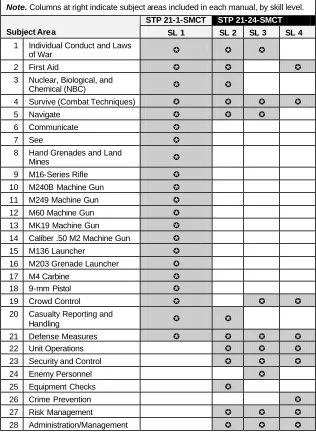
2-2. SUBJECT AREA CODES .
Below is a list of subject areas contained in this STP. Table 2-1
shows the relationship of subject areas between this STP and STP 21-1-SMCT.
Skill Level 2
1 Individual Conduct and Laws of War 2 First Aid
3 Nuclear, Biological, and Chemical (NBC) 4 Survive (Combat Techniques)
5 Navigate
20 Casualty Reporting and Handling 21 Defense Measures
22 Unit Operations 23 Security and Control 25 Equipment Checks 27 Risk Management
28 Administration/Management
Skill Level 3
1 Individual Conduct and Laws of War 4 Survive (Combat Techniques) 5 Navigate
2-22
22 Unit Operations 23 Security and Control 24 Enemy Personnel 27 Risk Management
28 Administration/Management
Skill Level 4
2 First Aid
4 Survive (Combat Techniques) 19 Crowd Control
21 Defense Measures 22 Unit Operations 23 Security and Control 26 Crime Prevention 27 Risk Management
2-23
Table 2-1. Subject Areas in the Soldiers Manuals of Common Tasks
Note. Columns at right indicate subject areas included in each manual, by skill level.
STP 21-1-SMCT STP 21-24-SMCT
Subject Area SL 1 SL 2 SL 3 SL 4
1 Individual Conduct and Laws
of War µ µ µ
2 First Aid µ µ µ
3 Nuclear, Biological, and
Chemical (NBC) µ µ
4 Survive (Combat Techniques) µ µ µ µ
5 Navigate µ µ µ
6 Communicate µ
7 See µ
8 Hand Grenades and Land
Mines µ
9 M16-Series Rifle µ
10 M240B Machine Gun µ
11 M249 Machine Gun µ
12 M60 Machine Gun µ
13 MK19 Machine Gun µ
14 Caliber .50 M2 Machine Gun µ
15 M136 Launcher µ
16 M203 Grenade Launcher µ
17 M4 Carbine µ
18 9-mm Pistol µ
19 Crowd Control µ µ µ
20 Casualty Reporting and
Handling µ µ
21 Defense Measures µ µ µ µ
22 Unit Operations µ µ µ
23 Security and Control µ µ µ
24 Enemy Personnel µ
25 Equipment Checks µ
26 Crime Prevention µ
27 Risk Management µ µ µ
Skill Level 2 181-101-2023 3-1
S
kill
L
evel
2
Chapter 3
Skill Levels 2, 3, and 4 Tasks
Skill Level 2
SUBJECT AREA 1: INDIVIDUAL CONDUCT AND LAWS OF WAR
181-101-2023
Enforce the Uniform Code of Military Justice (UCMJ)
Conditions: You are a noncommissioned officer (NCO) in a leadership pos ition in the U.S. Army. You are responsible for understanding that disciplinary action against a soldier for misconduct is a command responsibility. You are responsible for understanding the military justice system, including the Uniform Code of Military Justice (UCMJ) and disciplinary options available to a commander. You are responsible for identifying potential violations of the UCMJ and expeditiously reporting them to the appropriate authorities for investigation and processing.
Standards: Understood that disciplinary action against a soldier for misconduct was a command responsibility. Understood the military justice system, including the Uniform Code of Military Justice (UCMJ) and the disciplinary options available to a commander. Identified potential violations of the UCMJ and expeditiously reported them to the appropriate authorities for investigation and processing.
Performance Steps
1. Describe how disciplinary action against a soldier is a command responsibility.
2. Identify who has authority to take disciplinary action against a soldier for misconduct.
3. Describe a soldier's responsibility to identify potential or actual violations of the Uniform Code of Military Justice (UCMJ) and expeditiously report these violations to the appropriate authorities for investigation and processing.
4. Describe a commander's responsibility to conduct a preliminary investigation into misconduct allegedly committed by a soldier under his command.
a. Describe the basis and procedures of a commander's inquiry.
3-2 181-101-2023 Skill Level 2
S
kill
L
evel
2
Performance Steps
c. Describe the requirement for the military police or Criminal Investigation Division (CID) to conduct a criminal investigation.
5. List the disciplinary options available to the commander.
a. Describe how a commander can take no action at all or close a case.
b. Describe how a commander can use administrative or nonpunitive measures.
(1) List administrative or nonpunitive disciplinary measures available to a commander.
(2) Describe why a commander would wish to use nonpunitive or administrative disciplinary measures rather than impose nonjudicial punishment or proceed to court-martial.
(3) Describe how an NCO leader may be involved in the imposition of nonpunitive or administrative disciplinary measures (such as counseling or corrective training) to a subordinate soldier.
c. Describe how a commander can use nonjudicial punishment.
(1) Define nonjudicial punishment.
(2) List the different types of nonjudicial punishment.
(3) Describe nonjudicial punishment procedures.
(4) Describe a soldier's legal rights during nonjudicial punishment procedures.
(5) List the maximum punishment available under nonjudicial punishment.
(6) Describe a soldier's appellate rights under nonjudicial punishment.
d. Describe how a commander can use judicial punishment.
(1) Define judicial punishment.
(2) List the different types of court-martial in the military justice system.
(3) Describe judicial or court-martial procedures.
(4) Describe a soldier's legal rights during judicial or court-martial punishment.
(5) List the maximum punishment available under judicial or court-martial punishment.
Skill Level 2 181-101-2023 3-3
S
kill
L
evel 2
Performance Steps
6. List factors a commander should consider when determining what disciplinary option to pursue.
a. Describe whether a commander should consider the character and military service of the accused.
b. Describe whether a commander should consider the nature and circumstances of the offense and the extent of the harm caused.
c. Describe whether a commander should consider the needs of the Service and the probable effect of his or her decision on the command and the military community.
d. Describe whether a commander should consider the disposition of similar offenses in the past and the general disciplinary trends within the command.
e. Describe whether a commander should consider the appropriateness of the authorized punishment to the particular accused and offense.
f. Describe whether a commander should determine whether he has jurisdiction over the accused and the offense.
g. Describe whether a commander should consider the availability and admissibility of evidence against the accused.
h. Describe whether a commander should consider the cooperation of the accused in the apprehension or conviction of others.
i. Describe whether a commander should consider the possible improper motives of the accuser.
j. Describe whether a commander should consider that the victim or others are reluctant to testify.
7. Describe the permissibility of a commander discussing and gaining input from an NCO leader regarding which disciplinary option to pursue against a subordinate soldier within the unit.
8. Describe the authority of an NCO to issue a lawful order to a subordinate soldier.
a. Describe the duty of a subordinate soldier to follow this order.
b. Describe the potential adverse ramifications for a soldier violating this order.
3-4 181-101-2023 Skill Level 2
S
kill
L
evel
2
Evaluation Preparation:
Setup: Evaluate this task at the end of military justice training.
Brief Soldier: Tell the soldier that he will be evaluated on his ability to understand that disciplinary action against a soldier for misconduct is a command responsibility. Tell the soldier that he will also be evaluated on his ability to understand the military justice system, including the UCMJ; the disciplinary options available to a commander; and the ability to identify potential violations of the UCMJ and expeditiously report them to the appropriate authorities for investigation and processing.
Performance Measures GO NO GO
1. Described how disciplinary action against a soldier
is a command responsibility. —— ——
2. Identified who has authority to take disciplinary
action against a soldier for misconduct. —— ——
3. Described a soldier's responsibility to identify potential or actual violations of the UCMJ and
expeditiously report these violations to the appropriate authorities for investigation and processing.
—— ——
4. Described a commander's responsibility to conduct a preliminary investigation into misconduct allegedly committed by a soldier under his or her command.
—— ——
a. Described the basis and procedures of a commander's inquiry.
b. Described the basis and procedures of an AR 15-6 investigation.
c. Described the requirement for the military police or CID to conduct a criminal investigation.
5. Listed disciplinary options available to the
commander. —— ——
a. Described how a commander can take no action at all or close a case.
b. Described how a commander can use administrative or nonpunitive measures.
(1) Listed administrative or nonpunitive disciplinary measures available to a commander.
(2) Described why a commander would wish to use nonpunitive or administrative disciplinary measures rather than impose nonjudicial punishment or proceed to court-martial.
Skill Level 2 181-101-2023 3-5
S
kill
L
evel 2
Performance Measures GO NO GO
(3) Described how an NCO leader may be involved in the imposition of nonpunitive or administrative disciplinary measures, such as counseling or corrective training, to a subordinate soldier.
c. Described how a commander can use nonjudicial punishment.
(1) Defined nonjudicial punishment.
(2) Listed the different types of nonjudicial punishment.
(3) Described nonjudicial punishment procedures.
(4) Described a soldier's legal rights during nonjudicial punishment procedures.
(5) Listed the maximum punishment available under nonjudicial punishment.
(6) Described a soldier's appellate rights under nonjudicial punishment.
d. Described how a commander can use judicial punishment.
(1) Defined judicial punishment.
(2) Listed the different types of court-martial in the military justice system.
(3) Described judicial or court-martial procedures.
(4) Described a soldier's legal rights during judicial or court-martial punishment.
(5) Listed the maximum punishment available under judicial or court-martial punishment.
(6) Described a soldier's appellate rights under judicial or court-martial punishment.
6. Listed factors a commander should consider when
determining what disciplinary option to pursue. —— ——
a. Described whether a commander should consider the character and military service of the accused.
3-6 181-101-2023 Skill Level 2 S kill L evel 2
Performance Measures GO NO GO
b. Described whether a commander should consider the nature and circumstances of the offense and the extent of the harm caused.
c. Described whether a commander should consider the needs of the Service and the probable effect of his or her decision on the command and the military community.
d. Described whether a commander should consider the disposition of similar offenses in the past and the general disciplinary trends within the command.
e. Described whether a commander should consider the appropriateness of the authorized punishment to the particular accused and offense.
f. Described whether a commander should determine whether he has jurisdiction over the accused and the offense.
g. Described whether a commander should consider the availability and admissibility of evidence against the accused.
h. Described whether a commander should consider the cooperation of the accused in the apprehension or conviction of others.
i. Described whether a commander should consider the possible improper motives of the accuser.
j. Described whether a commander should consider that the victim or others are reluctant to testify.
7. Described the permissibility of a commander discussing and gaining input from an NCO leader regarding which disciplinary option to pursue against a subordinate soldier within the unit.
—— ——
8. Described the authority of an NCO to issue a lawful
order to a subordinate soldier. —— ——
a. Described the duty of a subordinate soldier to follow this order.
b. Described the potential adverse ramifications for a soldier violating this order.
c. Described the elements and maximum punishments available under Article 91, UCMJ.
Skill Level 2 181-105-2001 3-7
S
kill
L
evel 2
Evaluation Guidance: Score the soldier GO if all performance measures are passed. Score the soldier NO GO if any performance measure is failed. If the soldier scores NO GO, show him what was done wrong and how to do it correctly.
181-105-2001
Enforce the Law of War and the Geneva and Hague Conventions
Conditions: You are a soldier in the U.S. Army. As a soldier, you are responsible for identifying, understanding, and complying with the provisions of the Law of War, including the Geneva and Hague conventions. You are also responsible for identifying and notifying the appropriate authorities of any suspected or known violations of the Law of War. The appropriate authorities, including your chain of command, must enforce the provisions of the Law of War, including the Geneva and Hague conventions.
Standards: Identified, understood, and complied with the Law of War. Identified problems or situations that violated the policies and took
appropriate action, including notifying appropriate authorities, so expedient action could be taken to correct the problem or situation.
Performance Steps
1. Identify the key violations of the Law of War.
a. Define what is a Law of War violation.
b. Identify the two general types of war crimes.
c. Define what constitutes a grave breach and give examples .
d. Describe what obligations exist if there is a grave breach.
e. Define what constitutes an other than grave breach or a simple breach and give examples .
f. Describe what obligations exist if there is a simple breach.
2. Describe the responsibilities of U.S. soldiers to obey the Law of War.
a. Describe how U.S. soldiers are bound to obey all the rules of the Customary Law of War and the Hague and Geneva Conventions .
b. Describe how U.S. soldiers may be court-martialed for violating these rules.
c. Describe how U.S. soldiers may also be prosecuted for committing a war crime.
3-8 181-105-2001 Skill Level 2
S
kill
L
evel
2
Performance Steps
a. Describe how the legal responsibility for the commission of a war crime can be placed on the commander as well as the subordinate who actually commits the war crime.
b. Describe the circumstances under which a commander may be prosecuted for the commission of a war crime.
4. Describe a criminal order and a soldier's responsibility toward a criminal order.
a. Describe the applicability of a soldier asserting the defense of "obeying a superior order" for the commission of a war crime.
b. Describe whether a subordinate soldier, who actually commits a war crime, is excused from prosecution if the commander is charged with the commission of the war crime.
c. Describe the responsibility of a soldier to disobey any order that requires the soldier to commit criminal acts in violation of the Law of War.
d. Describe the responsibility of a soldier to obey the rules of engagement and the potential consequences for violating the rules of engagement.
e. Describe the responsibility of the soldier to ask a superior for clarification of an order presumed to be criminal or illegal.
5. Identify the key requirements in processing violations of the Law of War.
a. Describe what actions are required when a Law of War violation is suspected.
b. Describe what your combatant commander-in-chief's (CINC) guidance is.
c. Describe the requirement to report suspected violations of the Law of War.
d. Describe the obligations of the investigative team.
(1) Describe who appoints the investigating officer(s).
(2) Describe the qualifications of the investigating officer(s).
(3) Describe the importance of timely collection of inform ation/evidence.
(4) Describe the Initial Report format.
Evaluation Preparation:
Skill Level 2 181-105-2001 3-9
S
kill
L
evel 2
Brief Soldier: Tell the soldier that he will be evaluated on his ability to identify, understand, and comply with the Law of War, including the Geneva and Hague conventions. Tell the soldier that he will also be evaluated on his ability to identify problems or situations that violate the Law of War and take appropriate action, including notifying appropriate authorities of actual or suspected violations, so expedient action may be taken to correct the problem or situation.
Performance Measures GO NO GO
1. Identified the key violations of the Law of War.
—— ——
a. Defined a Law of War violation.
b. Identified the two general types of war crimes.
c. Defined what constitutes a grave breach and gave examples .
d. Described what obligations exist if there is a grave breach.
e. Defined what constitutes an other than grave breach or a simple breach, and gave examples .
f. Described what obligations exist if there is a s imple breach.
2. Described the responsibilities of U.S. soldiers to
obey the Law of War. —— ——
a. Described how U.S. soldiers are bound to obey all the rules of the Customary Law of War and the Hague and Geneva Conventions.
b. Described how U.S. soldiers may be court-martialed for violating these rules.
c. Described how U.S. soldiers may also be pros ecuted for committing a war crime.
3. Described the responsibilities of the commander in
regard to violations of the Law of War. —— ——
a. Described how the legal responsibility for the commission of a war crime can be placed on the commander as well as the subordinate who actually commits the war crime.
b. Described the circumstances under which a commander may be prosecuted for the commission of a war crime.
3-10 181-105-2001 Skill Level 2
S
kill
L
evel
2
Performance Measures GO NO GO
4. Described a criminal order and a soldier's
responsibility toward a criminal order. —— ——
a. Described the applicability of a soldier asserting the defense of "obeying a superior order" for the commission of a war crime.
b. Described whether a subordinate soldier, who actually commits a war crime, is excused from prosecution if the commander is charged with the commission of the war crime.
c. Described the responsibility of a soldier to disobey any order that requires the soldier to commit criminal acts in violation of the Law of War.
d. Described the responsibility of a soldier to obey the rules of engagement and the potential
consequences for violating the rules of engagement.
e. Described the responsibility of the soldier to ask a superior for clarification of an order presumed to be criminal or illegal.
5. Identified the key requirements in processing
violations of the Law of War. —— ——