Abstract—Oil and Gas operations require the maintenance of large inventory of spares, equipment and materials all referred to in this work as assets. The differences in the arrival time and the fact that the receiving personnel may be different from the personnel that ordered the items and also different from the personnel that may eventually check out the items from the warehouse makes it necessary to have an automated system for monitoring the inventory. The large number of inventories maintained by the oil and gas process and the multiplicity of teams increases the risk of loss of items due to unauthorized release of items from the warehouse and the challenges of managing inventory movement. This system presents the development of an RFID based real-time inventory tracking system which makes it mandatory for the suppliers to embed all supplied items with RFID Tags. The warehouse is to have RFID readers installed in each section and also at all entrance and exit points. The system logs personnel access and movement within the warehouse and it is also able to track items wrongly placed in the warehouse. It monitors the entire asset and reports the movement of each asset to the team leads and Managers of the team that made the item procurement. The system maintains a database of all items in the warehouse and is capable of generating reports of the entire inventory and their history. The system also integrates a reader at the main exist gates of the premises. For an item to exit the company premises, the supervising manager will be required to give a final approval by email to enable the item exit the company premises. This system will minimize the risks associated with illegal removal of items from the warehouse as the movement of the items is tracked in real-time, the access control monitors the staff access into the warehouse and matches it with the item movement out of the warehouse. Managers are aware of the item’s movement from the warehouse and in the event of item leaving the warehouse without authorization and without any record of its exit being approved by the required manager, a watch list is created at the security post to check for such items in the event that the RFID tags have been removed. This system will enable a more robust asset management process for oil and gas inventories and minimize the risks associated with unauthorized removal of inventory from the warehouse.
Index Terms—Active Tag, Asset Tracking, Inventory
Management, Mobile device, Mobile RFID reader.
Manuscript received March 29, 2017; revised July 04, 2017. This work was supported by Covenant University
Francis E Idachaba is currently an Associate Professor of Communication Engineering in the department of Electrical and Information Engineering in Covenant University Ota Ogun State
e-mail: [email protected]
I. INTRODUCTION
NVENTORY usually accounts for the largest expenditure in most operations expenses. This makes effective inventory control and management a vital function to help insure the continued success of operations and the projects. The effectiveness of inventory control is typically measured by how successful a company is at reducing inventory investment, meeting its customer service goals, and achieving maximum throughput and cost containment [1].Inventory can also be defined as items required in the manufacturing process and due to the need to eliminate delays associated with the procurement process, they are kept for future use.
Typical inventories include
1. Materials stock (raw materials, components) 2. Work-in-progress stock
3. Finished products stock
4. Spare parts and auxiliary materials stock Procedure for Paper Submission
II. INVENTORYMANAGEMENT
Effective inventory control and management is rooted in three distinct but interconnected processes [1] [3]. These processes are
1. Physical: This is the most visible and critical part of the inventory management process. It includes activities such as receiving, movement, stocking, and overall physical control of inventories. For large companies with several teams, these activities continue all year round with different teams placing orders and receiving delivery of their items all year round. Barcoding stock keeping units (SKUs), consigning, and kit repackaging are notable aspects of physical inventory control. Another daily responsibility of physical control is data entry. Physical Inventory control ensures that all items that either enter or leave the inventory system are tracked and all the required paperwork are filled out each day and are tracked using the company’s ERP system. 2. Planning: Inventory planning complements the physical inventory control in that it emphasizes a systematic management of the inventory acquisition process. Inventory planning and ordering relies upon various methodologies that in turn depend upon varying rates of demand. Thus companies commonly utilize material requirements planning (MRP) in high sales volume scenarios or kanban in a lean, just-in-time (JIT) environment. JIT systems base purchases of new stock upon customer demand as it happens. Whether stock is ordered for regular arrival by the truckload or by
RFID Applications for Asset Monitoring and
Multi-Level Asset Tracking
Francis E. Idachaba
irregular special deliveries, systematic, preplanned approaches to replenishing inventory involve information relevant to sales, finance, purchasing, possibly production, and shipping and receiving. The interplay of this information through an ERP system undergirds greater efficiency [1] [3].
3. Optimization: Inventory Optimization processes are required to ensure that stock outages are reduced to the barest minimum or eliminated totally. The Optimization processes are used to mathematically calculate where and when inventory should be deployed to satisfy predetermined management objectives. They’re designed to better classify stocking levels (buffer, replenishment, overage) based upon an analysis of past demand, augment supplier management based upon past supplier performance, and improve demand forecasting [1] [3].
III. KEYCHALLENGESWITHINVENTORY MANAGEMENT
Some key challenges companies face in Inventory management include
1. Having too much of some products especially if the demand for such products or spares are not critical or urgent.
2. Having too little products or spares urgently needed for critical repairs or projects
3. Lack of information of the available items in the warehouse thus leading to the purchase of more of the same items and tying down the budget.
4. Inability to track items and their locations in the warehouse. This leads to delays with project execution and in some cases poor handling of some specific items can result in the damage of these items. A typical example includes items with different IP classifications being stored in the same location. This will expose the item not suitable for that location to the hazard of the location.
5. Loss of inventory due to stealing and a lack of asset monitoring and tracking system
Effective inventory management requires a systematic plan to achieve effective inventory management (EIM). [2][4]. EIM includes
1. Knowing what products are available and the quantity of each
2. Knowing exactly where each piece of each product is located in your warehouse
3. Ensuring that all inventory remains in salable or usable condition
4 Storing products to minimize the cost of filling customer orders
IV. INVENTORYMANAGEMENTONTHEOILAND GASBUSINESS
The Oil and Gas business maintains a large inventory of materials, spares and consumables and this requires an automated system for the management and monitoring of these items. Different teams in the company place orders for items using the available ERP software. These items are usually sourced from different manufactures located all over
the world with and the all have different lead times. Oil and Gas companies are forced to keep a larger safety stock to prevent a shutdown of operations in case of a disruption in the supply chain. [5][6]
V. RFID BASED REAL-TIME INVENTORY TRACKING AND MONITORING SYSTEMS FOR OIL
AND GAS SUPPLY CHAIN MANAGEMENT Radio Frequency Identification (RFID) is a method of identification using radio waves. RFID systems are made up of three components: readers (interrogators), antennas and tags (transponders) that carry the data on a microchip. RFID is a technology suitable for collecting data on items for tracking and counting purposes. RFID systems consist of small transponders, or tags, attached to physical objects. When wirelessly interrogated by RFID transceivers, or readers, tags respond with some identifying information that may be associated with arbitrary data records. RFID systems can thus be classified as a type of automatic identification system. Figure 1 shows a typical RFID configuration.
E
th
e
rn
e
t
RFID Reader
RFID Tag RF Antenna Network Workstation
Fig. 1. RFID System configurations
RFID tags are further broken down into two categories: 1. Active RFID Tags: These are battery powered tags. They are capable of broadcasting signals to the reader and can transmit over the greatest distances (100+ feet). The cost more than the passive tags and are used to track high value goods.
Table 1 show the classification of RFID systems by frequency, range and application.
TABLE I Classification of RFID systems
Type Frequenc
y
Distanc e
Example Application Low
Frequency
125kHz Few cm Auto immobilizer
High Frequency
13.56MHz 1m Building Access
Ultrahigh Frequency
900MHz 7m Supply chain
Microwave 2.4GHz 10m Traffic Toll
VI. READER
[image:3.595.61.531.51.235.2]Readers, also known as interrogators are complementary to tags. A reader sends a pulse of energy to the tag and listens for the tag’s response. The tag detects this energy and sends back a response that contains the tag’s serial number and possibly additional information. [7] In simple RFID systems, the reader’s energy pulse functions like an on/off switch. In more sophisticated systems, the reader’s radio-frequency signal can contain commands to the tag, instructions to read or write tag memory, and even passwords. The reader can be configured to emit signals continuously such that it is always searching for the presence of tags. It can also be configured to be activated by an operator or an external even so as to minimize power consumption and interferences. Readers are designed in various sizes depending on the application. The can also be fixed or handheld and can embed GPS capabilities and connectivity to information systems and networks. The cost varies from USD 100 to USD 1 000 for readers of passive tags to USD 1 000 to USD 3 000 or more for readers that communicate with active tags over long distances [7] Figure 2 shows a typical reader
Fig. 2. RFID Reader
VII. DEVELOPMENTOFTHERFIDBASED REAL-TIMEINVENTORYTRACKINGSYSTEM The RFID based system is designed to include the following. Active tags embedded on the items by the Original Equipment Manufacturers (OEM). Readers are installed either at the different sections of the warehouse (for very large warehouses) or at the entrance and exit of the warehouse for small warehouses with separate entrance and exit points. The schematic diagram for the system is shown in Figure 3
Main gate Overhead
Reader
Handheld Reader Reader Reader
Reader Reader
Read
er
RFID Middleware
Internal Storage
CRM
EPC Applications Network
Warehouse Compartments Equipment
with Tags
Fig. 3. System Schematic diagram
A. Asset Tagging
1.All items procured from the OEMs are to be tagged with active RFID tags and the tags are to be fitted on the items using an epoxy based seal and adhesive. This is to ensure that the tags cannot be removed easily
2.All the storerooms and sections in the warehouse are to be fitted with RFID readers at each entrance
3.When an item is purchased, the tag details are submitted to the company by the OEM and this is used to update the inventory records.
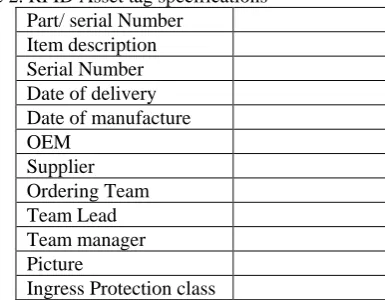
[image:3.595.326.519.429.579.2]The details to be supplied by the equipment supplier for the asset tagging is listed in table 2.
Table 2. RFID Asset tag specifications Part/ serial Number
Item description Serial Number Date of delivery Date of manufacture OEM
Supplier Ordering Team Team Lead Team manager Picture
Ingress Protection class
The details on the tags comprise of the item description, the OEM, the supplier details and also the team within the company that made the procurement. The section of the team lead and the team manager are active fields which are updated automatically to cater for any changes in the team leadership. The data also enable the security team to be able to identify the tool when they see it at the gates in the event that it is being removed without authorization
B. Asset Monitoring
The development protocol for the RFID based inventory tracking system is listed below
[image:3.595.46.198.515.595.2]manager that the store is yet to receive the items delivered.
2.In the event that the company representative decides to connive with the contractor to take the items outside the company without delivering to the company warehouse, the overhead reader installed at the company gates will pick the items as items ordered and yet to be checked into the store/ warehouse
3.Before any item is checked out of the store, a request for that item is sent to the managers and when approval is given, the item is tagged as approved for release 4.When the tagged item is being removed from the store,
the system keeps a record of the ID of the staff and the item being taken out. This is done for record purposes 5.If an item without approval for release is taken from the
store, an alert showing the ID number of the ID card used to open the store and the item details are sent to the manager of the team that purchased the item and another alert is sent to the security team at the main gates of the company premises.
6.Hand held readers are used at the gate to scan items and equipment as they are taken from the premises. Any item being taken without authorization or approval from the relevant parties will be stopped and the reader will show the details of the manager of the team that made the procurement
C. Multi-Level Asset Tracking
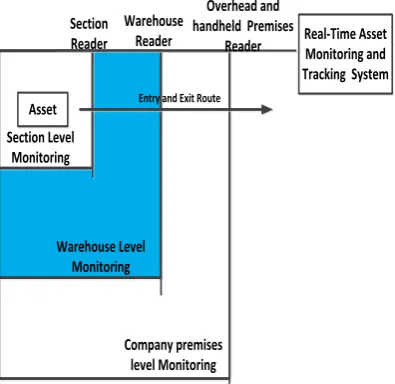
The system enables a feature called multi-level Asset tracking. Under this system, items are tracked as soon as they are taken from their section in the warehouse. Item shifted and placed wrongly or removed from the original locations can be located using the search function at the database system. In the event that an item is moved, the system logs the user ID of the staff whose ID card is used to access the section and the asset is tracked as it moves out of the ware house. In the event that there is no authorization for the asset to be moved by the approving manager, the item is flagged at the security post as soon as it leaves the warehouse. With this system, the security personnel are placed on alert to search for the item as vehicles pass through the gate. The schematic diagram for the multilevel asset tracking system is shown in figure 4.
Section Level Monitoring
Asset
Warehouse Level Monitoring
Company premises level Monitoring
Real-Time Asset Monitoring and Tracking System Section
Reader
Warehouse Reader
Overhead and handheld Premises
Reader
Entry and Exit Route
[image:4.595.307.525.223.450.2]
Figure 4: Multilevel Asset Tracking schematic diagram
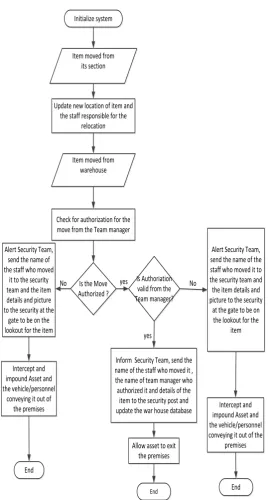
The flowchart for the Multilevel Asset tracking Scheme is implemented at the real time asset monitoring and tracking system control centre. This system receives alert from all the readers notifying it of the movement of the assets within and without the warehouse. The network diagram of the system is shown in figure 5. The section readers are Wi-Fi enabled such that they are able to transmit wirelessly to the access point as shown in figure 5. The Real-time Asset Monitoring and tracking system controls the entire system and is connected to the company IT infrastructure as it is designed to be able to send and receive authorization alerts from the team manager, and also send notifications to the security center.
Section reader
Section reader Section reader
Section reader
Access point
Warehouse reader
database
Security center Real-Time Asset Monitoring and Tracking System Section
reader
Section reader Section reader
[image:4.595.69.267.579.771.2]Company IT Network
Figure 5. System Network diagram
D. System Flowchart
The flowchart for implementing the multilevel asset tracking is shown in figure 6.
VIII. DISCUSSION
This system provides an opportunity for real time monitoring and tracking of items procured for company business. It ensures that the items, when delivered are carefully monitored and tracked to minimize the cases of these items being stolen from the warehouses. The system also ensures that items are not just delivered and dumped without being adequately received and warehoused. It ensures that the approving manager takes full responsibility of the items ordered by his team and provides him with an opportunity to monitor the activities of his subordinates in the procurement and management of company inventories.
IX. CONCLUSION
to a very large extent, the occurrences of stolen inventory and will also discourage company staff from attempting to connive with contractors to sell off or not deliver items already procured by the company. This work will contribute to the cost saving strategies which the oil and gas companies need in this era of low oil prices.
REFERENCES
[1] Better Inventory Management: Big Challenges, Big Data, Emerging Solutions ,2013.
[2] Schreibfeder J. The First Steps to Achieving Effective Inventory Control. Microsoft Dynamics
[3] Vrat P, Materials Management, Springer Texts in Business and Economics, Springer, 2014.
[4] Heck G.V Inventory Management Introducing A Framework To Assess Operational Performance Master Thesis – Systems Engineering, Policy Analysis and Management. Delft University of Technology, 2009.
[5] Herrera C. I, Outsourcing Logistics in the Oil And Gas Industry. Honors and Undergraduate Research Texas A&M University, 2012. [6] Binlootah. A and Sundarakani .B, Vendor Managed Inventory
Application in Oil and Gas Industry. Proceedings of the 2012 International Conference on Industrial Engineering and Operations Management Istanbul, Turkey, July 3 – 6, 2012.
[7] RFID. Radio Frequency Identification. OECD Policy guidance. A Focus on Information Security and Privacy Applications, Impacts and Country Initiatives. OECD Ministerial Meeting on the Future of the Internet Economy, 2008.
Update new location of item and the staff responsible for the
relocation
Check for authorization for the move from the Team manager
Is the Move Authorized ? Item moved from
its section
Item moved from warehouse
Alert Security Team, send the name of the staff who moved it to the security team and the item details and picture to the security
at the gate to be on the lookout for the
item Initialize system
yes Is Authoriation valid from the Team manager?
No
Inform Security Team, send the name of the staff who moved it , the name of team manager who authorized it and details of the
item to the security post and update the war house database Alert Security Team,
send the name of the staff who moved
it to the security team and the item details and picture to the security at the
gate to be on the lookout for the item
No
Intercept and impound Asset and the vehicle/personnel
conveying it out of the premises
End
yes
Intercept and impound Asset and the vehicle/personnel conveying it out of the
premises
End Allow asset to exit
the premises
[image:5.595.164.433.230.731.2]End