Expanded Trigonometrically Matched Block
Variable-Step-Size Technics for Computing
Oscillating Vibrations
J. G. Oghonyon, Member, IAENG, S. A. Okunuga, H. I. Okagbue
Abstract-The expanded trigonometrically matched block variable-step-size technics for computing oscillatory vibrations are considered. The combination of both is of import for determining a suited step-size and yielding better error estimates. Versatile schemes to approximate the error procedure bank on the choice of block variable-step-size technics. This field of study employs an expanded trigonometrically matched block variable-step-size-technics for computing oscillating vibrations. This expanded trigonometrically matched is interpolated and collocated at some selected grid points to form the system of equations and simplifying as well as subbing the unknowns values into the expanded trigonometrically matched will produce continuous block variable-step-size technic. Valuating the continuous block variable-step size technics at solution points of
will lead to the block variable-step-size
technics. Moreover, this operation will give rise to the principal local truncation error (PLTE) of the block variable-step-size technics after showing the order of the method. Numeral final results demonstrate that the expanded trigonometrically matched block variable-step-size technics are more efficient and execute better than existent methods in terms of the maximum errors at all examined convergence criteria. In addition, this is the direct consequence of designing a suited step-size to fit the acknowledged frequence thereby bettering the block variable-step-size with controlled errors.
Index Terms- block variable-step-size technics, convergence criteria, expanded trigonometrically matched, maximum errors, principal local truncation error.
Manuscript submitted June 22, 2017; revised for submission July 20, 2017. This work was supported by Covenant University Centre for Research, Innovation and Discovery (CUCRID), Ota, Ogun State, Nigeria.
J. G. Oghonyon, Department of Mathematics, College of Science and Technology, Covenant University, P.M.B. 1023, Ota, Ogun State, Nigeria (corresponding author phone no.: +234-8139724200; [email protected]).
S. A. Okunuga, Department of Mathematics, Faculty of Science, University of Lagos, Yaba, Akoka, Lagos State ([email protected]). H. I. Okagbue, Department of Mathematics, College of Science and Technology, Covenant University, P.M.B. 1023, Ota, Ogun State, Nigeria ( [email protected]).
I. INTRODUCTION
The expanded trigonometrically matched is one of the most utile process for formulating the block variable-step-size technics thereby estimating the solution of oscillating vibrations. Particularly, if the final result displays periodical or oscillating vibrations, trigonometrically matched methods are more effectual than non-matched methods as discoursed in [24].
Block variable-step-size technics is very pregnant for the purport of ascertaining a suited step-size. See [3]. This paper is concerned with gauging the solution of oscillating problems of the form [2], [17],
for
(1)
where , is an whole number and is the attribute of the physical system.
It is take for granted that
f
R
is differentiable to a sufficient degree on and gratifies a planetary Lipchitz stipulation, i.e., there is an invariable such that .Under this effrontery, par (1) ascertained the cosmos and singularity fixed on
x
[
a
,
b
]
likewise looked at to meet the Weierstrass theorem, see for instance [7], [9], [26] for inside information.Mostly, oscillatory vibrations oftentimes originate in fields of scientific discipline and applied science such as Newtonian mechanics, astronomy, quantum physics, control theory, electric circuit theory and biologies. Diverse numeral methods established on the usage of multinomial expression have been formulated for working out this family of all important problems. Distinct methods founded on trigonometrically matched techniques which possess the vantage of the especial properties of the solution that may be recognized beforehand have been existing in literature. Check [2], [14]-[18], [21]-25]
for more data. Notwithstanding, block hybrid
[21]-[25] for more info. These methods possesses some additions as well as their gaps. More also, their implementation is done using fixed step-size while the trigonometrically fitted predictor-corrector method is mainly employed for predicting and correcting apart from fixed step-size implementation. Consider [2], [14]-[18], [21]-[25] for more items. The motive regularizing the trigonometrically matched and block variable-step size technics are built-in the reality that whenever the frequence is recognized ahead, these methods becomes better than the multinomial founded methods as mentioned in [2], [14]-[18], [21]-[25]. Again, block variable-step-size technics is primarily design for varying the step-size, deciding the convergence criteria and control error. See [3]-[4], [9]-[10], [19]-[20], [27] for more particulars.
The main objective of this research work is to apply an expanded trigonometrically matched block variable-step-size technics for computing oscillating vibrations which accepts the frequence of the solution as an earlier noesis. This technic of proceeding in block variable-step-size technics comes with numerous vantage which includes designing a suited step-size, determining convergence criteria and error control. See [3]-[4], [9]-[10], [19]-[20] for more details. On the other hand, the expanded trigonometrically matched method own some benefits such as; ease computational difficulties, avoid time wasting and formulate block variable-step-size technics with better solutions. Block variable step size technic is Milne’s device for estimating ordinary differential equations which exclusively bank on some components. Milne’s device is viewed as an extensive aspect of the predictor-corrector method on account of the many computational gains. This include; convergence criteria, Adams type family, predictor-corrector formula pairs of like order, suited step size and principal local truncation error as cited in [3]-[4], [9]-[10], [19]-[20].
Definition- . If k denotes the
block size and h is the step size, then block size in time is . Let constitute the block number and let , then the , method can be scripted in the succeeding general class:
(2)
Where
and are constants matrices. See [6], [20]. Hence, starting at the supra explanation, a block method has the computational vantage that for each application program, the end product is measured at more than one point at the same time. The count of points relies on the structure of the block method. Thus, employing these methods can allow for more immediate and more immobile solutions to the problem which can be addressed to bring forth the sought after accuracy. Check [11]-[13], [19]-[20] for more info.
The residuary of this composition is studied as follows: in Part 2 Materials and Methods. Part 3 Numeric Results and Discussion. Part 4 Conclusion as mentioned [3], [19]-[20].
II. MATERIALS AND METHODS
In this part, the development of the block variable-step-size technics are carried out. This block variable-step-size technics can be of the form
, (3)
where , are invariables that count on the variable-step-size and frequence. Noting that is
the numeral estimate to the analytic solutions , and
having . To achieve par (3),
the trigonometrically matched method is rewritten as the expanded trigonometrically matched method which continues by looking to estimate the analytic solution on different time intervals of through the interpolating function
of the kind
. (4)
Rewriting par (4) give birth to the expanded
trigonometrically matched method as
, (5)
where and are constant quantity which must be ascertain in a unique manner. Assume the imposition that par (5) concurs with the analytic solution at the points
to get the par
, . (6) Necessitating that the function (5) meets the differential
coefficient par (1) at the points
to arrive at the succeeding pars
(7)
Combining Pars (6) and (7) will result to quintuple pars which gives rise to Ax=b. Solving the system of pars employing Mathematica 9 kernel 64 to find and replacing the values of into par (5) will produce the continuous block variable step size technics. Valuating the continuous block variable step size technics at some selected points of will produce the block variable step
size technics as
, (8)
where is the frequence, and are continuous invariables. Visit [14]-[18] for more info. Determining the convergence criteria of the block
variable-step-size technics- To establish the procedure of
(9) .
A corresponding analysis of the block Adams-Moulton brings about the principal local truncation error (10) ,
where and are autonomous of the step size h and act as the solution to the differential par meeting the initial precondition . Check out [3]-[4], [9]-[10], [19]-[20] for more particulars.
To go forward, the presumption for small measures of h is arrived at
,
and the potency of the block variable-step-size technics relies instantly on this presumption.
Simplifying further the pars (9) and (10) supra and omitting terms of degree , it poses no difficulty to arrive at the
calculation of the principal local truncation error of the block variable-step-size technics as
(11) .
Remarking the assertions that ,
and are called the predicted and corrected estimates which are given by the block variable-step-size technics of order p, while , and
is otherwise referred to as the principal local truncation error. and are the bounds of the convergence criteria or convergence criteria of the block variable-step-size technics.
However, the appraisal of the principal local truncation error (11) is expended to find out whether to consent the final results of the current step or to rebuild the step with a littler variable-step-size. The step is affirmed based on a try out as dictated by (11). Find out [3]-[4], [9]-[10], [19]-[20] for more items. Par (11) is the convergence criteria of the block variable-step-size technics, otherwise named Milne’s estimate for adjusting to convergence.
Moreover, par (11) finds out the convergence criteria of the method during the try out valuation. See [3]-[4], [9]-[10], [19]-[20]for details.
Stability analysis- To justifiably analyze the method for
stability, the block variable-step-size technics are anneal and
scripted as a block method constituted by the matrix finite difference par as seen [1], [8].
, (12)
where , , , .
The matrixes are k by k matrixes
having real entries, altho are k-vectors outlined supra.
Consequently [8]-[9], the boundary locus method is employed to ascertain the region of absolute stability of the block variable step size technics in order to find the roots of absolute stability. Thusly, replacing the try out par
and =
putting into the block (12) to have
(13)
Filling in
h
0
in (13), the roots of the deduced par will either be less than or equal to 1. Thence, explanation9 of absolutely stability is met.Furthermore, by [9], the boundary of the region of absolute stability can be got by subbing (3) into
(14)
and where , so after reduction in
agreement with valuating (14) among
[
0
0,
180
0]
.Therefore, the boundary of the region of absolute stability rests on the real axis as sited in [9].
Execution of block variable-step-size technics
Holding onto [3]-[4], [7], [9]-[10], [19]-[20], the execution of
block variable-step-size can be carried out in the
P
( )
EC
mand
P
( )
EC
mE
mode as it turns all-important for thepredictor and corrector methods, whenever both are of discrete like order. This touchstones establishes the important of the stepnumber of predictor method to be one step greater than that of the corrector method. So therefore, the mode
( )
EC
mP
orP
( )
EC
mE
can be represented in a formalmanner and examined to succeeds for
m
=
1
,
2
,...
:
( )
EC
mP
:z
z
f
mi n j i i m i n j i i j n
h
] 1 -[ 1 -0 ] [ 1 -0 ] 0 [∑
∑
,
)
,
(
≡
[ ] ] [z
x
f
s j n j n s jn
f
,
0
,
1
,...,
-
1
,
] 1 -[ 1 -0 ] [ ] [ 1 -0 ] 1 [∑
∑
m
s
h
h
f
f
z
z
nmij i i s j n j m i n j i i s j
n
(15)( )
E
P
EC
m :z
z
f
m
)
,
(
≡
[ ]] [
z
x
f
sj n j n s
j
n
f
,
0
,
1
,...,
-
1,
,
] [ 1
-0 ] [ ]
[ 1
-0 ] 1
[
∑
∑
m
s
h
h
f
f
z
z
nmij
i i
s
j n j m
i n j
i i s
j
n
)
,
(
≡
[ ]] [
z
x
f
mj n j n m
j
n
f
(16)Noting that as
m
→
∞
, the final result of approximating with either one of the above mode will gradient to those brought forth by the mode of adjusting to convergence.Encases, where are worked out error invariables
of the predictor-corrector method independently. The succeeding effect applies
Proposition- Imagine if the predictor method bears order
p
*and the corrector method holds order
p
be utilized in( )
EC
mP
andP
( )
EC
mE
mode, wherep
*,
p
,
m
arewhole numbers and
p
*
1
,
p
1
,
m
1
. Therefore: whenp
p
*≥
(
or
p
*<
p
withm
>
p
-
p
*)
, so then, the predictor-corrector method own like order and like PLTE as the corrector.If
p
*<
p
andm
=
p
-
p
*)
, so then, the predictor-corrector method own the like order as the predictor-corrector, but different PLTE.If
p
*<
p
andm
≤
p
-
p
*-
1
, so then thepredictor-corrector method own the like order equal to
p
*+
m
( thusless than
p
) as discussed in [9]-[10].III. NUMERIC RESULTS AND DISCUSSION In this part, the numeral final results shows the execution of the expanded trigonometrically matched block variable-step-size technics for computing oscillatory problems. The finish result furnished were obtained with the assistance of Mathematica 9 Kernel 64 on Microsoft windows (64-bit) to exemplify the accuracy and effectuality of the block variable-step-size technic. The terminology applied are named under: Numeric Tested Problems- Three numerical tested problems
were considered and worked out employing ETMBVSST at
respective convergence criteria of , , ,
and . Find [14]-[18] for more details. A computer
programming on block variable-step-size technics were
composed using Mathematica 9 kernel 64. This computer programming is implemented in a block by block manner together with the block variable step size technics.
Tested problem 1. Consider the inhomogeneous IVP:
, ,
, .
Analytical Solution:
Tested problem 2. Consider the nonlinear Duffing equation:
, , .
Analytical Solution:
,
where , , ,
, ,
and . Choose
.
Tested problem 3. Consider the harmonic oscillator with frequency and small perturbation .
, , ,
.
Analytical Solution: ,
where and .
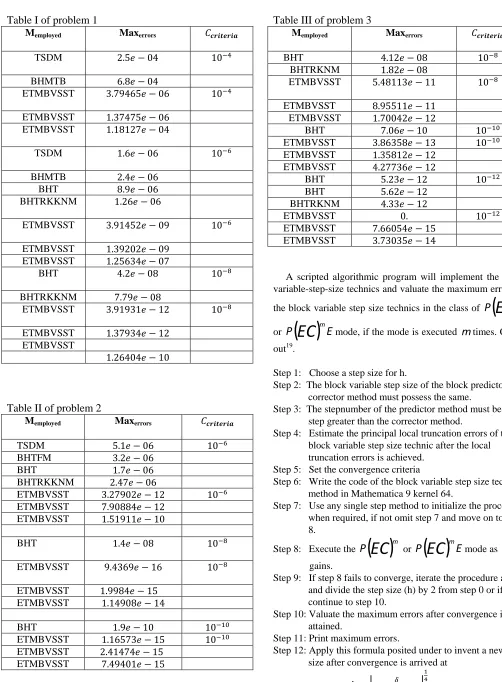
Table I, Table II and Table III demonstrates the numeral final results of problems 1, 2, and 3 applying ETMBVSST compared with existent methods.
ETMBVSST: errors in ETMBVSST (expanded
trigonometrically matched block variable-step-size technics) for numeric tested problems 1, 2 and 3.
BHMTB: errors in BHMTB (block hybrid method with trigonometric basis) for numeric tested problem 1. See [14].
BHTRKNM: errors in BHTRKNM (block hybrid
trigonometrically fitted Runge-Kutta-Nystrom method of
) for numeric tested problem 1, 2 and 3. See [18].
BHTFM: errors in BHTFM (block hybrid trigonometrically Fitted method) for numeric tested problem 2. See [15].
: convergence criteria.
Table I of problem 1
Memployed Maxerrors
TSDM
BHMTB
ETMBVSST
ETMBVSST
ETMBVSST
TSDM
BHMTB
BHT
BHTRKKNM
ETMBVSST
ETMBVSST
ETMBVSST
BHT
BHTRKKNM
ETMBVSST
ETMBVSST
ETMBVSST
[image:5.612.40.294.445.709.2]
Table II of problem 2
Memployed Maxerrors
TSDM
BHTFM
BHT
BHTRKKNM
ETMBVSST
ETMBVSST
ETMBVSST
BHT
ETMBVSST
ETMBVSST
ETMBVSST
BHT
ETMBVSST
ETMBVSST
ETMBVSST
Table III of problem 3
Memployed Maxerrors
BHT
BHTRKNM
ETMBVSST
ETMBVSST
ETMBVSST
BHT
ETMBVSST
ETMBVSST
ETMBVSST
BHT
BHT
BHTRKNM
ETMBVSST
ETMBVSST
ETMBVSST
A scripted algorithmic program will implement the block variable-step-size technics and valuate the maximum errors of
the block variable step size technics in the class of
P
( )
EC
mor
P
( )
EC
mE
mode, if the mode is executedm
times. Check out19.Step 1: Choose a step size for h.
Step 2: The block variable step size of the block predictor- corrector method must possess the same.
Step 3: The stepnumber of the predictor method must be one step greater than the corrector method.
Step 4: Estimate the principal local truncation errors of the block variable step size technic after the local truncation errors is achieved.
Step 5: Set the convergence criteria
Step 6: Write the code of the block variable step size technic method in Mathematica 9 kernel 64.
Step 7: Use any single step method to initialize the process when required, if not omit step 7 and move on to step 8.
Step 8: Execute the
P
( )
EC
m orP
( )
EC
mE
mode asm
gains.
Step 9: If step 8 fails to converge, iterate the procedure again and divide the step size (h) by 2 from step 0 or if not, continue to step 10.
Step 10: Valuate the maximum errors after convergence is attained.
Step 11: Print maximum errors.
Step 12: Apply this formula posited under to invent a new step size after convergence is arrived at
IV. CONCLUSION
Numeral final results have showed the ETMVSST is reached with the assistance of the convergence criteria. This convergence criteria settles whether the final result is admitted or reiterated. The final results besides prove the functioning of the ETMVSST is found out to provide a better maximum errors than the TSDM, BHMTM, BHT, BHTRKNM and BHTFM at all tested convergence criteria of , ,
, and as mentioned in [14]-[18]. Hence, it
can be resolved that the method formulated is worthy for solving oscillatory vibrations involving non-stiff and stiff ODEs. In addition, the ETMVSST is more beneficial likened to existent methods as stated supra for the reasons remarked antecedently. Future work will be to implement the block variable-step-size techniques on expanded exponentially fitted method.
ACKNOWLEDGEMENTS
The authors would like to appreciate Covenant University for providing financial backing through grants throughout the study period of time. Thanks to the anonymous reviewers for their continuous contribution.
REFERENCES
[1] A. O. Akinfenwa, S. N. Jator and N. M. Yao, “Continuous block Backward differentiation formula for solving stiff ordinary differential equations,” Computers and Mathematics with Applications, Vol. 65, No. 7, pp. 996-1005, April 2013. [2] R. D’Ambrosio, E. Esposito and B. Paternoster, “Exponentially
fitted two-step hybrid methods for y^''=f(x,y),” Journal of Computational and Applied Mathematics, Vol. 235, pp. 4888-4897, 2011.
[3] J. R. Dormand, “Numerical methods for differential equations,” A computational Approach, London, 1996.
[4] J. D. Faires and R.L. Burden, “Initial-value problems for ODEs,” 3rd Edition, Dublin City University, Brooks Cole, 2012. [5] E. Hairer and G. Wanner, Solving ordinary differential
equations II, Springer, New York, 1996.
[6] Z. B. Ibrahim, K.I. Othman and M. Suleiman, “Implicit r-point block backward differentiation formula for solving first-order stiff ODEs,” Applied Mathematics and Computation, Vol. 186, No. 1, pp. 558-565, March, 2007.
[7] M. R. Jain, S.R.K. Iyengar and R.K. Jain, “Numerical methods for scientific and engineering computation,” 5th Edition, New Delhi, India, 2007.
[8] Y. L. Ken, I. F. Ismail and M. Suleiman, “Block methods for special second order odes,” USA, 2011.
[9] J. D. Lambert, “Computational methods in ordinary differential equations,” New York, USA., 1973.
[10] J. D. Lambert, “Numerical methods for ordinary differential systems,” The Initial Value Problem. 1st Edn., John Wiley and Sons, New York, USA., 1991.
[11] Z. A. Majid and M. B. Suleiman, “Implementation of four-point fully implicit block method for solving ordinary differential equations,” Applied Mathematics and Computation, Vol. 184, No. 2, pp. 514-522, January, 2007.
[12] Z. A. Majid and M. Suleiman, “Parallel direct integration variable step block method for solving large system of higher
Order odes,” World Academy of Science, Engineering and Technology, Vol. 40, pp. 71-75, May, 2008.
[13] S. Mehrkanoon, Z. A. Majid and M. Suleiman, “A variable step implicit block multistep method for solving first-order ODEs,” Journal of Comp. and Appl. Math., Vol. 233, No. 9, pp. 2387-2394, March, 2010.
[14] F. F. Ngwane and S. N. Jator, Block hybrid method using trigonometric basis for initial value problems with oscillating solutions,” Numerical Algorithm, Vol. 63, pp. 713-725, October, 2012.
[15] F. F. Ngwane and S. N. Jator, “Solving oscillatory problems using a block hybrid trigonometrically fitted method with two off-step points,” Electronic Journal of Differential Equations, Conference on Differential Equations and Computational Simulations, Vol. 20, pp. 119-132, October, 2013.
[16] F. F. Ngwane and S. N. Jator, “Trigonometrically-fitted second derivative method for oscillatory problems,” SpringerPlus, Vol. 3, No. 1, pp. 1-11, June, 2014.
[17] F. F. Ngwane and S. N. Jator, “Solving the telegraph and oscillatory differential equations by a block hybrid trigonometrically fitted algorithm,” Hindawi Publishing Corporation, Vol. 2015, pp. 1-15, October 2015.
[18] F. F. Ngwane and S. N. Jator, “A trigonometrically fitted block method for solving oscillatory second-order initial value problems and Hamiltonian systems,” Hindawi Publishing Corporation, Vol. 2017, pp. 1-14, January 2017.
[19] J. G. Oghonyon, S. A. Okunuga and S.A. Iyase, “Milne’s implementation on block predictor-corrector methods,” Journal of Applied Sciences, Vol. 16, No. 5, pp. 236-241, April 2016. [20] J. G. Oghonyon, S. A. Okunuga and S. A. Bishop, “A
variable-step-size block predictor-corrector method for ODEs,” Asian Journal of Applied Sciences,” Vol. 10, No. 2, pp. 96-101, March 2017.
[21] G. Psihoyios and T. E. Simos, “Trigonometrically fitted predictor- corrector methods for IVPs with oscillatory solutions, “Journal of Computational and Applied Mathematics, Vol. 158, pp. 135-144, January 2003.
[22] G. Psihoyios and T. E. Simos “A fourth algebraic order trigonometrically fitted predictor-corrector scheme for IVPs with oscillating solutions,”Journal of Computational and Applied Mathematics,” Vol. 175, pp. 137-147, February 2004. [23] G. Psihoyios and T. E. Simos, “A new trigonometrically-fitted
sixth algebraic order P-C algorithm for the numerical solution of the radial Schrodinger equation,” Mathematical and Computer Modelling, Vol. 42, pp. 887-902, 2005.
[24] H. Ramo and J. Vigo-Aguiar, “On the frequency choice in trigonometrically fitted methods,”Applied Mathematics Letters, Vol. 23, pp. 1378-1381, 2010.
[25] T. E. Simos, “Dissipative Trigonometrically-fitted methods for linear second-order IVPs with oscillatory solution,”Applied Mathematics Letters, Vol. 17, pp. 601-607, 2010.
[26] L. Xie and H. Tian, “Continuous parallel block methods and their applications,”Applied Mathematics and Computation, Vol. 241, pp. 356-370, 2004.