http://www.ijmedicine.com pISSN 2349-3925 | eISSN 2349-3933
Original Research Article
Study of relationship between WBC count and diabetic complications
Naredi M.*, Jhavar D., Krishnan D.
INTRODUCTION
Diabetes mellitus is a chronic illness which is characterized by decreased insulin secretion with insulin resistance leading to glucose underutilization and hyperglycemia and other metabolic derangements that are responsible for pathologic changes in various body organs. It is estimated that there are about 69.2 million
individuals fighting diabetes in the year 2016 in India and, according to World Health Organization statistics, each diabetic patient spends about three times more money on his or her health than a person without diabetes.1,2 The long-term complications that result from
poor glycemic control contribute substantially to the morbidity, mortality, and economic burden of diabetes. Diabetes is the main cause of blindness and end stage renal disease in adults. Furthermore, most evidence
ABSTRACT
Background: There is plenty of evidence to support the fact that inflammation is a risk factor for atherosclerotic diseases and other lifestyle related diseases like diabetes and obesity. Elevated leukocyte count is associated with insulin resistance and is also associated with macro and micro vascular complications in diabetes. This study aimed to investigate the relation between peripheral total and differential WBC count in diabetes and its complications.
Methods: This was a cross sectional observational study. It was carried out in the outpatient wing of Department of Medicine, M. G. M. Medical College and M.Y. Hospital. A total of 130 consecutive consenting diabetic patients (type 2) were selected. Those with any obvious stressful condition like acute illness were excluded. All the participants were screened for retinopathy, neuropathy, cerebrovascular disease and cardiovascular disease by history and clinical examination and had their height, weight, waist circumference, hip circumference and white blood cell counts noted
Results: In the present study, most of the patients were middle aged patients (46 out of 130 were in age group 51-60 years) and were obese (60/130 had BMI of 26 to 30) with most of them having abdominal obesity (87% males i.e. 48/55 had waist hip ratio >0.90, 56% females i.e. 42/75 had waist hip ratio >0.85). It was found that, amongst 130 patients with type 2 diabetes 56% have WBC counts on the higher side of the normal range i.e. 7000-11000/cu mm. Polymorphs were also on higher side of the normal range in 47% of patients i.e. PMN= 61-70% and 26% had polymorphs above 70%. About 61% patients had monocyte count >6%. Out of the 130 patients, 35 had retinopathy, 57 had neuropathy and 9 had nephropathy as micro vascular complications while as macro vascular complications, 9 had a history of CVA, 14 had CAD and 4 had PVD. Also, maximum patients having micro and macro vascular complications had WBC counts in the range of 7000-11000.
Conclusions: An elevated leukocyte count even within the normal range was associated with chronic complications in type 2 diabetes and can be used to predict development of micro and macro vascular complications in patients diagnosed with type 2 diabetes.
Keywords: Diabetes complications, Leukocytes
Department of Medicine, M. G. M. Medical College and M. Y. Hospital, Indore, Madhya Pradesh, India
Received: 12 June 2017
Accepted: 07 July 2017
*Correspondence:
Dr. Naredi M,
E-mail: [email protected]
Copyright: © the author(s), publisher and licensee Medip Academy. This is an open-access article distributed under the terms of the Creative Commons Attribution Non-Commercial License, which permits unrestricted non-commercial use, distribution, and reproduction in any medium, provided the original work is properly cited.
indicates that atherosclerosis progresses faster in diabetic patients than in people without diabetes. Current understanding is that lowering the serum glucose level will delay the occurrence of microvascular complications but not the macrovascular ones or neuropathy.3 There are
some conventional and important risk factors that affect the development of complications of diabetes, but they cannot fully explain this excess risk. In recent era, the focus is on inflammatory markers. Previous studies determined that higher C-reactive protein, fibrinogen, and leukocyte count were related to higher risk of cardiac events. It was shown that inflammatory cells play an important role in the progression of diabetes complications. Leukocytes can be activated by glycation end products, oxidative stress, angiotensin II resulting from hyperglycemia, and can produce factors like tumor necrosis factor-α and interleukin β1 that involve pathogenesis of complications of diabetes.4
METHODS
This was a cross sectional observational study carried out in the outpatient department of our hospital. A total of 130 consecutive consenting diabetic patients (type 2) were selected. All diagnoses were based on American Diabetes Association diagnostic criteria. Patients with any kind of malignancy, infection in the past 2 weeks, or chronic inflammatory diseases such as rheumatoid arthritis in their medical history or those with any obvious stressful condition like acute illness were also excluded.
All the participants were screened for retinopathy and neuropathy by clinical examination and had their white blood cell counts noted. Nephropathy was diagnosed from a spot urine collection albumin measurement. Retinopathy was detected and differentiated by an ophthalmologist by fundoscopy and was defined based on non-proliferative and proliferative retinopathies. Cardiac events were filed by the opinion of a cardiologist on the basis of history of coronary care unit admission with Electrocardiogram changes in past. Cerebrovascular events were considered on the opinion of neurologist on the basis of history of acute hemiparesis or transient ischemic episode. Body Mass Index was calculated on the basis of weight in kilograms divided by square of height in meters. Waist hip ratio was calculated by dividing circumference of waist in centimeters divided by hip circumference in centimeters. The WHO definition of central obesity for South East Asians was used that considers waist circumference more than 90 cm for men and more than 80c m for women as centrally obese.
RESULTS
Age and sex distribution
In the present study, male patients enrolled were 55 and female patients were 75.
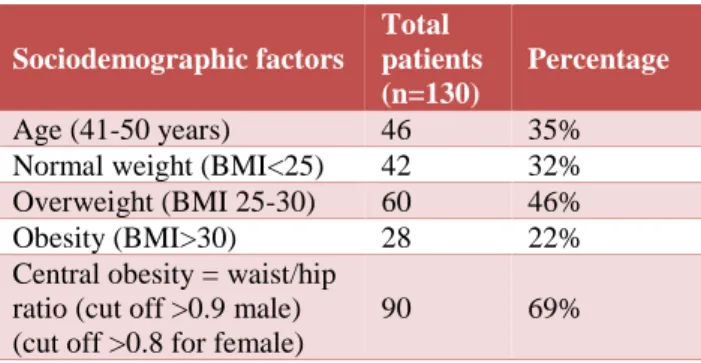
Most study patients with type 2 diabetes belonged to age group 41 to 50 years (n= 46/130, 35%). These were followed by 41 patients in age group 51-60 years (n= 41/130, 31.5%), 23 patients in age group 61-70 years (n= 23/130, 17.6%), 10 patients each in age group 71-80 and 31-40 years (n= 10, 7%). No patient was younger than 30 years.
Table 1: Sociodemographic factors.
Sociodemographic factors
Total patients (n=130)
Percentage
Age (41-50 years) 46 35% Normal weight (BMI<25) 42 32% Overweight (BMI 25-30) 60 46% Obesity (BMI>30) 28 22% Central obesity = waist/hip
ratio (cut off >0.9 male) (cut off >0.8 for female)
90 69%
BMI
Out of the 130 patients, 12 patients were lean (BMI less than 18, n= 18/130, 13.8%), 30 patients had BMI within normal range i.e. 18-25, 60 patients were overweight (BMI in range of 24-30, n= 60/130, 46.15%) and 28 were obese with BMI >30 (n=28/130, 21.5%).
Central obesity
Out of the 55 male patients, 44 had waist circumference more than 90 cm (n= 44/55, 80%) and thus had central obesity as defined for south east Asian men.
Out of the 75 female patients with type 2 diabetes, 59 patients had waist circumference above 80 cm (n= 59/75, 79%) and thus had central obesity as defined for south east Asian women.
Waist hip ratio
Out of the 55 male patients, 48 had waist hip ratio more than 0.90. Five patients had waist hip ratio between 0.81-0.90, and only two patients had below 0.80.
Out of 75 female patients with type 2 diabetes, 42 patients had ratio above 0.85. Twenty-nine patients had ratio between 0.75-0.85, and only four patients had ratio below 0.75.
Leukocyte count
Differential leukocyte count
On studying the differential counts, 61 patients (n= 61/130, 46%) had polymorph in range of 61-70 percent while 33 patients (n= 33/130, 26%) had PMN above 70%. Also, it was seen that 79 patients (n= 79/130, 60.7%) had monocyte count more than 6%.
Microvascular complications
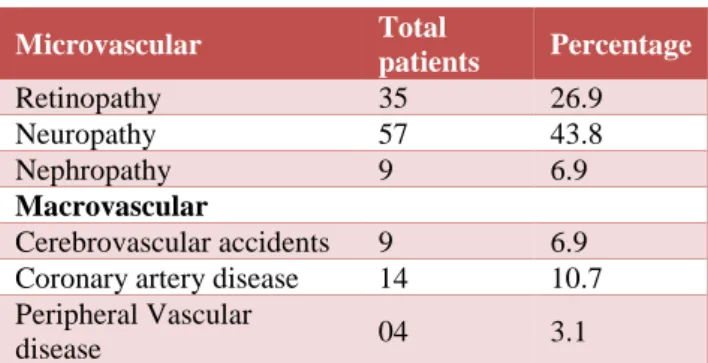
Forty seven out of 130 patients had evidence of retinopathy on fundoscopic examination and 7 patients had macroscopic albuminuria on urine examination. Fifty-three patients had features of neuropathy on clinical examination (defined by sensorimotor impairment).
Macrovascular complications
Out of the 130 patients with type 2 diabetes, 14 patients had coronary artery disease. Nine patients had history of CVA including hemiparesis or transient ischemic attack. And 4 patients had peripheral vascular disease.
Table 2: Micro and macrovascular complications.
Microvascular Total
patients Percentage
Retinopathy 35 26.9 Neuropathy 57 43.8
Nephropathy 9 6.9
Macrovascular
Cerebrovascular accidents 9 6.9 Coronary artery disease 14 10.7 Peripheral Vascular
disease 04 3.1
Prevalence of Microvascular complications with reference to WBC count
In 12 patients who had WBC counts more than 11000/cumm, 4 had retinopathy, 6 had neuropathy and 4 had nephropathy. In 73 patients who had WBC counts in range of 7000-11000/cumm, 18 had retinopathy, 34 had neuropathy and 2 had nephropathy. In 45 patients who had WBC counts less than 4000/cumm, only 13 had retinopathy, 17 had neuropathy and 3 had nephropathy.
Table 3: Prevalence of micro and macrovascular complications with respect to WBC counts in type 2 diabetes.
WBC count No. of patients (%) Microvascular
RE NE NH
Macrovascular
PVD CVA CAD
4000-7000 45 (34.6) 13 17 03 00 02 04 7001-11000 73 (56.1) 18 34 02 03 07 08 >11000 12 (9.2) 04 06 04 01 00 02
Legend: This table depicts correlation of Leukocyte counts with various micro and macro vascular complications of Diabetes. RE: Retinopathy, NE: Neuropathy, NH: Nephropathy, PVD: Peripheral Vascular Disease, CAD: Coronary Artery Disease, CVA: Cerebrovascular Accidents
Prevalence of Macrovascular complications with reference to WBC count
In 12 patients who had WBC counts more than 11000/cumm, 2 had CAD and 1 had PVD. In 73 patients who had WBC counts in range of 7000-11000/cumm, 8 had CAD, 7 had CVA and 3 had PVD. In 45 patients who had WBC counts less than 4000/cumm, 4 had CAD and 2 had CVA.
DISCUSSION
Investigations to find an inflammatory biomarker as an indicator of diabetes complications have been under consideration for some years. Numerous biomarkers have been investigated.
Many of the researchers have already shown that inflammatory processes play a part in the pathogenesis of diabetes and its complications.4
Antonetti et al, proposed a mechanism for diabetic retinopathy which involved inflammatory pathways including VEGF and other angiogenic mediators.5
Navarro JF proposed that activated innate immunity and inflammation are relevant factors in the pathogenesis of diabetes, with convincing data that type 2 diabetes includes an inflammatory component.6
Woo et al, proved that elevated systemic neutrophil count is associated with the presence and severity of retinopathy as well as diabetes. This result indicates that systemic subclinical inflammation is related with retinopathy, and neutrophil-mediated inflammation may play an important role in the pathogenesis of retinopathy.7
Similar results were seen in other researches also.9-16
Early diagnosis of diabetes and good control of glucose levels leading to reduced inflammation can prevent or reduce the development of complications. Furthermore, we need cost benefit and in reach methods to identify those patients who need more care. Therefore, this study was carried out to investigate the association of leukocyte count as a biomarker for inflammation with microvascular and macrovascular complications in diabetic individuals. Leukocyte count is a cost effective and universally available laboratory test that can show inflammatory activity.
In the present study, we found that a prototype diabetic patient is a middle-aged patient and is obese having abdominal type of central obesity. We found that, most of them have evidence of subclinical inflammation going on as evident by WBC counts on the higher side of the normal range i.e. 7000-11000/cu mm. Neutrophilia was also seen in many patients without any sign or symptom of acute inflammatory condition. Monocytes were also raised on the differential count. On differential analysis, it was evident that the complications were more prevalent in those with elevated total leukocyte counts along with neutrophilia or monocytosis.
Out of the 130 patients, 35 had retinopathy, 57 had neuropathy and 9 had nephropathy as micro vascular complications while 9 had a history of CVA, 14 had CAD and 4 had PVD. Also pointing towards the contribution of inflammatory activity leading to various complications was that maximum patients having micro vascular complications had WBC counts in the range of 7000-11000.
CONCLUSION
An elevated leukocyte count even within the normal range was associated with chronic complications in type 2 diabetes. This understanding can help in predicting the subset of patients who would otherwise have high probability of developing diabetic complications. Those patients can be advised for intensive control of blood glucose levels leading to reduced inflammation which can prevent or reduce the development of complications. Furthermore, we need cost benefit and in reach methods to identify those patients who need more care.
This study can be considered as a pilot study towards developing more cost effective and universally available laboratory tools that can help the understanding of disease progression to aid in decision making regarding chronic diseases. In our opinion, the leukocyte count test can be added to the diabetes control protocol as an early predictor beside that of a routine physical examination.
It was a clinical study. No invasive tests were done to define coronary artery disease or peripheral vascular disease or nephropathy
Funding: No funding sources Conflict of interest: None declared
Ethical approval: The study was approved by the institutional ethics committee
REFERENCES
1. International Diabetes Federation. IDF Atlas. 7th edition. Available at http://www.diabetesatlas.org. 2. Global report on diabetes. World Health
Organization, Geneva, 2016; Available at www.who.int/diabetes.
3. Intensive blood-glucose control with sulphonylureas or insulin compared with conventional treatment and risk of complications in patients with type 2 diabetes (UKPDS 33); The Lancet. 1998;352(9131):837-53.
4. Holman RR, Paul SK, Bethel MA, Matthews DR, Neil HA. 10-year follow-up of intensive glucose control in type 2 diabetes; N Engl J Med. 2008;359(15):1577-89.
5. Antonetti DA, Klein R, Gardner TW. N Engl J Med 2012; 366:1227-39.
6. Navarro JF, Mora C. Role of inflammation in diabetic complications. Nephrology Dialysis Transplant. 2005;20(12):2601-4.
7. Woo SJ, Ahn SJ, Ahn J, Park KH, Lee K. Elevated systemic neutrophil count in diabetic retinopathy and diabetes: a hospital-based cross-sectional study of 30,793 Korean subjects; Invest Ophthalmol Vis Sci. 2011;52:7697-7703.
8. Moradi S, Kerman SRJ, Rohani F, Salari F. Association between diabetes complications and leukocyte counts in Iranian patients. J Inflammation Res. 2012;5:7-11.
9. Jiang H, Yan W, Li C, Wang A, Dou J, Mu Y. Elevated white blood cell count is associated with higher risk of glucose metabolism disorders in middle-aged and elderly Chinese people. Int J. Environ Res Pub Health. 2014;11:5497-5509. 10. Tong PC, Lee KF, So WY, Ng MH, Chan WB, Lo
MK, et al. White blood cell count is associated with macro-and microvascular complications in Chinese patients with type 2 diabetes. Diabetes care. 2004;27(1):216-22.
11. Papatheodorou KP, Papanas NP, Papazoglou DP, Dimitriadis GD, Papazoglou LP, Ntakomyti EN, et al. Correlation of WBC and PLT count with parameters of type 2 diabetes mellitus. Endocrine Abstracts. 2006;11:373.
12. Vatcheva KP, Fisher-Hoch SP, Rahbar MH, Lee MJ, Olvera RL, Mccormick JB. Association of total and differential white blood cell counts to development of type 2 diabetes in Mexican Americans in Cameron county Hispanic cohort. Diabetes Res Open J. 2015;1(4):103-112.
Gondar, Northwest Ethiopia. Diabetes, Metabolic Syndrome and Obesity: Targets Ther. 2016;9:91-9. 14. Tsai JC, Sheu SH, Chiu HC, Chung FM, Chang
DM, Chen MP, et al. Association of peripheral total and differential leukocyte counts with metabolic syndrome and risk of ischemic cardiovascular diseases in patients with type 2 diabetes mellitus. Diabetes/Metabol Res Rev. 2007;23(2):111-8. 15. Chung FM, Tsai JC, Chang DM, Shin SJ, Lee YJ.
Peripheral total and differential leukocyte count in diabetic nephropathy. Diabetes care. 2005;28(7):1710-7.
16. Vozarova B, Weyer C, Lindsay RS, Pratley RE, Bogardus C, Tataranni PA. High white blood cell count is associated with a worsening of insulin sensitivity and predicts the development of type 2 diabetes. Diabetes. 2002;51(2):455-61.