Understanding the role of service integration in
e-government implementation in Jordan
AS’AD, Asa’d Mustafa Abedelqader
Available from Sheffield Hallam University Research Archive (SHURA) at:
http://shura.shu.ac.uk/21511/
This document is the author deposited version. You are advised to consult the
publisher's version if you wish to cite from it.
Published version
AS’AD, Asa’d Mustafa Abedelqader (2017). Understanding the role of service
integration in e-government implementation in Jordan. Doctoral, Sheffield Hallam
University.
Copyright and re-use policy
Understanding the role of service integration in e-government
implementation in Jordan
Asa’d Mustafa Abedelqader As’ad
A thesis submitted in partial fulfilment of the requirements of Sheffield Hallam University
Abstract
The general aim of this study is understanding the role of service integration in e-government implementation in Jordan as a developing country. Mixed method approach was selected to achieve this aim through construction and validation of the proposed research model using semi-structured interviews as a qualitative research method and questionnaires as a quantitative research method.
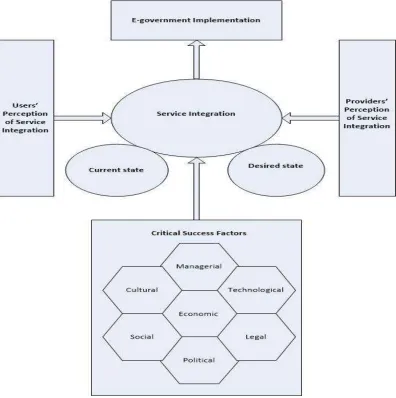
The main contribution of this study is developing a model towards understanding the role of service integration in e-government implementation in Jordan. This model is based on studying and analysing the critical factors affecting e-government service integration from the perspectives of providers and users of e-government services. Those factors are divided into managerial, cultural, social, political, legal, technological, and economic factors.
The construction of our model took into consideration the overall objectives, benefits and challenges of e-government mentioned in the literature, as well as an original contribution regarding the evaluation of current situation of service integration in Jordan. This is a significant addition to the literature which is lacking empirical investigation considering service integration in general, and within the context of Jordan in particular.
In this study, the analysis process is done using Statistical Package for the Social Sciences (SPSS) to examine the attitudes of respondents towards the role of service integration and the critical factors affecting that role, in addition to the other statistical analysis such as analysis of Means, Medians, Standard deviation, Chai squared and Mann Whitney U test.
cultural and economic factors have insignificant impacts on the role of service integration in e-government implementation in Jordan.
Dedication
Acknowledgements
All praise is due to Allah, the Lord of the Worlds, for granting me the strength and ability to successfully accomplish this work.
I would like to thank my director of studies Dr. Babak Khazaei and second supervisors: Prof. Babak Akhgar and Dr. Ja’far Al Qatawna. Their support, continuous follow up and valuable feedback in all stages of this research are really appreciated.
I also would like to express my appreciation to Prof. Jawed Siddiqi, my grand supervisor, who gave me all possible help and support from the beginning until the end of my PhD journey especially his valuable advice that helped me to overcome many difficulties and challenges. I cannot find the words to thank him enough.
I would also like to acknowledge my friends and colleagues in the United Kingdom and Jordan as well as the experts, reviewers and participants in the survey for their significant contribution in this study.
Table of Contents
Abstract……….i
Dedication………...iii
Acknowledgements……….iv
Table of Contents………..………..….v
List of Figures………..x
List of Tables……….…xii
Thesis Structure.………...xiii
Chapter 1: Introduction………..……...….1
1.1. Introduction……….……….…...1
1.2. Research aim and objectives………...……..………..……….…...4
1.3. Research questions……..……….………...5
1.4. Research contribution………..………...5
1.5. Research design………..6
1.6. Summary……….………….….10
Chapter 2: Literature Review……….……..11
2.1. Introduction……….…….….11
2.2. E-government………....11
2.3. Service integration……….……...16
2.4. Service integration in e-government implementation in Jordan………..….27
2.5. Summary……….………..36
Chapter 3: Research methodology……….….….37
3.1. Introduction……….….………37
3.2. Overview of research methodologies………..……….………….….…..37
3.3. Research design……….…….…..…39
Chapter 4: Interviews……….………….……….51
4.1. Introduction……….……….…………....51
4.2. Interview design……….……….……….52
4.3. Classifying interviews into groups………..……….57
4.3.1. Government sector experts……….……….………..58
4.3.2. Academic sector experts………..……….…….59
4.3.3. Private sector experts……….……60
4.4. Key findings of interviews………..……….….61
4.5. Summary……….………..62
Chapter 5: Qualitative findings………63
5.1. Introduction………...63
5.2. Research Model……….………...64
5.2.1. Current situation factors………66
5.2.1.1. The level of available e-government services………67
5.2.1.2. The level of official e-government portal………..68
5.2.1.3. The ability to reach all government information using the official e-government portal………...70
5.2.1.4. The ability of direct interaction between government and public via official e-government portal………71
5.2.1.5. The existence of actual integrated services………72
5.2.1.6. The standardization of procedures and protocols of different government agencies….73 5.2.1.7. The ability of e-government agencies to reach the advanced level reached by e-commerce and private sector………74
5.2.1.8. The availability of considerable number of e-government services on the official e-government portal………..…...75
5.2.1.11. The spread of public awareness about service integration and encouraging people
to use e-government portal………..…..80
5.2.1.12. The hope for rapid enhancements in service integration in forthcoming years.…….81
5.2.2. Critical factors construct………..………82
5.2.2.1. Managerial factors………83
5.2.2.2. Cultural factors……….84
5.2.2.3. Social factors………85
5.2.2.4. Political factors……….85
5.2.2.5. Legal factors……….………86
5.2.2.6. Technological factors………...86
5.2.2.7. Economic factors……….……….…87
5.3. Summary………88
Chapter 6: Questionnaires……….…….89
6.1. Introduction………..………..89
6.2. Questionnaire design and development………..89
6.3. Questionnaire specialized review……….……….….91
6.4. Conducting pilot studies……….…………....94
6.4.1. First pilot study (paper-based questionnaire) ……….95
6.4.2. Second pilot study (web-based questionnaire) ………...96
6.5. Validity and reliability………..……….….…97
6.6. Conducting a large-scale survey questionnaire………..98
6.7. Selecting the sample……….………105
6.8. Main constructs, themes and questions………106
6.9. Major challenges and difficulties….………107
6.10. Summary………..……….…..108
Chapter 7: Quantitative results…….……….…..109
7.1. Introduction……….…..109
7.3.1. Gender……….……….…..112
7.3.2. Age………..…………..……….115
7.3.3. Educational level……….………..…118
7.3.4. Internet and information technology skills………121
7.3.5. Daily use of internet……….………..125
7.3.6. Use of e-government services………128
7.4. Inferential data and statistical tests………131
7.4.1. Analysis of the responses for each question in the survey……….132
7.4.1.1. Current situation factors……….……….132
7.4.1.2. Managerial factors……….………..134
7.4.1.3. Cultural factors………..………..137
7.4.1.4. Social factors………...138
7.4.1.5. Political factors………..………..139
7.4.1.6. Legal factors………140
7.4.1.7. Technological factors…….……….140
7.4.1.8. Economic factors…………..………...142
7.4.2. Measuring attitude of respondents.………..…...143
7.4.3. Finding relationships between type of respondents and their demographic characteristics………149
7.4.3.1. Association between type of respondent and gender………...151
7.4.3.2. Association between type of respondent and age……….151
7.4.3.3. Association between type of respondent and educational level………..…….152
7.4.3.4. Association between type of respondent and internet and information technology skills………..153
7.4.3.5. Association between type of respondent and daily use of internet……….………….153
7.4.3.6. Association between type of respondent and use of e-government services………...154
7.4.4. Comparison of the perceptions of providers and users towards understanding the role Of service integration in e-government implementation in Jordan………..155
Chapter 8: Discussion of findings and results………..….168
8.1. Introduction……….168
8.2. Key findings and results of the study………..168
8.3. Recommendations for improving the role of service integration in e-government implementation in Jordan………173
8.4. Summary……….……….174
Chapter 9: Conclusion………..175
9.1. Introduction………..175
9.2. General overview of the study……….175
9.3. Contributions of the study……….………..179
9.4. Ethical considerations………..………180
9.5. Limitations of the study………..….182
9.6. Future work and directions for further research……..………....182
9.7. Summary………..183
References………..184
Appendix 1: Letter from Director of Studies……….193
Appendix 2: Interviews’ Questions………..………...194
Appendix 3: Major themes extracted from interviews (in Arabic and English).…..….195
Appendix 4: The questionnaire’s evaluation form sent to reviewers (in Arabic) ……..202
Appendix 5: English version of the questionnaire……….207
List of Figures
Figure 2.1: Types of transactions between stakeholders in e-government………….…………..14
Figure 2.2: Cycle of service integration in e-government implementations……..………...22
Figure 2.3: Pillars of service integration in e-government implementations………....27
Figure 5.1: Research model………..………64
Figure 5.2: Classification of critical factors based on stakeholders’ perceptions………...83
Figure 7.1: Sample’s distribution by the type of respondents………...111
Figure 7.2: Respondents distribution by gender………...113
Figure 7.3: Providers distribution by gender………...113
Figure 7.4: Users distribution by gender………...114
Figure 7.5: Respondents distribution by age………..………….116
Figure 7.6: Providers distribution by age………117
Figure 7.7: Users distribution by age………...117
Figure 7.8: Respondents distribution by educational level………...120
Figure 7.9: Providers distribution by educational level………...120
Figure 7.10: Users distribution by educational level………..……121
Figure 7.11: Respondents distribution by internet and information technology skills………...123
Figure 7.12: Providers distribution by internet and information technology skills………123
Figure 7.13: Users distribution by internet and information technology skills………..124
Figure 7.14: Respondents distribution by daily use of internet………..126
Figure 7.15: Providers distribution by daily use of internet………...127
Figure 7.16: Users distribution by daily use of internet………...127
Figure 7.17: Respondents distribution by use of e-government services………...129
Figure 7.18: Providers distribution by use of e-government services………130
Figure 7.19: Users distribution by use of e-government services………..130
Figure 7.20: Current situation of service integration in e- government implementation……...133
Figure 7.22: Cultural factors of service integration in e- government implementation …...136
Figure 7.23: Social factors of service integration in e- government implementation...138
Figure 7.24: Political factors of service integration in e- government implementation...139
Figure 7.25: Legal factors of service integration in e- government implementation...140
Figure 7.26: Technological factors of service integration in e- government implementation...141
List of Tables
Table 2.1: Maturity models……….…...20
Table 4.1: Interviews’ participants……….…...53
Table 6.1: Validity and Reliability assessment for the questions………...98
Table 7.1: Distribution of responses between providers and users……….……111
Table 7.2: Distribution of respondents by gender……….…..112
Table 7.3: Distribution of all respondents by age………...116
Table 7.4: Distribution of respondents by educational level……….…..119
Table 7.5: Distribution of respondents by internet and information technology skills…….…..122
Table 7.6: Distribution of respondents by daily use of internet………...126
Table 7.7: Distribution of respondents by use of e-government services………...128
Table 7.8: Statistical results of the responses regarding the current situation construct……….132
Table 7.9: Statistical results of the responses regarding the managerial factors ………134
Table 7.10: Statistical results of the responses regarding the cultural construct factors……….136
Table 7.11: Statistical results of the responses regarding the social factors ………...137
Table 7.12: Statistical results of the responses regarding the political factors ……...138
Table 7.13: Statistical results of the responses regarding the legal factors ………...139
Table 7.14: Statistical results of the responses regarding the technological factors...140
Table 7.15: Statistical results of the responses regarding the economic factors...142
Table 7.16: Median values of all responses for all constructs in the study...143
Table 7.17: Median values of providers’ responses for all constructs in the study...144
Table 7.18: Median values of users’ responses for all constructs in the study...144
Table 7.19: Weighted Median values for five choices Likert scale...145
Table 7.20: Medians for all respondents, providers and users...149
Table 7.21: Pearson Chi Square (x2), Probability (p) and existence of association for demographic variables based on the type of respondent (provider or user) ………...155
Thesis Structure
This thesis is divided into nine chapters as follows:
Chapter 1 (Introduction): Addresses the research overview, the research aims and objectives, the
research questions, the research contribution to knowledge and the research design.
Chapter 2 (Literature Review): Establishes the conceptual context and theoretical foundation
towards understanding the role of service integration in e-government implementation in Jordan
by reviewing existing research for main critical issues: e-government, service integration and
service integration in e-government implementation in Jordan.
Chapter 3 (Research Methodology): Provides a justification for selecting data collection and
analysis methods for quantitative and qualitative data that are used in this study. This study utilizes
the use of mixed methodology including semi-structured interviews conducted in the qualitative
part of the study to create the research model followed by a large-scale questionnaire conducted in
the quantitative part to validate the model.
Chapter 4 (Interviews): Provides a detailed description of a qualitative research method
(interviews) that is employed in this study to extract the main factors affecting service integration
in e-government implementation in Jordan. These factors are the main constructs of the proposed
Chapter 5 (Qualitative Findings): Introduces the research model that provides the basis for
understanding the role of service integration and identifies the critical factors that play a major role
in drawing the current picture of service integration in e-government implementation in Jordan.
Chapter 6 (Questionnaires): Provides a detailed description of a quantitative research method
(questionnaires) that is employed in this study to validate the proposed research model. All steps
and procedures are described such as formation of questionnaire and creating the questions,
reviewing the language and contents of the questionnaire by expert judges, conducting pilot
studies, selecting population and samples and collecting the data.
Chapter 7 (Quantitative Results): Presents the analysis of quantitative data collected through
questionnaires. A description of the statistical tests applied are provided such as Mean, Medians,
Standard Deviation, Chi squared and Mann Whitney U test.
Chapter 8 (Discussion of Findings and Results): Presents discussions and explanations for the
findings of qualitative part and the results of quantitative part to achieve the main aim and
objectives of the study.
Chapter 9 (Conclusion): Draws a conclusion about the factors affecting the current situation of
service integration in e-government implementation in Jordan and discusses the limitations of this
study in addition to come up with some recommendations for future research. It also presents a
summary of the objectives, activities and main findings of the study, as well as the contribution to
Chapter 1: Introduction
1.1. Introduction
This work explores one of the most important issues in the domain of e-government;
namely the role of service integration in e-government implementation.
In recent decades, the significant advancements in the internet and other tools of
information and communication technologies have encouraged governments worldwide
to adopt innovative e-government initiatives by exploiting these technologies in order to
attain better governments (Kumar et al., 2007; Zhang, Xu and Xiao, 2014).
This is achieved by administering and delivering e-services to citizens, businesses, and
others in much more convenient ways which save effort, time and money (Rehman,
Esichaikul and Kamal, 2012).
The aim of producing new e-services is to make the communication among all involved
stakeholders more effective, efficient, convenient and transparent (Sarpoulaki, Eslami
and Saleknia, 2008).
E-government guarantees a wide range of benefits to all stakeholders involved in
e-government transactions, but the most noticeable benefit is the delivery of integrated
services through a single point of access that is open twenty-four hours a day, seven
days a week. This single point of access is known as one stop government which refers
to the integration of e-services delivered by different government agencies or through
collaborated service providers from private sector (Reffat, 2003; Sirkemaa, 2010).
By definition, there are two essential requirements for one stop government. First, all
e-services must be integrated. Second, these e-e-services must be available and accessible
required to visit many government offices to obtain a service when they can do it from
home by few clicks (Xiong, 2006; Almarabeh and Abu Ali, 2010).
For the purpose of this research, the following definition of service integration can be
suggested: The combination of all e-government services provided by all government
agencies to all parties involved in e-government activities throughout an official main
portal with a single entry point available for everyone from anywhere at any time.
In line with this view, e-government services are the public e-services provided by
government agencies (service providers) to the people (service users) over the internet
and other electronic channels.
Considering the perspective of providers and the perspective of users at the same time is
an important aspect for successfully designing and developing e-government integrated
services. Providers of e-government services seek to offer services that match the needs
and expectations of the users.
All kinds of government services are considered for integration. In Jordan, potential
integrated services can be categorized under the following main areas: communication,
economy, education and training, health, industry, labor, natural resources and
environment, population and human settlements, tourism and antiquities, transportation
(Almaraabeh and Abu Ali, 2009; Al Dahuod et al., 2011).
However, even with promises of e-government to offer numerous benefits to all
stakeholders in order to attain a better government, many developing countries
including Jordan are still facing significant challenges in developing e-government
implementation in general and one stop government in particular. The failure in
addressing the challenge of service integration is a strong reason that hinders
e-government projects from achieving their goals and objectives (Davies, 2005; Shannak,
Therefore, the role of service integration in e-government implementation must be
clearly analyzed and understood. Finding and analyzing the main factors affecting the
role of service integration will assist in developing a model that can turn challenges into
opportunities, and improve the current situation of service integration to reach the
preferred situation.
Successful e-government implementations seek to fulfill users' needs and meet their
expectations by providing information and services at one stop portal in much faster and
easier ways without any consideration of the time and place constraints.
Dais et al. (2008) argued that integrated services require integrated information systems
where governments will not be able to improve e-services without the integration of
their local information systems. Ebrahim and Irani (2005) considered integration as a
key factor affecting the quality of services provided by governments, and Goldkuhl
(2008) argued that integration is one of the most important issues facing e-government.
E-government implementation goes through different stages of growth from the
immature to mature. The first stage is publishing, where governments provide
information to citizens through static web pages (one-way communication); the
second stage is transaction where government exchanges information with citizens
through dynamic web pages (two-way communication); and the final stage is
integration where all information and services are available online at one stop portal.
Providing integrated services to citizens, businesses, and other stakeholders in a single
stop is a big opportunity for governments to advance their services’ efficiency and
effectiveness, and improve the quality of service delivery to meet the demands of
public.
The focus of this research is government to citizens (G2C) interactions where the
1.2. Research aim and objectives
The aim of this research is to analyze the service integration in e-government
implementation in Jordan by identifying the factors affecting its current state in order to
provide a set of recommendations for improving.
In order to achieve this aim, the following specific objectives are addressed:
1. Investigate the importance of service integration in e-government implementation
and assess the current situation in Jordan.
This objective is addressed by presenting the motive for applying service integration in
e-government implementation in Jordan and introducing its objectives, benefits,
challenges and maturity level reached. This is done by conducting a comprehensive
literature review to identify main factors affecting service integration in e-government
implementations. The obtained factors from the literature will be used to form a basis
for formulation of a set of questions that will be asked during the next stage of
qualitative research in the fieldwork through interviews.
2. Construct a model that illustrates the main factors influencing the service integration
in e-government implementation in Jordan.
This objective is addressed by developing a model that identifies the critical success
factors affecting the current situation of service integration in e-government
implementation in Jordan based on the collected data from the fieldwork through the
use of interviews as a qualitative research approach. The proposed model is tested,
validated and confirmed by the use of large scale questionnaires as a quantitative
research approach.
3. Recommend a set of improvements on the service integration in e-government
This objective is addressed by putting forward a set of recommendations and
suggestions that help in developing the status of service integration in e-government
implementation in Jordan. These recommendations and suggestions resulted from the
analysis of the collected data from the fieldwork through interviews and questionnaires.
1.3. Research questions
To achieve the overall aim and objectives of this study, the following research questions
have been formulated:
RQ1: What is the current situation of service integration in e-government
implementation in Jordan?
RQ2: What are the major critical factors influencing the service integration in
e-government implementation in Jordan?
RQ3: What are the recommendations and improvements that can be suggested to
transfer service integration in e-government implementation in Jordan from the current
situation into a preferred situation?
1.4. Research contribution
Based on theoretical and empirical investigation of the research topic, this research
contributes to the existing body of knowledge and provides guidance for future research
in the domain of e-government especially in the service integration area.
According to the literature review, this is the first research that addresses the service
integration in e-government implementation in Jordan. Existing studies focus on the
2012; Alomari, Woods and Sandhu, 2012, Qutaishat, 2012; Alawneh, Al Refai, and
Batiha, 2013; Al Hujran, Al Oudat and Al Tarawneh, 2013; Abu Shanab, 2014; Al
Hujran et al., 2015).
This study considers the perspectives of two types of stakeholders at the same time. It
investigates the perspectives of both providers and users of e-government services in
Jordan, unlike other studies that considers only the perspective of one stakeholder about
the subject (Al Shihi, 2006; Al Shafi and Weerakkody, 2007; Al Hujran and Chatfield,
2008; Belwal and Al Zoubi, 2008; Venkatesh, Sykes and Xiaojun, 2011; Rehman,
Esichaikul and Kamal, 2012; Ahmed, Jouni and Markku, 2012).
The strength of this work relies on the fact that it combines the findings of literature
review with the findings from the fieldwork and takes both perspectives of providers
and users in consideration.
However, the main contribution of this work is proposing a model that analyzes the
factors affecting service integration in e-government implementation in Jordan. Our
model is based on a set of core constructs influencing the current situation of service
integration. They are divided into managerial, cultural, social, political, legal,
technological, and economic factors.
As a result, recommendations for e-government decision makers are proposed. This
model can be generalized to other developing countries with similar conditions.
1.5. Research design
To achieve the research objectives and to answer the main research questions, this
research goes through a series of steps and procedures including a comprehensive
two pilot studies, a quantitative large-scale questionnaire, interpretation of research
findings, model confirmation and a set of recommendations for improvement.
Since the main involved groups in G2C interactions are citizens and government
employees, this research investigated the role of service integration in e-government
implementation from two perspectives. The first is the perspective of users or citizens
who benefit from e-government services and the second is the perspective of providers
or employees of the government agencies that are responsible for the introduction and
deployment of integrated services.
The methodology employed in this research uses a mixed method approach through the
use of interviews in the qualitative part which is suitable for developing a model for
understanding the role of service integration in e-government implementation in Jordan
followed by the use of questionnaires in the quantitative part which is suitable for
validating the proposed research model.
Once the quantitative data is collected from both users and providers, the analysis
process is carried out to examine the constructs of the research model and to answer the
main research questions using various statistical techniques such as analysis of Mean,
Median, Chi squared and Mann Whitney U Test.
The importance of these statistical tests is to extract the useful data that will be used for
interpreting and explaining the factors affecting service integration in e-government
implementation in Jordan.
The main phases of the research that are conducted in this study:
Phase 1. Reviewing the literature:
This research begins with a comprehensive literature review about e-government,
service integration and service integration in the context of Jordan in order to identify
Phase 2. Conducting the interviews:
A set of open-ended questions regarding service integration in e-government
implementation in Jordan have been formulated based on suggested research questions
and the results of exploring previous studies in the literature.
In order to enrich the findings of the literature and to develop the research model,
fifteen experts who are aware of project planning and development of e-government
services in Jordan were selected from public and private sectors to be interviewed and
to answer the questions.
The interviews helped answering the research main questions, identified earlier in this
chapter, regarding critical factors affecting service integration in e-government
implementation and assessing the current situation of service integration in Jordan.
It also helped identifying users' and providers’ perceptions of the e-government
integrated services and the similarities and differences between them.
Phase 3. Developing the research model:
Based on the findings from the literature and the findings from initial interviews, a set
of major critical factors that might affect the role of service integration in e-government
implementation in Jordan is introduced. These critical factors are classified into
managerial, cultural, social, political, legal, technological, and economic.
Therefore, we constructed a model that identifies the critical factors controlling the role
of service integration in Jordanian e-government and recognize the double-view
perspective of providers and users regarding these factors.
Our model supports examining the similarities and differences between users'
Phase 4. Formulating the survey questions and designing the questionnaire:
A quantitative research approach is applied using a questionnaire to test and validate the
constructs of the proposed research model. The questions were formulated and
translated from English to Arabic which is the native language of the targeted
respondents.
After that, the first draft of the questionnaire was reviewed by seventeen experts and
specialists in relevant areas to be ready for the conducting the pilot studies.
Phase 5. Conducting the first pilot study:
A paper-based pilot questionnaire is distributed on a sample of forty participants in
order to test all constructs of the study to spot any errors or difficulties that might hinder
the research process and collect feedback from participants about the needed time to
complete, clarity of questions, and any other comments they might have. The revised
questionnaire is used for conducting the second pilot study in phase 6.
Phase 6. Conducting the second pilot study:
A web-based pilot questionnaire is conducted on a sample of forty participants in order
to assess and refine the study measurements using a variety of statistical tests. The
reliability of the constructs was tested statistically using Cronbach's alpha and the
validity was confirmed by calculating the square root of Cronbach's alpha.
Phase 7. Conducting a large-scale survey questionnaire:
After distributing, collecting, analyzing the pilot questionnaires and modifying some
questions, the main survey was conducted on a large scale of providers and users of
e-government services. The research model was confirmed based on the analysis of the
data obtained from the main questionnaire.
The perceptions of participants regarding the benefits, challenges, and progress of
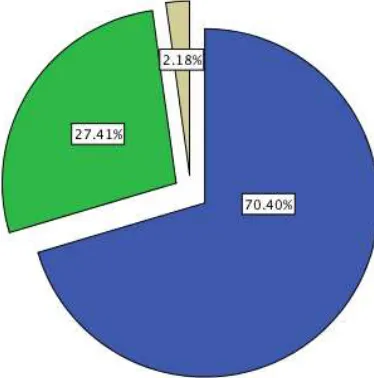
questionnaire to the participants, a total of 642 responses are collected; 90 from
providers and 552 from users.
Phase 8. Discussing and interpreting the results:
Findings of interviews’ analysis from qualitative part of the study and results of
questionnaires analysis from quantitative part of the study are discussed and compared
in order to explain them within the research context regarding the role of service
integration in e-government implementation in Jordan.
Phase 9. Confirming the proposed model of service integration in e-government
implementation in Jordan:
Based on the discussions and outcomes from the previous steps, any required
amendments and enhancements to the proposed research model are considered and
carried out in order to reach the final version of the model.
Phase 10. Suggesting a set of recommendations for improving service integration:
As a final step, a number of suggestions and recommendations to fully understand and
improve the role of service integration in e-government implementation in Jordan are
presented.
1.6. Summary
This chapter introduced an overview for the research topic: understanding the role of
service integration in e-government implementation in Jordan. It also addressed the
research aim and objectives, research questions, research contributions and research
design.
In the next chapter, a literature review is provided to establish the conceptual context
e-Chapter 2: Literature Review
2.1. IntroductionThis chapter presents a conceptual context and theoretical foundation of existing
research towards understanding the role of service integration in e-government
implementation in Jordan. The relevant literature for main research areas was reviewed
including e-government, service integration and service integration in e-government
implementation in the context of Jordan.
In the current literature, a significant number of studies have investigated these issues
using various theories and models to explain how governments perceive, adopt and
apply service integration in e-government implementation.
Section 2.2 addresses the topic of e-government. Section 2.3 addresses the topic of
service integration. Section 3.4 addresses service integration in e-government
implementation in Jordan.
2.2. E-government
In the last few decades, the revolution in information and communication technologies
especially the internet has inspired governments around the world to exploit a huge
number of potential benefits for using these new technologies and innovations through
adopting new initiatives including e-government (Kumar et al., 2007; Zhang, Xu and
Xiao, 2014), which will make the interaction between the government and all involved
stakeholders more user friendly, transparent, reliable, affordable, faster and convenient.
It will save effort, time and money (Sarpoulaki et al., 2008; Rehman, Esichaikul and
There are many definitions of e-government in the literature. Some definitions focus
only on one or two elements of e-government. Others are more comprehensive and
include several elements of e-government.
UNESCO (2016) defines e-government as the use of information and communication
technologies by government agencies to deliver information and services, draw polices,
make decisions, improve productivity, enhance accountability, increase transparency
and encourage public participations in government activities.
UNESCO definition considers multi-view perspective and takes more dimensions of
e-government into account such as managerial, political and technological.
A more comprehensive definition is the one that describes e-government as the use of
information technologies including wide area networks, internet, and mobile computing
by several government organizations to transform relations with citizens, businesses,
and other government agencies (World Bank, 2016).
By analyzing the definitions in the literature, a set of characteristics of the
e-government can be extracted:
It is a transformational process in governments from the old traditional
procedures into new electronic procedures.
It involves the automation or computerization of existing paper-based
procedures using information and communication technologies.
It focuses on the use of internet as a primary tool of information and
communication technologies to support e-government activities.
It includes all governmental operations conducted in different governmental
agencies.
It includes all governmental services provided to different types of stakeholders
It can provide more convenient access to government information and services.
It can improve information and service delivery through time saving and cost
reduction.
It can provide new ways to enhance relationships and increase positive
interactions between governments and their citizens.
It can improve accountability, transparency and citizen empowerment by
allowing wider participation in government policy shaping and decision making
process.
The impacts of e-government are numerous and touch all aspects of people’s life
including managerial, cultural, social, political, legal, technological and economic.
More details on such aspects and their relation to the topic of this study are presented in
chapter five.
The three main types of stakeholders involved in e-government interactions are citizens,
businesses and governments themselves (Almarabeh and Abu Ali, 2010).
E-government uses tools of information and communication technologies to connect
various stakeholders and to conduct processes with the goal of achieving better
government. Thus, the transactions in e-government are classified under the following
four types (Yildiz, 2007; Al Onizat, Al Oqeili and Hijazi, 2013; Vasiliki, 2017):
1) Government-to-Government (G2G):
Aims to manage relationships and administer connections between various government
agencies to behave as one department by allowing them to share information and
resources in order to create cooperation, coordination and transparency. Thus, they will
be able to interact with citizens and businesses effectively. Examples of G2G include:
2) Government-to-Business (G2B):
Aims to manage relationships with businesses and private sector companies by
providing them with all information and services they need from any government
agency in order to contribute to the development of national economy which will in turn
allow a country to keep in line with global economies. Examples of G2B include:
start-up a new company, taxation, and licensing.
3) Government-to-Citizen (G2C):
Aims to manage relationships and interactions with the citizens by providing them with
all information and services they need from any government agency in order to build
the trust between government and citizens and gain their satisfaction. Examples of G2C
include: paying bills, updating citizens’ information and downloading official
documents.
4) Government-to-Employee (G2E):
Aims to manage relationships and interactions with government employees by
improving all intra-government transactions and processes. Examples of G2E include:
e-payroll and e-training. Figure 2.1 shows the types of transactions between
E-government has a list of goals and objectives that must be realized in order to be
successful. These goals and objectives include renovating the form of government into
electronic shape instead of the traditional shape (Holzer and Kim, 2008), supporting
economic policy and transformation of the administrations (Almarabeh and Abu Ali,
2010), improving relationships between government and other stakeholders (Millard,
2003), providing value-added services to all involved stakeholders in government
activities, enhancing interactions with businesses and industries, improving efficiency
of government management, supporting citizen empowerment in various forms such as
accessing information and participating in decision-making process (Al Qatawna et al.,
2014).
By achieving the aforementioned goals and objectives, governments will have the
ability to provide all involved stakeholders in e-government transactions with a
significant number of benefits that includes delivering e-government integrated services
in one stop portal, bridging the digital divide, rebuilding government-citizen
relationship, increasing economic development, creating more participative form of
government (Reynolds and Regio, 2014), providing more accessible, more convenient,
more responsive and more cost effective services, making governments more open,
more accountable, more inclusive and more superior in leading their communities,
promoting local economy vitality through a modern infrastructure for information and
communication technologies, developing a highly skilled workforce and improving
employability of the citizens (Ferguson, 2005), corruption reduction, transparency
improvement, convenience maximization, revenue growth enhancement, and cost
lessening (Al Qatawna et al., 2014).
However, the accomplishment of e-government objectives and its potential benefits is
According to InfoDev (2002) and Odat (2012), the main obstacles and challenges are:
The infrastructure development, law, digital divide, e-literacy, accessibility, trust,
privacy, security, transparency, interoperability, record management, permanent
availability, education, marketing, public-private competition, public-private
collaboration, workforce shortage, cost, benchmarking. These challenges can be
categorized under the following areas: information and data, technical and
technological, organizational and managerial, legal and regulatory, institutional and
environmental (Eynon and Dutton, 2007; UNESCO, 2016), financial and economic
(Ebrahim and Irani, 2005; Lam, 2005) and service integration (Goldkuh, 2008; Btoush
et al., 2009; Shannak, 2013).
It can be seen from the above discussion that successful e-government is an
implementation that has the ability to meet the overall objectives of e-government on
one hand and utilize its promising benefits on the other. At the same time, successful
e-government has the ability to overcome all kinds of obstacles and challenges that might
hinder its progress towards achieving its main goals and objectives.
Al Qatawna et al. (2014) points out that governments lag behind when compared to
businesses in regard of e-services due to a number of major barriers that hinder the
development of e-government services to be fully integrated. These barriers can be
classified into organizational, policy, strategic, technological, legal, human factors,
volume of online users, security threats, and online payment methods.
2.3. Service integration
In order to successfully implement service integration, e-government projects go
The first phase is a one-way communication or online publishing of government
information to the public about available services over static websites. The second
phase is a two-way communication or online transaction where government interacts
with public to exchange information over dynamic websites. The final stage is
integration where all information and services are available online at a one stop portal
which is accessible anytime from anywhere by anyone (Al-Zoubi, Sam and Eam, 2011;
Jordanian e-government website, 2016).
Today, delivery of integrated services to all stakeholders in one stop can be seen as a
great opportunity for governments to improve their services’ efficiency and
effectiveness, and advance the quality of service delivery to meet the expectations of
public.
The term service integration is composed of two parts: service and integration. In the
context of this research, a service refers to a set of actions that are performed by any
government agency in response to any request from any involved stakeholder in
government transaction including other government agencies, businesses or citizens.
These services can be traditional and provided through conventional channels such as
public counters and telephones, or can be electronic and provided by electronic
channels such as mobile phones and internet.
Many definitions for electronic service (e-service) have been provided by many
researchers in the field of e-government (Buckley, 2003; Rais and Nazariah, 2003;
Lofstedt, 2012). For example, Rowley (2006:339) defines it as: “Deeds, efforts or
performances whose delivery is mediated by information technology. Such e-services
include the service element of e-tailing, customer support, and service delivery”.
This definition emphasizes the information and communication technologies used as
e-In the context of this study, e-government services are the public e-services provided by
government agencies (service providers) to the people (service users) over the internet
and other electronic channels.
According to the Tech Target Group (2014), the word 'integration' has many definitions
based on the field or context addresses it whether it is sociology, economy, biology,
mathematics, electronics, engineering or others, but generally it refers to the process of
forming a whole from combining a group of parts together to work in harmony and
consistency.
To provide more efficient and effective e-services by government agencies, integration
of services is critically required among different levels in different government agencies
that works together in harmony and consistency to deliver integrated services that meet
the needs and demands of the users (Klischewski and Scholl, 2008).
In other words, service integration is a method to achieve more efficiency, effectiveness
and competitiveness among all collaborative agencies where government agencies are
not exceptions (Wainwright and Waring, 2004).
Huang and Bwoma (2003) define service integration as the most sophisticated level of
e-government in which government services are integrated together. The required
services are accessible to all people involved in e-government activities irrespective of
the government agencies that are responsible for providing them.
Another definition to explain the concept of service integration in e-government is
presented by Goldkuh (2008) who defines service integration as the collaboration of
different government agencies to produce a combination of different e-government
services to become one unified service that will be delivered to users in a seamless
manner at one-stop portal which is a single entry point that allows individual users to
The aforementioned definitions of service integration highlight many key issues that
need to be taken into consideration in order to guarantee an efficient, an effective, and a
competitive integration of e-government services.
Major issues in this regard include availability, accessibility, personalization and
customization, cooperation and coordination, and one stop portal (Reffat, 2003).
Moreover, association of existing systems and databases in government agencies is
highly required in addition to a certain level of intra-departmental collaboration and
harmonization.
The importance of service integration can be realized by removing boundaries between
collaborating and cooperating agencies to provide integrated services to the public.
However, service integration as a process can take place within a single government
agency provides multiple services or among separate government agencies provide joint
services (Hassett and Austin, 1997).
In line with this view, taking the main characteristics of service integration mentioned
above in consideration, the following definition of service integration can be suggested:
The combination of all e-government services provided by all government agencies to
all stakeholders involved in e-government activities throughout an official main portal
with a single entry point available for everyone from anywhere at any time.
This definition reveals the following three main components: an integrated service
provider, an integrated service receiver and a channel to deliver integrated services. As
a result, all services provided by government service providers must be combined
together and must be integrated in order to be delivered to government service receivers
via e-government one stop portal.
To reach a high level of service integration maturity, an e-government implementation
here are examples of such models that are proposed by researchers and practitioners in
the field of e-government: Gartner (2000), United Nations (2000), Deloitte (2001),
Howard (2001), Layne and Lee (2001), World Bank (2002), Chandler and Emanuels
(2002), Moon (2002), National Audit Office (2002), Asia Pacific (2002), Accenture
(2003), West (2004), Siau and Long (2005), Public Process Rebuilding (2006), Six I
(2008), Klievink and Janssen (2009).
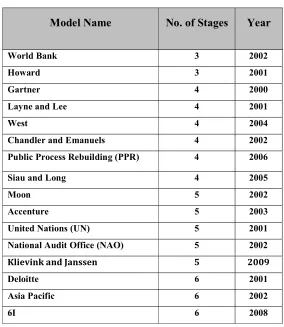
These models can be seen as a road map that helps in implementing e-services
efficiently and effectively on one hand and in evaluating the overall progress of
e-government projects on the other (Btoush et al., 2008). Table 2.1 which was presented
and discussed by As’ad et al. (2016b) shows examples of the most well-known maturity
models where the first column is the name of the model, the second column is the
number of stages or phases specified by each model to complete e-government lifecycle
[image:36.612.190.474.409.736.2]and the third column is the year of introduction.
Table 2.1. Maturity models
Model Name No. of Stages Year
World Bank 3 2002
Howard 3 2001
Gartner 4 2000
Layne and Lee 4 2001
West 4 2004
Chandler and Emanuels 4 2002 Public Process Rebuilding (PPR) 4 2006
Siau and Long 4 2005
Moon 5 2002
Accenture 5 2003
United Nations (UN) 5 2001 National Audit Office (NAO) 5 2002
Klievink and Janssen 5 2009
The models that are introduced by Howard in 2001 and World Bank in 2002 have three
phases only: publishing, transaction and integration. Those three phases are the core
phases of e-government maturity. However, many other researchers have expanded
those main phases into more sub phases. For example, Layne and Lee (2001), Gartner
(2000), West (2004), Chandler and Emanuels (2002), Public Process Rebuilding (2006),
and Siau and Long (2005) have introduced maturity models with four stages. On the
other hand, United Nations (2000), Moon (2002), Accenture (2003), National Audit
Office (2002) and Klievink and Janssen (2009) have introduced five stages models.
Deloitte (2001), Asia Pacific (2002) and Six I (2008) have introduced six stages models.
Despite the fact that the aforementioned maturity models consist of different numbers
of stages to reach an advanced level of e-government, it can be noticed that the ultimate
goal of all models is the integration of government services provided by different
government agencies for different functions at different levels of the government
system (Andersen and Henriksen, 2006; NOIE, 2014).
It is clear that service integration is a critical factor to reach an advanced stage of
government and achieve its overall goals and objectives. Therefore, the objectives of
e-government will be reached only when full service integration is accomplished.
It is important to give more attention to the role of service integration when making
plans and decisions regarding e-government strategies and implementations.
E-government policy-makers need to consider the importance of service integration
through understanding its multifaceted role in e-government and also need to consider
the overall objectives, benefits, challenges and maturity stages of e-government to
highlight the location of service integration on e-government map and how it can
support the overall development of e-government projects.
integration is based on realizing a set of objectives to reach the maturity stage, the drive
towards the maturity stage is the potential benefits of the integrated services, but the
challenges might impede its progress.
Figure 2.2. Cycle of service integration in e-government implementations.
Most of the previous studies in the literature investigated the role of service integration
in e-government implementation from one perspective, either the perspective of
providers of e-government services such as Ahmed et al. (2012) and Venkatesh et al.
(2011), or the perspective of users of e-government services such as Rehman,
Esichaikul and Kamal, (2012) and Al Hujran and Chatfield (2008).
Therefore, considering the perspective of providers and the perspective of users at the
same time is an essential requirement for successfully designing and developing the
e-government integrated services. Providers of e-e-government services seek to provide
services that match the needs and expectations of the users.
Thus, studies that focused on one perspective and ignored the other were not able to
provide sufficient results that could handle a broader picture and fill the gap between
the perspectives of providers and users of e-government services.
One of the most interesting aspects of this study is the consideration of both
perspectives of providers and users of e-government services. This will help in
integrating two perspectives and finding the links and relationships among them to
properly design and deliver efficient and effective e-government integrated services that
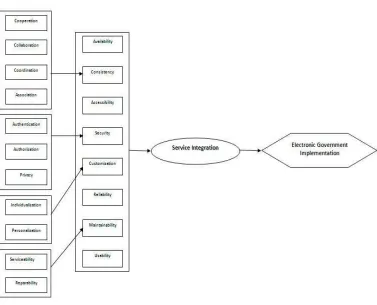
As a result of reviewing the literature and previous studies on service integration in
e-government implementation, a set of principles for successfully implementing service
integration are extracted and a model illustrating those principles is developed. In the
context of this study, those principles are called pillars of service integration in
e-government implementations.
The first pillar in our model is availability. According to As’ad et al. (2016a), a
successful implementation of service integration requires availability of integrated
services which refers to the ability of e-government portal to provide designated
integrated services at onstop whenever required to all stakeholders involved in
e-government interactions with no need to know the details behind the delivered
integrated services or even which government agencies are responsible for providing
them.
In line with this view, concepts such as cooperation, collaboration, association and
coordination of all governmental agencies responsible for providing integrated services
at one stop are key factors to accomplish successful integration of services in
e-government implementation.
The second pillar in our model is consistency. To ease and support the development of
successful service integration, high levels of consistency between data, information and
systems are required. The compatibility of software, hardware and other technologies is
another key factor that should be given careful attention during the implementation of
e-government service integration. Lack of compatibility results in poor integration
between collaborated government agencies working together to produce and deliver
e-government integrated services to people.
The third pillar in our model is accessibility of integrated services to all potential users
(Reffat, 2003). Accessibility is the ability to obtain designated integrated services from
anywhere at any time by anyone.
The fourth pillar is security. We can highlight two major security issues: authentication
and authorization. Authentication provides tools to verify user’s identity by
guaranteeing that the user accessing the e-government portal is what or who it claims to
be while authorization provides tools to grant or deny a user from accessing all or some
information or services on e-government portal.
Authentication and authorization support the idea of privacy and confidentiality by
restricting access to user’s data and profiles by certain authorities (Business Dictionary
Website, 2016).
Successful installation of software, hardware and new technologies that support
authentication and authorization is highly required to ensure that the standards of
security and privacy are well implemented when e-government services produced in a
secure and safe environment. So, government can keep the contents of e-government
portal secure over the time and protect all operations conducted to provide
e-government services at anytime from anywhere by anyone.
Security and privacy issues need more attention in the environment of e-government
where the databases and networks of different government agencies contain confidential
government information and personal profiles of the citizens. Failure in overcoming
security and privacy issues lead to increase the degree of risks and cause a big delay in
deployment of service integration in e-government implementation.
Many issues around security and privacy and how they may affect service integration in
e-government implementation have been presented and examined in the literature
(Ebrahim and Irani, 2005; Belanger and Crossler, 2011; Acquisti, John and
2) Securing privacy of confidential and personal data.
3) Costly price of security applications and privacy solutions.
4) Unauthorized access to government data and information.
5) Lack of awareness about potential security threats and risks.
6) Lack of advanced tools that approve validity and legality of online transaction.
7) Lack of laws and regulations supporting the implementation of security and
privacy of e-government services.
8) Insufficient hardware and software supporting the implementation of security
and privacy of e-government services.
9) Absence of risk management skills among the employees involved in
e-government transactions.
10)Unrestricted access to administration buildings or facilities that contain
government servers and computers.
Therefore, it is vital to use innovative security solutions that utilize effective
technologies such as digital certificates, biometric tools, digital signature, reliable
firewall, up to date anti-spyware software, up to date anti-virus software and advanced
encryption techniques. These technologies aim at providing an advanced level of
security and privacy in all stages of e-government service integration.
Andersen and Henriksen (2006) highlighted the concept of customization to refer to
personalization and individualization of integrated services provided through
e-government portal based on users’ profiles such as the ability to automatically filling in
information and downloading selected forms or documents based on users’ preferences.
That’s why we selected customization as the fifth pillar in our model.
The sixth pillar in our model is reliability. Many researchers give emphasis to it as a
the e-government portal to consistently perform its functions and offer its services to all
kinds of stakeholders when required without degradation or failure.
The seventh pillar is maintainability. It refers to characteristic of design and installation
that determines the probability if a failed equipment, machine, or system has the ability
to be restored to its normal operable state within a given timeframe based on a set of
prescribed practices and procedures. It has two main components: serviceability which
is ease of conducting scheduled inspections and servicing, and reparability which is
ease of restoring service after collapse or failure (Business Dictionary Website, 2016).
The eighth and last pillar in our model is usability. Codagnone and Undheim (2008)
identified usability as one of the main principles for achieving successful service
integration. They relied on the idea that it can provide ease, speed, and intuitiveness in
operating or using the e-government portal to offer all kinds of integrated services to all
users of e-government services. Usability arises from a combination of well thought-out
architectural and design factors, and interpreted as user's ability to perform tasks
efficiently and effectively with regular efforts (Business Dictionary Website, 2016).
All the aforementioned pillars have significant impacts on the implementation of
service integration in e-government and they must be taken into consideration in order
to achieve successful service integration.
Figure 2.3 shows the key pillars of service integration in e-government implementation
Figure 2.3. Key Pillars of service integration in e-government.
2.4. Service integration in e-government implementation in Jordan
Jordan is a developing country located in a politically unstable area with a centralized
place in the Middle East. Bordered by Syria to the north, Iraq to the east, Saudi Arabia
to the south and southeast, and Palestine to the west.
The total population of Jordan is 9,768,999 as of Tuesday, October 31, 2017, based on
the latest United Nations estimates (Worldometers, 2017). The density of population is
concentrated in the center and north of the country.
Arabic is the official language and the use of English is commonly widespread in
Jordan is classified as one of the lower-middle income countries with limited natural
resources, but because the country is rich in qualified human recourses, substantial
efforts by the government were made to put the country on the world map of
information and communication technologies through continuous attempts to label
Jordan as a center of information and communication technologies in the region
(Joudeh, 2011).
These attempts focus on compensating the lack of natural resources by encouraging
local firms and international giant companies to invest in the information and
communication technologies sector in Jordan in order to recognize the country as a
basis for their work in the Middle East (Al Jaghoub and Westrup, 2003).
His Majesty King Abdullah II emphasized on this when he said that “the vision of
Jordan is to become a regional IT leader and an internationally recognized exporter of
IT products and services exploiting its core human capital advantages. The key to
success is the central role of the private sector, which spearheads the sustained entry of
the sector into international markets” (Reach 2.0, 2001, p.2).
To achieve this vision, Ministry of Information and Communication Technology
(MoICT) was established to manage and administer the sector of information and
communication technologies with the goal of improving the life quality and supporting
the socio-economic development in the country (Al Shboul et al., 2014).
Therefore, the strategy of Information and Communication Technology (ICT) in Jordan
commenced since the beginning of this century to increase the rank of the country on
the global indicators regarding the overall progress in information and communication
technologies (Reach 1.0, 2000; Reach 2.0, 2001; Al Jaghoub and Westrup, 2003;).
Responsibilities of MoICT include (MoICT, 2014):