Selvan
Available from Sheffield Hallam University Research Archive (SHURA) at:
http://shura.shu.ac.uk/491/
This document is the author deposited version. You are advised to consult the
publisher's version if you wish to cite from it.
Published version
STOLTERMAN, Erik, MCATEE, Jamie, ROYER, David and THANDAPANI, Selvan
(2009). Designerly Tools. In: Undisciplined! Design Research Society Conference
2008, Sheffield Hallam University, Sheffield, UK, 16-19 July 2008.
Copyright and re-use policy
Designerly Tools
Erik Stolterman, School of Informatics, Indiana University, USA
Jamie McAtee, School of Informatics, Indiana University, USA
David Royer, School of Informatics, Indiana University, USA
Selvan Thandapani, School of Informatics, Indiana University, USA
Abstract
An assumption behind this paper is that research aimed at improving interaction design practice is not as successful as it could be. We will argue that one reason for this is that the understanding of what constitutes
designerly tools is not enough recognized among those who propose new tools for interaction design. We define designerly tools as methods, tools, techniques, and approaches that support design activity in way that is appreciated by practicing interaction designers. Based on a two empirical studies, we have developed a framework and a way of studying designers and their tools. We discuss some insights about what characterizes designerly tools and what kind of implications these insights might have for the further development of tools aimed at supporting design practice.
Keywords:
Design, Tools, Interaction Design, Activities, Support For Design
A substantial part of all research in design disciplines is aimed at supporting and improving some kind of design practice. The goal is to create methods, tools, techniques, and approaches--from here on generically called tools --that can be used by design practitioners to improve their design ability and the quality of the design outcome. However, it is not easy to develop a tool for design practice that is accepted both by researchers and by design practitioners. For the researcher the tool is judged based on how well it is a result of good research, while for the practitioner it is judged based on its practical usefulness in design.
An assumption behind this paper is that research aimed at improving design practice in general and more specifically interaction design practice is not as successful as it could be. We will argue that one reason for this is that the understanding of what constitutes designerly tools is not enough developed among those who propose new tools for interaction design. We define
designerly tools as methods, tools, techniques, and approaches that supports design activity in way that is appreciated by practicing designers.
Within interaction design research there has over the last years been a
debate about, and criticism of, the development of new design approaches coming out of research (Rogers, 2004). These research based approaches have been criticized for being too complex, too theoretical, demanding too much time to use, and requiring too much knowledge or learning from the practitioner. Another criticism has been that these approaches are not based on an understanding of the practical constraints that design practice always encounter, such as time, resource, and budget limitations. The overall criticism has been that the proposed approaches do not fit practice as designers experience it (Stolterman, 2008).
In this paper we will present a study were we have started to explore the characteristics of tools actually used in design practice. The study has been done within the field of interaction design, but as we mentioned above, we hope that it can be of interest to a broader range of design disciplines.
Our studies are mainly exploratory studies, consisting of interviews, small-scale surveys, and discussion sessions with interaction designers. The reason for this less structured approach is that we did not start with any preconceived notion of what would characterize designerly tools. So, based on the assumptions that (i) there exist tools that designers’ experience as useful and that (ii) it is possible to find generic characteristics among these tools, we have in an explorative way examined the practice of tools.
The final result from our research is mainly conceptual. We hope that our research will engage other design researchers in studies of what characterizes designerly tools in different design fields. We believe there is a lot to learn by comparing and contrasting designerly tools among diverse design disciplines. We anticipate such research to be firmly based on (i) an understanding of existing design practice and (ii) an understanding of tools from the
perspective of the practicing designer, and (iii) a developed theoretical framework that describes and defines different forms and types of designerly tools.
We end the paper with a discussion on what our results means for the advancement and the development of designerly tools.
Related Work
Over the years there has been research aimed at understanding the practice of design. Recently, on a more theoretical level, progress has been made by authors such as, Schön, (1987), Cross (2001), Lawson (2005), Krippendorff (2006), and Neslon & Stolterman (2003). Here we will look at research focused on the use of tools among designers.
Mao, Vredenburg, Smith, and Carey (2005) surveyed over one hundred leading professionals of User-Centered Design (UCD) to find what are the commonly used UCD methods, and the costs and benefits of each method, and organizational impacts of UCD. From the results it was clear that the commonly used methods were low cost methods while other methods, like field studies, were generally ranked high on practical importance but relatively infrequently used because it is costly and requires more time. Heuristic evaluations were heavily used since they are fairly easy to perform and also less costly.
In a study by Rosson, Maass, and Kellogg (1988) they conducted an
exploratory analysis of design practice (real design experiences). Their findings led to a recommendation to develop an array of tools appropriate to
different design contexts rather than attempting to build one best design tool. Venturi and Troost (2004) present another survey with a focus on UCD use. This survey focuses on some of the most often used UCD methods, such as user interviews (80 percent of the respondents had used it at least once), high and low fidelity prototyping (respectively 75 and 72 percent), expert and heuristic evaluation (70%), qualitative, “quick and dirty” usability testing (69%) and
observation of real usage (67%).
Clemmensen (2005) describes an online survey with members of the Sigchi.dk community. The results from the survey show details designers’ interest in theory, and the varied reasons behind that interest. The two main reasons for the interest in theories are that: (i) theories help in research and development work; and (ii) theories are useful for communicating with others. We read their result as an indication that theories are in many cases seen as a kind of ‘tools’ by designers.
Landay and Myers (2001) present the importance of flexibility in the early stages of user interaction design and how their new tool SILK (Sketching Interfaces Like Krazy), an informal sketching tool, could be used at the
different stages in a design process. From the evaluation, they found that SILK was effective for both early creative design and for communicating the resulting design ideas to others. Again, we read this as an indication that tools are appropriated by designers in ways that not always equates with the intentions by those who designed the tool.
Bailey, Konstan, and Calrlis (2001) noted that many multimedia design tools fall short, and because of this, they interviewed and surveyed professional multimedia designers to better understand their needs and practices. The research focused primarily around the different needs and artifacts created and tools used during the design process. The final outcome of their research was an interactive storyboard tool called DEMIAS, which aids designers early in the design process. Another interesting finding that relates to our work, in the sense that it confirms the assumption that formal design models and methodologies are rarely used in the design process.
design tools, very little research (even though we mentioned a few exceptions) is actually grounded in the perspective of the practicing designer.
In our research we have decided not to take an evaluative role in relation to the tools we are studying, except for the ‘variable’ of actual use. Our purpose is not to find the best tool for any given activity, but to find an approach that would let us describe and understand the intricate relationship between designers, their activities, and their tools.
Most research on design tools, both from academics and practitioners, have diverse purposes and base their approaches on different pre-defined notions of what constitute design and its stages or core activities. For instance, in the popular approach presented by Cooper (2007), design is a process of six stages, each with a well defined purpose and with its core activities and with recommendations on what tools should be used for each stage and activity. This is of course not problematic in itself; instead it can be highly valuable for a designer to relate to such a process description with its guidelines. But, if the purpose is to explore the actual use of design tools, it is crucial that the research approach and the understanding of design is not confined by any pre-defined understanding of what designers do and how they do it.
Even though we are proposing an approach not guided by a pre-defined understanding of the design process as it is manifested in activities and tools, we do have a an understanding of design that makes it possible for us to structure our work and to build concepts that might be useful in our analysis. The foundational understanding of design for this project is best found in the works by Schön (1987), Krippendorff (2006), Cross (2001), and Nelson & Stolterman (2003). Also informing our approach are works that in a more practical way describe the work of a designer and that discusses their relationships to methods and tools (Buxton, 2007 and Löwgren & Stolterman, 2004). Taken together these theoretical attempts to define and describe design as a practice, form a stable, even though not completely conform, understanding of design that underlies our work. So, based on this foundation, our overall purpose is to propose a framework that in a simple but structured way makes it possible to analyze design as a process of activities and tools, in order to create a better understanding of existing design practice.
Framework for Designerly Tools
One basic assumption in our study has been that it is possible to find qualities or characteristics of design tools that make them more or less appropriate for design practice. This assumption is of course disputable and it is possible to argue that any tool can be used for almost any purpose if used in a suitable way. Even though this argument is relevant, we do not see this work as an attempt to find out any true intrinsic qualities of tools. Instead we have based this study on how practicing designers actually view and evaluate tools. Our proposed framework is therefore not so much a real map of tool qualities as it is a map of how designers think about, appropriate, and use tools.
Our research started with the preliminary idea that it is possible to distinguish between tools that are analytic and reductionistic versus those who are
compositional way. This means that they can be used to bring information or ideas together into larger wholes where the focus is on emergent properties. For instance, the activity of sketching, with the simple tools of paper and pen, are commonly used to experiment with conceptual constructs that bring ideas together (Buxton, 2007). At the same time, it is possible to argue seen that research originated tools can be characterized as predominately
analytical and reductionistic. We see this difference as a consequence of an intended methodological purpose. In research, the main focus is to examine
existing and usually complex parts of reality with the purpose to describe and
explain the underlying structure and dynamics. The strategy behind this process is one of analysis with the aim to reduce complexity by dividing the object of study into entities of less complexity. The research methodology is in many cases, although not always, a way to establish an understanding of a phenomenon by explaining its underlying constitution. In design, however, the overall purpose is the opposite, it is all about bringing things together into a new whole—a composition that have new and emergent qualities. We believe the distinction between these two approaches might be one way to explain why some tools are suitable for research and others for design. This is not a new distinction, but we believe that our study in a more empirical way can support such a claim. This assumption has guided the design of our studies and we will return to it when we discuss our findings.
We have as part of our analysis of design tools started to form a framework
that could be used to categorize designerly tools used in interaction design. The framework has some core concepts that capture what we have identified as vital characteristics of tools for design. The framework is built around a
relational conceptual model that captures some of the complexity of designerly tools. Even though this framework is a result of the studies we will present below, we introduce the framework here. We label this simple model the Tool-in-Use Model. The model describes the relationships between the concepts: purpose, activities, and tools.
The Tools-in-Use Model describes the dynamic and fully reciprocal relationships
acting between the concepts that come into play when a designer is choosing a tool for a specific situation. The choice is based on what the designer see as the purpose of the action, and what activity the designer find as appropriate for the purpose, and then the designer’s choice of a tool
appropriate for the purpose and activity. Of course, the reality behind a choice of a tool is much more complex, for instance, in our interviews we have found that designers sometimes choose the tools first. There is no linear or causal relationship between the three concepts. Our purpose is to find ways to explore and understand this complex relationship manifested in the model.
Designers and their tools – explorative studie
s
As a way to explore the relationship between designers and their tools, we have conducted some initial and exploratory studies. These studies have been aimed at opening up our way of thinking around tools and how designers view tools. They have not been designed to lead to some specific and detailed answers or results, instead we have used them as a way of forming our framework and our overall way of thinking about designerly tools.
First Study
Our first study was an interview study where we asked designers about their use of tools. It was a small study with nine face-to-face interviews that lasted around 30-40 minutes each. They where conducted in an informal way. Most of the interviewees were interaction design students on a Masters or PhD level at the end of their education, some of them with professional experience.
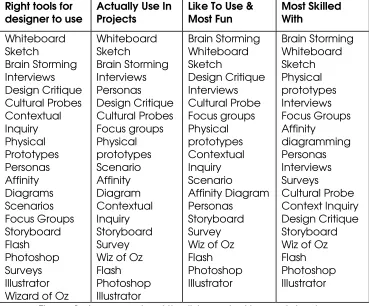
In the interview we asked them what tools they know and are used in interaction design, and had them create a list of tools on post-it notes. They were introduced to our notion of “tool” as a broad concept that includes anything from a simple artifact (as a pen) to more complex tools (such as theories) that a designer may use as support in the design process. After this step, they were asked to arrange the tools based on some questions asked. The questions asked were (i) what do you consider to be the right tools for interaction designers to use, (ii) what tools do you actually use in a design project, (iii) what tools do you most like to use, and (iv) what tools are you most skilled with. (See Figure 1 for an example of an interview).
Right tools for designer to use
Actually Use In Projects
Like To Use & Most Fun Most Skilled With Whiteboard Sketch Brain Storming Interviews Design Critique Cultural Probes Contextual Inquiry Physical Prototypes Personas Affinity Diagrams Scenarios Focus Groups Storyboard Flash Photoshop Surveys Illustrator Wizard of Oz
[image:7.595.145.514.434.740.2]Whiteboard Sketch Brain Storming Interviews Personas Design Critique Cultural Probes Focus groups Physical prototypes Scenario Affinity Diagram Contextual Inquiry Storyboard Survey Wiz of Oz Flash Photoshop Illustrator Brain Storming Whiteboard Sketch Design Critique Interviews Cultural Probe Focus groups Physical prototypes Contextual Inquiry Scenario Affinity Diagram Personas Storyboard Survey Wiz of Oz Flash Photoshop Illustrator Brain Storming Whiteboard Sketch Physical prototypes Interviews Focus Groups Affinity diagramming Personas Interviews Surveys Cultural Probe Context Inquiry Design Critique Storyboard Wiz of Oz Flash Photoshop Illustrator
Based on this informal study, and in relation to the conceptual work on our framework, we came up with some insights. It was quite obvious that what these interaction designers see as the ‘right’ tool to use is not the same as what they actually use, even though there are overlaps. Maybe the most noticeable example is ‘user research’ which by many was seen as the right thing to do, but few actually do.
The study also showed that even though designers know about tools and what they are ‘supposed’ to be used for, the way they use tools are quite diverse and creative. This resonates with the study by Newman & Landay (2000). The relationship between a specific tool and its intended use is complicated and not as straightforward as it commonly is described.
All this opened up for the notion of the interaction design as a craftsperson, someone who picks and chooses tools freely based on the situation and grounded in a judgment of overall benefits from using a specific tool. It was also clear that the ‘benefits’ have to do with so diverse aspects as the time available, the level of skill and mastery required, external pressure about standards, personal style of expression, etc.
Second Study
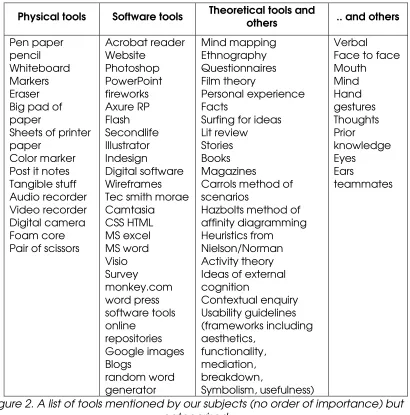
Figure 2. A list of tools mentioned by our subjects (no order of importance) but categorized.
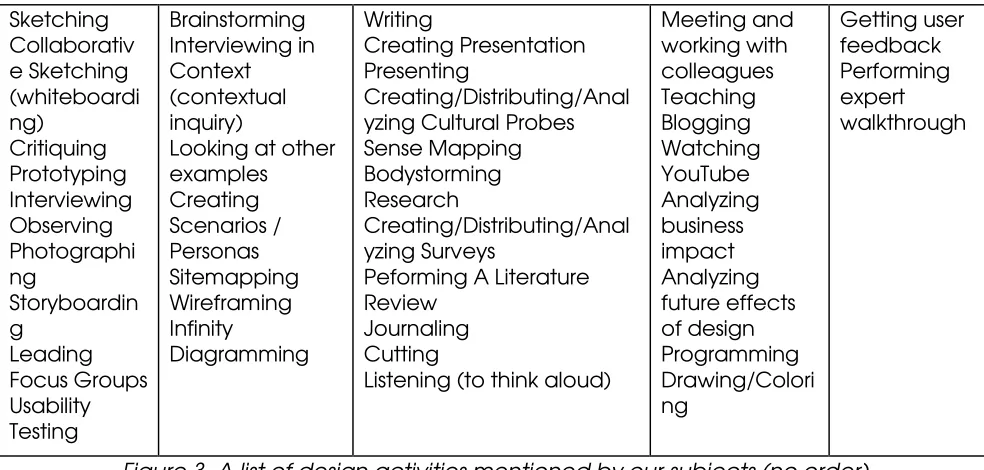
This study was done as a small survey with eight subjects. We asked them to identify tools for about 40 different design related activities (Figure 3). The purpose was not to have a complete list of activities that designers exercise, but to see how the designers did assign tools to activities. At this stage we are still not aiming at finding our the best list of either activities or tools, our studies have been more aimed at probing the way these designers think about tools and activities and the relationship between them.
Physical tools Software tools Theoretical tools and
others .. and others
Pen paper pencil Whiteboard Markers Eraser Big pad of paper
Sheets of printer paper
Color marker Post it notes Tangible stuff Audio recorder Video recorder Digital camera Foam core Pair of scissors
Acrobat reader Website Photoshop PowerPoint fireworks Axure RP Flash Secondlife Illustrator Indesign Digital software Wireframes Tec smith morae Camtasia CSS HTML MS excel MS word Visio Survey monkey.com word press software tools online repositories Google images Blogs random word generator Mind mapping Ethnography Questionnaires Film theory Personal experience Facts
Surfing for ideas Lit review Stories Books Magazines
Carrols method of scenarios
Sketching Collaborativ e Sketching (whiteboardi ng) Critiquing Prototyping Interviewing Observing Photographi ng Storyboardin g Leading Focus Groups Usability Testing Brainstorming Interviewing in Context (contextual inquiry)
Looking at other examples Creating Scenarios / Personas Sitemapping Wireframing Infinity Diagramming Writing Creating Presentation Presenting Creating/Distributing/Anal yzing Cultural Probes Sense Mapping Bodystorming Research
Creating/Distributing/Anal yzing Surveys
Peforming A Literature Review
Journaling Cutting
Listening (to think aloud)
[image:10.595.82.574.84.319.2]Meeting and working with colleagues Teaching Blogging Watching YouTube Analyzing business impact Analyzing future effects of design Programming Drawing/Colori ng Getting user feedback Performing expert walkthrough
Figure 3. A list of design activities mentioned by our subjects (no order)
Based on this study, our notion of ‘tool’ and ‘activity’ and their relationship became more concrete and we realized that it is a complex and rich relationship. We also ended up with both a list of tools (Figure 2) and a list of activities (Figure 3) that we will continue to work with in future studies.
Results and Discussion
We will here briefly discuss some of our results. We have already mentioned some of the results we have identified and it is important to remember that our Tools-in-Use model presented above is itself a result of our studies. The
observations discussed below are still at an early stage and we have not developed them conceptually to fit our framework yet, that work is ongoing.
Tools for ‘thinking’ and tools for ‘outcome’
[image:10.595.221.437.594.673.2]Designers in our study talked about their tools as either supporting them in their design thinking or as a tool that helps them to produce a specific artifact (see Figure 4). For example, a sketching tool can be valued based on the quality of the sketch it produces, or it can be judged based on how well the tool helps the designer to think about the problem.
Figure 4. Two ways tools are used, supporting ‘thinking’ or supporting ‘outcome’
help the designer produce something with certain qualities. It is possible to see this difference in how the results from these two tools are handled. The
whiteboard sketches are usually erased after a session while the Photoshop sketches are for further use.
However, it is more complex than that, and this is where our Tool-in-Use model can help our analysis. How to understand these individual tools is not only a question of the tool, it is also highly related to the activity and the purpose. For example, whiteboard sketches can be photographed and used in a
presentation, thus giving the ‘thing’ that is created more lasting value, and sometimes the purpose of using Photshop is not to create something lasting, but to support a form of “playing” with ideas, more like pen and paper sketching. This tight relationship between the tool, the activity and the purpose makes any analysis of designerly tools complex.
It is also clear that these relationships are determined in each particular case by the individual designer. From our study it was clear that different designers use tools in different ways depending on their education, skill set, and
background.
What designers think they ‘should use’ vs. what they actually use.
Based on our interviews, we came up with a list of top five tools that
interaction designers thought ‘should be used’ versus five that they ‘actually used’. This finding is a confirmation of what has been found in other studies, which is that practitioners have a sense of what is the ‘correct’ way of doing things while they experience a practice that leads them to use other tools. There are several explanations to this discrepancy. Some of them are due to time constraints, familiarity with tools, pressure from organizational standards, etc. A good explanation and deeper discussion on the causes for these observations and reports from similar studies can be found in Rogers (2004).
As our tools-in-use model implies, sometimes the choice of tool comes first, maybe due to a sense of mastery. That choice will influence what activities the designer sees as important and it might as well influence what will be considered as the purpose of the process. Based on our studies, we suspect that in many cases the choice of tools are not guided by a careful
understanding of purpose and what activities are necessary, instead the first decision a design makes about a process can be about any of the three; purpose, activity, or tools. This is a view that goes against the idea of a rational design process where the purpose should be decided first, which should lead to what activities need to be performed to achieve the purpose and then appropriate tools should be chosen based on those activities and purpose. However, a close look at practice with a sincere respect for what practicing designers actually do seems to reveal a different way of doing things. This resonates with the way design is understood by some design researches (Krippendorff, 2006; Schön, 1987; Nelson & Stolterman, 2003).
Designerly tools and theoretical approaches
In our studies we found that tools and theoretical constructs are not
considered to be that different. In the beginning of our study we separated
theoretical approaches are seen as more ‘research’ based ways of
approaching a practical design problem. In our study we saw that designers talk about tools and theoretical approaches almost in the same way, and they pick the ones that are most useful to them at that time.
For example, when a designer is approaching a situation, it can be with the help of a physical tool and a theoretical tool. He can use a camera (tool) to record the events during observations but he can also use activity theory as a lens to view the situation. The way designers talk about theories (activity theory, situated action, distributed cognition, etc.) as ‘lenses’ support our notion that they approach and see theories as tools.
This observation makes it possible to better understand the list of tools that we came up with. That list consists of everything from the pen to complex
theoretical approaches. If we relate this to our model, it is possible to see that purpose overrides any other consideration. When either a simple physical tool or a complex theoretical approach helps a designer to accomplish a purpose, it leads to certain activities. Each tool influences what activities are
conducted and through that influences the purpose.
Design is for the designer a pragmatic and situational process. It is never about what is the ‘correct’ way of doing things, it is all about “what can I use that help me reach my purpose”.
Implications for design education
We will here simply state that the discrepancy between what designers think is the ‘correct’ tools versus what they actually use, is something that could have serious consequences for design education. Since design education deals a lot with design tools, there is a need for each design field to ask questions around their own practice and the tools used in their field, such as: How are tools taught in our design education? Do designers feel as if they are using the ‘wrong’ tools in our field, and if so, why? What does it mean for designers and their practice to have this feeling of using ‘wrong’ tools? What is it that
distinguishes ‘correct’ but not used tools, from ‘wrong’ but used tools? And there is also a question of pedagogy, maybe this discrepancy is not a
question of the tools themselves but a result from the way they are introduced and taught.
Conclusions
The observations that we have discussed above are just a few of what we have found in our first studies. It is again important to state that we have not tried to examine the nature of specific tools, or to explain in detail how and why designers use tools. The purpose of our work has been primarily
exploratory and we have tried to stay open to the reality as experienced and expressed by interaction designers when they reflect on their own practice. Our aim for the future is of course to continue this work and to develop a deeper understanding of designerly tools and their use.
We will end this paper by commenting on some more general observations from our work that we believe have implications for future work.
This means that if a tool is developed in a research setting it seems as if the tool to a larger extent reflects aspects of research methodology with its focus on theoretical sophistication and methodological rigor, while developed in practice it reflect existing practice with its focus on usefulness and relevance. This is not strange or new, but it shows the need for what we label as rationality resonance (Stolterman, 1984). Rationality resonance points to the idea that useful design tools, need to reflect a rationality that is in resonance with what designers experience as the rationality underlying their practice. A designer will or can only recognize and appreciate a tool if it resonates with what the designer is experiencing as the logic and rationality of their own practice (Stolterman, 2008). The requirement for rationality resonance is a must for those who develop new tools for design and it creates a crucible for what is possible to do.
Nature of tools. One observation about tools has to do with the assumption we presented early in the paper, that is, the distinction between tools
intended to describe and explain (analytic) versus tools that are intended to bring things together (synthetic). Even though we have not examined this is detail in our studies, we do believe that our results show some support for this claim. Tools that are used by designers and liked by designers in most cases seem to be more suitable for synthetic activities. However, we do not claim that we can show this yet, but we think it would be worthwhile to examine this in more detail. A second observation has to do with the skill and competence of a designer. We have found that the tools that designers seem to
appreciate as useful, in most cases require quite sophisticated experience, skill, and judgment to be executed well, or with one word--craftsmanship. It seems as if tools favored by designers are not easy to use. In many ways these tools are easy to understand, but difficult to master. These tools are more like instruments that need to be in the hands of a highly skilled crafts person, for example, a pen. The tool do not guide the user of the tool, instead it can be used to do many things, but to be used in an efficient and intentional way they require skill and judgment, that is, design craftmanship. We see this observation as an interesting research field of its own since we believe that a deeper understanding or tools and a better way of categorizing tools would help the furthering of any design practice, and even more design education.
The overall contribution of this study is the proposed framework that, when further developed will make it possible to better understand and categorize tools for design. We would argue that this kind of knowledge is needed for both teaching purposes and for those who plan to develop new tools for design.
References
Bailey, B.P., Konstan, J.A., & Carlis, J.V. (2001). Supporting Multimedia Designers: Towards More Effective Design Tools.In Proc. Multimedia Modeling:
Buxton, B. (2007). Sketching User Experience – getting the design right and the right design. Morgan Kaufman.
Clemmensen, T. (2005). Community Knowledge in an Emerging Online Professional Community: The Case of Sigchi.dk. Knowledge and Process Management, 12(1), pp. 43–52 .
Cooper, A., Reimann, R. & Cronin, D. (2007). About Face 3, (3rd edition). Wiley.
Cross, N. (2001). Designerly Ways of Knowing: Design Discipline Versus Design Science. Design Studies, 17 (3), pp. 49-55.
Krippendorff, K. (2006). The Semantic Turn – a new foundation for design. Taylor & Francis.
Landay, J.A. & Myers, B.A. (2001). Sketching Interfaces: Toward More Human Interface Design. Computer, 34(3), pp. 56-64.
Lin, J., Newman, M.W., Hong, J.I., & Landay, J.A. (2000). DENIM: finding a tighter fit between tools and practice for Web site design. In Proceedings of the SIGCHI conference on Human factors in computing systems, (pp. 510-517).
Löwgren, J. & Stolterman, E. (2004). Thoughtful Interaction Design – A design perspective on Information Technology. MIT Press, Cambridge, MA.
Mao, J.Y., Vredenburg, K., Smith, P.W., & Carey, T. (2005). The state of user-centered designpractice. Communications of the ACM, 48(3), pp. 105-109.
Nelson, H. & Stolterman, E. (2003). The Design Way – Intentional Change in an Unpredictable World. Educational Technology Publications.
Newman, M.W. & Landay, J.A. (2000). Sitemaps, storyboards, and
specifications: A sketch of web site design practice. In Proceedings of the 3rd conference on Designing interactive systems: processes, practices, methods, and techniques, (pp. 263-264).
Rogers, Y. (2004). New Theoretical approaches for Human-Computer
Interaction. In Annual Review of Information, Science and Technology, Vol. 38, (pp. 87-143).
Rosson, M.B., Maass, S., & Kellogg, W.A. (1988). The designer as user: building requirements for design tools from design practice. Communications of the ACM, Vol. 31, (pp. 1288-1298).
Schön, D. A. (1983). The Reflective Practitioner. New York, NY. Basic Books.
Stolterman, E. (1994). The transfer of rationality - adaptability, acceptability and the transparency of methods. In Baets, W. (eds). Proceedings of the second european conference on information systems. Nijenrode University Press, Breukelen.
Stolterman, E. (2008). The Nature of Design Practice and Implications for Interaction Design Research. International Journal of Design, Vol. 2 (1).
Sutcliffe, A. (2000). On the Effective Use and Reuse of HCI Knowledge. ACM Transactions on Computer-Human Interaction, 7(2), pp. 197-221.
Erik Stolterman
Erik Stolterman is Professor and Director of the Human Computer Interaction Design program at the School of Informatics, Indiana University. Stolterman’s research is focused on interaction design, philosophy of design, information technology and society, information systems design, and philosophy of technology. Stolterman has published over thirty articles and five books, for instance “Thoughtful Interaction Design” (2004, MIT Press) and “The Design Way” (2003, ITP) and “Methods-in-Action” (2002. McGraw-Hill).