University of Warwick institutional repository: http://go.warwick.ac.uk/wrap A Thesis Submitted for the Degree of PhD at the University of Warwick
http://go.warwick.ac.uk/wrap/74145
This thesis is made available online and is protected by original copyright. Please scroll down to view the document itself.
THE PARTIAL CORRELATION FUNCTION IN THE
IDENTIFICATION OF NON-LINEAR SYSTEMS
and
AN
EYE
POSITION TRANSDUCER.ToM.W .WEEDON.
This thesis, being a report of research carried
out under the direction of Professor J.L.Douce,
B.Sc., M.Sc., Ph.D., D.Sc., F.I.E.E., C.E., is
subBitted to the University of Warwick for the
degree of Doctor or Philosophy.
Abstract.
Section 1.
A correlation technique is developed which enables the identification of systems belonging to a restricted class of
non-linear systems. The method is applicable to a syst~ which may be
represented as a single-valued, instantaneous, ti~e-invariant
non-linearity followed by linear dynamics. The characteristic of the
non-linearity and the impulse response of the linear element are
found simultaneously in a single eA~eriment.
A class of pseudo-r~ndom test signals is studied, and results are derived for sorne situations in which the results are contaminated
by noise.
Further work is required to extend the applicability of the
·technique, to compare its performance with other methods of
identifi-cation, nnd to investigate alternative test signals.
Section 2.
A simple eye-position transducer is described, which measures
eyeball rotation about two axes.· Dependine upon the characteristics
of the subject's eye, and the operating conditions, an accuracy of as
good as
!
5%
may be obtained over a range of 120.The user wears a light-weight infra-red optical-electronic
device on a spectacle frame. The transducer exploits the variation
in infra-red reflectivity over the surface of the eyeball, and
therefore varies in its performance from one subject to another.
It may be used by some subjects in all liehting conditions except
. direct sunlight.
Further work is needed to e~lminate the deficiencies of the
device, but an investigation into television techniques, which are
Seotion 3.
The experimental determination of the region of asymptotic
stability of a second order time invariant system may be considerably
simplified by taking advantage of the nature of the trajectories
Yhich form the boundary of the region. These trajectories are found
easily by reverse time simulation.
Further york is possible to investigate the extension of the
Acknowledrnent
I Ba grateful for the continuous help of ~y supervisor
Professor J.L.Douce, and for the support of the Science Research
,·Council. Also for the help and encouragement froTllTlY Tlany friends,
I
including those nentioned below, to all of wh~ I say 'Thank you'.
HR.L .BUD1ER.
MINISTRY OF AVIATION (R.A.E. BEDFORD)
UNIVERSITY OF 1"AR1VICK (ELECTRONICS WORKSHOP) UNIVERSITY OF 'tlAR~VICK (SCIENCE LIBRARIAN) UNIVERSITY OF T.fARWICK
UNIVERSITY OF ~"AR~VICK(SCIENCE LIBRARIAN) HINISTRY OF TECHNOLOGY (N.P.L.)
MINISTRY OF TECHNOLOGY (N.P.L.) UNIVERSITY OF l.fARWICK
HR.B.D.ARMSTRONG. MR.J .L.BAKER.
MR.J.K.CANf'(ELL. . MR.J .DAVIES.
MR.K.R.GODFREY. MR .P .H .HANHOND• DReM.T .G .HUGHES.
MRJ·f .S.HUNT. UNIVERSITY OF WARWICK
MR.R.L.HYDE. BRITISH AIRCRAFT CORPORATION
MR .H .S .P .JONES •
DR.K.C.NG.
UNIVERSITY OF WAR~aCK
UNIVERSITY OF WAmaCK (ENGThTEERING WORKSHOPS)
UNIVERSITY OF ~vARWICK UNIVERSITY OF ~.fAR~lICK MR.A.J.McINTYRE.
MR.P.C.PARKS.
PROF .J .G. THOHASON• I.C.I.
ABSTRACT
LIST OF CONTENTS
INTRODUCTION
SECTION 1. THE PARTIAL CORRELATION FUNCTION in the
identification of non-linear s.ystems.
. . '
Chapter 1. Introduction. 1
"
..
-1.1 I~pulse testing by cross correlation.
•
.Chapter 2. The Partial Correlation Function. 5
6
2.1 Definitions of Partial Correlation Functions.
2.2 The Use of the Partial Correlation Function 10
2.5
in the Identification of Non-linear .Systems.
Quantised Signals.
Periodic Input Signals.
Periodic, Quantised Input Signals.
11
12
14
Chapter 3.
3.1 Realisation.of a Test Signal for
Identification.
The p-1eve1 m-sequence.
15
16
3.3 Identification Using the p-leve1
m-sequence. 21
3.4 The Power Spectr~ of the Output of a
Non-linearity with p-level II-sequenceinput 23
Chapter 4.
Identification in the Presence of Noise
31
4.2 Identification of a System when the Input
Test Signal is Contaminated By Noise
4.3 Identification of a Non-linear SystellWhose
Chapter 5.
References.
Ap~endix 1.
.App()ndix2.
Appendix 3.
Appendix I..
Appendix 5.
Appendix 6.
Appendix
7.
Appendix 8.
Identification Using a p-level m-sequence
~hen the System Output is Contaminated
by Noise.
35
39
1.0
Conclusion.
The Partial Correlation Function of the
Input and Output of a Non-linear System. 1.1
The Cross-correlation Bet~een the
Co~ponents of a p-level m-sequence. 43
1.9
Identification Using a p-level m-sequence.
The Auto correlation Function of the Output
of a Non-linearity with p-level m-sequence
Input. 52
The Power Spectrum of a Signal Having a
Periodic Spikey Autocorrelation Function.
Identification of a Non-Linear System ~hen
Measurements of the Output are Contaminated
by Noise. 59
The Autocorrelation Function of a Clocked
Signal.
62
Identification of a Non-linear System ~hen
the Input Test Signal is Contaminated by
SECTION 2. AN EYE POSITION TRANSDUCER.
Chapter 1.
Chapter 2.
Introduction.
The Design and Development.of a Transducer
Based on the N.P.L. Version of Young's
Instrument.
Design of the Geometry. 2.1
2.2 Modification for Use in Any Lighting
Condi tiona.
Modification for Use in Two Dirtensions.
Practical 'Work.
Observations ",ith the Eye Position
Transducer, and with the Infra-red
Inage Converter.
3.2
Prelininary Experi~ents in TypewriterChapter
3.
3.1
Control •.
General Experimental Observations.
Chapter
4.
Conclusion.References.
Appendix 1. The Common Area of Two Circles.
Appendix 2. Linearity.
SECTION 3. EXPERD1ENTAL DETEm1INATION OF THE REGION
OF ASD1PTOTIC STABILITY BY
REVERSE TIME
snruLA
TIOM •68
74
77
82
84
8;
8;
87
89
90
92
93
97
i
INTRODUCTION.This thesis is co~posed of three sections. The first describes
work on the identification of a class of non-linear systems by a
cross-correlation technique. The second describes an instru~ent for
the Beasur~ent of eyeball position. The third consists of a paper
published in 'Electronics Letters' on an experimental method of
dete~ining syste~ stability.
Except where indicated, all of the work was carried out at the
SECTION 1.
I.
Chapter 1.
An engineer designing a controller for a given plant needs to know
the characteristics of the plant, in terms of some relationship between
its input and output, before he can achieve satisfactory performance
from the s.ystem of plant and controller. The more stringent is the
specification for system performance, the more detailed, and the more
accurate
.
.
must be his knowledge of the plant. By considering the nature of the plant he will be able to construct a theoretical model of theplant. Depending upon the extent of his initial knowledge, he will
then need to carry out an experimental investigation to determine the
suitability and parameters of his model. This is one example of the
need to 'identify' a system; to find experimentally the relationship
between its input and output.
If the plant is a linear system, it may be characterised by its
frequency response, or by its impulse response. The two characterisations
are equivalent, and each may be found from the other. Also, each may be
related to the theoretical model in terms of a differential equation.
This suggests two possible approaches to the identification of the plant.
The first is to generate a sinusoidal input to the plant and measure the
resulting gain and phase. By carrying out this procedure for all input
frequencies the frequency response of the system is found. The second
is to measure (as a time function) the output in response to an impulse
input.
Unfortunately both methods have severe disadvantages. Sine wave
testing is a very lengthy process, as the plant must be allowed to
settle to a steady state after the application 6f each new frequency.
Impulse testing must be carried out with very low input signal levels
otherwise the plant may be driven outside its region of linear operation.
Frequently economic consideration3dictate that the plant should remain
in service while the identification is performed. This means that the
2.
that the test signal must be kept to a very low level to maintain
satisfactory limits on the plant output. The signal to noise ratio may
be very small therefore, and reasonable results may only be obtained by
averaging over many observations.
Consequently, indirect methods have been developed to find the
impulse response of a linear system. As the time derivative of a unit
step is a unit impulse, for a linear S,ystem, the impulse response is
the time derivative of the step response. Step response testing still
gives a poor signal to noise ratio for the high frequency components.
1.1
3.
Impulse Testing hy Cros~-correlation.
~(t)
Linear System~(t)
yet)
figure 1.1.1
In chapter (2) we define the cross-correlation function, a
measure of the dependence of one signal upon the past values of
another. ~.Jealso define the auto-correIa ti on function which is a
measure of the dependence of a signal upon its own past value. It
can be shown (see, for example, Douce 1 Chapter (6) ) that the
cross-correlation function of the input and output of a linear system
is the convolution of the auto-correlation function of the input and
. the impulse response of the system. That is, for the system of
figure (1) CD
S:;Xy(r) =
L
W(I> !h:r(T-v)d.v 1.1.1Where ~v(t) is the system impulse response
~Iy(T) is the cross-correlation function of x(t) and yet) A random signal has an auto-correlation function which is
impulsive, because its current value is independent of all its past
values. ~e can see from equation (1) that if x(t) is a random signal,
then the cross-correlation function of the input and output is the
impulse response of the system.
~y(r)
=
WeT)when
~X(T)
=
aCT)
We have therefore, an indirect method of finding the impulse
response of the system, summarised in figure (2)
x(t) Linear System yet) Correlator ~.,(T
wet)
I
)
Random Signal.
The normal operating input of the plant may well be a random
signal, and therefore suitable as the input test signal. As the
auto-correlation function of a short length of a rand~ signal is not
necessarily impulsive, an experiment using the operating input must
be very carefully designed, and the statistics of the input signal
monitored over the time period of the experiment. This may be
,
overcome by introducing a test signal which is deterministic and has
statistics (notably its auto-correlation function) similar to that of
a truly random signal. In section (3.2) we meet a class of deterministic
signals which, in addition to having kno~n statistics over a short sample,
Chapter 2.
In chapter (1) we saw hm~ by correlation we could find the
impulse response of a linear system. In this chapter we will
define the partial correlation function and see how it may be used
(2.1) Definitions of Partial Correlation Functions.
Consider two signals, each a function of time, x(t) and yet)
The cross-correlation function ~y (T) is a measure of the dependence
6,
of the value of y(t+T) upon the value of x(t). It is defined by the
relationship
00 00
~y
(T)
=
J J
X.Y.p(X,Y,T).dX.dY 2.1.1_co ..00
where p(X,Y,T) is the joint probability density function of
x(t) and y(t+T). That is,
P[X" x(t) < (X +
Sx)]=
p(X,Y,T).SX.SY Y ~ yet) < (Y + SY)SX, Sy .. o, •
*
We may rewrite equation
(1)
asco 00
~y (T)
=
J
X [J
Y.p(X,Y,T) dYJdX
"00 ..co
Let us now consider the term in curly brackets. This we will call
the partial cross-correlation function, ¢Xy(T,X). Clearly the
partial cross correlation function is a function of the time shift T,
as was
~xy(T),
and is in addition a function of the value of X for whichit is evaluated, as a result of the dependence of p(X,y,T) on X.
We now define the partial cross-correlation function ¢Xy(T,X) of
x(t) and yet) with respect to x(t) as 00
~.v
(T,l)~~I'P(X'Y'T)
dY
and it is clear from the definition that co
!xy
(T)
=
J
X.~xy(T,X)
dX---2.1.2
-00
*' The symbol P
I ••• )
is used to mean litheprobability that thestatement in curly brackets is true".
H Equations are numbered starting from 1 in each section, with the
'section number as a prefix. tVithin the section the prefix is omitted.
1-Physically, ~xy(T,X) is the expected value of y at a time T after
x
=
X. It is the function which West2 calls the 'ti~e dependent meandensity function'. If x has a mean value that is zero, then
~Xy(T,X)
becomes Nuttall's g-function~
We will nryJ define a component signal, a(t,X), of x(t) such that
a(t,X).oX
=
1,x ~
x(t) < X +oX
oX
-+0
=
0, other"Jise 2.1.4X~b'<
X
I II
I I I t
I , I I I
I,
1/
"by. r :r-.,
tr-~ __ ~~u_ __ ~ __ +- ~
c
figure 2.1.1
from this definition we see that co
x(t)
= _[
X. a(t,X).OXIf x(t) is an ergodic process, the probability that x lies between
X and
(X
+oX)
isoX.Px (X)
=
limit1
t
SX. aCt,X) .dt·T-+oo 2T -T
and so Px (X)
=
limit1
J;
a(t,X) dtT-+oo 2T
2.1.6
"
where
Px
(X) is the probability density function of x,P
Ix ~
x < X +cSxl
=
SX. Px(X)now,
a(t,Xd. a(t+!,X2). OX2
=
1, [X1 ~ x(t) < X1 +sx
X2 ~ X(t+T) < Xa + OX
=
0, otherwise8
so it follows that for an ergodic process
T
Px (X1,X2,T).OX2
=
1i:init:..1
!
a(t,Xd.a(t+T,X2) OX~ dtT .. '0) 2T -T
and
T
=:
lirtit1
1
a(t,Xd. a(t+T,X2).dt- T ""0:>2T -T .
where Px (Xl,X2
,T)
is the joint probability density of x(t)and X(t+T).
Let us now return, from OGr digression on component signals, to the
correlation functions. If x(t) and yet) are ergodic processes, then
we may write their cross-correlation, ~y(T) as
T
thy (T)=:li::1it
11
x(t).y(t+T)dt, T'" eo 2T -T
2.1.8
and by substituting equation (5) into this expression
, TO).
~y (T)=·l~mit'].
1!
X.a(t,X).y(t+T)dX.dtT .. 0) 2T -T-co
1
0) T=
X [lirriit1J
a(t,x).y(t+T)dtJ dX_ co T .. co 2T -T
clearly the term in curly brackets is the cross-corrolation ~ay(T)
between a(t,X) and yet) co
~Y(-r:)
=
L
X giaY(T) dXComparing equations
(3)
and(9)
we see thatPXY (T,X)
=
!1iaY(T)where !1iay(T) is tho cross-correlation function between
a(t,X) and yet)
Hence, if x(t) and yet) are ergodic,
f/>:ty (T,X)=~lb1it'
l1T
a(t,X)y(t+T)dt, T'':'' Co 2T -T .',
2.1.10
If we now replace y by x in all the previous expressions, we find the
auto-correlation function, !1ixX(T),and partial auto-correlation function,
~XX(T,X),of the signal x(t)
~.c
r)=
J~J~
x••x••~x.,x.,r) .ex ••
dX.-00 -00
2.1.11
00
~xx(T,X)
=
!
X1.P(X,X1,T).dX1- 00
2.1.12
If x(t) is an ergodic process, then
T
~:dT)=~ limit'
1
1
x(t) .X(t+T) .dtT' ....·w·)2T T
~xx(T,X)=:limit
1/
Ta(t,X).x(t+T).dtT-" ·00.2T -T
By substituting equation (5) into (13) and (14),
~X(T)
=
/0I:1°°X1.X2. !l5a1a:a(T).dX1.dX:a -00 -00<i>XX(T,X)=
Joo
X1!15aa1(T)dX1-00
where ~aa1(T) is the cross-correlation between a(t,X)
and a(t,Xd
9
2.1.13
2.1.14
2.1.15
2.1.16
10.
Ihe Use of the Partial Correlation Function in the Identification
_ W' of Non-Linear Systems.
" The partial correlatton. function may be used in the identification
of Borne non-linear systems. These are the systems which may be
represented by figure
(1),
where a single-valued inst~ntaneous non-linearity, defined for all inputs, is followed by a linear system.x(t)
~ y ~ f{x)
Ld~~)J
ott)z(t)
,...
figure 2.2.1
In appendix
(1),
the partial cross-correlation function¢X~(T,X) of x(t) and z(t) is found to be
0) 0)
<P:r~(T,X)::
J
W(v)! f(X1) ~aa1(T-v).dX1.dvJ,l::o X1=-OQ
where ~aa1(T) is the cross-correlation function of the components a(t,X) and a(t,X1) of the input x(t)
If ~aa1(T)
=
0, for all X~1' and all T2.2.1
then, ~
"':t~(T,X) =
rtx) /
W(V).~aa (T-v)dv 2.2.211=0
where ~aa(T) is the autocorrelation function of'a(t,X) ,' ,::,
if,"further, lZiaaer) .has an i:npulsive form,
then,
2.2.3
In practice there is a signal which has properties closely
approximating those of x(t) above, and which we will discuss in
chapter
(3).
Using this signal and a partial correlation process we can identify the dynamics of the linear system, and find theII
Q~ntis~d Signals.
'Nhen the input signal x(t) is quanti sed into, say, p levels
(X
O
,X1, ••••XP-1)' the component signal a{t,X) of x(t) must be zerowhen X~ XL' one of the p levels.
=
0,x
=
Xt=
x(t) ))
otherwise )
l)X. a(t,X)
=
1,We see that a(t,X) is a unit impulse,
a(t,X) = 5(X-XL),
=0
x(t)
=
XL,
otherwi3e)
, )
)
It will be convenient when x(t) is quanti sed to write
XL+S
aCt,i) =
J
a(t,X).dXXt ..
o
where 20 « (Xt- Xt-i)
Xt+S
~xJCr,i)
=
!
~X3(r,X).dXXt-S
from equation (2), we see that a(t,X) is always zero outside the limits
used in equations
(3)
and(4).
We recall that s1>x3(r,X)=
Joo
Z.p(X,Z,r).dZ-0:)
which is zero outside the limits used in equations (3) and
(4)
sincep(X,Z,r) =0,
so in place of equations (2.1.5), (2.1.10) and (2.1.3), for a quanti sed
.ignal ~:
x(t)
=
-0 <px,( r,i)
=
Xl. a(t,i)
T
1i'nit
1...!
a(t,i).z(t +r)dt T .. 00 2T-T
2.3.6
(for x( t).•
~p
ergodic process)~:I.
T)=
rx
to i'.,( T.i) 2.3.7and equation (2;=2~1) becomes .
ifn}.
Toil
=
JM
11(.)r,
1'(X;). "'iaj (T - .)d. 2.3.8o J=o
12.
.
Let us consider the partial cross-correlation function of two
ergodic signals x(t) and Z1(t) with respect to aCt). We found in section
j
(2.1) that this may be written
T
CP:t~1(T,X)
=
limit.L
J
a(t,X).Z1(t + T).dt 2.4.1~' ~ co 2T .
-T .
where a(t,X) is a component signal of x(t)
It x(t) is periodic, with period Tc, then
(.
x(t + NTc)
=
x(t) for all integer NLet Z1(t)
=
z(t) + net)where z(t) is periodic, wi~h period Te, and net) has no component
wi th period Te.
Since Z1(t) is ergodic, and z(t) is ergodic as a periodic signal i~
necessarily so, then net) is ergodic
T
c/>X'J1(T ,X) = limit
L
J.
a(t,X).z(t + T)dtT -> co 2T -T .
T C
+ limit
.L
J
a(t,X).n(t + r)dt2.4.3
T ~ co 2T
-T
Now the first term in equation (3) is the average over.all time
ot
a(t,X) and z(t +T).
Since both signals have period Te, they willmaintain the same phase relationship over all time, and so the average
1s the same as the average over one period. T
T C
limit
1
J
a(t,X).z(t + T).dt=
1
J
a(t,X).z(t + T).dtT ~ co 2T -T
're
o
As net) has no component "dth period Te, the second term in equation (3)
is just the product of the expected values of a(t,X) and net)
T
limit _1
r
aCt,X) .n(t + r)dt=
E {a(t,X)}.E {nCt}}T~O) 2T
LT
Te
8~
J
I~X~1CTJX)
=
1
a(t,X).z(t + T)dt + E ia(t,x)}. E {net)}Te
2.4.4
o
A special case is when net) has zero mean value, equation
(4)
then.beccme e
Tc .
= 1
J
a·(t,X).z(t+ T)dtIn particular, equation (5) holds if net)
=
0, for instance if x(t) and z(t) are the input and output of a noise free system.If net) has zero mean value, the cross-correlation function
~X31(T)
is given by Tc
~31(T)
=
i
f
x(t).z(t +T)dto
2.4.6
It is important to obeerve that it is z(t + T) that appears under the
integral sign in equations
(5)
and(6),
and not Z1(t +T).
Errors occur in estimates, of ¢X31(T,X) or of~X31(T),
based on correlationperformed with Z1 for a finite integration time, since in general
even when E{n(t)}
=
0, Tcf
x(t).n(t + T).dtl- 0This isOtaken into account in appendix (6) where the variance of such
an estimate is found.
In chapter
(4)
we will study the identification of the system of figure(1),
in which the output z(t) is contaminated by noise net).figure
2.4.1
~e see from equation (5) that if net) has zero mean,
q,X~1( T,X)
=
<PX3 (T,X)This suggests that we could use an experimental estimate of 9X3~T,X)
14
2.5
,reriodic, Qu~ntised Input Signnls.•
. !ve will be dealing bter with quanti sed signals which are periodic •
For this case, the results of both sections (2.3) and (2.4) are
applicable, and we will summarize them here in a combined form, for
future use P-l
x(i) =L X t. a(t,i)
a(t,i) t=o x(t) X t
where
=
1,
=
2.5.1
=
0, otherwisex(t)
=
x(t + NTc)2.5.2
where Tc is the period of x(t) and N is any integer
Tc
ct>X3l(T,i)
= 1
J
a(t,i).z(t + T).dt Tco
where z l(t) = z(t) + n(t)
2.5.3
n(t) has z~~ mean, and is uncorrelated with x(t)
~3l( r)
=
X t. cJ>X3l( T,i)L=o
Also, it is obvious from equation (2) that
a(t,i) = aCt + NTc,i)
If W(II) = 0 for v~ Te, then equation (2.3.8) becomes
Tc
Pf1\
~X3(T,i)
=
J
W(v) ~ fj.·~ataj(T - v)dVwhich is the par%ia1 cro~s~corre1ation function of the input and
output of the system in figure (2.2.1), with respect to a quantised,
Chapter
C3l: "
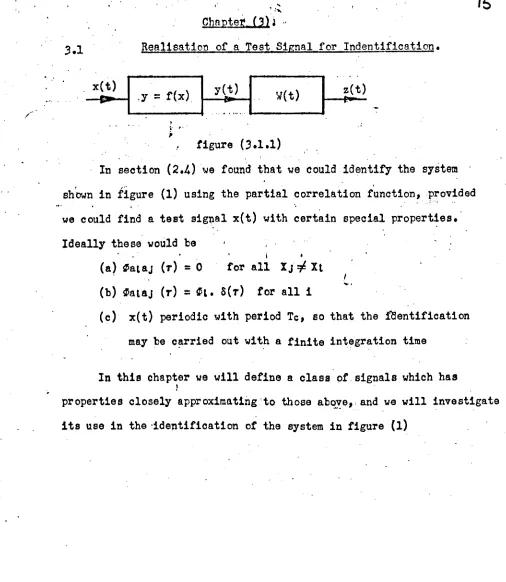
Realisation of a Test Signal for Indentification •
. .~ .7.= rex)
I
y~~ ...1_'_W(_t _)__'I-I_~
...
(t_) .~,
~' ~.;
figure (.:3.1.1)
In section (2.4) ~e found that we could identify the system .
sh'ownin figure (l) using the partial correlation function, .provdded we could find a test signal x(t) with certain special properties.
Ideally these would be
i I
for all IJ ~ Xt
(b) ~alaJ
(T)
=
~L.SeT)
for all i(c) x(t) periodic ~ith period Te, so that the £aentification
,
~,
may be c~rried out wit~ a finite integration time
In this chapter we will define a class of signals which has
!
properties closely approximating 'to those abq_~e" and ,we will investigate
[image:25.542.6.512.14.596.2]Ib
The p - level rn - sequence.
A random number sequence is a sequence of numbers in which each
element is independent of all previous elements. \Je may consider a
particular random signal which is generated from such a random sequence,
,in the follo1~ing way. A generator produces an output which may change
only at the instants when regularly spaced clock pulses are recei~9d by
the generator. The output after the arrival of a clock pulse is independent
of the output before the pulse arrived. Let us find the autocorrelation
function ~rr{T) of the output r(t), when the clock period is A. ~rr(iA)
=
E{r(t).r(t -iA)} for all integer i= E{r(t)} E{r(t -iA)jfor all i~ 0
=
E2{r (t )} for all if:
0!Z>rr(0)
=
Elr2(t)}In appendix (7) it is sh~~n that the autocorrelation function
of a clocked signal changes linearly between T
=
i.)" and T=
(i + 1) A for all i, so we have the correlation function sh~~n in figure (I)The feature at the time origin is defined in appendix (5) as a 'spike',
~nd approximates to an impulse of strength (E{r2(t)} _ E2{r(t)}}.A
~lr. (tlJ
.:i,\(Tl
BJ1{.tJi
:"---I
L
Irjr
-x
0 A Tfigure (3.2.l)
A pseudo-random sequence is a periodic number sequence which
has 'statistical properties approximating to those of a random number
sequence. In particular, the autocorrelation function of a pseudo-random
sequence is similar to that of the random sequence.
Clearly, as the pseudo-random sequence is periodic, its
auto-correlation function must be periodic and so the best approximation that
could be obtained is shown in figure (2) where Tc is the period of the
I:t-j"
---
'\---
- -----
-,
\
"
\
. -. --_.-.. _...
_/
\
__
figure (3.2.2)
I. _
1'0
..~
o
tIn practice it may also have other spikes of various heights
in each period. Of course, if the signal is physically realisable
these spikes cannot be of magnitude greater than the one at the time
origin.
Now consider a register of n stages, each of which has p stable
states. Upon receipt of a (regularly spaced) clock pulse, each stage
adopts the state of the previous stage before the clock pulse. Such a
register is called a p-level n-stage shift register, and is represented
in figure (.'3)
---'. c.leck.
.~..r
·--1---~·-·--·---·~--·-=·-·~-·~
C.-o(""-;l)C-'_''_!
et
j C2I .
.--..----.
r
~'tl'-I
t
r---- ---.----.._...
e , •. ~ - .c,.
shift
figure (3.2.3)
Ot (t) is the state of (and output from) the ith stage at time t.
We may write
dt(t)
=
CL-l (t - A) i=
1, 2, •••• nwhere A is the period between clock pulses.
If the input to the shift register, co(t), is formed by modulo p
operations upon the outputs Cl(t) ••• cn(t), we have a feedback shift
register as represented in figure
(4)
18
!.fe can describe the operation of this device by the equation
Where the symbol
<:....
::>P
is used to mean that the operationsbetween the b~ackets
<
and> are all performed modulo p,If p is a prime, we may choose a1, a2 •••••• an such that co(t)
is a periodic sequence of (pn - 1) elements, in the course of which
every n-tuple (C11 C2 •••• cn) occurs once, except the null n-tuple
(0, 0, 0 ••• 0) and this never occurs. Such a sequence is a
'maximal-length pseudo random p-level sequence
t,
and we will refer to it as a~level m-sequence.
The p-level m-sequence has (p-l) equally spaced spikes in each
period of its autocorrelation function. If the levels Xo, Xi ••• Xp-i
of the output of the shift register are chosen symmetrically about
zero, then the mean value of the sequence is zero and the
auto-correlation function is zero, between the (p-l) spikes in each period.
Some of the spikes may have zero amplitude, for example if (p=4N+l, N
integer) then the spikes at delays of one quarter and three quarters
I
of a period are of zero amplitude.
Figure (5) is an example of the autocorrelation function of a
p-1evel m-sequence. In this case p = 3, so there are jus·1;two spikes
in each period of the autocorre1s.tion function.
fc.:("(,)
IS
-18
Autocorrelation function of a 3-level m-sequence of length
(33 - 1)
=
26] clock periods.In appendix (2) the cross-correlation functions of the components
of the p-level m-sequence are found. The results are shown in figure
(6) for the general case.
'+--1:
__.1::: H:i ·t...•••••••»,. .it:
• 1 ~ .
!::: :;;1;:: '::'.. ;;::
·-1"
.,:: ::i: ;,; :::. ';;; ;:::.1.1 '" ••••••••.•••7TTI
I" ••"ITT"
,1;-;," :r;;••••,., .,j ,"1'·' .,.. ,.
·l-:'~i,.·
"i:' . 'I'"
• I ~•
·:··1·:· ::::1:::
::::k
::::1:: .. ~. ' t··.
:: :n:
••• ,1.
'11' '." .".,' j;;: :::, :::: .. '
r
ItI li!1 f'!!'!"il'l' ,':[:11::: ::;: :::; 'i:: .: , Ht! i;"IHl11 !n:
, mt
ni Ht :';11::: .;;i !::; ; ;: :it :jf! ;. 1 rtt: , ..tt '".t
!
t lid (II ::11;:1: :::: ::,: :::: :::; :, : ;:P 1:1' t:!l :P:i ! t ~ 1t:.. ;;:: .::: ::;; :~:: ;~;''! i :It: .:.!r:r: ::;: ., ..
l!;: j:j: t:
"'1
,1'1 ;11:
:II :,.:n: :"
.' ,t~,
.: t:':
21
Identification Using the p-level m-sequence.It is clear from figure (3.2.6) that the p-level m-sequence
does not meet our specification for a test signal. The cross-correlation
between any two components is the sum of a non-zero constant, and a
function yhich has spikes for T
=
o,~,
2 Te etc p-l p-lHowever, consider the identification of the system in section (2.2).
For a periodic quantised input signal x{t), and a noise free system,
the input-output partial cross-correlation function ¢xJ(T,i) is given
by equation {2. 5.~ as -1
. <1',.
(T,i)=
J
C \1(V)! fj.~'L
OJ(T - v)dvo j=o
yhere W(I)
=
0, IJ ~ Te~aLaJ{T) is the cross-correlation function of a{t,i)
and a(t,j)
fi
=
f(Xt)The constant term in ~ataj(T) produces a term CL in ¢x3(T,i) which
is independent of T but dependent on i. Ci depends upon the characteristic
of the non-linearity a~d upon the integral
e
.
J
T,.[{IJ) dll. 0
and is therefore unknown.
We see that if 1,.1(v)
=
0, forv ~ ~),
then over the range p-lo
~T<..I£. , the spikes in ~ataJ(T) which are not at the origin bave p-lno effect.
Hence, if W{v)
=
0 for v 7 (~) we can use the p-level m-sequence for p-lidentification, but we will have to remove the constant term Ct. We
will see later how to achieve this.
In appendix (3) ye derive an expression for ¢x3{T,i) in terms
of the parameters of the m-sequence, and those of the system, with the
result· n 1 [
¢X3{T,0)
= ~
·(r(o) - fav).~(T)p -1'
fTC
J
. + (fav -
.ficl)
W(II )dllpll_l
o
~xJ(r,i)
= ~~
[eft - fav)W(r)
1Xtlo p -1
provided that (1)
W(r)
has aTc
+ fay / W(V)dV].
o
(2) W(r)
=
0,settling time long compared yith A
r
1~~1)~1}
1\
and where fali
=
1:
L
fjp .
J
If ye were mechanising the identification on a digital computer, we
would compute
¢X3(~'
i) for k=
O,l, •••m.where
ni
=
pn - 1I
-p-l
'hA
and since we have assumed that W(~)
=
0,~:ra(lv\,O)
=
p~-1[(f(O) - fay·).W(~)p -1
~:r3(1~,i) = 'p~-1
[(£t -
fav).~"(kA)
+xtlo
p -1m
+ (fay - ~Ol) \' 1-1(jA)] P -1 ~
JTI_ J=O
fay
L
W(jA)]J=o
3.3.5
It is clear that
for all k, i
If we form a matrix of measurements [Mkt] such that
Mkt
=
pn_l[4>:J:
a(kA,i) - <ha(mA,i)]pn"'1
then Mkt
=
W(lv\). (fi-fay' 3.3.7Now we have the same information as we would have had if we
had performed the identification with our ideal test signal, except
that ye are unable to find fay from MtJ.
We are unable to find the equivalent gain ot the non-linearity
either from equation (7) or from equation (2.2.3), but this is
3.4
The Pover Spectrum of the Output of a Non-lineari ty .~ith..l?=levelm-sequence input.
..
p-level n-stage instantaneous
feedback
shift-xlt) single-valued
y(
t) }orregister non-linearity
clock period I~ y
=
f(x)figure
3.4.1
Consider the system of figure
(1).
We assume that thefeedback connections to the shift-register have been made such that
x(t) is an m-sequence of period Te,
Te
=
(pn_l)",In appendix
(4)
we found the autocorrelation functions ~xx(T) and gyy( T) for this case. When p >2, ~y( T) was found for T an integer~y( T)
=
p~-2[7jlqT1 P -1 (a) fJ
=
f(XJ)where
(b) T1
= ~
p-1
(c) q
=
0,1, •••• p-2(d) B is the delay gain bo which corresponds to T1(see appendix (2) )
We see from equation (2) that when the average value ~ ~ tt of
t=o
the non-linearity is zero, and when it has zero output for zero input,
then there is no constant level in the autocorrelation function of
yet).
Generally this will not be so, and there will be a constant level d in
the autocorrelation function 9yy(T), given by equation (2)
From equatlon
(1)
we see that spikes occur regularly at delays",Kq, q
=
0,1, •••• having heights Hq (see figure (2), so thatHq
=
pn-1 [\=~f«Bq Xt)p).ft-1 (~
ft)2J
pn_l
L
pL
2.4-'fhe power spectrum Gllyy(W) of yet) is the sum of an impulse
of strength d at zero frequency, due to the constant component d, and
G'yy(w), the power spectrum of the spikes alone. G'yy(w) was found in
appendix (A. 5)
G"yy{w)
=
d.S(w) + G'yy(w)where (a) G'yy(w)
=
sinc2t.h\
.Gyy{w)Tc
(b)
(c)
0-3
....,.._
Gyy(w)
=[
Ho+(-1)hHp;'.
+ 2 ~ Hq.gyy(w,Kq)J
gyy(w,Kq)
=
1
.Cos 21:"~ q=1').. Tc
(d) his any integer.
(e) sinc x ~ sin x x
So G'yy(w) is the line spectrum sinc2nh').., where h is
Tc
integral, modulated by a periodic function of h, Gyy{w) which has a
period in h of (p-l). We need evaluate Gyy(w) only for the (p-l) values
h
=
O,1, ••••p-2, to determine it for all values of h.The complete power spectrum of y, in terms of the parameters of
the system and of the m-sequence is
. GII{W)
=
o{w).[
~[r·1fLJ~_
~J
p -1 ~ p -1
L=o
+
1
p~-1 sinc2nh')..
\'
[
Cos211hg.').. p -1 Tc
L
p-l[r
f(BqXtl p) .ft -i/~
fI)']]
L=o L=o
where h is an integer.
25
where the symbols have the same meanings as in equation (2).
By the same method that we used to find G"yy (w), we find that
Gq.,(w)
=.1 •
p~-1 sinc' llhA )~ :[ Cos 21Th9t.. P -1 Tc p-1
2:<BQ.X,)p.
,x'J=O
3.4.7 and once again we ha~eoa modulated sinc2 function.An Example
A five 'level m-sequence is generated by a two stage shift
register which has B
=
2 and clock period one second. This sequence isthe input to a saturation ~on-1inearity y
=
f(x), given below. i.e. p=
5, n=
2, B=
2, 'A.=
1x -2 -1 0 1 2
y, -1 -1 0 1 1
A!J
-l -I /
~-I'
2
For T, ~he delay, a whole number of clock periods, the
autocorrelation function of the m-sequence is
)
n-1[
2-~
qJ
~:c:x:(qT1
= ~
<B.X L) s.x L
P -1 __J .
"=1
~x( ~Ts)
=
0. p~-1
=
j_p -1 24
q
=
0,1 }
=
4 + 1 + 1 + 4=
10 q=
1,3, { ]= -
2 + 2 + 2 - 2=
0•
q
=
2, {J
=
-10and the autocorrelation function of the m-sequence is the full
·~.,_.;TJ'i':al~('-c)
26
.'\"_' f:t{'<::)
~---~~-~
figure
3.4.3
For T an integer number of clock periods, !Pyy (Tfrs)
=
0, sinoe fo=
0, and ~: fl=
°
~y ('1.T~ = ~-1
[{'~«BQ
.XJ)p) .fJr:
fo2p -1
L
J
pn_1r=
n-1 I:;
~
=
""'-p -1 24
q
=
0, {}=
+ 1 + 1 + 1+ 1=
4
q = 1,
3,1
}= - 1 + 1 +~ ~ 1 = 0q = 2,
1
}= - 1 - 1 - 1 - 1 = - 4and the autocorrelation function of the output yet) of the
non-linearity is the dotted line in figure
(3).
We may now find the functions Gxx(w) and Gyy(w) using equation (5b)
G:x:x(w)
=
i.
x 101 1 - (-IfI
=
100 , h odd24. 24
=
0 ,h evenGyy{w) =i.x4{1- (-If}
24
= 112
,h odd 24=
0 ,h even,So the power spectrum of x(t) is the function sinc2 m1 (see figure
24
(4)
modulated by Gx:x:(w)(see figure (5). The power spectrum of yet) is the same sinc2 function, modulated by the function Gyy(w) (see figure(6).
For this particular non-linearity, the autocorrelation function
,.1·
• t~ •
.1...••,.
...
:1;:
!-i:.:
.1 ••
; rr :
.... ::;;
.... ., .
: :~••••••• H
.: f>v.t-c- :~: '"
:: :.:.;:. :;6'q.-+:-!:-::...:;_.:~~~
::::0:
...
: ~ ; • : t : I,. ...
.... ,l .. ,11,
I... .
,••. ~ •..;".•';... .;..''-I'....;..; C';.t.i
~~ii ... +•• ~1 ~ ;
••••• 1.
I ...1.·.
I-.~-'~'-'.~'-:-;~-.-f-::-~1--1:f-i-i
i-
;:+-.;~-~-q._:-.~'-.;-f-;i-;-H._~-~r;..·;+-,~...;l-~';...1{,-;~~~: ;IT:
+m
~'~;1';"::+-~:;..;~~'-:+--;:.:;.;..;i:..J:':';;';~':';+--::'::-::J,' -: ;';ij:':i1.;:':::.:.:~:~!.:.;_;.;:;;_.+.:_;.':'.:.J, c:.'l.:;_'+;.;::~c:.;;.;;;L:~':";;;_'+...::' ~.:.~.:..·IL:t.;..;;:_;::~ ;;~I~~
t :;:;
i~:
,1- .
._
,.• • ~ •1 ••
~i~!~~!::d~i:l~
~~i:r:':~ii~
nn
;:.::p:::::~E:
....:~~l~~~~r~~:
:.:;.!1-::: :!;:
:~~....
..._ .~ ,.-
-
.. .... .:~:~ : 1:'
... .-....
... -... • ....~.-+ ••
·tr: ::.,: ._...• ::..::.
-.
"'-+t· ..."4 ..•..
., ,.
..
~.
'H'
::~~A:-:i:
::~;f;;~()::'i:~~:~~:bf~_;::::r::d::;~~::':::::;:;.:r:.JD:+::~:t~:.- ....}iU~~;::::!:::ir; :.::;~~;:i~: :;~~:::~'I'~T
'~E::::3t;;:4~4::
::cY":::':1••.
:=s..::
::::-!~:::ii~t:-s
j~ ~:~;:::t:.::::.:: ::-:: ::;: :-.t::: :.~::1:-:-7
Hz.rrr: :::: it;; ~ ;~...•.. -=+--t
tt:: :.!:: ... :::r _,
:;: ...
'1'1 ., ••
.
,...*f¥.~:
....
t:::
.n:
:r:: ....,
....
..,. :1 ~ ., " " ::;; .~.: :1:; ::;: :r:' r:::.1,· ::1::1::
'1.'....
. :1:
..,.
..
28
Another Example
We will take the m-sequence of the previous example as the
input to a modulus non-linearity, given belO\l.
x -2 -1 0 1 2
Y 2 1 0 1 2
J
t~
2,/
-, /
+ t-'
-1 -I 2.
The autocorrelation function of the non-linearity output is
_P-1
g5yy (T
F
Ts) = pn-2 [\- 'fLJ2
= ~pn_l
L
.
2L=o
(since fo
=
0)~y (qT1)
=
f~[
~«B"
.Xj>
j>fJJ
~ - j_
p -1 24
q = 0, { }=
4
+ 1 + 1 +4
= 10q
=
1,3,1=
2 + 2 + 2 + 2=
8q
=
2,
{1
=
4
+ 1 +1
+4
=
10The autocorrelation function of yet) is the dotted line in
figure (7). The autocorrelation function of the m-sequence is
reproduced as the full line in figure (7), for comparison.
50
2+ \ "" /\ . '" / '_"-}jj{Y)
\... - - _'" ..._ - - _I \ '" , -.I \
The power spectrum Gyy(w) is given by equation (5b)
h
Gyy(w) =
1- {
14(1 + (-1) ) +B
Cos~l
~ 2
=
2,
h =0,4,B, ••••
2
= 0, h = 1,5,9,••••
=
j, h=
2,6,10, •••• 6=
0, h=
3,7,11, ••••Gllyy(W) = ~ 8(w) + sinc2-17'h • Gyy(w)
2 24
Gyy(w) is plotted in figure (9) with Gxx(w) in figure
(B)
;;;: ~ ;;;:·t-~~~-··~·-·~I·-·~ ... :~::I;':: :;:: •.+-~. • ~... ...
~!:::i: :
'"1"-.' _. ~_.,.• '-t.. ~ ...
..._
...+,
,._....
-l::: ... _..,.._. ....:;.;_....
-
~ ...... ::~~ t.':':: ., ..
...1 .
... _o.
:T::: .
....- I'"
... -t '
~:.:
"
....,,.._
·~··~·.j.:·';'''~·F+~';';::~:',::: ..
.... ,_... t·, .•.. h' ',;: ::1 : :::1 ·.t· .~.:I~. • ....t ... >-, •.
.••. ·to
..-0-•••••••••••
:;::I~::b!:
::..·I~.::V.
..-. ·tt· _.
... ~ .
4- ... ~ I'" - ••
... , .
~:;: f!.i~:~:-1'
~.: . .:-t ..._'.' ..•. '·0' ..•I.,·
... ~..
......- ~ . - .
, , .
:-:--:~ :-:. :!::
,..
..
,. ".,...: ~! :..,. ··t·....
..
,. .,......
::1: ...:~~:-t!::,'••-t.
·t'·
.,..
••• - M"
.;:: ::-;-; ... 1. ',' '" ...
.
. ::ug~ ,.. .".1.· .
::::
" "";;:::;; .... .r.: ::!: ...:::; .d, .••• :.'••i.: .... :.t':.:..•.. :.j'~.:.• ~... :t.· •.:.: !;;. ,::: :::: ;~:t .," .•r .• :ii; ;;ii ;.'f.i:.· ~:!!....:':"1':. :.~r,: ;.••.:.:.... -.:t!:i::: ..
·:1..···
::-::1::::::~ ~::~:~:~·~"~·~~~·~·~"~~~.;.;t'~~~4~"~'~'~';';f~~~~:·ri·i~:~~··'.~·~;~~~~~~~.~.~..~~~:+.~.i~:i~.~..~~14~·'~·~·~';';f~~~~~~l~~~~.t-·~"~·~·~·~·.+-··t··· ::I. . .. t... .•.. :t·I·.•·:'.'1: :a: ,.,. ... ..~;·H· :;~; ~.l.'.:;. ::;: ~t;.; ., .. ~f~' ;;ij i','i; :1:: .~•. ::~~:!:: .... .... .::....:;.Ij::
rl~ :::: :;;: "" ::1: 'j.. ... '1' ~:il ::-1: :t:: ~r:, :~i! 'r:: :::: T;:: :::t d~: "" 'r:: .. oIH .t-*. .... . ...
"I,
::!: ....:::: ."·f"·"... ,., .:!!:'" ...,.. :.:t:
::;:
:tl:
.ti:
....
>-1"
... ·t··
...
::;: ;j." ;Jp ,...
...
.·t-.~..
.:~.i:;<h::
;~i:i~:·
::::::!: ." :::: :!:!
..
,1'-',.
:1::
:.r: ::!:
..."-_..
. --:t:-:-:
...-_.
....,...
;;:: I:C:
~i:~:~::~:~.f;·_··;,;·~:I..;.;_:r:~:~:I+-:t;..:~'r:~:.·::+-'';';'-1'.:::
tl ~:::: .... ..t· qf ~ toI. ., T • • • • •••
..
"'1,·
:;;:
.".
.,.
I I ~
.,.
.... 1
..~, ::-!! "".1,1
.-1" ;;:;
.1 ••
31
Cha.pter 4.4.1
Identification in the nresence of noise.. In any experimental situation, the various signals within
a system viII be contaminated by noise, due to disturbances to the
,system. Also, any measurements will be contaminated by noise, due in
part to the instruments. Let us consider the effect of this on t.he
system of figure
(1)
which we have been studying._h Non- linear
Linearity. system
- ..., ".
. .
figure
4.1.1
The non-linearity is likely to be an element in which noise
'\..
injection can only take place at its input or output, a non-linear
transducer for example. lYhen this is the case we may represent the
non-linearity in the noisy environment as in figure (2)
non-linearity
n2,(t)
1--'-~~~_""--;iI;'-'
figure
4.1.2
The linear part of the system is more likely to be a distributed
dynamic system with noise injection taking place at various points. As
it is a linear system, the output will be the sum of the outputs dUd to
each of the inputs (the signal input and the noise in~uts), individually •.
We can therefore represent the linear system in the noisy environment by
figure
(3)
W (--r)
+
I
net)IP
;®-*-figure
4.1.3
.The noise net) in figure (3) can take account of all noise sources
at the input to the linear system and all noise sources in the measurement
of the output. We may consider the entire system as in figure
(4)
non-linearity
linear system
32
4.2 Identification of a non-linen.r system ,,,henthe input .test signal is contaminated by noise.
y
=f(x+n)ly(t~1
'N(r) z(t)For the sake of completeness, this situation is investigated
in appendix
(8).
If (a) the signal to noise po~er ratio is high(b) x(t) and n(t) are uncorrelated
(c) n(t) has zero mean
then the estimate rX3 (r,X) of 9X3 (r ,X) is unbiassed,
where Tc
=
1
J
a(t,X).z(t + r)dtTc o
The variance of this estimate is found in appendix (8), but
the result does not give any insight into the situation, and is
33
4.3
Identification of a non-linear system whose output is contaminated by noise.1
n(t)y
=
rex)I
yet)L-.I_W_(_V_)
-ojl
.(t)Cb "
(t) x(t)figure
4•
.3.1Consider the system of figure
(1).
This represents the non-linear system which we have considered, and takes account ofany noise injection after the output of the non linearity, as we
saw in section
(4.1)
We make an estimate r :J:3(T,X) of the partial cross-correlation
function ¢X3(T,X), by integrating over one period of the input signal,
to give Te
rX3(T,X)
=1
j
a(t,X).Z1(t + T)dt Teo
where a(t,X) is a component of x(t), as defined in section 2.1
In appendix (6) we find that rX3(T,X) is an unbiassed estimate
of ~X3(T,X) if the effective noise input net) at the system output
(a) is ergodic
(b) has zero mean value
(0) is uncorrelated with x(t)
In the same appendix the variance, a2 of the estimate is shown
to be
Te
(]2 =
Z
j(T
e -II).q;nn(v). q5a~II).dlJTc2
o
whe~e
~nn(V)
andq5~a(V)
are the autocorrelation functions ofnet) and of a(t,X) respectively.
Clearly a
2
is independent ofT,
andQnn(V)
is independent of X.When x(t) is an m-sequence, ~aa(V) is independent of X for all X
F
0, andthe variance of our estimate is independent of X and T. In many cases,
the variance for X
=
0 is similar to that for XF
0, but this depends upon the autocorrelation function of the noise, and must be checked inAn Example.
Let us consider the identification of the system in figure (1)
when x(t) is a p-level m-sequence, and net) has the auto-correlation
function shown in figure (2)
-A
'"
o
'~figure 4.3.2
net) could be, for example, a random clocked signal or an m-sequence
with period longer than that of x(t). In particular it could be a
binary m-sequence, which would be useful in a simulation to test the
theory that has been developed so far, because of its ease of generation.
We will assume that x(t) and net) are uncorrelated.
Let us take the very simple case An=A, the clock period of the
m-sequence generator producing x(t)
=
0,
otherwiseapplying equation
(2),
and inserting the results for a p-levelm-sequence we have, for X
F
0,0'2
=
Z
.C. p~-2!
(Tc - II). (1 -~) (p - (p - 1) J! )dllT~ (p 1-1) .).. )..
o
=
C • p;;-2 [ 4pn+1 + 2p n - ~ -3J .4.3.3(; (p _1)3 _
for X
=
0, ..._.. (,A
0'2
=
Z •
C. pn-2!(
Tc - II). (1 - J!) (p - (p - 1)L ) dIIT~ (pn_l) }.. }..
o A
- Z
.C. _L_!
(Tc - II). (1 -.u.J
dllT~ (pn_l) )..
o
=
Q • _L_ [pn-2(4 n+a + 2pn - 5p - 3) - (6p" - S>] 4.3.46 (pn_l)3
We see that· the variance for X
=
0 (equation(4),
is a small amount35
4.4
Identification usine A p=level m-sequence ·.JhentheSystem Output is Contaminated by Noise.
y
=
f(xl
IY(~l
I
~(tl
x(t)
".
In section
(3.3)
we considered identification with an m-sequence, In section (4.3) we considered the 'general effects of noise at thesystem output. So far we have not asked the question 'Given experimental
estimates of the partial correlation function, what are f(x) and T,{(t)?'.
It is the purpose of this section to ansver the question, given the
following
assumptions:-(1)
net) is stationary and not correlated to x(t)(2) The autocorrelation function of net) is such that the
variance in estimates of the partial correlation function
is independent of the level X for which the function is found.
(It is in any case the same for all non-zero X, but may differ
for X
=
0, see equation 4.3.2.)We saw in section
(3.3)
(Equation(3.3.6»
that~~l
[9X3 (jA,Xtl - ¢X3(mA,XIl]
=
flowJ
where A is the clock period of the m-sequence,
Wj
=
W(JA),..
ft
=
f(Xt) - rayfav
= ~
r
f(XI)
L=o WJ
=
0, j >,.. mLet us define a matrix of measurements ,._M, where
M
=
[111J]-11tJ
=
[r:z:
J(j A ,i) - ~ :x: J(rnA,i )J
.If.=l
pn-.l
36,
From our previous work, and assumption (2),
"
Ht J
=
ft. Wj + E'Lj .where the matrix of errors [E't J] has elements etj independent of t and j. ~
~'le '..Jish to choose ft and ~'Tj to be the best fit to the data H in the se~5a that the variance, C, ls minimized where
C =
L
Ld~j
:3 t j ,.,.
- (M' .
r.
H.)2E'tJ - . ~J - L· I"IJ __
ac
=:-22_t
Lj .'Jj +2LA
.r,.[j2=
0 for Cmax or minoh
j j~.
=
-2\Etj.ft
+ 2)fL2 .T.Tj=
0 for C max or mina""
••J/..:.;
L tRewriting these last two equations in matrix terms,
a
C=
2 (t
.~;r
.!,[ - NW)=
0a¥'
- - -
_-ac
=2(}!.tri -
NTf}=
00\'1 ...
-
Awhere
~f
,}! and I areac
=
W
-Wj oC
at;
= oC'it;:
= I oCart
..
equations (5) and (6) yield
}1
H
=I
HT
:l-
MTr = ~.,iT
'f
,-..J-
---for which,
M }1T~ =a2
of
~A..,I-
-where
....,
We would like to know how many solutions £or·a2 are oommon to
equations (9) and
(10).
This is dependent on the ranks of the matricesllMT and NTH.
Let us assume that H is an mxn matrix..., and that mcn ,
..
(In the rest of this section, we will use m,n and r as parameters of the matrices,and not in their former roles). The other case (that m>n) yields a
similar result by the same method. Generally ...!e would expect the
rank r of M to be m, but the follO'Jing is quite general and admits
'-'
the possi bili ty that r<rn.
l1NT is an m x m matrix, and MTH is an n x n matrix. The number
__ _-.J
of non-zero eigen values in equation (9) is the rank of W1T, and the
_'oJ
number of non-zero eigen values in equation (10) is the rank of HTl.f •
.
--In text books of matrix algebra it is shown that
(1)
the rank of a matrix is unchanged by elementary row operations. (2) the rank of a matrix is unchanged by elementary columnopera ti ons ,
(3) any number of elementary row operations may be represented by
premultiplication by a non-singular matrix.
(4)
any number of elementary colUMn operations may be represented,
by post multiplication by a non-singular matrix.
So, if M has rank r' there
- ~IRIB]
P H
=
'V, ...,
"V,_,-
06;-06 ~
00is a matrix P such that
"'-J
where ~ is an r x r non-singular matrix.
4.4.12
hence
!
=
,.:.-1
['!!~~J
000
.,
~l!T
=!~
[~~!]
000
. I'.J
R 0
A 0
...
r [;:]
,/\ where :.,
= ~
~T + ~;:T + ~13~-r
'It
~~~
38,
J!:,!,Tis ':":vedefinite, ~!..T and ~ are +ve semi definite, so.£. is nonsingular. C is an r x r subnat.rd,x, hence H HT is of rank r ,
,.-....~ ..." -..,..
A similar use of elementary column operations shows that 11TH is
-~
--'
also of rank r.
There are r non-zero eigen values of equation (9) and r non-zero
eigen values of equation (la); we must now find h ov many eigen values
are common to bcth ,
Let us assume that ~ is an eigen vector of equation (9) and a2
is a corresponding eigen value.
i \! MT ,... - ",,2 ...
• e.
--
'"....
co -" co prernultiplying by HT,...
11TM HT ~
=
(J2 HT ~....,.. ~ ~."I ..,_,
clearly, by canparison of this with equation (io),
_-
ET.:;is an eigenvector of equation (la), and ~ is the corresponding eigen value.
We see that all of the: r non-zero eigen values of equation (9)
are eigen values of equation
(10),
and so all the non-zero eigen vectors are common to both.To minimise the computation required, we should find the'eigen vectors
and eigen values of whichever of equations (9) and (la) has the ~aller
order. If m <n , then ~,fMT is m x in and smaller then ~~TU. So the
I"'tJ ,._, 'W ,_,
,..
estimation of
r
and ~ becomes(1)
find eigenvector and eigenvalue of equation(9)
to obtain ..."
a2 and
f
"
premultiply
!
by.~ to obtain ~"
"
scale f and/or ~ such that
IfI2.1~12
=
a2 •(2)
(:3)
1\ .
Unfortunately this will give us r sets of (%2 , f and J:!.eachone
corresponding to a local minimum in the variance.S (see equation (4"'.).
'.
,-We must therefore evaluate C for each set to obtain the true minlmum~'
"-"
Remembering that the eigenvalues are related to the sizes of the
vectors ~ and
f
by equation(11),
we see that the eigenvectorscorresponding to zero eigenvalues are for this case null-vectors, and
Experimental work was carried out vd.th an anaLogue aimu.la-tion of the non - linear system, and also with a digital simulation of the system. The former was unsatisfactory because of a period of ~~\Ulreliabili ty of the analogue computer. The digital simulation
'39
Conclusion
Chanter 5.
The technique which has been developed in the preceeding
chapters allows the characteristics of certain non-linear
time-invariant systems to be found in a single experiment. The method
is restricted to those systems which may be represented as a
non-linear elenent followed by linear dynamics. The non-linear element must be instantaneous and single-valued. The characteristic of the
non-linearity and the impulse response of the dyn~ics are found
simultaneously.
Further work is required on the partial-correlation function,
and on its application to identification, particularly in the presence
of noise. The following notes suronarise the work that is required.
1. An investigation of the application of the method to an
extended class of non-linear syst~s.
2. A comparison of the partial correlation technique with other
methods of identification, in the presence of noise. For
instance, the rela.tive efficiencies of this method and
repetitive experiments with binary signals could be found
for various noisey environments. This would be helpful in
determining the value of the partial correlation functions
in identification.
~
Preliminary experiments suggest that the identification of
non-linear systems by the partial correlation technique is
readily implemented by digital computer. Further work is
required to establish pro gran requirements, and to compare
them with those of other methods.
4.
The feasability of finding alternative test signals shouldbe investigated.
~ Please see note opposite •
40
'References.
I}. Douce, J .L., An Introduction to the Hathematics of
Servomechanisms, E.U.P., 1963.
2}.
3}.
1.Jest, J
.C.,
Non-linear Signal Distortion Correlation. I"tU't\Q.t.:r.co>'l.t,o(Cc;.s)J "01.2,rlo.b, 52.9 -3S (f9bS)Vuttall, A.H., Theory and Application of tha Separable Class of Random Processes, H.l.T.Technical Report No.343.,
l~ay 1958.
4).
Zierler, N., Linear Recurring Sequences,J. Soc. Indust. Appl. Uaths. Vol. 7, No.1, p.31•
5). Dickson, L.E., Modern Elementary Theory of Numbers,
University of Chicago Press, 1939.
, 6}. Neuton, G.C., GO:lld, L ••'., Y.,"!.iA'3:', J.F., The Analytical
Appendix (1)
+1
ThA Partial Correlation function of the innut
____...and output of El. non-linear system.
x(t) . y
=
f(x) yet) Wet) z(t)[N] [L]
figure A.l.l
Consider the system of figure (1). An instantaneous
non-linearity [N]has an output yet) related to its input x(t) by the
equation yet)
=
f(x(t» A.I.l'~ere f(X) is single-valued (i.e. to each value of x there
corresponds one, and only one, va.Iue of y).
The output of the non-linearity is applied to the input of a
linear dynamic element [L], having an impulse response wet).
Let us now investigate the result of forming the partial
cross-correlation function of the input x(t) and the output z(t), with·
I
respect to the input. The parti~l cross-correlation function ¢XJ(T,X)
was defined for two ergodic signals x(t) and z(t) in section (2.1).
It was expressed (equation 2.1.6) in terms of the component signal
a(t,X) of x(t) as
T
¢X3(T,X)
=
limit _lf
a(t,X).z(t + T).dtT .. co 2T
-T
A.I.2
where
co
x(t)
=
f
X.1i(t,X).dX A.1.3-co
Since [L] is linear, we may express the output z(t) in terms of
the input yet) and the impulse response wet) by the convolution integral, co
z{t)
=
[coW{II). y(t_- 1I).dll A.1.4where v is a dummy time variable. By equatjons (I) and
(3),
yet)
=
fcof{X). a{t,X).dX A.1.542
since by our definition of
[N] ,
the output y of[N]
for an input Xis rtx)
Frol!l(4) and (5)
.Ct)
=
L~\I
Cv)ir=-
v,X).dX.dvSo from (2) and (6)
¢X3(T,X) = limit
.L
;r
a(t,X).L~
(II)T -..00 2T
LT
A .1.6
00
J
f(X1). a( t + 'T - V,X1 ),dX1.dll.dt A.l.7-00
Changing the order of integration we get,
¢X3(T,X) =[ooW(II)100f(X1) [ limit
.L
f
a(t,X).-00 T ...co 2T
LT
·a(t + 'T - II,Xd.dt
J
dX1.dllr.r.s
Now, we saw in section
(2.1)
that the term in curly brackets is the cross-correlation function, ~aa1(T), of a (t,X) and a(t,X1), and that it is also the joint probability density function Px (X,X1,T - II), so00 00
¢X3(r,X) =
J
W(II)!
f(Xd.1SaadT - v).dX1.dll-00 -co
A.l.9
or
00 co
<P:r3(T,X) =! !V(II)
!
f(X1). Px (X,X1,',r - 1I).dX1.dll._0) -..00
A.l.lO
Equations (9) and (10) give us a relationship be tveen the partial
cross-correlation function, the characteristics of the system wet) and
43
Appendix (2)
The Cross-correlation bebleen the components
of 8 p-level m-sequence •
.AII the re3ults obtained in this appendix may be found in
Zierler's paper'4.·'. An alternative, more physical approach is
presented here, as Zierler's paper is not easy to read, and the
results are important to this thesis.
,Consider the m-sequence c(t) generated by a p-level n-stage shift register having feedback gains (ai' a2' •• an), and clock
period 1unit. p is a prime. c(t) may take any integer value in the
range 0 ~ c(t) ~ p-l, or in the range - Pil
s
c(t) ~ ~l or anyother range for vhdch modulo pari thmetic has been defined. The work of this appendix is applicable to all of these cases.
c.,IcK.l
t
figure A.2.l
If wa define a dalay operator D, by the relation
nkCc(t»)= cCt - k)
then we may write the following equation to describe the behaviour
of the feedback shift register.
c (t)
=
<
(a nDn + an- 1 nn-1 + ••• a,_D)cCt)>
p A.2.l where the symbol< ....
>
p is ueed to mean that the operationsb.etween the brackets
<
and> are carried out modulo p.Any delayed version c(t -
T),
of cCt) whereT
is an integral number of clock periods may be formed by linear modulo p operationsupon the outputs of the shift register. That is,
c C(t - ~) = (Cbn-1 Dn-i + •••••• +bo)c(t»p
for all T , where N is the number of elements in the sequence, n
N