Bachelor thesis
Cultural influence on the acceptability of lying in an
intergroup situation
Jonas Humrich
Faculty of Behavioural Science, Department Psychology of Conflict, Risk & Safety (PCRS)
June 2014
1st supervisor: Elze, Ufkes
2nd supervisor: Peter, de Vries
Abstract
The current study examined differences between German ( N = 62 ) and Chinese college
students (N = 66) concerning acceptability and morality of lying in an intergroup situation.
The design was a mixed design with nationality and condition as between subject’s factors
and type of lie as between subject’s factor. Participants answered an online survey and rated
12 scenarios about lying varying in type of lie (white lie vs. self-serving lie). The target of the
lie was manipulated and depending on the condition written with a typical Chinese or
German name. Ratings included the acceptability and the morality of lying in different
situations. It was investigated, whether the condition, the type of the lie and nationality had
influenced the two dependent variables. Results show, that the manipulation had no influence
on the acceptability of lying. There was a main effect of the factor type of lie found and an
interaction of nationality and type of lie. Results were interpreted with regard to the cultural
background of participants (collectivism & individualism) Finally, findings were discussed
Table of contents
1. Introduction 4
1.1 Factors influencing the acceptability of lying 4
1.2 How can intergroup situations influence lying behavior? 5
1.3 How can culture influence lying behavior? 6
1.4. The present study 7
2. Method 8
2.1 Participants and procedure 8
2.2 Design 8
2.3 Scenarios 9
2.4 Measures of acceptability and morality of lying 9 2.5 Cultural Measures 10
3. Results 11
4. Discussion 12
4.1 Manipulation 13
4.2 Sampling 14
4.3 Cultural differences 15
5. Limitations and implications 16
5. References 17
Lying is an everyday life phenomenon and widely studied. The frequency of lying is still controversial these days. According to diary research students reported to lie on average twice a day. (DePaulo et al. 1996) This view was supported by research done by Halevy, Shalvi and Verschuere (2013), who also came to the conclusion, that the individual lies in average twice a day. But their results also showed a large variation in the self-reported frequency of lying. There were only a minority of all people lying frequently and the majority reports rather lying rarely, or not at all (Halevy, Shalvi & Verschuere, 2013). An interesting question to be posed in this regard is: Why report some people to lie much more than others? To find an answer to this question the current paper will examine factors, who can influence the acceptability of lying. In the past philosophers like Kant (Groundwork of the metaphysics of morals, 1964) argued that lying could never be morally acceptable. But nowadays there is agreement, that the acceptability of lying depend on different factors like cultural orientation (Mealy et al, 2007; Sweet et al., 2010) , target of the lie ( Mealy et al., 2007, DePaulo et al., 1996) and type of lie being used (DePaulo et al., 1996; Talwar et al.,2007). In her article Rees (2014) even comes to the conclusion that lying is morally often better than not lying.
Factors influencing the acceptability of lying
There are several factors that can influence the acceptability of lying. These factors include the target of the lie, the content of the lie and its goal (Backbier et al., 1997). Further cultural influences can have an impact on the perception of lying (Mealy et al., 2007; Sweet et al., 2010; Lau et al., 2012).
The type of lie being used is of importance. The easiest way to categorize lies is to make a distinction between lies told in order to achieve one owns goal (self-serving lies) and lies told to help and benefit others (other-serving lies) (Backbier et al., 1997).
Research shows, that other-serving lies are judged more acceptable than self-serving lies (Lindskold & Han, 1986). DePaulo et al. (1996) reported, that in their study participants told more self-centered lies than other-oriented lies. An exception were situations, in which only were involved. In this situations other-oriented lies were more likely (DePaulo et al., 1996)
evidence, that age plays an important role in the development of other-serving lies. With increasing age, the children used other-serving lies more often for politeness purposes. This suggests, that societal norms may influence the use of other-serving lies.
In this study nationality divides the participants in in-group and out-group, as well as collectivistic participants and individualistic participants. In the following, we will have a closer look at the factors group-membership and cultural orientation and their influence on the acceptability of lying.
How can intergroup situations influence lying behavior?
Humans use self-categorization to group themselves into in- and outgroups (Allport, 1954). According to Allport this categorization into groups negatively influence the way the out-group is perceived, but nevertheless does not necessarily lead to outout-group hostility (Allport, 1954). Social categorization is the base of social identity theory. According to that theory, the perception of categorical differences and the need of positive distinctiveness leads to ingroup favoritism (Tajfel, 1981; Turner, 1984). Ingroup favoritism describes the preference of the ingroup in comparison with the outgroup (Turner, 1984).
It seems therefore logical to conclude, that group membership can have an influence on lying behavior in intergroup situations. It should be more acceptable to lie in a setting with out-group members than with in-group members.. This assumption is supported by DePaulo et al. (1996), who found out that people are less likely to lie in a situation with an ingroup member, than in situation with an outgroup member. The intention not to harm other ingroup members should lead to low acceptability of lying in ingroup settings. Research done with Ecuadorians and Euro-Americans support this view. In this study lying to the outgroup was more acceptable than lying to the ingroup (Mealy et al., 2007). Cappelen et al. (2013) found out, that, if the content of the lie is of personal nature, a lie is less probable. We assume, that communication with in-group members is more likely to contain personal content and therefore it should be less acceptable to lie in an in-group than in an out-group situation. But we will only assume this pattern to be the case with using self-serving lies.
For other-serving lies in contrast, we expect the reverse pattern and assume them to be more acceptable in an ingroup than in an outgroup situation. Ingroup favoritism should be responsible for that phenomenon.
Besides nationality the participants of this study are likely to differ regarding their cultural orientation. How this can influence the acceptability of lying will be introduced in the following paragraph.
How can culture influence lying behavior?
One of the most studied dimensions in cross-cultural psychology is the distinction of
individualism and collectivism. As defined by Hofstede (1980,1991) individualistic societies put high value on personal autonomy and individual needs. Personal accomplishments are seen as more important than group achievements and group harmony (Triandis, 1995). The individualistic cultures stress the importance of attitudes, whereas collectivistic cultures emphasize the importance of norms (Trafimow & Finlay, 1996).
In contrast, collectivism emphasizes the importance of group membership. According to Hofstede (1980, 1991) group loyalty, unity and harmony are valued highly in collectivistic societies. Communication in collectivistic countries is, in contrast to individualistic countries, more based on the response of others (norms) and not on individual beliefs like in
individualistic countries (Triandis, 1995). Triandis and Gelfand (1995) argued that collectivism as well as individualism can be either horizontal (emphasizing equality) or vertical (emphasizing hierarchy). They developed a scale in order to measure vertical
individualism (VI), horizontal individualism (HI), vertical collectivism (VC), and horizontal collectivism (HC) ( Triandis & Gelfand, 1995). This measurement was revised and enhanced by Triandis and Gelfand (1998).
Individualistic and collectivistic values seem to influence the acceptability of lying. Lau et al. (2012) found out, that Chinese children prefer to lie in order to help the collective rather than the individual. In their study Canadian Children did the reverse. Chinese
nationalities reported to use self-centered reasoning to explain their lying behavior to an equal degree. Further, they found evidence claiming that Chinese children find it less acceptable to lie in order to conceal groups-transgression (Sweet et al., 2010). As collectivistic societies stress the importance of group membership and individualistic societies put more value on individuality, this might have an impact on lying behavior in general, and particularly in intergroup situations.
The present study
Goal of this study is to investigate the acceptability/ morality of lying in an intergroup situation with respondents whose cultural background is likely to differ, namely between students from China and the Germany. This nations were selected because they have been found to differ in degree of collectivism. Kassin, Fein, and Markus (2010) mention China as an example for a collectivistic country. In a work of Oyserman et al. (2002) Chinese people has been found to have the highest scores on collectivism scales compared with 49 other countries. As part of the western societies German students were assumed to be more individual than Chinese students. In this study a survey was implemented to answer the following research question: To what degree differ students coming from a collectivistic country (China) from students coming from a country with more individualistic influences (Germany) concerning acceptability of lying in an intergroup situation?
This question leads to the following hypothesis that will be investigated in this paper:
Method
Participants and procedure
Participants of this online study were German students (n = 62) and Chinese students (n = 68). The mean-age was 21.83 years and ranged from 18 to 50 years. 31.25% percent of the
students were male and 68.75% were female. The link of the survey was send via e-mail and social networks (facebook.com & interpals.net). Three versions of the questionnaire were formulated, the original one in English and translated versions in Chinese and German. Only the latter two versions were used to collect data. We used a back translation procedure to ensure the similarity of the German and Chinese version. The translation was made by the researcher and proofread by German and Chinese native speakers. Afterwards it was
translated back into English by other native speakers to ensure that the meaning was still the same. In total it took 20 minutes to complete the survey. The introductory part consisted of the informed consent with information about the researcher and his background, basic
information about the survey (length, topic etc.) and highlights, that the data will be analyzed anonymously. Further, demographic information was gathered (age, gender, country of birth, country of birth of the parents, university). This was done to ensure, that participants are students really come from Germany or China. The program used to make the survey was Qualtrics and the data was collected in Mai 2014.
Design
The design of the current study is a 2 (Nationality: German vs. Chinese) x 2 (Target: ingroup vs. outgroup) x 2 (Type of lie: White vs. self-serving) mixed design.
Scenarios
The main part of the survey consists of 12 scenarios, in which a particular lying situation was described. Afterwards the participants were asked to rate how acceptable and moral it would be to lie in this particular situation.
The manipulation was done via changing the target group of the lie. The target varied in nationality. In one condition the person being lied to had a typical German name and in the other condition the person had a typical Chinese name. Besides this manipulation also neutral scenarios were included, in which no name was displayed. This was done in order prevent, that manipulation becomes obvious for the respondents. The manipulation contained six scenarios and the neutral scenarios were also six.
The scenarios also included two types of lie. There were scenarios, in which self-serving lies were told and scenarios containing other-self-serving lies. In six scenarios self-self-serving lies were used and in six scenarios other-serving lies. An example for an other-serving lie scenario is: ‘After class you were asked by Tim whether, Mark, the person sitting next to you in the previous exam copied your answer sheet. You deny it, although you know that he did it.’ and an example for a self serving lie scenario is: ‘You need some money to buy
something. Although your fellow student Kevin paid you the 20 Euro he borrowed a month ago, you lie and tell Kevin that you did not get the money, because you know Kevin will believe you.’. Both examples mentioned here are part of the manipulated scenarios, in this case using German names. Because all participants were students most of the scenarios include an university setting in order to ensure that this could be a common situation in daily life.
Measures of acceptability and morality of lying
The questions that the participants had to answer after each scenario were: ‘How acceptable do you find lying in this situation?’ and ‘How moral is it to lie in this situation?’. The
.798, p < .001. The reliability of the items of the scales was relatively high. The Cronbachs' Alpha of the items measuring acceptability/morality was α = .793 in the German version of
the survey and α = .848 in the Chinese version. Then the 6 items, measuring the manipulation
were clustered into the within-subjects items (type of lie), creating two new variables. The first variable was the mean of those items measuring the manipulation combined with self-serving lies and the second variable was the mean of items measuring the manipulation combined with other-serving lies.
Cultural measures
The second part of the survey consists of items designed to measure the cultural background of the participant. Therefore items of the IND-COL-scale as developed 1998 by Triandis and Gelfand were used and translated into German and Chinese. The measurement consists of 16 items divided into four categories, namely Horizontal Individualism (HI), Vertical
Individualism (VI), Horizontal Collectivism (HC) and Vertical Collectivism (VC). Examples of the items are: 'I'd rather depend on myself than others' as an example for horizontal individualism, ' It's important for me to do my job better than others' as an example for vertical individualism, ' To me pleasure is spending time with others' as an example for horizontal collectivism and ' Parents and children must stay together as much as possible' as an example for vertical collectivism. The expression 'co-worker' appears twice in the survey, in order to fit to the daily life of student it was exchanged with the expression 'fellow student'. The participants were asked to rate how accurately the statements describe themselves. The rating was also done via a seven point Likert-scale ranging from 1= 'Totally accurately' to 7= ' totally inaccurately'. It was afterwards recoded in a way that high values mean high degree of applicability. The Cronbachs' Alpha of the German version was α = .656 and of the Chinese
version α = .592. For further information about the scale see Triandis and Gelfand (1998).
There was a significant correlation between the mean of vertical and horizontal collectivism ( r = .37, p < .001) and between the mean of vertical and horizontal
Results
At first it was tested, whether the assumption that Chinese score higher on Collectivism than Germans, fits to the collected data. Therefore ANOVAs with nationality as fixed factor and collectivism and individualism as depended variables were implemented. A significant
difference of scores on collectivism was found, F ( 1, 127 ) = 5.64, p = .019. Chinese students ( M = 5.73, SD = .64) scored higher on collectivism than German students ( M = 5.47, SD = .60). This results are in accordance with the assumption, that Chinese will score higher on collectivism than Germans. Additionally, a significant difference of scores on individualism was also found, F ( 1, 127 ) = 19.93, p < .001. Chinese students ( M = 5.44, SD = .82) scored higher on individualism than German students ( M = 4.86, SD = .62). This was not previously suspected and contradicts the assumption, that Germans are more collectivistic than Chinese.
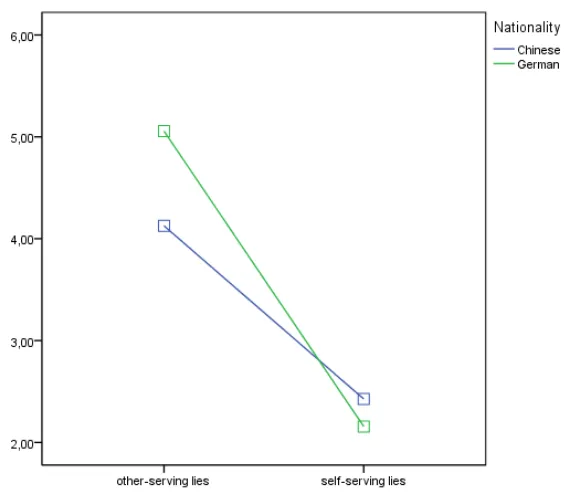
An ANOVA with repeated measures was implemented to answer the previously stated hypothesis. The independent variables were nationality and condition (between subjects) and type of lie (within-subjects). The dependent variables was the acceptability/morality of lying. There was a main effect of the factor type found, F (1, 124) =657.87, p < .001. Other-serving lies ( M = 4.59, SE = .08) were rated as more acceptable than self- serving lies ( M = 2.29, SE = .06 ). This is in accordance with hypothesis 1, stating that other-serving lies will be more acceptable than self-serving lies. Additionally, there was a main effect of the factor
nationality found, F ( 1, 124) = 8.96, p = .003. German students ( M = 3.61, SE = .08) rate lies as more acceptable than Chinese students ( M = 3.23 SE = .08) do.
An interaction of type and nationality was found, F (1, 124) = 44.82, p < .001.
Germans ( M = 2.16, SE = .0.87) rated self-serving lies as less acceptable than Chinese ( M = 2.43, SE = .08), F ( 1, 124) = 5.04, p = .027. White lies were rated as more acceptable by Germans ( M = 5.06, SE = .12) than by Chinese ( M = 4,16, SE = .11), F ( 1, 124 ) = 33,52, p < .001. The interaction is shown in figure 1. These results are not in accordance with
hypothesis 2a predicting, that Germans perceive self-serving lies as more acceptable than
Chinese and hypothesis 2b anticipating, that for white lies there will be no significant difference between the scores of Germans and Chinese.
of the factors condition, nationality and type of lie found F (1, 124) = .29, p = .592. These results do not support hypothesis 4, predicting that other-serving lies in the ingroup will be rated as more acceptable by Chinese than by Germans.
Figure 1: Interaction of nationality and type of lie
Discussion
are really limits to collectivism and also members of collectivistic societies show behavior usually associated with individualism (Sweet et al.,2010).
There was no support for any hypothesis containing the factor condition found. This are important results and indicate either, that the distinction between the in- and out-group was not made properly be the participants, or that the in- and out-group situation had simply no influence on the acceptability of lying. This question can not be answered accurately, because it remains unclear whether the unexpected results were due to weakness of the survey or whether participants really didn't care about the group membership of the target of the lie. The manipulation had no influence on the rating of acceptability of lying.
Manipulation
For the fact, that the factor condition had no significant influence on the dependent variable there could be several explanations. It could either mean that there is really no distinction between the in- and out-group made by the respondents, but it could also be explained by poor design of scenarios. This could be due to the way the scenarios were created. That either means, that the scenarios are not well chosen or, that the translations had changed the meaning somehow. Feedback given by the Chinese participants was mostly positive and nobody reported to have not understood the content of the survey, just a few respondents remarked, that some expressions were perceived as a bit weird. But according to them there were no faults and everything was comprehensive. Nevertheless, it could be the case, that because of the huge differences concerning the grammar and vocabulary of this two
languages, meaning of words and expressions could have changed in some way. Sometimes it is the case that words can not be translated perfectly accurate from German into Chinese or vice versa. This could lead to biased results and could have weakened the validity of the survey. Another explanation could be, that creating in- and out-group condition simply by changing names from typically German to typically Chinese had not the expected influence.
cases this is hard to achieve, because every individual belongs to plenty of groups at the same time and these groups are likely to supersede each other.
Another conclusion of this study is, that Germans perceive lying in general as more acceptable than Chinese do. This could be due to the cultural background of the students. As Chinese scored higher on horizontal collectivism it can be assumed, that they highly value membership of certain groups they belong to. It was previously mentioned, that the scenarios in the current study were using situations in an university environment. In this case being a student might have had more influence on ratings than the nationality of the target of the lie..
In Germany as well as in China, Chinese and Germans have little interaction in daily life. They might group each other in in-group and out-group, but the lack of contact in daily life could explain why no in-group favoritism can be found either by Germans nor Chinese. As supposed by Sweet et al. (2010) it could also be possible, that the very negative view of lying by societies supersede any cultural values of collectivism and individualism. According to this view the Chinese society might basically have a very negative view of lying.
Sampling
The sampling could be regarded critically and be responsible therefore, that assumed differences in the data were not found. At first it can be mentioned, that the distribution of male and female participants was not equal. A lot more female( 68.48%) than male( 31.52%) took place in the survey. As females tend to find other-serving lies more acceptable than men (DePaulo, 1996), this could have biased the results of this study. Additionally, the external validity might not be sufficiently high.
On top of that the whole range of the societies might not be represented. Only those people owning a personal computer or those who had access to one could answer the survey. That might lead to an underrepresentation especially of rural citizens in the Democratic People's Republic of China. Using social networking and e-mail facilities could have biased the outcome of the current study. The average Chinese students
included in the study. Problem is that they often have no internet connection and therefore hard to approach.
A study within China to detect differences on the cultural dimension between Chinese living in urban districts and rural districts could help to shed more light into that problem.
It could be the case, that the number of respondents in both version, the Chinese and the German were not enough. An important question to be asked is also: ’Does the self reported lying frequency can predict actual lying in real life situations?’. Halevy et al (2013) came to the conclusion that a high level of self reported lying can predict actual lying in reality. But the question whether low frequencies of self reported lying mean, that participants actually show little lying in real life still remains. This could be argued, a better explanation could be, that these participants know that lying is not socially rewarded/desirable and therefore report fewer lying than they actually do. The construct validity of this measurement might not be very high.
The fact, that Chinese tend to report fewer lying than Germans in general could explain why Chinese tend to find lying less acceptable and moral in general. But these results could be biased via social norms.
In summary, this study found interesting findings indicating that Chinese and German students differ regarding their acceptability of lying. But most importantly the manipulation in this study had no impact on the results. Therefore we did not find evidence for our stated hypothesis. More research is needed to investigate to what degree intergroup relations could have influence on lying behavior in a setting, in which participants differ regarding their cultural background.
Cultural differences
Some researchers argue, that there are limits to collectivism and people living in more collectivistic countries act more individually than they were suspected (Sweet et al.,2010; Turiel 2002; Wainryb& Turiel,1994).
Another explanation could be, that Chinese students might simply tend to agree with statements more than Germans students do. Explanation for cultural scale
Further Cozma (2011) stressed, that IND-COL is a dynamic concept, that can change in societies within decades. Thus, difference found in the past do not have to be the case in the present.
Additionally, people having the same nationality still display a high variance of individual’s differences. Cozma (2011) mentioned that existing individualism-collectivism scales rather measure individual differences and not cultural differences of societies. As ‘I’ and ‘In my opinion…’ appear in the scales differences on individual level will be measured. In the current research this kind of expression was also used. A solution to change that could be to speak of ‘In our society…’ instead of ‘I’ and ‘My…’ to ensure, that the focus is put on the societal level.
Limitations and implications
References
Allport, G. W. (1954). The nature of prejudice. Cambridge, MA: Addison-Wesley Aune, R. K., & Waters, L. L. (1994). Cultural differences in deception: Motivations to
deceive in samoans and north americans. International Journal of Intercultural
Relations, 18(2), 159-172.
Backbier, E. H. F., Hoogstraten, J., & Meerum Terwogt-Kouwenhoven, K. (1997). Situational determinants of the acceptability of telling lies. Journal of Applied Social Psychology, 27(12), 1048-1062.
Cappelen, A. W., Sørensen, E. T., & Tungodden, B. (2013). When do we lie? Journal of
Economic Behavior and Organization, 93, 258-265.
Cozma, I. (2011). How are individualism and collectivism measured? Romanian Journal of
Applied Psychology, 13(1), 11-17.
DePaulo, B. M., Kirkendol, S. E., Kashy, D. A., Wyer, M. M., & Epstein, J. A. (1996). Lying in everyday life. Journal of Personality and Social Psychology, 70(5), 979-995. Green, E. G. T., Deschamps, J., & Páez, D. (2005). variation of Individualism and
collectivism Within and Between 20 Countries. A Typological Analysis. Journal of
Cross-Cultural Psychology, 36(3), 321-339.
Gozna, L. F., Vrij, A., & Bull, R. (2001). The impact of individual differences on perceptions of lying in everyday life and in a high stake situation. Personality and Individual
Differences, 31(7), 1203-1216.
Halevy, R., Shalvi, S., & Verschuere, B. (2014). Being honest about dishonesty: Correlating self-reports and actual lying. Human Communication Research, 40(1), 54-72.
Hofstede, G. (1980). Motivation, leadership, and organization: Do American theories apply abroad? Organizational Dynamics, 9(1), 42-63.
Hewstone, M., Islam, M.R. and Judd, C.M. (1993) Models of crossed categorization and intergroup relations, Journal of Personality and Social Psychology, 64: 779-93 Kassin, S., Fein, S., & Markus, H.R. (2010). Social Psychology. Belmont, USA: Cengage
Lau, Y. L., Cameron, C. A., Chieh, K. M., O'Leary, J., Fu, G., & Lee, K. (2013). Cultural differences in moral justifications enhance understanding of Chinese and Canadian children's moral decisions. Journal of Cross-Cultural Psychology, 44(3), 461-477. Lindskold, S., & Han, G. (1986). Intent and the judgment of lies. The Journal of Social
Psychology, 126(1), 129-130.
Mealy, M., Stephan, W., & Carolina Urrutia, I. (2007). The acceptability of lies: A comparison of Ecuadorians and Euro-Americans. International Journal of
Intercultural Relations, 31(6), 689-702.
Minkov, M., Blagoev, V., & Hofstede, G. (2013). The boundaries of culture: Do questions about societal norms reveal cultural differences? Journal of Cross-Cultural
Psychology, 44(7), 1094-1106.
Oyserman, D., Coon, H. M., & Kemmelmeier, M. (2002). Rethinking individualism and collectivism: Evaluation of theoretical assumptions and meta-analyses. Psychological
Bulletin, 128(1), 3-52.
Rees, C. F. (2014). Better lie! Analysis, 74(1), 59-64.
Sweet, M. A., Heyman, G. D., Fu, G., & Lee, K. (2010). Are there limits to collectivism? culture and children's reasoning about lying to conceal a group transgression. Infant
and Child Development, 19(4), 422-442.
Talwar, V., Murphy, S. M., & Lee, K. (2007). White lie-telling in children for politeness purposes. International Journal of Behavioral Development, 31(1), 1-11.
Tajfel, H. (1970) Experiments in intergroup discrimination, Scientific American, 232(2): 96-102
Tajfel, H. and Forgas, J.P. (1981) Social categorization: cognitions, values and groups, in J. Forgas (ed.) Social Cognition. London: Academic Press.
Trafimow, D., & Finlay, K. A. (1996). The importance of subjective norms for a minority of people: Between-subjects and within-subjects analyses. Personality and Social
Psychology Bulletin, 22(8), 820-828.
Triandis, H. C., & Gelfand, M. J. (1998). Converging measurement of horizontal and vertical individualism and collectivism. Journal of Personality and Social Psychology, 74(1), 118-128.
Turiel, E., & Wainryb, C. (1994). Social reasoning and the varieties of social experiences in
cultural contexts
Appendices:
German Version:
Q1.1 Lieber Teilnehmer, Im Rahmen meiner Bachelorarbeit führe ich eine Umfrage zum Thema Akzeptanz von Lügen aus. Die Antworten werden anonym ausgewertet und nicht an Dritte weitergegeben. Auch ohne Angabe von Gründen ist es jederzeit möglich die Umfrage abzubrechen. Es geht um deine Meinung und deshalb kann es keine falschen oder richtigen Antworten geben. Das Ausfüllen des Fragebogens dauert ungefähr 15 Minuten. Wenn Du am Ende des Fragebogens über die Resultate informiert werden willst oder Fragen hast, kannst du mir jederzeit unter [email protected] schreiben. Sobald Du auf den Pfeil unten rechts klickst, bestätigst Du diese Informationen gelesen zu haben und erklärst dich bereit an der Umfrage teilzunehmen. Ich bedanke mich schon einmal im Voraus für deine Mitarbeit, Jonas Humrich
Q1.2 Geschlecht: männlich (1) weiblich (2)
Q1.3 Alter: Q1.4 Geburtsland:
Q1.5 Geburtsland der Mutter: Q1.6 Geburtsland des Vaters:
Q1.7 Bist Du Student? Ja (1)
Nein (2)
Q1.8 Falls ja, welchen Studiengang studierst Du? Q1.9 An welcher Universität bist Du eingeschrieben?
Q2.1 Der folgende Teil besteht aus mehreren Szenarien, nach denen jeweils einige Fragen zum Thema Lügen gestellt werden. Versuche bitte so gut wie möglich diese zu beantworten.
Q2.2 Nach der Vorlesung fragt dich Tom, ein Mitstudent, ob Mark, der während der letzten Klausur neben dir saß von dir abgeschrieben hat. Du verneinst obwohl du weißt, dass er es getan hat.
Q2.4 sehr schwierig (1) schwierig (2) eher schwierig (3)
neutral (4) eher leicht (5)
leicht (6) sehr leicht (7)
Wie schwierig findest du es
in dieser Situation zu lügen? (1) Q2.5 absolut moralisch vertretbar (1) moralisch vertretbar (2) eher moralisch vertretbar (3)
neutral (4) eher
moralisch verwerflich (5) moralisch verwerflich (6) sehr moralisch verwerflich (7) Wie moralisch vertretbar erscheint es
dir es in dieser Situation zu
lügen? (1)
Q2.6
sehr viel (1) viel (2) eher viel (3) neutral (4) ein bisschen (5)
wenig (6) sehr wenig (7) Inwiefern hast
du über die Konsequenzen in dieser Situation zu lügen nachgedacht? (1) Q2.7 sehr ernst (1)
ernst (2) eher ernst (3)
neutral (4) eher nicht so ernst (5)
nicht ernst (6)
überhaupt nicht ernst
(7) Als wie ernst
schätzt du die Konsequenzen dieser Lüge
ein? (1)
Q2.8 Du hast verschlafen und eine Prüfung verpasst. Als dich der Dozent später fragt warum du nicht bei der Prüfung teilgenommen hast, sagst du ihm um, keine Probleme zu bekommen, dass deine Oma gestorben sei. In Wirklichkeit geht es deiner Oma gut.
Q2.14 Während der Mittagspause bietet dir ein Sven, ein Mitstudent, ein selbstgemachtes Sandwich an. Es schmeckt wirklich nicht gut und du magst es nicht. Während dein Mitstudent weg ist, wirfst du es in den Müll. Als du später gefragt wirst wie es geschmeckt hat sagst du, dass es lecker war.
Q2.26 Du bist mit einem Freund in der Stadt. Ein Bettler auf der Straße fragt deinen Freund, ob er ihm ein bisschen Geld geben kann. Obwohl du weißt, dass dein Freund noch Geld hat verneinst du für ihn. Du willst nicht, dass dein Freund in eine unangenehme Situation kommt.
Q2.32 Deine Mitstudentin Sarah fragt dich, ob du ihr morgen beim Umzug helfen kannst. Du sagst ihr, dass du leider keine Zeit hast. In Wahrheit hast du den ganzen Tag frei, aber willst dich lieber ausruhen.
Q2.38 Du brauchst Geld um etwas zu kaufen. Tim, ein Mitstudent hatte sich 20 Euro von dir geliehen und sie dir bereits zurückgegeben. Trotzdem tust du so als, ob du das Geld noch nicht bekommen hättest. Du weißt, dass er dir glauben wird.
Q2.44 Auf dem Parkplatz vor dem Unigebäude hast du versehentlich das Auto eines deutschen Mitstudenten beschaedigt. Später fragt er dich, ob du weißt wer es war. Um nicht für den Schaden aufkommen zu müssen sagst du, dass du nicht weißt wer es gewesen sein könnte.
Q2.50 Du bist bei deinen Eltern und ein Freund deines Vaters ruft an. Du weißt, dass er gerade keine Lust hat zu telefonieren und sagst deshalb, dass er nicht zu Hause sei. In Wirklichkeit sieht er gerade Fußball im Fernsehen.
Q2.56 Am Ende des Jahres sagt dein Professor, dass er leider seine Unterlagen verloren hat und die Noten deshalb nicht mehr weiß. Obwohl du nur eine 3 auf deinen Aufsatz bekommen hast lügst du und sagst, dass es eine 2 war.
Q2.62 Deine Mitstudentin Leonie fragt dich, ob du ihr Morgen beim Umzug helfen kannst. Um hilfsbereit zu sein lügst du und sagst ihr, dass du noch nichts geplant hast und ihr helfen kannst. Eigentlich hattest du eingeplant an deiner
Bachelorarbeit zu arbeiten.
2.74 Bitte kreuze an inwiefern die Aussagen auf dich zutreffen. sehr zutreffend (1) zutreffend (2) teilweise zutreffend (3)
neutral (4) eher nicht zutreffend (5) nicht zutreffend (6) überhaupt nicht zutreffend (7) Es ist wichtig für
mich meine Arbeit besser zu erledigen als Andere (1) Es macht mir Spaß
Zeit mit Anderen zu verbringen (2) Familienmitglieder
sollten zusammenhalten, egal wie hoch der Aufwand ist (3) Meine persönliche
Identität, unabhängig von anderen, ist mir sehr wichtig (4) Wenn andere Menschen besser
sind als ich, bin ich angespannt und es spornt mich an mehr zu tun (5)
Wenn ein Mitstudent einen
Preis bekommt macht mich das
stolz (6) Es ist wichtig für
mich Entscheidungen,
die Gruppen treffen denen ich
angehöre, zu respektieren (7) Meistens bin ich auf mich selbst angewiesen, selten
auf Andere (8) Es ist wichtig für
mich, dass sich meine Mitstudenten wohl
fühlen (9) Wettbewerb ist ein
Naturgesetz (10) Es ist meine Pflicht mich um
meine Familie zukümmern, auch
wenn ich dafür persönliche Opfer bringen muss (11) Ich mache oft mein eigenes Ding
an, wenn ich mit anderen zusammen arbeite
(13) Es gibt nichts Wichtigeres als
Erfolg (14) Ich bin lieber auf
mich selbst angewiesen als auf
Andere (15) Eltern und Kinder sollten so viel Zeit
miteinander verbringen wie
Q2.75 Welche Absichten hast du wenn es um die Abwägung einer Lüge geht? sehr zutreffend (1) zutreffend (2) teilweise zutreffend (3)
neutral (4) eher nicht zutreffend (5) nicht zutreffend (6) überhaupt nicht zutreffend (7) Meine Intention
ist es eine schamvolle Situation für
mich zu vermeiden (1) Meine Intention
ist es, das Selbstwertgefühl
der anderen Person zu wahren (2) Meine Intention
ist es mein Image zu bewahren (3) Meine Intention
ist es den Stolz der anderen Person nicht zu
kränken (4) Meine Intention
ist es vor Anderen nicht
schwach dar zustehen (5) Meine Intention
ist es meinen eigenen Stolz zu
wahren (6) Meine Intention
ist es mit Bescheidenheit zu agieren, um die Beziehung zur anderen Person nicht zu
gefährden (7) Meine Intention
ist es die Glaubwürdigkeit
der anderen Person nicht in Frage zu stellen
Q2.76 Wie nimmst Du die Mitglieder der folgenden Gruppen wahr? Bitte wähle die Antwort aus, die deiner Meinung nach am Ehesten zutrifft.
Q2.77 Deutsche sehr zutreffend (1) zutreffend (2) teilweise zutreffend (3)
neutral (4) eher nicht zutreffend (5) nicht zutreffend (6) überhaupt nicht zutreffend (7) gutmütig (1) tüchtig (2) tolerant (3) freundlich (4) ehrlich (5) selbstbewusst (6) intelligent (7) vertrauenswürdig (8) geschickt (9) Q2.78 Studenten sehr zutreffend (1) zutreffend (2) teilweise zutreffend (3)
neutral (4) eher nicht zutreffend (5) nicht zutreffend (6) überhaupt nicht zutreffend (7) gutmütig (1) tüchtig (2) tolerant (3) freundlich (4) ehrlich (5) selbstbewusst (6) intelligent (7) vertrauenswürdig (8) geschickt (9) Q2.79 Chinesen sehr zutreffend (1) zutreffend (2) teilweise zutreffend (3)
Q2.80 Professoren
sehr zutreffend
(1)
zutreffend (2)
teilweise zutreffend
(3)
neutral (4) eher nicht zutreffend
(5)
nicht zutreffend
(6)
überhaupt nicht zutreffend
(7) gutmütig (1)
tuechtig (2) tolerant (3) freundlich (4)
ehrlich (5) selbstbewusst (6)
intelligent (7) vertrauenswuerdig
Q2.81 Im folgenden Teil wirst Du nacheinander verschiedene Graphiken zu sehen bekommen. Es geht darum, wie viele Gemeinsamkeiten Du mit den folgenden Gruppen hast bzw. diese Gruppen untereinander haben. Bitte kreuze jene Graphik an, die deine Identität am Besten wiedergeben.
Q2.82
Q2.83 Welches Bild gibt deine Gemeinsamkeiten/Schnittmengen mit Deutschen am Besten wieder? 1 (1)
Q2.84
Q2.85 Welches Bild gibt deine Gemeinsamkeiten/Schnittmengen mit Chinesen am Besten wieder? 1 (1)
Q2.86
Q2.87 Welches Bild gibt die Gemeinsamkeiten/Schnittmengen der Gruppen am Besten wieder? 1 (1)
2 (2) 3 (3) 4 (4) 5 (5) 6 (6) 7 (7)
Q2.88 Wie oft hast Du innerhalb der letzten zwei Tage gelogen? kein Mal (1)
1-2 Mal (2) 3-5 Mal (3) mehr als 5 Mal (4)
Chinese version
Q1.1 你好, 我的本科毕业论文做一项关于人们对谎言的可接受程度的调查。所以答复将会以匿名形式呈现,
不会提供给任何第三方。答卷人可以在任何时候选择无条件终止搭问卷。我非常期待得到你最真实的答复,因此请
你独自完成问卷。完成整个问卷将花费你不到20分钟时间。如果你想要或得更对关于此项调查的信息或者是你有
任何的相关问题,请发送邮件至:[email protected]. 你可以点击确认键开始回答问卷内容。感谢你参与
此次调查!
Q1.2 性别: 男 (1) 女 (2) Q1.3 年龄:
Q1.4 出生国:
Q1.5 母亲的出生国:
Q1.6 父亲的出生国:
Q1.7 你是大学生吗?
是的 (2) 不是 (3)
Q1.8 你学什么?
Q2.1 下面这个部分包含了不同的情节,之后关于谎言的问题将会被问到。请试着尽可能好的和准确的回答这些问
题。
Q2.2 下课以后李伟问考试中坐在你旁边的昊天受否作弊抄了你的答案。虽然你知道他有作弊,但是你否认
Q2.3
完全接受 (1)
接受 (2) 颇为接受
(3)
中立 (4) 不太接受
(5)
不接受 (6) 完全不接受
(7)
在这个情况
下你觉得说
谎接受吗?
(1)
Q2.4
很难 (1) 难 (2) 颇为难 (3) 中立 (4) 颇为容易
(5)
容易 (6) 很容易 (7)
在这个情况
下你觉得说
谎难吗?
(1)
Q2.5
很道德 (1) 道德 (2) 颇为道德
(3)
中立 (4) 不太道德
(5)
不道德 (6) 很不道德
(7)
在这个情况
下你觉得说
谎道德吗?
(1)
Q2.6
很多 (1) 多 (2) 颇为多 (3) 中立 (4) 颇为少 (5) 少 (6) 很少 (7)
你有多少想
过关于这个
情况的后果 ? (1)
Q2.7
很严重 (1) 严重 (3) 颇为严重
(4)
中立 (5) 不太严重
(6)
不严重 (7) 很不严重
(8)
在这个情况
下你觉得说
谎有多严重
Q2.8 你因睡过头而错过了一场考试。事后,老师问你为什么不参加考试,为了不招惹任何麻烦,你告诉他说你外婆
过世了。事实上外婆身体好。
Q2.14 午餐时间你的同学张敏请你吃他自己做的三明治。那个三明治真的很难吃,而且你不喜欢。所以在下课时间
你把它给丢了,然而五分钟後她回来问你好不好吃? 你说还不错。
Q2.20 你去餐厅吃饭,但是你不喜欢你的餐点。你觉得这一点都不划算。然而即使你觉得不好吃,但是当服务生问
你喜不喜欢餐点的时候,你还是说挺好吃的。
Q2.26 你跟朋友在市中心,有一个街友问你的朋友可不可以给他一些钱去买食物吃? 虽然你知道朋友的身上还有钱
,但是你还是阻止朋友给他钱,并对街友说不好意思没有钱可以给他。
Q2.32 有一个你的同学王莉问你是否可以找一天帮忙他搬家? 你说你很抱歉不能够帮他,但其实你有空的,只是你
想要休息一整天。
Q2.38 你需要钱买东西。虽然你朋友刘伟已经把一个月前借你的20欧元还给你了,但是你撒谎说你没收到他的钱,
因为你知道他会相信你的。
Q2.44 在教学楼前的停车场,你不小心撞到了你中国同学的车。之后,他问你是否知道是谁弄坏了他的车。为了逃
避支付赔偿费,你告诉他说你不知道是谁干的。
Q2.50 你在你的父母房子里,你爸爸的一个朋友正大来电话。你接听了电话,你爸爸的朋友问他是否能让你爸爸接
听电话。你知道你的父亲现在没有心情接听电话,所以你说你爸爸不在家。事实上他在看足球比赛。
Q2.56 学期末的时候,老师说她丢了成绩单,也忘记了同学们的论文成绩。虽然你只得了个C,但是为了得到一个
好成绩,你撒谎说你得了B。
Q2.62 你的同学李明问你是不是明天可以帮他搬家? 虽然你明天计画要花整天写你的大学毕业论文,但是为了表示
礼貌,你还是说谎并且告诉她可以帮忙她搬家。
Q2.68 在去学校的公共汽车上,你旁边坐着一个美女/帅哥,你开始跟她/他聊天。虽然你是个大学生,但是为了给
Q2.74 请选择一个恰当的答案。 完全同意
(1)
同意 (2) 颇为同意
(3)
中立 (5) 颇为反对
(7)
反对 (8) 完全反对
(9)
我认为工作
比别人做的
好很重要 (1)
与人相处是
我的乐趣
(2) 不管要个人 要做出多少
牺牲,家人
都应该在一
起 (3)
保持独立对
我很重要 (4)
当别人做的
比我好的时
候,我感到 焦虑 (5)
如果我的合 作伙伴得到
表扬,我会
为他感到骄
傲 (6) 我尊重家人 做出的决定
(7)
大多时候靠
自己,很少
依赖别人
(8) 我的合作伙 伴有好的状
态对我很重
要 (9)
竞争是自然
生存法则
(10)
照顾家人是
我的责任,
即使我要做
出一些牺牲
(11)
我经常自己
做自己的事 (12)
和别人合作
时,我感到
快乐 (17)
胜利就是一
自己 (15) 父母和子女 要尽可能在 一起 (16)
Q2.75 你说谎的目的通常会是什么?
完全同意 (1)
同意 (2) 颇为同意
(3)
中立 (4) 颇为反对
(5)
反对 (7) 完全反对
(8) 我的目的是
不让自己蒙
羞。 (1) 我的目的是
维持他人做
人的姿态。
(2) 我的目的是
保护自我形
象。 (3) 我的目的是
维护他人的
尊严。 (4) 我的目的是 不在他人面 前暴露弱点
。 (5) 我的目的是
维护自尊。
(6) 我的目的是
用谦逊的态
度来维持与
他人的关系 。 (7) 我的目的是 帮助他人确
保他/她的
Q2.76 你是如何理解一下这些团体的?请选择一个恰当的答案。
Q2.77 德国人
完全准确 (1)
准确 (2) 颇为准确
(3)
中立 (4) 不太准确
(5)
不准确 (6) 完全不准确
(7)
向善的 (1)
能干的 (2)
宽恕的 (3)
慈祥的 (4)
诚恳的 (5)
自信的 (6)
聪慧的 (7)
可靠的 (8)
纯熟的 (10)
Q2.78 中国人
完全准确 (1)
准确 (2) 颇为准确
(3)
中立 (4) 不太准确
(5)
不准确 (6) 完全不准确
(7)
向善的 (1)
能干的 (2)
宽恕的 (3)
慈祥的 (4)
诚恳的 (5)
自信的 (6)
聪慧的 (7)
可靠的 (8)
纯熟的 (10)
Q2.79 同学们
完全准确 (1)
准确 (2) 颇为准确
(3)
中立 (4) 不太准确
(5)
不准确 (6) 完全不准确
(7)
向善的 (1)
能干的 (2)
宽恕的 (3)
慈祥的 (4)
诚恳的 (5)
自信的 (6)
聪慧的 (7)
可靠的 (8)
Q2.80 老师们
完全准确 (1)
准确 (2) 颇为准确
(3)
中立 (4) 不太准确
(5)
不准确 (6) 完全不准确
(7)
向善的 (1)
能干的 (2)
宽恕的 (3)
慈祥的 (4)
诚恳的 (5)
自信的 (6)
聪慧的 (7)
可靠的 (8)
纯熟的 (10)
Q2.81 在下面的部分,你会看到不同类型的图形,请选择最能表现你身份的那一个,你和下图展现的团体有多少的
Q2.82
Q2.83 你和中国人有多少的共同点?
Q2.84
Q2.85 你和德国人有多少的共同点?
Q2.86
Q2.87 这些团体各自有多少共同点?
1 (1) 2 (2) 3 (3) 4 (4) 5 (5) 6 (6) 7 (7)
Q2.88 过去两天你说了几次谎?
没有 (1) 1-2 次 (2) 3-5 次 (3) 5次多 (4)
Q2.89 你已经完成问卷。感谢你的参与,如果还有问题或者其他意见,请通过电子邮件联系我: