Fe
2+
Coupled with Vitamin c (Vc) Can Enhance Glucose
Metabolism and Decrease Blood Glucose Levels of
Alloxan-Induced Diabetic Mice
Huihua Zhen1, Hui Chen1, Zhenle Tian1, Zhicai Zhang2*
1Jiangsu Alphay Bio-technology Co. Ltd., Nantong, China; 2School of Food science and Biological Engineering, Jiangsu University, Zhenjiang, China.
Email: *[email protected]
Received September 27th,2012; revised October 27th, 2012; accepted November 4th, 2012
ABSTRACT
That FeSO4 not FeCl3 can reduce the blood glucose levels of alloxan-induced diabetes mice has been reported in previ-
ous research. This study explained the cause of difference in activity of two different iron ions on diabetic mice based on glucose consumption (GC). FeSO4, FeCl3, Vitamine c (Vc), FeSO4 + Vc, metformin were administrated to the al-
loxan induced-diabetic mice, respectively. After administrated, serum glucose, fructosaminr, insulin, triglyceride, total cholesterol, total iron and Fe2+ levels and GC of liver in vivo were analyzed, respectively. In vitro, effect of different
iron ions coupled with Vc or streptozotocin on GC of liver of diabetic mice of model group were analyzed. The body weights and serum insulin levels of Fe2+ and Fe2+ + Vc treated diabetic mice notably increased. The serum glucose, fructosamine, triglyceride and total cholesterol levels were significantly decreased, whereas serum total iron and Fe2+
levels and GC in liver were increased in the Fe2+, Vc and Fe2+ + Vc groups compared with in the model groups. In addi-
tion, hardly change of serum insulin level was caused by Fe2+, Vc and Fe2+ + Vc treatment. However, the similar
re-sultst did not obtain a Fe3+ treated. Further, liver’s GC of untreated-diabetic mice was lower than of normal mice and
significantly increased after Fe2+ not Fe3+ added to the reaction resolution in vitro, and further increased when Fe2+ and
vitamin c (Vc) synchronously added to the reaction system, however, decreased when Fe2+ and Streptozotocin were
added synchronously to the reaction resolution. It is suggested that iron coupled with reducer can enhance the glucose metabolism to eventually achieve to controlling blood glucose levels.
Keywords: Glucose Metabolism; Glucose Consumption; FeSO4; Oxidant Stress; Vc
1. Introduction
Under normal physiologic conditions, there is a critical balance in generation of oxygen free radicals and anti- oxidant defense systems used by organisms to deactivate and protect themselves against free radical toxicity. However, rapid cultural and social changes, ageing populations, increasing urbanization, dietary changes, reduced physical activity and other unhealthy lifestyle and behavioral patterns has broken the balance and caused abrupt accumulation of free radical in vivo [1-4]. It has been generally accepted that free radicals can react with a variety of biomolecules, including lipids, carbo- hydrates, proteins, nucleic acids, and macromolecules of connective tissue, thereby interfering with cell function. However, whether and how accumulation of free radicals
in vivo impact on glucose metabolism by other pathway can few be understood.
Iron (Fe), a trace element, is a key membrane com- ponent and an essential cofactor required for a number of cell functions. For example, 50% mitochondrial proteins operate smoothly in the present of iron. Iron has involved in many physiological functions as a major electron- carrier, such as, the tricarboxylic acid (TCA) cycle, oxygen transportation and oxidation-phosphorylation pro- cess [5]. Iron content and the special ration of Fe2+ and
Fe3+ be maintained in vivo helped for the normal
metabolic regulation of sugar, protein and lipid. The inter-conversion of Fe2+ and Fe3+ might be a critical
factor for maintaining normal metabolism. However, if the inter-conversion rate from oxidized iron (Fe3+) to
reduced iron (Fe2+) becomes slow for some reasons, iron
will fail to play its function. There is evidence that falling oxidation stress in vivo was accompanied by increased serum iron (Fe2+) content [6]. It was found that after oral
administration of [Cr3O(O2CCH2CH3)6(H2O)3]+ to healthy
Sprague Dawley rats, plasma glucose and insulin levels
simultaneously lowered [7,8]. Whether
[Cr3O(O2CCH2CH3)6(H2O)3]+ weakened oxidant stress in
vivo, increased the solubility of iron and finally lowered the blood glucose levels is worth further studying.
Diabetes was an epidemic whose critical character was foul-up of glucose metabolism. Among the factors to cause foul-up of metabolism, the Fe3+’s content increase,
Fe2+ and total iron’s content decrease led by oxidant stress
is the critical factor induced diabetes generation. In previous study, we have also reported that supplementation of FeSO4 can decrease blood glucose level and accelerate
glucose metabolism [9].
Glucose consumption (GC), which is the amount of glucose degraded by the organ, tissue or organism in the unit time, reflects the speed of glucose metabolism. In this study, the effects of Fe2+, Fe3+, Vc, and co-effect of
Fe2+ and Vc on serum glucose, lipid, fructosamine levels
and serum Fe2+ and total iron content alloxan-induced
diabetic were compared. Then we analyzed GC in liver of alloxan-induced diabetic mice in vitro and the changes of GC after complemented different forms of iron coupled with reducer vitamin c (Vc) and oxidant Stz to find the mechanism of oxidant stress and iron (Fe2+) to
regulate blood glucose metabolism in alloxan-induced diabetes mice, Finally, we analyzed the mechanism that iron coupled with anti-oxidant controlled blood glucose levels and offered a new strategy for prevention and treatment of diabetes.
2. Material and Methods
2.1. Chemicals
Alloxan and Streptozotocin (STZ) were purchased from Sigma (St. Louis, MO, USA). Vitamin c (Vc), which content was more than 99%, was purchased from Ying Chen Chemical Co., Ltd. All chemicals used in this study were of analytical grade or higher.
2.2. Drug Administration in Experimental Animals
Male ICR mice with body weight of 16.46 +/− 2.21 g were purchased from the Central Animal Facility, Chinese Academy of Sciences (Nanjing, China). The animal cer- tification number was SCXK Su20020018.
All the mice were kept in steel cages in the room with controlled temperature at 22˚C +/− 2˚C and a light/dark cycle of 12 h/12 h. They were fed with the standard pellet chow diet, which was comprised of (%) 5 corn oil, 23 casein, 31.9 corn starches, 30.4 sucrose, 5.3 cellulose, 1.2 vitamin complex and 3.7 mineral mixture, and allowed free access to the drinking water. Iron and Fe2+ content was 48 mg/Kg dry diet and 3.6 mg/Kg dry diet, respectively. The diabetic mice were induced by in-
traperitoneal injection of alloxan at a dose of 200 mg/kg body weight. The alloxan solution was freshly prepared with 0.1 mol/L citrate buffer (pH 4.0), kept in ice and injected immediately. Ten randomly selected mice that were only injected with citrate buffer were used as the normal group. Five days after injection of alloxan, blood was drawn from the tail vein of the fasted mice, The serum glucose level was determined by the glucose assay kit (Jiancheng Biological Institute, Nanjing, Jiangsu). These mice whose serum glucose levels exceeded 13 mmol/L were considered as the diabetic mice. All mice were not treated by insulin in the study. Procedures involving animal handling and care were conducted in conformity with the institutional guidelines of school of Medicine, Jiangsu University.
60 alloxan-induced diabetes mice (divided into six groups) and 10 normal mice as a normal group were used in the experiment. The mice were divided into the following seven treatment groups.
Group 1 (Normal group): Normal mice treated with the citrate buffer only.
Group 2 (Model group): Alloxan-treated diabetes mice intragastrically administrated with distilled water only.
Group 3 (FeSO4 group): Alloxan-treated diabetes mice
daily gavaged with FeSO4 at a dose of 25 mg/Kg body
weight [9].
Group 4 (FeCl3 group): Alloxan-treated diabetes mice
daily gavaged with FeCl3 at a dose of 25 mg/Kgbody
weight [9].
Group 5 (Vc group): Alloxan-treated diabetes mice daily gavaged with Vc at a dose of 200 mg/Kgbody weigh [10].
Group 6 (FeSO4 + Vc group): Alloxan-treated diabetes
mice daily gavaged with FeSO4 at a dose of 25 mg/Kg
body weight and Vc at a dose of 200 mg/Kgbody weight. Group 7 (Metformin group): Alloxan-treated diabetes mice daily gavaged with metformin at a dose of 50 mg/Kgbody weight.
The blood glucose levels were checked every seven days. After continuously administrated drugs for 28 days, all mice were fasted overnight (18 - 24 hours), and their blood was drawn from the orbital sinus after anesthetization with ether and collected into the tubes containing potassium oxalate and sodium fluoride. These indexes including the blood insulin, glucose and fructosamine levels, Fe2+ and total iron content, blood total cholesterol,
G
all of other solutions, the final stable reaction volume was adjusted by H2O. GC was calculated as follows:
The homogenates were centrifuged at 10,000 × g for 15 minutes at 4˚C to discard any cell debris. The glucose consumption (GC) of supernatant was analyzed. Simul- taneously, the effect of iron and oxidant (STZ) and reducer (vitamine c, Vc) on GC of diabetic mice in the model group was analysized.
C G
G C S (1)
Gc: GC (g/48 h); CG: the glucose concentration of
control tube. SG: the glucose concentration of sample
tube.
The levels of blood glucose, fructosamine, total cholesterol and triglycerides in the serum samples were determined by their corresponding colorimetric assay kits (Jiancheng Biological Insititute, Nanjing, Jiangsu) ac- cording to the manufacturer’s protocols. The serum Fe2+
and total iron levels were determined with the phe- nanthroline spectrophotometry methods [12].
2.3. The Design of Experiment in Vitro
[image:3.595.62.537.458.553.2]To disclose the mechanism that iron coupled with oxidant stress regulated GC of diabetic mice, three test systems in vitro were designed using diabetes of model group and method and purpose of system was shown in
Table 1.
2.4. Analytical Methods 2.5. Statistical Analysis
The glucose consumption (GC) of mice’s liver was carried out according to the method described by Zhang
et al. [11]. The reaction solution was composed of 1 mL supernatant of liver homogenates, 0.3 mL H2O and 1 mL
pH 7.4 0.2 mol/L phosphate buffer solutions contained 0.2% glucose and 0.2% NaN3. Before incubated and after
being incubated for 48 h at 37˚C, the sample of reaction solution was withdrawn for assaying glucose, respectively. The supernatant of liver exterminated activity homogenates in 80˚C for 60 min instead of the supernatant was used as control. Glucose was assayed by blood glucose assay kit according to the manufacturer’s protocols. After adding
Data were expressed as the mean ± SD for values obtained from ten mice in each group. Differences between groups were calculated by the Student’s t-test [13]. The differences between the means were assessed using Duncan multiple range test with p < 0.05 considered statistically significant.
3. Results
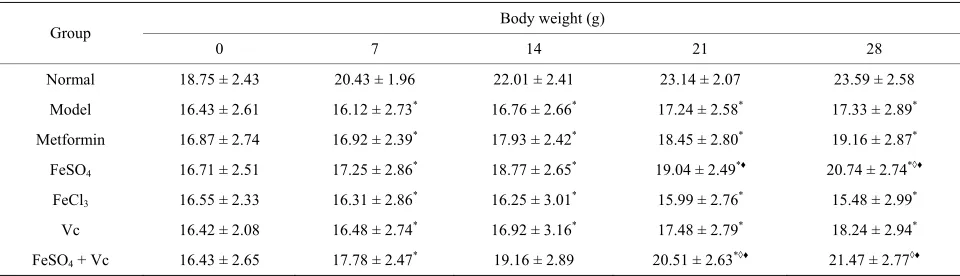
The animal’s body weights were stable and significant lower in FeCl3 group and diabetic model group than in
normal group (Table 2) (p > 0.05), and the body weight
Table 1. The methods and purposes of three test systems.
System Method Purpose
1 Adding 0.2 mL of H2O and 0.1 mL of FeSO4 or FeCl3 with various
concentra-tions in glucose consumption test, respectively.
To compare the effect of FeSO4 or FeCl3 on
glu-cose consumption in liver of diabetic mice
2 Adding 0.1 mL of FeSO4 with various concentrations, 0.1 mL of vitamin C with
various concentrations and 0.1 mL of H2O in glucose consumption test.
To study the impact of reduced oxidative stress on glucose consumption
3 Adding 0.1 mL of FeSO4 with various concentrations, 0.1 mL of streptozotocin
with various concentrations and 0.1 mL of H2O in glucose consumption test.
[image:3.595.58.538.576.714.2]To study the impact of enhanced oxidative stress on glucose consumption
Table 2 Effect of tested drugs on body weight of diabetic mice for 28 days.
Body weight (g) Group
0 7 14 21 28
Normal 18.75 ± 2.43 20.43 ± 1.96 22.01 ± 2.41 23.14 ± 2.07 23.59 ± 2.58
Model 16.43 ± 2.61 16.12 ± 2.73* 16.76 ± 2.66* 17.24 ± 2.58* 17.33 ± 2.89*
Metformin 16.87 ± 2.74 16.92 ± 2.39* 17.93 ± 2.42* 18.45 ± 2.80* 19.16 ± 2.87*
FeSO4 16.71 ± 2.51 17.25 ± 2.86* 18.77 ± 2.65* 19.04 ± 2.49*♦ 20.74 ± 2.74*◊♦
FeCl3 16.55 ± 2.33 16.31 ± 2.86* 16.25 ± 3.01* 15.99 ± 2.76* 15.48 ± 2.99*
Vc 16.42 ± 2.08 16.48 ± 2.74* 16.92 ± 3.16* 17.48 ± 2.79* 18.24 ± 2.94*
FeSO4 + Vc 16.43 ± 2.65 17.78 ± 2.47* 19.16 ± 2.89 20.51 ± 2.63*◊♦ 21.47 ± 2.77◊♦
Data are presented as Mean ± SD for ten mice in each group. A significant difference is considered at p < 0.05 (DMRT). *: Compared with the normal group; ◊: Compared with the model group; ♦: Compared with the FeCl
of animals in FeSO4, FeSO4 + Vcand metformin group
were all significantly increased, and higher than not only their initial body weights but also the body weight of model group in the all experimental process (Table 2) (p
< 0.05). Although the body weight of FeSO4 + Vc were
higher than those of FeSO4 group, but no significant
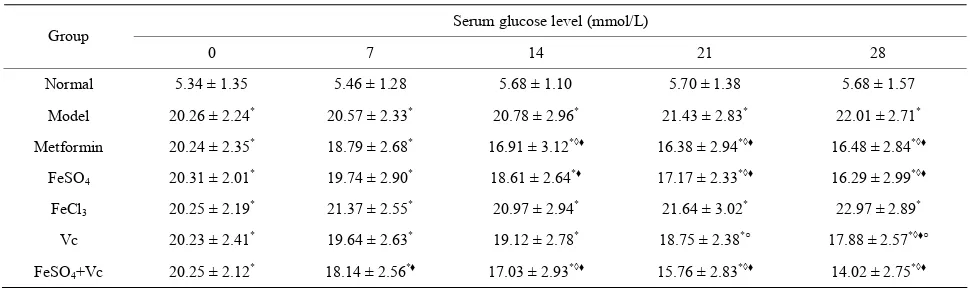
difference between two group’s body weight was found after administered drugs (p > 0.05). The levels of serum glucose in diabetic mice were summarized in Table 3. At
the beginning of the experiment, all tested groups of mice had nearly the same blood glucose levels (p > 0.05) and their blood glucose levels were higher than those of normal group. The constant blood glucose levels of diabetic model group during all experimental process demonstrated that the model mice could be used to study. The results serum glucose levels of the mice in the FeSO4, FeSO4 + Vc and metformin groups decreased,
and were significantly lower than those in the model group and FeCl3 group (p < 0.05). The difference of
serum glucose levels was also found between FeSO4 +
Vc and Vc group (p < 0.05).
The serum insulin levels of diabetes mice were lower
than normal mice (Table 4). After administrated drugs,
metformin remarkably elevated the serum insulin level of model animal and the similar effect was not found in other drugs group. The fructosamine and total triglyceride, cholesterol levels of model and FeCl3 group
were significantly higher than those of normal group. No significant difference between FeCl3 and model group
were observed in these indexes (p > 0.05) (Table 4).
Compared those in the model group and FeCl3 treated
mice, the serum fructosamine, triglyceride and total cholesterol levels in the FeSO4, Vc, FeSO4 + Vc and
metformin groups were significantly decreased (p < 0.05). Moreover, these indexes of FeSO4 + Vc group were
lower than of FeSO4 and Vc group (Table 4). Because of
the alloxan induced effect, total iron and iron (II) were remarkably decreased in diabetic mice (Table 5).
Supplying FeSO4, Vc and FeSO4 + Vc could increase the
total iron and iron (II) levels. Especially, increase amount of the total iron and iron (II) of the FeSO4 + Vc group
was biggest in three group. But the similar effect could be found in FeCl3 group.
[image:4.595.55.540.386.530.2]The GC test in vitro (Figure 1) showed the GC was
Table 3. Effect of test drugs on serum glucose level in diabetic mice for 28 days.
Serum glucose level (mmol/L) Group
0 7 14 21 28
Normal 5.34 ± 1.35 5.46 ± 1.28 5.68 ± 1.10 5.70 ± 1.38 5.68 ± 1.57
Model 20.26 ± 2.24* 20.57 ± 2.33* 20.78 ± 2.96* 21.43 ± 2.83* 22.01 ± 2.71*
Metformin 20.24 ± 2.35* 18.79 ± 2.68* 16.91 ± 3.12*◊♦ 16.38 ± 2.94*◊♦ 16.48 ± 2.84*◊♦
FeSO4 20.31 ± 2.01* 19.74 ± 2.90* 18.61 ± 2.64*♦ 17.17 ± 2.33*◊♦ 16.29 ± 2.99*◊♦
FeCl3 20.25 ± 2.19* 21.37 ± 2.55* 20.97 ± 2.94* 21.64 ± 3.02* 22.97 ± 2.89*
Vc 20.23 ± 2.41* 19.64 ± 2.63* 19.12 ± 2.78* 18.75 ± 2.38*○ 17.88 ± 2.57*◊♦○
FeSO4+Vc 20.25 ± 2.12* 18.14 ± 2.56*♦ 17.03 ± 2.93*◊♦ 15.76 ± 2.83*◊♦ 14.02 ± 2.75*◊♦
Data are presented as Mean ± SD for ten mice in each group. A significant difference is considered at p < 0.05 (DMRT). *: Compared with the normal group; ◊: Compared with the model group; ♦: Compared with the FeCl
[image:4.595.58.539.589.715.2]3 group; ○: Compared with the (FeSO4 + Vc) group.
Table 4. Effect of test drugs on serum insulin, fructosamine, triglyceride and total cholesterol levels in diabetic mice for 28 days.
Group Insulin (μU/L) Fructosamine (mmol/L) Triglyceride (mmol/L) Total cholesterol (mmol/L)
Normal 71.34 ± 9.08 2.53 ± 0.19 3.62 ± 0.48 4.09 ± 0.38
Model 52.83 ± 8.32* 4.71 ± 0.24* 7.03 ± 0.31* 7.54 ± 0.36*
Metformin 66.59 ± 7.58◊♦○ 3.94 ± 0.17*◊♦○ 6.02 ± 0.42*◊♦ 4.73 ± 0.32*◊♦○
FeSO4 53.14 ± 8.06* 3.06 ± 0.20*◊♦○ 5.57 ± 0.42*◊♦○ 4.57 ± 0.36*◊♦○
FeCl3 52.19 ± 8.62* 4.67 ± 0.23* 6.85 ± 0.33* 7.43 ± 0.42*
Vc 55.61 ± 8.91 4.07 ± 0.18*◊♦○ 6.36 ± 0.37*◊♦○ 5.63 ± 0.51*◊♦○
FeSO4 + Vc 54.86 ± 7.77 2.84 ± 0.22*◊♦ 5.44 ± 0.34*◊♦ 4.38 ± 0.42◊♦
Data are presented as Mean ± SD for ten mice in each group. A significant difference is considered at p < 0.05 (DMRT). *: Compared with the normal group; ◊: Compared with the model group; ♦: Compared with the FeCl
Table 5. Effect of FeSO4, FeCl3 and metformin on serum
total iron and iron (II) contents in diabetic mice for 28 days.
Group Total iron content (μmol/L) Iron (II) content (μmol/L)
Normal 21.45 ± 1.67 7.46 ± 1.18
Model 16.31 ± 2.31* 4.03 ± 2.06*
Metformin 18.27 ± 2.07*○ 4.25 ± 1.83*
FeSO4 21.44 ± 1.88◊♦○ 6.84 ± 1.75†‡
FeCl3 17.61 ± 1.94*○ 3.79 ± 1.66*
Vc 19.63 ± 1.83◊♦○ 5.82 ± 1.49
FeSO4 + Vc 23.67 ± 2.05*◊♦ 7.52 ± 1.95
Data are presented as Mean ± SD for ten mice in each group. A significant difference is considered at p < 0.05 (DMRT). *: Compared with the normal
group; ◊: Compared with the model group; ♦: Compared with the FeCl
3
group, ○: Compared with the (FeSO
[image:5.595.56.288.123.257.2]4 + Vc) group.
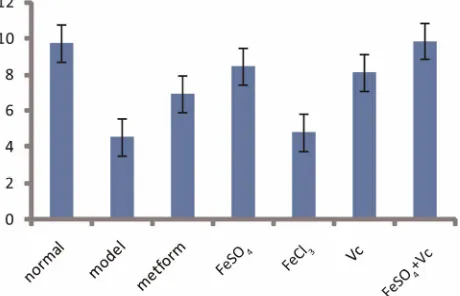
Figure 1. Effect of FeSO4, FeCl3, Vc, (FeSO4 + Vc) or
metformin on glucose consumption in liver of diabetic mice for 28 days. Data are presented as Mean ± SD from ten mice in each group.
significantly lower in model group than in normal group. After administrated drugs, the GC of the animal liver in FeSO4, Vc, FeSO4 + Vc and metformin group increased
significantly, especially, the GC in FeSO4 + Vc was
nearly equal to the one in normal group. No significantly difference GC between FeCl3 and diabetic model groups
was found.
After different concentration of FeSO4 and FeCl3 was
added to the react solution, the GC of liver of diabetic mice showed different change (Figure 2). With the
concentration of FeSO4 increasing from 0 to 0.6 mg/mL,
the GC of diabetic mice’s liver gradually increased, when concentration of FeSO4 was between 0.6 - 0.8 mg/mL,
the GC kept stable and when concentration of FeSO4 was
over 0.8 mg/mL, the GC gradually reduced. However, with FeCl3 concentration increasing from 0 to 1 mg/mL,
no significantly change in GC was observed.
Effect of the different concentration of FeSO4 coupled
Figure 2. Effect of FeSO4 or FeCl3 on glucose consumption
in liver of diabetic mice. :FeSO4; :FeCl3.
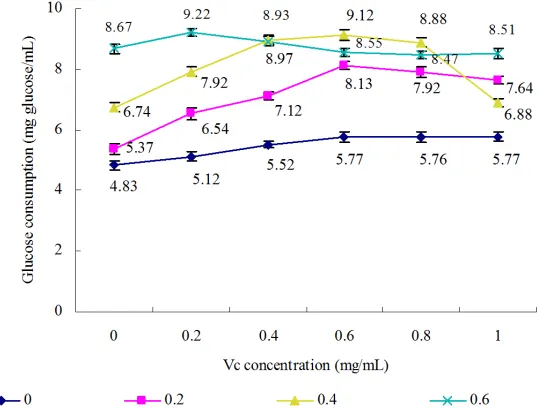
with varied amount of Vc on GC diabetes mice was studied (Figure 3). When Vc concentration increased
from 0 to 0.6 mg/mL without FeSO4, the GC increased
gradually and over 0.6 mg/mL, the GC stabilized all the time; with the Vc concentration increased from 0 to 0.6 mg/mL at 0.2 mg/mL FeSO4, the GC gradually increased
and achieved the maximum (8.13 mg/mL) at the 0.6 mg/mL Vc; with the Vc concentration from 0 to 0.4 mg/mL at the 0.4 mg/mL FeSO4, the GC significantly
enhanced, then stabilized when Vc concentration was between 0.4 - 0.8 mg/mL and the concentration of FeSO4
was over 0.8 mg/mL, GC sharply declined; GC has markedly increased with the concentration Vc rising from 0 to 0.2 mg/mL at 0.6 mg/mL FeSO4, but when the
concentration Vc exceeded 0.2 mg/mL, GC significantly reduced. However, no matter how much FeSO4 was
added to reactive solution, GC sharply declined in the present of streptozotocin (Figure 4). These results also
showed that proper control of oxidative stress, supplying Fe2+ contributes to the regulation of glucose metabolism
in animals.
4. Discussion
[image:5.595.59.289.309.457.2]Figure 3. Synergistic effect of combinatorial supplementation of FeSO4 and Vc on glucose consumption in liver of diabetic
mice. : 0 mg/ mL FeSO4; : 2 mg/mL FeSO4; : 4 mg/mL FeSO4; : 6 mg/mL FeSO4.
Figure 4. Antagonistic effect of combinatorial supplementation of FeSO4 and STZ on glucose consumption in liver of diabetic
mice. : 0 mg/mL FeSO4; : 2 mg/mL FeSO4; : 4 mg/mL FeSO4; : 6 mg/mL FeSO4.
group, different valences of these elements common transformed each other and form a micro-cycle. Iron is a most typical example.
Iron presences in the human body as a prosthetic group of those enzymes related with glucose metabolism, such as cytochrome oxidase, catalase, aldehyde oxidase, xanthine oxidase, succinate dehydrogenase, α-glycerol phosphate oxidase, lipid peroxidase, proline hydroxylase and lysine hydroxylase. Tricarboxylic acid cycle (TCA) is the aerobic oxidation of glucose in vivo, an important path-
way to supply energy. More than half of the enzymes or cofactors of TCA cycle and electronic transmission chain contain iron or play a physiological function only in the present of iron. Thus, its deficiency and excess will impact on glucose metabolism and electron transmission of the body. Iron exists as Fe2+ and Fe3+. When iron plays
their physiological role, two different valence of iron continuously transforms each other and form iron cycle
[image:6.595.177.444.337.578.2]studies showed this hyper-oxidation can damage tissue [23-25,18]. However, the studies on that the hyper- oxidation interdicts reduction of Fe3+ and blocks the
glucose metabolism in body have few reported. GC is degraded in unit time can directly reflect the relative strength of glucose metabolism. In our test, the GC of normal and diabetic rate’s liver was first compared. It was found that the GC of diabetic rat’s liver was significantly lower than of normal rat’s liver (Figure 1)
and elevated by added Fe2+ instead of Fe3+ (
Figure 2). If
some reducer (such as Vc) and Fe2+ simultaneously were
added, GC could be elevated further (Figure 3) and if
some oxidant (such as STZ) and Fe2+ simultaneous were
added, GC markedly decreased (Figure 4). Under higher
oxidant stress state, supplying Fe3+ could not facilitate
glucose metabolism. Therefore, to control appropriate oxidative stress redounded to glucose metabolism.
The only different in glucose metabolism between in vivo and in vitro is each cell is surrounded by cell membrane which separates it from the outside world in vivo, interior of cell is separated into many special circumscriptions by membrane and glucose metabolism is fulfilled in these special circumscriptions, such as Embden-Meyerhof-Parnas (EMP) takes place in cyto- plasm, the tri-carboxylic acid cycle (TCA) pathways and the electron transfer do within mitochondrion and in membrane of mitochondrion, respectively. Biological membranes separates cell from the outside circumstance and also becomes physical barriers which limit glucose to enter into cell. The pathways that glucose enters into cellular primarily includes two type: Na+-glucose
transporter (active transporter) and facilitate diffusion. Facilitate diffusion was the dominating factor [26]. The flux for glucose to enter into cell may be described with following formula:
j D l CC p CC
(2)where j are the flux for glucose to enter into cell, C● the
extracellular glucose concentration (bulk concentration);
C the intracellular glucose concentration, D is the (constant) diffusion coefficient, α is the glucose distribution co- efficient between the extra- and intra-cellular phase, and l
the membrane thickness. p is called permeability [27]. It is clear that the impetus to increase diffusion flux of glucose depends on permeability and the glucose levels’ difference of both sides of the membrane. Insulin heightens the flux of glucose to enter into cell mostly by increasing the affinity of glucose for carrier protein. The high glucose level of intracellular under hyper-oxidation lessens the glucose level’ difference of extra- and intra- cellular, the flux for glucose to enter into cell and elevates the blood glucose level. Therefore, reducing
oxidation stress in vivo helps to elevate GC of body, accelerate glucose metabolism, facilitate glucose in blood entering into cellular and finally decrease blood glucose levels.
To prove the hypothesis, the alloxan induced diabetic mice were treated with FeSO4, FeCl3, Vc and FeSO4 +
Vc, respectively. Alloxan is a kind of strange oxidant and not only damages islet cell, induce diabeties and but also elevated oxidant stress of test animal in vivo. Therefore, many papers have reported that higher oxidant stress than normal test animals exists in alloxan induced diabetic animals. Hyperoxidation in diabetic mice blocked Fe3+
reduced to Fe2+ and contributed to serum iron deficiency
of diabetic mice (Figure 1). After oral administration of
FeSO4, Vc and FeSO4 + Vc, serum glucose, fructosamine
and lipid levels would decrease (Table 4) and serum total
iron and Fe2+ content and GC of liver would be signifi-
cantly increase. Specially, the effect of FeSO4 + Vc was
more significant. These results demonstrated that sup- plied Fe2+ coupled with controlling oxidative stress helps
to enhance glucose metabolism and decrease the blood glucose levels of diabetes.
5. Conclusion
The study showed that supplying Fe2+ coupled with Vc
can elevate the GC of diabetic mice’s liver in vitro. The same result was also obtained in vivo. Supplementation of Fe2+ and Vc to alloxan induced diabetic mice could
renew the iron cycle, improve oxygen transportation and oxygen utilization efficiency and decrease serum glucose and lipid levels in the alloxan-induced diabetes mice or even in the diabetes mellitus patients. If Vc and Fe2+
supplement at the same time, these activity of Fe2+ in
diabetes would be better. In all, it is helpful to monitor Fe2+ content instead of total iron content and control
sufferer oxidant stress to maintain Fe2+ at a special
content in vivo for prevention and treatment of diabetes.
6. Acknowledgements
This work was supported by a grant from the Ministry of Science and Technology of China (Grant No.
2006CB403200), Chinese Postdoctoral Science Fund (Grant No. 20080440810), Nantong social development fund (S2008004)
REFERENCES
[1] V. B. Junqueira, S. B. Barros, S. S. Chan, L. Rodrigues, L. Giavarotti, R. L. Abud and G. P. Deucher, “Aging and Oxidative Stress,” Molecular Aspects of Medicine, Vol. 25, No. 1-2, 2004, pp. 5-16.
[2] J. Karolkiewicz, E. Michalak, B. Pospieszna, E. Deskur- Smielecka, A. Nowak and L. Pilaczyńska-Szcześniak, “Response of Oxidative Stress Markers and Antioxidant Parameters to an 8-Week Aerobic Physical Activity Pro-gram in Healthy, Postmenopausal Women,” Archives of Gerontology and Geriatrics, Vol. 49, No. 1, 2009, pp. e67-e71. doi:10.1016/j.archger.2008.09.001
[3] P. Moller, H. Wallin and L. E. Knudsen, “Oxidative Stress Associated with Exercise, Psychological Stress and Life-Style Factors,” Chemico-Biology Interactions, Vol. 102, No. 1, 1996, pp. 17-36.
doi:10.1016/0009-2797(96)03729-5
[4] C. Nasuti, R. Gabbianelli, M. L. Falcioni, A. Di Stefano, P. Sozio and F. Cantalamessa, “Dopaminergic System Modulation, Behavioral Changes, and Oxidative Stress after Neonatal Administration of Pyrethroids,” Toxicology, Vol. 229, No. 3, 2007, pp. 194-205.
doi:10.1016/j.tox.2006.10.015
[5] A. Peter, “Bioenergentics and the Metabolism of Carbo-hydrates and Lipids,” In: K. Robert, K. Daryl and W. Victor, Eds., Harper’s Biochemistry, 25th Edition, Sicence Press, 2000, pp. 182-208.
[6] S. Filiz, Ö. Gülyüz, E. Deniz and H. Alev, “Antioxidant Effect of Vitamin E in the Treatment of Nutritional Iron Deficiency Anemia,” Turkish Journal of Hematology, Vol. 23, No. 1, 2006, pp. 15-24.
[7] B. J. Clodfelder, B. M. Gullick, H. C. Lukaski, Y. Neg-gers and J. B. Vincent, “Oral Administration of the Biomimetic [Cr3O(O2CCH2CH3)6(H2O)3]+ Increases In-sulin Sensitivity and Improves Blood Plasma Variables in Healthy and Type 2 Diabetic Rats,” Journal of Biological Inorganic Chemistry, Vol. 10, No. 2, 2005, pp. 119-130. doi:10.1007/s00775-004-0618-0
[8] Y. Sun, K. Mallya, J. Ramirez and J. B. Vincent, “The Biomimetic [Cr3O(O2CCH2CH3)6(H2O)3]+ Decreases Plasma Cholesterol and Triglycerides in rats: Towards Chro- mium-Containing Therapeutics,” Journal of Biological Inorganic Chemistry, Vol. 4, No. 6, 1999, pp. 838-845. doi:10.1007/s007750050357
[9] Z. C. Zhang, B. Lian and F. J. Cui, “Effect of FeSO4 Treatment on Glucose Metabolism in Diabetic Rats,” Biometals, Vol. 21, No. 6, 2008, pp. 685-691.
doi:10.1007/s10534-008-9153-8
[10] N. Aksoya, H. Vural, T. Sabuncub, O. Arslan and S. Ak-soy, “Beneficial Effects of Vitamins C and E against Oxidative Stress in Diabetic Rats,” Nutrition Research, Vol. 25, No. 6, 2005, pp. 625-630.
doi:10.1016/j.nutres.2005.05.005
[11] Z. C. Zhang, X. Li, M. X. Chen and W. L. Shen, “Assay of the Glucose Consumption Rate in Liver with a Novel Colorimetric Method,” Current Pharmaceutical Analysis, Vol. 7, No. 3, 2011, pp. 195-201.
doi:10.2174/157341211796353336
[12] J. Lin and S. H. Ji, “The Determination of Dietary Fe (II) and (III),” Guangdong Microelement Science, Vol. 3, No. 8, 1996, pp. 148-152.
[13] D. Duncan, “Multiple Range Tests for Correlated and
Heteroscedastic Means,” Biometrics, Vol. 13, No. 2, 1957, pp. 164-176. doi:10.2307/2527799
[14] M. Brownlee, “Biochemistry and Molecular Cell Biology of Diabetic Complications,” Nature, Vol. 414, No. 6865, 2001, pp. 813-820. doi:10.1038/414813a
[15] M. Brownlee, “The Pathobiology of Diabetic Complica- tions: A Unifying Mechanism,” Diabetes, Vol. 54, No. 6, 2005, pp.1615-1625. doi:10.2337/diabetes.54.6.1615 [16] J. L. Evans, I. D. Goldfine, B. A. Maddux and G. M.
Grodsky, “Oxidative Stress and Stress-Activated Signal- ing Pathways: A Unifying Hypothesis of Type 2 Diabe- tes,” Endocrine Reviews, Vol. 23, No. 5, 2002, pp. 599- 622. doi:10.1210/er.2001-0039
[17] D. Jay, H. Hitomi and K. K. Griendling, “Oxidative Stress and Diabetic Cardiovascular Complications,” Free Radical Biology & Medicine, Vol. 40, No .2, 2006, pp. 183-192. doi:10.1016/j.freeradbiomed.2005.06.018 [18] P. Rosen, P. P. Nawroth, G. King, W. Möller, H. J.
Tritschler and L. Packer, “The Role of Oxidative Stress in the Onset and Progression of Diabetes and Its Complica- tions: A Summary of a Congress Series Sponsored by UNESCO-MCBN, the American Diabetes Association and the German Diabetes Society,” Diabetes/Metabolism Research and Reviews, Vol. 17, No. 3, 2001, pp. 189-212. doi:10.1002/dmrr.196
[19] J. A. Scott and G. L. King, “Oxidative Stress and Anti- oxidant Treatment in Diabetes,” Annal of the New York Academy Science, Vol. 1031, No. 12, 2004. pp. 204-213. doi:10.1196/annals.1331.020
[20] I. C. West, “Radicals and Oxidative Stress in Diabetes,” Diabetic Medicine, Vol. 17, No. 3, 2000, pp. 171-180. doi:10.1046/j.1464-5491.2000.00259.x
[21] P. Anabela and M. P. Carlos, “Diabetes and Mitochon- drial Function: Role of Hyperglycemia and Oxidative Stress,” Toxicology and Applied Pharmacology, Vol. 212, No. 2, 2006, pp. 167-178. doi:10.1016/j.taap.2006.01.003 [22] A. C. Maritim, R. A. Sanders and J. B. Watkins, “Diabe-
tes, Oxidative Stress, and Antioxidants: A Review,” Journal of Biochemical and Molecular Toxicology, Vol. 17, No. 1, 2003, pp. 24-38. doi:10.1002/jbt.10058
[23] Z. C. Feng, T. J. Sick, M. Rosenthal, “Oxygen Sensitivity of Mitochondrial Redox Status and Evoked Potential Re- covery Early during Reperfusion in Post-Ischemic Rat Brain,” Resuscitation, Vol. 37, No. 1, 1998, pp. 33-41. doi:10.1016/S0300-9572(98)00031-8
[24] M. A. Perez-Pinzon, P. L. Mumford, M. Rosenthal and T. J. Sick, “Antioxidants, Mitochondrial Hyperoxidation and Electrical Recovery after Anoxia in Hippocampal Slices,” Brain Research, Vol. 754, No. 1-2, 1997, pp. 163-170. doi:10.1016/S0006-8993(97)00066-8
[25] M. Rosenthal, Z. C. Feng, C. N. Raffin, M. Harrison and T. J. Sick, “Mitochondrial Hyperoxidation Signals Re- sidual Intracellular Dysfunction after Global Ischemi a in Rat Neocortex,” Journal of Cerebral Blood Flow & Me- tabolism, Vol. 15, No. 4, 1995, pp. 655-665.
doi:10.1038/jcbfm.1995.81
Publisher, Beijing, 2000.
[27] W. Ebel, “Carrier Facilitated Diffusion,” Journal of