http://dx.doi.org/10.4236/jemaa.2012.411063 Published Online November 2012 (http://www.SciRP.org/journal/jemaa)
Computation of Optical Force on Nanoparticles Using
Locally Non-Orthogonal Overlapping Yee FDTD Method
Jinjie Liu1*, Moysey Brio2, Jerome V. Moloney2
1
Department of Mathematical Sciences, Delaware State University, Dover, USA; 2Arizona Center for Mathematical Sciences at De-partment of Mathematics, The University of Arizona, Tucson, USA.
Email: *[email protected]
Received August 30th, 2012; revised September 25th, 2012; accepted October 10th, 2012
ABSTRACT
In this paper, a locally non-orthogonal overlapping Yee (OY) FDTD method is proposed in order to accurately calcu-lates the optical force on dielectric and dispersive nanoparticles. It extends our previous work to geometries with sharp corners and dispersive materials. In addition to consistently achieving the smallest errors in comparison to the standard FDTD method, the OY approach is a stable non-orthogonal FDTD method that attains second-order convergence when sharp corners are present.
Keywords: FDTD; Overlapping Yee; Optical Force; Nanoparticle
1. Introduction
Recent advances in optical trapping of nanoparticles, ori- ginated by Ashkin [1,2], have been successfully applied in both physics and biology [3]. Accurate and reliable al- gorithms for computation of the optical forces are critical in studying optical trapping [4]. It has been pointed out in [4] that the methods of using the Lorentz force [5] and the Maxwell stress tensor [6] are equivalent theoretically but accuracy of their numerical implementation may dif-fer. Here we use the later approach. In the Maxwell stress tensor formulation, the total optical force acting on a par- ticle due to a time-harmonic electromagnetic field is gi- ven by
d S
F
T S, (1) where T is the stress tensor
2 2
1 2
ij i j i j ij
T E E H H E H . (2)
The εand μare the electric permittivity and magnetic permeability, respectively. S is a surface that encloses the object. The angle brackets indicate time-averaged values. A simple choice of the surface S is a cube surrounding the object.
Mie scattering theory gives accurate analytical solu-tion of Maxwell’s equasolu-tions but is limited to spherical objects. For arbitrary geometries, several methods have been used to compute optical forces, such as the coupled
dipole method [7], the T-matrix method [8] and the fi-nite-difference time-domain (FDTD) method [9].
The FDTD method (Yee’s scheme) [10,11] is a popu- lar and very successful method for solving time-domain Maxwell’s equations. A major drawback of this method is the stair-casing approximation when modeling curved geometries that leads to large errors and reduced order of accuracy. Many methods have been proposed to elimi- nate the stair-casing error. The contour-path and locally conformal FDTD methods [12-14] deform the grid only locally to accommodate the curved surface. When diele- ctric material interfaces are present, the effective permit- tivity technique is applied [13-15], but the accuracy is re- duced to first-order. The subpixel smoothing technique proposed in [16] achieves second-order accuracy by us- ing an inverse dielectric tensor, and this method has been extended to anisotropic media [17], combined with a re- cently proposed stable FDTD scheme in anisotropic me-dia [18]. However, as it has been pointed out in [16], a remaining challenge is to accurately handle objects with sharp corners, where the accuracy is still less than sec- ond-order.
In this paper, we show that the non-orthogonal Over- lapping Yee (OY) method we developed in [19,20] can accurately model the optical force and achieve second order convergence. The OY method requires multiple Yee grids which lead to more memory and CPU costs. To improve the efficiency, we propose a locally non-or- thogonal OY technique. In our new method, the com- putational cells are non-orthogonal and overlapped only
in a small region near the curved geometry, and the rest of the computational domain is regular Yee grid. The interface between regular and overlapping cells is treated carefully to avoid instability. Numerical simulations on optical force computation confirm that in addition to consistently achieving the smallest errors in comparison to the standard FDTD method, the new approach is stable and attains second-order convergence when sharp cor-ners are present.
2. The Locally Non-Orthogonal OY
Algorithm
d S
S
B S E L
t
d (3)d d
S S
S
D S H L J S
t
d (4)The OY FDTD method solves the integral form of the Maxwell’s Equations (3) and (4), for the magnetic and electric fluxes B and D over a non-orthogonal staggered grid with overlapping cells. J is the electric current den-sity. The overlapping cells provide multiple pieces of in- formation per computational cell. The components of the electric fluxes D are collocated and form a local basis that is used to determine the electric field E from the lo-cal constitutive relation D = ME, where the material ma-trix M is symmetric and positive definite. The same con-siderations hold for the magnetic field. The symmetry and positive definiteness of the material matrices guar-antees that the CFL condition [11] is the only stability criterion for the OY method.
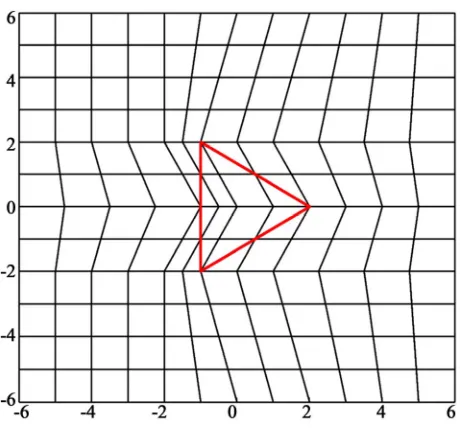
[image:2.595.322.526.82.275.2]The diagonal split-cell model is an alternative way of constructing quadrilateral meshes for the OY method that avoids the permittivity averaging. The diagonal split-cell model has been discussed in Taflove’s book [11] for or-thogonal Cartesian grid. We have extended this model to non-orthogonal grids. As shown in Figure 1, the quadri-lateral mesh is constructed in such a way that the mate-rial interface does not go along cell edges but passes th- rough the diagonal vertices of the cells using a smooth circle mapping method similar to the method proposed in [21]. Besides the simple test cases (e.g., cylinders and rectangles), our method can be applied to more compli-cated geometries, such as a triangular wedge as shown in Figure 2. By placing the magnetic fields at the cell cen-ters and the electric fields along cell edges, this approach guarantees that no line integral of the electric field cro- sses the material interface so that the permittivity aver-aging is avoided. This approach is identified as the Split- Cell Overlapping Yee (SC-OY) method. The split-cell mesh construction and some preliminary result of com-puting force on cylindrical particle were presented in [20].
[image:2.595.308.538.321.535.2]Figure 1. Non-orthogonal quadrilateral meshes near a tilt- ed-square. The sides of the square (in red) go through the diagonal vertices of the grid cells.
Figure 2. A sample non-orthogonal 8 by 8 quadrilateral mesh near a triangular wedge using diagonal split-cell mo- del. The edges of the triangle (in red) go through the diago-nal vertices of the grid cell.
In general, the 2D OY technique requires two sets of Yee grids to be overlapped to each other, so it doubles the computational cost. In 3D, it quadruples the cost. To improve the efficiency of OY method, we have employed a locally non-orthogonal approach. That is, in our im- plementation, the computational cells are overlapped and non-orthogonal in a small region that near the nano-par- ticle. The rest of the computational domain is rectangular. A sample mesh is shown in Figure 3. In the non-ortho- gonal region, the OY method is applied and the standard FDTD method is applied elsewhere. As shown in this figure, the non-orthogonal mesh is only about 10% of the whole computational domain, so that the overall compu-tational cost decreases from 200% to 110%.
In 3D, this locally non-orthogonal technique will fur-ther improve the performance of numerical simulation.
[image:3.595.75.273.335.520.2]An important step in designing the locally non-or- thogonal OY algorithm is the treatment of the interface between regular rectangular cells and overlapping cells. As shown in Figure 4, for 2D TEz mode where only
Figure 3. A locally non-orthogonal quadrilateral mesh near a tilted-square.
Figure 4. Computational cells near the interface of regular and overlapping cells.
, , z x y
H E E fields are involved, the magnetic field Hz on primary grid is defined in the cell (at cell center) and the Hz on the overlapping cell is defined at the corner of the cell. Our algorithm follows the following three steps:
1) Update the solution inside the regular grid (Yee mesh) by using the standard FDTD method;
2) Update the solution inside the OY region using the OY FDTD algorithm;
3) Calculate the magnetic field Hz on the interface by averaging the neighbor values on the primary grid. The formula is given as
1 1 1 1, ,
4 2 2 2
1 1 1 1
, ,
2 2 2 2
z z z
z z
H i j H i j H i j
H i j H i j
1 ,
2
.
Similarly, for TMz mode, in step 3 the magnetic field z
H is replaced by the electric field Ez in our algori- thm.
3. Numerical Simulations
[image:3.595.57.287.561.709.2]In our numerical examples, we apply the technique we proposed to compute the optical force on a tilted-square. The side length of the square is 240 nmand it is titled for 30 degrees. The wavelength of the incident plane wave propagating in the x-direction is 600 nm.The com-putational domain is surrounded by the uniaxial perfectly matched layer (UPML) boundaries in all directions. A sample computational mesh is shown in Figure 3.
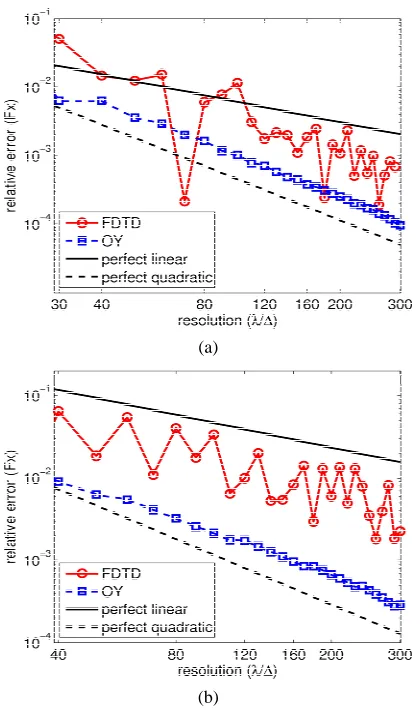
Figure 5 shows the relative errors of the computed op-tical forces on dielectric and metallic particles. The rela-tive permittivity inside the dielectric particle is 9. The metallic (gold) particle is simulated using the linear Drude dispersive model with frequency dependent per-mittivity:
1 2 2p i
,
where 1.367 10 s16 1 p
and 6.478 10 s 13 1
(a)
[image:4.595.68.278.82.437.2](b)
Figure 5. Relative errors of force versus resolution for tilt- ed-square illuminated by TEzplane wave for (a) Dielectric medium (ε= 9); (b) Dispersive medium.
4. Conclusion
We have implemented local non-orthogonal OY FDTD method that was applied to the optical force computation. Our numerical simulations showed that in addition to con- sistently achieving the smallest errors in comparison to the standard FDTD method, the OY approach is a stable non-orthogonal FDTD method that attains better effici- ency and second-order convergence even when sharp cor- ners are present.
5. Acknowledgements
The authors would like to thank Dr. Colm Dineen and Dr. Yong Zeng for their invaluable discussions. This work is supported by the Air Force Office of Scientific Research (AFOSR) under Grant numbers FA9550-10-1-0127 and FA9550-10-1-0064.
REFERENCES
[1] A. Ashkin, “Acceleration and Trapping of Particles by
Radiation Pressure,” Physical Review Letters, Vol. 24, No. 4, 1970, pp. 156-159. doi:10.1103/PhysRevLett.24.156
[2] A. Ashkin and J. M. Dziedzic, “Optical Levitation by Radiation Pressure,” Applied Physics Letters, Vol. 19, No. 8, 1971, pp. 283-285. doi:10.1063/1.1653919
[3] K. C. Neuman and S. M. Block, “Optical Trapping,” Re-view of Scientific Instruments, Vol. 75, No. 9, 2004, pp. 2787-2809. doi:10.1063/1.1785844
[4] M. Dienerowitz, M. Mazilu and K. Dholakia, “Optical Manipulation of Nanoparticles: A Review,” Journal of Nanophotonics, Vol. 2, No. 1, 2008, Article ID: 021875. doi:10.1117/1.2992045
[5] A. R. Zakharian, M. Mansuripur and J. V. Moloney, “Ra- diation Pressure and the Distribution of Electromagnetic Force in Dielectric Media,” Optics Express, Vol. 13, No. 7, 2005, pp. 2321-2336. doi:10.1364/OPEX.13.002321
[6] J. D. Jackson, “Classical Electrodynamics,” 2nd Edition, Wiley, New York, 1975.
doi:10.1103/PhysRevB.61.14119
[7] P. C. Chaumet and M. Nieto-Vesperinas, “Coupled Di-pole Method Determination of the Electromagnetic Force on a Particle over a Flat Dielectric Substrate,” Physical Review B, Vol. 61, No. 20, 2000, pp. 14119-14127. [8] M. I. Mishchenko, L. D. Travis and D. W. Mackowski,
“T-Matrix Computations of Light Scattering by Non-spherical Particles: A Review,” Journal of Quantitative Spectroscopy & Radiative Transfer, Vol. 55, No. 5, 1996, pp. 535-575. doi:10.1016/0022-4073(96)00002-7
[9] K. Okamoto and S. Kawata, “Radiation Force Exerted on Subwavelength Particles near a Nanoaperture,” Physical Review Letters, Vol. 83, No. 22, 1999, pp. 4534-4537. doi:10.1103/PhysRevLett.83.4534
[10] K. S. Yee, “Numerical Solution of Initial Boundary Value Problems Involving Maxwell’s Equations in Isotropic Media,” IEEE Transactions on Antennas and Propaga-tion, Vol. 14, No. 3, 1966, pp. 302-307.
doi:10.1109/TAP.1966.1138693
[11] A. Taflove and S. Hagness, “Computational Electrodyna- mics: The Finite-Difference Time-Domain Method,” 3rd Edition, Artech House, Norwood, 2005.
[12] T. G. Jurgens, A. Taflove, K. R. Umashankar and T. G. Moore, “Finite-Difference Time-Domain Modeling of Curved Surfaces,” IEEE Transactions on Antennas and Propagation, Vol. 40, No. 4, 1992, pp. 357-366. doi:10.1109/8.138836
[13] S. Dey and R. Mittra, “A Conformal Finite-Difference Time-Domain Technique for Modeling Cylindrical Di-electric Resonators,” IEEE Transactions on Microwave Theory and Techniques, Vol. 47, No. 9, 1999, pp. 1737- 1739. doi:10.1109/22.788616
[14] A. Mohammadi, H. Nadgaran and M. Agio, “Contour path Effective Permittivities for the Two-Dimensional Fi-nite-Difference Time-Domain Method,” Optics Express, Vol. 13, No. 25, 2005, pp. 10367-10381.
doi:10.1364/OPEX.13.010367
45, No. 9, 1997, 1645-1649. doi:10.1109/22.622937
[16] A. Farjadpour, D. Roundy, A. Rodriguez, M. Ibanescu, P. Bermel, J. D. Joannopoulos, S. G. Johnson and G. W. Burr, “Improving Accuracy by Subpixel Smoothing in the Finite-Difference Time Domain,” Optics Letters, Vol. 31, No. 20, 2006, pp. 2972-2974. doi:10.1364/OL.31.002972
[17] A. F. Oskooi, C. Kottke and S. G. Johnson, “Accurate Finite-Difference Time-Domain Simulation of Anisotro- pic Media by Subpixel Smoothing,” Optics Letters, Vol. 34, No. 18, 2009, pp. 2778-2780.
doi:10.1364/OL.34.002778
[18] G. R. Werner and J. R. Cary, “A Stable FDTD Algorithm for Non-Diagonal, Anisotropic Dielectrics,” Journal of Computational Physics, Vol. 226, No. 1, 2007, pp. 1085-
1101. doi:10.1016/j.jcp.2007.05.008
[19] J. Liu, M. Brio and J. V. Moloney, “Overlapping Yee FDTD Method on Nonorthogonal Grids,” Journal of Sci-entific Computing, Vol. 39, No. 1, 2009, pp. 129-143. doi:10.1007/s10915-008-9253-1
[20] J. Liu, M. Brio and J. V. Moloney, “A Diagonal Split Cell Model for the Overlapping Yee FDTD Method,” Acta Mathematica Scientia, Vol. 29, No. 6, 2009, pp. 1670- 1676. doi:10.1016/S0252-9602(10)60009-4