Constrained Portfolio Optimisation: the state-of-the-art Markowitz
Models
Yan Jin, Rong Qu and Jason Atkin
ASAP Group, School of Computer Science, The University of Nottingham, Nottingham, UK
{ywj,rxq,jaa}@cs.nott.ac.uk
Keywords: Constrained Portfolio Optimisation, Mean-Variance, Cardinality, Pre-assignment, Round-lot, Class
Abstract: This paper studies the state-of-art constrained portfolio optimisation models, using exact solver to identify the optimal solutions or lower bound for the benchmark instances at the OR-library with extended constraints. The effects of pre-assignment, round-lot, and class constraints based on the quantity and cardinality constrained Markowitz model are firstly investigated to gain insights of increased problem difficulty, followed by the analysis of various constraint settings including those mostly studied in the literature. The study aims to provide useful guidance for future investigations in computational algorithms.
1
INTRODUCTION
Portfolio optimisation (PO) is an extensively stud-ied area in finance. The seminal work by (Markowitz, 1952) had a profound impact on the development of PO in the last 60 years. The Mean-Variance (MV) model introduced by Markowitz focusses on finding the best trade-off between the return and risk of port-folios, i.e. mean of return and covariance of return, to minimise the risk given an expected return level or vice versa.
Although the significance of the MV model is unanimously recognised, the basic model has been widely challenged for some underlying assumptions. It neglects many realistic restrictions faced by in-vestors like tax and transaction cost; personal or strategic investment decisions, etc. It assumes as-sets are traded at any fractions. It implicitly encour-ages holdings of as many assets as possible to diver-sify the overall risk. In reality, an investment man-ager may face the restrictions on the minimum and/or maximum capital allocated to an asset or industry. In-vestors also prefer a limited number of assets (Jansen and van Dijk, 2002).
The complexity of the PO problem to a large ex-tent depends on the constraints (Maringer, 2008). The basic MV model is a standard quadratic programming problem. There has been numerous tools to solve it optimally. However real-world financial constraints significantly increase the level of complexity. For in-stance, cardinality constraint requires only a limited number of assets to be included in the portfolio, which
turns the problem into non-convex. It is no longer always suitable to use exact methods to find optimal solutions thus the majority of work in the current lit-erature has focused on heuristics for the constrained PO problem.
Nevertheless, due to the fast development some constraints now can be handled by commercial solvers such as CPLEX with limited computational cost for many difficult optimisation problems. The purpose of our study is to provide an insight into the current state of the MV models with subsets of prac-tical constraints using CPLEX, and provide useful guidance of potential areas of future research on com-putational algorithms for constrained PO problems.
2
PROBLEM FORMULATION
2.1
Mean-Variance Model
The MV model considers a single period of invest-ment. The process of PO allocates amongNdifferent assets the proportions (xi,i=1, ...N) of the capital to form a portfolio. Each assetihas a return rateriand is associated with a covarianceσi jof the return with each other asset j. The total returnrPof a portfolio is given by the weighted combination of the constituent assets’ returns ∑Ni=1xiri, and its risk vP is defined by ∑Ni=1∑Nj=1σi jxixj. The aim is to minimize the portfolio riskvPfor a given level of expected return
Rexp or vice versa, mathematical formulation of the model as follows:
Minimise
vP= N
∑
i=1
N
∑
j=1
σi jxixj (1)
Subject to
rP= N
∑
i=1
xiri=Rexp (2)
N
∑
i=1
xi=1 (3)
06xi61,i=1, ...,N (4) Constraint (2) defines the expected return. The budget constraint (3) requires the whole capital should be invested. Investment to each asset is non-negative, defined in constraint (4). A set of optimal portfolios of the lowest risk for various values ofRexp can be obtained by solving the above model repeat-edly, which forms the efficient frontier (EF). For each point on EF, there should be no portfolio with a higher expected return at the same risk level, and no portfolio with a lower risk at the same level of return.
2.2
Additional Practical Constraints
Several extensions have been proposed to enrich the MV model with real world constraints in the liter-ature. In this paper, we investigate the following mostly studied additional practical constraints based on the basic MV model.
Cardinality constraint The cardinality constraint restricts the number ofK assets in a portfolio. A bi-nary variable zi is introduced to denote whether an
asset is selected or not. This constraint is relaxed to i.e.∑Ni=1zi≤Kin some work in the literature.
N
∑
i=1
zi=K (5)
zi∈ {0,1},i=1, ...,N (6) Quantity constraint The quantity constraint spec-ifies the lower (ε) and upper (δ) bounds allowed for
the allocated proportions to each asset in a portfolio.
εzi6xi6δzi,i=1, ...,N (7) Pre-assignment constraint Pre-assignment con-straint pre-selects investor’s preferred assets in the portfolio. It was firstly discussed in (Chang et al., 2000) and firstly applied in (Di Gaspero et al., 2011). A binary variablesi is introduced to denote if asseti belongs to the pre-assigned setP, 0 otherwise.
si=1,i∈P (8)
zi>si,i=1, ...,N (9) Round lot constraint Round lot constraint defines that the investment of any asset in the portfolio should be an exact multiple units of a minimum lot. An inte-ger variable yi and minimum lotli for each asset are introduced. The round lot constraint might cause the budget constraint (3) not strictly satisfied, as the cap-ital cannot always be divided as an exact multiple of trading lot for all the assets.
xi=yi∗li,i=1, ...,N (10) Class constraint Introduced by (Chang et al., 2000), class constraint is used to limit the total pro-portion invested in those assets with common charac-teristics, leading to a more diversified and safe port-folio. Classes of assets are considered to be mutually exclusive, i.e.Ci∩Cj=∅for all assetsi6= j. In this
study we require at least one asset from each of the M classes to be selected, thusK≥M. Here the upper bound is set as 1, and the lower bound of each class isLm>0 for every classCm,m=1, ...,M. Then the bound constraint is formulated as follows:
Lm6
∑
i∈Cm
xi61,m=1, ...M (11)
3
STUDIES OF VARIOUS
EXTENDED MV MODELS
branch and bound methods. These techniques can also handle arbitrary linear constraints, like quantity constraint, see (Borchers and Mitchell, 1997). Never-theless the problem becomes increasingly much more complex when the number of assets increases and with additional constraints. For instance, with the cardinality constraint, the problem turns into a mixed integer nonlinear programming and NP-hard (Bien-stock, 1995). (Bien(Bien-stock, 1995) presented a branch and cut algorithm for the cardinality constrained PO problem of up to 3897 assets with various cardinality values. At the time of publication results shown that this type of problem with larger size may be impossi-ble to solve to a proved optimality within a reasonaimpossi-ble time. Some works require strictlyK assets to be in-cluded in a portfolio ((Chang et al., 2000; Fernandez and Gomez, 2007; Xu et al., 2010; Woodside-Oriakhi et al., 2011; Jin et al., 2014)) while some others use relaxed version ((Schaerf, 2002; Ruiz-Torrubiano and Suarez, 2010)).
There are not many experimental studies on the pre-assignment constraint so far, except some infor-mal discussion (Di Tollo and Roli, 2008).(Di Gaspero et al., 2011) examined the impact of the pre-assignment constraint and reported that pre-assigning one asset tended to worsen the performance except when the asset is in the optimal solution for all the expected return levels.
Recently, some scholars included the round-lot constraint into PO problems, which makes it more difficult to find a feasible solution. Some of these were measured in units of money ((Speranza, 1996; Mansini and Speranza, 1999; Kellerer et al., 2000; Lin and Liu, 2008; Bonami and Lejeune, 2009; Gol-makani and Fazel, 2011)), while others imposed that the continuous weight variables should be an integer multiple of a given fraction ((Jobst et al., 2001; Stre-ichert et al., 2004; Skolpadungket et al., 2007)). Some of them included transaction cost at the same time. (Mansini and Speranza, 1999) showed that a PO prob-lem with minimum lot and without any fixed transac-tion cost is NP-complete.
Class constraint was first introduced by (Chang et al., 2000), also mentioned in (Ruiz-Torrubiano and Suarez, 2010), and applied in ((Anagnostopoulos and Mamanis, 2010; Anagnostopoulos and Mamanis, 2011a; Anagnostopoulos and Mamanis, 2011b)). An-other form of this constraint is splitting the universe of assets into subsets with similar features. Optimi-sation is performed on the best representative of each class (Vijayalakshmi Pai and Michel, 2009).
Most of the research in the literature adopt two constraints in the problem formulation. In particu-lar, cardinality and quantity constraints were
stud-ied 44.93% and 30.43%, respectively, in the portfo-lio management models (Metaxiotis and Liagkouras, 2012).
4
ANALYSIS ON DIFFERENT
CONSTRAINTS IN THE MV
MODEL
As most of the applications in the literature dealt with quantity and cardinality constrained PO problems, in this section we first discuss the ef-fect of pre-assignment, round-lot and class constraint based on the quantity and cardinality constrained MV model in terms of solution quality and computational cost. Then we present experimental framework us-ing CPLEX 12.6 to identify solutions for the most commonly applied constrained MV models in the lit-erature, some models with different settings in con-straints.
Five widely tested benchmark datasets in the OR-library (Beasley, 1990) (http://people.brunel.
ac.uk/˜mastjjb/jeb/info.html) are chosen in
our experiments. They were extracted from the well-known indices, the Hong Kong HangSeng, the Ger-man DAX100, the UK FTSE100, the US S&P100 and the Japan Nikkei, with dimension N=31,85,89,98 and 225 (N31-N225), respectively. The portfo-lios obtained under different constraints and settings form constrained efficient frontiers (CEF). The un-constrained efficient frontier (UEF), for the uncon-strained PO problem from the OR-library, is used as the upper bounds for CEF. For each dataset, 50 points across the UEF are chosen. For each point on the CEF, the solver is run to minimise risk (QP) given a respected return. The stopping time limit is set to 3600 seconds.
Several performance measures are adopted, for which smaller values denote better solutions. The Average Percentage Error (APE) (Di Gaspero et al., 2011) measures the relative distance between the ob-tained CEF from the UEF with the same expected re-turn, calculated using Formula (11), where x∗andx
denote the portfolios on the CEF and UEF, respec-tively, firdenotes the value of the obtained risk, andp
is the number of portfolios on the frontier.
APE=1
p∗
p
∑
i=1
fir(x∗)−fir(x)
fr i(x)
(11)
risk (Eq.(1)) and return (Eq.(2)) of the portfolio. It measures how close the obtained CEF is to the UEF.
GD= 1
p∗x∗∈
∑
XCEF
min{dx∗x|x∈XU EF} (12)
dx∗x=
q
(fr(x∗)−fr(x))2+ (fv(x∗)−fv(x))2 (13) Inverted generational distance(IGD) is a variant of GD. It uses UEF as a reference to calculate the av-erage minimum distance of its each portfolio to the CEF, calculated using Formula (14). This measure mainly shows the overall quality of the obtained so-lution set (i.e. its diversity and convergence to the UEF).
IGD=1
p∗x∗∈
∑
XU EF
min{dx∗x|x∈XCEF} (14) Algorithm Effort (AE) (Chen et al., 2012),AE= Time
p , measures the ratio of the total run time to the number of feasible portfolios obtained on the CEF. MAX and MIN denote the maximum or minimum time spent for one portfolio. Optimal Rate is used to denote the rate of optimal solutions obtained out of all the points on the CEF.
The experiments are coded in C++ in Microsoft Visual Studio 2012, and run on a PC with Windows 7 Operating System (64-bit), 6GB of RAM, and an Intel Core i7 CPU ([email protected]).
4.1
Pre-assignment, Round-lot and
Class constraints
We first test all the extended constraints on the MV model. The lower and upper bounds of the weights are set as ε=0.01,δ=1, and cardinality K =10. These are widely used in the literature. Preliminary computational results indicate that the pre-assigned asset(s) is not a main performance discriminator of the basic MV model, thus is randomly set as P= {30}. The class constraints is set to: randomly de-fine two classes with size of 20% proportionately to problem dimension (N). These constraints are set as those in (Lwin et al., 2014). Initial experiment results showed that cardinality constraint contributes the most to the problem difficulty.
We then assess the effect on the computational cost from pre-assignment (C3), round-lot (C4) and class (C5) constraints based on the MV model with cardinality (C1) and quantity (C2) constraints, i.e.
ε=0.01,K=10.
4.1.1 Pre-assignment Constraint(C3)
To evaluate the impact of pre-assignment constraint on the computational cost, for each benchmark
in-stance, we fix in turn one of the assets as pre-assigned (imposing C1 and C2 with the settings as mentioned above). For each instance we then obtain a group ofN
CEFs, one for each pre-assigned asset. Intuitively, the choice of the pre-assigned assets determines the so-lution quality measured in APE. For example, if the pre-assigned asset does not belong to any optimal so-lution for most of the values of the required return
Rexpon UEF, the pre-assignment constraint generally deteriorates the solution quality. Moreover, the mag-nitude of this worsening may depend on the features of the asset, e.g. return rate, standard deviation(sd), and the ratio of return/sd, etc.
As an example, in Figure 1, for instance N98, the average time spent for computing the CEF for each pre-assigned asset is plotted. It can be seen that the time used varies with obvious difference among dif-ferent assets, ranging from around 20s to 400s. Figure 2 reports the frequency of each asset appearing in the optimal portfolios on the UEF. For instance, asset 1 which leads to the maximum time used (400s) never appears in the optimal solution in the unconstrained problem. Moreover, the rankings of its return rate, sd, and the ratio of return/sd are quite low, ranked as 61, 64, and 71, respectively. The assets ranked top in return rate, sd and ratio (namely assets 82, 62, and 89) appear to lead to around only 50s, which is at the lower level of time used in Figure 1. Moreover, asset 89 appears 36 times out of 50 in the optimal portfo-lios on the UEF shown in Figure 2. These imply that there is some correlation between the feature of the pre-assigned asset and the solution construction.
Intuitively, if we pre-assign more assets in ad-vance, the problem becomes smaller with only (K−
pre assigned) number of assets. We conduct an
[image:4.595.323.505.623.652.2]an-other experiment on two groups of pre-assigned assets on instance N98, each with the top five and bottom five shown in Figure 2. As expected in Table 1, the computational time with more pre-assigned assets is much lower than that with fewer assets. Pre-assigning the assets which intend to appear in the optimal port-folio on UEF can reduce the computational cost and lead to better solution quality.
Table 1: Results of pre-assigned assets with different fea-tures
Pre-assigned APE MAX AE Optimal Rate Top 5 0.100718 19.005 4.609 0.98 Bottom 5 0.234882 122.136 22.716 0.96
4.1.2 Round-lot Constraint(C4)
96 92 88 84 80 76 72 68 64 60 56 52 48 44 40 36 32 28 24 20 16 12 8 4 1 400
350
300
250
200
150
100
50
0
Index of asset
Ti
m
e(
s)
Figure 1: Average time used for N98, with each pre-assigned asset
96 93 89 86 82 76 73 66 65 64 62 52 51 45 44 43 42 37 36 34 33 23 22 20 19 14 11 2 40
30
20
10
0
index of asset
Co
un
tN
o. 23
8 36
28
23
18
11
1 10 15 19
2 2 25
3 4 34
7 41 38
3 27
4 28
14
[image:5.595.77.286.99.237.2]6 26 34
Figure 2: Frequency of each in the optimal solution on UEF in N98, y-axix is the occurrence number
[image:5.595.76.287.267.407.2]without round-lot constraint. As seen in Table 2, there are no significant differences in terms of the computa-tional time and optimal rate. The chosen lot unit size has a slight effect on the optimal rate.
Table 2: Results on the C4 constrained problem based on C1 and C2 constrained MV model
Dataset Lot unit APE Max Time AE Optimal Rate
N31
NA 0.02107 0.983 0.138 0.92 0.005 0.02157 0.719 0.269 0.92 0.008 0.03321 9.612 2.675 0.88 0.01 0.02194 0.577 0.108 0.92
N85
NA 0.07539 61.463 11.500 0.94 0.005 0.07686 49.954 5.550 0.94 0.008 0.07686 49.954 5.550 0.94 0.01 0.07838 44.33 5.03887 0.94
N89
NA 0.02569 902.803 101.885 0.94 0.005 0.02625 1586.61 97.140 0.94 0.008 0.02936 400.068 39.773 0.92 0.01 0.02681 1177.83 91.809 0.94
N98
NA 0.06181 3600.59 1055.72 0.7 0.005 0.06265 3600.47 1042.23 0.72 0.008 0.06749 3600.64 979.171 0.76 0.01 0.06345 3600.4 1037.42 0.72
N225
NA 0.01034 16.333 7.229 0.98 0.005 0.01107 12.592 5.284 0.98 0.008 0.01129 23.865 8.139 0.96 0.01 0.01138 9.441 4.146 0.98
4.1.3 Class Constraint(C5)
The class constraint is tested with different settings on the class defined and the lower bound. From the theoretical perspective, class constraint is linear thus does not increase the problem difficulty. The number of classes should also reduce the problem difficulty as the original problem is partitioned into a set of sub-problems with lower dimension. Table 3 shows the results obtained on instance N98 with different class settings based on the C1 and C2 constrained models. The class classification here is randomly assigned.
[image:5.595.316.512.358.412.2]From Table 3, it can be seen that the higher lower bound 0.1 could reduce the optimal rate compared to 0.05. As expected, the setting with less classes requires much more computational effort than those with more classes. Intuitively expected, in terms of computational cost, the class constraint does not gen-erate much difficulty on the cardinality constrained model, while it can affect the rate of optimality.
Table 3: Results with different class settings based on the C1 and C2 constrained MV Model
Class setting APE MAX AE Optimal Rate NA 0.061814 3600.59 1055.72 0.7 size=6, LC=0.05 0.163718 519.235 101.793 0.84 size=6, LC=0.1 0.246108 999.286 156.248 0.68 size=2, LC=0.1 0.096405 3601.05 1123.34 0.62 size=2, LC=0.05 0.079334 3599.82 433.568 0.9
4.2
Performance on the Complete
Model
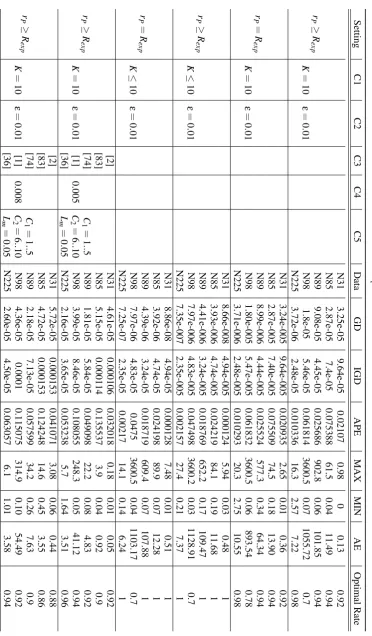
Table4 reports our results under different constraint settings (Columns C1-C5) in terms of optimality, so-lution quality (GD, IGD, APE), and computational cost (MAX, MIN, AE) for the constrained models. This feature is varied by the researchers. In the last two models, for each instance, the asset which took the longest time in Figure 1 is pre-assigned. Two classes are defined in the class constraint with the lower bound set as 0.05. The results illustrate that, the last two models spent much less computational cost compared to the C1 and C2 constrained models. In other words, combination of all these constraints seems to have neutralising effect.
4.3
Performance on Existing MV
Models in the Literature
[image:5.595.77.283.544.706.2]Table 5: Results for various models in literature
Models in the literature Data GD IGD APE AE Optimal Rate (Maringer and Kellerer, 2003) N31 5.82E-08 4.94E-05 8.20E-05 0.01176 1
N85 3.91E-06 4.74E-05 0.024185 0.66952 1 N89 4.40E-06 3.24E-05 0.018769 1.95914 1 N98 7.96E-06 4.83E-05 0.047486 10.6813 1 N225 6.76E-07 2.35E-05 0.002015 1.2937 1 (Chang et al., 2000) N31 3.25E-05 9.64E-05 0.02107 0.137674 0.92 (Fernandez and Gomez, 2007) N85 2.87E-05 7.40E-05 0.075388 11.4999 0.94 (Xu et al., 2010) N89 9.08E-06 4.45E-05 0.025686 101.885 0.94
K=10 N98 1.80E-05 5.46E-05 0.061814 1055.72 0.7
ε=0.01 N225 3.72E-06 2.48E-05 0.010336 7.22906 0.98 (Ruiz-Torrubiano and Suarez, 2010) N31 8.86E-08 4.94E-05 0.000128 0.51264 1 (Schaerf, 2002) N85 3.92E-06 4.74E-05 0.024198 12.2765 1
K<=10 N89 4.39E-06 3.24E-05 0.018719 107.883 1
ε=0.01 N98 7.97E-06 4.83E-05 0.0475 1103.17 0.7 N225 7.25E-07 2.35E-05 0.00217 6.2358 1 (Lwin et al., 2014) N31 5.38E-05 0.00015 0.036569 1.90675 0.88
K=10 N85 4.14E-05 0.000108 0.104911 16.5399 0.9
ε=0.01 N89 2.22E-05 5.93E-05 0.054954 12.4044 0.92 N98 2.68E-05 6.68E-05 0.084467 107.943 0.96 N225 1.74E-05 3.86E-05 0.04161 7.39513 0.94 (Woodside-Oriakhi et al., 2011) N31 2.66E-05 0.000159 NA 0.0766 1
K=10 N85 1.08E-05 0.000128 NA 9.91606 1
ε=0.01 N89 6.81E-06 9.35E-05 NA 94.7458 1
Rexpin range:[0.9Rexp,1.1Rexp] N98 1.46E-05 0.00014 NA 1105.7 0.72 N225 2.06E-06 5.27E-05 NA 6.54972 1
the space limited, a sketch of the performance of the representative models with different combinations of constraints is shown in Table 5. More detailed data and updated models are published in http://www.
cs.nott.ac.uk/˜pszrq/benchmarks.htm.
5
CONCLUSION AND FUTURE
WORK
This paper studies the constrained Markowitz MV model for the portfolio optimisation problem, where quantity, cardinality, pre-assignment, round-lot and class constraints are considered. We first discuss the effect of the pre-assignment, round-lot and class straints based on the cardinality and quantity con-strained models in terms of computational cost. Then we conduct experiments using CPLEX to obtain op-timal or feasible solutions within a limited computa-tional cost for various models with different constraint settings. The results for the thoroughly studied con-strained models are presented.
According to the results, the pre-assignment, round-lot and class constraints do not make a big dif-ference to the cost of solving the quantity and cardi-nality constrained problem. As the mostly considered constraint in the current literature, the cardinality con-straint is proved to contribute to mainly the problem difficulty. In addition, the more specific settings im-posed on these constraints, the easier the problem is. The complete constrained MV model with all the straints can neutralize the effect of cardinality con-straint, and the optimal solutions can be much easier to obtain.
There are some exceptional points on instance N98, which still requires a huge amount of compu-tational effort for the cardinality constrained models. Nevertheless, due to the fast development of commer-cial solvers, most of the currently studied constrained MV models can be efficiently solved to obtain most of the optimal solutions within a limited time.
The above results motivate our future research to more challenging PO problem. In the future, we plan to further study the constrained PO problem based on other risk measures such as VaR and CVaR which are favoured by investors in reality. It is also interesting to consider other constraints such as transaction cost which occurs for problem with more than one invest-ment period. We also aim to analyse the performance on difficult real instances of larger problem size.
REFERENCES
Anagnostopoulos, K. and Mamanis, G. (2010). A portfo-lio optimization model with three objectives and dis-crete variables. Computers & Operations Research, 37(7):1285 – 1297. Algorithmic and Computational Methods in Retrial Queues.
Anagnostopoulos, K. and Mamanis, G. (2011a). The mean-variance cardinality constrained portfolio optimiza-tion problem: An experimental evaluaoptimiza-tion of five mul-tiobjective evolutionary algorithms. Expert Systems with Applications, 38(11):14208 – 14217.
Anagnostopoulos, K. P. and Mamanis, G. (2011b). Multiob-jective evolutionary algorithms for complex portfolio optimization problems. Computational Management Science, 8(3):259–279.
prob-lems by electronic mail. Journal of the Operational Research Society, 41:1069–1072.
Bienstock, D. (1995). Computational study of a family of mixed-integer quadratic programming problems. In
Integer Programming and Combinatorial Optimiza-tion, volume 920 ofLecture Notes in Computer Sci-ence, pages 80–94. Springer Berlin Heidelberg. Bonami, P. and Lejeune, M. A. (2009). An exact
solu-tion approach for portfolio optimizasolu-tion problems un-der stochastic and integer constraints.Operations Re-search, 57(3):650–670.
Borchers, B. and Mitchell, J. E. (1997). A computational comparison of branch and bound and outer approxi-mation algorithms for 01 mixed integer nonlinear pro-grams.Computers & Operations Research, 24(8):699 – 701.
Chang, T.-J., Meade, N., Beasley, J., and Sharaiha, Y. (2000). Heuristics for cardinality constrained portfo-lio optimisation. Computers & Operations Research, 27(13):1271 – 1302.
Chen, A., Liang, Y.-C., and Liu, C.-C. (2012). An artificial bee colony algorithm for the cardinality-constrained portfolio optimization problems. In2012 IEEE Congress on Evolutionary Computation (CEC), pages 1–8.
Cura, T. (2009). Particle swarm optimization approach to portfolio optimization. Nonlinear Analysis: Real World Applications, 10(4):2396 – 2406.
Di Gaspero, L., Di Tollo, G., Roli, A., and Schaerf, A. (2011). Hybrid metaheuristics for constrained portfolio selection problems. Quantitative Finance, 11(10):1473–1487.
Di Tollo, G. and Roli, A. (2008). Metaheuristics for the portfolio selection problem. International Journal of Operationas Research, 5(1):13–35.
Fernandez, A. and Gomez, S. (2007). Portfolio selection using neural networks. Computers & Operations Re-search, 34(4):1177 – 1191.
Golmakani, H. R. and Fazel, M. (2011). Constrained port-folio selection using particle swarm optimization. Ex-pert Systems with Applications, 38(7):8327 – 8335. Jansen, R. and van Dijk, R. (2002). Optimal benchmark
tracking with small portfolios. The Journal of Portfo-lio Management, 28(2):33–39.
Jin, Y., Qu, R., and Atkin, J. (2014). A population-based incremental learning method for constrained portfolio optimisation. InSymbolic and Numeric Algorithms for Scientific Computing (SYNASC), 2014 16th Inter-national Symposium on, pages 212–219.
Jobst, N., Horniman, M., Lucas, C., and Mitra, G. (2001). Computational aspects of alternative portfolio selec-tion models in the presence of discrete asset choice constraints.Quantitative Finance, 1(5):489–501. Kellerer, H., Mansini, R., and Speranza, M. (2000).
Se-lecting portfolios with fixed costs and minimum trans-action lots. Annals of Operations Research, 99(1-4):287–304.
Lin, C.-C. and Liu, Y.-T. (2008). Genetic algorithms for portfolio selection problems with minimum
transac-tion lots. European Journal of Operational Research, 185(1):393 – 404.
Lwin, K., Qu, R., and Kendall, G. (2014). A learning-guided multi-objective evolutionary algorithm for constrained portfolio optimization.Applied Soft Com-puting, 24:757 – 772.
Mansini, R. and Speranza, M. G. (1999). Heuristic algo-rithms for the portfolio selection problem with min-imum transaction lots. European Journal of Opera-tional Research, 114(2):219 – 233.
Maringer, D. (2008). Heuristic optimization for portfolio management [application notes]. Computational In-telligence Magazine, IEEE, 3(4):31 –34.
Maringer, D. and Kellerer, H. (2003). Optimization of cardinality constrained portfolios with a hybrid local search algorithm. OR Spectrum, 25(4):481–495. Markowitz, H. (1952). Portfolio selection. The Journal of
Finance, 7(1):pp. 77–91.
Metaxiotis, K. and Liagkouras, K. (2012). Multiobjective evolutionary algorithms for portfolio management: A comprehensive literature review. Expert Systems with Applications, 39(14):11685 – 11698.
Ruiz-Torrubiano, R. and Suarez, A. (2010). Hybrid ap-proaches and dimensionality reduction for portfolio selection with cardinality constraints. Computational Intelligence Magazine, IEEE, 5(2):92–107.
Schaerf, A. (2002). Local search techniques for constrained portfolio selection problems. Computational Eco-nomics, 20:177–190.
Skolpadungket, P., Dahal, K., and Harnpornchai, N. (2007). Portfolio optimization using multi-objective genetic algorithms. InEvolutionary Computation, 2007. CEC 2007. IEEE Congress on, pages 516–523.
Speranza, M. G. (1996). A heuristic algorithm for a portfo-lio optimization model applied to the milan stock mar-ket. Computers & Operations Research, 23(5):433 – 441.
Streichert, F., Ulmer, H., and Zell, A. (2004). Evaluating a hybrid encoding and three crossover operators on the constrained portfolio selection problem. In Evolution-ary Computation, 2004. CEC2004. Congress on, vol-ume 1, pages 932–939.
Vijayalakshmi Pai, G. and Michel, T. (2009). Evolution-ary optimization of constrained k -means clustered as-sets for diversification in small portfolios. Evolution-ary Computation, IEEE Transactions on, 13(5):1030– 1053.
Woodside-Oriakhi, M., Lucas, C., and Beasley, J. (2011). Heuristic algorithms for the cardinality constrained ef-ficient frontier. European Journal of Operational Re-search, 213(3):538 – 550.