Reducing falls among older people in general practice: the ProAct65+
exercise intervention trial
!
Gawler S
, Skelton DA, Dinan-Young S, Masud T, Morris RW, Griffin M,
Kendrick D, Iliffe S for the ProAct65+ team
!
Sheena Gawler, Research Dept. of Primary Care & Population Health, UCL, Royal Free campus, Row-land Hill St., London NW3 2PF, UK
Professor Dawn A Skelton, School of Health & Life Sciences, Glasgow Caledonian University, Cowcad-dens Road, Glasgow, G4 0BA, UK
Dr Susie Dinan-Young, Research Dept. of Primary Care & Population Health, UCL, Royal Free campus, Rowland Hill St., London NW3 2PF, UK
Professor Tahir Masud, Nottingham University Hospitals NHS Trust, Hucknall Road, Nottingham, NG5 1PB, UK,
Professor Richard Morris, School of Social & Community Medicine, University of Bristol, Canynge Hall, 39 Whatley Rd, Bristol BS8 2PS and Research Dept. of Primary Care & Population Health, UCL, Royal Free campus, Rowland Hill St., London NW3 2PF, UK
Mark Griffin, Research Dept. of Primary Care & Population Health, UCL, Royal Free campus, Rowland Hill St., London NW3 2PF, UK
Professor Denise Kendrick, School of Medicine, Division of Primary Care, Tower Building, University Park, University of Nottingham, Nottingham, NG7 2RD, UK
Professor Steve Iliffe, Research Dept. of Primary Care & Population Health, UCL, Royal Free campus, Rowland Hill St., London NW3 2PF, UK
!
Corresponding author: Sheena Gawler, Dept of Primary Care & Population Health, UCL. [email protected]
!
!
Abstract
!
Background:
Falls are common in the older UK population and associated costs to the NHS are high. Systematic reviews suggest that home exercise and group-based exercise interventions, which focus on progressively challenging balance and increasing strength, can reduce up to 42% of falls in those with a history of falls. The evidence is less clear for those older adults who are currently at low risk of falls.
Aim:
Setting & participants:
1256 community-dwelling older adults (aged 65+) were recruited through GP practices in two sites (London and Nottingham). Frequent fallers (≥3 falls in last year) and those with unstable medical conditions were excluded, as were those already reaching the UK Gov-ernment recommended levels of physical activity (PA) for health.
Methods:
Baseline assessment (including assessment of health, function and previous falls) oc-curred before randomisation; the intervention period lasted 24 weeks and there was an immediate post-intervention assessment; participants were followed up every six months for 24 months. Falls data were analysed using negative binomial modelling.
Outcome measures:
Falls data were collected prospectively during the intervention period by 4-weekly di-aries (6 in total). Falls recall was recorded at the 3-monthly follow-ups for a total of 24 months. Balance was measured at baseline and at the end of the intervention period us-ing the Timed Up & Go and Functional Reach tests. Balance confidence (CONFbal), falls risk (FRAT) and falls self-efficacy (FES-I) were measured by questionnaire at baseline and at all subsequent assessment points.
Results:
in-tervention arms compared with UC. There were no significant changes in any of the functional balance measures, FES-I or FRAT, between baseline and the end of the inter-vention period.
Conclusion:
Community-dwelling older adults who joined an exercise intervention (FaME) aimed at increasing MVPA did not fall more during the intervention period, fell less and had fewer injurious falls in the 12 months after cessation of the intervention. However, 24 months after cessation of exercise, the beneficial effects of FaME on falls reduction ceased, ex-cept in those who maintained higher levels of MVPA. OEP exercise appears less effective at reducing falls in this functionally more able population of older adults.
Background
!
Older people are the most sedentary segment of the population, with 57% of men and 52% of women aged 65-74 years meeting the UK’s physical activity recommendations, dropping to 43% of men and 21% of women aged 75-84 years (HSE 2012). Falls risk is in-creased if a person is inactive and has poor strength and balance (Todd and Skelton 2004). The incidence of hip fractures in the UK is 86,000 per year, and 95% of these are the result of a fall. The cost to the National Health Service (NHS) is £1.7 billion a year (NICE 2013).
!
There is already robust evidence to support the use of exercise in falls prevention and rehabilitation following falls, with as many as 42% of falls being prevented by a 'well-de-signed' exercise intervention; balance retraining and lower limb strengthening exercises with a total dose of at least 50 hour (Sherrington 2008, Sherrington 2011). The Cochrane Systematic Review of falls interventions in community dwelling older people states that both group and home based exercise reduce falls rate (Rate Ratios 0.71 and 0.68, re-spectively) (Gillespie 2012). Most studies have recruited those at high risk of future falls. It is not clear whether community-based interventions, apart from Tai Chi, are effective with unselected populations of older people. In fact, there is some concern that increas-ing physical activity, particularly brisk walkincreas-ing, may increase exposure to risk of falls (Sherrington 2011). Two falls reduction programmes (Falls Management Exercise and the Otago Exercise Programme) which have previously been successful in higher risk popula-tions, were evaluated in this study, ProAct65+, in a primary falls prevention context. In the UK, 54% of falls services use FaME exercises and 41% the OEP exercises in their provi-sion (RCP 2012) and both programmes are recommended in the Department of Health Prevention Package (DoH 2009).
!
aged 65+ and reported a 54% reduction in falls in the exercise group compared to the control group.
!
The ProAct65+ Study, a multi-centre, cluster-randomised controlled trial, compared shorter (24 week) versions of FaME and OEP with usual care (UC) in community-dwelling over 65s recruited through general practice and who were inactive (not achieving the amount of physical activity recommended for health (DoH 2011)). The primary outcome, minutes of moderate to vigorous intensity physical activity (MVPA) per week at 12
months post intervention, showed a significant increase in the FaME group compared to UC (Iliffe 2014), which is clinically important considering the poor exercise habits of the UK's older population (DoH 2011) and the strong association of physical inactivity with sarcopenia and frailty outcomes (BGS 2014).
!
The general older adult population recruited by ProAct65+, although not selected ac-cording to falls status and therefore at lower risk of falls than those with a falls history, was expected to contain a proportion of older people who had already fallen and those who displayed other risk factors for future falls, such as poor balance and poor leg strength. Our hypothesis therefore was that shorter FaME and OEP interventions would reduce falls in older people aged 65+ at lower risk of falls as the intensity of the pro-gramme could be greater, and the progression of exercises could be faster, in those whose balance was less compromised. With the prevalence of use of FaME and OEP exer-cises already in the UK (RCP 2012) and nearly 5000 trained FaME instructors and OEP leaders in the UK, this study aimed to examine whether the use of existing programmes to reduce falls, in those considered currently at lower risk of falls but facing a decline in function due to inactivity, was effective.
!
Methods
!
Participants
Participants were aged 65 years or over, registered with participating general practices, living independently (not in residential or nursing homes) and physically able to attend group exercise. Frequent fallers (≥3 falls in the past year) were excluded, as were those
already achieving sufficient exercise to benefit health (≥150 minutes of MVPA
cog-nitive impairment. A random sample of eligible patients was invited to participate via a letter from their GP. Further information on the study design, recruitment and outcome measures can be found elsewhere (Iliffe 2010, Iliffe 2014).
!
Randomisation, Blinding
Cluster-randomisation to study arm was by practice using minimisation. The variables used in the minimisation process were trial site, practice size and practice deprivation. The practices, their patients and the researchers were all blinded to allocation until all patients at a practice were recruited.
!
Interventions
There were 3 arms to the trial: home based exercise programme (OEP), community-cen-tre based group exercise programme (FaME) and usual care (UC). The exercise pro-grammes were modelled on their previous trials; FaME participants attended a once-weekly, 1 hour, supervised session which was supplemented with twice-once-weekly, 30-minute sessions of a home exercise programme and OEP participants were required to perform their 30-minute set of home exercises thrice-weekly, except a shorter duration (24 weeks) was used for both interventions. In the OEP volunteer Peer Mentors (PMs) were recruited to provide support (home visits and telephone calls) to OEP participants after baseline assessment of ability and starting exercise level, by the trial exercise spe-cialist researcher (SG). Full compliance in the exercise programmes would total 48 hours and 36 hours in the FaME and OEP groups, respectively.
!
Outcome Measures for Falls and Falls Injury
act as a method for potentially infilling any missing falls diary data. During the two year follow-up period, participants were asked every three months to recall any falls over the preceding 3 months (rather than daily falls recording). This was a protocol amendment following high drop-out rates due to reported ‘research burden’ (the number of ques-tionnaires and diaries to complete) (Stevens 2013).
!
Functional assessments
Timed Up and Go (TUG) and Functional Reach tests were conducted at baseline and at the end of the interventions as measures of balance and falls risk. Baseline functional assessment scores were compared to published normative data.
!
TUG is a simple, quick assessment for identifying those at risk of falls (Podsiadlo 1991) and is recommended by the American Geriatric Society/British Geriatric Society (AGS/ BGS 2010). Studies focusing on TUG’s use as a tool to identify fallers have reported off points from 10 to 15 seconds (Rose 2002, Shumway-Cook 2000, Whitney 2005). A cut-off point of 13.5 seconds was selected, following Shumway-Cook 2000, who studied a similar population.
!
Functional Reach (FR) is a reliable and reproducible measure of balance (Duncan 1990) and in community dwellers aged 70+, those with a reach of 6 inches (15.24cm) or less had a significantly increased risk of having ≥2 falls in the next 6 months (Duncan 1992).
This study used 15cm as a cut-off point for identifying those with a risk of falls at base-line.
!
As measures of fear of falling and confidence in maintaining balance during everyday tasks, the Short Falls Efficacy Scale-International (FES-I) and Confidence in Maintaining Balance (CONFbal) were conducted at baseline, at the end of the interventions and at all subsequent follow-up points. CONFbal contains 10 questions regarding everyday ac-tivities (such as getting up from a chair and walking) each with three possible responses; confident, slightly confident and not confident, which are awarded a score of 1, 2 and 3, respectively (Simpson 2009). A higher total score indicates poorer confidence, with a maximum possible total score of 30. The short FES-I contains 7 domains (Kempen 2008)
each with a possible scoreof 1 through 4 (1=not at all concerned, 4=very concerned)
pos-sible total score of 28. The published cut off point of 11, which differentiates between low and high concern about falls for a range of activities of daily living, was used to di-chotomise baseline FES-I scores (Delbaere 2010).
Data Analysis
Falls data were entered into SPSS (version 21) and analysed using negative binomial modelling on an intention to treat basis accounting for clustering by practice (Robertson 2005). Three comparisons of falls rates were made between each intervention group and usual care: 1) during the intervention period; 2) for each post-intervention year; and 3) for the combined intervention period and first post-intervention year; due to the possi-bility that the intervention itself might have induced falls in the short term, until muscle strengthening and balance retraining had occurred. Missing falls diary data was account-ed for by calculating a time at risk (of falls) for each patient basaccount-ed on the number of di-aries they completed e.g. if all 6 didi-aries were completed and indicated 2 falls, 2 falls in 24 weeks (at risk) was entered, whereas if only 2 diaries were completed and indicated 2 falls, 2 falls in 8 weeks (at risk) was entered. A sensitivity analysis was carried out to see if diary data were missing at random across study arms, and to investigate if any pa-tient characteristics (gender, age, falls rate, number of co-morbidities) were associated with diary returns rate.
!
Two post-hoc analyses were carried out. The first compared falls incidence rates be-tween only those in the OEP arm who adhered to at least 75% of the exercise programme with the control group. This cut-off point was selected as the original FaME trial (Skelton 2005) reported the proportion of subjects who attended more than 75% of the exercises classes, so, for ease of comparison, we adopted 75% as a pragmatic level of ‘compliance’ in ProAct65+ interventions. The second post-hoc analysis was a within-group analysis of second year post-intervention data comparing only those in the FaME group who contin-ued to achieve 150 minutes of MVPA per week compared to those in the FaME group who did not maintain this level of physical activity. The rationale for the selection of this outcome related to the purpose of this final post-hoc analysis; to investigate why the effect of the intervention on falls was lost in the second post-intervention year.
!
missing information on falls in fact sustained one fall in the intervention period, and one fall in each of the first and second years post intervention; this was approximately dou-ble the expected rate based on those who did return information on falls in those peri-ods.
!
Protocol violations
Participants who reported more than 2 falls in the year preceding the study (but who had not been excluded by the researcher at baseline) were deemed to be protocol viola-tors and were removed from the falls analysis.
!
Results
!
Recruitment
A total of 1256 patients were recruited from 43 GP practices in London and Nottingham and 387, 411 and 458 were randomised into the FaME, OEP and UC arms, respectively. The flow of participants throughout the trial has already been published (Iliffe 2014) and can be accessed from http://www.ncbi.nlm.nih.gov/pubmed/25098959, page 31. The required number of Postural Stability Instructors (PSIs) and London Peer Mentors (PMs) were recruited, trained and deployed, but the recruitment of PMs in Nottingham was less successful, resulting in only 33% of patients in the OEP group receiving PM support.
!
Protocol violations
Eighteen participants' data were excluded from the falls analysis as they reported more than 2 falls in the year preceding the study. A participant who reported 76 falls during the intervention period, despite not reporting any falls in the year prior to the study, was also excluded from this analysis following telephone follow up with him that re-vealed he had withheld information regarding his previous falls. We checked to see if any other patients had reported dramatically different numbers of falls during the study compared with prior to the study, but there were no other such cases. Two further par-ticipants withdrew from the study and requested removal of their data from the analy-ses, leaving a total of 1235 patients.
Baseline patient demographic characteristics
The patient age range was 65 to 94 years (average age 73) with 84% of participants in the 65-79 age group. 779 participants (62%) were female and 176 (14%) were non-white. The mean number of co-morbidities and medications was 1.7 and 3.7, respectively. Fur-ther detail regarding the recruited population has already been published (Iliffe 2014) and can be accessed from http://www.ncbi.nlm.nih.gov/pubmed/25098959, page 26.
!
Baseline patient falls characteristics
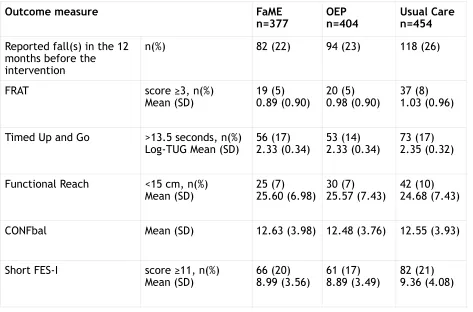
A total of 294 participants (24%) reported 1 or 2 falls in the previous year (21% of men and 27% of women). At baseline, there were similar proportions of fallers in all trial arms; 82 (22%) in FaME, 94 (23%) in OEP and 118 (26%) in UC. The average number of falls per person reported in the year prior to the study in each group was 0.27, 0.29 and 0.31 in FaME, OEP and UC, respectively. FRAT identified 76 (6%) participants as being at high risk of a future fall, 182 (16%) took longer than 13.5 seconds to complete the TUG test, 97 (8%) scored less than 15cm on the Functional Reach assessment, and 209 (19%) scored ≥11 for falls self-efficacy. Table 1 shows participants’ baseline falls characteris-tics by group. When compared with normative data in older, healthy populations, base-line functional assessments revealed functional levels of less than published averages for all assessments despite the significantly higher percentage meeting the UK guidelines than the general UK population. Functional assessment data compared with normative scores can be viewed in the ProAct65+ report (Iliffe 2014).
Falls Diary Data
Despite telephone call reminders from the researcher to return diaries, diary return was poor, resulting in missing falls data. Overall, 62% of intervention diaries were returned. 595 (48%) patients returned all 6 diaries, 345 (28%) did not return any. 35%, 37% and 41% of diaries were missing in the OEP, FaME and UC groups, respectively. We have published elsewhere that there was no association between returning diaries and gender nor age, but those at risk of falls were less likely to return diaries than non-fallers (Perry 2012). Those patients who returned all 6 diaries had a falls rate of 0.67 falls/person year, but those who returned between one and three diaries had a rate of 1.59 falls/person year.
!
Table 1, Participants’ baseline falls characteristics by group
!
!
!
Adherence & Compliance
150 participants (40%) in the FaME group attended 75% (or more) of classes. In the OEP group, 149 (37%) subjects reported that they achieved 75% or more of the home exercise prescription (90 minutes per week). Progression of the OEP strength and balance exer-cises was limited. Only 20% of those in the OEP group received heavier ankle weights or progressed on to unsupported balance exercises.
!
Attrition
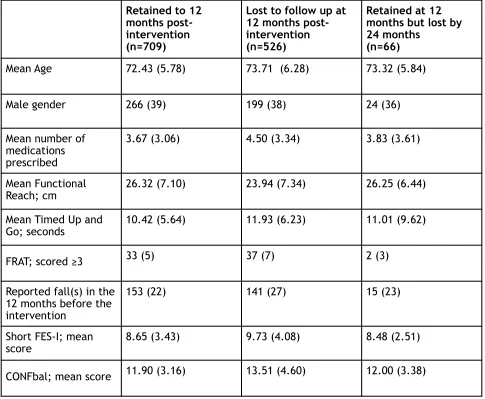
A total of 643 (52%) participants were lost to follow up of falls data by the end of the second post-intervention year (Table 3). Attrition was considerable, but was similar across treatment arms; 54%, 50% and 53% in the FaME, OEP and UC group, respectively. Participants’ characteristics by loss to follow up status are shown in Table 2. Losses to follow up were more likely to occur in the first 18 months of the trial. Those lost in this period were slightly older, less functional able, more likely to have fallen in the 12 months prior to the start of the trial and more concerned about falling.
!
!
Outcome measure FaME
n=377 OEP n=404 Usual Care n=454
Reported fall(s) in the 12 months before the intervention
n(%) 82 (22) 94 (23) 118 (26)
FRAT score ≥3, n(%)
Mean (SD) 19 (5) 0.89 (0.90) 20 (5) 0.98 (0.90) 37 (8) 1.03 (0.96)
Timed Up and Go >13.5 seconds, n(%)
Log-TUG Mean (SD) 56 (17) 2.33 (0.34) 53 (14) 2.33 (0.34) 73 (17) 2.35 (0.32)
Functional Reach <15 cm, n(%)
Mean (SD) 25 (7) 25.60 (6.98) 30 (7) 25.57 (7.43) 42 (10) 24.68 (7.43)
CONFbal Mean (SD) 12.63 (3.98) 12.48 (3.76) 12.55 (3.93)
Short FES-I score ≥11, n(%)
!
Table 2, Distribution of variables at baseline according to retention status at 12 and 24 months. Mean (SD) for continuous variables, n(%) for categorical variables
!
!
!
Intervention and Follow Up
322 falls were reported during the 24 week intervention period, 351 in the first post-in-tervention year and 256 in the second year. The number of falls, and the number of falls that were injurious, by group for each time point are displayed in Table 3, along with the corresponding number of person years. Person years take into account attrition and missing data, therefore also time at risk. Person time at risk was similar between groups at all time points.
!
!
!
Retained to 12 months post-intervention (n=709)
Lost to follow up at 12 months post-intervention (n=526)
Retained at 12 months but lost by 24 months
(n=66)
Mean Age 72.43 (5.78) 73.71 (6.28) 73.32 (5.84)
Male gender 266 (39) 199 (38) 24 (36)
Mean number of medications prescribed
3.67 (3.06) 4.50 (3.34) 3.83 (3.61)
Mean Functional
Reach; cm 26.32 (7.10) 23.94 (7.34) 26.25 (6.44) Mean Timed Up and
Go; seconds 10.42 (5.64) 11.93 (6.23) 11.01 (9.62) FRAT; scored ≥3 33 (5) 37 (7) 2 (3)
Reported fall(s) in the 12 months before the intervention
153 (22) 141 (27) 15 (23)
Short FES-I; mean
Table 3,Falls Incident Rates & Rate Ratios
FaME OEP Usual
care
Randomised, minus protocol violators (n) 377 404 454
During the intervention
Number of fallers 50 56 66
Number of falls 96 108 118
Person years* 118 130 134
Falls per person year 0.81 0.83 0.88
Falls Rate Ratio (95% CI) (compared to
UC) 0.91 (0.54, 1.52) p=0.72 0.93 (0.64, 1.37) p=0.72 Ref Per protocol analysis (OEP only): Falls
Rate Ratio (95% CI) (OEP75% adherence compared to UC)
NA 0.54 (0.33, 0.89)
p=0.02 Ref
Number of injurious falls 44 64 85
Injurious Falls per person year 0.37 0.49 0.63 Injurious Falls Rate Ratio (95% CI)
(compared to UC) 0.55 (0.31,0.96) p=0.04 0.77 (0.50,1.20) p=0.25 Ref
First year post intervention
Remaining in the trial 12 months
post-intervention (n) 230 227 252
Number of fallers 59 59 76
Number of falls 100 98 153
Person years* 188 184 221
Falls per person year 0.53 0.53 0.69
Falls Rate Ratio (95% CI) (compared to
UC) 0.74 (0.55, 0.99) p=0.04 0.76 (0.53, 1.09) p=0.14 Ref Per protocol analysis (OEP only): Falls
Rate Ratio (95% CI) (OEP75% adherence compared to UC)
NA 0.60 (0.31, 1.10)
p=0.10 Ref
Number of injurious falls 77 66 99
Injurious Falls per person year 0.41 0.36 0.45 Injurious Falls Rate Ratio (95% CI)
(compared to UC) 1.00 (0.70,1.45) p=0.98 0.69 (0.43,1.10) p=0.12 Ref
Combined intervention and first year post-intervention period
Falls per person year 0.64 0.66 0.76
Falls Rate Ratio (95% CI) (compared to
* Person years reflect attrition, missing data and time at risk
All p-values & confidence intervals were generated from negative binomial modelling.
!!
The 322 falls during the intervention period were reported by 172 fallers; 50 (13%), 56 (14%) and 66 (15%) fallers in FaME, OEP and UC respectively. The average number of falls per person was 0.25 in the FaME group, 0.27 in OEP and 0.26 in UC. There was no differ-ence between the exercise interventions' falls inciddiffer-ence rate and UC during the inter-vention (Table 3).
!
The 351 falls in the 12 months following the close of the interventions were reported by 194 fallers; 59 (16%), 59 (15%) and 76 (17%) fallers in FaME, OEP and UC, respectively. Average falls per person were 0.27 in the FaME group, 0.24 in OEP and 0.34 in UC. In this phase there was a 26% reduction in falls in the FaME group compared with UC (Table 3) and a non-significant 24% reduction in the OEP arm (FaME: IRR=0.74, 95% CI 0.55, 0.99, p=0.04, OEP: IRR=0.76, 95% CI0.53, 1.09, p=0.14) (Table 3). We performed a post-hoc analysis to explore the poorer effect of the OEP intervention. When only those patients
Injurious Falls per person year 0.40 0.41 0.52 Injurious Falls Rate Ratio (95% CI)
(compared to UC) 0.73 (0.54,0.99) p=0.05 0.74 (0.50,1.10) p=0.13 Ref
Second year post intervention
Remaining in the trial 24 months
post-intervention (n) 202 201 240
Number of fallers 41 44 55
Number of falls 71 89 96
Person years* 169 168 210
Falls per person year 0.42 0.53 0.46
Falls Rate Ratio (95% CI) (compared to
UC) 0.94 (0.62,1.41) p=0.76 1.04 (0.69,1.55) p=0.86 Ref Falls per person year (FaME only) <150 mins MVPA 0.59
≥150 mins MVPA 0.30 NA NA Within-group analysis (FaME only): Falls
Rate Ratio (95% CI) (<150 mins MVPA compared to ≥150 mins MVPA)
0.49 (0.30, 0.79)
p=0.004 NA NA
Number of injurious falls 49 68 52
Injurious Falls per person year 0.29 0.40 0.25 Injurious Falls Rate Ratio (95% CI)
achieving 75% or more of the OEP intervention were compared with UC, there was a 46% reduction in falls during the intervention (IRR=0.54, 95%CI 0.33, 0.89: p=0.02) but no significant difference was found in falls incidence in the 12 months following the close of the intervention (IRR=0.60, 95%CI 0.31, 1.10: p=0.10) (Table 3). Interestingly, the like-lihood of compliance with the OEP intervention (achieving ≥75%) was similar for those with, versus those without, a peer mentor (39% versus 35%).
!
Sensitivity analysis where one fall over each period was assumed for those with missing falls information showed similar IRRs for the effect of FaME and OEP compared with UC. However, in the first year post-intervention, the reduction in falls in the OEP group be-came statistically significant (IRR=0.74, 95% CI 0.60, 0.91, p=0.005).
!
In the second year following the discontinuation of interventions, the effect of the in-terventions on falls rate was lost (FaME: IRR=0.94, 95% CI 0.62, 1.41, p=0.76, OEP: IRR=1.04, 95% CI 0.69, 1.55, p=0.86). Given that there was a statistically significant re-duction in falls during the year following the end of the FaME intervention, followed by a loss of this effect in the second year, a post-hoc analysis of this group was carried out to further investigate the second year. We found that when those in the FaME group who continued to achieve 150 minutes of MVPA per week into the second post-intervention year were compared to those in the FaME group who did not maintain their physical ac-tivity, there continued to be a significant reduction in falls incidence (IRR=0.49, 95% CI 0.30, 0.79; p=0.004) (Table 3).
!
Injurious falls
year post intervention than in the intervention period, with the greatest reduction in the usual care group.
!
Other Falls-related Outcome measures
Functional assessments (TUG, Functional Reach) were measured at baseline and at the end of the intervention period. FES-I and CONFbal were measured at baseline, at the end of the interventions and at all subsequent follow-up points. As we have previously reported, there were no statistically significant changes in any of these measures at 12 months post intervention, with the exception of CONFbal, which was significantly im-proved in both intervention arms compared with UC (Iliffe 2014, http://
www.ncbi.nlm.nih.gov/pubmed/25098959, pages 47 to 53). There were no significant changes in any of these measures at 24 months post intervention.
!
Discussion
!
FaME is effective at reducing falls and fall-related injuries in older people recruited through general practices, and the effect continues for a year after cessation of the in-tervention (Intention to Treat). The positive effects on falls reduction are no longer present at 24 months after the intervention, suggesting that strength and balance exer-cise may need to be continued to maintain the benefit. However, those in the FaME group who maintained their MVPA, continued to benefit from a reduction on falls some two years post intervention. OEP supported by Peer Mentors did not appear to be effec-tive at reducing falls in the general, older population. As well as this, only 37% of the OEP group achieved 75% or more of the intervention. However, falls were not significant-ly reduced following the OEP intervention even in those who were compliant.
Compliance within the OEP arm did not appear to be associated with having a Peer Men-tor. It may be that there was insufficient progression of intensity of the OEP exercises to affect falls rate. Indeed, only 20% of those in the OEP group received heavier ankle weights or progressed on to unsupported balance exercises.
!
(injurious and non-injurious) between groups during the intervention is not significantly different, the severity of the falls (in terms of the number of injuries sustained) is lower in the FaME group, suggesting that although still falling in the intervention period, the FaME subjects are less likely to injure themselves. This might be a transitional stage to-wards falling less often, which occurred in the FaME group in the first post-intervention year.
!
There is a reduction in injurious falls in the usual care group over the whole 2.5 years of the study and this appears to be greater than the decline in injurious falls in either in-tervention arm. This may be a response bias as a higher percentage of falls diaries were not returned in the usual care arm (41%) compared to the OEP (35%) or FaME (37%) arms. We previously showed that ProAct65+ participants at higher risk of falls were less likely to return falls diaries than those at lower risk (Perry 2012).
!
We also note that falls rates were generally lower in all three arms in the second follow-up year compared with the first follow-follow-up year. This may be due to selective drop out of those inclined to fall. Those who were lost to follow up performed more poorly on the Timed Up and Go test and Functional Reach, were more likely to have fallen in the 12 months preceding the study and were more concerned about falling (Table 2).
!
There is some evidence that increasing physical activity in those at high risk of falls can increase exposure to risk (Sherrington 2011), so it is heartening that, in older people re-cruited through general practice (not frequent fallers), the interventions did not in-crease risk of falls alongside the inin-crease in MVPA. However, ProAct65+ deliberately chose two interventions that focused on improving strength and balance and therefore this may have prepared the older adults in this study for safer movement. This may have been reflected in the improvements seen in CONFbal, as their confidence to be active without falling appears improved.
!
de-spite a recent review suggesting that strength and balance exercise reduces fear of fall-ing (Kendrick 2014). However, only a very small percentage of people in this population admitted concern about falling.
!
Strengths & limitations of the study
Less than 10% of the eligible population participated in the trial, and attrition was rela-tively high (Iliffe 2014) so our findings cannot be generalised to a wider population. Nev-ertheless the study did recruit a group who wanted to increase their physical activity levels, and so may represent those who would take up such an exercise programme if it were available to them.
!
Almost a quarter of participants reported one or two falls in the previous year. Given the exclusion of frequent fallers, and that exercise trials tend to attract fitter, healthier in-dividuals, it was notable that this percentage of fallers was recruited. Fallers were less likely to return diaries than non-fallers. However, return rates of diaries were similar among study arms, therefore the reduction in falls and injuries in the FaME group is not likely to be attributable to under-reporting.
!
The 2005 FaME trial reported that 79% of subjects attended more than 75% of classes (Skelton 2005). By comparison, adherence was poorer in the ProAct65+ FaME group with only 40% (n=150) attending 75% (or more) of classes. The original trial recruited frequent fallers who may have been more motivated to attend falls prevention exercise sessions. The findings from the per protocol analysis (comparing falls incidence rates between only those in the intervention arms who adhered to at least 75% of the exercise pro-gramme with UC) should be interpreted with caution because the participants in both intervention groups were a select sub-sample, probably highly motivated, and therefore not representative of the complete trial population.
!
Comparison with other studies
exercise programme. The difference is likely explained by the characteristics of the two recruited populations; the frequent fallers recruited by Skelton and colleagues initially fell more frequently, perhaps as their confidence rose before their abilities could match their confidence, but the general older population's falls rate was unaffected in this study, suggesting that exposure to falls risk did not exceed their physical abilities, even in the early weeks of the intervention.
!
Furthermore, a dose of at least 50 hours has been identified as instrumental in achieving a reduction in falls (Sherrington 2011). ProAct65+ utilised shorter interventions and ad-herence was poorer than expected, meaning that many participants' dose fell consider-ably short of 50 hours. However, our per protocol analysis, showed that falls incidence in patients achieving at least 75% of the OEP intervention dose was not reduced compared with the control, suggesting that poor adherence was not the explanatory factor for the ineffectiveness of this intervention. It may be that a more challenging intervention is needed in the low falls risk population. Poor compliance in the OEP arm may have been attributable to the lack of peer mentors. The peer mentor shortfall meant that only 33% of OEP subjects received the planned support (telephone calls and visits) and this may have affected motivation and therefore compliance. However, many falls services that deliver the OEP do not support the participant to progress their exercises when they are given a home exercise booklet, most do not encourage the use of heavier ankle weights for strength progression and if they do support adherence, it is often for less than 12 weeks (RCP 2012), so the lack of support seen in ProAct65+ is a reflection of what hap-pens in many services.
!
In the FaME group, however, falls rate was reduced despite a dose of lower than 50 hours (not including walking) which may have been due to the strict progression of in-tensity of strength and balance exercises within the group sessions.
!
Implications for practice and research
The Royal College of Physicians audit on exercise provision in falls services (2012) and the Age UK Expert Series Falls Prevention Guide (2013) report that most regions in the UK have falls exercise services, but few stick to evidence-based guidelines, including the provision of exercise programmes of adequate length to achieve outcomes. The shorter, more rapidly progressive FaME programme used in this trial appears to be safe and ef-fective for the general older adult population, thus implementation (for appropriate participants) may reduce pressure on resources and associated implementation costs. The role of FaME in primary prevention of the first injurious fall and it’s potential to re-duce the future burden on services working with those at high risk of falls should be con-sidered. Six months of FaME increases MVPA and reduces falls even a year after the in-tervention has ceased, potentially contributing to better frailty risk outcomes. Indeed, some UK exercise services offer ‘graduation’ exercise classes (adhering to the FaME model) in order to help prevent the readmission of older adults after detraining and fur-ther falls (Age UK Expert Series 2013). In those who maintain their increased MVPA, FaME continues to reduce the risk of falls. Services should focus more on motivating their par-ticipants to adhere to interventions and when safe, encourage an increase in physical activity to maintain benefits.
!
Recruiting peer mentors was successful in London but not in Nottingham, suggesting ge-ographical differences in availability and motivation of older adults to be involved as motivators in physical activity promotion. In ProAct65+ the peer mentors were responsi-ble (after trial training) to advise participants on exercise progression over the interven-tion period, thus without a peer mentor, even the most self-motivated participants most likely performed a non-progressive exercise regime. The effectiveness of the OEP inter-vention in those participants who were assigned a peer mentor versus those without a mentor needs further investigation. However, ProAct65+ suggests that providing general, older adults with OEP as a home exercise programme, without adequate support, moti-vation and progression, is ineffective at reducing falls.
!
Conclusions
!
rein-forcement. Per protocol analysis suggests that beyond the initial intervention of target-ed, evidence-based exercise, the key to preventing future falls may well be a commit-ment to maintaining moderate intensity physical activity of any type.
!
Acknowledgements: We thank all those who participated in this study, including the
re-search team, practice staff, postural stability instructors and peer mentors, and mem-bers of the trial steering committee.
!
Funding: The project described in this paper was funded by the HTA stream of the NIHR
[06/36/04]. The views expressed in this paper are those of the authors, not of the De-partment of health or the NIHR
!
Contributors: All authors made substantial contributions to the conception or design of the ProAct65+ trial and to the acquisition, analysis, or interpretation of data for the study. All have contributed to drafting this report and revising it critically for important intellectual content. All authors have given their final approval of the version to be pub-lished. All authors agree to be accountable for all aspects of the trial report in ensuring that questions related to the accuracy or integrity of any part of the work are appropri-ately investigated and resolved.
!
The authors are independent of the funders and sponsors of this trial, and have access to all the data. Professor Steve Iliffe is the guarantor and affirms that the manuscript is an honest, accurate, and transparent account of the study being reported; that no impor-tant aspects of the study have been omitted; and that any discrepancies from the study as planned (and, if relevant, registered) have been explained.
!
Declarations of Interest: DAS and SDY are Directors of Later Life Training, a not for prof-it company that has provided specialist training for health and exercise professionals in FaME (since 2003) and OEP (since 2006).
References
!
Age UK Expert Series Falls Prevention Guide, 2013; http://www.ageuk.org.uk/Docu-ments/EN-GB/For-professionals/Research/Falls_Prevention_Guide_2013.pdf?dtrk=true (Accessed 22nd June 2016)
!
American Geriatrics Society (AGS)/British Geriatrics Society (BGS) Clinical Practice Guideline: Prevention of Falls in Older Persons, 2010; http://geriatricscareonline.org/ toc/updated-american-geriatrics-societybritish-geriatrics-society-clinical-practice-guide-line-for-prevention-of-falls-in-older-persons-and-recommendations/CL014/(Accessed 22nd June 2016)
!
British Geriatrics Society (BGS), Fit for Frailty; Consensus best practice guidance for the care of older people living with frailty in community and outpatient settings, 2014; http://www.bgs.org.uk/campaigns/fff/fff_full.pdf (Accessed 22nd June 2016)
!
Campbell AJ, Robertson MC, Gardener MM, Norton RN, Tilyard MW, Buchner DM. Ran-domised control trial of a general practice programme of home based exercise to pre-vent falls in elderly women. BMJ 1997;315:1065–9.
!
Campbell AJ, Robertson MC, Gardener MM, Norton RN, Buchner DM. Psychotropic med-ication withdrawal and a home based exercise programme to prevent falls: a randomised controlled trial. J Am Geriatr Soc 1999;47:850–3.
!
Cummings SR, Nevitt MC, Kidd S. Forgetting falls. The limited accuracy of recall of falls in the elderly. J Am Geriatrics Soc 1988;36:613-6.
!
Delbaere K, Close JCT, Mikolaizak AS, Sachdev PS, Brodaty H, Lord SR. The falls efficacy scale international (FES-I). A comprehensive longitudinal validation study. Age Ageing 2010;39:210–6.
!
Department of Health (DoH), 2009. http://webarchive.nationalarchives.gov.uk/
20130107105354/http://www.dh.gov.uk/prod_consum_dh/groups/dh_digitalassets/@dh/ @en/@pg/documents/digitalasset/dh_103151.pdf (Accessed 22nd June 2016)
!
Department of Health (DoH). Start Active, Stay Active. A report on physical activity for health from the four home countries' Chief Medical Officers. London: DH; 2011. http:// www.dh.gov.uk/en/Publicationsandstatistics/Publications/PublicationsPolicyAndGuid-ance/DH_128209 (Accessed 22nd June 2016)
!
Duncan PW, Weiner DK, Chandler J, Studenski S: Functional reach: a new clinical mea-sure of balance. J Gerontol 1990;45(6):M192-7.
!
Duncan PW, Studenski S, Chandler J, Prescott B: Functional reach: predictive validity in a sample of elderly male veterans. J Gerontol 1992;47(3):M93-8.
!
Gillespie LD, Robertson M, Gillespie WJ, Sherrington C, Gates S, Clemson LM, Lamb SE. Interventions for preventing falls in older people living in the community. Cochrane Database of Syst Rev 2012;Issue 9. Art. No.: CD007146.
Health Survey for England (HSE) 2012. Volume 1: Chapter 2 – Physical activity in adults. Health and Social Care Information Centre: Leeds. http://www.hscic.gov.uk/catalogue/ PUB13218/HSE2012-Ch2-Phys-act-adults.pdf (Accessed 22nd June 2016)
!
Iliffe S, Kendrick D, Morris R, Skelton DA, Gage H, Dinan S, Stevens Z, Pearl M, Masud T. Multi-centre cluster randomised trial comparing a community group exercise programme with home based exercise with usual care for people aged 65 and over in primary care: protocol of the ProAct65+ trial. Trials 2010;11:6-10.
!
Iliffe S, Kendrick D, Morris R, Masud T, Gage H, Skelton DA, Dinan S, Bowling A, Griffin M, Haworth D, Swanwick G, Carpenter H, Kumar A, Stevens Z, Gawler S, Barlow C, Cook J, Belcher B. Multi-centre cluster randomised trial comparing a community group exercise programme with home based exercise with usual care for people aged 65 and over in primary care Health Technology Assessment 2014;18:49.
!
Kempen GI, Yardley L, van Haastregt JC, Zijlstra GA, Beyer N, Hauer K, Todd C. The Short FES-I: a shortened version of the falls efficacy scale-international to assess fear of falling. Age Ageing 2008;37(1):45-50.
!
Kendrick D, Kumar A, Carpenter H, Zijlstra GAR, Skelton DA, Cook JR, Stevens Z, Belcher CM, Haworth D, Gawler SJ, Gage H, Masud T, Bowling A, Pearl M, Morris RW, Iliffe S, Del-baere K. Exercise for reducing fear of falling in older people living in the community (Review). Cochrane Database of Syst Rev 2014; doi:10.1002/14651858.CD009848.pub2
!
Nandy S, Parsons S, Cryer C, Underwood M, Rashbrook E, Carter Y, Eldridge S, Close J, Skelton D, Taylor S, Feder G, on behalf of the falls prevention pilot steering group: De-velopment and preliminary examination of the predictive validity of the Falls Risk As-sessment Tool (FRAT) for use in primary care. J Publ Health 2004;26(2):138-43.
!
NICE Clinical Guideline 161. Falls: assessment and prevention of falls in older people 2013, http://www.nice.org.uk/guidance/cg161 (Accessed 22nd June 2016)
!
Perry L, Kendrick D, Morris R, Dinan S, Masud T, Skelton DA, Iliffe, S. Completion and re-turn of fall diaries varies with participants' level of education, first language, and base-line fall risk. J Gerontol A Biol Sci Med Sci 2012;67(2):210-4.
!
Podsiadlo DA, Richardson S. The Timed Up and Go: A test of basic functional mobility for frail elder persons. J Am Geriatr Soc 1991;39:142-8.
!
Robertson MC, Campbell AJ, Herbison P. Statistical analysis of efficacy in falls prevention trials. J Gerontol Med Sci 2005; 60A:530-4.
!
Robertson MC, Devlin N, Gardener MM, Campbell AJ. Effectiveness and economic evalua-tion of a nurse delivered home exercise programme to prevent falls. 1: Randomised con-trolled trial. BMJ 2001a;322:697–701.
!
Robertson MC, Gardener MM, Devlin N, McGee R, Campbell AJ. Effectiveness and eco-nomic evaluation of a nurse delivered home exercise programme to prevent falls. 2: Controlled trial in multiple centres. BMJ 2001b;322:701–4.
Rose DJ, Jones CJ, Lucchese N. Predicting the probability of falls in community-residing older adults using the 8-foot up-and-go: a new measure of functional mobility. J Aging Phys Act 2002;10,466-75.
!
RCP (Royal College of Physicians) 2012. Older people’s experiences of therapeutic exer-cise as part of a falls prevention service - patient and public involvement. London: RCP.
!
Scuffham P, Chaplin S, Legood R. Incidence and costs of unintentional falls in older peo-ple in the United Kingdom. J Epidemiol Community Health 2003;57:740-4.
!
Sherrington C, Whitney JC, Lord SR, Herbert RD, Cumming RG, Close JC. Effective exer-cise for the prevention of falls: a systematic review and meta-analysis. J Am Geriatr Soc 2008;56(12):2234–43.
!
Sherrington C, Tiedemann A, Fairhall N, Close JC, Lord SR. Exercise to prevent falls in older adults: an updated meta-analysis and best practice recommendations. NSW Public Health Bulletin 2011;22(4):78-83.
!
Shumway-Cook A, Brauer S, Woollacott M. Predicting the probability for falls in commu-nity-dwelling older adults using the Timed Up and Go Test. Phys Ther 2000;80(9):
896-903.
!
Simpson JM, Worsfold C, Hawke J. Balance confidence in elderly people. The CONFbal Scale (abstract 123). Age Ageing 1998;27(Suppl 2):57.
!
Simpson JM, Worsfold C, Fisher KD, Valentine JD. The CONFbal scale: a measure of bal-ance confidence--a key outcome of rehabilitation. Physiother 2009;95,103-9.
!
Skelton DA, Dinan SM. Exercise for falls management: rationale for an exercise pro-gramme aimed at reducing postural instability. Physiother Theory Pract 1999;15:105-20.
!
Skelton DA, Dinan SM, Campbell MG, Rutherford OM. Tailored group exercise (Falls Man-agement Exercise – FaME) reduces falls in community-dwelling older frequent fallers (an RCT). Age Ageing 2005;34:636–9.
!
Stevens Z, Carpenter H, Gawler S, Belcher C, Haworth D, Kendrick D, MorrisR, MasudT,
SkeltonDA, Iliffe S. Lessons learnt during a complex, multi–centre cluster randomised controlled trial: the ProAct65+ trial. Trials 2013;14:192.
!
Todd C, Skelton DA. What are the Main Risk Factors for Falls Amongst Older People and what are the Most Effective Interventions to Prevent These Falls? How should Interven-tions to Prevent Falls be Implemented? Denmark: World Health Organization Health Evi-dence Network; 2004.
!
Whitney JC, Lord SR, Close JC. Streamlining assessment and intervention in a falls clinic using the Timed Up and Go Test and Physiological Profile Assessments. Age Ageing
2005;34,567-71.