A Self-adaptive Multimeme Memetic Algorithm
Co-evolving Utility Scores to Control Genetic
Operators and Their Parameter Settings
Ender ¨Ozcana
, John H. Drakeb
, Cevriye Altınta¸sc
, Shahriar Astaa
a
ASAP Research Group, School of Computer Science, University of Nottingham, NG8 1BB, Nottingham, UK
b
The OR Group, Queen Mary University of London, Mile End Road, London, E1 4NS, UK c
S¨uleyman Demirel University, Isparta, Turkey
Abstract
Memetic algorithms are a class of well-studied metaheuristics which combine
evolutionary algorithms and local search techniques. A meme represents
con-tagious piece of information in an adaptive information sharing system. The
canonical memetic algorithm uses a fixed meme, denoting a hill climbing
oper-ator, to improve each solution in a population during the evolutionary search
process. Given global parameters and multiple parametrised operators,
adap-tation often becomes a crucial constituent in the design of MAs. In this study,
aself-adaptive self-configuring steady-state multimeme memetic algorithm
(SS-MMA) variant is proposed. Along with the individuals (solutions), SSMMA
co-evolves memes, encoding the utility score for each algorithmic component
choice and relevant parameter setting option. An individual uses tournament
selection to decide which operator and parameter setting to employ at a given
step. The performance of the proposed algorithm is evaluated on six
combina-torial optimisation problems from a cross-domain heuristic search benchmark.
The results indicate the success of SSMMA when compared to the static MAs
as well as widely used self-adaptive Multimeme Memetic Algorithm from the
scientific literature.
Keywords: Memetic Algorithms, Multimeme Memetic Algorithms,
1. Introduction
Many real-world optimisation problems create a search space which is so
large that it becomes impractical to exhaustively search all possible states.
Heuristics, in the field of optimisation, seek to find good quality solutions to
a problem given a ‘rule of thumb’ using some intuition, with no guarantee of
solution quality. In essence, ametaheuristicis a high-level strategy which is
de-signed to guide a computational search for any problem where heuristics exist
to modify the current state of a given solution [64]. Traditional heuristics are
liable to become trapped in local, suboptimal areas of the search space, never
to discover the globally optimal solution. Metaheuristics are designed to escape
local optima, often offering a good trade-off between computational effort and
solution quality.
Memetic Algorithms (MAs) [41] are a hybrid metaheuristic approach to
problem solving which combine evolutionary algorithms with local search
tech-niques. The term Memetic Algorithm was first used to cover a number of
techniques using the idea of a meme [18] as a ‘unit of cultural transmission’
which is considered analogous to the local search/hill climbing process. MAs
have previously been used to solve problems in a large number of different
prob-lem domains. The taxonomy provided by Ong et al. [50] identifies three main
categories of Memetic Algorithms, considering how the algorithmic components
and their settings are decided based on feedback received during the
evolution-ary search process. The first category of MAs do not use any feedback, hence,
they are referred to as static MAs. The canonical MA which utilises a single
hill climbing operator or makes a random choice among multiple operators falls
into this category. The second category consists ofadaptive MAs which embed
a method to receive feedback during the search process and influence the choice
of a meme at a given decision point. The third category of MAs areself-adaptive
algorithms that use evolution itself for adaptation and the selection of an
appro-priate meme. Adaptation strategies are crucial for the second and third types
The generic Multimeme Memetic Algorithm (MMA) of Krasnogor and Smith
[35] is aself-adaptive MA, which co-evolves memetic material encoded into each
individual at the same time as evolving solutions to a given problem. Although
MMA was proposed as a general method, particular choices have been made
regarding adaptation and inheritance. For example each meme option is directly
encoded into the memetic material, referred to as amemeplex, and is perturbed
with a certain probability. ¨Ozcan and Onba¸sıo˜glu [58] used an MMA to solve
a parallel processing problem. The authors tested three different strategies
to decide which meme to use as a hill climbing operator, showing that this
algorithmic choice influences the performance of MMA on this problem.
There are a limited number of studies addressing the issue of how to select a
meme in addition to choosing what to encode within a meme. In this study, we
introduce a Steady-state Multimeme Memetic Algorithm (SSMMA), a new
self-adaptive MA which employs a different encoding of options to a generic MMA.
The utility score for each option is separately maintained within each individual
in a population and gets updated using a strategy inspired by Reinforcement
Learning [30, 57]. Based on these scores, a meme is selected when needed using
tournament selection. To the best of authors’ knowledge this approach, which
diminishes the need for the innovation rate parameter, is used for the first time
within MMAs.
One of the main limitations of self-adaptive MAs by Krasnogor and Smith
is that the general framework was mostly theoretical and had no actual
imple-mentation. The performance of SSMMA is evaluated on six different problem
domains including real-world problems from the HyFlex cross-domain heuristic
search benchmark [48]. Overall, the empirical results show that the proposed
MMA improves upon the original MMA presented by Krasnogor and Smith [35]
in many cases.
The subsequent sections of this paper are organised as follows. In Section
2, an overview of Memetic Algorithms and the HyFlex benchmark is given. In
Section 3, we describe the details of the Memetic Algorithms which are tested in
used during experimentation before presenting the empirical results and
analy-ses. Finally, some concluding remarks and potential future work are provided
in Section 5.
2. Related Work
2.1. Memetic Algorithms
Evolutionary algorithms are a class of search techniques inspired by the
nat-ural process of evolution, of which by far the most well-known are Genetic
Algo-rithms (GAs) [25]. A GA iteratively updates a population of solutions through
the use of mutation and crossover operators, which modify a solution or
recom-bine multiple solutions respectively. Hill climbing methods for local search are
a relatively simple class of heuristics, utilising the concept of locality between
candidate solutions for a given problem. A typical hill climbing algorithm moves
through the search space from one solution to another non-worsening solution
within a neighbourhood, where a neighbour is defined as any state that can be
reached from the current solution through some modification. A core challenge
when using such methods is the trade-off between intensification and
diversifi-cation, where intensification refers to the exploitation of the current area of the
search space and diversification refers the exploration of new regions of search
space [4, 16].
Memetic Algorithms (MAs) were introduced by Moscato [41] as a set of
evolutionary algorithms that make heavy use of hill climbing. A simple MA
introduces a local search phase into a GA after crossover and mutation have
been performed during the evolutionary process. Since their emergence, MAs
and subsequent variants of MAs have been applied to a wide variety of problems,
including educational timetabling [2, 10, 56, 60, 59], multi-objective optimisation
problems [31, 24], permanent-magnet synchronous motor (PMSM) design [11],
Optimal Placement of PMUs [37], permutation flow shop scheduling [28], the
economic load dispatch problem [51, 52], protein folding [33], HIV therapy design
[42, 5, 26]. As well as the application of MAs to practical optimisation problems,
a number of studies have sought to understand the concepts underpinning MAs
and the behaviour of memes [34]. Indeed the performance of an MA has been
observed to be strongly linked to the choice of local search mechanism used [58,
54], with competition and cooperation between different local search methods
beneficial to to overall search process [49].
Previous studies have tried to address the issues in the design of MAs.
Nguyen et al. [45] highlighted a number of design decisions within MAs, namely,
the trade-off between intensification and diversification within the context of
MAs, the choice of which individuals to improve if not all solutions undergo
local search and choosing which meme to use when multiple memes are
avail-able depending on the problem currently being solved. A result of note from
this work was that the choice of local search mechanism was found to be more
critical to the overall performance of an MA than the choice of underlying
population-based search strategy. Acampora et al. [1] tested a large number
of MA configurations applied to ontology alignment, based on the issues
out-lined in Nguyen et al. [45], with the best MA found to be competitive with
state-of-the-art ontology alignment systems.
In addition to the traditional MAs described above, a separate branch of
evolutionary algorithms which are capable of adapting parameter settings and
algorithmic component choices also exist [19, 14]. Self-adaptive Multimeme
Memetic Algorithms (MMAs) [35, 33, 32] contain individuals that are made
up of both genetic and memetic material. The memes denoting the choices for
operators including hill climbing and their settings are co-evolved along with
the genes during the search process.
Jakob [29] proposed a cost-benefit adaptation strategy for multi-meme
algo-rithms in which adaptation is guided by the costs and benefits of a local search
run. As a by-product, the strategy maintains a balance between intensification
and diversification. Smith [63] described a co-evolutionary memetic algorithm in
which the depth and resolution of the local search heuristics as well as the pivot
study showed that a simple co-evolutionary model is able to maintain a balance
between intensification and diversification. However, extensive experiments in
the study failed to establish a logical and problem-independent link between the
size of the meme pool and the evaluation accuracy of a meme’s value at various
points in the search space. Epitropakis et al. [23] used Separability Prototype
for Automatic Memes (SPAM), initially proposed by Caraffini et al. [12], in
which a success-based adaptation strategy is employed. This strategy, which
is based on recent advances in hyper-heuristics, rewards promising memes and
increases their chance to be used in subsequent stages of the search. Nogueras
and Cotta [47] studied self-adaptation in spatially structured multi-memetic
al-gorithms where populations use specific topologies within which operator
inter-actions are constrained. The authors observed that these MMAs are sensitive to
self-adaptation and suggest to use variable length memes to increase robustness
for various population structures.
An overview of some adaptation schemes using multiple memes can be found
in [50, 62]. Previous studies on learning, adaptation and evolution have led to
the more general concept of Memetic Computing which introduces co-evolution,
machine learning, cognitive observation of other individuals and memory
util-isation for operator and parameter control, as well as the generation of the
methods/rules used by them, into the evolutionary search process [13, 43]. In
this study, we present a variant of the co-evolutionary MMA with a novel
adap-tation mechanism for operator selection and parameter setting.
2.2. Hyper-Heuristics and HyFlex
Hyper-heuristics form a class of high-level methods which search a space of
low-level heuristics or components, rather than solutions, while solving
com-putationally hard problems [7]. There are two main classes of hyper-heuristic
methods: selection hyper-heuristics that mix and control a given set of
low-level heuristics andgenerationhyper-heuristics that construct low-level
heuris-tics from a set of given components [8]. Hyper-heurisheuris-tics have been successfully
[9] and multi-objective scheduling problems [46].
Originally hyper-heuristic research set out to develop methods which are
more general than the traditional search and optimisation techniques, with
re-cent research focussing considerably on cross-domain heuristic search. HyFlex
v1.0 (Hyper-heuristics Flexible framework) [48] was introduced mainly to
sup-port the first Cross-domain Heuristic Search Challenge (CHeSC 2011) [6]. The
results obtained from the selection hyper-heuristics competing in this challenge
currently serve as a benchmark for comparison of selection hyper-heuristic
meth-ods. The HyFlex v1.0 framework provides means for rapid implementation and
performance evaluation of high-level adaptive search methods. HyFlex v1.0
im-poses a logical barrier between the problem domain implementation and the
high-level method controlling a set of low-level operators operating over the
do-main. This barrier does not allow any problem domain specific information, such
as solution representation, to be accessed by the high-level method. HyFlex v1.0
supports six problem domains, including Boolean Satisfiability (MAX-SAT),
One Dimensional Bin Packing (BP), Permutation Flow Shop (PFS),
Person-nel Scheduling (PS), Travelling Salesman Problem (TSP) and Vehicle Routing
Problem (VRP). Each domain comes with a set of low-level heuristics
(opera-tors) from four different categories: (i) mutation, (ii) local search/hill climbing,
(iii) ruin-recreate, and (iv) crossover. Each operator implemented in a domain
is given a unique ID and a high-level method can access a chosen operator using
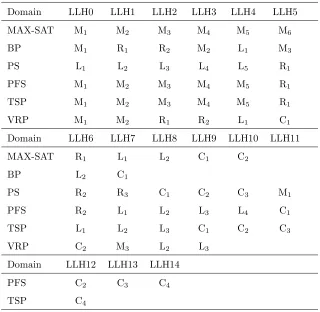
this ID. Table 1 provides the ID and type of each low-level heuristic for each
Hyflex v1.0 problem domain, where C, M, R and L indicate a crossover,
mu-tation, ruin-recreate, and hill climbing operator respectively. As an example,
Bin Packing has eight low-level heuristics in total: one crossover, three
muta-tion, two ruin-recreate and two hill climbing. These IDs will be used later in
Section 3.1 to identify particular memeplexes. Permutation Flow Shop has the
most low-level heuristics available, with 15 in total.
Ruin-recreate operators form a partial solution using a given complete
so-lution, and then rebuild a complete solution. In this study, ruin-recreate
Table 1: The nature of each low level heuristic with a given unique ID implemented in each HyFlex v1.0 problem domain.
Domain LLH0 LLH1 LLH2 LLH3 LLH4 LLH5
MAX-SAT M1 M2 M3 M4 M5 M6
BP M1 R1 R2 M2 L1 M3
PS L1 L2 L3 L4 L5 R1
PFS M1 M2 M3 M4 M5 R1
TSP M1 M2 M3 M4 M5 R1
VRP M1 M2 R1 R2 L1 C1
Domain LLH6 LLH7 LLH8 LLH9 LLH10 LLH11
MAX-SAT R1 L1 L2 C1 C2
BP L2 C1
PS R2 R3 C1 C2 C3 M1
PFS R2 L1 L2 L3 L4 C1
TSP L1 L2 L3 C1 C2 C3
VRP C2 M3 L2 L3
Domain LLH12 LLH13 LLH14
PFS C2 C3 C4
non-worsening solution as output. All crossover operators in HyFlex take two
solutions as input, then recombine them to yield a new solution.
Addition-ally, the mutation and hill climbing low-level heuristics have an adjustable
pa-rameter to modify their behaviour. In the case of mutation and ruin-recreate,
theintensity of mutationparameter is a value in [0, 1] specifying the extent
to which a low-level heuristic will perturb a solution. Setting this
parame-ter to a higher value will result in a mutation low-level heuristic performing
larger perturbations to the original solution. In the case of hill climbing, the
depth of search parameter will dictate the number of steps executed during
local search. This parameter also takes a value in [0, 1], with a higher value
indicating a greater number of local search steps. More details on the
imple-mentation of problem domains, including specifics of the low-level heuristics,
and the selection hyper-heuristics that competed in the challenge can be found
at the CHeSC 2011 website1
.
Four different frameworks for selection hyper-heuristics were described by ¨
Ozcan et al. [55]. Their work observed that a selection hyper-heuristic based on a
framework distinguishing between mutation and hill climbing operators
outper-forms traditional approaches which use all operators together. This framework
used the idea of explicitly enforcing diversification and intensification processes
in hyper-heuristics, in a similar way to other existing approaches such as
iter-ated local search [38] and MAs. ¨Ozcan et al. [53] evaluated the performance of
two static MAs on the six problem domains of the HyFlex benchmark described
above. The first approach, a Steady-State Memetic Algorithm (SSMA), is a
tra-ditional MA which applies a random crossover operator to two individuals from
the population before applying a random mutation and hill-climbing operator
to the resultant solution. The new individual then replaces the worst individual
in the current population. The second, a Transgenerational Memetic Algorithm
(TGMA), generates an entire new population at each generation rather than
using steady-state replacement to update the existing population. Both SSMA
and TGMA generate the first population using the initialisation methods
pro-vided with the problem domains. They do not control the parameter settings
for the operators and they make a random choice from five different discrete
settings. Both approaches arestaticMAs with external adaptationunder the
taxonomy of [50]. The experimental results in [53] showed that SSMA performs
better than TGMA overall, however most of the single-point-based search
se-lection hyper-heuristics entrants to CHeSC 2011 outperform both MAs.
Although the hyper-heuristic and MA research communities have evolved
separately, they are closely linked, with a number of shared goals. In the case of
multiple operators and a range of values to choose from for parameter setting,
adaptation is crucial. In this study, we propose a new steady state Multimeme
Algorithm which employs a new encoding for the adaptation of genetic operators
and their parameter settings. We compare its performance to MMA [35] on six
problem domains of the HyFlex benchmark.
3. Self-Adaptive Memetic Algorithms for Cross-Domain Heuristic Search
As discussed in the previous sections,self-adaptiveMAs inherit memes across
generations [50]. The Multimeme Memetic Algorithm (MMA) of Krasnogor
and Smith [35] is a canonical self-adaptive MA, which co-evolves a set of
local-search heuristics acting as memes, at the same time as evolving solutions to
computationally difficult problems. Each individual in an MMA consists of two
parts, its own independent genetic material (chromosome) and memetic material
(memeplex). In the context of hyper-heuristics, MMAs are able to adaptively
select appropriate low-level heuristics to use for different problem instances,
different stages of a given search or for different individuals in a population.
Individual memes can adapt through changes to their parameter settings or the
neighbourhoods in which they operate. Here we will present a new memeplex
structure for MMAs and compare to the MMA of Krasnogor and Smith [35].
Due to the success of using a steady state approach as reported by ¨Ozcan et
variant, a Steady-state Multimeme Memetic Algorithm (SSMMA), supports the
adaptation of genetic operators including hill climbing and their settings through
the use of Reinforcement Learning [30] with the memeplex encoding. MMA and
SSMA both make use of Lamarckian learning, placing an improved individual
back into the population to compete within the next generation of evolution,
andlocal-leveladaptation as defined by Ong et al. [50]. Local-level adaptation
indicates that some previous historical knowledge is used when deciding which
meme to use among multiple memes. MMA and SSMMA are implemented as a
high-level search method within HyFlex, enabling us to test their performance
on six different problem domains. We also compare their performance to two
other static MAs studied in [53] and a number of previously proposed
single-point-based search selection hyper-heuristics from the scientific literature.
3.1. Multimeme Memetic Algorithm (MMA)
The MMA of Krasnogor and Smith [35], using steady state replacement, is
implemented as shown in Algorithm 1. Each individual in the population
con-sists of a candidate solution and a memeplex containing the memetic information
associated with that individual. A memeplex, denoted as Cc{M or R}mIiLlDd,
represents thecth
crossover operator (C),mth
mutation (M) or ruin-recreate
op-erator (R) using anintensity of mutation(I) parameter setting ofi∈[0,1] and
lth
hill climbing method (L) using adepth of search(D) parameter setting ofd∈
[0,1]. As an example, the MAX-SAT domain of HyFlex contains two crossover,
seven mutation (one of them being a ruin-recreate operator) and two hill
climb-ing operators (labelled LLH0-LLH10 in Table 1 above). Assumclimb-ing that there
are five discrete choices for each parameter setting, i.e. {0.2,0.4,0.6,0.8,1.0}, a
memeplex for this domain can encode 2×7×5×2×5 = 700 different memes.
Given C1M2I0.6L1D0.8, this meme denotes that crossover with low-level heuristic
LLH9, mutation with low-level heuristic LLH1 having anintensity of mutation
setting of 0.6 and hill climbing with low-level heuristic LLH7 having adepth of
searchsetting of 0.8 are going to be used at a given decision point during the
The first generation of candidate solutions is created using the initialisation
methods provided for each HyFlex domain, with values for each of the five
com-ponents of the memeplex initialised randomly. At this point, a hill climbing
heuristic is applied to each initial individual for improvement. Following the
initialisation phase, the evolutionary cycle starts its execution. Tournament
selection is used to choose two individuals from the population with which to
perform crossover. Each parent is selected by comparing the fitness
(objec-tive value/quality of a solution) of ‘tournament size’ randomly selected
indi-viduals from the population and choosing the one with the better fitness. In
the case of equal quality individuals, an arbitrary individual is selected. The
stronger of the two parents with the better fitness is designated Parent1. A
new Child solution is generated by performing crossover between the solutions
of the two parents using the crossover operator from the meme of Parent1. The
Simple Inheritance M echanismas proposed by Krasnogor and Smith [35] is
utilised, which propagates memetic material from one generation to the next
by directly passing the meme of a parent to a child. The mutation
opera-tor encoded in the inherited meme is then applied to the solution using the
intensity of mutationparameter setting from the same memeplex. During the
mutation process, memetic material is also mutated with a probability labelled
asInnovation Rate(IR). A meme is mutated to another option value randomly.
This mechanism is used to introduce ‘new’ memetic material into the
evolution-ary process. If IR is high then the memes will be perturbed in each generation
and each algorithmic component choice will be almost random. If IR is low,
then new memetic material might not be introduced and the search could
stag-nate. Following mutation, the hill climbing operator is applied to the Child
solution with the givendepth of searchparameter setting from the meme. The
evolutionary cycle continues until the termination criteria is satisfied.
3.2. Steady-state Multimeme Memetic Algorithm (SSMMA)
The MMA described above needs the IR parameter to ensure that every
Algorithm 1Pseudocode of Multimeme Memetic Algorithms (MMA) [35]
1: Create a population ofpopSizerandom individuals.
2: Apply a random hill climber to each individual
3: whiletermination criteria is not satisfieddo
4: Parent1←Select-Parent(population, tour-size)
5: Parent2←Select-Parent(population, tour-size)
6: if Parent2 has a better fitness than Parent1then
7: Swap(Parent1, Parent2)
8: end if
9: Child←ApplyC(Parent1crossover, Parent1, Parent2)
10: Copy thememeof Parent1to Child
11: Child←ApplyM(Childmutation, Childintensity, Child)
12: Mutate meme of Child with a probability ofIR
13: Child←ApplyL(Childhillclimber, Childdepth, Child)
14: Child replaces the worst individual in the population
search process. Each meme directly encodes the choices of algorithmic
compo-nents to use. The memetic material used during evolution is restricted to the
material that the first population introduces, particularly if the IR setting is
low. Increasing the innovation rate increases the likelihood of (re)introducing
new memes into the search process. In previous studies, a fixed setting is
sug-gested for IR, however, managing the interaction between IR and population
size becomes crucial, especially if the number of potential memes is large which
is the case in this study. Using the simple inheritance mechanism, the likelihood
of good memes propagating thorough generations increases with the population
size. As a result the population size arguably represents the memory size, with
IR representing the probability of forgetting and refreshing that memory.
Here we propose a new variant of aself-adaptiveMA, a Steady-state
Multi-meme Memetic Algorithm (SSMMA). In this approach we build on the original
MMA by introducing a feedback loop, increasing the potential to remember
previous performance in a way that is not limited by population size. Rather
than simply encoding a specific operator or parameter setting in each meme, a
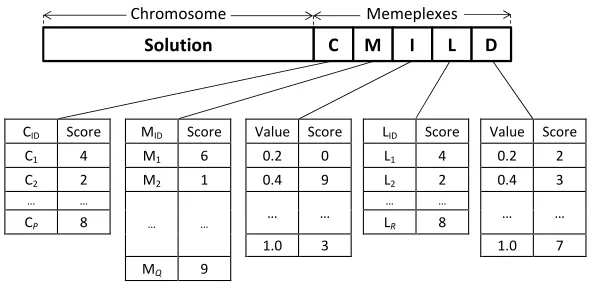
set ofutility scoresfor each possible option is maintained as a meme. The
struc-ture of this encoding is shown in Figure 1. The proposed approach increases
the memory requirement for the memes, however this increase is reasonable
considering that it will be within a factor of the number of algorithmic
compo-nents. For example, for the MAX-SAT domain of HyFlex, a meme consists of
2 + 7 + 5 + 2 + 5 = 21 entries where each entry holds the utility score (or option
value) for each algorithmic component choice. The pseudocode for SSMMA is
given in Algorithm 2.
Initially the first generation of candidate solutions is created using the
meth-ods in HyFlex and a hill climbing heuristic is applied to every individual, with
the utility scores in the memeplex set to 0. The evolutionary cycle operates in
almost the same manner as MMA. Tournament selection is again used to choose
two individuals from the population with which to perform crossover, with the
stronger of the two parents with the best fitness taken to be Parent1. A crossover
CID Score MID Score Value Score LID Score Value Score
C1 4 M1 6 0.2 0 L1 4 0.2 2
C2 2 M2 1 0.4 9 L2 2 0.4 3
… …
… … … …
… …
… …
CP 8 LR 8
1.0 3
1.0 7 MQ 9
Solution C M I L D
[image:15.595.158.455.180.324.2]Chromosome Memeplexes
Figure 1: Encoding of an individual in SSMA
Algorithm 2Pseudocode of Steady-state Multimeme Memetic Algorithm
(SS-MMA)
1: Create a population ofpopSizerandom individuals.
2: Apply a random hill climber to each individual
3: whiletermination criteria is not satisfieddo
4: Parent1←Select-Parent(population, tour-size)
5: Parent2←Select-Parent(population, tour-size)
6: if Parent2 has a better fitness than Parent1then
7: Swap(Parent1, Parent2)
8: end if
9: Tournament selection of Parent1crossover, Parent1mutation,
Parent1hillclimber, Parent1intensityand Parent1depth
10: Child←ApplyC(Parent1crossover, Parent1, Parent2)
11: Child←ApplyM(Parent1mutation, Parent1intensity, Child)
12: Child←ApplyL(Parent1hillclimber, Parent1depth, Child)
13: Copy thememeof Parent1to Child
14: Update the scores of thememeof Child
15: Child replaces the worst individual in the population
and values forintensity of mutationanddepth of search are selected (using
tournament selection), based on the scores encoded in the meme of Parent1. In
each case, the operator or parameter setting with the highest value within the
tournament size of options, indicating superior past performance, is favoured.
In the case of equal scores, an arbitrary option is selected. For example, assume
that the solver is operating on a MAX-SAT problem instance and it is time for
mutation, and score for each one of the seven mutation operators is given as
[1, 0, 4, 2, 3, 3, 5]. As an example, if the tournament size is 2 and 0th
and 6th
operators are chosen, then based on their scores which are 1 and 5 respectively,
the 6th operator with the highest value option would be chosen. In the case of
equal scores, an operator is chosen arbitrarily. The crossover low-level heuristic
is applied to recombine the two selected parents and generate a new solution, the
mutation low-level heuristic is applied using theintensity of mutation
param-eter and finally the local search low-level heuristic is applied with the selected
depth of searchparameter. Finally thememeof Parent1is copied to the Child
individual. In the case that the Child solution is an improvement over the
par-ent, the scores for each of the five memes within the memeplex of the Child
are modified using an additive Reinforcement Learning scheme [57], with each
value incremented by 1. In the case that the Child solution is of equal or poorer
quality than the parent then no modification is made to the scores within the
memeplex of the Child. This is similar to theSimple Inheritance M echanism
proposed by Krasnogor and Smith [35] which propagates memetic material from
one generation to the next by directly passing the meme of a parent to a child.
4. Experimental Results
4.1. Experimental Design and Parameter Settings
In order to evaluate the performance of the proposed Steady-state
Multi-meme Memetic Algorithm (SSMMA), we have used the CHeSC 2011 dataset
which contains five instances per domain and six different problem domains as
problems, with a lower objective value indicates a better fitness. The
perfor-mance of SSMMA is compared to the self-adaptive MMA [35] and two static
MAs from ¨Ozcan et al. [53] over 30 instances. In both SSMMA and MMA,
population size is set to 10 in line with the MAs of ¨Ozcan et al. [53]. The
intensity of mutationanddepth of searchparameters are able to take one of a
set of five discrete values in{0.2,0.4,0.6,0.8,1.0}. In MMA, theinnovation rate
(IR) in MMA is fixed as 0.2 [35, 58, 54], parent selection is performed using
tournament selection with atournament size of 2 and all memetic values are
initialised randomly. In SSMMA tournament selection withtournament size2
is used for both parent selection, and meme selection. In both cases, the parent
or meme with highest score is kept with the other discarded. The scores for
each low-level heuristic and parameter setting of each meme are initially set to
0, giving each option an equal chance of selection.
All experiments were performed on an Intel Core Duo 3.16 GHz machine
with 2 GB RAM. Each trial is run for a notional duration of 600 seconds and
repeated 31 times, in line with the standard used by the CHeSC 2011
organ-isers. The original duration was determined based on the configuration of the
machine used for ranking the competitors. The organisers provided a
bench-marking tool to compute the equivalent time required for termination of a trial
on another machine. The equivalent duration using our machine calculated by
the benchmark tool is 576 seconds. Although this is not the primary goal of
this study, using the same termination criterion as in CHeSC 2011 enables us to
compare the performance of memetic algorithms to a range of adaptive heuristic
optimisation methods which competed at CHeSC 2011, including the state of
the art methods [48].
Using this termination criteria gives us a fair base for performance
com-parison of algorithms for cross domain search, where the run-time efficiency of
heuristic implementations could vary not only for a given domain, but from one
domain to another. It is worth noting that the execution time of a program does
not only depend on the CPU speed. There are other influential factors ranging
benchmark-ing tools make an attempt to take such factors into account, the use of time
limit for termination could still pose some validity risk [17] on the precision
of results obtained from a time-contract algorithm which terminates when the
given time expires.
4.2. Performance comparison of SSMMA and MMA
Firstly we will compare the performance of SSMMA and MMA [35] using
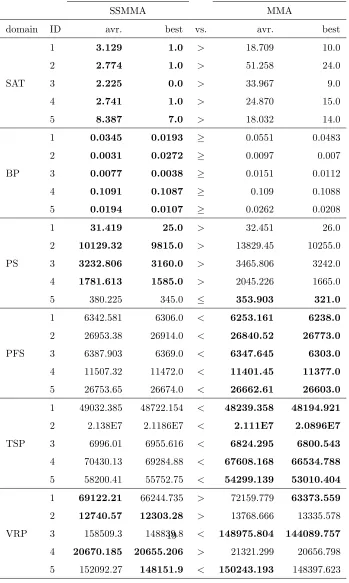
six HyFlex problem domains. Table 2 shows the average and best fitness values
obtained by each method over 31 runs of each instance used in the CHeSC
2011 competition, with the better of the two methods given inbold. Where
this table refers to a particular ID number, this represents the order in which
this instance appears in the list of the instances tested for CHeSC 2011, rather
than the HyFlex index of that problem instance. Thevs. column indicates the
results of Wilcoxon signed-rank tests within a 95% confidence interval, which is
performed to assess the statistical significance of the performance variation of
two algorithms using the results from 31 runs for each instance. Here, >(<)
denotes that SSMMA (MMA) performs statistically significantly better than
MMA (SSMMA) on the given instance. Additionally,≥(≤) denotes that there is
no significant performance variation between the two methods, however SSMMA
(MMA) performs slightly better on average.
SSMMA performs better than the original MMA in some problem domains,
however each of the MAs have different strengths in different problem domains.
SSMMA is very strong in the case of MAX-SAT, Bin Packing and Personnel
Scheduling, outperforming MMA with a statistically significant difference in all
five instances of MAX-SAT and four of the five instances of Personnel
Schedul-ing in terms of both average performance and best solution found. For Bin
Packing, SSMMA outperforms MMA in all five instances, however this
differ-ence is not statistically significant. Conversely, in the case of Permutation Flow
Shop and the Travelling Salesman Problem, MMA is statistically significantly
outperforming SSMMA in terms of average and best performance in all
Table 2: Performance comparison of SSMMA and MMA based on best and average fitness obtained from 31 trials for each instance of CHeSC 2011
SSMMA MMA
domain ID avr. best vs. avr. best
SAT
1 3.129 1.0 > 18.709 10.0
2 2.774 1.0 > 51.258 24.0
3 2.225 0.0 > 33.967 9.0
4 2.741 1.0 > 24.870 15.0
5 8.387 7.0 > 18.032 14.0
BP
1 0.0345 0.0193 ≥ 0.0551 0.0483
2 0.0031 0.0272 ≥ 0.0097 0.007
3 0.0077 0.0038 ≥ 0.0151 0.0112
4 0.1091 0.1087 ≥ 0.109 0.1088
5 0.0194 0.0107 ≥ 0.0262 0.0208
PS
1 31.419 25.0 > 32.451 26.0
2 10129.32 9815.0 > 13829.45 10255.0
3 3232.806 3160.0 > 3465.806 3242.0
4 1781.613 1585.0 > 2045.226 1665.0
5 380.225 345.0 ≤ 353.903 321.0
PFS
1 6342.581 6306.0 < 6253.161 6238.0
2 26953.38 26914.0 < 26840.52 26773.0
3 6387.903 6369.0 < 6347.645 6303.0
4 11507.32 11472.0 < 11401.45 11377.0
5 26753.65 26674.0 < 26662.61 26603.0
TSP
1 49032.385 48722.154 < 48239.358 48194.921
2 2.138E7 2.1186E7 < 2.111E7 2.0896E7
3 6996.01 6955.616 < 6824.295 6800.543
4 70430.13 69284.88 < 67608.168 66534.788
5 58200.41 55752.75 < 54299.139 53010.404
VRP
1 69122.21 66244.735 > 72159.779 63373.559
2 12740.57 12303.28 > 13768.666 13335.578
flexible and adaptive than the original MMA, it is clearly not performing well
in these problem domains. The case of the Vehicle Routing Problem is slightly
more complex with both SSMMA and MMA statistically significantly
outper-forming one another in different instances. It is also the case in Vehicle Routing
Problem Instance 1 and Vehicle Routing Problem Instance 5 that the method
performing best on average does not find the best result of the two over 31
runs. As MMA has a shorter memory length than SSMMA, these results could
be an indication that SSMMA needs a better mechanism to forget and refresh
its memory. However, such a mechanism would require the design of multiple
components, including a method to decide when to forget and another to decide
how to update which utility score, adding significant complexity to the proposed
simple approach.
4.3. Performance comparison of static versus self-adaptive MAs
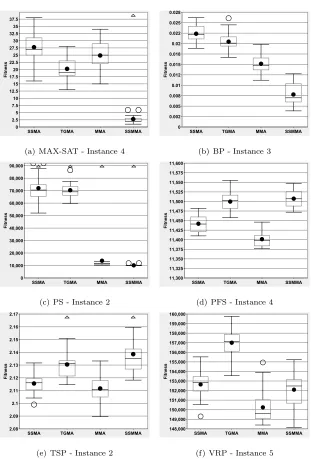
Figure 2 shows box and whisker plots of the best fitness values obtained from
31 runs on a selected instance from each of the six problem domains using four
MAs. In addition to the self-adaptive SSMMA and MMA we also report the
results for the static MAs, SSMA and TGMA, presented by ¨Ozcan et al. [53].
The results of a Freidman test [61] within a 95% confidence interval over the
me-dian results of each of the 30 problems tested indicate that MMA and SSMMA
perform statistically significantly better than SSMA and TGMA. No
statisti-cally significant difference is shown between SSMMA and TGMA using this test.
These box and whisker plots give us some indication of the performance
con-sistency of a given MA over the 31 runs of each instance. Rather than provide
all 30 figures for each individual instance, these six instances have been chosen
as representative of each problem domain. Any significant variations within
problem domains are highlighted and discussed below.
In the case of MAX-SAT, shown in Figure 2(a), SSMMA clearly outperforms
the other three MAs on average. The relatively small distance between the first
and third quartiles indicate that SSMMA is consistently achieving good quality
in-(a) MAX-SAT - Instance 4 (b) BP - Instance 3
(c) PS - Instance 2 (d) PFS - Instance 4
[image:21.595.151.462.196.655.2](e) TSP - Instance 2 (f) VRP - Instance 5
stances of MAX-SAT, with SSMMA clearly and consistently achieving the best
results and TGMA the second best method ahead of MMA and SSMA. For
Bin Packing, the relative performance of all four MAs is again similar in all five
problem instances, with Bin Packing Instance 3 shown as a typical example.
SS-MMA is again the best performing MA on average in each of the five instances.
On Bin Packing, self-adaptive MAs perform better than the static MAs.
Sim-ilarly, Figure 2(c) shows the results for the Personnel Scheduling domain, in
which a clear performance split between the self-adaptive MAs and static MAs
can be observed. Learning through evolution seems to make a difference in these
two cases, with the design of operators in Bin Packing and Personnel
Schedul-ing enablSchedul-ing the more dynamic self-adaptive MAs to learn the best choice of
algorithmic components during the search process.
In both the Permutation Flow Shop and Travelling Salesman Problem
do-mains, SSMMA is the worst of the four methods tested as can be seen in
Fig-ure 2(d) and FigFig-ure 2(e). Typically in both of these problem domains SSMA
and MMA offer similar performance, ahead of TGMA. The poor performance
of SSMMA in these problem domains may be an unintended consequence of the
Reinforcement Learning scheme which does not ‘forget’ while controlling meme
selection. SSMMA focusses on the improvement of solution quality and
there-fore intensification over diversification within the search. If at one point of the
search a particular set of memes performs well, dominating the Reinforcement
Learning scores, some other memes may have a very low chance of selection. It
could be the case that those other memes are more beneficial to the search later
on, however with such low probability of selection, those memes will struggle to
improve their score and therefore their chance of selection within the time limit.
This is not the case within SSMA and MMA, where when mutation occurs,
each meme has equal probability of being reintroduced and applied. Finally in
the Vehicle Routing Problem, we have included the box and whisker diagram
for Instance 5 of the competition set. This instance is one of the cases where
SSMMA was outperformed by MMA on average in Table 2. Again, in general
domain, with SSMMA outperforming MMA in some instances and vice versa in
others.
4.4. An analysis of the behaviour of SSMMA
This section provides an analysis of the performance and behaviour of
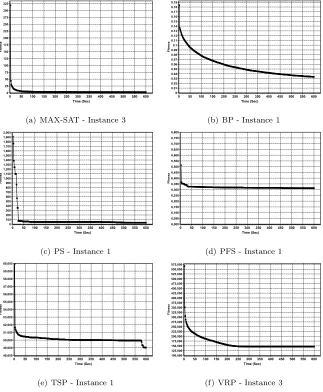
SS-MMA on a per-domain basis. Figure 3 shows the progress of the best fitness
value observed with respect to time for a sample run of SSMMA on a single
instance selected from each of the six CHeSC 2011 problem domains. In all
cases the first instance from the competition test set is used.
In all six problem domains there is a large improvement made in the
best-of-run solution quality within the early stages of the search. This indicates that
typically upon solution initialisation, the starting point for each search is in
an area of the search space containing very poor quality solutions. The rate
of improvement in solution quality appears to be more drastic in some cases
than others depending on the problem domain. In MAX-SAT and Personnel
Scheduling, SSMMA converges to a high quality solution rapidly, while in
Per-mutation Flow Shop, in which SSMMA does not perform well on average, the
search seems to get stuck at a local optimum very quickly. In these domains,
very little improvement in the best solution found occurs after the first 100
sec-onds of running time. In the remaining three problem domains, Bin Packing,
Travelling Salesman Problem and Vehicle Routing Problem, the convergence
to the final best-of-run solution is somewhat more gradual, with improvements
observed later on in the search. In the case of Bin Packing in particular, a large
number of small improvements are observed almost continually throughout the
run. Arguably in this domain the search has not converged on the best
solu-tion it is capable of achieving within the time limit. For the Travelling Salesman
Problem, after an initial sharp improvement in best-of-run solution, the amount
of improvement levels off to a more gradual rate, however better quality
solu-tions are again observed later on in the search. This shows that in this domain,
the best quality solutions that this method is capable of finding are again not
(a) MAX-SAT - Instance 3 (b) BP - Instance 1
(c) PS - Instance 1 (d) PFS - Instance 1
[image:24.595.146.469.237.629.2](e) TSP - Instance 1 (f) VRP - Instance 3
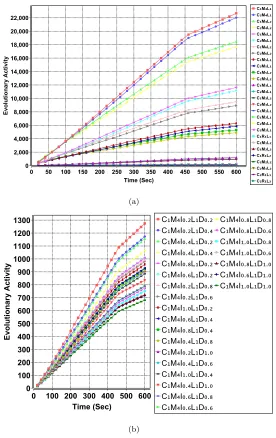
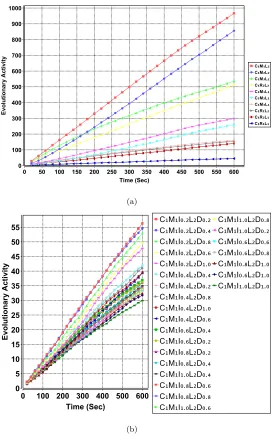
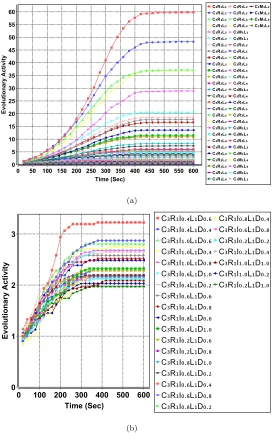
Anevolutionary activityplot provides the progress of the cumulative utility
score of a meme in a population at each time step. If a meme is not used, then
it is ignored in the plots. In an evolutionary activity plot, slope denotes the
rate of increase in the utility score of the related meme among the individuals
in the population during the evolutionary process. Figures 4–9 provide the
evolutionary activity plot of memes based on their utility scores averaged over
31 trials for each HyFlex problem domain separately. Part (a) in each figure
focusses on the memes encoding combination of crossover, mutation and hill
climbing operators while part (b) provides the evolutionary activity plot of
the best performing operator combination taking into account its parameter
settings. For the ease of visualisation, instead of the ID of a parameter setting,
its exact value is used in the plots. The evolutionary activity plots show that two
memeplexes differing in one of the genetic operators are favoured over the others
overall. The parameter settings forintensity of mutationanddepth of search
vary depending on the problem instance.
Figure 4(a) shows that the meme C1M4L1 performs the best on the
In-stance 3 in MAX-SAT, however, this figure ignores the parameter settings of
the mutation and hill climber operators. Figure 4(b) provides the evolutionary
activity plot of all memes including their parameter settings for that
combi-nation of operators, which shows that adaptation preferred low values (0.2) for
intensity of mutationanddepth of searchfor this particular instance. In
gen-eral, these figures provide some insight into particular operators and parameter
settings that are performing well in the instances considered. Figures 5(a) and
5(b) show that in the case of Instance 1 of the Bin Packing domain, L1 (ID#4)
is a preferable hill climbing heuristic in combination with most other memes
and for the best set of operators, theintensity of mutation setting is best at
a low value of 0.2. For the Personnel Scheduling problem and Travelling
Sales-man Problem (Figure 6 and 8), whilst there are clearly better operator choices
evidenced by their high likelihood of appearing in high quality memeplexes, the
choice ofintensity of mutationanddepth of searchdoes not seem to influence
Problem, a domain that SSMMA seems to perform poorly in overall. In the case
of Permutation Flow Shop and the Vehicle Routing Problem the combination of
two operators is particularly effective (C41and R1 for Permutation Flow Shop
and C1 and L2 for the Vehicle Routing Problem). Also for these two domains
there is a clear distinction in performance related todepth of searchparameter
setting, with lower values clearly performing better but little difference can be
observed between different values forintensity of mutation.
As seen in the previous subsections, the proposed adaptation method with
long-term memory outperforms previous MAs which either contain no learning
or learning on a more short-term basis. Despite this, SSMMA does not
par-ticularly perform well on the Permutation Flow Shop and Traveling Salesman
Problem domains. The sample evolutionary activity plots from these two
do-mains reveal that there could be several reasons for this poor performance. All
memes in the Traveling Salesman Problem seem to have been used and the
ap-proach cannot figure out the best parameter setting for the relevant operators
either. Although SSMMA detects several useful memes in Permutation Flow
Shop, those memes cause the search to get stuck. Remembering that SSMA
us-ing random choice with a fixed parameter settus-ing performs better than SSMMA
in both of these domains, the proposed adaptation method is struggling to
de-tect a similar strategy. The search process turns into almost a random walk for
Traveling Salesman Problem, while the adaptation cannot recover from initially
detected extremely successful memes which seem to mislead the search process
causing it to get stuck for Permutation Flow Shop within the given limited time.
4.5. Performance comparison of SSMMA and MMA to the CHeSC 2011
en-trants
The goal of this study is to provide a novel Multimeme Memetic Algorithm
using a novel encoding, with the potential to outperform generic Multimeme
Al-gorithms, not to provide a hyper-heuristic approach which performs well across
different domains. However as we have utilised the HyFlex cross-domain search
and MMA in terms of relative performance against the selection hyper-heuristics
which competed in CHeSC 2011. Following the competition, median results of
31 runs for each of the 30 problem instances were made available for each of
the 20 competitors. SSMMA and MMA are compared independently to the
20 CHeSC 2011 entrants, based on the median score obtained in 31 runs of
each instance, using the scoring metric used in the competition. CHeSC 2011
used a points-based scoring system inspired by a system used previously by
Formula One motor racing to rank the performance of hyper-heuristics entered
to the competition. This ranking system assigns a number of points to each
competitor based on their performance for each of the 30 instances tested. The
method which obtains the best objective value for a given instance is awarded
10 points, the method in second is given 8 points and then each subsequent
method is awarded 6, 5, 4, 3, 2, 1 and 0 points respectively. As this system
only allocates scores to the top 8 ranked contestants, all entrants which are
ranked ≥ 9th position are allocated a score of 0. It is worth noting that the
Formula One ranking system cannot be used to compare for statistically
sig-nificant differences between methods, unlike other comparison methods such
as Null Hypothesis Significance Testing (NHST) and Chess Rating System for
Evolutionary Algorithms (CRS4EAs) [65]. However as the Formula One ranking
system was used in the original CHeSC 2011 competition, using it here allows
us to easily compare with a wide variety of existing methods from the literature.
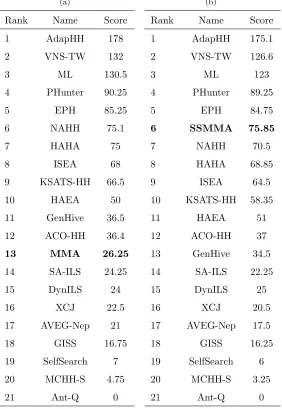
Table 3(a) and 3(b) provide the relative ranking of MMA and SSMMA,
re-spectively compared to the selection hyper-heuristics entered into CHeSC 2011
based on the Formula 1 scoring system described above. Please note that here
we are comparing SSMMA and MMA to the CHeSC2011 competitors
indepen-dently. In each case, the 21 hyper-heuristics compared compete for a total of
1170 points, with a maximum of 300 points available to a single hyper-heuristic.
This accounts for the slightly different values for some methods in this table.
From these tables, we can clearly see that SSMMA outperforms MMA, with
each method scoring 75.85 and 26.25 points respectively. The static MAs
dif-Table 3: Ranking of (a) MMA, and (b) SSMMA with respect to the CHeSC 2011 competitors based on Formula 1 scores.
(a)
Rank Name Score
1 AdapHH 178
2 VNS-TW 132
3 ML 130.5
4 PHunter 90.25
5 EPH 85.25
6 NAHH 75.1
7 HAHA 75
8 ISEA 68
9 KSATS-HH 66.5
10 HAEA 50
11 GenHive 36.5
12 ACO-HH 36.4
13 MMA 26.25
14 SA-ILS 24.25
15 DynILS 24
16 XCJ 22.5
17 AVEG-Nep 21
18 GISS 16.75
19 SelfSearch 7
20 MCHH-S 4.75
21 Ant-Q 0
(b)
Rank Name Score
1 AdapHH 175.1
2 VNS-TW 126.6
3 ML 123
4 PHunter 89.25
5 EPH 84.75
6 SSMMA 75.85
7 NAHH 70.5
8 HAHA 68.85
9 ISEA 64.5
10 KSATS-HH 58.35
11 HAEA 51
12 ACO-HH 37
13 GenHive 34.5
14 SA-ILS 22.25
15 DynILS 25
16 XCJ 20.5
17 AVEG-Nep 17.5
18 GISS 16.25
19 SelfSearch 6
20 MCHH-S 3.25
[image:28.595.166.448.263.672.2]ferent problem domains compared to the selection hyper-heuristics in the
com-petition. If these two MAs were entered into the original competition, TGMA
would have scored 0 points, and SSMA would have scored 7.5 points [53]. Here,
both self-adaptive MAs outperform these methods by some distance. The ability
to ‘learn’ which memes are useful in an adaptive manner is clearly beneficial in
the context of cross-domain optimisation. SSMMA ranks 6th overall compared
to the CHeSC 2011 competitors.
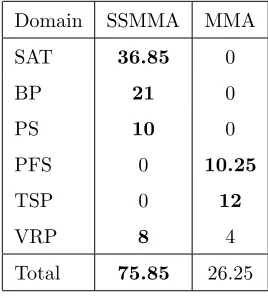
Table 4 separates the results given in Table 3(a) and Table 3(b), breaking
down performance in each problem domain. The most striking figure within this
table is that SSMMA is performing extremely well in the MAX-SAT problem
domain, in fact outperforming all 20 CHeSC 2011 competitors. These results
are also superior to the previous state-of-the-art results of Drake et al. [20],
which scored 32.85 points in this problem domain. Despite extremely
encour-aging results overall, SSMMA still performs relatively poorly in the Travelling
Salesman Problem and Permutation Flow Shop problem domains, two domains
in which MMA does score some points. Although scoring 0 points in a
sin-gle domain indicates poor performance using this ranking system, it should be
highlighted that this corresponds to a method not being one of the top 8
com-petitors. This does not necessarily mean that it is one of the worst of the 21
methods compared.
Interestingly, the performance of SSMMA is extremely similar to the
Mod-ified Choice F unction - All M oves (MCF-AM) hyper-heuristic presented by
Drake et al. [21] both in terms of overall performance (MCF-AM scored 73.7
points compared to the CHeSC 2011 competitors) and the individual problem
domains in which it is stronger and weaker. This version of MCF-AM used a
framework introduced by Drake et al. [22] to manage crossover low-level
heuris-tics, which were omitted from the set of low-level heuristics in the original
MCF-AM [20]. They suggested that in the case of the Travelling Salesman Problem,
where the top three methods ML [36], AdapHH [40], and VNS-TW [27] were
also the top three in the competition overall, a hyper-heuristic framework which
Table 4: Number of Formula One points scored in each CHeSC 2011 problem domain by SSMMA and MMA
Domain SSMMA MMA
SAT 36.85 0
BP 21 0
PS 10 0
PFS 0 10.25
TSP 0 12
VRP 8 4
Total 75.85 26.25
doesn’t seem to be the case here, where SSMMA uses a hill climbing operator at
each step through the use of memes, with relatively poor performance observed
in this problem domain.
Overall, single-point-based adaptive search methods outperform self-adaptive
multi-point evolutionary algorithms for cross domain search. However,
consid-ering the advances in CPUs and multi-core/multi-threaded hardware
technolo-gies, it is not difficult to see the underlying potential in this area. There has
been a large increase in the number of parallel processing methods proposed
in the literature, at least partially as a result of the availability of affordable
multi-core computers as well as general purpose GPUs. Combining MAs with
hyper-heuristics which exploit the underlying computer architecture has the
po-tential to lead to more efficient and effective solvers. Asta et al. [3] described
such an approach which was the winner of an international challenge solving a
project scheduling problem.
5. Conclusion
Adaptation and control are crucial in many metaheuristics considering that
many applications often require implementation of multiple operators,
the neighbourhood move or number of steps for repeating a chosen process. In
this study, we propose a new self-adaptive Memetic Algorithm [50], referred
to as Steady-state Multimeme Memetic Algorithm (SSMMA) with a new
adap-tation mechanism having a long-term memory for controlling genetic operators
and their parameter settings during the search process. SSMMA co-evolves
utility scores, indicating the success of producing an improved solution for all
algorithmic component choices encoded as a meme in each individual. The
simple inheritance mechanism is used for transmitting memes from parents to
offspring, however memetic material does not get mutated as is the case in the
Multimeme Memetic Algorithm (MMA) of Krasnogor and Smith [35]. The
util-ity scores are maintained based on a simple Reinforcement Learning strategy,
increasing the score of a meme if an improved solution is produced.
The performance of SSMMA is evaluated using a software library, referred
to as HyFlex, containing six problem domains. The empirical results show that
SSMMA performs significantly better than MMA on 12 out of 15 instances
across three of the domains. It is slightly better than MMA on 5 instances on
another domain, while MMA performs significantly better than SSMMA on 10
instances from the remaining two domains on average. Based on Formula 1
ranking used in CHeSC2011, SSMMA performs better than MMA with a score
of 75.85 against 26.25 and memetic algorithm variants without operator control
as well as fifteen other previously proposed algorithms.
Both methods were shown to be vastly superior to traditional static Memetic
Algorithms. Additionally, SSMMA is able to offer results that are competitive
with some of the state-of-the-art methods from CHeSC 2011, outperforming
all 20 entrants in the five instances of the MAX-SAT problem domain used in
the competition. The results in this domain are also an improvement over the
previously best results reported in the literature for these instances.
Looking into the cases for which SSMMA performs poorly, there seems to be
an issue with the use of long term memory, i.e., memory length. The proposed
approach might need a ‘forgetting’ mechanism, however this will require design
to forget and how to forget. We intend to continue our work in this area in
future by analysing the effect of the Reinforcement Learning mechanism used
to select a low-level heuristic of a given type and memory length. Currently
SSMMA relies on tournament selection to choose a heuristic to apply based on
previous performance, however a different component can be used instead, such
as Roulette Wheel or Choice Function [15], and even this choice could be
co-evolved. A more ‘intelligent’ selection mechanism could lead to a more reactive
system, capable of quickly learning which heuristics are effective at a particular
point in the search.
Considering the success of selection hyper-heuristics performing
single-point-based search in the control of operators, Memetic Algorithms embedding
se-lection hyper-heuristics is another research direction we plan to take. There
is already empirical evidence that such approaches could yield improved
per-formance, particularly when implemented in a distributed processing setting
exploiting the underlying computer architecture with multiple cores [3].
References
[1] G. Acampora, V. Loia, A. Vitiello, Enhancing ontology alignment through
a memetic aggregation of similarity measures, Information Sciences 250
(2013) 1–20.
[2] A. Alkan, E. ¨Ozcan, Memetic algorithms for timetabling, in: Proceedings
of the IEEE Conference on Evolutionary Computation (CEC 2003), vol. 3,
IEEE Press, Canberra, Australia, 2003, pp. 1796–1802.
[3] S. Asta, D. Karapetyan, A. Kheiri, E. ¨Ozcan, A. J. Parkes, Combining
Monte-Carlo and hyper-heuristic methods for the multi-mode
resource-constrained multi-project scheduling problem, CoRR abs/1511.04387.
URL http://arxiv.org/abs/1511.04387
and conceptual comparison, ACM Computing Surveys 35 (3) (2003) 268–
308.
[5] L. Buriol, P. M. Fran¸ca, P. Moscato, A new memetic algorithm for the
asymmetric traveling salesman problem, Journal of Heuristics 10 (5) (2004)
483–506.
[6] E. K. Burke, M. Gendreau, M. Hyde, G. Kendall, B. McCollum, G. Ochoa,
A. J. Parkes, S. Petrovic, The cross-domain heuristic search challenge - an
international research competition, in: C. A. C. Coello (ed.), Proceedings
of Learning and Intelligent Optimization (LION 2011), vol. 6683 of LNCS,
Springer, Rome, Italy, 2011, pp. 631–634.
[7] E. K. Burke, M. Hyde, G. Kendall, G. Ochoa, E. ¨Ozcan, R. Qu,
Hyper-heuristics: A survey of the state of the art, Journal of the Operational
Research Society 64 (12) (2013) 1695–1724.
[8] E. K. Burke, M. Hyde, G. Kendall, G. Ochoa, E. ¨Ozcan, J. R. Woodward, A
classification of hyper-heuristic approaches, in: M. Gendreau, J.-Y. Potvin
(eds.), Handbook of Metaheuristics, vol. 146 of International Series in
Op-erations Research & Management Science, Springer US, 2010, pp. 449–468.
[9] E. K. Burke, G. Kendall, M. Mısır, E. ¨Ozcan, Monte carlo hyper-heuristics
for examination timetabling, Annals of Operations Research 196 (1) (2012)
73–90.
[10] E. K. Burke, J. D. L. Silva, The design of memetic algorithms for scheduling
and timetabling problems, in: W. E. Hart, J. Smith, N. Krasnogor (eds.),
Recent Advances in Memetic Algorithms, vol. 166 of Studies in Fuzziness
and Soft Computing, Springer Berlin Heidelberg, 2005, pp. 289–311.
[11] A. Caponio, G. L. Cascella, F. Neri, N. Salvatore, M. Sumner, A fast
adaptive memetic algorithm for online and offline control design of pmsm
drives, IEEE Transactions on Systems, Man, and Cybernetics, Part B:
[12] F. Caraffini, F. Neri, L. Picinali, An analysis on separability for memetic
computing automatic design, Information Sciences 165 (2014) 1–22.
[13] X. Chen, Y.-S. Ong, M.-H. Lim, K. C. Tan, A multi-facet survey on
memetic computation, IEEE Transactions on Evolutionary Computation
15 (5) (2011) 591–607.
[14] H. G. Cobb, An investigation into the use of hypermutation as an adaptive
operator in genetic algorithms having continuous, time-dependent
nonsta-tionary environment, Tech. Rep. NRL Memorandum Report 6760, U. S.
Navy Center for Applied Research in Artificial Intelligence Information
Technology Division (1990).
[15] P. Cowling, G. Kendall, E. Soubeiga, A hyperheuristic approach to
schedul-ing a sales summit, in: E. K. Burke, W. Erben (eds.), Proceedschedul-ings of
the International Conference on the Practice and Theory of Automated
Timetabling (PATAT 2000), vol. 2079 of LNCS, Springer, Konstanz,
Ger-many, 2001, pp. 176–190.
[16] M. ˇCrepinˇsek, S.-H. Liu, M. Mernik, Exploration and exploitation in
evo-lutionary algorithms: a survey, ACM Computing Surveys 45 (3) (2013)
35.
[17] M. ˇCrepinˇsek, S.-H. Liu, M. Mernik, Replication and comparison of
compu-tational experiments in applied evolutionary computing: common pitfalls
and guidelines to avoid them, Applied Soft Computing 19 (2014) 161–170.
[18] R. Dawkins, The Selfish Gene, New York City: Oxford University Press,
1976.
[19] K. A. De Jong, An analysis of the behavior of a class of genetic
adap-tive systems., Ph.D. thesis, University of Michigan, Ann Arbor, MI, USA,
aAI7609381 (1975).
[20] J. H. Drake, E. ¨Ozcan, E. K. Burke, An improved choice function heuristic
K. Deb, S. Forrest, G. Nicosia, M. Pavone (eds.), Proceedings of Parallel
Problem Solving from Nature (PPSN 2012), Part II, vol. 7492 of LNCS,
Springer, Taormina, Italy, 2012, pp. 307–316.
[21] J. H. Drake, E. ¨Ozcan, E. K. Burke, A modified choice function
hyper-heuristic controlling unary and binary operators, in: Proceedings of the
IEEE Congress on Evolutionary Computation (CEC 2015), IEEE Press,
Sendai, Japan, 2015, pp. 3389–3396.
[22] J. H. Drake, E. ¨Ozcan, E. K. Burke, A case study of controlling crossover in
a selection hyper-heuristic framework using the multidimensional knapsack
problem, Evolutionary Computation.
[23] M. Epitropakis, F. Caraffini, F. Neri, E. Burke, A separability prototype
for automatic memes with adaptive operator selection, in: Foundations of
Computational Intelligence (FOCI), 2014 IEEE Symposium on, 2014, pp.
70–77.
[24] C.-K. Goh, Y.-S. Ong, K. C. Tan, Multi-Objective Memetic Algorithms,
Springer Berlin Heidelberg, 2009.
[25] D. E. Goldberg, Genetic Algorithms in Search, Optimization and Machine
Learning, Addison-Wesley, Boston, MA, USA, 1989.
[26] G. Gutin, D. Karapetyan, A memetic algorithm for the generalized
travel-ing salesman problem, Natural Computtravel-ing 9 (1) (2010) 47–60.
[27] P.-C. Hsiao, T.-C. Chiang, L.-C. Fu, A vns-based hyper-heuristic with
adaptive computational budget of local search, in: Proceedings of the
IEEE Congress on Evolutionary Computation (CEC 2012), IEEE Press,
Brisbane, Australia, 2012, pp. 1–8.
[28] H. Ishibuchi, T. Yoshida, T. Murata, Balance between genetic search and
local search in memetic algorithms for multiobjective permutation flowshop
scheduling, IEEE Transactions on Evolutionary Computation 7 (2) (2003)
[29] W. Jakob, A general cost-benefit-based adaptation framework for
multi-meme algorithms, Memetic Computing 2 (3) (2010) 201–218.
[30] L. P. Kaelbling, M. L. Littman, A. W. Moore, Reinforcement learning: a
survey, Journal of Artificial Intelligence Research 4 (1996) 237–285.
[31] J. Knowles, D. Corne, Memetic algorithms for multiobjective optimization:
Issues, methods and prospects, in: W. E. Hart, J. Smith, N. Krasnogor
(eds.), Recent Advances in Memetic Algorithms, vol. 166 of Studies in
Fuzziness and Soft Computing, Springer Berlin Heidelberg, 2005, pp. 313–
352.
[32] N. Krasnogor, Studies on the theory and design space of memetic
algo-rithms, Ph.D. thesis, University of the West of England, Bristol, UK (2002).
[33] N. Krasnogor, B. Blackburne, E. Burke, J. Hirst, Multimeme algorithms
for protein structure prediction, in: J. Guerv´os, P. Adamidis, H.-G. Beyer,
H.-P. Schwefel, J.-L. Fern´andez-Villaca˜nas (eds.), Proceedings of Parallel
Problem Solving from Nature (PPSN 2002), vol. 2439 of LNCS, Springer,
Granada, Spain, 2002, pp. 769–778.
[34] N. Krasnogor, S. Gustafson, A study on the use of ”self-generation” in
memetic algorithms, Natural Computing 3 (1) (2004) 53–76.
[35] N. Krasnogor, J. Smith, Emergence of profitable search strategies based on
a simple inheritance mechanism, in: L. Spector, E. Goodman, A. Wu, W. B.
Langdon, H. M. Voigt, M. Gen, S. Sen, M. Dorigo, S. Pezeshk, M. Garzon,
E. Burke (eds.), Proceedings of the Genetic and Evolutionary Computation
Conference (GECCO 2001), Morgan Kaufmann, San Francisco, CA, US,
2001, pp. 432–439.
[36] M. Larose, A hyper-heuristic for the chesc 2011, in: CHeSC2011
Competi-tion, 2011.
[37] O. Linda, D. Wijayasekara, M. Manic, M. McQueen, Optimal placement
Proceedings of the IEEE International Symposium on Industrial Electronics
(ISIE 2014), IEEE Press, Istanbul, 2014, pp. 2035 – 2041.
[38] H. R. Louren¸co, O. C. Martin, T. St¨utzle, Iterated local search:
frame-work and applications, in: M. Gendreau, J.-Y. Potvin (eds.), Handbook of
Metaheuristics, vol. 146 of International Series in Operations Research and
Management Science, Springer US, 2010, pp. 363–397.
[39] P. Merz, B. Freisleben, Fitness landscape analysis and memetic algorithms
for the quadratic assignment problem, IEEE Transactions on Evolutionary
Computation 4 (4) (2000) 337–352.
[40] M. Mısır, K. Verbeeck, P. De Causmaecker, G. V. Berghe, An intelligent
hyper-heuristic framework for chesc 2011, in: Y. Hamadi, M. Schoenauer
(eds.), Proceedings of Learning and Intelligent Optimization (LION 2012),
vol. 7219 of LNCS, Springer, Paris, France, 2012, pp. 461–466.
[41] P. Moscato, On evolution, search, optimization, genetic algorithms and
martial arts: Towards memetic algorithms, Caltech concurrent
computa-tion program, C3P Report 826 (1989) 1989.
[42] P. Moscato, M. G. Norman, A memetic approach for the traveling salesman
problem implementation of a computational ecology for combinatorial
opti-mization on message-passing systems, Parallel Computing and Transputer
Applications 1 (1992) 177–186.
[43] F. Neri, C. Cotta, Memetic algorithms and memeting computing
optimiza-tion: A literature review, Swarm and Evolutionary Computation 2 (2012)
1–14.
[44] F. Neri, J. Toivanen, G. L. Cascella, Y.-S. Ong, An adaptive multimeme
algorithm for designing hiv multidrug therapies, IEEE/ACM Transactions