1
Generating a series of fine spatial and temporal resolution
1land cover maps by fusing coarse spatial resolution remotely
2sensed images and fine spatial resolution land cover maps
34
Xiaodong Li
a, Feng Ling
a,b,*, Giles M. Foody
b, Yong Ge
c, Yihang Zhang
a,
5
Yun Du
a 67
a Key Laboratory of Monitoring and Estimate for Environment and Disaster of Hubei
8
Province, Institute of Geodesy and Geophysics, Chinese Academy of Sciences, Wuhan 9
430077, China 10
b School of Geography, University of Nottingham, University Park, Nottingham NG7
11
2RD, U.K. 12
c State Key Laboratory of Resources and Environmental Information System, Institute
13
of Geographic Sciences & Natural Resources Research, Chinese Academy of Sciences, 14
Beijing 100101, China 15
16
*Corresponding author at Key Laboratory of Monitoring and Estimate for Environment 17
and Disaster of Hubei Province, Institute of Geodesy and Geophysics, Chinese 18
Academy of Sciences, Wuhan 430077, China 19
2
ABSTRACT 21
Studies of land cover dynamics would benefit greatly from the generation of land 22
cover maps at both fine spatial and temporal resolutions. Fine spatial resolution images 23
are usually acquired relatively infrequently, whereas coarse spatial resolution images 24
may be acquired with a high repetition rate but may not capture the spatial detail of the 25
land cover mosaic of the region of interest. Traditional image spatial–temporal fusion 26
methods focus on the blending of pixel spectra reflectance values and do not directly 27
provide land cover maps or information on land cover dynamics. In this research, a 28
novel Spatial–Temporal remotely sensed Images and land cover Maps Fusion Model 29
(STIMFM) is proposed to produce land cover maps at both fine spatial and temporal 30
resolutions using a series of coarse spatial resolution images together with a few fine 31
spatial resolution land cover maps that pre- and post-date the series of coarse spatial 32
resolution images. STIMFM integrates both the spatial and temporal dependences of 33
fine spatial resolution pixels and outputs a series of fine spatial–temporal resolution 34
land cover maps instead of reflectance images, which can be used directly for studies 35
of land cover dynamics. Here, three experiments based on simulated and real remotely 36
sensed images were undertaken to evaluate the STIMFM for studies of land cover 37
change. These experiments included comparative assessment of methods based on 38
single-date image such as the super-resolution approaches (e.g., pixel swapping-based 39
super-resolution mapping) and the state-of-the-art spatial–temporal fusion approach 40
that used the Enhanced Spatial and Temporal Adaptive Reflectance Fusion Model 41
3
the fine-resolution images, in which the maximum likelihood classifier and the 43
automated land cover updating approach based on integrated change detection and 44
classification methodwere then applied to generate the fine-resolution land cover maps.
45
Results show that the methods based on single-date image failed to predict the pixels 46
of changed and unchanged land cover with high accuracy. The land cover maps that 47
were obtained by classification of the reflectance images outputted from ESTARFM 48
and FSDAF contained substantial misclassification, and the classification accuracy was 49
lower for pixels of changed land cover than for pixels of unchanged land cover. In 50
addition, STIMFM predicted fine spatial–temporal resolution land cover maps from a 51
series of Landsat images and a few Google Earth images, to which ESTARFM and 52
FSDAF that require correlation in reflectance bands in coarse and fine images cannot 53
be applied. Notably, STIMFM generated higher accuracy for pixels of both changed 54
and unchanged land cover in comparison with other methods. 55
4
1. Introduction
57Land cover maps are one of the most fundamental datasets used in many scientific 58
fields and are often produced from remotely sensed images (Bartholome and Belward 59
2005; Friedl et al. 2002). A wide variety of remote sensing systems have been 60
developed, and hence, images are available with different spatial and temporal 61
resolutions, thereby allowing the production of land cover maps at different spatial and 62
temporal scales. With most satellite remote sensing systems, a trade-off typically exists 63
between spatial and temporal resolution. In general, fine spatial resolution remote 64
sensors can acquire images that provide spatially detailed land cover information, but 65
their relatively coarse temporal resolution limits their usage in monitoring rapid land 66
cover changes. By contrast, coarse spatial resolution remotely sensed images can often 67
be acquired at a fine temporal resolution that provides a repetition rate suitable for the 68
detection of rapid land cover changes but are unable to represent the spatial detail of 69
the land cover mosaic. To realize the full potential of remote sensing as a source of 70
information on land cover change, a method that allows the production of land cover 71
maps with both fine spatial and temporal resolutions is required. Such maps could be 72
obtained by combining all available remotely sensed images of varying spatial and 73
temporal resolution to form a series of fine-resolution land cover maps. 74
Recently, spatial–temporal image fusion, which aims to produce fine spatial and 75
temporal resolution remotely sensed images from images with different spatial and 76
temporal resolutions, has become a promising means to address the trade-off between 77
5
Spatial–temporal data fusion methods can be categorized into weighted function based 79
methods, unmixing-based methods, and dictionary-pair learning based methods (Zhu 80
et al. 2016). Among the weighted function based methods, the Spatial and Temporal 81
Adaptive Reflectance Fusion Model (STARFM) proposed by Gao et al. (2006) was 82
developed first and is one of the most popular spatial–temporal image fusion methods. 83
By fusing coarse spatial resolution Moderate Resolution Imaging Spectroradiometer 84
(MODIS) and fine spatial resolution Landsat sensor images, STARFM can predict 85
Landsat-like reflectance images with the spatial resolution of Landsat and the temporal 86
resolution of MODIS. A number of studies have suggested improvements to STARFM, 87
including studies of forest disturbance (Hilker et al. 2009a), and in heterogeneous 88
regions (Zhu et al. 2010), as well as in gap filling to reduce the negative effects of cloud 89
(Gevaert and Garcia-Haro 2015). STARFM and the improved models based on it have 90
been mainly used to detect reflectance changes caused by processes such as phenology 91
over large areas, and used to generate dense time series of Landsat-like data (Hilker et 92
al. 2009b), enhance land cover classification (Jia et al. 2014), and predict key 93
environmental variations such as evapotranspiration (Anderson et al. 2011) and 94
temperature (Hilker et al. 2009b). Other spatial–temporal image fusion models, such as 95
the unmixing-based algorithm that extracts endmembers on the basis of linear spectral 96
mixture model and assigns the unmixed reflectance to fine spatial resolution pixels 97
(Huang and Zhang 2014; Zhukov et al. 1999; Zurita-Milla et al. 2009) and the 98
dictionary-pair learning based methods, which capture features from the coarse- and 99
6
2012), have also been proposed and applied to Landsat and MODIS images in recent 101
years (Amoros-Lopez et al. 2013; Wu et al. 2012). 102
Generally, spatial–temporal image fusion models aim to generate a series of 103
continuous reflectance values instead of discrete categorical values. A further image 104
classification step is needed to produce from the reflectance images a corresponding 105
series of land cover maps for the study of land cover class dynamics (Jia et al. 2014). 106
The use of these methods for generating land cover maps and monitoring land cover 107
changes often suffers from two important limitations. 108
First, most spatial–temporal image fusion algorithms assume that land cover type 109
does not change during the data observation period (Fu et al. 2013; Gao et al. 2006; 110
Zhu et al. 2010). Previous research has shown that STARFM does not deal well with 111
abrupt land cover changes. Song and Huang (2013) showed that STARFM failed to fuse 112
the pixel reflectance accurately in a study of land cover change in an urban area. The 113
Enhanced STARFM (ESTARFM) is often better than STARFM for studies of 114
heterogeneous landscapes (Zhu et al. 2010) but can be worse than STARFM for 115
predicting abrupt changes of land cover type (Emelyanova et al. 2013). The Spatial 116
Temporal Adaptive Algorithm for mapping Reflectance CHange (STAARCH) 117
improves STARFM’s performance when land cover type change and disturbance exist, 118
but it is more suitable for spatial–temporal fusion of forest land cover (Hilker et al. 119
2009a). The Flexible Spatiotemporal DAta Fusion model (FSDAF) can predict 120
Landsat-like reflectance values with both gradual change and land cover type change, 121
7
pixels experienced land cover type change and the change is invisible in the coarse-123
resolution image (Zhu et al. 2016). Similar to STARFM, the unmixing-based spatial– 124
temporal reflectance fusion methods consider only the change in endmember spectra 125
but not in land cover types (Huang and Zhang 2014; Zhukov et al. 1999; Zurita-Milla 126
et al. 2009). 127
Second, most spatial–temporal image fusion methods need one or more observed 128
pairs of coarse- and resolution images for training and require the coarse- and fine-129
resolution remotely sensed data from different satellite sensors to be mutually 130
comparable and correlated. All the weighted function based methods, including 131
STARFM, ESTARFM, STAARCH, and all the dictionary-pair learning-based methods 132
need one or more observed pairs of coarse- and fine-resolution images, which have 133
comparable reflectance bands, for training (Gao et al. 2006; Gevaert and Garcia-Haro 134
2015; Zhu et al. 2010). These methods mainly focus on predicting Landsat-like 135
remotely sensed images with MODIS repetition rates. However, these methods cannot 136
deal with other satellite images, which have uncorrelated reflectance bands, and are 137
thus limited in the use of land cover change analysis. For instance, in regional-scale 138
land cover analysis, the detection of very-high-resolution land cover changes at high 139
temporal resolutions is required. In general, we can obtain a series of Landsat images 140
and a few very-high-resolution images such as panchromatic aerial photograph. The 141
weighted function based and dictionary-pair learning based methods cannot fuse these 142
data because the very-high-resolution images usually have different reflectance bands 143
8
The spatial–temporal image fusion methods aim to produce fine spatial–temporal 145
resolution reflectance images rather than land cover maps. The fused fine-resolution 146
images have many applications, such as phenology analysis. If the aim is to generate a 147
sequence of land cover maps from the reflectance images from which land cover change 148
trajectories may be extracted, then a further image classification analysis is still required, 149
which may introduce uncertainty and error in the land cover maps. First, the 150
classification of an image series can be complex and laborious. Training statistics are 151
required to inform classification analysis, and these may vary in quality in time due to 152
issues such as phenology. Moreover, the classification is also problematic, with the 153
potential for different classifiers to generate dissimilar land cover maps from the same 154
training data. Traditional classifiers applied to mono-temporal image may also ignore 155
the temporal information contained in a series of images and thereby produce a 156
classification of sub-optimal accuracy. The spatial–temporal–based image classifier has 157
the advantage in taking both the spatial and temporal links between neighboring pixels 158
(Cai et al. 2014), but is challenging to use for voluminous image series (Liu and Cai 159
2012; Liu et al. 2006). Finally, the spatial–temporal image fusion models generate a 160
large volume of fine spatial–temporal resolution reflectance images as the intermediate 161
data to be used for the production of land cover maps. This situation may represent 162
practical challenges in terms of data access and storage. 163
Given the concerns with the spatial–temporal reflectance fusion model for 164
producing land cover maps, a more appropriate fusion approach could be based on 165
9
land cover maps rather than reflectance images, with the aid of information derived 167
from a few fine spatial resolution images that may be available. Chen et al. (2015) 168
updated land cover maps from downscaled Normalized Difference Vegetation Index 169
(NDVI) time-series data from MODIS, a current Landsat image, and a Landsat image 170
that pre-dates it. The NDVI time-series data are used as ancillary data to extract changed 171
pixels in the Landsat images, and the labels of changed pixels are determined using the 172
current Landsat image. Thus, this method can update fine-resolution land cover maps 173
with Landsat repetition rates based on available Landsat images, but cannot predict 174
fine-resolution land cover maps with MODIS repetition rates. In addition, a major 175
problem with this approach is that a large proportion of coarse spatial resolution image 176
pixels may be of mixed land cover composition. A possible solution of this problem is 177
to use the fractional land cover class composition images that can be extracted via a 178
spectral unmixing analysis. A comparison of the obtained fraction images indicates the 179
change, if any, in land cover that has occurred in the time period between the dates of 180
image acquisition (Lu et al. 2004). This approach can potentially reveal important 181
temporal land cover information, such as land cover modification and conversion 182
(Foody 1999; Lu et al. 2011). Unfortunately, these approaches show only the change in 183
the fraction of the area that is represented by each coarse-resolution pixel and not the 184
geographical location of the change. Information on the location of change might be 185
obtained through a super-resolution analysis (Li et al. 2016; Wang et al. 2015). 186
Super-resolution land cover mapping (SRM) is a promising technique used to 187
10
typically viewed as a post-processing approach applied after a spectral unmixing 189
analysis. SRM predicts the spatial distribution of each land cover class in the area 190
represented by each coarse spatial resolution pixel and provides more fine spatial 191
resolution land cover information than spectral unmixing (Atkinson 2009). Various 192
approaches have been proposed (Atkinson 2005; Ge et al. 2016; Kasetkasem et al. 2005; 193
Ling et al. 2016; Tatem et al. 2003), and SRM has been used in many fields, including 194
the extraction of waterlines (Foody et al. 2005), rural land cover (Tatem et al. 2003), 195
refining the estimation of ground control point location (Foody 2002), land cover 196
change detection (Wang et al. 2015), land cover map updating (Li et al. 2015b), and 197
wetland inundation analysis (Li et al. 2015a). 198
Traditionally, SRM is applied to a mono-temporal coarse spatial resolution image 199
dataset. The SRM solution space is large because SRM predicts land cover maps with 200
finer spatial resolution than the input data, and it can provide multiple plausible 201
solutions that satisfy the constraints of the SRM analysis. A fine spatial resolution land 202
cover map that pre- or post-dates the coarse spatial resolution image could be used to 203
provide fine spatial resolution information to constrain and enhance the SRM solution 204
(Li et al. 2015b; Ling et al. 2011; Wang et al. 2015; Xu and Huang 2014). Although 205
the accuracy of SRM may be increased through the use of multi-temporal data, 206
challenges remain, especially if a time series of images are used. Often, a sequence of 207
coarse spatial resolution images together with a few fine spatial resolution images that 208
pre- and post-date the coarse-resolution images are available. Applying existing SRMs 209
11
that pre- or post-dates it fails to account for the temporal dependence in the image series 211
and fails to fully exploit the available information. The construction of SRM that 212
considers the temporal dependences of a coarse-resolution image from fine-resolution 213
maps that pre- and post-date it is necessary for a fuller reconstruction of land cover 214
dynamics. 215
The objective of this paper is to propose a Spatial–Temporal remotely sensed 216
Images and land cover Maps Fusion Model (STIMFM). The inputs to STIMFM are a 217
series of coarse spatial resolution multi-spectral remotely sensed images and few fine 218
spatial resolution land cover maps that pre- and post-date the coarse spatial resolution 219
image series. The fine spatial resolution land cover maps can be obtained from various 220
data sources, such as through classification of remotely sensed images or maps 221
produced conventionally from field survey. As a result, the input to STIMFM is more 222
general than that of other spatial–temporal image fusion models. Critically, STIMFM 223
outputs a series of fine spatial–temporal resolution land cover maps, not reflectance 224
images. In addition, STIMFM takes information on class temporal dependence that 225
exists in different images into account and is able to deal with land cover change. 226
STIMFM was compared with a set of alternative methods. The latter includes two SRM 227
methods that use a mono-temporal coarse spatial resolution image as input and two 228
spatial–temporal image fusion methods, namely, the ESTARFM which adopts the 229
coarse spatial resolution image and two fine and coarse spatial resolution image pairs 230
that pre- and post-date the coarse-resolution image as input, and the FSDAF which 231
12
image pair that pre- or post-date the coarse-resolution image as input. 233
2. Methods
2342.1. STIMFM 235
A coarse spatial resolution image Y contains I × J pixels. Fine spatial resolution
236
land cover maps of the same geographical region are Xpre and Xpost, which are
237
temporally close to and pre- or post-date Y, respectively. Xpre and Xpost contain I × s ×
238
J × s pixels, where s is the scale or zoom factor and each coarse spatial resolution pixel
239
contains s × s fine spatial resolution pixels. C land cover classes are present in Xpre and
240
Xpost. The STIMFM predicts a fine spatial resolution land cover map X at the time of
241
coarse-resolution image Y observation, and has I × s × J × s pixels, each of which has
242
a land cover class label in C. STIMFM produces a series of fine spatial and fine
243
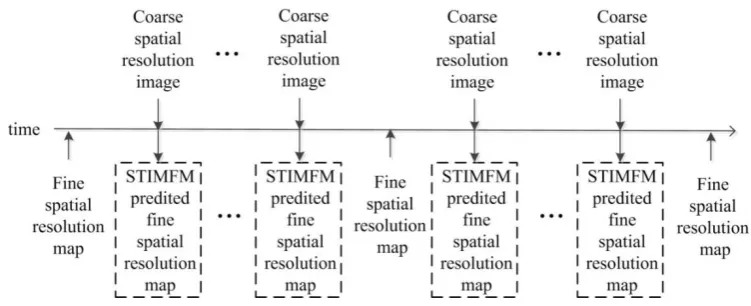
temporal resolution land cover maps. It uses a series of coarse spatial resolution 244
remotely sensed images and a few fine spatial resolution land cover maps as input (Fig. 245
1). STIMFM comprises several main steps, including spectral endmember estimation, 246
analysis of land cover class fraction temporal change, objective function construction, 247
and model optimization. The STIMFM flowchart is shown in Fig. 2. 248
13
[image:13.595.109.485.75.228.2]250
Fig. 1 Production of a series of fine spatial and temporal resolution land cover maps from a series of 251
coarse spatial resolution remotely sensed images and a few fine spatial resolution land cover maps in 252
STIMFM. 253
254
255
Fig. 2 Flowchart of STIMFM. 256
[image:13.595.76.481.348.658.2]14
In STIMFM, endmembers that are representative of the spectra of pure land cover 258
classes are estimated for coarse spatial resolution remotely sensed images. Endmember 259
spectra need to be extracted for each coarse spatial resolution image in the dataset as 260
differences may be expected in a time series due to issues such as phenology or 261
variation in image acquisition properties (e.g., angular viewing geometry). Although 262
many endmember extraction algorithms are available, they are not directly used in 263
STIMFM because spectral endmembers are difficult to extract accurately from coarse 264
spatial resolution remotely sensed images due to the small proportion of pure pixels 265
that are typically contained. Information for the estimation of endmembers is instead 266
provided by the fine spatial resolution land cover maps that pre- and post-date the 267
coarse spatial resolution image time series. 268
The land cover classes are defined in the fine spatial resolution land cover maps. 269
For each coarse spatial resolution remotely sensed image, the linear mixture model 270
(LMM) is applied in STIMFM to estimate endmember spectra. With the LMM, the 271
spectral response of each coarse spatial resolution pixel is viewed as being composed 272
of a weighted linear sum of the endmember spectra within that pixel, in which the 273
weights are determined by the relative areal proportions of each endmember (Settle and 274
Drake 1993). On the basis of the linear mixing assumption, the spectral signature yij for
275
the coarse spatial resolution pixel (i,j) in Y can be represented by 276
i ij E j
y f (1) 277
where yij is a B × 1 spectral vector. B is the number of spectral bands. E is a B × C
278
matrix that represents the endmembers used for Y. fij is the C × 1 vector that represents
15
fractions of all endmembers in the pixel (i,j) in Y. 280
Theoretically, to solve for E with B × C unknown variables, at least B × C 281
equations are required. l (l>C) coarse pixels are collected to compose a system of linear 282
mixture equations 283
y1,y2, ,yl
E
f1,f2, ,fl
(2) 284
where yl is the spectral signature for the l-th coarse spatial resolution pixel in Y, and fl
285
is the fraction vector of different classes in the l-th coarse spatial resolution pixel in Y.
286
E can be solved on the basis of the inversion of Eq. (2) by computing a least squares
287
best fit solution 288
2 1
[ ] arg min
l
n n n
f
E y (3)
289
where yn is the n-th coarse spatial resolution pixel's spectral signature in Y, and fn is the
290
fraction vector in the n-th coarse spatial resolution pixel in Y. 2 is the L2 norm of
291
the residual vector. "argmin" means the minimizing argument of the function. 292
A number of coarse spatial resolution pixels in Y with known endmember fractions
293
are sought to solve Eq. (3). For each class, the focus is a set of coarse-resolution pixels 294
that have the least changed fractions of that class during the time period covered by Xpre
295
and Xpost. To avoid the collinearity problem in the use of LMM (van der Meer and Jia
296
2012), m coarse-resolution pixels that have the highest fraction of a given class (i.e.,
297
the m purest resolution pixels of the class) among the selected set of
coarse-298
resolution pixels are used. All the m × C coarse spatial resolution pixels are used for
299
endmember estimation in Eq. (3), which can be solved by computing a least squares 300
best fit solution. Assuming the fractions of the m × C coarse spatial resolution pixels
16
are unchanged, the fractions of these coarse pixels in Xpre or Xpost are used as a substitute
302
of those in Y. The fractions in Xpre and Xpost are produced through a spatial degradation
303
process by dividing the number of fine spatial resolution pixels of each class by the 304
total number of fine spatial resolution pixels in a coarse spatial resolution pixel (i.e., s2). 305
2.3. Analysis of land cover class fraction temporal change 306
With the estimated endmembers, class fraction images that represent the area 307
percentage of a pixel occupied by each endmember can be extracted from coarse spatial 308
resolution image Y using the estimated endmember spectra E and on the basis of the
309
mean square error minimization criterion of the LMM 310
2
[fij]arg min yij fij (4) 311
0 fijc1, c1, ,C (5) 312
1
1
C ijc c
f
(6) 313where fij fij1,fij2, ,fijCT, and fijc is the fraction value of the c-th endmember in
314
coarse spatial resolution pixel (i,j) in Y. 315
The fraction images produced from the coarse spatial resolution image by spectral 316
unmixing, as well as those produced by spatially degrading the fine spatial resolution 317
land cover maps that pre- and post-date the coarse spatial resolution image, provide the 318
land cover trajectory at the acquisition times of Xpre, Y, and Xpost. The change of class
319
fractions in each coarse spatial resolution pixel represents the temporal transitions 320
between classes in the period between the dates of image acquisition. If the class 321
17
map that pre- or post-dates it, then the fine spatial resolution pixel class labels may 323
probably also be unchanged during this period. In this case, the images are temporally 324
correlated. By contrast, if the class fractions changed drastically between two images, 325
then the fine spatial resolution pixels may have changed during this period. Thereby, 326
the images are temporally uncorrelated. As a result, the temporal dependence between 327
different images can be analyzed on the basis of the change in fractions in each coarse 328
spatial resolution pixel. 329
Assume aijk is the k-th (k1, ,s2) fine spatial resolution pixel in the coarse
330
spatial resolution pixel (i,j) (i1, ,I , j1, ,J) in the land cover map X, aijk,pre
331
and aijk,post are the k-th fine spatial resolution pixel in coarse spatial resolution pixel (i,j)
332
in the maps Xpre and Xpost, and c(aijk), c(aijk,pre), and c(aijk,post) are land cover class labels
333
for fine spatial resolution pixels aijk, aijk,pre, and aijk,post, respectively. The temporal
334
dependence or correlation between fine spatial resolution pixels aijk,pre and aijk during
335
Xpre and Y observation period or between fine spatial resolution pixels aijk and aijk,post
336
during Y and Xpost observation period, which is dependent on the class labels of aijk,pre
337
and aijk or the class labels of aijk and aijk,post [Eqs. (7)–(8)] and the change in fractions in
338
this coarse pixel measured by wij,pre and wij,post [Eqs. (9)–(10)], can be characterized as
339
, ( ( ), ( , ))
ij pre ijk ijk pre
w c a c a or wij post, (c a( ijk), (c aijk post, )).
340
,
,
if
( ), ( 1
( )
0 otherwis )
e
ijk ijk pre ijk ijk pre
c a c a
c a c a
(7)
341
, , 1 ( ) 0 othif ( )
( ), (
wise )
er
ijk ijk post ijk ijk post
c a c a
c a c a
. (8)
342
18
spatial resolution pixel in different images have an unchanged class label, thereby 344
indicating that different image pixels are temporally correlated, and a value of 0 if the 345
fine spatial resolution pixel in different images have changed class labels, thereby 346
indicating that the different image pixels are temporally uncorrelated. 347
The changes in fractions in coarse-resolution pixel (i,j) during Xpre and Y
348
observation period and during Y and Xpost observation period are measured by wij,pre
349
and wij,post on the basis of the Gaussian model in Eqs. (9)–(10)
350
2
, exp ,
ij pre ij ij pre
w = f f
(9) 351
2
, exp ,
ij post ij ij post
w = f f
(10) 352
where fij,pre and fij,post are the land cover fraction vector in coarse pixel (i,j) in Xpre and
353
Xpost produced by spatially degrading Xpre and Xpost according to the scale factor s. wij,pre
354
and wij,post indicate the strength of temporal dependence between fine pixels in coarse
355
pixel (i,j) during Xpre and Y observation period or during Y and Xpost observation period.
356
wij,pre and wij,post decrease with the increase in the change of fractions in Eqs. (9)–(10).
357
2.4. Spatial–temporal SRM model 358
Given the coarse spatial resolution image Y, the fine spatial resolution maps Xpre
359
and Xpost, STIMFM aims to predict the fine spatial resolution land cover map X at the
360
time of Y observation. The optimal STIMFM result X, given Y, Xpre ,and Xpost, can be
361
formulated by applying the maximum a posteriori rule in Bayesian framework, i.e., by 362
19
arg max , ,
1
arg max exp , ,
posterior pre post posterior pre post P U Z
X X Y X X
X Y X X
(11) 364
where Z is a normalizing constant. Pposterior
X Y X, pre,Xpost
is the posterior 365probability of X, given Y, Xpre,and Xpost. Uposterior
X Y X, pre,Xpost
is the posterior366
energy function of X, given Y, Xpre , and Xpost. The solving of (11) is complicated
367
because it involves the optimization of a global distribution model of the entire image. 368
Based on the Markov random field approach, the searching of the optimal X is
369
equivalent to minimization the posterior energy function, which can be specified to 370
model the spatial and temporal dependencies of pixel on its spatial and temporal 371
neighborhoods (Cai et al. 2014; Li et al. 2014). 372
, ,
= spectra( ) ( ) ( , )posterior
pre
l spati
post pre p
al temporal
ost
U U U
U X Y X X Y X X X X X (12) 373
where Uspectral(Y X) is spectral constraint function that represents the inconsistency
374
between Y and X, Uspatial( )X and Utemporal(X Xpre,Xpost) are the spatial and temporal 375
constraint functions, respectively. 376
2.4.1 Spectral constraint function 377
The spectral constraint function is used to link the fine spatial resolution land cover 378
map X with the observed coarse spatial resolution image Y. The spectral response of a
379
coarse spatial resolution pixel in Y is composed of a weighted linear sum of endmember
380
spectral responses within that pixel in the fine spatial resolution map X on the basis of
381
the LMM. A synthetic coarse spatial resolution pixel spectral signature is developed for 382
a coarse spatial resolution pixel on the basis of the endmember spectral signatures and 383
20
constraint function aims to minimize the L2 norm of the residual vector between the 385
observed and synthetic coarse spatial resolution spectral signatures 386
2
1 1
( ) ij
I J spectral ij i j U f
Y X y (13)
387
where the class fraction vector fij is calculated by dividing the number of
fine-388
resolution pixels of different classes in coarse-resolution pixel (i,j) by s2 in X, which is 389
estimated and iteratively updated from STIMFM. fij is the synthetic spectra for
390
coarse-resolution pixel (i,j) on the basis of the LMM.
391
2.4.2 Spatial constraint function 392
The spatial constraint function is used to describe the spatial pattern of land cover 393
distribution. In STIMFM, the maximal spatial dependence model that aims to maximize 394
the spatial dependence between neighboring fine spatial resolution pixels was used for 395
its simplicity and effectiveness (Atkinson 2009). For a fine spatial resolution pixel aijk,
396
the spatial dependence is quantified with respect to its neighboring fine spatial 397
resolution pixels. The STIMFM spatial constraint function is computed as 398
2
1 1 1 ( )
1
( )= ( ), ( )
,
ijk
I J s spatial
s ijk l
i j k l a ijk l
U c a c a
d a a
X N (14) 399where N(aijk) is the spatial neighborhood that includes all fine spatial resolution pixels
400
inside a square window whose center is aijk (aijk itself is not included), and al is a
401
neighboring fine spatial resolution pixel of aijk in N(aijk). The size of the neighborhood
402
N(aijk) is W. d a
ijk,al
is the Euclidean distance between aijk and al. c(al) is the land403
cover class label for fine spatial resolution pixel al.
c a( ijk), ( )c al
equals 1 if c(aijk)404
and c(al) are the same and 0 otherwise. S is the spatial weight parameter. -S is
21
multiplied because the STIMFM objective function seeks the minimal value as the 406
optimal solution. 407
2.4.3 Temporal constraint function 408
The STIMFM temporal constraint function is used to measure the temporal 409
dependence between the predicted fine spatial resolution map X and the input fine
410
spatial resolution maps Xpre and Xpost. The class label of fine spatial resolution pixel aijk
411
is temporally correlated to fine spatial resolution pixel aijk,pre and aijk,post in the maps Xpre
412
and Xpost depending on the class labels of aijk, aijk,pre and aijk,post and the strength of
413
temporal dependences measured by the weights wij,pre and wij,post. T is the temporal
414
weight parameter. The STIMFM temporal constraint function is written as 415
2
, ,
, ,
1 1 1
( pre, post)= ij pre ( ), ( pre) i ( ), ( )
I J s
j pos temporal
T ijk ijk ijk ijk post i k
t j
U w c a c a w c a c a
X X X (15)
416
2.5. Model initialization and optimization 417
An initial fine spatial resolution land cover map is used as input to STIMFM at the 418
outset. The initialization map is produced according to the land cover class fraction 419
images estimated from a coarse spatial resolution image. The fine spatial resolution 420
pixels are randomly allocated class labels in a manner that maintains the class 421
proportional information conveyed by a prior spectral unmixing analysis (Kasetkasem 422
et al. 2005). The class labels in the initial fine spatial resolution land cover map are then 423
updated iteratively. Here, the Iterative Conditional Mode (ICM) was applied to 424
22
labels change during two successive iterations or when a predefined number of 426
iterations have been undertaken. 427
3. Experiments and results
428The proposed STIMFM was evaluated in three experiments. The first used Landsat 429
multi-spectral images and the National Land Cover Database (NLCD) land cover maps 430
(Landsat–NLCD). The second used MODIS and Landsat multi-spectral images 431
(MODIS–Landsat). The third used Landsat and Google Earth Images (Landsat–GEI). 432
For a rigorous assessment, several traditional approaches were used for comparison, 433
including the Pixel Swapping based SRM (PS_SRM) (Atkinson 2005), the Spatial 434
Regularization based SRM (SR_SRM) (Ling et al. 2014), the ESTARFM (Zhu et al. 435
2010), and the FSDAF model (Zhu et al. 2016). 436
PS_SRM and SR_SRM use only a mono-temporal coarse spatial resolution image 437
as input and hence do not exploit the temporal information in the land cover. By contrast, 438
ESTARFM uses a coarse spatial resolution image and pairs of coarse and fine spatial 439
resolution images that pre-and post-date it as input. ESTARFM is based on the 440
assumption that remotely sensed data from different satellite sensors observed on the 441
same, or at least very close, date are mutually comparable and correlated, and uses the 442
correlation to blend multi-source data and minimize the system biases. The FSDAF, 443
which is based on spectral unmixing analysis and a thin plate spline interpolator, is also 444
used for comparison. It requires only one pair of fine and coarse spatial resolution 445
images that pre- or post-date the coarse-resolution image. 446
23
than a land cover map. The fine spatial resolution image produced may then be 448
classified. Two types of classification methods were applied. The first one is the 449
Maximum Likelihood Classifier (MLC), which is one of the statistical classifiers that 450
relies on the second-order statistics of a Gaussian probability density function for the 451
distribution of the feature vector of each class. In MLC, a pixel is allocated to the class 452
with which it has the highest likelihood of membership (Richards and Jia 1999). The 453
produced final fine spatial resolution land cover maps by MLC, which are referred to 454
as ESTARFM_MLC and FSDAF_MLC, were compared with STIMFM. 455
The second used classification method is the automated Land Cover updating 456
approach based on integrated change detection and classification methods (LCupdating) 457
produced by Chen et al. (2012). MLC used only the fused fine-resolution image as input 458
but ignored the available fine-resolution image and land cover map that pre- or post-459
dates the coarse-resolution image. LCupdating was applied to the fused image from 460
ESTARFM and FSDAF by incorporating the fine-resolution remotely sensed image and 461
land cover map that pre-date the coarse-resolution image. LCupdating first detects 462
changes between the input and fused fine-resolution images from ESTARFM or 463
FSDAF and then predicts the changed pixel labels in the fused image based on the 464
Markov random field based classifier. The ESTARFM and FSDAF incorporating 465
LCupdating methods (ESTARFM_LCupdating and FSDAF_LCupdating) were 466
compared with STIMFM. 467
The parameters of these different methods were set according to results reported 468
in the literature and through trial and error. The STIMFM spatial weight parameter S
24
and temporal weight parameter T were set to 0.05. The neighborhood window size
470
W in the STIMFM spatial constraint function was set to 2×s-1 (Tolpekin and Stein
471
2009). The number of unchanged coarse pixels, m, in STIMFM endmember estimation
472
was set to 100. 473
474
3.1 Landsat–NLCD experiment 475
3.1.1 Data preparation 476
This experiment used Landsat Thematic Mapper (TM) multi-spectral images and 477
NLCD land cover maps. The NLCD is a land cover classification scheme of Albers 478
Equal Area projection, which has been applied consistently at a spatial resolution of 479
30 m across the conterminous USA primarily on the basis of Landsat satellite data. 480
NLCD maps for the years 2001, 2006, and 2011 were used in this experiment. The 481
NLCD 2001 was based primarily on a decision tree classification of 2001 Landsat 482
satellite data. The NLCD 2006 and 2011 were based primarily on a decision tree 483
classification from 2006 and 2011 Landsat satellite data, and also quantified land cover 484
change from 2001 to 2006 and 2006 to 2011 (Homer et al. 2015; Jin et al. 2013; Xian 485
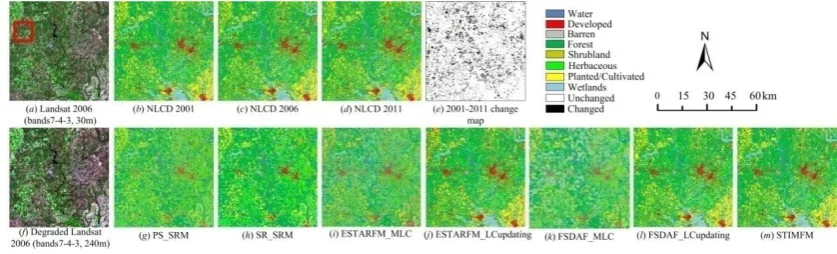
et al. 2009). The original sixteen classes were reclassified into eight classes (Fig. 3). 486
Subset land cover maps, each with a size of 2000 × 2000 pixels (centered at 34°4′00″N
487
and 79°27′00″W), were acquired from NLCD 2001, 2006, and 2011 [Fig. 3(b–d)].
488
25
[image:25.595.88.507.72.199.2]490
Fig. 3 Input and result maps for the entire study area in the Landsat–NLCD experiment. 491
492
A Landsat TM image (path 016, row 036) acquired on April 9, 2006 in the study 493
area was downloaded from the United States Geological Survey (USGS). This Landsat 494
image was re-projected to the Albers Equal Area projection, and six spectral bands at 495
the spatial resolution of 30 m (the 120 m thermal infrared band was excluded) were 496
used to extract the same 2000 × 2000 pixel area that was identified in the NLCD maps 497
[Fig. 3(a)]. The subset image was calibrated to surface reflectance (Gao et al. 2006;
498
Masek et al. 2006) and then spatially degraded to simulate a coarse spatial resolution 499
multi-spectral image using a scale factor s=8 [Fig. 3(f), 240 m] with a mean filter. The
500
NLCD 2006 [Fig. 3(c)] was used as the reference map used for accuracy assessment.
501
The pixels that changed land cover class from 2001 to 2011 accounted for 12.08% of 502
all fine spatial resolution pixels. 503
For analyses with the PS_SRM and SR_SRM, only the degraded multi-spectral 504
image [Fig. 3(f)] was needed as input. For the STIMFM, the required input included
505
the degraded multi-spectral image [Fig. 3(f)] and the NLCD 2001 and NLCD 2011 land
506
cover maps [Fig. 3(b), 3(d)]. For ESTARFM, pairs of fine and coarse spatial resolution
507
26
remotely sensed image were needed. To obtain the required data, a Landsat TM image 509
acquired on April 17, 2001 and a Landsat TM image acquired on April 7, 2011 were 510
also downloaded, re-projected, subsetted, and calibrated. The original 30 m spatial 511
resolution reflectance images with six spectral bands (the 120 m thermal infrared band 512
was excluded) were spatially degraded to simulate their corresponding coarse spatial 513
resolution multi-spectral images at scale factors s=8, respectively. Therefore, the input
514
to the ESTARFM_MLC and ESTARFM_LCupdating included fine and coarse spatial 515
resolution multi-spectral image pairs in 2001 and 2011 and the coarse spatial resolution 516
multi-spectral image for 2006. The input to FSDAF_MLC and FSDAF_LCupdating 517
included fine and coarse spatial resolution multi-spectral image pairs in 2001 and the 518
coarse spatial resolution multi-spectral image in 2006. In ESTARFM_LCupdating and 519
FSDAF_LCupdating, the NLCD 2001 fine-resolution land cover map was also used as 520
the base data. 521
522
3.1.2 Results 523
524
27
The land cover maps produced from the different methods are shown in Fig. 3 for 526
the entire area and in Fig. 4 for the zoomed area [320 × 320 pixel area in Fig. 3(a)]. In
527
the zoomed area, the PS_SRM map contained many speckle-like artifacts [Fig. 4(g)].
528
This situation arises because the spectral unmixing may determine a small fractional 529
cover of a class that is actually absent in a coarse-resolution pixel, and this fraction 530
must be maintained in the result. The SR_SRM map contained fewer speckle-like 531
artifacts than PS_SRM, because SR_SRM relaxed the constraint of land cover fraction 532
maintenance [Fig. 4(h)]. However, the maximal spatial dependence model used in
533
SR_SRM also led to rounded land cover patches. Compared with PS_SRM and 534
SR_SRM, more spatial detail of the land cover mosaic was retained in the ESTARFM, 535
FSDAF, and STIMFM maps. Many speckle-like artifacts in the ESTARFM_MLC [Fig. 536
4(i)] and FSDAF_MLC [Fig. 4(k)] maps existed because MLC is a per-based
537
classification method, and the spatial context information was not used. 538
ESTARFM_MLC and FSDAF_MLC incorrectly classified cases that have similar 539
reflectance values, such as “forest”, “herbaceous”, and “wetlands”, in the result maps 540
[Figs. 4(i), (k)]. 541
542
Fig. 5 Landsat, ESTARFM and FSDAF images in the zoomed area for the Landsat–NLCD experiment. 543
In contrast to ESTARFM_MLC and FSDAF_MLC, ESTARFM_LCupdating [Fig. 544
4(j)] and FSDAF_LCupdating [Fig. 4(l)] quantified the land cover changes between
545
[image:27.595.78.507.573.648.2]28
map [Fig. 4(c)]. The labels of pixels that were detected as unchanged by LCupdating
547
were preserved in the ESTARFM_LCupdating and FSDAF_LCupdating maps. The 548
labels of changed pixels were determined based on the Markov random field based 549
classifier, which considers the contextual information in classification. Thus, most 550
speckle-like artifacts were eliminated in ESTARFM_LCupdating and
551
FSDAF_LCupdating. However, many changed pixel labels were incorrectly predicted 552
by ESTARFM_LCupdating and FSDAF_LCupdating. “Herbaceous” was incorrectly 553
labeled as “developed” in the ESTARFM_LCupdating highlighted by the black circle 554
[Fig. 4(j)], and the linear-shaped “developed” in the FSDAF_LCupdating highlighted
555
by the black circle was disconnected [Fig. 4(l)]. The predicted reflectance for pixels of
556
changed land cover for “herbaceous” and “planted/cultivated” in ESTARFM [e.g., 557
those highlighted by the red circle in Fig. 5(f)] was dissimilar to that in the Landsat
558
2006 reference image [Fig. 5(b)] because ESTARFM cannot capture abrupt land cover
559
changes (Zhu et al. 2010), and the predicted reflectance of linear-shaped “developed” 560
land cover was similar to that of “planted/cultivated” in the FSDAF image highlighted 561
by the red circle in Fig. 5(g), because FSDAF cannot capture tiny land cover changes
562
(Zhu et al. 2016). By contrast, the STIMFM land cover map as shown in Fig. 4(m) was
563
quite similar to the reference map, and the detailed land cover patterns were well 564
represented. STIMFM correctly predicted the class labels not only for almost all pixels 565
of unchanged land cover but also for most of those pixels for which land cover class 566
had changed, such as those highlighted in the red circle in Fig. 5(d).
567
29 Table 1
569
Overall accuracies (OAs) and accuracies of different methods in predicting PULC and PCLC in the 570
Landsat–NLCD experiment. 571
OA PULC PCLC
PS_SRM 41.61 41.54 42.13
SR_SRM 49.10 49.01 49.77
ESTARFM_MLC 33.57 35.10 22.44
ESTARFM_LCupdating 88.28 94.89 40.18
FSDAF_MLC 33.60 34.29 28.60
FSDAF_LCupdating 89.50 96.15 41.08
STIMFM 94.89 99.24 63.27
572
The overall accuracies of different methods are shown in Table 1. The result maps 573
were compared with the NLCD 2006. The overall accuracy of STIMFM is higher than 574
those obtained from the other methods. Table 1 also shows the accuracies of pixels of 575
changed and unchanged land cover (PULC means the percentage of correctly labeled 576
pixels of unchanged land cover among all pixels of unchanged land cover, and PCLC 577
means the percentage of correctly labeled pixels of changed land cover among all pixels 578
of changed land cover) obtained from the different methods. For PS_SRM and 579
SR_SRM, which applied a mono-temporal remotely sensed image, no obvious 580
difference was found between PULC and PCLC values. For ESTARFM, FSDAF, and 581
STIMFM applied to multi-temporal data, the PULC values were higher than the PCLC 582
values. These results indicate that extracting changed land cover information is more 583
difficult than extracting unchanged land cover information from ESTARFM, FSDAF, 584
and STIMFM. STIMFM integrates the temporal dependence model in its objective 585
30
those in the pre- and post-dated fine-resolution land cover maps. If the fine-resolution 587
pixel class labels are unchanged during the observation period, then STIMFM could 588
make the best use of pixel class labels in the fine-resolution maps that pre- and post-589
date the coarse-resolution image. Thus, the accuracies for classes with unchanged class 590
labels are high. By contrast, if the fine-resolution pixel class labels have changed during 591
the observation period, then STIMFM could not make the best use of pixel class labels 592
in the fine-resolution maps that pre- and post-date the coarse-resolution image, and the 593
accuracies for classes with changed class labels are relatively low. The PULC was 594
higher than 99%, and the PCLC was higher than 63% for STIMFM; these values are 595
higher than those obtained from the other methods. 596
597
3.2 MODIS–Landsat experiment 598
3.2.1 Data preparation 599
The study area was located near Sorriso (12°33′00″S and 55°42′00″W) in Mato 600
Grosso State, Brazil. This area was mainly covered by tropical forests but has suffered 601
from deforestation in recent years (Hansen et al. 2008). This experiment used eleven 602
coarse spatial resolution MODIS images and two fine spatial resolution land cover 603
maps that pre- and post-date the coarse spatial resolution image series as input and 604
outputs eleven fine-resolution land cover maps with MODIS repetition rates to show 605
the fine spatial and temporal deforestation process in the study area. Landsat Enhanced 606
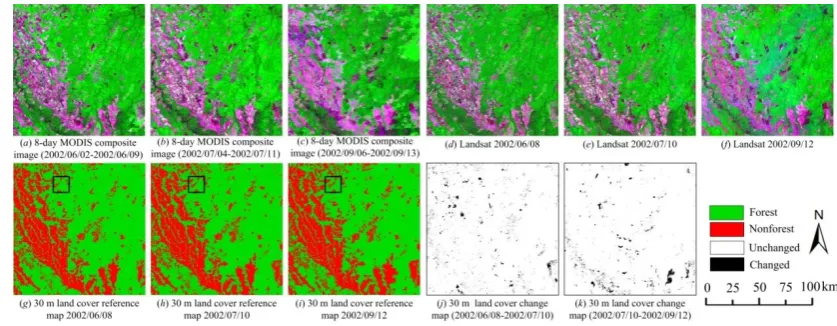
Thematic Mapper Plus (ETM+) images (path 226, row 069) acquired on 2002/06/08 607
and 2002/09/12 were downloaded from USGS [Fig. 6(d) and (f)]. Data in six bands (the
31
120 m thermal infrared band was excluded) at the 30 m spatial resolution with the 609
Universal Transverse Mercator projection were used and calibrated to surface 610
reflectance values (Gao et al. 2006; Masek et al. 2006). One cloud-free Landsat ETM+ 611
image acquired on 2002/07/10 was used for accuracy assessment [Fig. 6(e)]. A total of
612
thirteen eight-day surface reflectance MODIS product (MOD09A1) datasets that 613
comprise seven spectral bands (620 nm–2055 nm) with a spatial resolution of 463 m 614
acquired from 2002/06/02 to 2002/09/13 were downloaded from USGS (Walker et al. 615
2012). The MODIS images were re-projected into the UTM coordinate system and 616
resampled to a spatial resolution of 450 m using the nearest neighbor interpolation, and 617
were adopted as the coarse spatial resolution multi-spectral images required for the 618
analyses. The study area covers 300 × 300 MODIS pixels, which correspond to 4500 × 619
4500 Landsat pixels, with a scale factor s=15.
620
621
[image:31.595.85.504.482.645.2]622
Fig. 6 MODIS, Landsat images, and reference maps in the MODIS–Landsat experiment from 623
2002/06/08 to 2002/09/12. 624
625
32
spatial resolution [Fig. 6(g)–(i)]. Two land cover classes, forest and nonforest, were 627
considered in this experiment. The endmembers of each class were manually selected 628
from each Landsat image, and MLC was applied to generate the fine spatial resolution 629
forest/nonforest reference maps. The fine-resolution change maps that produced by a 630
per-pixel comparison of maps in Fig. 6(g)–(i) are shown in Fig. 6(j)–(k). The pixels that
631
changed land cover class from 2002/06/08 to 2002/09/12 accounted for 4.30% of all 632
fine spatial resolution pixels. 633
STIMFM used the MODIS multi-spectral image series from 2002/06/10 to 634
2002/09/05 and the 2002/06/08 and 2002/09/12 fine spatial resolution land cover maps 635
in Fig. 6 (g) and (i) as input and predicted a series of land cover maps at 30 m spatial
636
resolution with MODIS repetition rates during this period. The accuracy was assessed 637
using the 2002/07/10 land cover map [Fig. 6(h)]. The STIMFM was compared with
638
PS_SRM, SR_SRM, ESTARFM_MLC, ESTARFM_LCupdating, FSDAF_MLC, and 639
FSDAF_LCupdating using the 2002/07/10 land cover map in Fig. 6(h) for assessment.
640
In these methods, the eight-day composite MODIS image [2002/07/04–2002/07/11 in 641
Fig. 6(b)] was used as the coarse-resolution image. Aside from this data, ESTARFM
642
used the eight-day composite MODIS images [2002/06/02–2002/06/09 in Fig. 6(a) and
643
2002/09/06–2002/09/13 in Fig. 6(c)] and Landsat multi-spectral images [2002/06/08 in
644
Fig. 6(d) and 2002/09/12 in Fig. 6(f)] as input, and FSDAF used the eight-day
645
composite MODIS image [2002/06/02–2002/06/09 in Fig. 6(a)] and Landsat
multi-646
spectral image [2002/06/08 in Fig. 6(d)] as input. In ESTARFM and FSDAF, the
647
33
spectral band of Landsat image was observed from MODIS band 5. The 2002/06/08 649
fine spatial resolution land cover map in Fig. 6(g) was also inputted in the
650
ESTARFM_LCupdating and FSDAF_LCupdating. 651
3.2.2 Results 652
653
34 Table 2
655
Overall accuracies (OAs) and accuracies of different methods in predicting PULC and PCLC in the 656
MODIS–Landsat experiment. The MODIS image used in different methods was the eight-day composite 657
data from 2002/07/04 to 2002/07/11. 658
OA PULC PCLC
PS_SRM 88.14 89.29 62.52
SR_SRM 89.28 90.42 63.73
ESTARFM_MLC 95.17 96.90 56.71
ESTARFM_LCupdating 96.32 98.07 57.42
FSDAF_MLC 95.07 96.72 58.23
FSDAF_LCupdating 96.61 98.37 57.38
STIMFM 98.27 99.69 66.67
659
The OA, PULC, and PCLC values obtained from the application of the different 660
methods are shown in Table 2. The overall accuracies obtained from the PS_SRM and 661
SR_SRM were lower than 90%, whereas the overall accuracies of ESTARFM_MLC, 662
ESTARFM_LCupdating, FSDAF_MLC, and FSDAF_LCupdating were higher than 663
95%. These findings indicate that the classification from fine-resolution image 664
extracted by spatial–temporal fusing of coarse and fine-resolution images can better 665
improve the accuracy compared with SRM applied to a mono-temporal coarse-666
resolution image. The OA value for STIMFM was 98.27%, which is higher than all the 667
other methods. The PCLC values were lower than the PULC values for ESTARFM, 668
FSDAF, and STIMFM methods, which is similar to those in the Landsat–NLCD 669
experiment. The STIMFM has the highest PULC value, which was 99.69%, and the 670
35
672
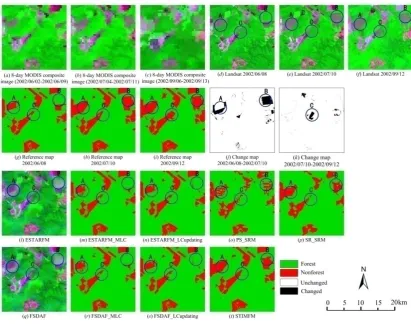
Fig. 7 Input, reference, and result images and maps for the zoomed area at different years for the MODIS– 673
Landsat experiment. The MODIS image used in different methods was the eight-day composite data 674
from 2002/07/04 to 2002/07/11. 675
676
The reference, input, and result images and maps in the zoomed area are shown in 677
Fig. 7. A part of the forest patch (highlighted by a blue circle in regions A and B in Fig. 678
7) changed to nonforest from 2002/06/08 to 2012/07/10 [Fig. 7(j)], and a part of the
679
forest patch (highlighted by a blue circle in region C in Fig. 7) changed to nonforest 680
from 2002/07/10 to 2012/09/12 [Fig. 7(k)]. The PS_SRM map contained many
speckle-681
like artifacts [Fig. 7(o)], and SR_SRM contained land cover patches with oversmoothed
682
rounded boundaries [Fig. 7(p)]. In the ESTARFM and FSDAF fused images [Fig. 7(l),
683
(q)], the pixels of unchanged land cover considerably resemble those in the reference
[image:35.595.91.503.75.399.2]36
Landsat image, whereas the pixels of changed land cover (highlighted by blue circles 685
in Fig. 7) were noticeably different from those in the reference Landsat image [Fig. 686
7(e)]. As a result, these pixels of changed land cover were erroneously classified in the
687
ESTARFM_MLC, ESTARFM_LCupdating, FSDAF_MLC, and FSDAF_LCupdating 688
results [Figs. 7(m), (n), (r), and (s)]. By contrast, most of the changed and unchanged
689
pixels are correctly allocated by STIMFM [Fig. 7(t)], thereby showing the ability of the
690
proposed STIMFM model in the reconstruction of land cover trajectories for pixels of 691
both changed and unchanged land cover. The land cover changes in Fig. 8 were 692
extracted by comparing the STIMFM predicted maps and input fine-resolution land 693
cover map that pre-dates the coarse images [Fig. 6(g)]. The colors in Fig. 8 indicate the
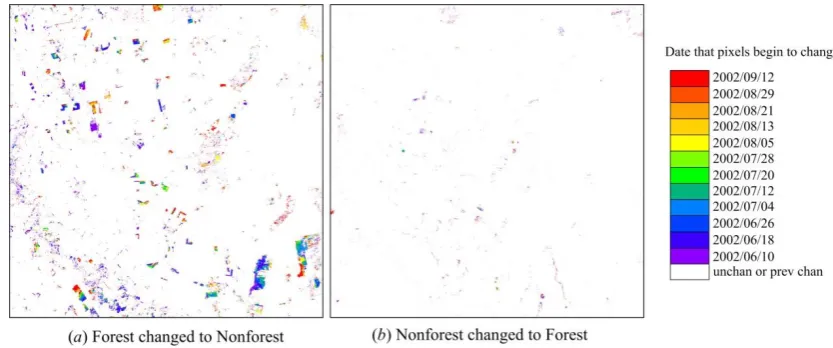
694
date when the pixels begin to change. The forest area decreased gradually, whereas the 695
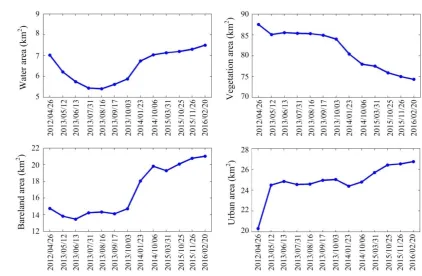
nonforest area increased in Fig. 9. With STIMFM, the detailed spatial extent 696
information and the change of areas for different classes can be extracted, thereby 697
showing the effectiveness of the proposed method. 698
37
700
Fig. 8 30 m spatial extent of land cover change with MODIS repetition rates derived from STIMFM. The 701
colors represent the date when pixels begin to change. “unchan or prev chan” marked as white color 702
means unchanged or previously changed before 2002/06/08. 703
704
[image:37.595.87.504.78.252.2]705
Fig. 9 Forest and nonforest areas extracted using STIMFM in the MODIS–Landsat experiment. 706
707
708
3.3 Landsat–GEI experiment 709
The study area was located in Wuhan (30°27′30″N and 114°32′30″E), Hubei
710
province, China. This area underwent rapid urbanization in 2010–2016. This 711
experiment used eleven cloud-free 30 m spatial resolution Landsat-8 Operational Land 712
[image:37.595.58.506.92.517.2]38
5 m spatial resolution land cover maps acquired in 2012 and 2016 as input. Eleven 5 m 714
resolution land cover maps during 2013–2015 were predicted to show the fine spatial 715
and temporal urbanization process in the study area. The acquired eleven Landsat OLI 716
images were downloaded from USGS. The first seven bands of OLI image with a spatial 717
resolution of 30 m were selected. Two GEIs acquired on 2012/04/26 and on 2016/02/20 718
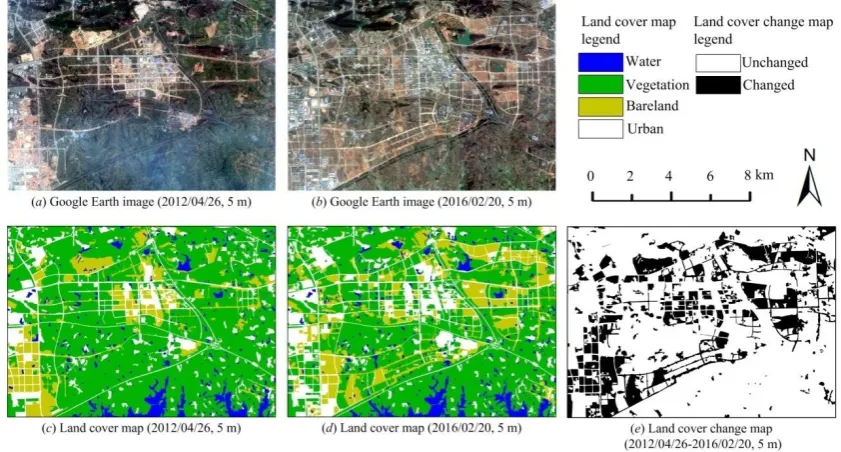
[Figs. 10(a), (b)] with a spatial resolution of 5 m were re-projected into the UTM 719
coordinate system and digitized into the 5 m land cover maps [Figs. 10(c), (d)]. Four
720
land cover classes, namely, water, vegetation, bareland, and urban, were found in the 721
fine-resolution maps. The study area covers 320 × 450 Landsat pixels, which 722
correspond to 1920 × 2700 fine-resolution pixels in Figs. 10(c) and (d), with a scale
723
factor s = 6. The land cover change map from 2012/04/26 to 2016/02/20 is shown in
724
Fig. 10(e). The pixels that changed land cover class accounted for 23.49% of all fine
725
spatial resolution pixels from 2012/04/26 to 2016/02/20. 726
39
[image:39.595.88.509.76.302.2]728
Fig. 10 Google Earth images, land cover maps and change maps in the Landsat–GEI experiment. 729
730
STIMFM was used to produce the eleven 5 m resolution land cover maps with 731
Landsat repetition rates during 2013–2015 using the eleven cloud-free Landsat images 732
and two 5 m land cover maps on 2012/04/26 and 2016/02/20 as input. The STIMFM 733
accuracy was assessed using a 5 m fine-resolution land cover map, which was produced 734
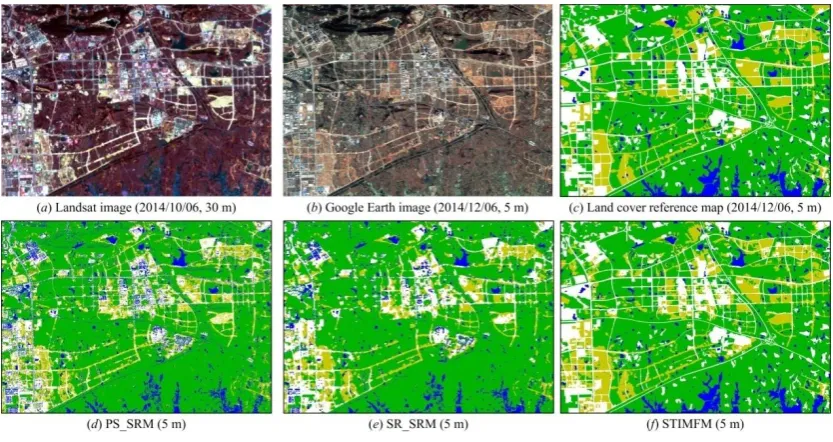
according to a GEI at the spatial resolution of 5 m acquired on 2014/12/06 [Fig. 11(b)].
735
This GEI is the only fine-resolution one available in the study area during 2012–2016 736
and was re-projected into the UTM coordinate system and digitized to the reference 737
land cover map [Fig. 11(c)]. STIMFM was compared with PS_SRM and SR_SRM,
738
which were applied to a single-date Landsat OLI image acquired on 2014/10/06 [Fig. 739
11(a)]; this image is temporally closest to the GEI in 2014 [Fig. 11(b)]. ESTARFM and
740
FSDAF were not used for comparison because they require the coarse- and fine-741
resolution images to have comparable and correlated reflectance bands, whereas 742
40
into reflectance images, which are correlated to the Landsat images. 744
745
Table 3
746
Overall accuracies (OAs) and accuracies of different methods in predicting PULC and PCLC in the 747
Landsat–GEI experiment. The Landsat image used for assessment in the different methods was acquired 748
on 2014/10/06. 749
OA PULC PCLC
PS_SRM 72.71 76.22 61.13
SR_SRM 73.73 77.29 61.99
STIMFM 94.31 99.61 76.81
750
The OA accuracies were lower than 74% for PS_SRM and SR_SRM and increased 751
to 94.31% for STIMFM (Table 3). The PULC value was higher than 99%, and the 752
PCLC value was higher than 76% for STIMFM; these values were obviously higher 753
than those for PS_SRM and SR_SRM. The PULC values were higher than the PCLC 754
values for STIMFM because STIMFM could make the best use of unchanged pixel 755
labels in the fine-resolution maps that pre- and post-date the Landsat images in land 756
cover mapping. 757