Automorphism groups of countable algebraically closed graphs
and endomorphisms of the random graph
Igor Dolinka∗, Robert D. Gray†, Jillian D. McPhee‡, James D. Mitchell‡ & Martyn Quick‡
November 9, 2015
Abstract
We establish links between countable algebraically closed graphs and the endomorphisms of the countable universal graph R. As a consequence we show that, for any countable graph Γ, there are uncountably many maximal subgroups of the endomorphism monoid ofR
isomorphic to the automorphism group of Γ. Further structural information about EndRis established including that Aut Γ arises in uncountably many ways as a Sch¨utzenberger group. Similar results are proved for the countable universal directed graph and the countable universal bipartite graph.
1
Introduction
Existentially closed relational structures have been widely considered with the example of the
countable universal homogeneous graph (also known as the random graph or the Rado graph) probably the most studied (see, for one example of a survey, [2]). It was established by Truss [20] that the automorphism group of the countable universal homogeneous graph is simple and this was placed in a general setting by Macpherson and Tent [15]. The work in the present paper arose when attempting to establish what can be said about other naturally arising groups acting (in some sense) upon the countable universal graph R. To be more precise, we present information about the maximal subgroups of the endomorphism monoid of R. We note that this is not the first work to focus on endomorphisms in the context of homogeneous structures. For example, Cameron and Neˇsetˇril [3] consider homomorphism-homogeneous structures and there are various links between their results and our work, particularly [3, Section 2]. More recently, Lockett and Truss [14] examine generic endomorphisms of homogeneous structures and in their concluding remarks propose that there should be a counterpart to the literature on automorphism groups of such structures applying to the monoids of endomorphisms. This paper may be thought of as part of the study suggested by Lockett and Truss.
∗Department of Mathematics and Informatics, University of Novi Sad, Trg Dositeja Obradovi´ca 4, 21101 Novi
Sad, Serbia
†
School of Mathematics, University of East Anglia, Norwich NR4 7TJ, United Kingdom
‡
School of Mathematics & Statistics, University of St Andrews, St Andrews, Fife KY16 9SS, United Kingdom Keywords: existentially closed graphs, algebraically closed graphs, random graph, endomorphism monoid, countable universal graph, countable universal bipartite graph
A maximal subgroup of the endomorphism monoid of R is determined by the idempotent endomorphism that plays the role of its identity element. Indeed, it is theH-class of that endo-morphism, as we summarise in Section2below. Bonato and Deli´c [1, Proposition 4.2] show that the images of idempotent endomorphisms of the countable universal graph are characterised as beingalgebraically closed (a property weaker than existentially closed) and this is discussed in detail by Dolinka [5, especially Theorem 3.2]. We make the same observation and also the cor-responding result for images of idempotent endomorphisms of the countable universal directed graph and countable universal bipartite graph in the course of our work. Indeed, we observe that there are, except for one case, 2ℵ0 idempotent endomorphisms with image isomorphic to a
given algebraically closed graph, directed graph, or bipartite graph (Theorems3.6,4.4and5.6, respectively). These observations are, however, merely the first steps in establishing the results herein.
We shall establish the same types of theorem for the classes of graphs (that is, undirected graphs), directed graphs, and bipartite graphs. These classes of relational structure are treated in turn in separate sections below. The proofs for (undirected) graphs are the archetypes and so the sections relating to directed graphs and bipartite graphs are concerned mostly with explain-ing what modifications are required to establish the analogous results. One needs particular care with bipartite graphs, in the first instance to ensure that the correct definition is chosen so that the class of bipartite graphs does indeed have a Fra¨ıss´e limit, as noted in [8]. However, a second wrinkle occurs since there are examples of algebraically closed bipartite graphs that are finite (for example, the complete bipartite graph Km,n on two parts of cardinalitymand n respectively), unlike the situation for graphs and directed graphs where algebraically closed structures are necessarily infinite, and this has some surprising consequences for our results (compare Theorems 5.6 and 5.9 with their graph analogues). We therefore need to introduce a stronger condition, that we term strongly algebraically closed, in order to establish some of the analogues for the countable universal bipartite graph. These issues are discussed in detail in Section 5. Homogeneous bipartite graphs were, for example, also considered by Goldstern, Grossberg and Kojman [11], but they only permit what we term part-fixing automorphisms whereas our automorphisms will be allowed to interchange the parts.
In the summary of our results that follows, we use the term “any group” to mean a group isomorphic to the automorphism group of a countable graph. The extension of Frucht’s Theo-rem [10] to infinite groups established by de Groot [7] and by Sabidussi [19] tells us this includes every countable group. We note in the course of our work that this class of groups is the same as those arising as the automorphism group of countable directed graphs (Proposition4.2) and of countable bipartite graphs (Theorem5.3).
Let C denote either the class of countable graphs, countable directed graphs, or countable bipartite graphs and let Ω denote the universal homogeneous structure inC. Then
• any group arises in 2ℵ0 ways as the automorphism group of an algebraically closed
struc-ture in C (Theorems 3.4,4.3 and 5.4);
• any group arises in 2ℵ0 ways as a maximal subgroup of the endomorphism monoid of Ω
(Theorems 3.7,4.5and 5.7);
• any group arises in 2ℵ0 ways as the Sch¨utzenberger group of a non-regularH-class in the
endomorphism monoid of Ω (Theorems3.14,4.10 and 5.11).
generalH-classes (including all those inD-classes that are not regular), there is an alternative group that one can use instead. This is the Sch¨utzenberger group referred to above (and which we expand upon in Section2) and generalises the concept of a groupH-class (not least because the Sch¨utzenberger group is isomorphic to theH-class when the latter happens to be a group). Theorems 3.7,4.5 and5.7say more about the structure of the endomorphism monoid of Ω, namely every group arises as a group H-class in 2ℵ0 manyD-classes and, except for one case
for the countable universal bipartite graph, every regularD-class contains 2ℵ0 groupH-classes.
From the first of these facts, it follows there are 2ℵ0 regularD-classes in End Ω. We also describe
how many L- and R-classes there are (usually 2ℵ0) in each of these regular D-classes (see
Theorems 3.9, 4.6 and 5.9, the latter containing the exceptions and illustrating the surprising behaviour of the countable universal bipartite graph). For non-regularD-classes, we observe in Theorems3.11,4.7and5.8that there exist non-regular injective endomorphisms with specified image and whoseD-class contains both 2ℵ0 manyL- andR-classes. By varying the image, we
shall deduce there are 2ℵ0 non-regular D-classes in the endomorphism monoid of Ω.
A number of questions remain about the endomorphism monoid of each of our universal structures. For example, is it true that every D-class of the endomorphism monoid of the countable universal graph contains 2ℵ0 many L- and R-classes? This question has a positive
answer for regular D-classes (Theorem 3.9) and some of the non-regular D-classes (by Theo-rem 3.11). It is unclear whether the latter can be extended to all non-regular D-classes. One reason for the difficulty in making further progress is that we have a necessary condition for en-domorphisms to beD-related in terms of the isomorphism class of the images (in Lemma2.3(iii) below) but only for regular endomorphisms can we reverse the condition to be also sufficient.
One could also consider endomorphisms of the countable universal linearly ordered set (that is, the rationals Q under 6) or the countable universal partially ordered set. Indeed, the third author’s PhD thesis [17] contains information, including an analogue of Theorem 3.7, about End(Q,6). The methods are inevitably a little different and this will appear in a subse-quent publication.
2
Preliminaries
In this section, we establish the terminology used throughout the paper. We summarise the basic facts about relational structures, including what it means for them to be algebraically closed, and the semigroup theory needed when discussing their endomorphism monoids.
A relational structure is a pair Γ = (V,E) consisting of a non-empty set V and a sequence
E = (Ei)i∈I of relations onV. In general, one permits theEi to have arbitrary arity, but as we are principally concerned with (various types of) graphs it will be sufficient to deal only with binary relations. For convenience then we shall make this assumption throughout. When Γ is a graph, we shall then also callV the set ofvertices of Γ. The definitions of graph, directed graph and bipartite graph with this viewpoint are given at the beginning of Sections3–5, respectively. A relational substructure of Γ is a relational structure ∆ = (U,D), where U is a non-empty subset of V and where D= (Di)i∈I satisfies Di ⊆Ei for all i. If U is a subset of V, we write
hUi for the substructure (U,D) where D= (Di)i∈I is defined byDi =Ei∩(U×U) for each i. We shall callhUi therelational substructure induced by U.
whenever (u, v) ∈ Ei. The map f:V → W then induces f:Ei → Fi, for each i∈ I, and we call the substructure imf = (V f,Ef), where Ef = (Eif)i∈I, of ∆ the image of f. We define thekernel off to be the relation {(u, v) |uf =vf} on the vertex setV. Anembedding is an injective homomorphismf: Γ→∆ such that, for eachi, (u, v)∈Ei if and only if (uf, vf)∈Fi.
In order to describe what it means for a relational structure to be algebraically closed we shall need a little model theory. We refer to Hodges [12] for the basic terminology.
Let L be a signature and K be a class of L-structures. A structure A in K is called
algebraically closed (inK) if given a formula Φ(x) of the form
(∃y) k
^
i=1
Ψi(x,y), (1)
where k ∈ N and each Ψi is an atomic formula, and a finite sequence a of elements of A such that there exists an extension A′ of A with A′ |= Φ(a), then already A |= Φ(a). (As an aside, we mention that the formula Φ(x) given in (1) is called apositive primitive formula, see, for example, [12, page 50].) In certain cases, this definition of algebraic closure can often be simplified. For example, it is easy to see that a graph Γ is algebraically closed if and only if, given any finite set A of vertices in Γ, there exists some vertex w that is adjacent to every one of the vertices in A. We shall similarly interpret below what algebraically closed means for directed and bipartite graphs in Sections 4 and 5. The concept of an existentially closed
relational structure is defined similarly but for this we permit each Ψi to be an atomic formula or its negation.
Algebraically closed structures for our classes of relational structures can be characterised as follows. Part (i) of this result is [3, Proposition 2.1(a)], which is established by a back-and-forth argument. The proof is easily adjusted to cover directed graphs and bipartite graphs, though one necessarily needs to use the strongly algebraically closed condition for the latter. This condition is defined in Section 5 just before Theorem5.4 where it is first used.
Proposition 2.1 (i) Let Γ = (V, E) be a countable graph or directed graph. Then Γ is algebraically closed (in the class of graphs or directed graphs, respectively) if and only if there existsF ⊆E such that(V, F) is existentially closed.
(ii) LetΓ = (V, E, P) be a countable bipartite graph. Then Γis strongly algebraically closed if and only if there exists F ⊆E such that(V, F, P) is existentially closed.
The classes of finite graphs, of finite directed graphs and of finite bipartite graphs each possess what is known as the hereditary property, the joint embedding property and the amal-gamation property. (Indeed, the reason for our particular way of defining the term bipartite graph below is to ensure that the class of such graphs has these properties.) Consequently, each class has a unique Fra¨ıss´e limit [9], referred to as thecountable universal homogeneous structure
Corollary 2.2 LetΓbe countable and either an algebraically closed graph, algebraically closed directed graph, or strongly algebraically closed bipartite graph. LetΩbe, correspondingly, the countable universal graph, countable universal directed graph, or countable universal bipartite graph. Then there is a homomorphism fromΩintoΓgiven by a bijection between the vertices.
Since we shall be concerned with maximal subgroups (that is, the group H-classes) of endomorphism monoids, we need to recall Green’s relations and their properties. We refer to Howie’s monograph [13] for a general background on semigroups.
Let M = End Γ be the endomorphism monoid of a relational structure Γ = (V,E). Two elementsf andgofM areL-related iff andggenerate the same left ideal (that is,M f =M g), while they are R-related if f M = gM. Green’s H-relation is the intersection of the binary relations L and R, while the D-relation is their composite L ◦R (which can be shown also to be an equivalence relation). Finally, but less central to our work, f and g are J-related if M f M = M gM. We shall use the notation fLg to denote that f and g are L-related and similarly for the other relations. If f ∈ M, we write Hf for the H-class of f. If e is an idempotent inM (that is,e2 =e), theH-classHeis a subgroup ofM [13, Corollary 2.2.6] and the maximal subgroups of our monoidM are precisely theH-classes of idempotents ofM.
The L-, R- and D-classes in the full transformation monoid TV, of all maps V → V, are fully described in terms of the images and kernels of the maps involved (see [13, Exercise 2.6.16]). We may view the endomorphism monoid M of Γ = (V,E) as a submonoid ofTV and if f and g are, for example, L-related in End Γ, they are certainly L-related in TV. Consequently, parts (i) and (ii) of the following lemma follow immediately.
Lemma 2.3 Letf and g be endomorphisms of the relational structure Γ = (V,E).
(i) Iff andg areL-related, then V f =V g.
(ii) Iff andg areR-related, then kerf = kerg.
(iii) Iff andg areD-related, then the induced substructureshV fi and hV gi are isomorphic.
Proof: (iii) Write E = (Ei)i∈I. By assumption, there exists h ∈ End Γ such that fRh and hLg. By (i), it followsV h=V g. AsfRh, there exist endomorphismssandtof Γ withh=f s and f =ht. As f =f stand h=hts, the mapsinduces a bijection from V f to V h. Moreover, as s and t are endomorphisms, s induces, for each i∈ I, a bijection from Ei∩(V f ×V f) to Ei∩(V h×V h) with inverset. Hencesinduces an isomorphism fromhV fito hV hi=hV gi.
An elementf ofM is calledregular if there existsg∈M such thatf gf =f. An idempotent endomorphism e is regular sincee3 =e and if f is regular, then every element in the D-class of f is also regular [13, Proposition 2.3.1]. We refer to suchD-classes asregular D-classes. We are particularly concerned with idempotent endomorphisms and their H- and D-classes and so the observation in Lemma2.5 below that the implications in Lemma2.3 reverse for regular elements is useful.
If f is any endomorphism of Γ = (V,E), where E = (Ei)i∈I, then immediately Eif ⊆
Proposition 2.4 Letf be a regular endomorphism of the relational structureΓ = (V,E). Then the imageimf = (V f,Ef)and the induced substructue hV fi of Γare equal.
Lemma 2.5 Let f and g be regular elements in the endomorphism monoid of the relational structureΓ = (V,E). Then
(i) f and g areL-related if and only if V f =V g;
(ii) f and g areR-related if and only if kerf = kerg;
(iii) f and g areD-related if and only if the images of f and g are isomorphic.
Proof: It suffices to establish the “if” versions of each part. For (i) and (ii) this follows immediately since, for example, if V f = V g, then f and g are L-related in TV (by [13, Exercise 2.6.16]) and hence areL-related in End Γ (see [18, Proposition A.1.16]).
(iii) A more general version of this result is Theorem 2.6 in [16], but what we require can be completed easily. Ifα is an isomorphism from imf to img, then f α is an endomorphism of Γ with image img. Asgis regular, there is an idempotent endomorphismethat isL-related tog, by [13, Proposition 2.3.2]. By (i), V e =V g and therefore img = ime, using Proposition 2.4. Hence the restriction e|img is the identity. Then eα−1 is an endomorphism of Γ such that f α·eα−1=f αα−1 =f and we conclude thatfRf α. It follows, by [13, Proposition 2.3.1], that f α is also a regular element and so fαLg by (i). Hence fDg, as required.
One might ask what happens in the case that theH-classH=Hf, of some endomorphismf inM = End Γ, is not a group. In such a case, one can associate toH theSch¨utzenberger group, which we shall denote SH. This consists of the permutations of the H-class H induced by certain elements of M. Specifically, we define TH = {t ∈ M | Ht ⊆ H} and SH = {γt | t ∈ TH}, where the map γt: H → H is given by h 7→ ht. It is known (see, for example, [4, Theorem 2.22]) that SH is a group and if H is itself a group (for example, when f is an idempotent) then SH ∼= H. Moreover, two H-classes in the same D-class have isomorphic Sch¨utzenberger groups (see [4, Theorem 2.25]), which is why we produce distinct D-classes in Theorems 3.14,4.10and 5.11. Amongst other things, we shall observe that in our context this group can be expressed as a subgroup of the automorphism group of the image off.
Proposition 2.6 Let f be an endomorphism of the relational structure Γ = (V,E) and H be theH-class off inEnd Γ. Then
(i) if t ∈ TH, the restriction of t to the set V f induces an automorphism of both hV fi and imf;
(ii) the mapping φ: γt 7→ t|V f (for t ∈ TH) defines an injective homomorphism from the Sch¨utzenberger groupSH intoAuthV fi ∩Aut(imf);
(iii) if f is an idempotent endomorphism, then H∼= Aut(imf) (as groups);
Part (iii) of this lemma can also be shown directly without reference to the Sch¨utzenberger group; see [17, Theorem 2.7]. When Γ is one of the existentially closed structures that we are interested in and f arises in a specific way, we shall extend part (iv) to show that f g is actuallyH-related tof and hence that the image ofφin part (ii) is AuthV fi ∩Aut(imf) (see Propositions 3.13,4.9and 5.10below).
Proof: (i) If t ∈ TH, then f t is H-related to f and so V f t = V f and kerf t = kerf, by Lemma 2.3. It follows that t induces a bijection on the set V f and hence an endomorphism of the substructure hV fi. Also there exists some endomorphism s such that f ts = f. Hence if (uf t, vf t) ∈Ei for some relationEi ∈ E, then so is (uf, vf) = (uf ts, vf ts) and we conclude thatt induces an automorphism of hV fi.
Now f t is, in particular, L-related to f and so there exist endomorphisms g and h of Γ such that f t = gf and hf t = f. Let (v1, v2) ∈ Eif for some Ei ∈ E, so vj = ujf for some
points uj ∈ V, for j = 1, 2, with (u1, u2) ∈ Ei. Then vjt = ujf t = ujgf and we conclude
(v1t, v2t) is the image of (u1, u2) under the endomorphism gf and so (v1t, v2t) ∈ Eif. Thus
tinduces an endomorphism of imf. In addition, the endomorphismsin the previous paragraph is the inverse of ton the setV f and, sincef s=hf ts=hf, we similarly conclude sinduces an endomorphism of imf. Hencetinduces an automorphism of the image.
(ii) Note that ifγs=γtfor somes, t∈TH, then in particularf s=f tand so the restrictions ofsandttoV f coincide. Conversely, if these restrictions coincide thenf s=f tand we conclude thaths=ht for all h that are L-related tof. Henceγs=γt. Therefore, using (i), we observe thatφ is a injective map and it is straightforward to see that it is also a homomorphism.
(iii) Sincef is an idempotent endomorphism,hV fi= imf, by Proposition2.4. Then, given an automorphism g of imf, note that f g is H-related to f, because (f g)(f g−1) = f since f acts as the identity on its image. We then see that γf gφhas the same effect on points inV f asg does. Hence φ:S →Aut(imf) is surjective, as required to establish the isomorphism.
(iv) If gis an automorphism of imf, defineh: V →V by settingvhto be the unique point satisfying vhf =vf g. Sincef is injective and g is a bijection on the setV f, we conclude that h is a permutation of V. As both g and g−1 are automorphisms of imf, we deduce thath is
an automorphism of Γ. Then, from f =h−1f g, we conclude that f gand f are L-related.
3
Graphs
In this paper, a graph will have its usual definition; that is, a relational structure Γ = (V, E) where V is the set of vertices and E is an irreflexive symmetric binary relation on V. Thus the term graph refers to an undirected graph without loops or multiple edges. If (u, v) is an edge in E, we then say that the vertices u and v are adjacent in Γ. Recall that a graph Γ is
algebraically closed if for every finite subset A of its vertices, there exists some vertex v such thatv is adjacent to every member ofA.
In order to establish our results, we introduce a number of constructions. If Γ = (V, E) is any graph, we define the complement of Γ to be the graph Γ† with vertex set V and edge set (V ×V)\(E∪ {(v, v) |v∈V }). Thus Γ† is the graph containing precisely all the edges that are not present in Γ. We observe immediately:
Lemma 3.1 Let Γ and ∆ be any graphs. Then (i) Aut Γ† = Aut Γ;(ii) Γ ∼= ∆ if and only if
. . .
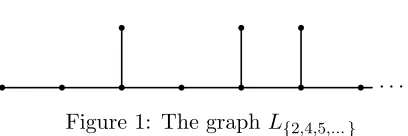
Figure 1: The graph L{2,4,5,...}
Recall that a graph islocally finite if every vertex is adjacent to a finite number of vertices. If Γ = (V, E) and ∆ = (W, F) are two graphs (where the vertex sets V and W are assumed disjoint), then thedisjoint union Γ ˙∪∆ is the graph with vertex set V ∪W and edge setE∪F. These two concepts may be used to construct an algebraically closed graph as follows:
Lemma 3.2 Let Γ be any graph and Λ be an infinite locally finite graph. Then (Γ ˙∪Λ)† is algebraically closed.
Proof: LetV and W denote the vertex sets of Γ and Λ respectively and let ∆ = (Γ ˙∪Λ)†. If Ais a finite subset ofV ∪W then, since Λ is locally finite, there exists some vertex v∈W that is not adjacent in Λ to any vertex in A∩W. Consequently, v is not adjacent in Γ ˙∪Λ to any vertex in Aand so by construction v is adjacent in ∆ to every vertex inA.
We shall use here, and also in later sections, the locally finite graphs LS defined as follows. LetS be any subset ofN\ {0,1}. The set of vertices of LS is{ℓn|n∈N} ∪ {vn|n∈S}. For everyn∈N, vertexℓnis adjacent toℓn+1, while for everyn∈S, vertexℓnis also adjacent tovn.
See Figure 1 for a diagram of an example of LS. The following presents the basic information we need about the graphsLS. IfS⊆N\ {0,1}, then we writeS+kfor the set{n+k|n∈S}.
Lemma 3.3 LetS, T ⊆N\ {0,1}. Then
(i) AutLS =1;
(ii) there exists a graph homomorphismf:LS →LT defined by an injective map on the sets of vertices if and only if there exists some k∈N such thatS+k⊆T;
(iii) LS ∼=LT if and only if S =T.
Proof: (i) By construction,ℓ0 is the only vertex of degree 1 inLS that is adjacent to a vertex of degree 2. All other vertices ℓn (forn>1) have degree at least 2. All verticesvn (for n∈S) have degree 1 and are adjacent to vertices ℓn of degree 3. It follows that AutLS =1.
(ii) Suppose f:LS →LT is a graph homomorphism given by an injective map on the sets of vertices. Then f must map the infinite path {(ℓ0, ℓ1),(ℓ1, ℓ2), . . .} in LS to an infinite path
of distinct vertices inLT. Hence there exists k∈Nsuch thatℓnf =ℓn+kfor alln∈N. In order that edges of the form (ℓn, vn) in LS are mapped to edges inLT, it follows that S+k⊆T.
Conversely, if S+k ⊆ T, then the map f:LS → LT given by ℓnf = ℓn+k for n ∈ N and vnf =vn+k forn∈S is a graph homomorphism.
(iii) follows immediately from (ii).
We now establish the first of our main theorems for graphs.
Theorem 3.4 Let Γ be a countable graph. Then there exist 2ℵ0 pairwise non-isomorphic
Proof: Fix the countable graph Γ. This has at most countably many connected components and so, by Lemma 3.3(iii), there are 2ℵ0 choices of subsets S of N\ {0,1} such that LS is
isomorphic to no component of Γ. For such a choice ofS,
Aut(Γ ˙∪LS)†= Aut(Γ ˙∪LS)∼= Aut Γ×AutLS∼= Aut Γ.
Hence there are 2ℵ0 choices ofS such that ∆S= (Γ ˙∪LS)† has automorphism group isomorphic
to that of Γ. Lemma 3.2tells us that each ∆S is algebraically closed.
Finally, if S and T are distinct subsets of N\ {0,1} such that neither LS nor LT are isomorphic to a connected component of Γ, then LS 6∼=LT by Lemma 3.3(iii). It then follows that Γ ˙∪LS 6∼= Γ ˙∪LT and hence ∆S6∼= ∆T by Lemma3.1(ii). This completes the proof.
To establish the required information about images of endomorphisms of the countable universal graph R, we shall remind the reader of a standard way to construct R by building it around any countable graph. For a countable graph Γ = (V, E), construct a new graph G(Γ) as follows. Enumerate the finite subsets of V as (Ai)i∈I where I ⊆N. For each i∈I, let vi be a new vertex. DefineG(Γ) to be the graph with vertex set V ∪ {vi |i∈I} and edge set
E∪ {(vi, a),(a, vi)|a∈Ai, i∈I};
thus, we have, for each i, added a new vertex vi that is adjacent to every vertex in Ai but to no other vertex in G(Γ). Now construct a sequence of graphs Γn by defining Γ0 = Γ and
Γn+1=G(Γn) for eachn>0. Since each Γnis naturally a subgraph of Γn+1, we can define Γ∞to be the limit of this sequence of graphs. The resulting graph is countable and is, by construction, existentially closed and so isomorphic to the countable universal graphR.
Suppose now that we also have a graph homomorphism f: Γ→ Γ∞. As before, enumerate the finite subsets ofV as (Ai)i∈N. We shall define an extension ˜f:G(Γ)→Γ∞. Indeed, suppose that a graph homomorphism fn has been defined with domain equal to the subgraph of G(Γ) induced byV ∪ {v1, v2, . . . , vn} and such that the restriction of fn to Γ equals f. As Γ∞ is in
particular algebraically closed, there exists a vertexwwithin it that is adjacent to every vertex in (An+1∪ {v1, v2, . . . , vn})fn. We extend to a functionfn+1with domain equal to the subgraph
of G(Γ) induced byV ∪ {v1, v2, . . . , vn+1} by defining vn+1fn+1 =w. The choice of w ensures
that fn+1 is a graph homomorphism. Note that, if imf was originally an algebraically closed
subgraph of Γ∞, then we could at every stage choose wn+1 ∈imf. Consequently, in this case
we can arrange for imfn= imf for alln.
Since each fn+1 extends fn, we may define ˜f = limn→∞fn =S∞n=0fn. Then ˜f is a graph
homomorphism G(Γ)→Γ∞ whose restriction to Γ equalsf. Moreover, if imf is algebraically closed, we can arrange that im ˜f = imf. We use this contruction to establish the first two parts of the following result (a variant of which appears in a more general setting as [6, Theorem 4.1]):
Lemma 3.5 LetΓ be a countable graph, letΓ∞be the copy of the countable universal graph constructed around Γas described above, and let f: Γ→Γ∞be a graph homomorphism.
(i) There exist2ℵ0 endomorphismsfˆ: Γ
∞→Γ∞such that the restriction offˆtoΓequals f. (ii) If imf is algebraically closed, then there are2ℵ0 such extensionsfˆoff withim ˆf = imf.
Proof: (i), (ii): Our recipe above describes how to extend a graph homomorphismf: Γ→Γ∞ to ˜f:G(Γ)→Γ∞. As Γ∞is defined as the limit of the sequence given by Γ0 = Γ, Γn+1 =G(Γn),
repeated use of this recipe constructs one example of the required endomorphism ˆf. Now observe that algebraic closure ensures there are infinitely many suitable vertices w adjacent to every vertex in (An+1∪ {v1, v2, . . . , vn})fn. This freedom at each stage ensures that there are
uncountably many possible extensions ˆf.
(iii) This is achieved by a variant construction. The automorphismf induces a permutation of the finite subsets Ai. If Aif = Aj, then define the extension ˜f: G(Γ) → G(Γ) by setting vif˜= vj. This is an automorphism of G(Γ) and repeated use of this construction yields the
required extension to Γ∞.
We can now observe that images of idempotent endomorphisms of the countable universal graph R are characterized by being algebraically closed. This was established by Bonato and Deli´c [1, Proposition 4.2] and is part (i) of the following theorem. However, our proof shows there are in fact uncountably many idempotents with specified (algebraically closed) image.
Theorem 3.6 LetΓ be a countable graph. Then
(i) there exists an idempotent endomorphismf of the countable universal graphR such that imf ∼= Γif and only if Γ is algebraically closed;
(ii) if Γ is algebraically closed, there are 2ℵ0 idempotent endomorphisms f of R such that
imf ∼= Γ.
Proof: An existentially closed graph is certainly also algebraically closed and it is easy to see that this latter property is inherited by images of an endomorphismf.
Conversely, if Γ is algebraically closed, let f be one of the extensions to Γ∞, given by Lemma3.5(ii), of the identity map Γ→Γ. We identify Γ∞withR. Then the restriction off to imf = Γ is the identity and so f is an idempotent endomorphism of R with image isomorphic to Γ. Moreover, as observed in Lemma 3.5, there are actually 2ℵ0 many such idempotent
endomorphisms. Consequently, part (ii) also follows.
We may now establish that any suitable group arises in 2ℵ0 ways as a maximal subgroup
of EndR.
Theorem 3.7 LetR denote the countable universal graph.
(i) Let Γ be a countable graph. Then there exist 2ℵ0 distinct regular D-classes of EndR
whose group H-classes are isomorphic to Aut Γ.
(ii) Every regularD-class of EndR contains 2ℵ0 distinct group H-classes.
Proof: (i) By Theorem 3.4, there are 2ℵ0 pairwise non-isomorphic countable algebraically
closed graphs with automorphism group isomorphic to that of Γ. For each such graph ∆, there is an idempotent endomorphism f∆ of R with imf∆ ∼= ∆ by Theorem 3.6(i). The
idempotents f∆ belong to distinct D-classes, by Lemma 2.5(iii). By Proposition 2.6(iii), the
corresponding group H-class satisfiesHf∆ ∼= Aut ∆∼= Aut Γ. This establishes part (i).
(ii) Let Df be a regular D-class in EndR with f an idempotent endomorphism belonging to this class. Let Γ = imf. Then by Theorem3.6, there exist 2ℵ0 idempotent endomorphisms
We now turn to the L- and R-classes in the endomorphism monoid of R. We use the graph Γ♯ constructed from a countably infinite graph Γ by, loosely speaking, replacing every edge in Γ by a copy of the complete bipartite graph K2,2. More precisely, if Γ = (V, E) and
V ={vi |i∈N}, then define Γ♯= (V♯, E♯) where
V♯={vi,r|i∈N, r∈ {0,1} }
and
E♯={(vi,r, vj,s)|(vi, vj)∈E, r, s∈ {0,1} }.
The following observations are straightforward.
Lemma 3.8 Let Γbe any countably infinite graph.
(i) If Γ is algebraically closed, then so isΓ♯.
(ii) For any sequence (bi)i∈N with bi ∈ {0,1} for all i, the subgraph of Γ♯ induced by the
vertices {vi,bi |i∈N}is isomorphic to Γ.
Theorem 3.9 Every regular D-class of the endomorphism monoid of the countable universal graphR contains 2ℵ0 many L- and R-classes.
Proof: Fix an idempotent endomorphism f of R and let Γ be the image of f, which is algebraically closed by Theorem 3.6. First assume that R is constructed as Γ∞ as described above by taking Γ0= Γ. Lemma3.5(ii) tells us that there 2ℵ0 extensions toRof the identity map
on Γ with the same image and all such extensions ofD-related tof by Lemma2.5(iii). However, as idempotents with the same image, they have distinct kernels and so are not R-related.
On the other hand, we may start with the same graph Γ, form Γ♯ as described above and then construct Γ∞ ∼=R now taking Γ0 = Γ♯. As Γ♯ is also algebraically closed, we can extend
the identity map on Γ♯ to an idempotent endomorphismg of R with image equal to Γ♯. Now let b= (bi)i∈I be an arbitrary sequence with bi ∈ {0,1} for eachiand defineφb: Γ♯→Γ♯ by
vi,rφb=vi,bi.
Then φb is an endomorphism of Γ♯ with image equal to the subgraph Λb ∼= Γ induced by the set of vertices {vi,bi |i∈N}. Note that gφb is an idempotent endomorphism of R with image equal to Λb and hence isD-related tof by Lemma2.5(iii). As we permitbto vary, we produce endomorphisms that are notL-related, by Lemma 2.5(i), since ifb6=c then Λb6= Λc.
This establishes that the D-class off has both 2ℵ0 manyL- andR-classes within it.
Comment 3.10 It is possible to construct a collection P of 2ℵ0 subsets ofN such that for all
distinct pairs S, T ∈ P and all positive integers k, the translate S+k is not contained in T. Consequently, the graphLS cannot be embedded in anyLT forS, T ∈ P. Let us writefSfor an idempotent with image isomorphic to the graph ∆S as defined in the proof of Theorem 3.4. It then follows that imfS cannot be embedded in imfT for distinctS, T ∈ P and this is sufficient to establish that EndR has 2ℵ0 manyJ-classes. See [17, Theorem 3.32] for more details.
Proof: From the graph Γ, first build Γ♯ as above and take Γ0 = Γ♯ when building Γ∞∼=R as described earlier. We may thus assume that the countable universal graphR contains amongst its vertices thevi,r. WriteV for the set of vertices ofR. Let Λ0denote the subgraph of Γ♯induced
by the set of vertices V0 = {vi,0 | i ∈ N}. Then, by Lemma 3.8(ii), Λ0 ∼= Γ 6∼= R. There is
therefore, by Corollary2.2, a bijectionV →V0 defining a graph homomorphismf:R→Λ0. By
construction,hV fi=hV0i ∼= Γ. We shall view f as an endomorphism of R via the constructed
embedding of Λ0 in R. Since Λ0 6∼= R, there must exist a pair of vertices u and v in R that
are not adjacent but such that (uf, vf) is an edge in Λ0. Consequently, f is not regular by
Proposition2.4.
A variant of the argument used in Theorem 3.9 shows that the R-class of f contains 2ℵ0
many H-classes, i.e., that it intersects 2ℵ0 L-classes in the D-class of f. Let b = (bi)i∈
N be
an arbitrary sequence withbi ∈ {0,1} for each iand defineψb: Γ♯→Γ♯ by
vi,jψb =vi,j+bi
(where, in the subscript, we perform addition in{0,1}modulo 2). It follows from the definition of Γ♯ that ψ
b is an automorphism of this graph. By Lemma 3.5(iii), ψb can be extended to an automorphism ˆψb of R. Certainly fψˆb is R-related to f. Now V fψˆb = V0ψb and so, using Lemma 2.3(i), fψˆb and fψˆc are not L-related if b and c are different sequences, since V0ψb 6=V0ψc. It follows that theR-class off contains 2ℵ0 non-L-related elements, as required. Now let ∆ denote the graph that is the disjoint union of a copyR′ of the countable universal graph and the empty graph E (i.e., with no edges) on a countably infinite set of vertices. By taking Γ0 = ∆ in the initial step of our standard construction, we may assume that ∆ =R′∪˙E
occurs as a subgraph of R. Let g: R′ → R be a fixed isomorphism and let h: E → R be any map. Then using Lemma3.5(i) we find an endomorphismξh:R→ R that simultaneously extends both g and h. We continue to use the endomorphism f constructed above. Note that ξhf and f are L-related, for any choice of h, since g−1ξhf = f (where by g−1 we mean the endomorphism of R corresponding to the inverseR →R′ ofg).
Observe kerξhf = kerξh since f is injective. Therefore, if h, k: E → R are chosen with kerh6= kerk, thenξhf and ξkf are notR-related, by Lemma2.3(ii). As there are 2ℵ0 possible kernels for the maph, we conclude theD-class off indeed contains 2ℵ0 many R-classes.
Corollary 3.12 There are 2ℵ0 non-regular D-classes in EndR.
Proof: By Theorem 3.4 there are 2ℵ0 isomorphism types of countable algebraically closed
graphs. By the previous theorem, for each such graph Γ, with Γ 6∼= R, there is a non-regular injective endomorphism f with hV fi ∼= Γ and each Γ determines a distinct D-class of f by
Lemma2.3(iii).
Finally, we turn to the Sch¨utzenberger groups of H-classes of non-regular endomorphisms. As mentioned in Section2, for specific injective endomorphisms of the countable universal graph we are able to make Proposition 2.6more precise.
Let Γ0 = (V0, E0) be a countable algebraically closed graph. Then, by Proposition 2.1(i),
there exists some F0 ⊆E0 such that (V0, F0) is isomorphic to the countable universal graphR.
Use Γ0 in the initial step of the construction of R. Hence we can assume that R = (V, E)
contains Γ0 = (V0, E0) as a subgraph. Let f:R → R be the endomorphism that realises the
Consider a bijection g:V0 → V0 such that g is an automorphism both of imf = (V0, F0)
and of hV fi =hV0i = (V0, E0). By Proposition 2.6(iv), f g is L-related to f. However, since
g is an automorphism of Γ0, we can, by Lemma3.5(iii), extend it to an automorphism ˆg of R.
Then we observe that f g and f are also R-related since f g = fgˆ and (f g)ˆg−1 = f. We can now similarly establish that ifhis an element of theH-classH off, thenhˆg is alsoH-related toh. Hence ˆg∈TH (in the notation introduced in Section2). Now returning to Proposition2.6
we see that
γgφˆ = ˆg|hV0i=g.
Hence we conclude that the image ofφ is Aut(V0, F0)∩Aut(V0, E0); that is:
Proposition 3.13 Let f be an injective endomorphism of the countable universal graph R of the form specified above and let H=Hf. Then SH ∼= AuthV fi ∩Aut(imf).
To construct H-classes with Sch¨utzenberger group isomorphic to a particular group, we need to specify the particular graph to select as Γ0 in the above argument. We shall again make
use of the graphs LS, forS ⊆N\ {0,1}, defined earlier. For such a subset S, defineMS to be the graph whose vertices are those of LS together with new vertices xn (for n∈N) and whose edges are those ofLS together with additional edges
{(y, xn),(xn, y),(xm, xn),(xn, xm)|y∈V(LS), m, n∈N, m6=n}.
Note that thexnare joined to every other vertex inMS, while no other vertex has this property. It follows that any automorphism ofMS must induce an automorphism ofLS and permute the vertices xn. As AutLS =1, we conclude AutMS is isomorphic to the symmetric group on a countably infinite set. Similarly, using Lemma3.3(iii), if S and T are subsets of N\ {0,1} then MS ∼=MT if and only if S=T.
Now let Γ be an arbitrary countable graph and let Sn, forn∈N, be a sequence of distinct subsets of N\ {0,1} such that the graph MSn is not isomorphic to any connected component of Γ. We perform the following construction: Define Γ∗0 = Γ† (the complement of Γ, as previ-ously). Then, assuming that Γ∗nhas been defined, enumerate the finite subsets of vertices of Γ∗n as (Ai)i∈N. Let the vertices of Γ∗n+1 be the union of the vertices of Γ∗n, the vertices of LSn and new vertices {x(in) | i ∈ N}. Define the edges of Γ∗
n+1 to be the edges of Γ∗n together with edges between a and x(in) for all a ∈ Ai and all i. Having constructed the graphs Γ∗n, we let Γ∗ = (V∗, E∗) be the limit of this sequence of graphs. By construction, Γ∗ is existentially closed and therefore isomorphic to the countable universal graphR.
Now let Γ0 = (V∗, E0) be the graph whose edges are all possible edges between pairs of
vertices except the following arenot included:
(i) the edges in Γ;
(ii) for each n∈N, all edges between distinct vertices of{x(in)|i∈N};
(iii) for each n∈N, the edges inLSn;
(iv) for each n∈N, all edges between a vertex inLSn and a vertex x(in).
Note then that E∗ ⊆E
0. Therefore Γ0 is algebraically closed and it is this graph that we use
that f is necessarily not regular by Proposition 2.4, since imf = (V∗, E∗) 6=hV fi= (V∗, E0).
Then the Sch¨utzenberger group of theH-class off is as specified by Proposition3.13, namely
SHf ∼= Aut(V ∗, E
0)∩Aut(V∗, E∗).
To apply this result, we first determine the automorphism group of Γ0. Note that Γ†0 is the
disjoint union of the graphs Γ and MSn forn∈N. Hence
Aut Γ0 ∼= Aut Γ†0 ∼= Aut Γ× Y
n∈N
AutMSn ∼= Aut Γ×(SymN)ℵ0
by our earlier observations. It follows that if g is a bijection V →V that is simultaneously an automorphism of both (V∗, E0) and (V∗, E∗), then g induces an automorphism of Γ, fixes all
vertices of LSn (for all n ∈ N) and, for each n ∈ N, permutes the vertices in {x(in) | i ∈ N}. However, given an automorphism of Γ, there is precisely one choice for these permutations that defines an automorphism of (V∗, E∗) since, at each stagen, the vertex x(in)must be mapped to the vertex adjoined to the finite set Aig. We conclude that mapping g to its restriction to the vertices of Γ yields an isomorphism from Aut(V∗, E
0)∩Aut(V∗, E∗) to Aut Γ.
Finally, note that this method also constructs for us 2ℵ0 manyD-classes where the Sch¨
utzen-berger group is isomorphic to the automorphism group of Γ. First fix the subsetsSnforn>2 as above. There remain 2ℵ0 possible choices now forS
1 in order to follow the above construction.
Each such S1 determines an (injective) non-regular endomorphism f = fS1 of R with SHf ∼=
Aut Γ. Moreover, sincehV fi†= Γ†0 is the disjoint union of Γ and theMSn, whenS1 6=S1′ there
can exist no isomorphism from hV fS1i to hV fS′
1i sinceMS1 6∼=MS1′. HencefS1 and fS′1 belong
to distinctD-classes if S1 6=S1′ by Lemma2.3(iii).
We have now established our final result about the endomorphism monoid of R:
Theorem 3.14 Let Γ be any countable graph. There are 2ℵ0 non-regular D-classes of the
countable universal graphRsuch that the Sch¨utzenberger groups ofH-classes within them are
isomorphic to Aut Γ.
4
Directed graphs
A directed graph is a relational structure Γ = (V, E) where E is an irreflexive binary relation on V. This ensures that every graph is, in particular, a directed graph. We can therefore use all the graphs constructed in Section 3 but now viewed as directed graphs. Consequently, our methods in this section are almost identical to those for undirected graphs and we therefore omit most of the details. Furthermore, the class of groups arising as the automorphism group of a graph are amongst those that arise as the automorphism group of a directed graph. Our first step is to show that these two classes are actually the same.
Let Γ = (V, E) be a countable directed graph. Enumerate the vertices of Γ as V ={vi |i∈
I} (whereI ⊆N). We construct an (undirected) graph Γ⊣= (V′, E′) as follows. Set V′ =V ∪ {xjk, yjk, zjk|(vj, vk)∈E}
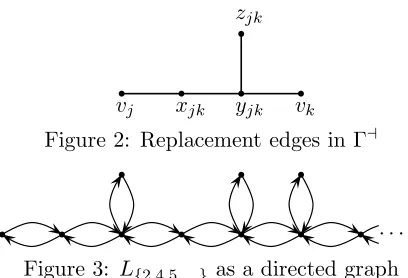
and define the (undirected) edges in Γ⊣ to be all (vj, xjk), (xjk, yjk), (yjk, zjk) and (yjk, vk) for all (vj, vk) ∈ E. This has the effect of replacing the “arrow” from vj to vk in Γ by the shape shown in Figure2.
For our directed graph Γ = (V, E), let us also define, for v∈V,
vj xjk yjk vk zjk
Figure 2: Replacement edges in Γ⊣
. . .
Figure 3: L{2,4,5,...} as a directed graph
Lemma 4.1 Let Γ = (V, E) be a directed graph. Suppose that |Γ+(v)|+|Γ−(v)| >3 for all v∈V. ThenAut Γ⊣∼= Aut Γ.
Proof: We observe that, by construction, in Γ⊣, every vertex in X = {xjk | (vj, vk) ∈ E} has degree 2, every vertex in Y = {yjk | (vj, vk) ∈ E} has degree 3, every vertex in Z =
{zjk | (vj, vk) ∈ E} has degree 1 and (by assumption) every vi has degree greater than 3. Consequently, if f ∈Aut Γ⊣ thenXf =X,Y f =Y, Zf =Z and V f =V.
Let us define a map φ: Aut Γ⊣ → Aut Γ by f φ = f|V for all f ∈ Aut Γ⊣. For such an automorphism f, from the above observation, f φ defines a bijection V → V. If (u, v) is a (directed) edge in Γ, then there exists x ∈X and y ∈Y such that (u, x), (x, y) and (y, v) are (undirected) edges in Γ⊣. Then (uf, xf), (xf, yf) and (yf, vf) are edges in Γ⊣ and necessarily xf ∈ X and yf ∈ Y. It follows that (uf, vf) must be an edge in Γ. Similarly, if (u, v) ∈/ E, then (uf, vf)∈/ E. Hencef φis indeed a graph automorphism of Γ.
It is straightforward to see that φ is a homomorphism and, since the images of xjk, yjk and zjk (for (vj, vk) ∈ E) under f are completely determined by vjf and vkf, it follows that φis injective. Finally, if h ∈Aut Γ, define vif =vih for alli and if (vj, vk)∈E withvjh=vℓ and vkh =vm define xjkf =xℓm, yjkf =yℓm and zjkf =zℓm. This definesf ∈ Aut Γ⊣ with the property that f φ=f|V =h. Consequently, φis an isomorphism as required.
In addition to the above lemma, the other tools we require are the constructions used in Section 3. IfS is a subset of N\ {0,1}, we define the graph LS as earlier, but we now view it as a directed graph. So, for any pair of vertices u and v joined in LS, there is both an edge from u to v and from v to u (see Figure3). The disjoint union of two directed graphs and the complement Γ† of a directed graph Γ are defined exactly as earlier. In particular, there is an edge (u, v) from u to v in Γ† if and only if there is no edge from u to v in Γ. Using these we now observe that the classes of groups arising as the automorphism group of a directed graph and as the automorphism group of an undirected graph coincide.
Proposition 4.2 Let Γ be a countable directed graph. Then there exists an (undirected) countable graphΛ such that Aut Λ∼= Aut Γ.
Proof: As Γ is countable, we can chooseS such that the directed graphLS is not isomorphic to any component of Γ. Take ∆S to be the directed graph (Γ ˙∪LS)†and Λ to be the undirected graph ∆⊣
For the class of directed graphs, the condition to be algebraically closed is easily seen to be equivalent to the following: a directed graph Γ = (V, E) is algebraically closed if for any finite subsetA of its vertices, there exists some vertex v such that (u, v),(v, u) ∈E for allu∈A. If we start with a directed graph Γ and perform the same constructions as in Section 3, then we observe that ∆S = (Γ ˙∪LS)†is algebraically closed (as a directed graph) and, providedLS is not isomorphic to any (weakly) connected component of Γ, that Aut ∆S ∼= Aut Γ. This establishes the analogue of Theorem3.4for the class of directed graphs:
Theorem 4.3 Let Γ be a countable (undirected) graph. Then there exist 2ℵ0 pairwise
non-isomorphic countable algebraically closed directed graphs whose automorphism group is
isomor-phic to that of Γ.
As in the previous section, we shall make use of a standard method to construct a copy of the countable universal directed graph. If Γ = (V, E) is any countable directed graph, first construct a new directed graph H(Γ) as follows. Enumerate the set of all triples of finite and pairwise disjoint subsets of Γ as (Ai, Bi, Ci)i∈I forI ⊆N. DefineH(Γ) to be the directed graph with vertex setV ∪ {vi|i∈I} (where eachvi is a new vertex) and edge set
E∪ {(vi, a),(b, vi),(vi, c),(c, vi)|a∈Ai, b∈Bi, c∈Ci, i∈I}.
Thus each new vertex vi has the property that there is an edge from vi to every vertex in Ai, from every vertex in Bi to vi, and from vi to every vertex in Ci andvice versa.
Now construct a sequence of directed graphs Γn by defining Γ0 = Γ and Γn+1 =H(Γn) for
each n >0. We define Γ∞ to be the limit of this sequence of graphs, which is countable and, by construction, existentially closed. Therefore Γ∞ is isomorphic to the countable universal directed graphD.
The same arguments apply to constructing extensions of homomorphisms and an analogue of Lemma 3.5 transfers straight across to the setting of directed graphs. We then establish, by identical methods as used in Section 3, first the characterization of graphs that arise as images of idempotent endomorphisms of the countable universal directed graph Dand second observations aboutH- and D-classes of regular elements of the endomorphism monoid D:
Theorem 4.4 LetΓ be a countable directed graph. Then
(i) there exists an idempotent endomorphism f of the countable universal directed graph D such thatimf ∼= Γif and only if Γ is algebraically closed;
(ii) if Γ is algebraically closed, there are 2ℵ0 idempotent endomorphisms f of D such that
imf ∼= Γ.
Theorem 4.5 LetD denote the countable universal directed graph.
(i) Let Γbe a countable (undirected) graph. Then there exist 2ℵ0 distinct regular D-classes
of EndDwhose group H-classes are isomorphic toAut Γ.
(ii) Every regularD-class of EndD contains 2ℵ0 distinct group H-classes.
The formulae used in Section 3 to define Γ♯ make perfect sense when Γ is a directed graph. They provide us with a directed graph satisfying analogous properties to those stated in Lemma3.8. This is the primary tool in establishing the following results, which are the directed graph analogues of 3.9,3.11 and 3.12. The proofs are identical to those for undirected graphs, except for judicious insertion of the word “directed”, and so we omit them.
Theorem 4.6 Every regular D-class of the endomorphism monoid of the countable universal directed graphD contains 2ℵ0 many L- and R-classes.
Theorem 4.7 Let Γ be any algebraically closed directed graph that is not isomorphic to the countable universal directed graphD. Then there exists a non-regular injective endomorphismf of D such that the subgraph induced by the images of the vertices underf is isomorphic to Γ and such that theD-class off contains 2ℵ0 R- andL-classes.
Corollary 4.8 There are 2ℵ0 non-regularD-classes inEndD.
For the Sch¨utzenberger groups ofH-classes of non-regular endomorphisms of the countable universal directed graph D = (V, E), we proceed once more as in Section 3. If Γ0 = (V0, E0)
is an algebraically closed directed graph, let F0 ⊆ E0 be such that (V0, F0) ∼= D (as provided
by Proposition 2.1(i)). Assume that Dhas been constructed using Γ0 in the initial step of our
standard method and let f:D→Dbe the endomorphism that realises this isomorphism; that is, f is given by a bijection V → V0 that induces a bijection from E to F0. Then the same
argument as used to establish Proposition3.13 gives:
Proposition 4.9 Let f be an injective endomorphism of the countable universal directed graphD of the form specified above and H=Hf. Then SH ∼= AuthV fi ∩Aut(imf).
To apply this proposition, we make minor changes in the argument used to establish The-orem 3.14. Let Γ be an arbitrary countable (undirected) graph and let Sn, for n ∈ N, be a sequence of distinct subsets ofN\ {0,1}such that the graphMSn (as defined towards the end of Section3) is not isomorphic to any connected component of Γ. Define Γ∗0 = Γ†(the complement of Γ) and view this as a directed graph. Then, assuming that the directed graph Γ∗n has been defined, enumerate the triples of finite pairwise disjoint subsets of Γ∗
n as (Ai, Bi, Ci)i∈N. Let the
vertices of Γ∗
n+1be the union of the vertices of Γ∗n, the vertices of the graphLSnand new vertices
{x(in), y(in), z(in) |i∈N}. Define the edges of Γ∗
n+1 to be the edges of Γ∗n together with, for all i∈N, (x(in), a) for a∈Ai, (b, yi(n)) for b∈Bi, and both (zi(n), c) and (c, zi(n)) for c∈Ci. We define Γ∗ = (V∗, E∗) to be the limit of this sequence of directed graphs, which is existentially closed by construction and so isomorphic to the countable universal directed graphD.
Then let Γ0 = (V∗, E0) be the directed graph whose edges are all possible edges between
pairs of vertices except the following are not included:
(i) the edges of Γ;
(ii) for each n∈N, all edges between distinct vertices of{x(in), yi(n), z(in)|i∈N};
(iii) for each n∈N, the edges inLSn;
We have, of course, constructed an undirected graph but in this context we shall view Γ0 as
a directed graph. By construction, E∗ ⊆ E0. Therefore Γ0 is an algebraically closed directed
graph and we use this graph when applying Proposition 4.9. The endomorphism f: D → D whose image is (V∗, E∗) is not regular sinceE∗ 6=E0.
The complement Γ†0 is the disjoint union of Γ and copies of MSn (namely the graph com-prising the vertices of LSn and the vertices x(in),yi(n) and zi(n) fori∈N). Hence
Aut Γ0 ∼= Aut Γ†0∼= Aut Γ× Y
n∈N
AutMSn ∼= Aut Γ×(SymN)ℵ0.
The same argument as employed in Section 3 shows that Aut(V∗, E0)∩Aut(V∗, E∗)∼= Aut Γ.
Equally, by varying the subset S1 we produce 2ℵ0 many D-classes of the endomorphism f.
Therefore, the analogue of Theorem 3.14holds for the countable universal directed graph:
Theorem 4.10 Let Γ be any countable (undirected) graph. There are 2ℵ0 non-regular D
-classes of the countable universal directed graph D such that the Sch¨utzenberger groups of H-classes within them are isomorphic toAut Γ.
5
Bipartite graphs
One usually defines an (undirected) graph Γ = (V, E) to be bipartite if there exists a function c:V → {0,1} such that c(u) 6= c(v) whenever (u, v) ∈ E. However, as noted by Evans in [8, Section 2.2.2], it is easy to observe that the class of finite graphs satisfying this condition does not have the amalgamation property and so we cannot speak of the Fra¨ıss´e limit of such graphs. The solution is to encode the partition of the vertex setV via an additional equivalence relation. Accordingly, we define a bipartite graph to be a relational structure Γ = (V, E, P) such that E is an irreflexive symmetric binary relation onV, P = (V0×V0)∪(V1×V1) for some partition
V =V0∪˙ V1 of the vertex set, and if (u, v) ∈E then (u, v) 6∈ P (which means one of u and v
belongs to V0 and the other belongs toV1).
Let Γ = (V, E, P) and ∆ = (W, F, Q) be bipartite graphs in this sense, where V =V0∪˙ V1
and W = W0 ∪˙ W1 are the partitions of the vertex sets given by P and Q, respectively. It
follows from the definition that if f: Γ →∆ is a homomorphism, thenV0f is contained in one
of W0 or W1 and similarly forV1f. Moreover, iff is an embedding then either V0f ⊆W0 and
V1f ⊆W1, or V0f ⊆W1 and V1f ⊆ W0. This enables one to show that the class of bipartite
graphs (according to our definition) satisfies the amalgamation property and hence there is a unique Fra¨ıss´e limit of the finite bipartite graphs, the countable universal bipartite graph B.
A particular observation from the previous paragraph is that if f is an automorphism of the bipartite graph Γ = (V, E, P), whereP = (V0×V0)∪(V1×V1), then either V0f =V0 and
V1f = V1, or V0f =V1 and V1f = V0. We call f part-fixing if V0f = V0 and V1f = V1. The
following observation is straightforward.
Lemma 5.1 Let Γ = (V, E, P) be a bipartite graph such that the graph (V, E) is connected. Then Aut Γ = Aut(V, E).
achieve the first of these, let Γ = (V, E) be any countable graph. We now associate a countable bipartite graph Γ′ = (V′, E′, P′) to Γ. Enumerate the vertices of Γ as V ={vi |i∈I} (where I ⊆ N). Whenever there is an edge joining vertices vi and vj in Γ (with i < j), choose a new vertex xij so that the set X = {xij | (vi, vj) ∈ E, i < j} is a set disjoint from V. Set V′ =V ∪X, P′= (V ×V)∪(X×X) and
E′={(vi, xij),(vj, xij),(xij, vi),(xij, vj)|(vi, vj)∈E, i < j}.
(Intuitively, we have added a new vertexxij in the middle of each original edge (vi, vj) and the partition of our new graph Γ′ is into “old vertices” and “new middle-edge vertices”.)
Define Γ(v) to be the set of vertices in Γ that are joined by an edge to v.
Lemma 5.2 Let Γ = (V, E) be a countable graph such that |Γ(v)| > 3 for all v ∈ V. Then Aut Γ′∼= Aut Γ and every automorphism of Γ′ is part-fixing.
Proof: Iff ∈Aut Γ′, thenf defines an automorphism of the graph (V′, E′). Since eachx∈X has degree 2 and each vertex v ∈ V has the same degree in Γ′ as in Γ, we conclude from the hypothesis that Xf =X and V f =V. In other words, each automorphism of Γ′ is part-fixing. Now define a map φ: Aut Γ′ → Aut Γ by defining f φ to be the restriction of f to the elements of V. We have observed that f restricts to a bijection V → V. If (u, v) ∈ E, then there is a unique x ∈X such that (u, x),(x, v) ∈ E′. Then (uf, xf),(xf, vf) ∈ E′, as f is an automorphism of Γ′, and the definition of our bipartite graph Γ′then tells us that (uf, vf)∈E. Similarly, if (uf, vf) ∈ E, then we deduce (u, v) ∈ E and we conclude that f φ does indeed define an automorphism of the graph Γ.
Then φ is a homomorphism from Aut Γ′ to Aut Γ. It is injective, since the effect of f on the vertices in V completely determines the effect on the vertices in X. If h ∈Aut Γ, we may extend h to an automorphism ˜h of Γ′ by mapping a vertex x∈ X satisfying (u, x),(x, v) ∈ E to the unique vertex y ∈ X satisfying (uh, y),(y, vh) ∈ E. Then ˜h ∈ Aut Γ′ and ˜hφ = h,
completing the proof.
We shall also need analogues of the constructions in Section 3 for bipartite graphs. First, if Γ = (V, E, P) is a bipartite graph, with P = (V0 ×V0) ∪(V1 ×V1), define the bipartite complement Γ‡ to be Γ‡= (V, E‡, P) where
E‡= (V ×V)\(E∪P).
Then by construction, Γ‡ is a bipartite graph with the same vertex partition as Γ such that, for u∈V0 and v∈V1, (u, v) is an edge in Γ‡ if and only if (u, v) is not an edge in Γ.
If Γ = (V, E, P), where P = (V0 ×V0)∪(V1 ×V1), and ∆ = (V′, E′, P′), where P′ =
(V0′ ×V0′)∪ (V1′ ×V1′), are bipartite graphs, then we define the bipartite disjoint union of Γ and Γ′ to be
Γ ˙⊔∆ = (V ∪V′, E∪E′, Q)
whereQ= (V0∪V0′)×(V0∪V0′)∪(V1∪V1′)×(V1∪V1′). This definition depends upon our choice
for V0, V1, V0′ and V1′ (i.e., which way round we pair the parts of the vertex sets) so strictly
Finally, we shall use the following adjustment to produce a bipartite analogue of the graphLS defined in Section 3. For S ⊆ N\ {0,1}, take ΛS = (VS, ES, PS), where VS and ES are the vertices and edges ofLS as defined in Section 3 andPS = (V0×V0)∪(V1×V1) where
V0={ℓn|n is even} ∪ {vn|n∈S is odd} V1={ℓn|n is odd} ∪ {vn|n∈S is even}.
With these constructions, we easily establish analogues of Lemmas 3.1and 3.3: If Γ and ∆ are bipartite graphs then Aut Γ‡= Aut Γ and Γ ∼= ∆ if and only if Γ‡∼= ∆‡. Also if S and T are subsets of N\ {0,1}, then Aut ΛS =1 and ΛS ∼= ΛT if and only ifS =T.
Theorem 5.3 The class of groups arising as automorphism groups of countable graphs is pre-cisely the same as the class of groups arising as automorphism groups of countable bipartite graphs.
Proof: Let Γ be a countable graph. Choose S ⊆ N\ {0,1} such that the graph LS, as in Section 3 is not isomorphic to any connected component of Γ. Let ∆S = (Γ ˙∪LS)†, so that Aut ∆S ∼= Aut Γ (see Theorem3.4). Then each vertexvof ∆S has infinite degree and so, taking Λ = (∆S)′ as defined above, we conclude from Lemma 5.2that Aut Λ∼= Aut ∆S∼= Aut Γ.
Conversely, if Γ = (V, E, P) is a bipartite graph, choose S ⊆ N\ {0,1} such that LS is not isomorphic to any connected component of the graph (V, E). Take ∆S = (W, F, Q) to be the bipartite graph (Γ ˙⊔ΛS)‡. Then (W, F) is a connected graph and so, by Lemma 5.1,
Aut(W, F) = Aut ∆S ∼= Aut Γ.
The definition of algebraic closure for bipartite graphs is soon established to be equivalent to the following. A bipartite graph Γ = (V, E, P) isalgebraically closed if, given a finite collection of vertices {v1,v2, . . . ,vk} such that (vi, vj)∈P for alliandj, there exists some vertexwthat is connected by an edge to each of the vi. Equivalently, if V =V0∪˙ V1 is the partition of the
vertices determined by the relation P, then if given finite subsets A0 ⊆V0 and A1 ⊆V1, there
exist vertices w0∈V0 andw1 ∈V1 such that w0 is joined by an edge for each vertex inA1 and
w1 is joined by an edge to each vertex in A0.
There are some potentially unexpected consequences of this observation. The first is that, for m, n∈N, the complete bipartite graphKm,n on two parts of cardinalitiesmandn, respectively, is algebraically closed. There are also examples of algebraically closed infinite bipartite graphs but with only one witnesswof the algebraic closure condition. This stands in contrast to the ob-servation that in both algebraically closed graphs and algebraically closed directed graphs, there are always infinitely many witnesses. Accordingly, we define a bipartite graph Γ = (V, E, P) to bestrongly algebraically closed if for every finite collectionAof vertices satisfying (v, w) ∈P for all distinctv, w∈V, there exist infinitely many verticesx connected to every vertex ofA by an edge. Our analogue of Theorem3.4 for bipartite graphs makes use of this stronger condition.
Theorem 5.4 Let Γ be a countable graph. Then there exist 2ℵ0 pairwise non-isomorphic
strongly algebraically closed bipartite graphs whose automorphism group is isomorphic to that of Γ.
Proof: By Theorem5.3, there is a countable bipartite graph ∆ such that Aut ∆∼= Aut Γ. Now there are 2ℵ0 choices for subsetsS ofN\ {0,1} such that ΛS is not isomorphic to any connected
Aut Γ, while ΠS ∼= ΠT if and only if S =T. Moreover, each ΠS is strongly algebraically closed: given any finite subset A of vertices of ΠS that are related under the partition relation, there are in fact infinitely many vertices in ΛS that are joined to every vertex inA.
The standard method to construct a copy of the countable universal bipartite graph is as follows. If Γ = (V, E, P) is any countable bipartite graph with corresponding vertex partition V =V0∪˙ V1, enumerate the set of all finite subsets of V0 as (Ai)i∈I and all finite subsets ofV1
as (Bj)j∈J for someI, J ⊆N. Set W0 =V0∪ {vj |j ∈J} and W1 =V1∪ {wi |i∈I}, where
thevj andwi are new vertices. DefineI(Γ) to be the bipartite graph with vertex setW0∪W1,
edge set to consist of E and new edges joining each vj to every element of Bj (for j ∈J) and each wi to every element ofAi (for i∈I), and partition relation
Q= (W0×W0)∪(W1×W1).
As in the previous sections, we construct a sequence of bipartite graphs by setting Γ0 = Γ
and Γn+1 = I(Γn). Then the limit Γ∞ of this sequence is existentially closed and therefore
isomorphic to the countable universal bipartite graphB.
Many of our arguments transfer from Section3but throughout one needs to be careful when, for example, finite algebraically closed bipartite graphs arise. The first example of this occurs in our analogue of Lemma 3.5for bipartite graphs.
Lemma 5.5 Let Γ be a countable bipartite graph, let Γ∞ be the copy of the countable uni-versal bipartite graph constructed around Γ as described above, and let f: Γ → Γ∞ be a homomorphism of bipartite graphs.
(i) There exist2ℵ0 endomorphismsfˆ: Γ
∞→Γ∞such that the restriction offˆtoΓequals f. (ii) If imf is an algebraically closed bipartite graph, then there is an extension fˆof f with im ˆf = imf. Moreover, if imf is not isomorphic toK1,1, the countable universal bipartite
graphΓ∞may be constructed so that there are 2ℵ0 such extensionsfˆ.
(iii) If f is an automorphism of Γ, then there is an automorphism fˆof Γ∞ such that the restriction offˆto Γ equals f.
Proof: For (i) and (ii), the argument is essentially the same as in Lemma3.5: having defined an extension fn of f to Γn, we extend to fn+1: Γn+1 → Γ∞, where Γn+1 =I(Γn) by mapping
each new vertex wn to a vertex joined to every vertex of Bnfn and each vn to a vertex joined to every vertex of Anfn. In Γ∞, there are always infinitely many choices and hence in the end we obtain 2ℵ0 extensions ˆf in (i).
The only place where extra care is required in the argument is in part (ii) since, although we can at every stage arrange that imfn= imf, we can no longer guarantee there are infinitely many such extensions. If imf is not isomorphic to K1,1, there is some vertex x in imf that is
joined to at least two vertices in this image. Supposex =yf. At each stage, when construct-ingI(Γn) we enumerate the finite subsets as above by always choosing A1 ={y}. This ensures
that there are at least two choices for the image of the new vertexw1, namely any of the vertices
joined to x. We then continue as before. We conclude that there are at least two extensions of the endomorphism fn of Γn to endomorphisms fn+1 of Γn+1 preserving the image being equal
to imf. Hence there are 2ℵ0 extensions ˆf off to an endomorphism of Γ∞ with im ˆf = imf.
Relying on the above lemma, but otherwise proceeding in exactly the same way as in Sec-tion3, we establish parts (i) and (ii) of the result that classifies images of idempotent endomor-phisms of the countable universal bipartite graph.
Theorem 5.6 LetΓ be a countable bipartite graph. Then
(i) there exists an idempotent endomorphismf of the countable universal bipartite graph B such thatimf ∼= Γif and only if Γ is algebraically closed;
(ii) if Γis algebraically closed and is not isomorphic to the finite complete bipartite graphK1,1,
then there are2ℵ0 idempotent endomorphismsf of B such that imf ∼= Γ;
(iii) if Γ∼=K1,1, there areℵ0 idempotent endomorphismsf of B such that imf ∼= Γ.
Proof: (iii) If V =V0∪˙V1is the partition of the vertex set associated to the partition relation on Γ, then idempotent endomorphisms of f with imf ∼=K1,1 are determined by choosing any
edge (u, v) present in E where u ∈ V0 and v ∈V1, and then mapping vertices in V0 to u and
vertices inV1 to v. AsB hasℵ0 many edges, there are ℵ0 such idempotent endomorphisms.
By following the same steps as used to establish Theorem 3.7, we can then establish parts (i) and (ii) of the following. We rely on Theorem 5.4 and note that strongly algebraically closed bipartite graphs are certainly not isomorphic toK1,1. For the final part, two idempotent
endomorphisms of B with image isomorphic toK1,1 are D-related by Lemma 2.5 and each of
theℵ0 such idempotent endomorphisms determines a groupH-class.
Theorem 5.7 LetB denote the countable universal bipartite graph.
(i) Let Γ be a countable graph. Then there exist 2ℵ0 distinct regular D-classes of EndB
whose group H-classes are isomorphic to Aut Γ.
(ii) Let f be an idempotent endomorphism of B whose image is not isomorphic to the finite complete bipartite graphK1,1. Then theD-class off inEndB contains2ℵ0 distinct group
H-classes.
(iii) There is a single D-class of B containing the idempotent endomorphisms with image isomorphic to K1,1. This D-class contains preciselyℵ0 groupH-classes, each of which is
isomorphic to the cyclic group of order2.
We now turn to establishing information about L- and R-classes in the endomorphism monoid ofB. We deal first with the bipartite graph version of Theorem 3.11, since it involves fewer changes. We use essentially the same construction Γ♯ as in Section 3. Let Γ = (V, E, P) be a bipartite graph with P = (V0 ×V0)∪(V1×V1). Assume that Vk = {vi(k) | i ∈ N} for k= 0, 1. Then define Γ♯= (V♯, E♯, P♯), whereV♯=V0♯∪V1♯,
Vk♯ ={v(i,rk) |i∈N, r∈ {0,1} }, fork= 0,1,