Int. J. Communications, Network and System Sciences, 2009, 4, 249-324
doi:10.4236/ijcns.2009.24033 Published Online July 2009 (http://www.SciRP.org/journal/ijcns/).
Adaptive Backoff Algorithm for IEEE 802.11 MAC Protocol
Maali ALBALT1, Qassim NASIR2
Department of Electrical and Computer Engineering, College of Engineering, University of Sharjah, Sharjah, UAE
Email: {1
maali, 2nasir}@sharjah.ac.ae
Received October 4, 2008; revised December 28, 2008; accepted March 3, 2009
ABSTRACT
A Mobile Ad Hoc Network (MANET) is a collection of mobile nodes that can communicate directly over wireless media, without the need for a pre-configured infrastructure. Several approaches have been suggested to improve Quality of Service (QoS) in IEEE 802.11-based MANETs through modifying some of the IEEE 802.11 Medium Access Control (MAC) algorithms, such as the backoff algorithm that is used to control the packets collision aftermath. In this work, an adaptive IEEE 802.11 backoff algorithm to improve QoS is de-veloped and tested in simulations as well as in testbed implementation. While the Binary Exponential Backoff (BEB) algorithm deployed by IEEE 802.11 reacts based on individual packet transmit trials, the new algo-rithm takes the history of successive packet transmit trials into account to provide a better QoS performance.
The new algorithm has been tested against the legacy IEEE 802.11 through simulations using QualNet and a Linux-based testbed comprising a number of stations. The performed tests have shown significant im-provements in performance, with up to 33.51% improvement in delay and 7.36% improvement in packet de-livery fraction compared to the original IEEE 802.11.
Keywords: MANETs, Ad-Hoc Networks, Quality of Service, Backoff Algorithm, IEEE 802.11
1. Introduction
A MANET is a collection of mobile nodes that are con-nected without any infrastructure or base station [1]. In such networks, nodes are free to enter, leave the network, move and organize themselves; thus, the topology of the network can change unpredictably. Since the wireless medium is shared by all transmitting nodes in range, there should be a mechanism to control medium access among contending stations so as to minimize the effect of collisions on the performance of the network. The famous IEEE 802.11, for instance, adopts a binary ex-ponential backoff (BEB) algorithm that exex-ponentially increases a station’s waiting time if the medium is found busy, and resets to a minimum value right after a suc-cessful transmission. The BEB algorithm is considered “memory-less” since it resets the Contention Window (CW) value to the minimum right after a successful transmission without taking into consideration the net-work conditions.
Many researchers were motivated to enhance the per-formance of the IEEE 802.11 through modifying the
BEB algorithm [1–12]. Most of the prior work in this
area have changed or modified the BEB algorithm such that it provides relative priority among two or more
traf-fic classes [1–5]. This solves the intra-class contention
problem since the class with the least specified CW value would access the channel first. However, it does not solve the inter-class contention problem since a number of stations wishing to send packets of the same priority class may still contend and collide (in case their backoff timers expire simultaneously). The latter problem is solved by determining what to do until a successful transmission takes place, or simply how to increment the value of the contention window in the case of a busy channel. The suggested backoff algorithms were mostly slight variations or scales of the BEB algorithm for each traffic class. However, the way how to decrement the CW was unaddressed explicitly and hence assumed to remain the same as the original BEB algorithm (the CW would reset to CWmin upon a successful transmission).
But that is not enough since the sudden CW reset to CWmin may cause several collisions, which requires addressing the contention problem from a congestion point of view. More specifically, when a station succeeds in transmitting a packet at a given CW, that doesn’t mean a decrease in congestion, but it means arriving at a con-venient CW value [6].
This finding inspired some researchers to adopt a dif-ferent approach of looking at the backoff algorithm, which is what to do after a successful transmission takes place, or simply how to decrement the CW. Several works on slowly decreasing the CW value were proposed
[6–12]. [7] and [8] suggested an exponential decrease in
the CW value upon a successful transmission instead of resetting to CWmin, but they assumed a fixed scale of decrease without taking the network conditions into ac-count. That might result in underutilizing the channel if it was idle or returning to a congestion state if the network had not yet relieved from a previous congestion.
While [6] and [9] suggested slow decrease backoff al-gorithms to adapt to the network load, there was another proposal to assume a p-persistent MAC protocol in which the station would transmit with a probability p and refrain form transmitting with a probability 1-p [10,11]. That p-value was calculated in runtime and updated after each transmission to reflect the current number of active stations in [10] or the average time the channel is idle or busy in [11] among other conditions that affect the net-work load. In both the slow decrease and p-persistent cases, complex computations were needed to update the p-value and to estimate the network load, respectively. Complex computations also mean high power consump-tion, which is in many cases considered unaffordable in the wireless ad hoc networks context.
This work has modified the IEEE 802.11’s main mechanism for managing access to the shared wireless medium, which is the Binary Exponential Backoff (BEB) algorithm; it is replaced with a History-Based Adaptive Backoff (HBAB) algorithm that updates the value of the BEB’s Contention Window (CW) according to the net-work conditions with a suitable prediction. The algo-rithm proposes a novel approach to slowly increase and decrease the CW value based on the busyness of the channel, i.e. MAC layer transmission retrials. In a previ-ous work by the same authors [13] a similar backoff al-gorithm was introduced under the same name, but it used a different technique to update CW. Besides developing HBAB in theory and testing it in simulation, this work has built a Linux-based MANET to act as a testbed for implementing HBAB. The constructed testbed, which integrates a number of ready-made and customized hardware and software components, implements HBAB as well as the original IEEE 802.11 protocols in real-time. Both simulation and testbed results show significant im-provements in QoS related performance measures,
espe-cially in delay, when using HBAB over the original IEEE 802.11.
The paper is organized as follows. Section 2 reviews the IEEE 802.11 MAC protocol backoff algorithm and QoS in MANETs. Section 3 presents the HBAB algo-rithm. Sections 4 and 5 discuss performance evaluation of the proposed HBAB against the standard BEB IEEE 802.11 in simulation and Linux testbed, respectively. Section 6 concludes the paper and provides directions for future work.
2. IEEE 802.11 and Binary Exponential
Backoff
The IEEE 802.11 family of standards defines the speci-fications of both the physical (PHY) and medium access control (MAC) layers to construct a WLAN [14]. While the 802.11 PHY layer defines the signaling and modula-tion properties of the protocol, the 802.11 MAC layer controls access to the shared wireless medium. In order to accomplish that, the 802.11 MAC defines two medium access functions: a mandatory distributed coordination function (DCF) and an optional point coordination func-tion (PCF) [3]. The DSF funcfunc-tion uses BEB to manage access to the medium in the case of packet collisions.
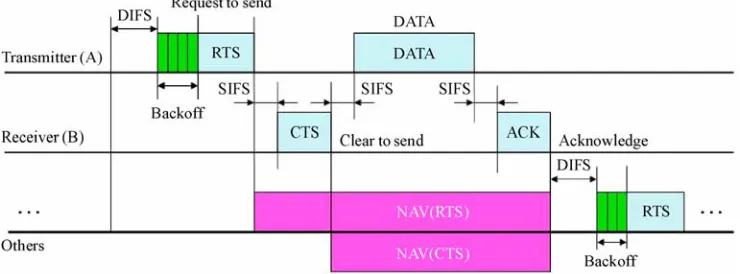
The DCF function uses a carrier sense multiple access with collision avoidance (CSMA/CA) mechanism to control access to the shared wireless medium. This mechanism features the exchange of control packets (Re-quest-To-Send (RTS) and Clear-To-Send (CTS)) before data transmission to minimize the chances of collisions. Furthermore, before initiating that type of RTS/CTS ex-change, each STA is required to sense the medium for a time interval consisting of the DCF Interframe Space (DIFS) and the current value of the backoff timer [3]. The value of the backoff timer is randomly picked in the range of the current Contention Window (CW) of the station. CW value is updated by a Binary Exponential Backoff (BEB) algorithm that exponentially increases a station’s waiting time if the medium is found busy, and resets to a minimum value right after a successful trans-mission. A positive Acknowledgment (ACK) is used to notify the sender that the frame has been successfully received. If an ACK is not received within a time period of ACKTimeout, the sender assumes that there is a colli-sion and schedules a retransmiscolli-sion by entering the backoff process again until the maximum retransmission limit is reached [3]. A maximum of 7 retransmissions (4 retransmissions) for short frames (long frames) are al-lowed before the frame is dropped. The basic access procedure is shown in Figure 1.
status. When a station has some data to send, it senses the channel to determine whether it is idle. If the medium remains idle for a time interval equal to DIFS, the station is allowed to transmit. If the medium is busy, the trans-mission is postponed until the ongoing transtrans-mission con-cludes. Meanwhile, a slotted binary exponential backoff procedure takes place: each slot is equal to DIFS, and the number of such slots is determined by a random value uniformly chosen in [0, CW -1], where CW is the current contention window size.
That random value is used to initialize the backoff timer, which keeps running as long as the channel is sensed idle, paused when data transmission (initiated by other stations) is in progress, and resumed when the channel is sensed idle again for more than DIFS. The time immediately following an idle DIFS is slotted, with each slot equal to the time needed for any station to
de-tect the transmission of a frame (in the IEEE 802.11 term, MAC Service Data Unit (MSDU)) from any other station. When the backoff timer expires, the station attempts to transmit a data frame at the beginning of next slot.
Finally, if the data frame is successfully received, the receiver transmits an acknowledgment frame after a specified interval, called the short inter-frame space (SIFS), that is less than DIFS. If an acknowledgment is not received, the data frame is presumed to be lost, and a retransmission is scheduled. The value of CW is set to
CWmin in the first transmission attempt, and is doubled at
each retransmission up to a pre-determined value CWmax.
Retransmissions for the same data frame can be made up to a pre-determined retry limit, L, times. Beyond that, the pending frame will be dropped [3]. The contention win-dow update can be summarized as follows:
current new
min
2 CW , transmission failure- up to max value CW
CW , transmission success
The metrics used in comparing protocol performance are 1) the Packet Delivery Fraction (PDF), which represents the ratio of the number of the successfully delivered data packets to their destinations versus the number of all data packets being sent; 2) the average end to end delay, which measures the average required time in seconds to receive a packet; and 3) the throughput, which is the amount of data successfully transferred through the channel in a given time period. It is measured in kilo bits per second (kbps) [15].
3. History Based Adaptive Backoff (HBAB)
Algorithm
This paper proposes a novel backoff algorithm, the His-tory Based Adaptive Backoff (HBAB) algorithm, in which the history of the past trials for transmission is
taken into account. In short, HBAB modifies BEB in such a way that the history of the past trials of trans-mission is taken into account. In order to do that, HBAB defines three variables: the contention window size (CW), which holds the current contention window
size, the multiplicative factor, α, which is used to
update CW and the ChannelState, which captures a
snapshot of the medium (or channel) representing its most recent busy/free states. The first variable is common with BEB whereas the latter two variables are HBAB-specific.
The parameter α is a multiplicative factor used to
up-date CW value. A similar multiplicative factor is implic-itly defined in the original IEEE 802.11 BEB to have the value of two since CW is doubled upon each transmis-sion failure, i.e. the current CW is multiplied by two to
get the new CW. However, α is different from that
[image:3.595.115.485.557.694.2]im-plicit definition in two aspects:
- Value: theoretically, any positive value greater than 1
-EB uses the
multiplica-I
Cha history of
th
ium trying to
When HBAB begins, the three variables, CW, α and
ChannelState
where CWmin is th
sen value for the
current value of CW multiplied by the
m
the cu
he possible update schemes:
can be assigned to α while the multiplicative factor
of the original algorithm is fixed at two. The value of
α can be either assigned statically, i.e. before runtime
and remains constant during runtime or dynamically, i.e. to change according to certain parameters that are sampled during runtime. In this work, only static assignment is implemented.
Usage: α is used to update CW upon both
transmis-sion failures and successes. B
tive factor only in transmission failure updates since it resets CW upon a transmission success.
n addition to α, HBAB defines another parameter,
nnelState, which reflects the most recent
e medium in terms of its busy/free states. That is, ChannelState stores the most recent N states of the me-dium sensed upon each transmission trial. A free channel state means that the channel is available and no stations are currently transmitting; it is represented by 1. A busy channel state means that there is at least one stations currently transmitting; it is represented by 0. Hence, if N=2 (which is the case in this work), a ChannelState of 01 means that the medium had been busy then becomes free. N indicates the depth of this history; the greater N, the deeper captured history of the channel. An obvious tradeoff will be the depth of the channel history versus the available memory to store the states.
The ChannelState is updated upon each transmission
trial, i.e. each time the station senses the med
transmit a packet. To make room and store the new channel state, the oldest channel state is removed and the remaining stored states are shifted to the left.
, are initialized as follows:
CW = CWmin (1)
α = f, f >1 (2)
ChannelState = 11 (3)
e minimum value of CW, f is the
cho-multiplicative factor α and
Channel-State is expressed in binary representation. f could be theoretically any positive value greater than one to assure the multiplicative impact on CW; in the special case of f is exactly one, no updates will take place as the process of updating CW involves multiplication or division as will be shown later in this section. If f is a positive value less than one, then the multiplicative
impact is reversed: multiplying by α decreases the
multiplicand whereas dividing by α increases it.
Nega-tive values of f are meaningless since α is used to
up-date a counter.
If the current transmission trial has failed, CW is up-dated to be the
ultiplicative factor α. Thus, the station would wait for a
number of time slots equal to the new value of CW be-fore attempting transmission again. If, however, the cur-rent transmission trial has succeeded, further checks need to be done in order to calculate the updated, namely:
1) If the value of the ChannelState represents two con-secutive busy states, the new value of CW would be
rrent CW divided by α.
2) Otherwise, CW is reset to CWmin.
Equation (4) illustrates t
CW ,
CW CWmin, transmission success, ChannelState 00 CW, transmission success, ChannelState 00
transmission failure
(4)
here ChannelState is expressed in binary representa-ion.
heck (0 indicates a busy channel and 1 indicates a fr
BEB doubles the value of CW upon a tra
cates a congested medium), CW is divided by α instead
of resetting to CW . In other words, a slow decrease in
w t
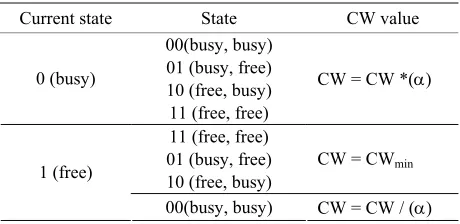
Table 1 shows the suggested CW updating method per state c
ee channel):
Compared to BEB adopts a similar incrementing ap-proach. While
nsmission failure, HBAB multiplies the value of CW
by α. As for the decrementing approach, it is somehow
different. Instead of resetting CW to CWmin all the time as
in BEB, HBAB first checks the value of the Channel-State is not busy for two consecutive times provided that the current channel state is free (the latter condition is indicated by the transmission success). In case the chan-nel state is busy for two consecutive times (which
[image:4.595.309.539.609.721.2]indi-min
Table 1. Possible CW update values based on HBAB opera-tion.
urrent state State CW value
C
00(busy, busy) 01 (busy, free) 10 (free, busy) y)
11 (free, free)
CW = CW *() 0 (bus
11 (free, free) 01 (busy, free) 10 (free, busy)
CW = CWmin
1 (free)
CW is preferred in t congested medium
(for at least stat to b
sin-gle s
As for the overh s w g
for memory, the extra storage space is ne
ection shows the performance of HBAB-based EE 802.11 against the BEB-based IEEE 802.11 under
simulation is carried out in ualNet network simulator version 4.0 [17]. Each point
ion modelled a network of 50 mobile nodes
laced randomly within a 1000 × 1000 meters area.
is 250 meters and hannel capacity is 2 Mbits/sec. As for node mobility,
lasts until the end of the simula-tio
his case since a two
uccess.
es) is unlikely e free upon a
ead that come ith implementin
HBAB, it is due to two factors: extra memory space for new variables and extra computations for additional op-erations. As
eded for the new variables: ChannelState and eight other utility variables. As for computations, five addi-tional operations are needed to determine the next value of CW, which are multiplication, shifting, ‘if’ condi-tional statement, memory read and memory write opera-tions (to update the hardware registers). An implicit power overhead is associated with the additional opera-tions.
4. Simulation Results
This s IE
different network loads. The Q
on every graph represents the average of 10 trials using different SEED values to minimize the effect of outliers. The SEED value is used to initialize the random number generator, which is used for node placement and mobility among other usages. Each SEED was used twice: once for an IEEE 802.11 simulation run and the other for the corresponding HBAB simulation run under the same parameters. That ensures the testing has been conducted under the exact conditions, including any random-based parameter.
4.1.
Simulation Environment
Our simulat p
dio propagation range for each node c
the random waypoint model is used. In this model, a node chooses a random point in the network, and moves towards that point at a constant speed. The speeds are uniformly chosen between the minimum and maximum speeds set to 0 m/s and 10 m/s, respectively. When the node reaches its destination, it stays there for a certain pause time (fixed to be 20 seconds in this paper), after which it chooses another random destination point and repeats the process.
All simulations last for 600 seconds. The data traf-fic is generated by Constant Bit Rate (CBR) sessions initiated between random source and destination pairs. Each session
[image:5.595.310.538.93.230.2]n. Table 2 shows the common simulation parame-ters.
Table 2. Simulation parameters.
Parameter Value
Area 1000×1000m
Number of n Simulation t
Packet s 512 bytes
rate (per connection)
dom waypoint with max of 10m/s and pause
rate (CBR) CW , CW
odes 50
ime 600s
ize
Packet 4 packets/s
Mobility pattern Ranspeed time of 20s Traffic type Constant bit
min max 31, 1023
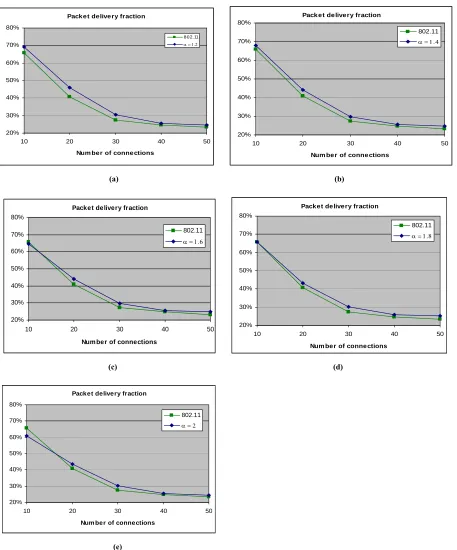
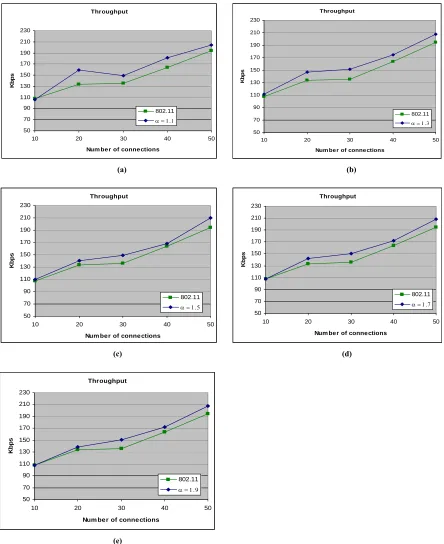
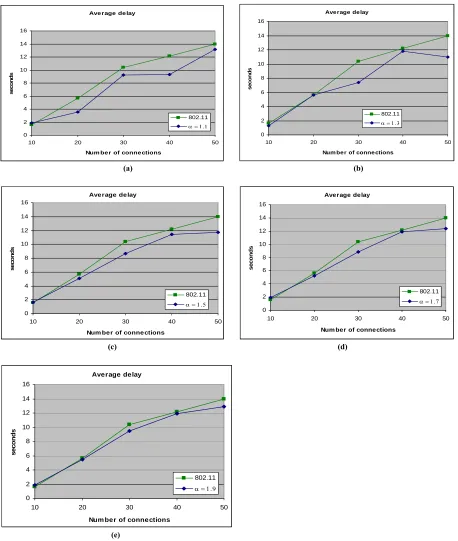
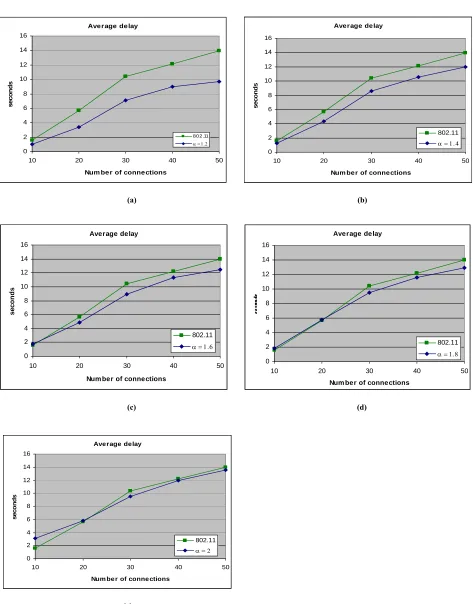
Simulation results are show and Figures 2
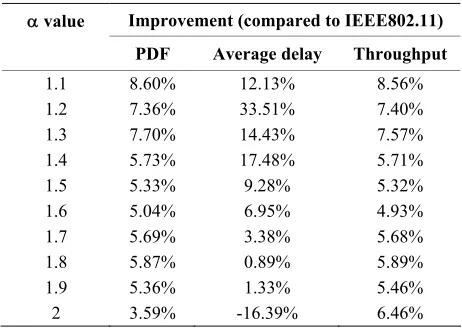
th ble 3 shows a de
ove-ment of HBAB averaged for ections loads per
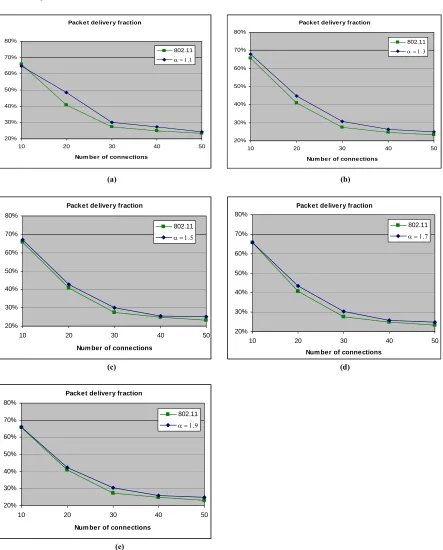
alues of α (compared to IEEE 802.11). Figures (2)–(4)
sh
wed a different be-ha
n in Table 3
rough 4. Ta tailed percentage impr
all conn v
ow the individual PDF, throughput and average delay
comparisons between HBAB (for selected values of α)
and IEEE 802.11. It was noted that for all values of α and
under most of the tested networks loads, HBAB had out-performed IEEE 802.11 for all of the three performance metrics. The only exception was the lowest network load
(the ten connections) for higher values of α. In general,
performance improvement tended to be higher for smaller
values of α; in other words, as the value of α increases,
the percentage improvement in HBAB performance compared to IEEE 802.11 decreases.
As for each of the performance metrics, the PDF maintained a descending pattern of improvement as the
value of α increased (with the highest improvement at α
= 1.1), while the average delay sho
vior; it reached the peak at α = 1.2 and recorded
an-other increase at α = 1.4. Throughput showed similar
behavior to PDF. Overall, the best performance
im-provement was obtained for α = 1.2 (with 33.51%
im-provement in delay and 7.36% imim-provement in PDF compared to IEEE 802.11).
Table 3. Performance improvement of HBAB.
value Improvement (compared to IEEE802.11)
PDF Average delay Throughput
1.1 8.60% 12.13% 8.56%
1.2 7.36% 33.51% 7.40%
1 1.4
-16.39%
.3 7.70%
5.73%
14.43% 17.48%
7.57% 5.71%
1.5 5.33% 9.28% 5.32%
1.6 5.04% 6.95% 4.93%
1.7 5.69% 3.38% 5.68%
1.8 5.87% 0.89% 5.89%
1.9 5.36% 1.33% 5.46%
2 3.59% 6.46%
[image:5.595.308.539.556.720.2]5. L
x Te
Resul
The testbed that was used to BAB for real time
erfor nce co 4 L d station
sk-ork in the ad-hoc mode. loaded on an Atheros-
inu
stbed
ts
test H
based wireless adapter [18] running the Madwifi driver [19]. All of the four stations ran Fedora 7 distribution [20] and the Linux kernel version 2.6.21. Although Atheros chipset and Madwifi driver offer a level of coding flexi- bility not present in other chipsets, implementing the backoff algorithm fully was not possible because packet
p ma mprises inux-base s: 3 de
tops and 1 laptop configured to w he backoff algorithm itself was T
Packe t de live ry fraction
20% 30% 40% 50% 60% 70% 80%
10 20 30 40 50
Num ber of connections
802.11
Packet delivery fraction
20% 30% 40% 50% 60% 70% 80%
10 20 30 40 50
Num ber of connections
802.11
(a) (b)
Packet delivery fraction
20% 30% 40% 50% 60% 70% 80%
10 20 30 40 50
Num ber of connections
802.11
Packet delivery fra
80%
ction
20% 30% 40% 50% 60% 70%
10 20 30 40 50
Num ber of connections
802.11
(c) (d)
Packet delivery fraction
20% 30% 40% 50% 60% 70% 80%
10 20 30 40 50
Num ber of connections
802.11
[image:6.595.78.521.153.703.2](e)
transmission trial handling is done per-packet, not per transmission. That is, a packet success in Madwifi means that a packet has been delivered to the destination re-gardless the number of retransmissions it had encoun-tered. Similarly, a packet failure means that the packet
had failed all the possible transmission trials (until hit-ting the maximum retry limit). Not being able to access the packets per retransmission means that implementing a backoff algorithm per transmission is not possible. Alter-natively, a per-packet variant of HBAB has been pro-
Packet delivery fraction
20%
10 20 30 40 50
Num ber of conne ctions
Pack et de livery fraction
30% 40% 50% 60% 70% 80%
802.11
40% 50% 60% 70% 80%
802.11
20%
10 20 30 40 50
Num ber of connections
30%
(a) (b)
Packet delivery fraction
20% 30% 40% 50% 60% 70% 80%
10 20 30 40 50
Num ber of connections
802.11
Packet de livery fraction
20% 30% 40% 50% 60% 70% 80%
10 20 30 40 50
Num be r of connections
802.11
(c) (d)
Packet delivery fraction
20% 30% 40% 50% 60% 70% 80%
10 20 30 40 50
Num ber of connections
802.11
[image:7.595.72.529.146.696.2](e)
posed to demonstrate the new backoff algorithm. Table 4 shows the wireless adapters used in this work along with their specifications.
A number of Linux-compatible software tools were used to implement and evaluate HBAB. The network load traffic was generated using the Multi-Generator
(MGEN) tool, which is open source software that pro-vides the ability to perform IP network performance tests and measurements using UDP/IP traffic [21]. The TRace Plot Real-time (TRPR) software tool was used to analyze the output files generated by MGEN and calculate the performance metrics used in this work [22]. In order to
Throughput
50 70
10 20 30 40 50
90 110 130 150 170 190 210 230
Kb
p
s
Num ber of conne ctions
802.11
Throughput
110 130 150 170 190 210 230
Kb
p
s
50 70
10 20 30 40 50
Num ber of connections
90
802.11
(a) (b)
Throughput
50 70 90 110 130 150 170 190 210 230
10 20 30 40 50
Num ber of connections
Kb
p
s
802.11
Throughput
50 70 90 110 130 150 170 190 210 230
10 20 30 40 50
Num ber of connections
Kb
p
s
802.11
(c) (d)
Throughput
50 70 90 110 130 150 170 190 210 230
10 20 30 40 50
Num ber of connections
Kb
p
s
802.11
[image:8.595.76.520.159.703.2](e)
monitor the network and capture live packets as experi-ments were conduct
lyzer was used [23]. Forming a MANET needed a suit-able routing protocol, which was the DSR routing proto-col in this work (DSR-UU implementation) [24].
In order to evaluate HBAB real-time performance, a number of testing scenarios were conducted in both simulation and Linux testbed environments. In all testing scenarios, the main connection that was used to evaluate HBAB performance, i.e. to generate the fore ground traf-fic, was established between Station 2 (source; HBAB- loaded) and Station 4 (destination). The packet genera-tion rate was changed per testing scen rio. Other connec-tions were establis
as Stations 2 and 4 to g
acket generation rate also varied per testing scenario.
s were co
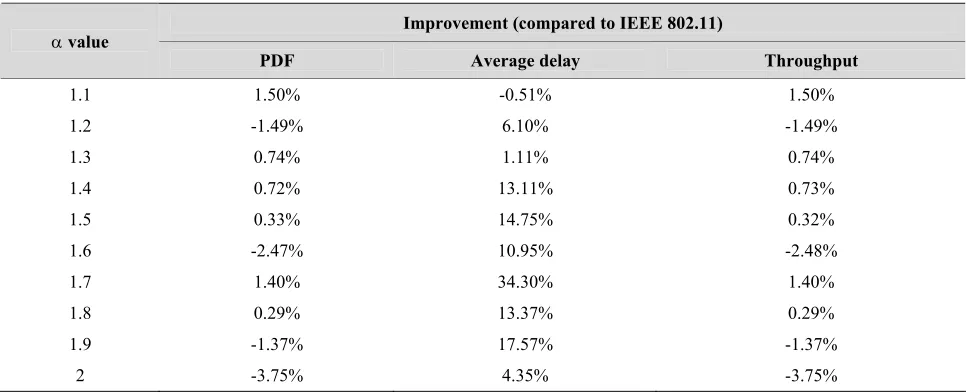
all connections loads per values of α (compared to IEEE
the individual PDF, throughput and average delay comparisons
be-tween HBAB (for selected values of α) and IEEE 802.11.
Since HBAB implementation in the Linux testbed was a bit different from simulation, performance results were different as well. In general, there was no consis-tent performance improvement pattern in the testbed experiment results as illustrated in simulation. HBAB
outperformed IEEE 802.11 for almost all values of α
(except α = 1.1) with respect to the average delay, and
for half of the val es of α with respect to the PDF and
. Over ll, the best performance 34.30% improve-ent in PDF com-pared to IEEE 802.11).
ed, Wireshark network protocol ana- 802.11), whereas Figures (6)–(8) show
a au
hed between Stations 1 and 3 as well throughput
enerate background traffic, whose ment was obtained for ment in delay and 1.40% improvemα = 1.7 (with
Throughput
50 70 90 110 130 150 170 190 210 230
10 20 30 40 50
Num be r of conne ctions
Kb
p
s
802.11
Throughput
50 70 90 110 130 150 170 190 210 230
10 20 30 40 50
Num ber of connections
Kb
p
s
802.11
Throughput
50 70 90 110 130 150 170 190 210 230
10 20 30 40 50
Num ber of connections
Kb
p
s
802.11
(a) (b) (c)
Throughput
50 70 90 110 130 150 170 190 210 230
0 10 20 30 40 50 60
Num ber of connections
Kbps
802.11
Thr
p
The performance measures (average delay, loss fraction and throughput) were extracted from the log files pro-duced at Station 4 after each testing scenario. Traffic generation rate was changed from 100 to 200 packets/s per station in steps of 20. All testbed scenario
nducted using the special per-packet variant of HBAB
(with varying the multiplicative factor α from 1.1 to 2.0
in steps of 0.1). Table 5 further shows the parameters of the testing scenarios.
The results of the Linux testbed experiments are
shown in Table 6 and Figures (5)–(7). Table 6 shows a
detailed percentage improvement of HBAB averaged for
6. Conclusions
A MANET is an infrastructure-less network connecting a number of mobile nodes via wireless media. The special characteristics of MANETs, such as mobility and ab-sence of centralized control, have made the provisioning of end-to-end QoS guarantees a very challenging prob-lem.
In this work, an adaptive backoff algorithm was de-veloped based on the IEEE 802.11 MAC to provide bet-ter QoS performance (especially delay) in MANETs. In
oughput
50 70 90 110 130 190 210 230
10 20 30 40 50
Num ber of connections
Kb
p 150
170
s
802.11
[image:9.595.55.535.85.353.2](d) (e)
Ave rage de lay
0 2 4 6 8 10 12 14 16
10 20 30 40 50
Num be r of conne ctions
se
co
n
d
s
802.11
Ave rage de lay
14 16
0 2 4 6 8
s
e
c
10
onds
12
10 20 30 40 50
Num be r of conne ctions
802.11
(b) (a)
Ave rage de lay
16
Average delay
0 2 4 6 8 10 12 14 16
10 20 30 40 50
Num ber of connections
s
e
c
onds
802.11
0 2 4 6 8 10 12 14
10 20 30 40 50
Num be r of conne ctions
s
e
c
on
ds
802.11
(c) (d)
Average delay
0 2 4 6 8 10 12 14 16
10 20 30 40 50
Num ber of connections
seco
n
d
s
802.11
[image:10.595.70.528.82.623.2](e)
Figure 4A. Average delay of HBAB (α = 1.1, 1.3, 1.5, 1.7 and 1.9) vs BEB-simulation. particular, the IEEE 802.11’s Binary Exponential Back
off (BEB) algorithm was replaced with a History-Based Adaptive Backoff (HBAB) algorithm that updated the value of the BEB’s Contention Window (CW) according to the channel state over a period of time. In addition to the channel state, HBAB utilized a multiplicative factor,
α, to increase or decrease CW value.
Average de lay
0 2 4 6 8 10 12 14 16
10 20 30 40 50
Num be r of conne ctions
seco
n
d
s
802.11
Average delay
0 2 4 6 8 10 12 14 16
10 20 30 40 50
Num ber of connections
seco
n
d
s
802.11
(a) (b)
Average delay
10 12 14 16
0 2 4 6 8
10 20 30 40 50
Num ber of connections
se
co
n
d
s
802.11
Average delay
14 16
0 2 4 6 8 10 12
10 20 30 40 50
Num ber of connections
802.11
(c) (d)
Average delay
0 2 4 6 8 10 12 14 16
10 20 30 40 50
Num be r of conne ctions
seco
n
d
s
802.11
[image:11.595.62.535.83.687.2](e)
Table 4. Wireless cards specifications.
Make and model Dlink DWL-122 Netgear WPN-511 Dlink DWA-110
Chipset Intersil Prism II Atheros AR5002 (AR5212) Ralink RT2501U
Network standards 802.11 b 802.11 b and g 802.11 b and g
Host interface USB PCMCIA USB
[image:12.595.57.541.100.181.2]Wireless adapter driver Linux-wlan-ng 0.2.8 Madwifi 0.9.3.1 rt73 1.1.0.0
Table 5. Testbed parameters.
Parameter Value
Area 4×4m
Number of stations Testing scenario duration
Packet size (foreground and background traffic) 512 bytes
Packet rate (foreground and background traffic) 100, 120, 140, 160, 180, 200 packets/s (per station)
Background traffic type UDP Constant Bit Rate (CBR)
4
Average of 2 trials, each of 60 s
Table 6. HBAB performance improvement (compared to IEEE 802.11) for the hardware testbed experiments.
Improvement (compared to IEEE 802.11) value
PDF Average delay Throughput
1.1 1.50% -0.51% 1.50%
1.2 -1.49% 6.10% -1.49%
1.3 0.74% 1.11% 0.74%
1.4 0.72% 13.11% 0.73%
1.5 0.33% 14.75% 0.32%
1.6 -2.47% 1.7 1.40%
1.8 0.29% 0.29%
-1.37% -3.75%
10.95% -2.48%
34.30% 1.40%
13.37%
1.9 -1.37% 17.57%
2 -3.75% 4.35%
s with t ry hardware and
s a MANET. Du me hardware
limita-t e to the
its o
ple-ented in simulation. Therefore, a special variant was developed for that purpose as detailed in Se
Simulation results have shown significant
improve-ment in IEEE 802.11 p measures upon using
H ver BEB. For HBAB (α = 1.2), the average
im-provements in PDF and average delay were 7.36% and
3 . The Linux-based testbed results
f and 34.30% improvement in
PDF and a on those
r ues of α
(which are associated with lower delay) combined with
approach in updatin better
utilization and eliminated unnecessary waiting
revealed as a decre erage
de-F and throug overhead
implementing HBAB is due to two fac-emory space for nine new variables and ex-tra computations for five additional operations.
There are a number issues for future
develop-t. For instance, HBAB can be applied to different Access Categories (ACs) in IEEE 802.11e instead of only one category as in the legacy IEEE 802.11. Also, n be implemented in such a at it can be dynamically modified according to the network load and/or medium status.
tationary nodes equipped he necessa
oftware to form e to so
ions, it was not possibl
nux-based testbed with implement HBAB inriginal design as im
Li
m of HBAB
ction 5. associated withtors: extra m
erformance BAB o
3.51%, respectively
or α = 1.7 showed 1.40%
verage delay, respectively. Based esults, it could be concluded that the lower val
HBAB’s novel g CW provided
channel time. That was
lay and increase in PD ase in the avhput. The
of open men
the multiplicative factor α ca
[image:12.595.56.539.351.547.2]Packet delivery fraction
92% 94% 96% 98%
120 140 180 200
Packet ra s/s)
100%
100 160
te (packet 802.11
HBAB1.1
(a)
Packet delivery fraction 100%
92%
100 120 140 160 180 200
Packet rate (packets/s) 94%
96% 98%
802.11
HBAB1.3
(c)
Packet delivery fraction
96% 98% 100%
92% 94%
100 120 140 160 180 200
Packet rate (packets/s) 802.11
HBAB1.5
(e)
Packe t deliv e ry fraction
92 98% 100%
% 96%
100 120 140 180 200
Packet rate (p )
94% 802.11
HBAB1.7
160
ackets/s
(b)
Packet delivery fraction
90% 92% 94% 96% 98% 100%
100 120 140 160 180 200
Packet rate (packets/s)
802.11
HBAB1.9
[image:13.595.59.543.72.703.2](d)
Packet deliv ery fraction
92% 94% 96% 98% 100%
100 120 140 160 180 200
Packet rate (packets/s) 802.11
HBAB1.4 Packet de livery fraction
92% 94% 96% 98% 100%
100 120 140 160 180 200
Packet rate (packets/s) 802.11
HBAB1.2
(a) (b)
Packet delivery fraction
92% 94% 96% 98% 100%
100 120 140 160 180 200
Packet rate (packets/s)
802.11
HBAB1.6
Packet delivery fraction
92% 94% 96% 98% 100%
100 120 140 160 180 200
Packet rate (packets/s) 802.11
HBAB1.8
(c) (d)
Packet delivery fraction
84% 86% 88% 90% 92% 94% 96% 98% 100%
100 1
802.11
HBAB2
20 140 160 180 200
Packet rate (packets/s)
[image:14.595.63.539.88.696.2](e)
Average delay
3 4 5 6 7 8 9
100 120 140 160 180 200
Packet rate (packets/s)
m
illi
s
e
c
o
n
d
s
802.11
HBAB1.3 Ave rage de lay (ms)
3 4 5 6 7 8 9 10
100 120 140 160 180 200
Packet rate (packets/s)
m
il
is
e
c
onds
802.11
HBAB1.1
(a) (b)
Ave rage delay
3 4 5 6 7 8 9
100 120 140 160 180 200
Packet rate (packets/s)
m
il
li
s
e
c
onds
802.11
HBAB1.5
Average de lay
3 4 5 6 7 8 9
100 120 140 160 180 200
Packet rate (packets/s)
kb
p
s
802.11
HBAB1.7
(c) (d)
Average delay
2 3 4 5 6 7 8 9
100 120 140 160 180 200
Packet rate (packets/s)
m
ill
is
e
c
o
n
d
s
802.11
HBAB1.9
[image:15.595.58.537.77.688.2](e)
Average delay
3 4 5 6 7 8 9
100 120 140 160 180 200
Packet rate (packets/s)
m
illi
s
e
c
o
n
d
s
802.11
HBAB1.2
Ave rage delay
3 4 5 6 7 8 9
100 120 140 160 180 200
Packet rate (packets/s)
m
illi
s
e
c
onds
802.11
HBAB1.4
(a) (b)
Average delay
2 3 4 5 6 7 8 9
100 120 140 160 180 200
Packet rate (packets/s)
m
ill
is
e
c
o
n
d
s
802.11
HBAB1.8
Average delay
3 4 5 6 7 8 9
100 120 140 160 180 200
Packet rate (packets/s)
milli
s
e
c
o
n
d
s
802.11
HBAB1.6
(c) (d)
Average delay
2 3 4 5 6 7 8 9
100 120 140 160 180 200
Packet rate (packets/s)
milli
s
e
c
o
n
d
s
802.11
HBAB2
[image:16.595.57.530.95.697.2](e)
Throughput (kbps)
350 400 450 500 550 600 650 700 750 800 850
100 120 140 160 180 200
Packet rate (packets/s)
kb
p
s
802.11
HBAB1.1
Throughput
350 400 450 500 550 600 650 700 750 800 850
100 120 140 160 180 200
Packet rate (packets/s)
kb
p
s
802.11
HBAB1.3
(a) (b)
Throughput
350 400 450 500 550 600 650 700 750 800 850
100 120 140 160 180 200
Packet rate (packets/s)
kb
p
s
802.11
HBAB1.5
Throughput
350 400 450 500 550 600 650 700 750 800 850
100 120 140 160 180 200
Packet rate (packets/s)
k
bps
802.11
HBAB1.7
(c) (d)
Throughput
350 400 450 500 550 600 650 700 750 800
100 120 140 160 180 200
Packet rate (packets/s)
k
bps
802.11
HBAB1.9
[image:17.595.57.540.98.693.2](e)
Throughput 350 400 450 500 550 600 650 700 750 800 850
100 120 140 160 180 200
Packet rate (packets/s)
k bps 802.11 HBAB1.2 Throughput 350 400 450 500 550 600 650 700 750 800 850
100 120 140 160 180 200
Packet rate (packets/s)
k bps 802.11 HBAB1.4 Throughput 350 400 450 500 550 600 650 700 750 800
100 120 140 160 180 200
Packet rate (packets/s)
k
bps
802.11 HBAB1.6
(c) (a) (b)
Throughput 350 400 450 500 550 600 650 700 750 800 850
100 120 140 160 180 200
Packet rate (packets/s)
kb p s 802.11 HBAB1.8 Throughput 350 400 450 500 550 600 650 700 750 800
100 120 140 160 180 200
Packet rate (packets/s)
kb
p
s
802.11
HBAB2
[image:18.595.57.516.80.326.2](d) (e)
Figure 7B. Throughput of HBAB ( and) vs BEB-Linux implementation.
7. References
[1] C. Jones, “A survey of energy efficient network protocols for wireless networks,” Wireless Networks, Vol. 7, No. 4, pp. 343-358, 2001.
[2] D. Deng and R. Chang, “A priority scheme for IEEE 802.11 DCF access method,” IEICE Transactions on Communications, Vol. E82-B, No. 1, pp. 96-102, 1999. [3] M. Barry, A. Campbell, and A. Veres, “Distributed
con-trol algorithms for service differentiation in wireless packet networks,” Proceedings of INFOCOM 2001, An-chorage, AK, USA, April 2001.
[4] V. Kanodia, C. Li, A. Sa Knightly, “Distributed mul
access with delay and throughput constraints,” Proceed-ings of MobiCOM 2001, Rome, Italy, July 2001.
[5] I. Aad and C. Castelluccia, “Differentiation mechanisms for IEEE 802.11,” Proceedings of INFOCOM 2001, An-chorage, AK, USA, April 2001.
[6] Q. Ni, I. Aad, C. Barakat, and T. Turletti, “Modeling and analysis of slow CW decrease for IEEE 802.11 WLAN,” Pro-ceedings of PIMRC 2003, Beijing, China, September 2003. [7] P. Chatzimisios, et al., “A simple and effective backoff scheme for the IEEE 802.11 MAC protocol,” Proceedings of CITSA 2005, Orlando, FL, USA, July 2005.
[8] J. A. Moura and R. N. Marinheiro, “MAC approaches for QoS enhancement in wireless LANs,” Proceedings of JETC 2005, Lisbona, Portugal, November 2005.
[9] B Li and R. Battiti, “Achieving optimal performance in IEEE 802.11 wireless LANs with the combination of link adaptation and adaptive backoff,” Computer Networks Journal, Elsevier Science BV, Vol. 51, No. 6, pp. 1574- 1600, 2007.
[10] F. Calì, M. Conti, and E. Gregori, “IEEE 802.11 protocol: Design and performance evaluation of an adaptive back-off mechanism,” IEEE Journal on Selected Areas in Communications, Vol. 18, No. 9, pp. 1774-1786, 2000. [11] R. Bruno,
for the dynamic tuning of the backoff mechanism in IEEE 802.11 networks,” Computer Networks Journal, Elsevier Science BV, Vol. 37, No. 1, pp. 33-44, 2001.
[12] T. B. Reddy, J. P. John, and C. S. R. Murthy, “Providing MAC QoS for multimedia traffic in 802.11e based multi-hop ad hoc wireless networks,” Computer Net-works: The International Journal of Computer and Tele-communications Networking, Vol. 51, No. 1, pp. 153- 176, 2007.
[13] Q. Nasir and M. Albalt, “History based adaptive backoff (HBAB) IEEE 802.11 MAC protocol,” Proceedings of CNSR 2008, Nova Scotia, Canada, May 2008.
[14] Q. Ni, “Performance analysis and enhancements for IEE EEE Networks, Vol. 19, No. [15] K. Farkas, D. Budke, B. Plattner, O. Wellnitz, and L. Wolf, “QoS extensions to mobile ad hoc routing support-ing real-time applications,” Proceedsupport-ings of AICCSA 2006, Sharjah, UAE, March 2006.
[16] T. Reddy, J. John, and C. Murthy, “Providing MAC QoS for multimedia traffic in 802.11e based multi-hop ad hoc wireless networks,” Computer Networks, Vol. 51, No. 1, pp. 153–176, 2007.
[17] Scalable Network Technologies, Inc., QualNet 4.0 product tour, 2006.
[18] Atheros Communications, AR5002 product bulletin, 2007. [19] Madwifi driver webpage: www.madwifi.org, retrieved on
April 15, 2008.
[20] Fedora Linux distribution webpage: www.fedoraproject. org, retrieved on April 15, 2008.
[21] MGEN webpage: http://cs.itd.nrl.navy.mil/work/mgen/, retrieved on April 15, 2008.
[22] TRPR webpage: http://pf.itd.nrl.navy.mil/protools/trpr. html, retrieved on April 15, 2008.
[23] Wireshark webpage: http://www.wireshark.org/, retrieved on August 15, 2008.
[24] DSR-UU webpage: http://core.it.uu.se/core/index.php/ bharwal, B. Sadeghi, and E.
ti-hop scheduling and medium
802.11e wireless networks,” I 4, pp. 21-27, 2005.
M. Conti, and E. Gregori, “A simple protocol DSR-UU, retrieved on August 15, 2008.