Generalized dimensions of images of measures under
Gaussian processes
Kenneth Falconer
Mathematical Institute, University of St Andrews, North Haugh, St Andrews, Fife, KY16 9SS, Scotland
Yimin Xiao
∗Department of Statistics and Probability, Michigan State University, East Lansing, MI 48824, USA
November 22, 2013
Abstract
We show that for certain Gaussian random processes and fields X:RN →Rd,
Dq(µX) = min
n
d, 1 αDq(µ)
o
a.s.,
for an indexαwhich depends on H¨older properties and strong local nondeterminism of X, whereq >1, where Dq denotes generalizedq-dimension and where µX is the
image of the measure µ under X. In particular this holds for index-α fractional Brownian motion, for fractional Riesz-Bessel motions and for certain infinity scale fractional Brownian motions.
1
Introduction
Dimensions of images of sets under stochastic processes have been studied for many years. The Hausdorff dimension of the image or sample path of Brownian motionX :R+ →Rd
is almost surely equal to
dimHX(R+) = min
d,2 ,
where dimH denotes Hausdorff dimension, see L´evy [17], with the exact gauge function
for the dimension established by Ciesielski and Taylor [6] for d≥ 3 and by Ray [27] and Taylor [32] for d = 2. Similar questions were subsequently studied for other processes, notably for sample paths of stable L´evy processes, see [33], and for fractional Brownian motion, see [1, 2, 18, 23, 30, 31]. There are several comprehensive surveys of this work [2, 18, 34, 37] which contain many further references.
A more general, but very natural, question is to find the almost sure dimensions of the image X(E) of a Borel set E ⊆ RN under a process X :
RN → Rd, in terms of the
dimension of E. In particular, Kahane [18] showed that
dimHX(E) = min
n
d,dimHE α
o
a.s. (1.1)
ifX is index-α fractional Brownian motion (which reduces to standard Brownian motion whenα = 1
2 and N = 1).
The corresponding question for packing dimension dimP, where dimensions of images
of sets can behave in a more subtle manner, was not answered until rather later, when Xiao [36] showed that for index-α fractional Brownian motion,
dimPX(E) =
dimαdP E
α a.s.,
where dimsPE is the ‘packing dimension profile’ of E, a notion introduced in connection with linear projections of sets by Falconer and Howroyd [14], and which is defined in terms of a certain s-dimensional kernel.
In recent years, many other dimensional properties of the range, graph, level sets and images of given sets have been studied for a wide range of random processes, see [2, 19, 35, 39, 41] for surveys of this work.
It is natural to study dimensional properties of images of measures under random processes or fields in an analogous way to images of sets. For µ a Borel measure on RN and X :RN →
Rd, the random image measureµX onRd is defined by µX(A) =µ{x:X(x)∈A}, A⊆Rd.
When µ is the Lebesgue measure on RN and X is a Gaussian process, the properties
of the corresponding image measure µX have played important roles in studying the
exact Hausdorff measure functions for the range, graph and level sets ofX [30, 35]. For more general Borel measures µ, one can look at the almost sure Hausdorff and packing dimensions of the measures (given by the minimal dimension of any set with complement of zero measure); indeed, by supporting suitable measures on sets, this approach is often implicit in the set dimension results mentioned above. Explicit results for Hausdorff and packing dimensions of image measures under a wide range of processes are given in [29], with dimension profiles again key in the packing dimension cases.
However, the singularity structure of a measure may be very rich, and multifractal analysis in various forms has evolved to exhibit this structure as a function or spectrum; for general discussions see, for example, [12, 16, 21, 25]. In this paper we consider generalized
q-dimensions which reflect the asymptotic behaviour as r & 0 of the qth-moment sums
Mr(q) =
P
Cµ(C)q over the mesh cubes C of side r in RN. It will be convenient for us
to work with the equivalentqth-moment integrals R µ(B(x, r))q−1dµ(x), where B(x, r) is the ball centrexand radius r, see Section 2 or [21, 24] for further details ofq-dimensions. Our main results are natural measure analogues of (1.1) for the generalizedq-dimension. Thus, for example, for Gaussian processes X : RN → Rd which are strongly locally α
-nondeterministic and which satisfy anα-H¨older condition, and for a compactly supported probability measure µonRN, we show that
Dq(µX) = min
n
d, 1
αDq(µ)
o
whereDq denotes (lower) generalized q-dimension. Such processes include index-α frac-tional Brownian motion, fracfrac-tional Riesz-Bessel motions and infinity scale fracfrac-tional Brow-nian motion. We restrict attention to ‘larger’ moments, that is whereq >1.
Typically, upper bounds for the generalized dimensions follow easily from the almost sure H¨older continuity of the sample paths. Lower bounds are more elusive because
X : RN →
Rd may map many disparate points into a small ball. Simplifying things
somewhat, we need to obtain upper bounds for µX(B(X(y), r))q−1 by bounding their
expectations. Taking n to be the integer with n ≤q < n+ 1, this requires bounding the probability that the images under X of sets of points {x1, . . . , xn, y} in RN are within
distancer of each other, that is, essentially,
P|X(y)−X(xi)| ≤r for all 1≤i≤n . (1.2)
For this we use the strong local non-determinism ofX, roughly that the conditional vari-ance var X(xi)|X(xj) (j 6=i)
is comparable to the unconditional variance var X(xi)− X(xj)
wherexj is the point (withj 6=i) closest toxi. This enables us to obtain a bound
for (1.2) in terms of an expressionφ(x1, . . . , xn, y) which reflects the mutual distance
dis-tribution of the points{x1, . . . , xn, y}. To estimate this, we integrateφ with respect to µ
for each x1, . . . , xn, then a further integration overy bounds the generalized q-dimension
in terms of integrals of φ.
This reduces the problem to estimating ‘multipotential’ integrals of the form
Z Z
· · ·
Z
φ(x1, . . . , xn, y)dµ(x1). . . dµ(xn)
(q−1)/n
dµ(y).
Two stages are then needed to estimate such integrals. In Section 3 we introduce a device that allows us to replace integrals over Euclidean space by more tractable ones over an ultrametric space, so that the integral becomes an infinite sum over the vertices of an (n+ 1)-ary tree. We then estimate this in Section 4 using an induction process over ‘join’ vertices of tree, at each step using H¨older’s inequality to estimate the relevant sums over increasingly large sets of vertices on the tree. Obtaining these estimates turns out to be significantly more awkward when q is non-integral and we need to associate a particular path in the tree with the fractional part ofq.
2
Main definitions and results
This section details generalizedq-dimensions of measures and the random processes that we will be concerned with, to enable us to state our main results.
We first review generalized q-dimensions of measures, which are the basis for the ‘coarse’ approach to multifractal analysis, that is the approach based on ‘box sums’, as opposed to the ‘fine’ approach based on Hausdorff or packing dimensions, see [12, 15, 16, 21, 25] for various treatments. Ther-mesh cubes inRN are the cubes in the family
Mr =
[i1r,(i1+ 1)r)× · · · ×[iNr,(iN + 1)r)⊆RN :i1, . . . , iN ∈Z .
Throughout the paper µ will be a finite Borel measure of bounded support on RN. For
q >0 andr >0 the qth-moment sums of µare given by
Mr(q) =
X
C∈Mr
Forq >0, q6= 1, we define thelowerand upper generalized q-dimensionsorR´enyi dimen-sionsof µto be
Dq(µ) = lim inf
r→0
logMr(q)
(q−1) logr and Dq(µ) = lim supr→0
logMr(q)
(q−1) logr. (2.1)
If, as happens for many measures,Dq(µ) = Dq(µ), we writeDq(µ) for the common value
which we refer to as thegeneralized q-dimension. When we just writeDq(µ) it is implicit
that the generalized q-dimension exists. Note that the definitions of q-dimensions are independent of the origin and coordinate orientation chosen for the mesh cubes.
There are useful integral forms ofDq and Dq. For q >0, q6= 1,
Dq(µ) = lim inf
r→0
logR µ(B(x, r))q−1dµ(x)
(q−1) logr (2.2)
and Dq(µ) = lim sup r→0
logR µ(B(x, r))q−1dµ(x)
(q−1) logr ; (2.3)
see [21] forq >1 and [24] for 0< q <1.
It is easily verified that Dq(µ) andDq(µ) are each nonincreasing in q and continuous
(forq 6= 1), and that 0≤Dq(µ)≤Dq(µ)≤N for all q.
Letµbe a Borel probability measure onRN with compact support, and letf :
RN →
Rd be Borel measurable and bounded on the support of µ. The image measure µf of µ
underf is the Borel measure of bounded support defined by
µf(A) =µ{x:f(x)∈A}, A⊆Rd.
In particular, for any measurableg :Rd→R+
Z
Rd
g(y)dµf(y) =
Z
RN
g(f(x))dµ(x).
It follows easily from (2.2) and (2.3) that if f : RN →
Rd is α-H¨older on compact
intervals inRN, where 0 < α≤1, and q >0, q6= 1, then
Dq(µf)≤min
n
d, 1
αDq(µ)
o
and Dq(µf)≤min
n
d, 1
αDq(µ)
o
. (2.4)
These inqualities may be regarded as measure analogues of the relationships between the Hausdorff, packing and box dimensions of sets and their images under H¨older mappings, see [12].
Now letX :RN →
Rdbe a continuous random process or random field on a probability
space (Ω,F,P) and let E denote expectation. Then forµa Borel probability measure on
RN with compact support, the random image measure µX onRd is defined by
µX(A) = µ{x:X(x)∈A}, A a Borel subset of Rd.
The main aim of the paper is to relate theq-dimensions ofµX andµfor suitable Gaussian
processes.
Immediately from (2.4), if X :RN →Rd almost surely has a H¨older exponentα on a
compact intervalK ⊆RN which contains the support of µ, then for q >0, q 6= 1
Dq(µX)≤min
n
d, 1
αDq(µ)
o
and Dq(µX)≤min
n
d, 1
αDq(µ)
o
For many processes, Kolmogorov’s continuity theorem, see for example [28], provides a suitable H¨older exponent. Much of our effort will be devoted to obtaining inequalities in the opposite direction to those of (2.5).
Henceforth we assume that X :RN →
Rd is a Gaussian random field defined by
X(x) = X1(x), . . . , Xd(x)
, x∈RN, (2.6) whereX1, . . . , Xd are independent copies of a mean zero Gaussian process X0 :RN →R
withX0(0) = 0 a.s. We also assume that X0 satisfies the following Condition (C):
(C) For some δ0 > 0, let ψ : [0, δ0) → [0,∞) be a non-decreasing, right continuous
function with ψ(0) = 0 such that, for some constant C1 >0,
ψ(2r)
ψ(r) ≤C1 for all r∈(0, δ0/2). We assume:
(C1) There is a constant C2 >0 such that for allx, h∈RN with |h| ≤δ0,
E X0(x+h)−X0(x)
2
≤C2ψ(|h|).
(C2) For all T > 0, the process X0 is strongly locally ψ-nondeterministic on
[−T, T]N, that is, there exist positive constants C
3 and r0 such that for all
x∈[−T, T]N and all 0< r≤min{|x|, r 0},
Var X0(x)
X0(y) : y ∈[−T, T]N, r≤ |x−y| ≤r0
≥C3ψ(r). (2.7)
The concept of local nondeterminism was first introduced by Berman [4] for Gaussian processes and was subsequently extended by Pitt [26] to random fields. The above defini-tion of strong localψ-nondeterminism is essentially due to Cuzick and DuPreez [8] (who considered the caseN = 1). For brief historical details and various applications of strong local nondeterminism see [38, 39].
Dimensional properties of Gaussian fields have been studied in [2, 19, 35, 39] in in-creasing generality. The almost sure Hausdorff dimensions of certain random sets as-sociated with a random process X given by (2.6), such as the range X([0,1]N), graph GrX([0,1]N) = {(x, X(x)) :x∈[0,1]N}and level setsX−1(z) = {x∈[0,1]N :X(x) =z},
depend on theupper index of ψ at 0 defined by
α∗ = infnβ ≥0 : lim
r→0
ψ(r)
r2β =∞
o
(2.8)
(with the convention inf∅ = ∞). Analogously, we can define the lower index of ψ at 0 by
α∗ = sup
n
β≥0 : lim
r→0
ψ(r)
r2β = 0
o
. (2.9)
Clearly, 0 ≤ α∗ ≤ α∗ ≤ ∞. Under Condition (C), the indices α∗ and α∗ are uniquely
determined byX0. Xiao [41] showed that the packing dimension of the range X([0,1]N)
is determined by the lower index α∗. Moreover, if ψ(r) is regularly varying at r = 0 of
index 2α∈(0,2], then α∗ =α∗ =α.
Theorem 2.1 LetX :RN →
Rdbe a Gaussian random field defined by (2.6)and assume
that the associated random process X0 satisfies Condition (C) for some ψ. Let q >1 and let µ be a Borel probability measure on RN with compact support.
(i) If 0< α∗ =α∗ =α <1, then
Dq(µX) = min
n
d, 1
αDq(µ)
o
a.s. (2.10)
(ii) If the generalized q-dimension Dq(µ) of µ exists and 0< α∗ ≤α∗ <1, then
minnd, 1
α∗Dq(µ)
o
=Dq(µX)≤Dq(µX)≤min
n
d, 1 α∗
Dq(µ)
o
a.s. (2.11)
(iii) If the generalized q-dimension Dq(µ) of µ exists and 0< α∗ =α∗ =α <1, then the generalized q-dimension Dq(µX) of µX exists almost surely, and
Dq(µX) = min
n
d, 1
αDq(µ)
o
a.s.
There are several examples to which Theorem 2.1 is readily applicable. The most im-portant Gaussian random fields which satisfy Condition(C) are the fractional Brownian motions. Recall that, for 0 < α < 1, a real-valued index-α fractional Brownian motion Bα :RN →R is the centered Gaussian random field with covariance function
E Bα(x)Bα(y)= 1 2 |x|
2α
+|y|2α− |x−y|2α
, x, y ∈RN, (2.12)
introduced by Mandelbrot and Van Ness [23] for N = 1. When N > 1 and α = 1/2, then Bα is L´evy’s N-parameter Brownian motion, see [18, Chapter 18]. It follows that E
Bα(x)−Bα(y)2
=|x−y|2α soBα has stationary, isotropic increments and isα
-self-similar. Strong localψ-nondeterminism of Bα, with ψ(r) =r2α, follows from Lemma 7.1
of Pitt [26], whose proof relies on the self-similarity ofBα. A different proof using Fourier analysis can be found in [39].
Corollary 2.2 (Fractional Brownian motion) Let X : RN →
Rd be index-α
frac-tional Brownian motion(2.12). Let µ be a Borel probability measure on RN with compact support. Then for all q >1,
Dq(µX) = min
n
d, 1
αDq(µ)
o
and Dq(µX) = min
n
d, 1
αDq(µ)
o
a.s.
Another example isfractional Riesz-Bessel motionYγ,β :
RN →R, with indicesγ and
β, introduced by Anh, Angulo and Ruiz-Medina [3]. This is a centered Gaussian random field with stationary increments and spectral density
fγ,β(λ) =
c(γ, β, N)
|λ|2γ(1 +|λ|2)β, (2.13)
whereγ and β are constants satisfying
β+γ− N
2 >0, 0< γ < 1 + N
and c(γ, β, N) > 0 is a normalizing constant. These random fields are important for modelling as they exhibit long range dependence and intermittency simultaneously, see [3].
It may be shown that ifγ+β−N
2 >1 then the sample functionY
γ,β(x) has continuous
(first order) partial derivatives almost surely, see, for example, [43]. So the generalized dimensions of µX are the same as those of µ. For 0< γ+β− N2 <1, it is proved in [39]
that Yγ,β satisfies Condition (C) with ψ(r) =r2(γ+β−N2), so applying Theorem 2.1 leads
to the following statement.
Corollary 2.3 (Fractional Riesz-Bessel motion) Let X : RN →
Rd be index-(γ, β)
fractional Riesz-Bessel motion with spectral density (2.13). Let µ be a Borel probability measure on RN with compact support. If γ +β − 1
2N > 1 then Dq(µX) = Dq(µ) and Dq(µX) = Dq(µ) a.s. for all q >0, q6= 1. If 0< γ+β− 12N <1 then for all q >1,
Dq(µX) = min
n
d, Dq(µ)
(γ+β−1 2N)
o
and Dq(µX) = min
n
d, Dq(µ)
(γ+β− 1 2N)
o
a.s.
When X0 has stationary and isotropic increments, α∗ and α∗ coincide with the upper
and lower indices ofσ2(h) defined in an analogous manner to (2.8)-(2.9), where
σ2(h) = E X0(x+h)−X0(x)
2
, x, h∈RN
(by isotropyσ2(h) is a function of khk). Many interesting examples of Gaussian random
fields with stationary increments which satisfy condition (C) can be constructed, see [10, 22, 35, 39, 40].
We recall a class of Gaussian random fields with α∗ < α∗, due to Clausel [7]. The
approach is similar to the method for constructing L´evy processes with different upper and lower Blumenthal-Getoor indices [5]. We remark that, while Blumenthal and Getoor’s indices are concerned with the asymptotic behavior ofσ2(h) askhk → ∞, we are interested
in the behavior ofσ2(h) nearh= 0.
LetH={Hj, j ≥0}be a sequence of real numbers such that
0<lim inf
j→∞ Hj ≤lim supj→∞ Hj <1.
A real-valued Gaussian random field BH : RN → R with stationary increments may be
defined by the harmonizable representation:
BH(t) = ∞
X
j=0
Z
Dj
eiht,λi−1
kλkHj+N
2
dW(λ),
where D0 = {λ ∈ RN : kλk < 1} and Dj = {λ ∈ RN : 2j−1 ≤ kλk < 2j} for j ≥ 1,
see [7]. Then BH is called the infinity scale fractional Brownian motion with indices H={Hj, j ≥ 0}. It is proved in [10] that α∗ = lim inf
j→∞ Hj and, under an extra condition
on {Hj, j ≥ 0}, we have α∗ = lim sup j→∞
Hj. To be more precise, let H = lim inf
j→∞ Hj and H= lim sup
j→∞
Hj. For each ε∈(0, H), we define a sequence Tn=Tn(ε) as follows
and for allk ≥1 define inductively
T2k+1 = inf{j > T2k:Hj ≥H−ε}
and
T2k+2 = inf{j > T2k+1 :Hj < H −ε}.
If we assume that for every ε∈(0, H),
T2k+2 >
(H−ε)(1−H+ε)
(H−ε)(1−H+ε)T2k+1 (2.14) for all k large enough, then it can be verified that α∗ = lim sup
j→∞
Hj, see [10].
Corollary 2.4 (Infinity scale fractional Brownian motion) Let X : RN →
Rd be
an infinity scale fractional Brownian motion with indicesH={Hj, j ≥0}, which satisfies
(2.14) for all ε > 0 small enough. Let q > 1 and let µ be a Borel probability measure on
RN with compact support.
(i) If limn→∞Hj =α∈(0,1), then
Dq(µX) = min
n
d, 1
αDq(µ)
o
a.s.
(ii) If 0 < lim infj→∞Hj < lim supj→∞Hj < 1, then if µ has generalized q-dimension Dq(µ), we have
Dq(µX) = min
n
d, 1
HDq(µ)
o
a.s.,
where H = lim supj→∞Hj.
The proof of Theorem 2.1 will be completed in Section 5. However, before we can make the necessary probability estimates we need some technical results, which are developed in Sections 3 and 4.
3
Equivalent ultrametrics
In this section we define, for eachn ∈N, an ultrametric d on the unit cube in RN and a
finite number of translates da (i.e. of the form da(x, y) =d(x+a, y+a)) and a constant c ≥ 1, such that, given any set of n points x1, . . . , xn ∈ [0,12)N, there is a da such that c−1|x
i−xj| ≤ da(xi, xj) ≤ c|xi−xj| for all 1 ≤ i, j ≤ n, where |x−y| is the Euclidean
distance betweenxandy. Thus, on any given set ofnpoints, one of thedais equivalent to
the Euclidean metric in a uniform manner. We need this so we can replace the Euclidean metric by an ultrametric when estimating the expectations that arise in Section 5.
Form ≥2 we construct a hierarchy of m-ary subcubes of the unit cube [0,1)N in the
usual way. Fork = 0,1,2, . . . define the set ofk-th level cubes
Ck =
n
[i1m−k,(i1+1)m−k)×· · ·×[iNm−k,(iN+1)m−k) : 0 ≤i1, . . . , iN ≤mk−1
o
These cubes define an ultrametric don [0,1)N given by d(x, y) = m−k, x, y ∈[0,1)N,
where k is the greatest integer such that x and y are in the same cube of Ck, with d(x, x) = 0.
Whilst it is easy to see that |x−y| ≤ constd(x, y), the opposite inequality is not uniformly valid. To address this, we consider translates ofdto get a family of ultrametrics on [0,12)N, from which we can always select one that will suit our needs.
Assume (to avoid the need for rounding fractions) thatm is even. LetAm denote the
family of translation vectors:
Am=
n j1
m−1, . . . ,
jN m−1
: 0≤j1, . . . , jN ≤ m
2 −1
o
. (3.2)
For eacha ∈ Am define
da(x, y) = d(x+a, y+a), x, y ∈[0,12)N; (3.3)
then da is an ultrametric on [0,12)N which we may think of as a translate of d by the
vector a. (Note that the restriction on the indices 0 ≤ jl ≤ m2 −1 in (3.2) ensures that
the da are defined throughout [0,12)N.)
Fora∈ Amwe writeCkafor the cubes obtained by translating the familyCkby a vector
−a, that is
Ca k =
C−a:C ∈ Ck}; (3.4)
thusda(x, y) is also given by the greatest integer suchksuch thatx andyare in the same
cube ofCa k.
Proposition 3.1 (i) For all a∈ Am we have
|x−y| ≤N1/2da(x, y) x, y ∈[0,12)N. (ii) Given x, y ∈[0,1
2)
N, we have
da(x, y)≤8m(m−1)|x−y| (3.5) for all except at most N(m2)N−1 vectors a∈ Am.
Proof. (i) With k the greatest integer such thatx+aand y+a are in the samek-th level cube ofCk,
da(x, y) =d(x+a, y+a) = m−k=N−1/2N1/2m−k≥N−1/2|x−y|.
(ii) We first prove (ii) in the case N = 1.
Letx∈[0,12) and let k ≥1. We claim that, for all j such that 0≤j ≤ m
2 −1 with at
most one exception,
x+
j
m−1 −im
−k
≥
1
Suppose, for a contradiction, that there are 0 ≤ j 6= j0 ≤ m
2 −1 and i, i 0 ∈
Z such that
both
x+
j
m−1 −im
−k
<
1
4mk(m−1) and
x+
j0 m−1 −i
0 m−k < 1 4mk(m−1).
Then
j−j0
m−1 −(i−i
0
)m−k
<
1 2mk(m−1)
so
(j−j0)mk−1(1 +m−1+m−2+· · ·)−(i−i0) =
(j−j0)mk
m−1 −(i−i
0 ) < 1 2(m−1).
Thus the integerz = (j−j0)mk−1(1 +m−1· · ·+m−k+1)−(i−i0) satisfies
z+
j −j0 m−1
=
z+ (j −j0)(m−1+m−2+· · ·) <
1 2(m−1), which cannot hold for any 0≤j 6=j0 ≤ m
2 −1, proving the claim (3.6).
Now supposex, y ∈[0,12) satisfy |x−y| ≤1/(8m(m−1)) and letk ≥1 be the integer such that
1
8mk+1(m−1) <|x−y| ≤
1
8mk(m−1). (3.7)
For allj such that (3.6) holds for this x and k, we have for all i∈Z
y+
j
m−1 −im
−k ≥ x+ j
m−1 −im
−k
− |x−y|
≥ 1
4mk(m−1) − |x−y|
≥ |x−y| (using (3.7)) =
y+ j
m−1
−x+ j
m−1
.
Hence,y+j/(m−1) is in the same interval of Ck as x+j/(m−1), so for allj such that
(3.6) holds, that is for all except at most one value ofj,
dj/(m−1)(x, y) = d x+j/(m−1), y+j/(m−1)
≤m−k ≤8m(m−1)|x−y|.
If 1/(8m(m−1)) < |x−y| ≤ 1
2 then dj/(m−1)(x, y) ≤ 1 < 8m(m −1)|x−y| for all j,
completing the proof of (ii) whenN = 1.
For N ≥ 2, write, in coordinate form, x = (x1, . . . , xN), y = (y1, . . . , yN) ∈ RN and a= (a1, . . . , aN)∈ Am. Applying the result for N = 1 to each coordinate,
da(x, y) = max
1≤l≤Ndal(xl, yl)≤8m(m−1) max1≤l≤N|xl−yl| ≤8m(m−1)|x−y|,
provided thatal is not an exceptional value for the 1-dimensional case for any coordinate
l. There are at mostN(m2)N−1 such exceptional vectors in a∈ A
Corollary 3.2 Letx1, . . . , xn∈[0,12)N. If m >2n2N then there exists a∈ Am such that
N−1/2|xi−xj| ≤da(xi, xj)≤8m(m−1)|xi−xj| (3.8) for all 1≤i, j ≤n.
Proof. By Proposition 3.1, for each pairxi, xj there are at mostN(m2)N−1 vectorsa ∈ Am
for which (3.8) fails. Since there are a total of (m2)N vectors in A
m, this leaves at least
(m2)N −n2N(m 2)
N−1 vectors in A
m such that (3.8) holds for all 1 ≤ i, j ≤ n, and this
number is positive ifm >2n2N. 2
4
Integral estimates
This section is devoted to proving Theorem 4.4 which bounds the multipotential integral (4.11) which arises when estimating the q-dimensions of the image measures. A related procedure was used in [11, 13] in connection with self-affine measures. We work with a
code space or word space on M symbols, which we may identify with the vertices of the
M-ary rooted tree in the usual way. In Section 5 this will in turn be identified in a natural way with the hierarchy ofm-ary cubes (3.1) in the ultrametric construction of Section 3, withM =mN.
For k = 0,1,2, . . . let Ik be the set of all k-term sequences or words formed from the
integers 1,2, . . . , M, that is Ik = {1,2, . . . , M}k, with I0 comprising the empty word ∅.
We write |v| = k for the length of a word v ∈ Ik. Let I = ∪∞k=0Ik denote the set of all
finite words, and let I∞ ={1,2, . . . , M}N denote the corresponding set of infinite words.
We writex|k for the curtailmentof x∈I∪I∞ after k terms, that is the word comprising
the initialk terms ofx. For v ∈ I and x ∈ I∪I∞ we write v x to mean that v is an
initial subword ofx. If x, y ∈I∞ thenx∧y is the maximal word such that bothx∧yx
and x∧yy.
We may topologise I∞ in the natural way by the metric d(x, y) = 2−|x∧y| for distinct x, y ∈ I∞ to make I∞ into a compact metric space, with the cylinders Cv = {y ∈ I∞ : v y} forv ∈I forming a base of open and closed neighborhoods of I∞.
It is convenient to identify I with the vertices of an M-ary rooted tree with root ∅. The edges of this tree join each vertexv ∈I to its M ‘children’v1, . . . , vM.
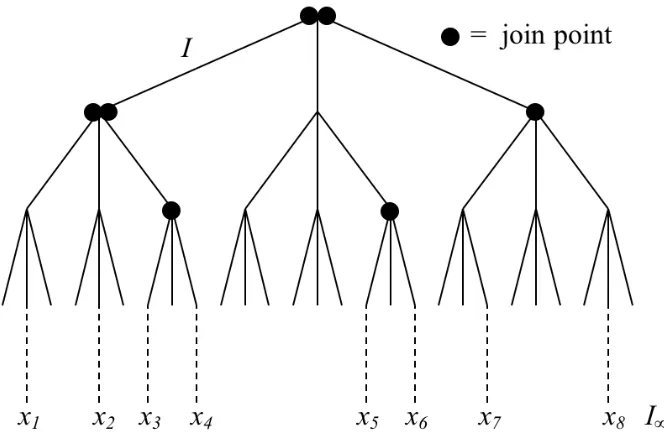
The join set ∧(x1, . . . , xn) ofx1, . . . , xn∈I∞ is the set of vertices {xk∧xk0 : 1≤k 6=
k0 ≤ n}. We say that u∈ ∧(x1, . . . , xn) has multiplicity r−1 if r is the greatest integer
for which there are distinct indices k1, . . . , kr with xkp∧xkq = u for all 1 ≤ p < q ≤ r,
see Figure 1. (In the case of M = 2 where I is a binary tree, every vertex of a join set has multiplicity 1.) Counting according to multiplicity, the join set ∧(x1, . . . , xn) always
comprises n−1 vertices of I. The top vertex ∧T(x
1, . . . , xn) of a join set is the vertex v ∈ ∧(x1, . . . , xn) such that v xl for all 1≤l ≤n.
To establish (4.11) below, we will split the domain of integration into subdomains consisting ofn-tuples (x1, . . . , xn) lying in different orbits of automorphisms of the tree I.
We will use induction over certain classes of orbit to estimate the integrals over each such domain, with H¨older’s inequality playing a natural role at each step. It is convenient to phrase the argument using a little terminology from group actions.
Figure 1: A set of 8 points in I∞ showing the 7 join points, with multiplicity 2 at two of
the vertices
way. For eachn ∈N let
S(n) ={(x1, . . . , xn) :xk∈I∞ for all k= 1, . . . , n},
for each n∈N and l = 0,1,2, . . . let
Sl(n) ={(x1, . . . , xn) :xk∈I∞ for all k= 1, . . . , n| ∧T (x1, . . . , xn)| ≥l},
and for eachn∈N and v ∈I let
S(v, n) = {(x1, . . . , xn) :xk∈I∞, xk v for all k = 1, . . . , n}
= {(x1, . . . , xn) :xk∈I∞,∧T(x1, . . . , xn)v for allk = 1, . . . , n}.
The group Aut acts on S(n) by g(x1, . . . , xn) = (g(x1), . . . , g(xn)) for g ∈ Aut, and in
particular acts on each Sl(n), since if g ∈ Aut maps (x1, . . . , xn) to (x01, . . . , x 0
n) then g
maps the join set ∧(x1, . . . , xn) to the join set ∧(x01, . . . , x 0
n). Similarly, for each v, the
subgroup Autv of Aut that fixes the vertex v ∈ I acts on S(v, n). We write Orbl(n) for
the set of orbits of Sl(n) under Aut, and Orb(v, n) for the set of orbits of S(v, n) under
Autv. In other words, defining an equivalence relation∼ onS(n) by
(x1, . . . , xn)∼(x01, . . . , x 0
n) if there exists g ∈Aut such that g(xk) = x0k for all 1≤k ≤n,
then
Orbl(n) = Sl(n)/∼ and Orb(v, n) = S(v, n)/∼.
For eachlandnwe haveSl(n) =
S
|v|=lS(v, n) with this union disjoint. Thus if|v|=l
then the orbit O ∈ Orbl(n) restricts to an orbit O(v) ∈ Orb(v, n) in the obvious way,
that is
The level of a vertexv ∈I is just the length of the word |v|, and theset of levels of a join setis the set ofn−1 levels of the vertices in ∧(x1, . . . , xn), counting by multiplicity.
Since the set of levels of a join set is constant across each orbit, we may define theset of levels of an orbit O ∈ Orbl(n) or O ∈ Orb(v, n), written L(O), to be the set of levels of
the join set ∧(x1, . . . , xn) of any (x1, . . . , xn)∈ O.
Throughout this section we will be working with products over sets of levels of certain orbits. To aid keeping track of terms, particularly when H¨older’s inequality is invoked, we use a number in square brackets above the product sign to indicate the number of terms in this product (for example the product in (4.1) is overn−1 levels).
The following proposition provides our basic estimate for the µn-measure of n-tuples
of points in I∞ lying in a given orbit, in terms of the measures of cylinders at the levels
of the join classes of the orbit.
Proposition 4.1 Let q > 1 and n ≥ 1 be such that q ≥ n. Let v ∈ I and let O ∈
Orb(v, n). Then
µn
(x1, . . . , xn)∈ O ≤µ(Cv)(q−n)/(q−1) [n−1]
Y
l∈L(O)
X
|u|=l,uv
µ(Cu)q
1/(q−1)
. (4.1)
Proof. We prove (4.1) by induction on n. When n = 1, the only orbit O ∈ Orb(v, n) comprises the set ofx1 such that x1 v, so
µ(x1)∈ O =µ
x1 :x1 v =µ(Cv),
which is (4.1) in this case.
Now assume inductively that (4.1) holds for all O ∈ Orb(v, n) for all v ∈ I and all 1≤n ≤n0. We show that (4.1) holds with n=n0+ 1.
LetO ∈Orb(v, n). We first consider the case where v =∧T(x
1, . . . , xn) for some, and
therefore for all, (x1, . . . , xn) ∈ O (thus v is the top vertex of the ∧(x1, . . . , xn) in the
orbit). Then each (x1, . . . , xn)∈ O decomposes into 2≤r≤n subsets
{(x11, . . . , x1n
1), . . . ,(x
r 1, . . . , x
r nr)}
such that the top verticesvk =∧T(xk1, . . . , xnkk) are distinct with vkv, vk 6=v and with
the paths in the treeI that join the vk tov meeting only at v. Then 1≤nk < n for each k, and
n1+· · ·+nr =n. (4.2)
The orbit O induces orbits Ok ∈ Orb(v, nk) of (xk1, . . . , xknk) for eachk, and thus O may
be decomposed as a subset of the product of the {Ok : 1 ≤ k ≤ r}. Thus applying the
inductive hypothesis (4.1) to eachOk, µn(x1, . . . , xn)∈ O
≤µn1(x1
1, . . . , x 1
n1)∈ O1 × · · · ×µ
nr(xr 1, . . . , x
r
nr)∈ Or
≤µ(Cv)(q−n1)/(q−1) [n1−1]
Y
l∈L(O1)
X
|u|=l,uv
µ(Cu)q
× · · · ×µ(Cv)(q−nr)/(q−1) [nr−1]
Y
l∈L(Or)
X
|u|=l,uv
µ(Cu)q
1/(q−1)
,
=µ(Cv)(q−n1−···−nr)/(q−1) µ(Cv)q
(r−1)/(q−1)
[n1+···+nr−r]
Y
l∈L(O1)∪···∪L(Or)
X
|u|=l,uv
µ(Cu)q
1/(q−1)
≤µ(Cv)(q−n)/(q−1) [n−1]
Y
l∈L(O)
X
|u|=l,uv
µ(Cu)q
1/(q−1)
,
whereL(O) is the complete set of levels ofO (including level|v|with multiplicity r−1) and where we have used (4.2). This is (4.1) in the case where v is the top vertex of the join sets of the n-tuples in O.
Finally, letO ∈Orb(v, n) be such that | ∧T (x
1, . . . , xn)|=l0 for each (x1, . . . , xn)∈ O
with l0 >|v| (so the top vertex of ∧(x1, . . . , xn) is strictly below v). The orbit O may be
decomposed into orbits Ow ∈Orb(w, n) where w v and |w|=l0. We have shown that
(4.1) holds for such w, so summing and using H¨older’s inequality,
µn(x1, . . . , xn)∈ O
≤ X
|w|=l0,wv
µ(Cw)(q−n)/(q−1) [n−1]
Y
l∈L(Ow)
X
|u|=l,uw
µ(Cu)q
1/(q−1)
≤ X
|w|=l0,wv
µ(Cw)
(q−n)/(q−1)
[n−1]
Y
l∈L(O)
X
|w|=l0,wv
X
|u|=l,uw
µ(Cu)q
1/(q−1)
=µ(Cv)(q−n)/(q−1) [n−1]
Y
l∈L(O)
X
|u|=l,uv
µ(Cu)q
1/(q−1)
.
This completes the induction and the proof. 2
Proposition 4.1 would be enough for our purposes when q is an integer. However, when estimating (4.11) for a non-integerq >1 we need a generalization where one of the pointsy∈I∞ is distinguished. The proof of Proposition 4.2 again uses induction on join
sets and H¨older’s inequality, but the argument is more intricate than that of Proposition 4.1 on which it depends.
Let 1 ≤ p ≤ n, 0 ≤ l1 < l2 < . . . < lp be levels and m1, . . . , mp ∈ N be such that m1+· · ·+mp =n. For each y ∈I∞ and 1 ≤ r ≤ p, write yr = y|lr and, given an orbit
Or ∈Orblr(mr), writeOr(yr)∈Orb(yr, mr) for the suborbit under automorphisms fixing
yr.
In the next proposition we integrate overypowers of the measures of those (x1. . . , xn)
for which the joins of the distinguished pointywith thexk are the verticesyr=y|lr lying
on the path from∅toyin the treeI∞at levelslr, and which, for eachr, the set ofxksuch
that xk∧y =yr lie in a given orbit fixing yr. Thus the set of join levels of (x1. . . , xn, y)
comprises the levels lr of joins with y together with the join levels of each of the orbits
Or(yr), which are just the join levels L(Or) of the orbits Or. Thus the integral in the
Proposition 4.2 Let q > 1 and let n be an integer with n ≥ q − 1. As above, let
1 ≤ p ≤ n, let 0 ≤ l1 < l2 < . . . < lp be levels and let m1 +· · ·+mp = n. For each r= 1, . . . , p let Or∈Orblr(mr) be given. Then
Z
y∈I∞
µn(x1. . . , xn) : (x1, . . . , xm1)∈ O1(y1), . . . ,(xn−mp+1, . . . , xn)∈ Op(yp)
(q−1)/n dµ(y)
≤
[n]
Y
l∈L
X
|u|=l
µ(Cu)q
1/n
, (4.3)
where L denotes the aggregate set of levels of {l1, . . . , lp, L(O1), . . . , L(Op)}.
Proof. We proceed by induction on r≤p, starting with r=p and working backwards to
r= 1, taking as the inductive hypothesis: For allyr ∈Ilr,
Z
yyr
µmr+···+mp(xr 1, . . . , x
r
mr, . . . , x p 1, . . . , x
p mp)
: (xr1, . . . , xrmr)∈ Or(yr), . . . ,(xp1, . . . , xpmp)∈ Op(yp)
(q−1)/n dµ(y)
≤µ(Cyr)
(n−nr)/n [nr]
Y
l∈Lr
X
|u|=l,uyr
µ(Cu)q
1/n
, (4.4)
wherenr =mr+· · ·+mp andLr denotes the set of levels of{lr, . . . , lp, L(Or), . . . , L(Op)}
counted by multiplicity (so thatLr consists of mr+· · ·+mp =nr levels).
To start the induction, we apply Proposition 4.1 to get, for each yp ∈Ilp,
Z
yyp
µmp(xp 1, . . . , x
p
mp)∈ Op(yp)
(q−1)/n
dµ(y) (4.5)
≤
Z
yyp
µ(Cyp)
(q−mp)/(q−1)
[mp−1]
Y
l∈L(Op(yp))
X
|u|=l,uyp
µ(Cu)q
1/(q−1)(q−1)/n
dµ(y)
=µ(Cyp)
(n−mp)/n µ(C yp)
q1/n
[mp−1]
Y
l∈L(Op)
X
|u|=l,uyp
µ(Cu)q
1/n
=µ(Cyp)
(n−np)/n [np]
Y
l∈Lr
X
|u|=l,uyp
µ(Cu)q
1/n
,
on incorporating (µ(Cyp)
q)1/n in the main product and noting that m
p = np. (Observe
that this remains valid if mp = 1, in which case the measure in (4.5) is at most µ(Cyp).)
This establishes the inductive hypothesis (4.4) whenr =p.
Now assume that (4.4) is valid for r = k, . . . , p for some 2 ≤ k ≤ p. Then for each
yk−1 ∈Ilk−1,
I :=
Z
yyk−1
µmk−1+mk+···+mp(xk−1
1 , . . . , x k−1 mk−1, x
k
1, . . . , xkmk, . . . , x p
: (xk−1 1, . . . , xk−m 1
k−1)∈ Ok−1(yk−1),(x
k
1, . . . , xkmk)∈ Ok(yk),
. . . ,(xp1, . . . , xpmp)∈ Op(yp)
(q−1)/n dµ(y)
≤µmk−1(xk−1
1 , . . . , x k−1
mk−1)∈ Ok−1(yk−1)
(q−1)/n
× X
ykyk−1,|yk|=lk
Z
yyk
µmk+···+mp(xk 1, . . . , x
k
mk, . . . , x p 1, . . . , x
p mp)
: (xk1, . . . , xkm
k)∈ Ok(yk), . . . ,(x p
1, . . . , xpmp)∈ Op(yp)
(q−1)/n dµ(y)
≤
µ(Cyk−1)
(q−mk−1)/n
[mk−1−1]
Y
l∈L(Ok−1(yk−1))
X
|u|=l,uyk−1
µ(Cu)q
1/n
× X
ykyk−1,|yk|=lk
µ(Cyk)
(n−nk)/n [nk]
Y
l∈Lk
X
|u|=l,uyk
µ(Cu)q
1/n
,
(4.6)
where in obtaining the last inequality we have used Proposition 4.1 to estimate the first part and the inductive hypothesis (4.4) for the second part. Using H¨older’s inequality for eachyk−1:
X
ykyk−1,|yk|=lk
µ(Cyk)
(n−nk)/n [nk]
Y
l∈Lk
X
|u|=l,uyk
µ(Cu)q
1/n
≤ X
ykyk−1,|yk|=lk
µ(Cyk)
(n−nk)/n [nk]
Y
l∈Lk
X
ykyk−1,|yk|=lk
X
|u|=l,uyk
µ(Cu)q
1/n
=µ(Cyk−1)
(n−nk)/n [nk]
Y
l∈Lk
X
|u|=l,uyk−1
µ(Cu)q
1/n
.
Thus from (4.6)
I ≤µ(Cyk−1)
(n−nk−mk−1)/n µ(C
yk−1)
q1/n
×
[mk−1−1]
Y
l∈L(Ok−1(yk−1))
X
|u|=l,uyk−1
µ(Cu)q
1/n Y[nk]
l∈Lk
X
|u|=l,uyk−1
µ(Cu)q
1/n
=µ(Cyk−1)
(n−nk−mk−1)/n
[mk−1+nk]
Y
l∈Lk−1
X
|u|=l,uyk−1
µ(Cu)q
1/n
,
which is (4.4) withr =k−1, noting that mk−1+nk=nk−1.
Finally, taking r = 1 in (4.4) and noting thatn1 =n,
Z
yy1
µn(x1, . . . , xn) : (x1, . . . , xm1)∈ O1(y1), . . . ,(xn−np+1, . . . , xn)∈ Op(yp)
(q−1)/n dµ(y)
≤
[n]
Y
l∈L1
X
|u|=l,uy1
µ(Cu)q
1/n
and summing over all y1 at level l1 and using H¨older’s inequality again, gives (4.3). 2
To use Proposition 4.2 to determine when the integral in (4.11) converges we need to bound the number of orbits that have prescribed sets of join levels. Let 0≤k1 ≤ · · · ≤kn
be (not necessarily distinct) levels. Two types of join levels arise in Proposition 4.2: those on a distinguished path at levelslr and the join levelsOr of the subsidiary orbits, see the
remark before Proposition 4.2.
N(k1, . . . , kn) = #
n
(l1, . . . , lp,O1, . . . ,Op) : 1≤p≤n,0≤l1 <· · ·< lp,
Or ∈Orblr(mr) for some mr wherem1+· · ·+mr =n,
such that {l1, . . . , lp, L(O1), . . . , L(Op)}={k1, . . . , kn}
o
. (4.7)
Lemma 4.3 Let n∈N and 0< λ <1. Then
X
0≤k1≤···≤kn
N(k1, . . . , kn)λ(k1+···+kn)/n<∞.
Proof. The crucial observation here is that we may find an upper bound forN(k1, . . . , kn)
that depends on n but not on the particular levels (k1, . . . , kn).
LetN0(k1, . . . , kn) be the total number of orbits in Orb(∅, n+ 1) (where ∅is the root
of the treeI) with levels 0≤k1 ≤ · · · ≤kn. Every join set with levels 0≤ k1 ≤ · · · ≤kn
may be obtained by adding a vertex at levelknof the formxi|kn to a join set∧(x1, . . . , xn)
with levels 0≤k1 ≤ · · · ≤ kn−1 for some 1 ≤i ≤ n, and this may be done in at most n
ways. It follows thatN0(k1, . . . , kn)≤nN0(k1, . . . , kn−1), so since N0(k1) = 1, we obtain
N0(k1, . . . , kn)≤n!.
The number N(k1, . . . , kn) given by (4.7) is no more than the number of orbits in
Orb(∅, n+ 1) having levels 0≤k1 ≤ · · · ≤kn with a subset of the join vertices (to within
equivalence) of each member of the orbit distinguished to correspond to levels l1, . . . , lp.
But given (x1, . . . , xn+1) ∈ O where O has join levels k1, . . . , kn, there are at most 2n
ways of choosing a distinguished subset (y1, . . . , yp) of the join set ∧(x1, . . . , xn+1); these
vertices then determine mr as well as Or(yr) = Or ∈ Orblr(mr) for r = 1, . . . , p. (Note
that we are considerably over-counting since the same contributions to (4.7) may come from different orbits of Orb(∅, n+ 1).) Hence
N(k1, . . . , kn)≤2nN0(k1, . . . , kn)≤2nn!.
Thus
X
0≤k1≤···≤kn
N(k1, . . . , kn)λ(k1+···+kn)/n ≤2nn!
X
0≤k1≤···≤kn
λ(k1+···+kn)/n
≤2nn!
∞
X
k=0
P(k)λk/n, (4.8)
where P(k) is the number of distinct ways of partitioning the integer k into a sum of n
integers k =k1 +· · ·+kn with 0 ≤ k1 ≤ · · · ≤ kn. Since P(k) is polynomially bounded
To obtain the main estimate, we use Lemma 4.3 to count the domains of integration to which we apply Proposition 4.2.
Letf :N0 →R+ be a function. Define the multipotential kernel φ :In+1 →R+ to be
the product of f evaluated at the levels of the vertices of each join set, that is
φ(x1, . . . , xn, y) = f(l1)f(l2)· · ·f(ln) whereL(∧(x1, . . . , xn, y)) ={l1, l2, . . . ln}. (4.9)
Theorem 4.4 Let n∈N and q >1 with n≤q < n+ 1. Suppose that
lim sup
l→∞
log f(l)q−1P
|u|=lµ(Cu)q
l <0. (4.10)
Then, with φ as in (4.9),
J :=
Z Z
· · ·
Z
φ(x1, . . . , xn, y)dµ(x1). . . dµ(xn)
(q−1)/n
dµ(y)<∞. (4.11)
Proof. For each y∈I∞ we decompose the integral inside the square brackets as a sum of
integrals taken over allp, all 0≤l1 <· · ·< lp, allm1, . . . , mp ≥1 such thatm1+· · ·+mp = n, and all orbits O1 ∈ Orbl1(m1), . . . ,Op ∈ Orblp(mp). As before, for each r we write
yr =y|lr, and Or(yr) for the suborbit of Or in Orb(yr, mp). Thus, using the power-sum
inequality, (4.9) and (4.3), and noting thatφ depends only on the levels of the join sets,
J =
Z
X
0≤l1<· · ·< lp m1+· · ·+mp=n
O1, . . . ,Op
Z
(x1,...,xm1)∈O1(y1)
· · ·
Z
(xn−mp+1,...,xn)∈Op(yp)
φ(x1, . . . , xn, y)dµ(x1). . . dµ(xn)
(q−1)/n
dµ(y)
≤ X
0≤l1<· · ·< lp m1+· · ·+mp=n
O1, . . . ,Op
Z
µn(x1, . . . , xn) : (x1, . . . , xm1)∈ O1(y1),
. . . ,(xn−mp+1, . . . , xn)∈ Op(yp) φ(x1, . . . , xn, y)
(q−1)/n
dµ(y)
≤ X
0≤l1<· · ·< lp m1+· · ·+mp=n
O1, . . . ,Op
[n]
Y
l∈L
f(l)q−1X
|u|=l
µ(Cu)q
1/n
,
where the products are over the set of levels L = {l1, . . . , lp, L(O1), . . . , L(Op)} counted
with repetitions Condition (4.10) implies that f(l)q−1P
|u|=lµ(Cu)
q ≤ cλl for all l, for
somec > 0 and someλ <1. Thus, with N(k1, . . . , kn) as in (4.7),
I ≤ X
0≤k1≤...≤kn
N(k1, . . . , kn) n
Y
i=1
f(ki)q−1
X
|u|=ki
µ(Cu)q
≤ X
0≤k1≤...≤kn
N(k1, . . . , kn) n
Y
i=1
cλki)1/n
≤c X
0≤k1≤...≤kn
N(k1, . . . , kn)λ(k1+···+kn)/n <∞
using Lemma 4.3. 2
5
Proofs of main results
We can now complete the proof of our main results.
Firstly, to enable us to work separately with upper and lower indices, it is convenient to have a variant of (2.4) under a weakened H¨older condition
Lemma 5.1 Suppose thatf :RN →
Rd and that for some compact intervalK ⊆RN and
0< α≤1, there exist a sequence rn &0 and a constant c such that
sup
x,y∈K:|x−y|≤rn
f(x)−f(y)
≤c rnα. (5.1)
Then for all q > 0, q 6= 1 and every finite Borel measure µ with support contained in K, we have
Dq(µf)≤min
n
d, 1
αDq(µ)
o
.
In particular, if the generalized q-dimension Dq(µ) exists, then
Dq(µf)≤min
n
d, 1
αDq(µ)
o
.
Proof. Let ρn=c rnα for all n≥1. Then (5.1) implies that
Z
Rd
µf B(z, ρn)
q−1
dµf(z) =
Z
K
µf B(f(x), ρn)
q−1
dµ(x)
≥
Z
K
µ B(x, rn)
q−1
dµ(x)
forq >1, with the reverse inequality for 0 < q <1. Hence, in both cases,
lim inf
n→∞
R
Rdµf B(z, ρn)
q−1
dµf(z)
(q−1) logρn
≤lim sup
n→∞
R
µ B(x, rn)
q−1
dµ(x) (q−1) logρn
= 1
α Dq(µ). 2
The following well-known lemma on the modulus of continuity of a Gaussian process follows from [9, Corollary 2.3].
Lemma 5.2 Let X0 : RN → R be a centered Gaussian random field which satisfies Condition (C1) for some ψ with 0< α∗ ≤ α∗ < 1. Given a compact interval K ⊆ RN,
let
ωX0(δ) = sup
x, x+y∈K
|y| ≤δ
be the uniform modulus of continuity of X0(x) on K. Then there exists a finite constant
C4 >0 such that
lim sup
δ→0
ωX0(δ)
q
ψ(δ) log1δ
≤C4, a.s.
Assuming Condition (C1) we can now obtain a.s. upper bounds for the generalized
q-dimensions of the image measure µX of µ. Proposition 5.3 Let X :RN →
Rd be the Gaussian random field defined by (2.6) such
that the associated random fieldX0 satisfies Condition (C1), and let q > 0, q 6= 1. Let µ be a Borel probability measureµ on RN with compact support.
(i) If 0< α∗ =α∗ =α <1, then
Dq(µX)≤min
n
d, 1
α Dq(µ)
o
a.s. and Dq(µX)≤min
n
d, 1
αDq(µ)
o
a.s.
(ii) If 0< α∗ ≤α∗ <1, then
Dq(µX)≤min
n
d, 1
α∗ Dq(µ)
o
a.s. and Dq(µX)≤min
n
d, 1 α∗
Dq(µ)
o
a.s.
Proof. This follows from combining (2.4) and Lemmas 5.1 and 5.2. If 0 < β0 < β < α∗
then from (2.8)ψ(r)≤cr2β for all smallr. By Lemma 5.2 there is a.s. a random C such that ωX0(δ) ≤ Cδ
β0 for all small δ, so that |X
0(x)−X0(y)| ≤ Cδβ
0
for all x and y in the support of µwith |x−y| sufficiently small. By Lemma 5.1 Dq(µX)≤ β10 Dq(µ); this
is true for all 0 < β0 < α∗, giving the first inequality of (ii). The other inequalities are derived in a similar way. 2
As is often the case when finding dimensions or generalized dimensions, lower bounds are more elusive than upper bounds. For this, we use the strong localψ-nondeterminism of X along with Corollary 3.2 to bound the probability that points X(x1), . . . , X(xn) all
lie in the ballB(X(y), r) in terms of a multipotential kernel defined using an ultrametric
da. We then apply Theorem 4.4 to bound an integral involving this kernel.
Recall that an isotropic multivariate Gaussian random variableZ inRdwith variance σ2 satisfies
P|Z−u| ≤r ≤c
r
σ
s
, u∈Rd, r >0
for all 0 < s ≤ d, for some constant c ≡ cd,s. Since the conditional distributions in a
Gaussian process are still Gaussian, it follows from the strong local nondeterminism of
X0 given by (C2) that, for t0 >0, there exists c >0 such that
P
|X(x)−u| ≤rX(y) : t≤ |x−y| ≤t0 ≤crsψ(t)−s/2 (5.2)
for all u∈Rd, x∈
RN,t >0 and r >0.
We now introduce the multipotential kernel that will be used when applying Theorem 4.4. Let m≥ 2 and a ∈ Am, see (3.2). Recall that Cka denotes the set of kth level cubes
in the hierarchy of m-ary half-open cubes that define the metric da, i.e. the cubes of Ck
translated by the vector −a, see (3.1) and (3.4). LetCa=∪∞ k=0C
For a given a ∈ Am and w, z ∈ [0,21)N, let w∧z denote the smallest cube C ∈ Ca
such that w, z∈C. Then if w1, . . . , wn+1 are distinct points of [0,12)N there is a uniquely
defined set of n join cubes, C1, . . . , Cn ∈ Ca, with the property that wi∧wj is one of the
cubes Cl for all i 6= j. To ensure that a set of n+ 1 points has exactly n join cubes we
regard a join cube C as having multiplicity r ≥ 1 if r is the greatest integer such that there are distinctwj1, . . . , wjr+1 with wjp∧wjq as the cube C for all 1≤p < q ≤r+ 1.
The hierarchy of cubes Ca may be identified in a natural way with the vertices of
the mN-ary tree I of Section 4, with the points of [0,1)N −a identified with the infinite tree I∞, and with corresponding join points identified. This identification provides an
isometry between [0,1)N −a under the ultrametric of Section 3 and the corresponding
tree of Section 4 under the natural metric.
For a simple example, takingm= 2 and N = 1,Ca
0 is the interval [−a,−a+ 1] andCka
consists of 2k half-open intervals of length 2−k each of which contains 2 disjoint intervals
of Ca
k+1. This hierarchy of intervals is indexed by the binary tree I = ∪∞k=0{1,2}k under
the identification
h(i1, . . . , ik) = [
Pk
l=1(il−1)2−l−a,
Pk
l=1(il−1)2−l+ 2−k−a)
with the infinite words of I∞ = {1,2}N identified with [−a,−a + 1) by h(i1, i2, . . .) =
P∞
l=1(il−1)2−l−a. In particular, forx1, x2 ∈I∞, the intervalh(x1∧x2) = h(x1)∧h(x2)
is the smallest interval in Ca containing both of the points h(x
1) and h(x2). Henceforth
we will identify the tree with the hierarchy of cubes in this way, referring to whichever representation is most convenient.
Write k(C) for the level of the cube C ∈ Ca, so that C ∈ Ca
k(C). We define the multipotential kernelφa by
φa(w1, . . . , wn+1) =mk(C1)mk(C2)· · ·mk(Cn), (5.3)
whereC1, . . . , Cn are the join cubes of w1, . . . , wn+1 in the hierarchy Ca.
The following proposition uses strong local nondeterminism, in the form of (5.2), to estimate inductively the probability that the images of a set of points all lie inside a ball.
Proposition 5.4 Let X : RN →
Rd be the Gaussian random field defined by (2.6),
and assume the associated random field X0 : RN → R satisfies Condition (C2). Given
N, d, n, s and α, where 0 < s≤d and α > α∗, there are positive constants c2 and r0 and an integer m ≥ 2 such that, for all x1, x2, . . . , xn, y ∈ [0,12)N, we may choose a vector a∈ Am, see (3.2), such that for all 0< r≤r0
Pn|X(y)−X(x1)| ≤r,|X(y)−X(x2)| ≤r, . . . ,|X(y)−X(xn)| ≤r
o
≤c2rsnφa(x1, x2, . . . , xn, y)αs. (5.4)
In particular, for all x1, x2, . . . , xn, y ∈[0,12)N and 0< r≤r0,
Pn|X(y)−X(x1)| ≤r,|X(y)−X(x2)| ≤r, . . . ,|X(y)−X(xn)| ≤r
o
≤c2rsn
X
a∈Am
Proof. Let m = 2n2N + 2 and c
0 = max{8m(m−1), N1/2}. By Corollary 3.2, given
x1, x2, . . . , xn, y ∈[0,12)N, there exists a∈ Am such that
c−01|z−w| ≤da(z, w)≤c0|z−w|, z, w ∈ {x1, x2, . . . , xn, y}; (5.6)
thus da restricted to the set of points {x1, x2, . . . , xn, y} is equivalent to the Euclidean
metric with constantc0.
We now appeal to the strong local ψ-nondeterminism of X. For i= 2,3, . . . , n letwi
be the point (or one of the points) from{x1, . . . , xi−1, y} such thatda(wi, xi) is least. By
local nondeterminism (5.2), noting the equivalence of the metrics (5.6), there are constants
c1 and r0 such that
P|X(wi)−X(xi)| ≤2r
X(x1), . . . , X(xi−1), X(y) ≤c1rsψ(|wi−xi|)−s/2
≤c1rs|wi−xi|−αs
(5.7)
for eachi= 2, . . . , n and 0< r ≤r0, where the last inequality follows from the fact that
ψ(r)≥r2α.
Starting withP|X(y)−X(x1)| ≤2r ≤c1rs|y−x1|−αs, and applying the conditional
probabilities in (5.7) inductively, we obtain
P
|X(y)−X(x1)| ≤r,|X(y)−X(x2)| ≤r, . . . ,|X(y)−X(xn)| ≤r
≤P|X(y)−X(x1)| ≤2r,|X(w2)−X(x2)| ≤2r, . . . ,|X(wn)−X(xn)| ≤2r
≤(c1)nrns|y−x1|−αs|w2−x2|−αs. . .|wn−xn|−αs
≤(c1)n(c0)nαsrnsda(y, x1)−αsda(w2, x2)−αs. . . da(wn, xn)−αs
=c2rnsφa(x1, x2, . . . , xn, y)αs,
using the definitions (3.3) and (5.3) of da and φa and the choice of the wi.
Inequality (5.5) is immediate from (5.4). 2
Proposition 5.5 Let n ≥ 1 and 1 < q ≤ n + 1. Then for all 0 < s ≤ d, there exist numbers c3 >0 and r0 >0 such that for all 0< r≤r0,
E
Z
µX(B(z, r))q−1dµX(z)
≤c3rs(q−1)
X
a∈Am
Z Z
· · ·
Z
φa(x1, . . . , xn, y)αsdµ(x1). . . dµ(xn)
(q−1)/n
dµ(y).
(5.8)
Proof. First note that, for everyy ∈RN, using Fubini’s theorem and (5.5), we obtain E µX(B(X(y), r))n
=E µ{x:|X(y)−X(x)| ≤r}n
=
Z
· · ·
Z
Pn|X(y)−X(x1)| ≤r,|X(y)−X(x2)| ≤r,
. . . ,|X(y)−X(xn)| ≤r
o
dµ(x1). . . dµ(xn)
≤c2rns
Z
· · ·
Z X
a∈Am
φa(x1, x2, . . . , xn, y)αsdµ(x1). . . dµ(xn).
Sincen/(q−1)≥1, Jensen’s inequality, (5.9) and the power-sum inequality give
E
Z
µX(B(z, r))q−1dµX(z)
=E
Z
µX(B(X(y), r))q−1dµ(y)
≤
Z h
E µX(B(X(y), r))n
i(q−1)/n
dµ(y)
≤c3rs(q−1)
Z X
a∈Am
Z
· · ·
Z
φa(x1, x2, . . . , xn, y)αsdµ(x1). . . dµ(xn)
(q−1)/n
dµ(y)
≤c3rs(q−1)
Z X
a∈Am
Z
· · ·
Z
φa(x1, x2, . . . , xn, y)αsdµ(x1). . . dµ(xn)
(q−1)/n
dµ(y),
to give (5.8). 2
We now derive the almost sure lower bound forDq(µX).
Proposition 5.6 Let X : RN → Rd be the Gaussian random field defined by (2.6) and assume that the associated random field X0 satisfies Condition (C2). Let µ be a Borel probability measure on RN with compact support. Then for all q >1,
Dq(µX)≥min
n
d, 1
α∗Dq(µ)
o
a.s. (5.10)
Proof. Without loss of generality we may assume that the support of µ lies in the cube [0,12)N. As before, for each a ∈ Am we write Cka for the kth level cubes in the hierarchy
ofm-ary cubes that define the metricda.
Letα > α∗ and 0< s <min{d, Dq(µ)/α}. From (2.1)
lim inf
k→∞
logP
C∈Ca kµ(C)
q
(q−1) logm−k =Dq(µ)> sα
so
lim sup
k→∞
logms(q−1)αkP
C∈Ca k µ(C)
q
k <0.
Note that this estimate holds for all a∈ Am since the definition of the lower generalized
dimension (2.1) is independent of the origin selected for the mesh cubes used for the moment sums.
Let n be the integer such that n ≤q < n+ 1. For each a ∈ Am in turn, identify the
cubes ofCa
k with the kth level vertices of the M-ary tree of Section 3 in the natural way,
where M = mN. Thus, with xj ∈I∞ identified with xj ∈ RN and y ∈I∞ with y ∈ RN,
we have thatli =k(Ci), i= 1, . . . , n, are the levels both of the cubes and the equivalent
vertices in the tree I∞ in the join set of x1, . . . , xn, y. Setting f(l) = mαsl in (4.9) and
using (5.3), we get
φ(x1, . . . , xn, y) = mαsl1· · ·mαsln =mαsk(C1)· · ·mαsk(Cn) =φa(x1, . . . , xn, y)αs.
Thus, Proposition 5.5 together with Theorem 4.4 gives that
E
Z
for all r≤1, for some constant 0< c4 <∞.
For all 0 < t < s < min{d, Dq(µ)/α}, summing (5.11) over r = 2−k, k = 0,1,2, . . ., gives
E
∞ X
k=0
2kt(q−1)
Z
µX(B(z,2−k))q−1dµX(z)
≤c4 ∞
X
k=0
2−k(s−t)(q−1) <∞.
Thus the bracketed series on the left converges almost surely, so as the generalized dimen-sions (2.2) are determined by the sequence of scalesr = 2−k, k = 0,1,2, . . ., we conclude that Dq(µX) ≥ t almost surely for all 0 < t < min{d, Dq(µ)/α}. Since α > α∗ is
arbitrary, (5.10) follows. 2
Proof of Theorem 2.1. The upper bound in (2.10) follows from Proposition 5.3, and the lower bound in (2.10) follows from Proposition 5.6. This proves (i). Part (ii) also follows from Propositions 5.3 and 5.6. Finally, (iii) follows from (ii). 2
6
Further remarks
Here are some open problems and remarks about generalized dimensions of random fields which are not covered by this paper.
1. Note that (2.11) in Theorem 2.1 only provides an upper bound for Dq(µX). While
we believe that if the generalized q-dimension of Dq(µ) exists then
Dq(µX) = min
n
d, 1 α∗
Dq(µ)
o
a.s.,
we have not been able to prove it, because the last inequality in (5.7) fails when
α∗ < α < α∗.
2. Besides fractional Brownian motion, another important Gaussian random field is the Brownian sheetW :RN
+ →Rd,W(x) = (W1(x), . . . , Wd(x)), which is a centered
Gaussian random field with covariance function given by
EWi(x)Wj(y)
=δij N
Y
k=1
xk∧yk, x= (x1, . . . , xN), y = (y1, . . . , yN)∈RN+,
where δij = 1 if i = j and 0 if i 6= j, see [19]. The Brownian sheet W is not
strongly locally nondeterministic, but satisfies a weaker form of local nondetermin-ism, namely, sectorial local nondeterminism as it is called in [20]. We expect that the conclusion of Corollary 2.2 still holds for the Brownian sheet, but since strong local nondeterminism played an important rˆole in Section 5, a different method may be needed to study the effect of the Brownian sheet on generalized dimensions.
approach can be used for non-Gaussian random fields, such as linear and harmo-nizable fractional stable random fields, see [42]. For example, difficulties arise from possible discontinuities of the sample paths.
4. The case of small moments, that is for 0< q <1, is interesting but is likely to need very different methods. The negative exponent that appears in the generalized di-mension integralR µ(B(x, r))q−1dµ(x) makes such integrals difficult to estimate, for
example H¨older’s inequality, used throughout the proof of Proposition 4.2, cannot be used with negative powers. Extrapolating from the case q = 0 (when the gener-alized dimension reduces to box counting dimension of the support of the measure), it is possible that some kind of generalized dimension profile is needed, see [14, 36].
References
[1] R.J. Adler. Hausdorff dimension and Gaussian fields, Ann. Probab. 5 (1977), 145–151.
[2] R.J. Adler. The Geometry of Random Fields, (John Wiley, 1981).
[3] V.V. Anh, J.M. Angulo and M.D. Ruiz-Medina. Possible long-range dependence in fractional random fields, J. Statist. Plann. Inference80 (1999), 95–110.
[4] S.M. Berman. Local nondeterminism and local times of Gaussian processes, In-diana Univ. Math. J. 23 (1973), 69-94.
[5] R.M. Blumenthal and R. Getoor. Sample functions of stochastic processes with stationary independent increments, J. Math. Mech. 10 (1961), 493–516.
[6] Z. Ciesielski and S.J. Taylor. First passage times and sojourn times for Brownian motion in space and the exact Hausdorff measure of the sample path, Trans. Amer. Math. Soc. 103 (1962), 434–450.
[7] M. Clausel. Lacunary fractional Brownian motion, ESAIM: Probability and Statistics 16 (2012), 352-374.
[8] J. Cuzick and J. DuPreez. Joint continuity of Gaussian local times,Ann. Probab. 10 (1982), 810–817.
[9] R.M. Dudley. Sample functions of the Gaussian processes,Ann. Probab.3(1973), 66–103.
[10] A. Estrade, D. Wu and Y. Xiao. Packing dimension results for anisotropic Gaus-sian random fields, Commun. Stoch. Anal.5 (2011), 41–64.
[11] K.J. Falconer. Generalized dimensions of measures on self-affine sets, Nonlinear-ity 12 (1999), 877–891.
[13] K.J. Falconer. Generalized dimensions of measures on almost self-affine sets,
Nonlinearity 23 (2010), 1047–1069.
[14] K.J. Falconer and J.D. Howroyd. Packing dimensions of projections and dimen-sion profiles, Math. Proc. Cambridge Philos. Soc. 121 (1997), 269–286.
[15] P. Grassberger. Generalized dimension of strange attractors, Phys. Rev. Lett. A 97 (1983), 227-230.
[16] D. Harte. Multifractals: Theory and Applications, (Chapman and Hall, 2001).
[17] P. L´evy, Processus stochastiques et mouvement brownians, (Gauthier-Villars, Paris, 1948).
[18] J.-P. Kahane.Some Random Series of Functions, 2nd Ed. (Cambridge University Press, 1985).
[19] D. Khoshnevisan.Multiparameter Processes: An Introduction to Random Fields, (Springer, 2002).
[20] D. Khoshnevisan and Y. Xiao. Images of the Brownian sheet, Trans. Amer. Math. Soc. 359 (2007), 3125–3151.
[21] K.-S. Lau. Self-similarity, Lp-spectrum and multifractal formalism, In: Fractal Geometry and Stochastics(Eds. C. Bandt, S. Graf and M. Z¨ahle),Progr. Probab. 37, pp. 55–90 (Birkh¨auser, 1995).
[22] N. Luan and Y. Xiao. Spectral conditions for strong local nondeterminism and exact Hausdorff measure of ranges of Gaussian random fields, J. Fourier Anal. Appl. 18 (2012), 118–145.
[23] B.B. Mandelbrot and J.W. Van Ness. Fractional Brownian motions, fractional noises and applications, SIAM Review 10 (1968), 422–437.
[24] Y. Peres and B. Solomyak. Existence of Lq dimensions and entropy dimension for self-conformal measures, Indiana Univ. Math. J.49 (2000), 1603–1621.
[25] Y.B. Pesin. Dimension Theory in Dynamical Systems, (University of Chicago Press, 1997).
[26] L.D. Pitt. Local times for Gaussian vector fields, Indiana Univ. Math. J. 27
(1978), 309–330.
[27] D. Ray. Sojourn times and the exact Hausdorff measure of the sample path for planar Brownian motion, Trans. Amer. Math. Soc.106 (1963), 436–444.
[28] L.C.G. Rogers and D. Williams. Diffusions, Markov Processes, and Martingales
Vol.1, (Cambridge University Press, 2000).
[30] M. Talagrand. Hausdorff measure of trajectories of multiparameter fractional Brownian motion. Ann. Probab. 23 (1995), 767–775.
[31] M. Talagrand. Multiple points of trajectories of multiparameter fractional Brow-nian motion. Probab. Theory Related Fields 112 (1998), 545–563.
[32] S.J. Taylor. The exact Hausdorff measure of the sample path for planar Brownian motion, Proc. Cambridge Philos. Soc. 60 (1964), 253–258.
[33] S. J. Taylor. Sample path properties of a transient stable process.J. Math. Mech. 16 (1967), 1229–1246.
[34] S.J. Taylor. The measure theory of random fractals, Math. Proc. Cambridge Philos. Soc. 100 (1986), 383–406.
[35] Y. Xiao. H¨older conditions for the local times and the Hausdorff measure of the level sets of Gaussian random fields. Probab. Theory Related Fields 109 (1997), 129–157.
[36] Y. Xiao. Packing dimension of the image of fractional Brownian motion, Statist. Probab. Lett. 333 (1997), 379–387.
[37] Y. Xiao. Random fractals and Markov processes, In: Fractal Geometry and Ap-plications: A Jubilee of Benoit Mandelbrot, (Eds: Michel L. Lapidus and Machiel van Frankenhuijsen), pp. 261–338 (American Mathematical Society, 2004).
[38] Y. Xiao. Properties of local nondeterminism of Gaussian and stable random fields and their applications, Ann. Fac. Sci. Toulouse Math. XV (2006), 157–193.
[39] Y. Xiao. Strong local nondeterminism and the sample path properties of Gaus-sian random fields, In: Asymptotic Theory in Probability and Statistics with Applications (Eds: Tze Leung Lai, Qiman Shao, Lianfen Qian), pp. 136–176 (Higher Education Press, Beijing, 2007).
[40] Y. Xiao. Sample path properties of anisotropic Gaussian random fields, In: A Minicourse on Stochastic Partial Differential Equations, (Eds: D. Khoshnevisan and F. Rassoul-Agha), Lecture Notes in Math. 1962, 145–212 (Springer, New York, 2009).
[41] Y. Xiao. A packing dimension theorem for Gaussian random fields, Statist. Probab. Lett. 79 (2009), 88–97.
[42] Y. Xiao. Properties of strong local nondeterminism and local times of stable ran-dom fields, In: Seminar on Stochastic Analysis, Random Fields and Applications VI, (Eds: R.C. Dalang, M. Dozzi and F. Russo),Progr. Probab.63, pp. 279–310 (Birkh¨auser, Basel, 2011).